There is a moment that stays with you long after you first see it.
You are standing on a street in Seminyak, maybe on your way to lunch or back from the beach, when the road suddenly fills with white. Dozens of people moving together, dressed in immaculate white and orange, carrying flags and offerings, their footsteps quiet against the asphalt. The incense reaches you before the sound does. And for a few minutes, you forget about everything else.

This is Bali. Not the Bali of Instagram reels or rooftop bars, but the real one. The one that has been here for centuries, still breathing, still walking its own streets on the same sacred calendar it always has.
Traditional Balinese paintings exist to hold this moment. Not to freeze it, but to keep it alive.
When You Look at a Balinese Painting, You Are Looking at a Living Tradition
Walk into any serious Balinese art gallery in Seminyak, and you will notice something that sets these paintings apart from decorative art sold anywhere else in the world. The scenes are not invented. They are witnessed.
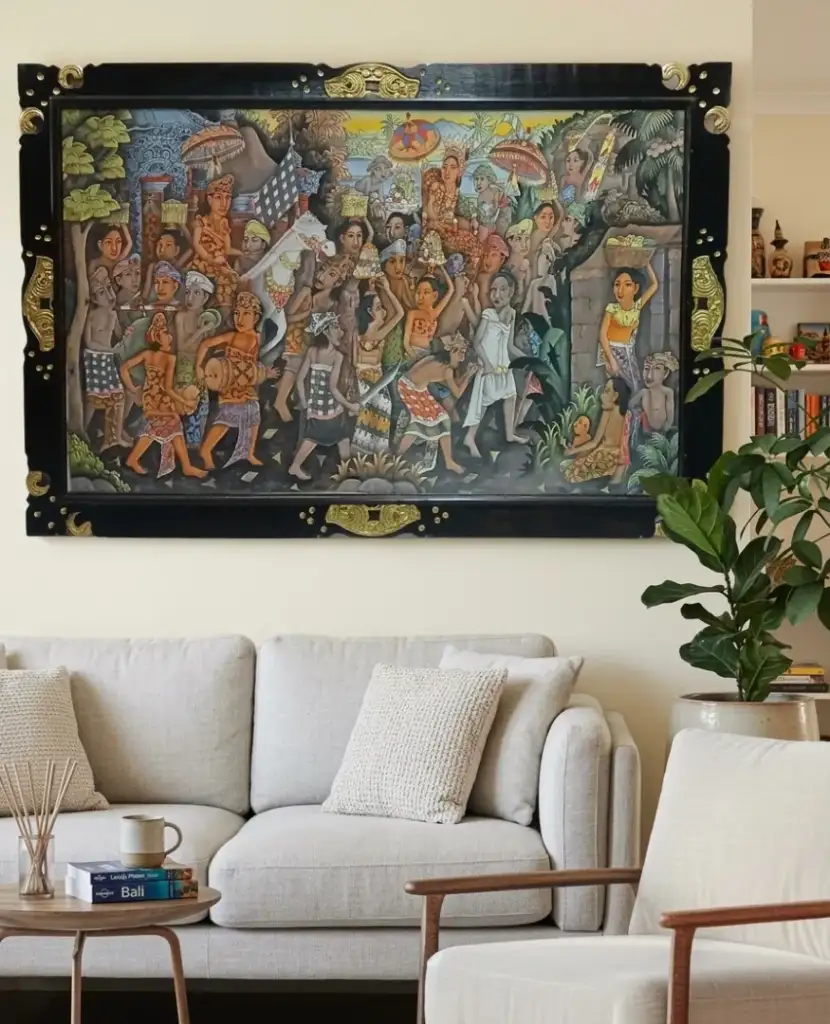
The large ceremonial procession painting that hangs above a sofa, its black frame edged in gold, its canvas crowded with figures carrying offerings, musicians playing gamelan, women balancing elaborate fruit towers on their heads, a white horse stepping through the crowd. Every detail in that painting has been seen with real eyes. It reflects an actual procession, a real melasti, a genuine moment of collective devotion.
That is not a coincidence. It is the core philosophy behind traditional Balinese paintings.
Putu, the owner of Arts of Bali gallery, has spent years building a collection around this exact principle. He works alongside five artists, each with their own speciality and visual voice, but all sharing the same foundational commitment.
“Every artist here grew up inside this culture. They are not painting Bali from the outside. They are painting what they have lived, what their families have lived for generations. That is what makes the work true.”
Putu, Owner Arts of Bali
Balinese artists have always understood their role as more than decorators. They are visual historians, community storytellers, and keepers of cultural memory. When a painter sits down to paint a barong, a prayer ceremony, or a procession of women carrying offerings under ceremonial umbrellas, they are not simply painting a picture. They are performing an act of preservation.
The Street and the Canvas: How Real Life Becomes Art
One of the most powerful things about traditional Balinese paintings is how directly they connect to the world outside the gallery window.

Look at a procession of Balinese Hindu worshippers walking down a Seminyak street, dressed in white, carrying tall ceremonial flags called umbul-umbul, moving with quiet purpose through the modern commercial landscape around them. Then look at a palette knife painting of women in white and orange sarongs, their figures slightly abstracted by thick, textured brushwork, ceremonial parasols rising above them in cool blue tones.
The distance between the street and the canvas is almost nothing.
On the eve of Nyepi, the streets tell a different story entirely.

The massive Ogoh-ogoh figures, carried on the shoulders of dozens of young men, represent the casting out of negative forces before the Balinese new year. Painters who capture this scene are not painting a parade. They are painting a cosmological act, a moment where the spiritual and the physical world overlap on a street you might have walked that same afternoon.
This is what makes traditional Balinese paintings genuinely different from souvenir art. They do not romanticize or exoticize Balinese culture from the outside. They come from inside it. The painter grew up watching these processions. Their parents and grandparents were in them. The acts of painting and the acts of ceremony share the same root.
When you bring one of these paintings into your home, you are not hanging a piece of tourism. You are bringing in a fragment of lived spiritual life.
Walking Through the Gallery: Three Ways of Seeing Bali
Step inside the gallery and you immediately notice that traditional Balinese paintings do not all look the same. The culture they carry is consistent, but the visual language shifts depending on which tradition the artist works within.
The first thing that stops you is usually one of the large, dense compositions in the classic Ubud or Batuan school style. Dozens of figures share a single canvas. There is no Western perspective, no vanishing point, yet the image feels overwhelmingly alive.
A ceremonial procession stretches across the frame, every figure dressed in precise detail, every textile pattern rendered with the patience of someone who has seen these sarongs their entire life. Flat in geometry but rich in meaning. Balinese viewers can read these paintings like a text, identifying the ceremony, the village, the season, sometimes even the specific temple from visual clues alone.
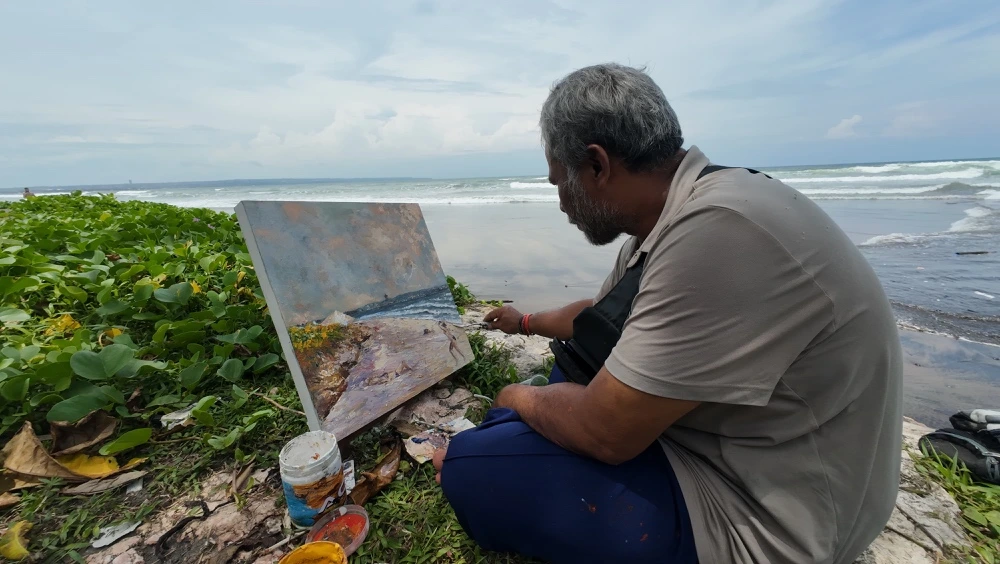
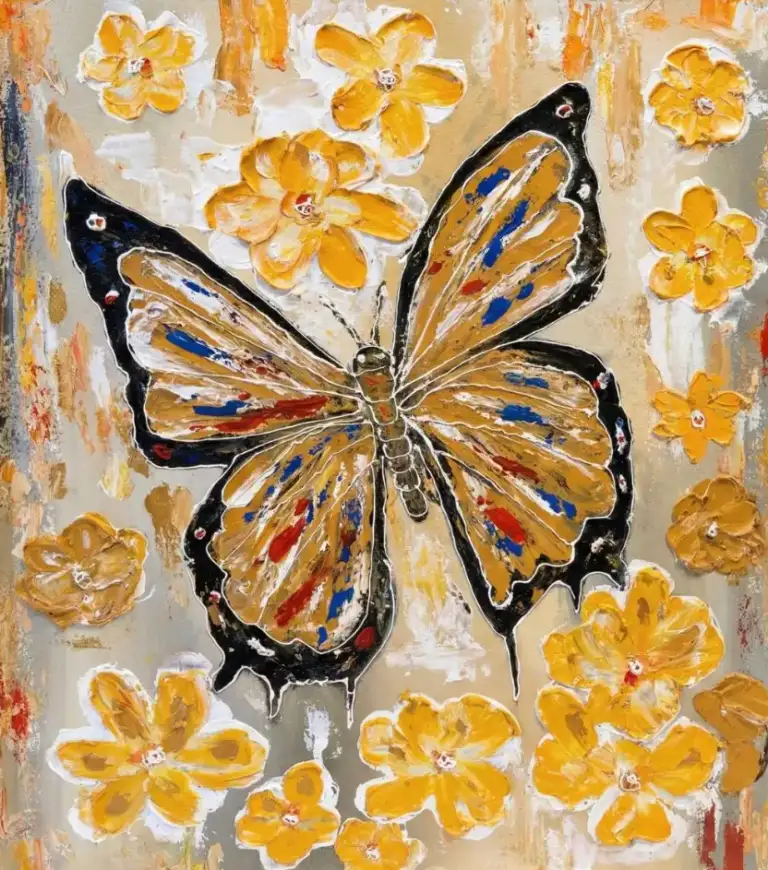
Then you move further in and encounter something physically different. The surface of the canvas is built up, almost sculptural. This is palette knife painting, and in Bali it has become one of the most expressive ways of translating traditional subjects into something raw and felt.
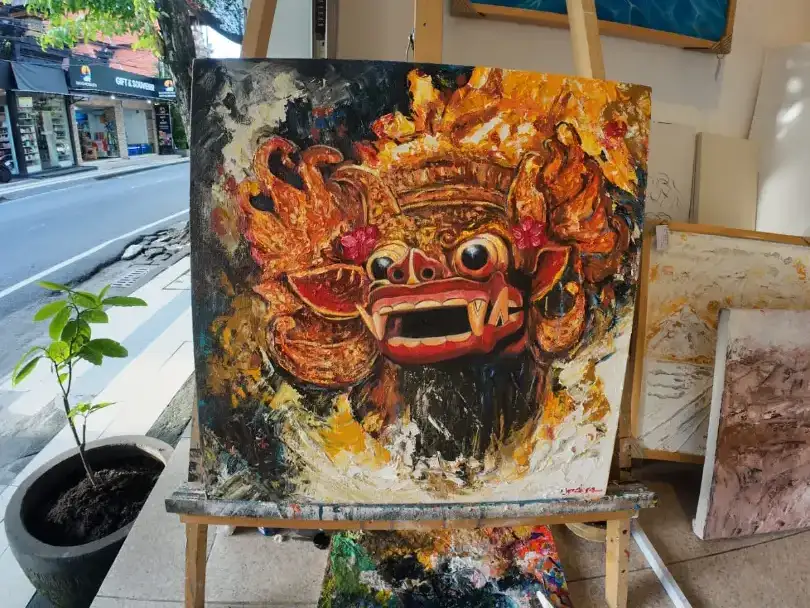
The Barong here is not softened or prettified. The face of Bali’s sacred lion guardian, built in slabs of orange and gold and black, the paint literally standing up from the canvas, the ceremonial flowers at its cheeks shaped in relief. You sense the weight of the mythology, not just its surface appearance. The palette knife forces a kind of honesty, a directness that comes from building the image rather than drawing it.

Putu explains why he sought out artists who work this way:
“I look for artists who understand that the subject matters. Anyone can learn a technique. But to paint the Barong and have someone feel its spirit — that requires an artist who has grown up with it, who has stood in front of it during a real ceremony. That is what I wanted for this gallery.”
Putu, Owner Arts of Bali

Further into the gallery, smaller and quieter paintings ask for a different kind of attention. A single figure. A private moment. This kind of intimate work is the speciality of Upeksa, one of the five artists whose work forms the core of the Arts of Bali collection.
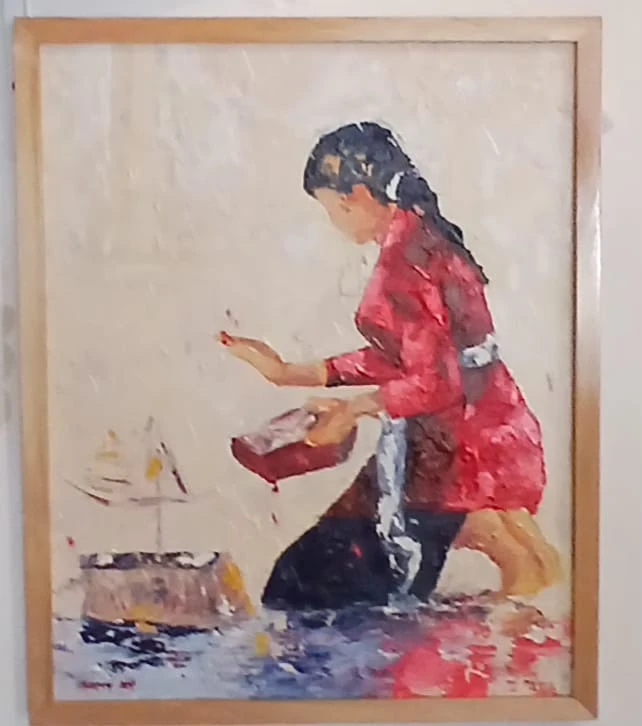
A woman in red, kneeling, her hands extended toward a small canang sari, the scene painted in soft whites and warm reds with palette knife texture throughout. No crowd, no ceremony, no pageantry. Just one person and one moment of daily devotion. These are the paintings that often surprise international visitors the most, because they reveal how spiritual life in Bali is not reserved for special occasions. It is woven into ordinary mornings.
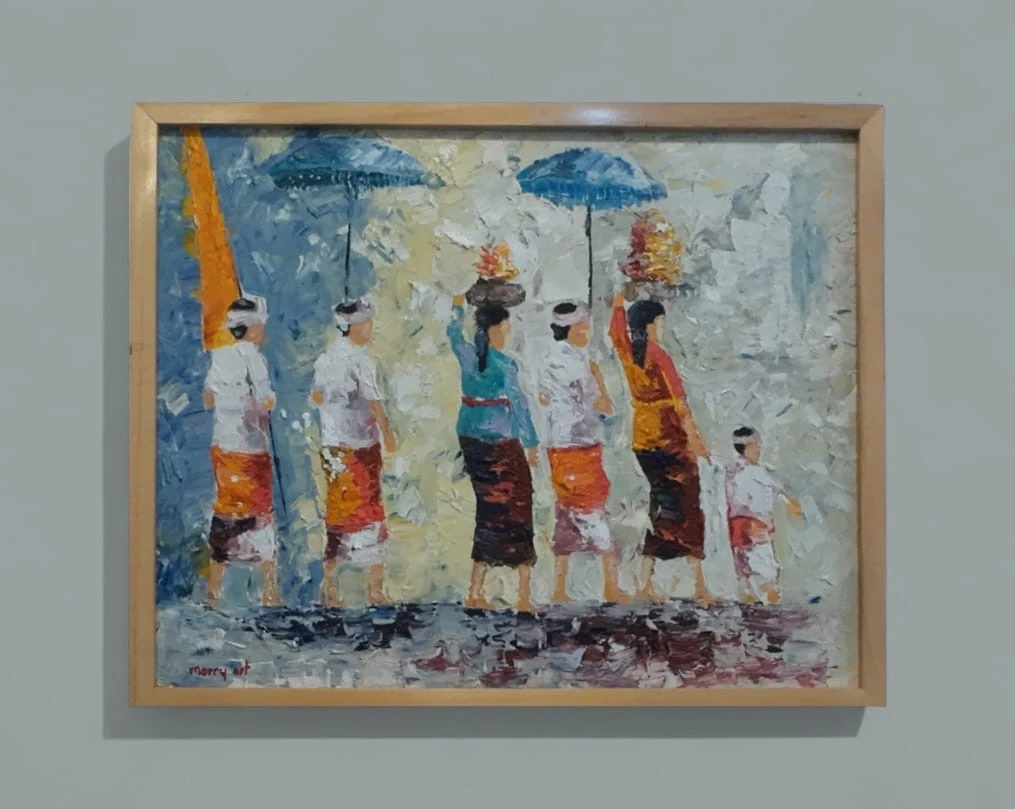
And then there is this: a group of women in white and burnt orange moving together, ceremonial parasols arching above them in blue, a child beside them, the whole scene slightly softened by the knife technique into something that feels like a memory rather than a photograph. This is realist Balinese painting in its most moving form, specific enough to feel true, impressionistic enough to feel timeless.
These three ways of painting Bali are not competing. They are the same story told in three different voices.
The Philosophy Behind the Paint
Every traditional Balinese painting carries something that does not appear in the visible image. It carries a philosophical worldview.
Balinese Hinduism is built on the concept of Tri Hita Karana, the three sources of harmony: the relationship between humans and the divine, between humans and each other, and between humans and the natural world. Look at any traditional ceremonial painting through this lens and the composition begins to make a different kind of sense.
The procession is not just people walking. It is the three relationships made visible: offerings carried upward toward the divine, families and communities moving together in collective purpose, and the surrounding landscape of palms and temple walls completing the frame. The painting is a diagram of a worldview as much as a depiction of a scene.
This is also why Balinese painting as a tradition developed so distinctly from Western art movements. It was never primarily about aesthetics. It was about function, about community, about the maintenance of right relationship between the visible and invisible worlds. Beauty was a consequence of devotion, not its goal.
That philosophical depth is what distinguishes authentic traditional Balinese paintings from work made purely for the tourist market. The content is not added on. It is the reason for painting in the first place.
Bringing Balinese Culture Into Your Home
There is a particular kind of calm that settles into a room where a genuine traditional Balinese painting hangs on the wall.
It is not a passive decoration. People stop in front of it. Guests ask questions. Children want to know what is happening, who the figures are, why the woman is carrying fruit on her head. The painting opens conversations about a culture that most of the world knows only through photographs.
A large ceremonial procession piece above a sofa transforms the entire energy of a living space. It brings with it the density and richness of a culture that has survived and adapted and continued to celebrate itself across centuries. A smaller palette knife portrait of a woman at prayer works differently: more quiet, more personal, a reminder of the everyday spiritual life that makes Bali what it is.
Both are ways of keeping something alive. Not in a museum, but in the middle of daily life, exactly where Balinese culture has always lived.
Where to Find Authentic Traditional Balinese Paintings in Seminyak
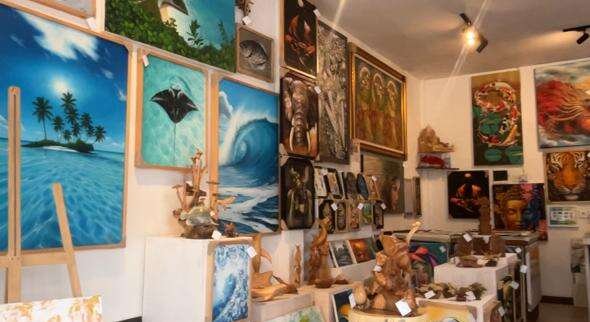
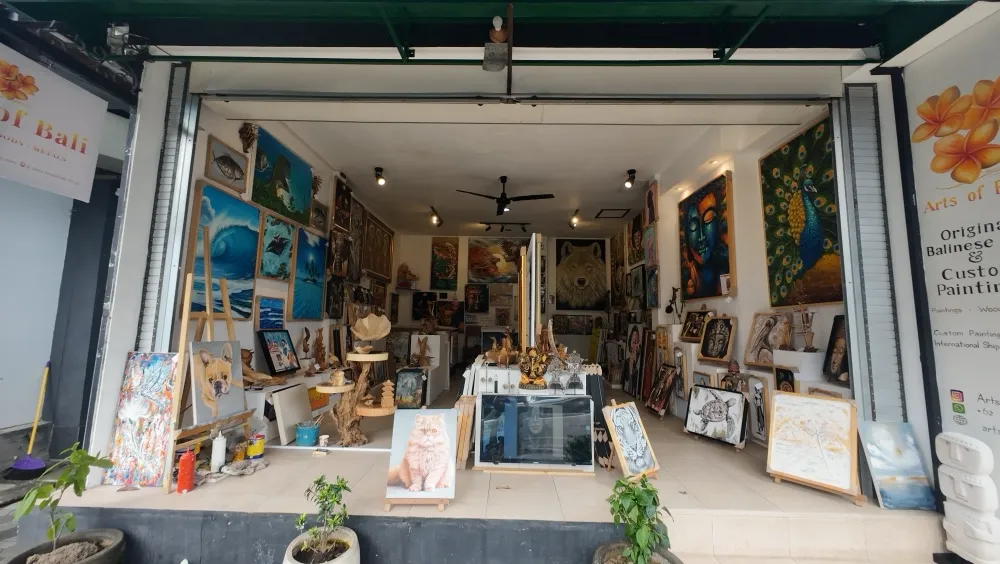
Arts of Bali gallery, located on Jalan Raya Seminyak No. 42, carries an edited collection of original traditional Balinese paintings across all three of the styles described above. Every piece is an original work, not a print, not a reproduction.

The gallery brings together five artists, each with a distinct speciality: traditional Ubud and Batuan school compositions, palette knife interpretations of ceremony and myth, realist figurative studies of daily Balinese life, and more. The collection is curated by Putu with a single consistent standard: every work must carry genuine cultural truth, not just surface decoration.
You can explore available works in the online gallery or browse the shop directly. For custom commission inquiries, including pieces of a specific size or subject, reach out via the contact page or directly on WhatsApp.
A Final Thought
Bali’s culture does not exist behind glass. It walks down the street. It lights incense every morning. It carries fruit towers on its head and sings gamelan into the night. It paints itself onto canvas because painting is one more way of saying: this matters, this is real, this is worth keeping.
Traditional Balinese paintings are not documents of a disappearing way of life. They are evidence of a living one. And when you bring one home, wherever in the world home happens to be, you carry a little of that life with you.
Arts of Bali is an original fine art gallery based in Seminyak, Bali. All works in the collection are original paintings by Balinese artists. No prints. No reproductions. Only originals.
Explore the full collection at Our Gallery