“In Bali, the dancer does not perform. She prays with her body — and the painter watches with his heart.”
Every brushstroke in a Balinese dancer painting begins with something that cannot be manufactured: the living memory of a dance. In studios and galleries across Seminyak, Ubud, and the island’s quieter creative villages, painters have spent generations trying to hold that moment still. The arc of a wrist mid-gesture. The gold of a crown catching firelight. The quiet that exists just before a dancer’s eyes open. At 巴厘岛艺术 in Seminyak, our collection of Balinese dancer paintings spans styles, spirits, and centuries of tradition. Whether rendered in the bold impasto of a palette knife or the fluid strokes of a contemporary brush, each work carries the same irresistible pull: Bali’s most sacred art form, made permanent on canvas.
Why Balinese Dancers Have Captivated Painters for Over a Century
Long before painting studios lined the streets of Seminyak and Ubud, the Balinese dancer was already a subject of devotion rather than mere observation. In Bali’s Hindu tradition, dance is not performance in the Western sense. The three genres of traditional Balinese dance were recognized by UNESCO as Intangible Cultural Heritage of Humanity in 2015, a designation that affirms what Balinese people have always known: these dances are sacred offerings, acts of worship expressed through the body rather than through prayer beads or incense alone.
For painters, that sacredness is both the challenge and the reward. A Balinese dancer at the height of her performance exists in a state that photography can capture but rarely conveys. The eyes shift in a way that seems to come from elsewhere. The fingers curve into mudra gestures that carry specific narrative meaning. The body holds a tension between stillness and energy that resists stillness itself. It is precisely this quality — the feeling of a moment charged with more meaning than the moment should be able to contain — that makes a true balinese dancer painting so captivating on canvas.
When Western artists arrived in Bali in the 1930s, among them Walter Spies and Rudolf Bonnet, they found a culture that had already placed the dancer at the centre of its visual identity. Their presence helped open new markets and new media for Balinese artists, but the subject was always already there, woven into the island’s way of seeing itself. Today, a Balinese dancer painting is not a tourist souvenir. It is an archive of a living tradition — one that dances still in temples and palace courtyards every week.
Janger: The Song That Became a Dance, and Then a Painting
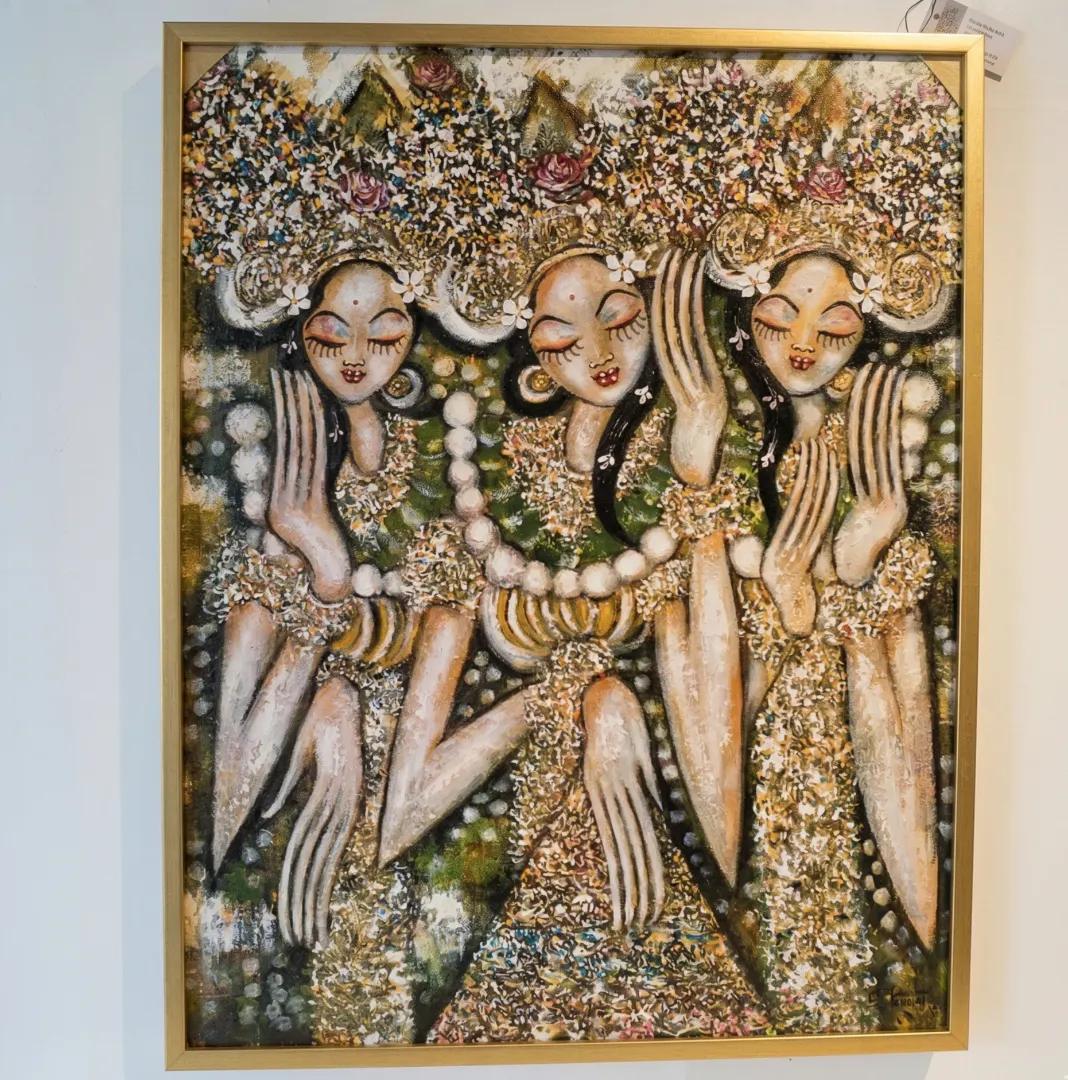
Of all the dance forms that have found their way onto Balinese canvases, the Janger holds a particular warmth. Born in the 1920s from the singing of women farmers who gathered in the fields to ease their fatigue after long harvests, Janger is a dance of community, joy, and the playful courtship of youth. Its name translates loosely as “infatuation,” and the performance reflects that spirit entirely. Ten pairs of young men and women face each other in a square formation, the women kneeling and weaving patterns with their arms and hands, the men responding in rhythmic call-and-answer, all of it accompanied by the bright, rolling pulse of gamelan music.
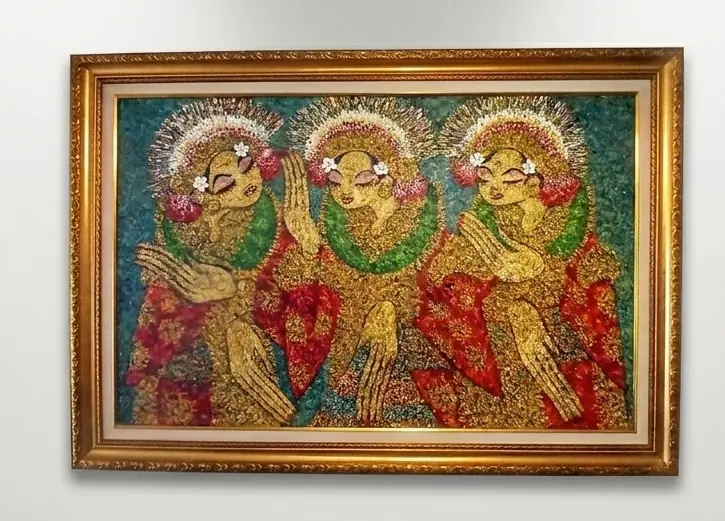
What makes the Janger such a compelling subject for Balinese painters is exactly what makes it so beloved on stage: the sheer communal energy of multiple figures in synchronized movement. In the painting above, that energy is held through color rather than narrative. The red and gold of ceremonial costume, the downward cast of eyes in focused concentration, and the hands positioned mid-gesture are not details invented by the artist. They are observed, remembered, and translated into the language of paint with the kind of accuracy that only comes from genuine familiarity with the dance.
“What the dancer feels in the moment of performance, the painter tries to preserve for a lifetime.”
Legong: The Royal Court Dance Translated into Gold and Paint
If Janger carries the warmth of the village, Legong carries the weight of the palace. Originating as royal entertainment in the courts of Bali — legend places its beginning in a prince of Sukawati who, falling ill, dreamed of two maidens dancing to gamelan music — Legong is considered the most refined of all Balinese dance forms. Traditionally performed by young girls trained from early childhood, its characteristic features are an extraordinary precision: the rapid, controlled movements of the fingers and eyes, the elaborate gilded headdress known as gelungan, and the layered costume that seems to give the dancer the silhouette of something between human and divine.
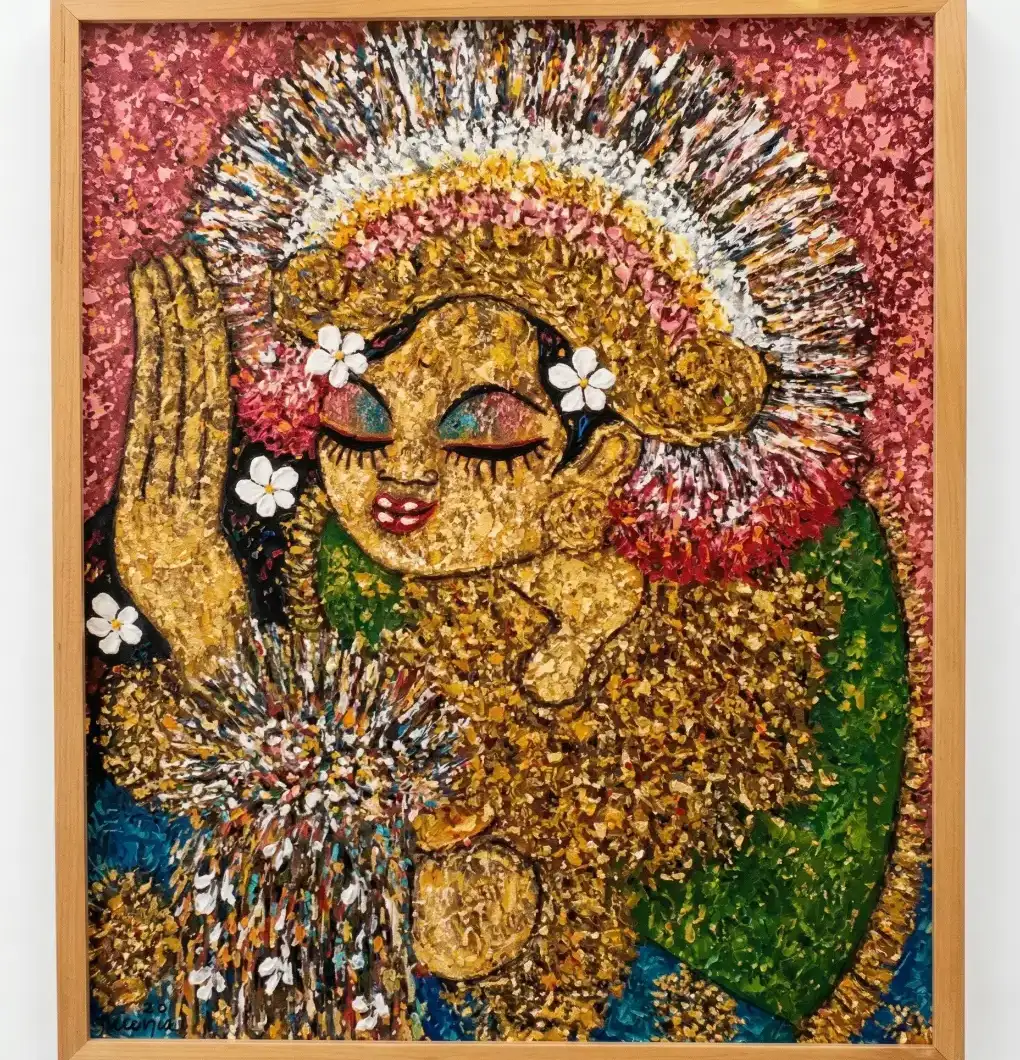
In Balinese dancer paintings inspired by Legong, that refined quality tends to translate as restraint. The palette knife works against the impulse to fuss, building form through accumulation rather than line. The result is a face that reads simultaneously as still and alive: serene closed eyes, a half-smile that holds more expression than a grin, hands that seem to be mid-phrase in a language only Bali fully understands. It is a visual equivalent of the dance itself — controlled energy, deliberately held.
Painters who approach Legong as a subject are not simply documenting a performance. They are entering a conversation that has been ongoing since Balinese artists first began rendering the dancer as a sacred subject, long before canvas and oil paint arrived on the island. Today’s palette knife paintings carry that lineage forward in texture and color, but the impulse is unchanged: to hold the ineffable in place long enough to be seen.
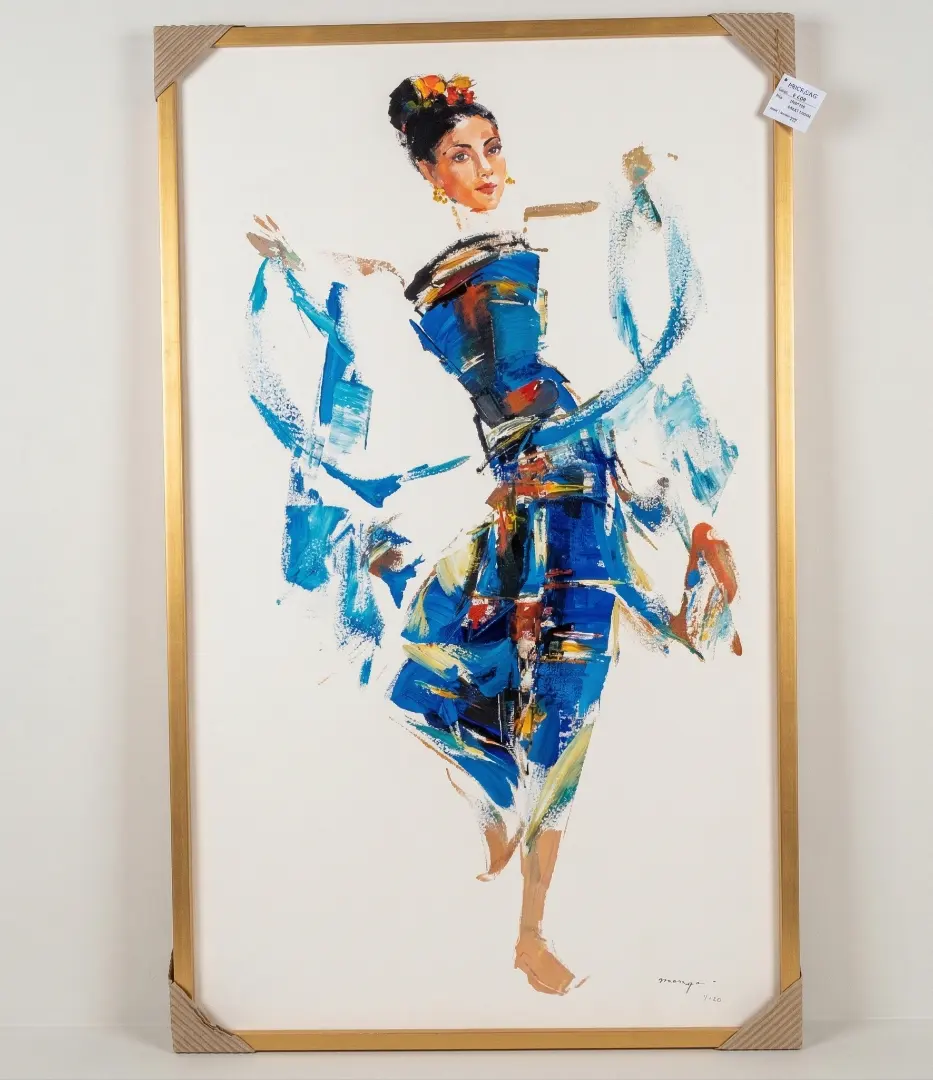
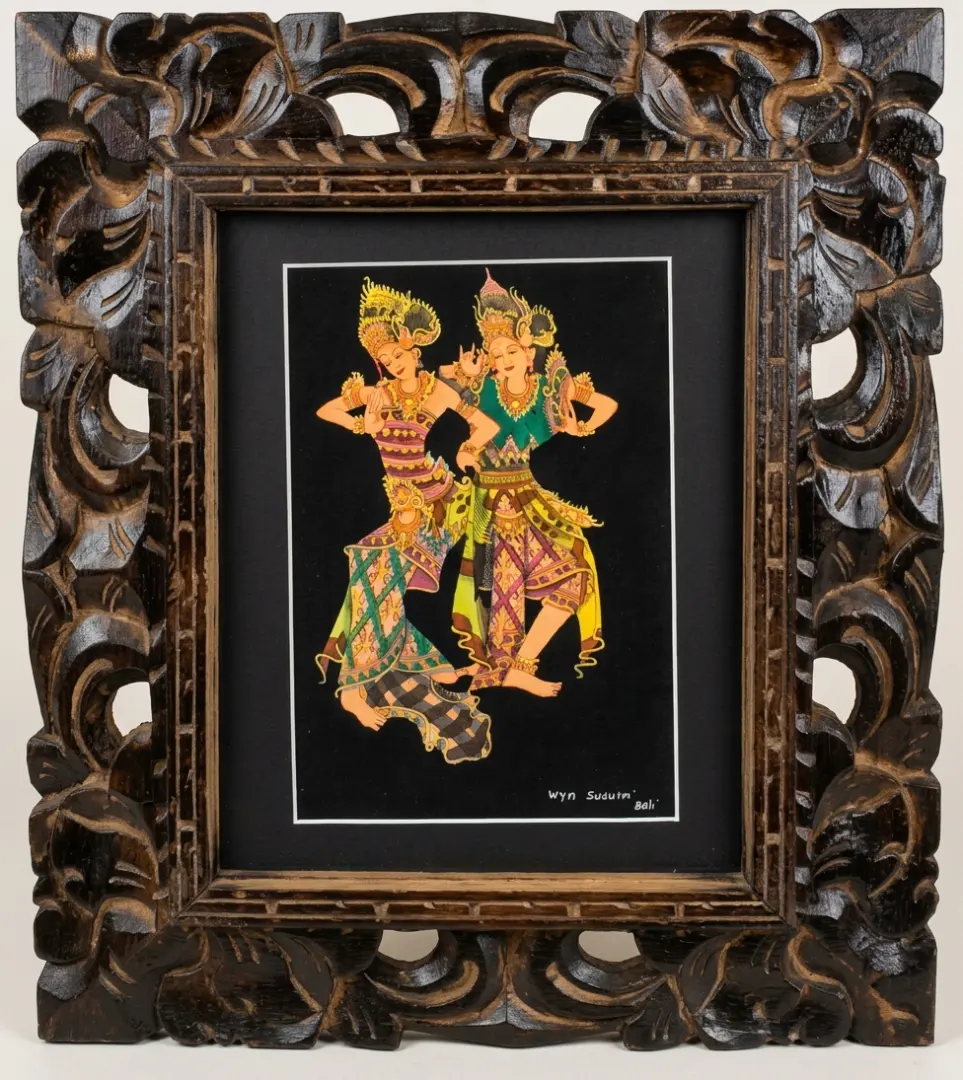
These two paintings illustrate how wide the range of Balinese dancer painting genuinely is. The contemporary work treats movement as its primary subject: the dancer’s form dissolves at the edges, as if she is still in the act of becoming. The traditional approach records with precision — every bead, every headdress ornament, every finger position documented with care. Both approaches are valid. Both are Balinese. For collectors choosing between them, the question is less about which is better and more about which kind of presence you want to bring into a room. One speaks in energy; the other speaks in detail. The best Balinese collections often contain both.
Barong Painting: When the Spirit King Comes to Canvas
Among all the subjects in Balinese fine art, Barong may be the most charged. According to Encyclopædia Britannica, Barong is the symbol of health and good fortune in Balinese culture — a benevolent spirit king whose elaborate masked form has been crafted, blessed, and venerated in villages across the island for centuries.
In the great dance drama that bears his name, Barong confronts Rangda, the demon queen, in a battle whose outcome is never a clean resolution. The conflict is eternal and held in deliberate balance, because in Bali’s philosophical understanding, the coexistence of good and evil is not a tragedy to be overcome but the very condition of a functioning universe. This concept, known as Rwa Bhineda, permeates everything from temple architecture to the checked black-and-white cloth wrapped around sacred trees.
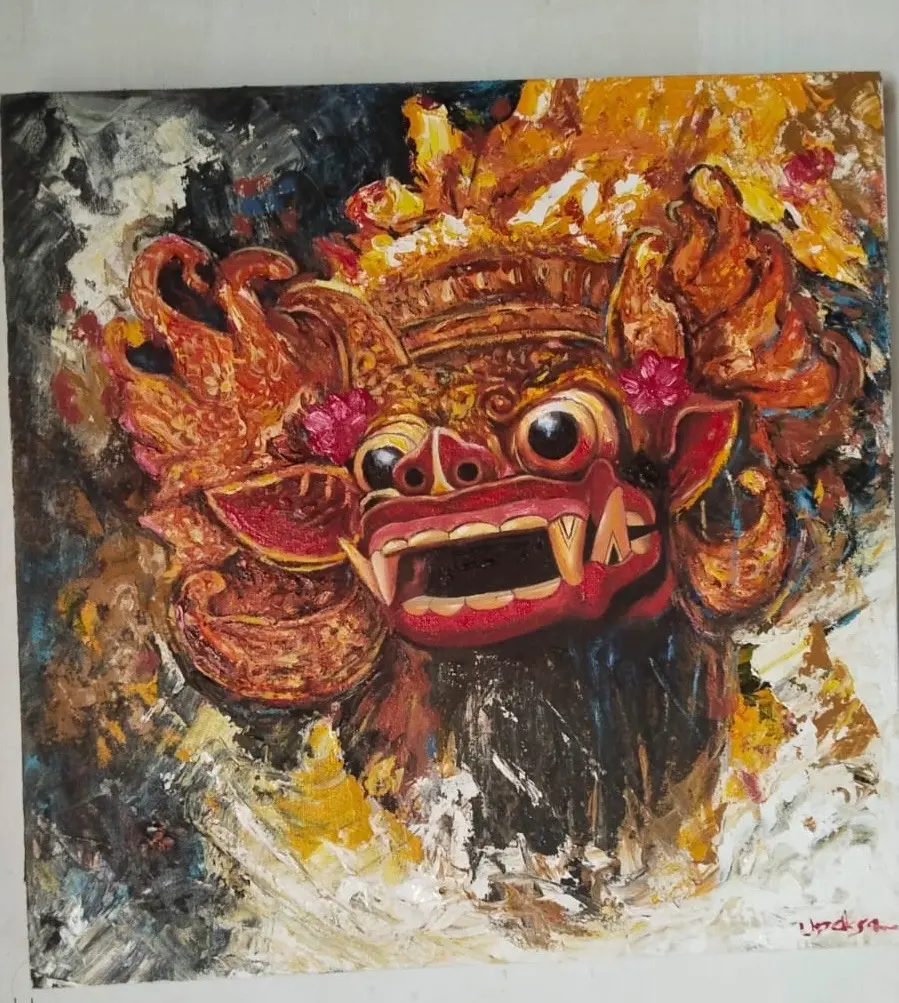
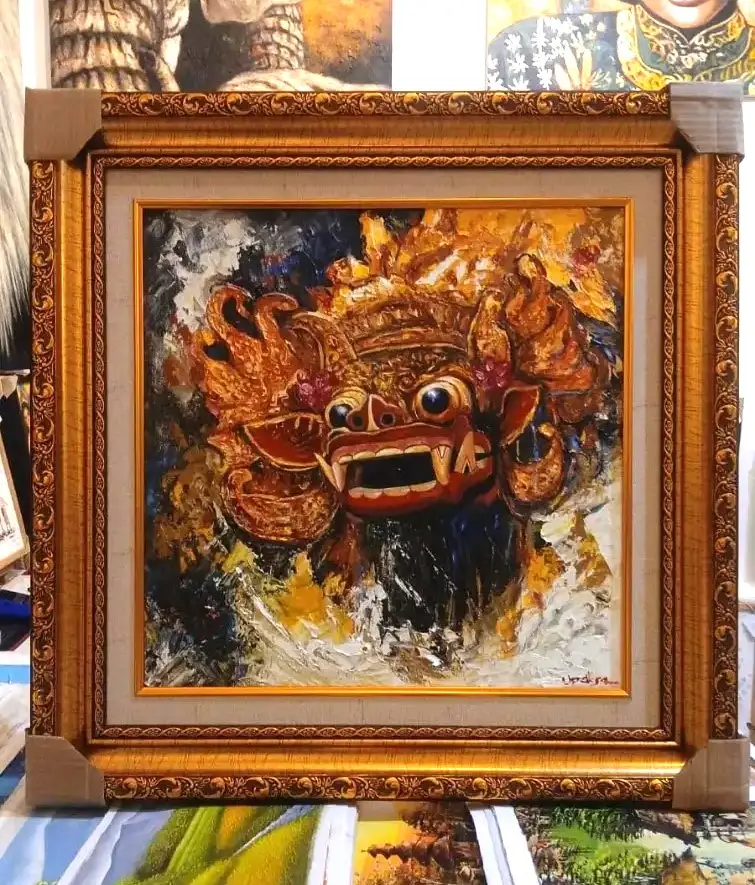
Painting Barong in the palette knife technique requires a particular kind of courage from the artist. The spirit king’s face — red, with round protuberant eyes, curved fangs, and a crown of layered ornament — is not easily rendered with a blade.
Yet the palette knife serves Barong well in ways that a fine brush does not. The impasto texture suggests not smoothness but force. The accumulated paint builds a face that seems to push forward from the canvas, the way Barong himself is said to push back against the darkness. In the works by Upeksa held in the Arts of Bali collection, Barong is approached not as mythology to be illustrated but as a living presence to be encountered.
How to Choose a Balinese Dancer Painting That Will Last a Lifetime
Visitors to Bali encounter Balinese dancer painting in almost every market, art shop, and gallery on the island. The range in quality is enormous, and price alone rarely signals authenticity. What separates a gallery-quality piece from a mass-produced reproduction comes down to a handful of observable qualities that any collector can learn to recognize, regardless of prior experience with art.
The first thing to examine is texture. In an original Balinese dancer painting worked in palette knife, the surface of the canvas is genuinely three-dimensional. Draw your eye across the painting at an angle to the light and you will see ridges, valleys, and directions of movement in the paint itself. A print or a reproduction will be flat, regardless of how detailed and vibrant the image appears from a viewing distance.
The second quality is the specificity of gesture. Balinese dance is a precise language, and a painter who genuinely knows that language will depict hands and eyes that correspond to actual mudra positions and recognizable dance vocabulary. The fingers are not generic; they are curved in ways that carry specific names and meanings within the tradition. A Balinese dancer painting that gets those details right carries the cultural knowledge of someone who has spent real time watching, or dancing, or both.
Finally, consider the frame. In fine Balinese paintings, the frame is rarely an afterthought. Hand-carved Balinese wood frames, ornate gold frames with relief detail, and clean natural wood frames each speak to the artist’s and gallery’s intention for the work. At 巴厘岛艺术, every framing decision is made in conversation with the painting it holds — complementing rather than competing.
“A Balinese dancer painting that gets the gesture right carries something irreplaceable — the cultural knowledge of someone who truly understands the dance.”
For those who wish to go further — to commission a Balinese dancer painting that depicts a specific dance form, a specific moment in the performance, or even a specific figure — the gallery’s custom painting service makes that conversation possible. Working directly with the artists in the collection, you can specify the dance form, the color palette, the size, and the technique, and receive a work that is genuinely personal rather than simply beautiful.
Visit the Gallery in Seminyak
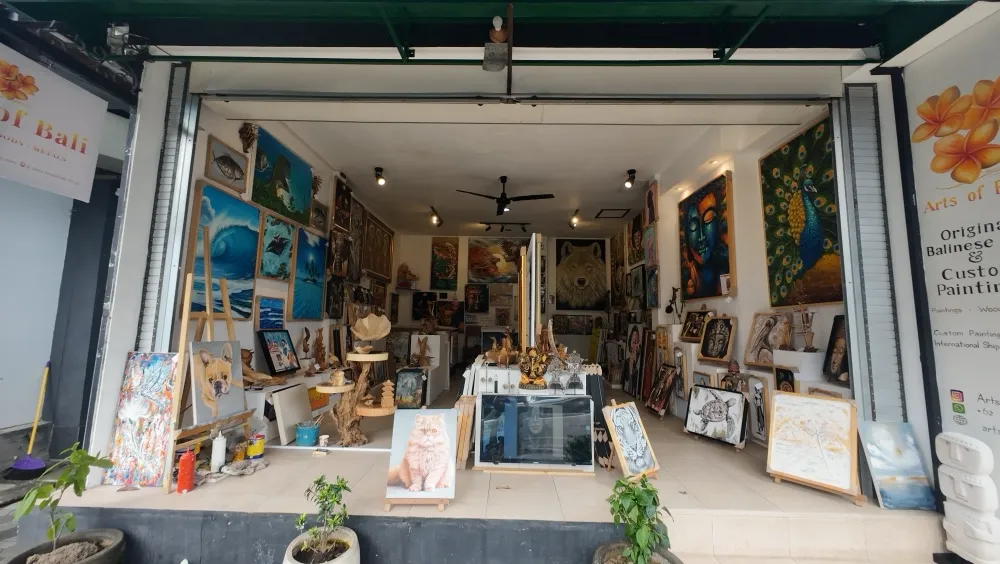
Arts of Bali is located at Jalan Raya Seminyak No. 42, Seminyak, Bali. Our collection of Balinese dancer paintings is available for viewing and purchase seven days a week. Our team is happy to guide you through the styles, artists, and stories behind each work. Custom commissions are welcome.
Explore the Full Collection