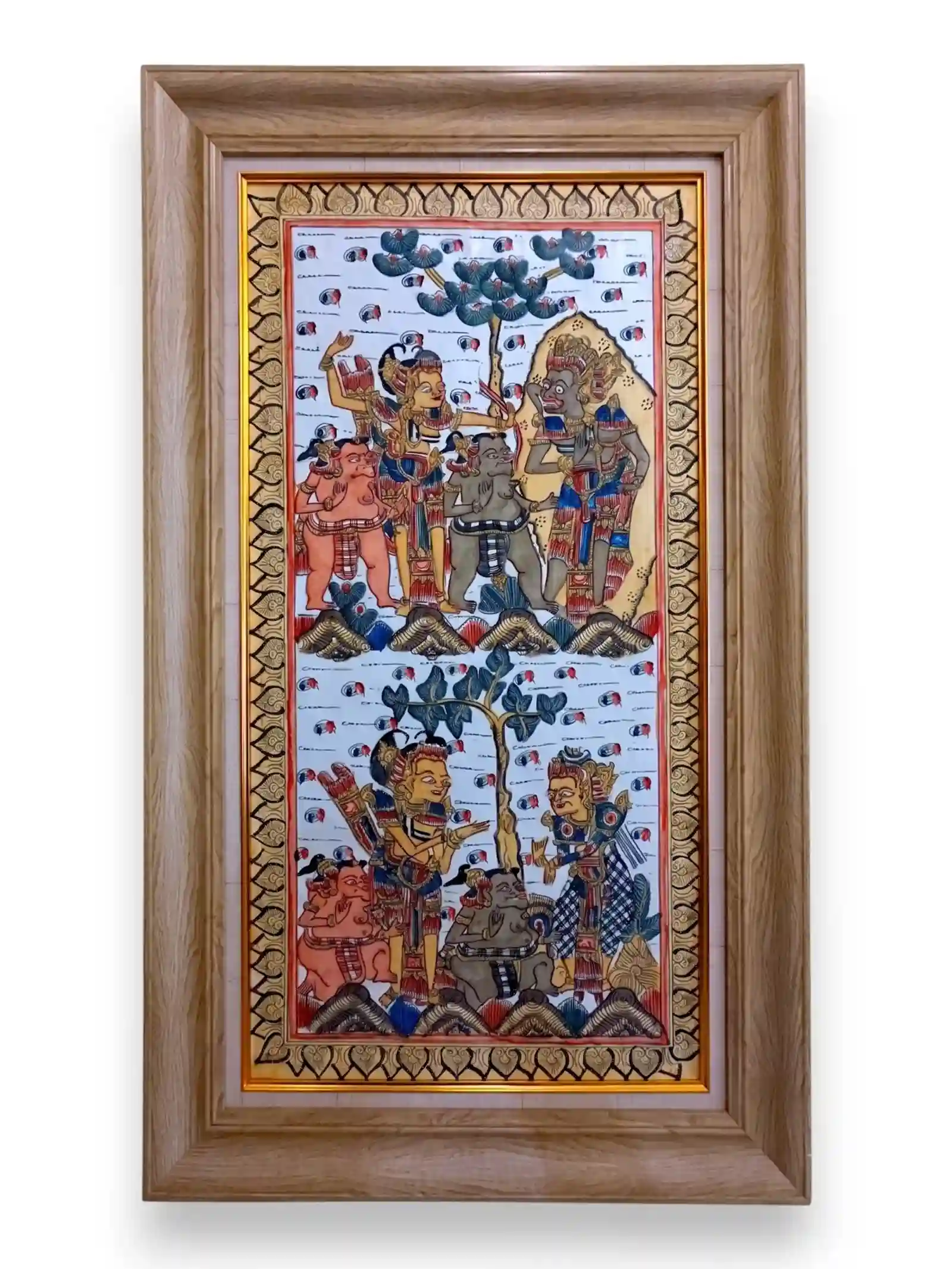
An Arjuna Wiwaha painting depicts scenes from an eleventh century Old Javanese epic poem, composed by the court poet Mpu Kanwa during the reign of King Airlangga, that tells how the hero Arjuna wins the favor of the gods through meditation on Mount Indrakila and receives the divine Pasupati weapon from Shiva. In Kamasan painting, this story is one of the most recognizable subjects painted on cloth, alongside the Ramayana and the Mahabharata, and Arts of Bali currently has an original Arjuna Wiwaha painting available in the gallery.
Key Takeaways
- Arjuna Wiwaha was written around 1030 CE by the poet Mpu Kanwa, during the reign of King Airlangga in East Java, making it the first known kakawin of that period.
- The story is drawn from an episode in the Mahabharata, but it stands as its own complete work with its own name, its own structure, and its own place in Kamasan painting.
- The plot centers on Arjuna’s meditation at Mount Indrakila, a test by seven celestial nymphs, a dispute over a wild boar with a hunter who turns out to be Shiva, and the gift of the Pasupati weapon.
- The text is not a museum piece. It is still read aloud and interpreted in Bali today through the mabebasan tradition, and it remains connected to Panca Yadnya ceremonies.
- Arts of Bali has an original Arjuna Wiwaha Kamasan painting in the gallery now, hand-painted on cotton canvas using the same natural pigment technique used for centuries in Kamasan village.
Most visitors who walk into a gallery in Seminyak and see a Kamasan painting recognize the style before they recognize the story. The flat profile figures, the natural pigments, the crowded panels full of warriors and courtiers, all of it reads as unmistakably Balinese. What is harder to recognize, unless someone explains it, is which specific story is being told. Ramayana and Mahabharata scenes get mentioned often because they are the two most common sources. Arjuna Wiwaha deserves its own explanation, because it is a distinct work with its own author, its own history, and its own visual details that separate it from a generic battle scene.
This guide walks through where the Arjuna Wiwaha story comes from, what actually happens in it, how Kamasan artists paint it, and why it is still part of living Balinese Hindu practice rather than a piece of history frozen in old manuscripts. For the wider context of Balinese art and its styles, see our complete guide to Balinese art.
What Is an Arjuna Wiwaha Painting?
An Arjuna Wiwaha painting depicts scenes from Arjuna Wiwaha, sometimes written Arjunawiwaha, an Old Javanese kakawin, a long narrative poem composed in Indian-derived meter. It was written by the court poet Mpu Kanwa, and most historical accounts place its completion between 1028 and 1035 CE, during the reign of King Airlangga of the Kahuripan kingdom in East Java. It is generally regarded as the first kakawin of that East Javanese period, which makes it a foundational text for the entire tradition of court poetry that later spread to Bali and continued there long after it had faded in Java itself.
The poem draws its plot from an episode inside the much larger Mahabharata, specifically the period after the Pandava brothers lose their kingdom to their cousins, the Kaurava, and go into exile. Arjuna leaves his brothers to seek spiritual power and divine weapons that the Pandavas will need to reclaim what was taken from them. That single episode was expanded by Mpu Kanwa into a complete, self-contained work with its own title, its own emotional arc, and its own ending. It is this expanded, independent version, not the shorter Mahabharata passage, that Balinese painters draw on when they paint an Arjuna Wiwaha scene.
There is one detail scholars often point out that adds weight to the poem beyond its plot. In the closing lines, Mpu Kanwa writes that he intends to accompany King Airlangga into battle himself. Many readers take this as a sign that the poem was never meant purely as entertainment. Arjuna’s own struggle to reclaim his family’s position reads as a quiet parallel to Airlangga’s real struggle to reclaim and hold his kingdom, written by a poet who was about to share in that struggle directly.
Arjuna’s Trial on Mount Indrakila
The story opens with Arjuna alone on Mount Indrakila, a mountain the poem treats as standing in for the cosmic Mount Meru. He has left his brothers behind to practice tapa, a form of intense ascetic meditation, in order to earn the attention and favor of the gods. His goal is not personal enlightenment. It is a weapon powerful enough to help the Pandavas survive the war that is coming.
The god Indra decides to test whether Arjuna’s discipline is genuine before granting anything. He sends seven apsaras, celestial nymphs known for their beauty, down the mountain to seduce Arjuna and pull him away from his meditation. In the poem, and in most retellings, the nymphs fail completely. Arjuna’s focus does not break, which is itself the point of the episode: real spiritual authority is proven by resisting exactly the kind of temptation most stories assume no one could resist.
Indra tests him a second time, this time appearing disguised as an old Brahmana priest, and asks Arjuna directly why he is seeking such power. Arjuna’s answer matters as much as his resistance to the nymphs. He explains that he is not seeking liberation for himself alone, but strength to protect and provide for others, his brothers and, by extension, the kingdom they are trying to reclaim. That answer, choosing duty to others over private spiritual escape, is treated in the text as the real proof of his worthiness, more than the meditation itself.
The Boar, the Hunter, and the Pasupati Weapon
The story’s best known scene comes next. A wild boar appears near Arjuna, sent by a demon army massing to threaten heaven itself. Arjuna shoots it. At almost the same moment, a hunter in the forest also claims to have killed the same boar. The two argue over whose arrow struck first, and the argument escalates into a fight between them.
The hunter is Shiva in disguise, testing Arjuna one final time. Once Arjuna realizes who he is actually facing, he stops fighting and shows the god proper reverence. Satisfied, Shiva reveals his true form and rewards Arjuna’s courage and humility with the Pasupati, a divine weapon associated with Shiva himself and considered one of the most powerful weapons in the entire Mahabharata tradition. Shiva appears elsewhere in Balinese iconography carrying a different weapon, the trisula, covered in our guide to Balinese art symbols.
With the Pasupati in hand, Arjuna is called on to help the gods defeat Niwatakawaca, a demon king who has been threatening heaven because he wants to force one of the apsaras, Supraba, to marry him. Arjuna succeeds, heaven is safe, and as a reward he is invited to stay in the heavenly realm for seven days, married in turn to each of the seven apsaras who had originally been sent to distract him. It is a pointed, almost playful twist that the same nymphs who could not break his discipline become his reward once that discipline has been proven and the real work is done.
How Kamasan Artists Paint the Arjuna Wiwaha Story
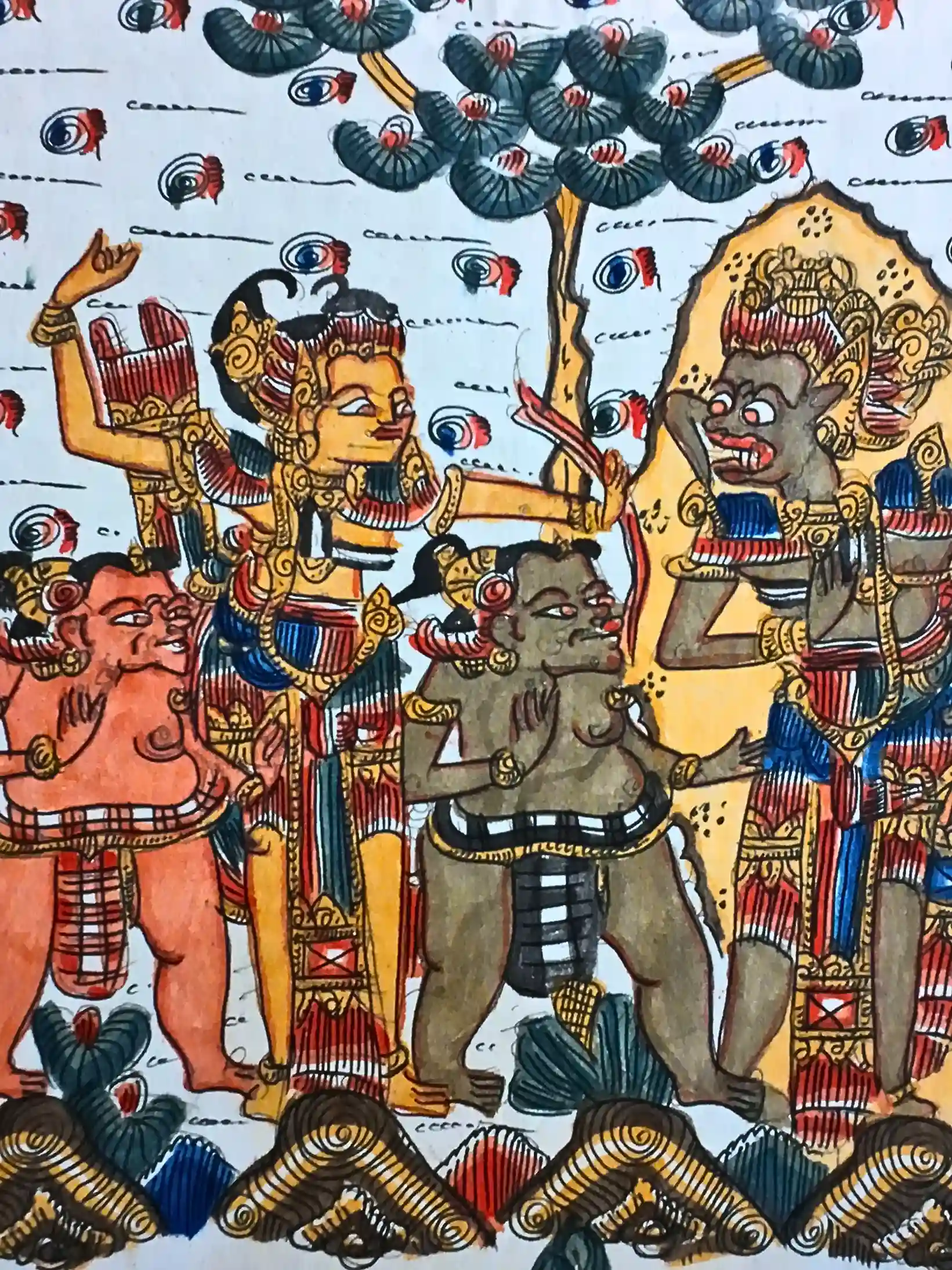
Kamasan painting works in a visual language that has stayed remarkably consistent since it developed in Klungkung centuries ago. Figures are shown in profile, with proportion and posture used to signal rank and virtue rather than realistic anatomy. Kings, sages, and heroes like Arjuna are drawn with elegant, elongated features. Demons and coarse characters, like Niwatakawaca, are drawn heavier and more exaggerated. Skin tone carries meaning too: refined characters are typically painted lighter, while rougher or more animalistic characters are darker or more heavily shaded.
An Arjuna Wiwaha scene has a few visual details that separate it from a generic epic battle painting. Look for a single meditating or kneeling figure on a mountain, often shown smaller and set apart from a cluster of finely dressed female figures nearby, that is Arjuna and the seven apsaras. A hunting scene with a boar between two figures marks the Shiva confrontation. Multi-panel compositions are common, since the story naturally breaks into these separate episodes, the mountain trial, the hunt, and the heavenly reward, and a single painting will often stack two or three of these scenes rather than trying to compress everything into one image.
The materials have not changed much either. Painters still work with natural pigments ground from local minerals and plant sources, applied to cotton or bark cloth that has been treated and stretched by hand, with fine detail work done using a brush of trimmed hair. It is slow work, and it shows in the final piece. Our full guide to Kamasan painting covers the technique itself in more depth, from pigment preparation to how a finished piece is framed. The same technique applied to a different deity is covered in our piece on Kamasan Ganesha painting, if you want a point of comparison.
Why This Story Still Matters in Bali Today
It would be easy to treat Arjuna Wiwaha as a historical curiosity, a poem written nearly a thousand years ago for a king who no longer has a kingdom. That is not how it functions in Bali. Academic research on the kakawin’s place in Balinese Hindu religion and culture describes it as a functional text, one still used as an accompaniment to Panca Yadnya, the five categories of ceremonial offering that structure much of Balinese Hindu religious life.
Part of what keeps it alive is a practice called mabebasan, a form of communal chanting where the kakawin is read aloud in its original Old Javanese, then interpreted line by line into everyday Balinese by a specialist reader known as a paneges, so that everyone listening understands the story as it unfolds rather than just hearing unfamiliar verse. Because copies of the manuscript have been made and passed down across Bali for centuries, and because the story has more recently been adapted into modern printed books, websites, and other accessible formats, Arjuna Wiwaha has never fully receded into pure academic study. It stays in circulation because people keep choosing to read it, chant it, and paint it.
Painting is simply one more way that circulation continues. A Kamasan artist working on an Arjuna Wiwaha scene today is drawing on the same story a mabebasan reader is chanting at a temple ceremony the same week, using techniques passed down almost as long as the poem itself has existed.
Arjuna Wiwaha vs Other Kamasan Epic Scenes
Because Kamasan painting draws so heavily on Hindu epic literature, it helps to know how to tell Arjuna Wiwaha apart from the other narratives painted in the same style. A general Ramayana scene centers on Rama, Sita, Hanuman, and the demon king Rawana, usually built around the abduction of Sita or the battle to rescue her. A general Mahabharata battle scene shows the wider war between the Pandava and Kaurava armies, recognizable by massed warriors, chariots, and the chariot wheel motif specifically tied to that larger conflict. Arjuna Wiwaha is narrower and more personal than either. It follows one hero through one extended trial, not an army through a war, and its signature scenes, the mountain meditation, the seven nymphs, the boar hunt, belong to this story specifically rather than to the Mahabharata as a whole.
If it is the broader mythology you are after, our guide to Balinese mythology painting covers Ramayana and Mahabharata scenes alongside figures like Barong in more general terms. This guide exists specifically for readers who already know they are looking at, or looking for, the Arjuna Wiwaha story itself.
See the Arjuna Wiwaha painting in person
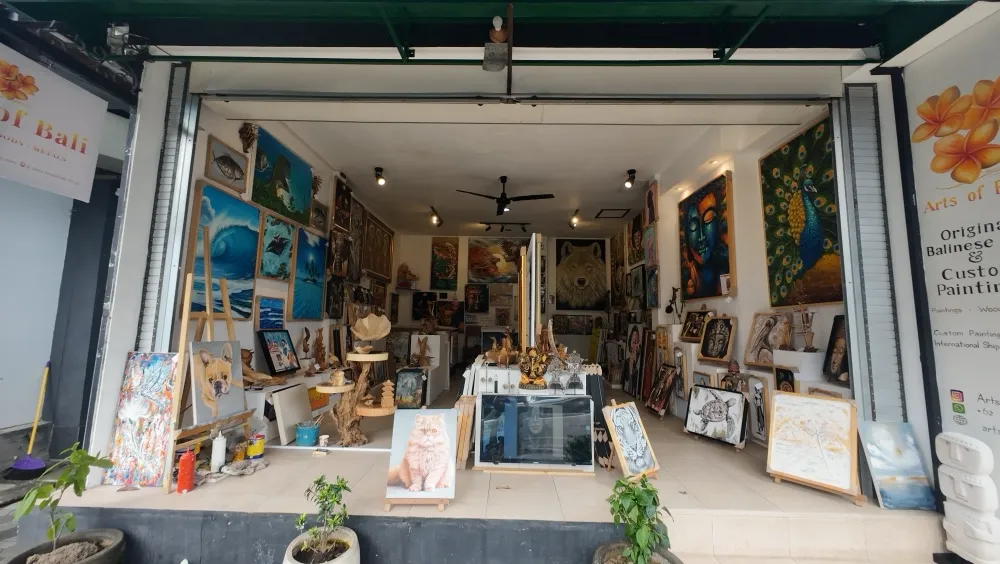
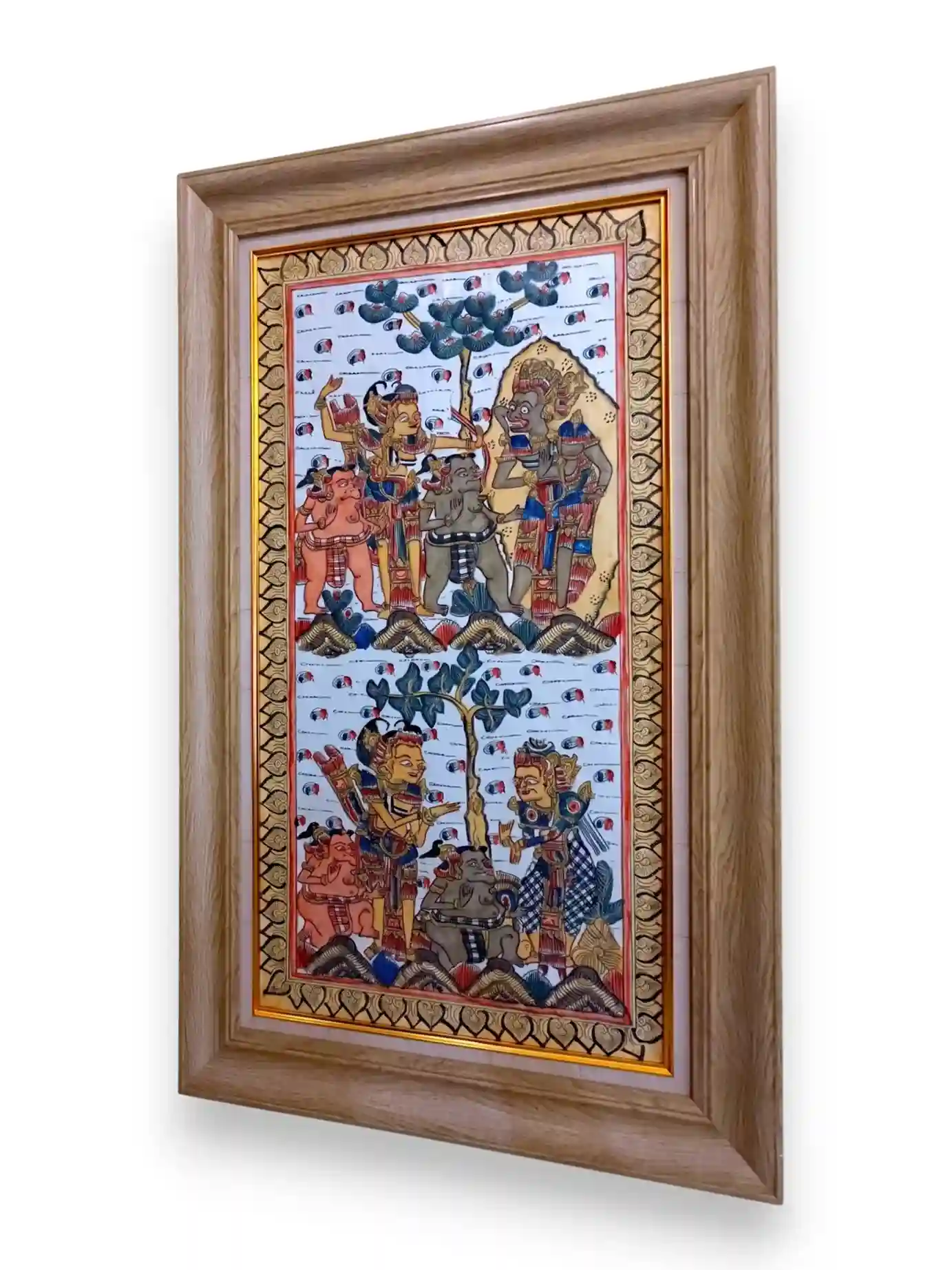
The original piece described in this guide is on display at our Seminyak gallery, hand-painted on cotton canvas in a natural wood frame, 42 by 87 centimeters.
Chat on WhatsApp View This PieceFrequently Asked Questions
What is Arjuna Wiwaha?
Arjuna Wiwaha is an Old Javanese kakawin, a narrative poem, composed by Mpu Kanwa around 1030 CE. It tells how the hero Arjuna meditates on Mount Indrakila, resists temptation from seven celestial nymphs, and earns the divine Pasupati weapon from Shiva. It is one of the most common story subjects in Kamasan painting.
Who wrote Arjuna Wiwaha and when?
It was written by the court poet Mpu Kanwa, most likely completed between 1028 and 1035 CE, during the reign of King Airlangga of the Kahuripan kingdom in East Java. It is generally considered the first known kakawin of that East Javanese period.
What is the difference between Arjuna Wiwaha and the Mahabharata?
Arjuna Wiwaha expands one episode from inside the Mahabharata, Arjuna’s period of exile and ascetic quest, into its own complete, self-contained poem with its own title and ending. A general Mahabharata painting usually shows the larger Pandava-Kaurava war, while Arjuna Wiwaha follows one hero through one specific trial.
What is the Pasupati weapon?
The Pasupati is a divine weapon associated with the god Shiva, considered one of the most powerful weapons in the Mahabharata tradition. In the story, Shiva gives it to Arjuna after testing his humility and courage during a disguised confrontation over a wild boar.
Why did the seven nymphs fail to distract Arjuna?
The god Indra sent the seven apsaras specifically to test whether Arjuna’s meditation was genuine. Their failure to break his focus is the point of the episode: it demonstrates real spiritual discipline rather than a performance of it, which is what earns him the second, deeper test that follows.
Is the Arjuna Wiwaha story still practiced or read in Bali today?
Yes. It is still read and interpreted through mabebasan, a tradition of communal chanting where a specialist reader explains the Old Javanese verse in everyday Balinese, and it remains connected to Panca Yadnya ceremonial life. Manuscript copies are still widely distributed across Bali.
How can I recognize an Arjuna Wiwaha scene in a Kamasan painting?
Look for a solitary meditating figure on a mountain near a group of finely dressed female figures, that is Arjuna and the seven nymphs, or a hunting scene built around a boar between two men. Multi-panel compositions stacking these separate episodes are common for this specific story.
Does Arts of Bali have an Arjuna Wiwaha painting available?
Yes, an original Arjuna Wiwaha Kamasan painting is currently in the gallery, hand-painted on cotton canvas in a natural wood frame, sized 42 by 87 centimeters. Message us on WhatsApp or visit the piece’s page for current price and availability.