A Balinese dancer painting depicts sacred ceremonial dances from Balinese Hindu tradition — Legong, Barong, Kecak, and Janger — hand-painted by trained Balinese artists using techniques including palette knife impasto, gold leaf, or classical fine brushwork. Authentic examples carry visible texture, named artist signatures, and accurate cultural costume detail. They are collected internationally as both fine art and cultural documents of a living tradition.
There is a specific moment that stops people mid-step in every serious art gallery in Seminyak. It is usually a Balinese dancer painting — a figure in full ceremonial headdress, caught between movements, paint built up so thick you feel the weight of the gold and silk before you reach out to touch the canvas. The dancer is not posing. She is mid-prayer. And the painter, somewhere behind every mark, has been watching long enough to know the difference.
Balinese dance is not performance in the Western sense. The dances of Bali — Legong, Barong, Kecak, Janger — are ritual acts of devotion, performed at temples, at festivals, and at every intersection between the human and the divine. When a painter chooses a dancer as a subject, they are not choosing something decorative. They are choosing the most concentrated form of Balinese spiritual life available to a canvas.
This guide covers everything a serious buyer or collector needs to know: which dances inspire which paintings, what techniques distinguish quality work, and how to recognise authentic craftsmanship from the mass-produced imitations that crowd tourist markets across Bali.
“In Bali, the dancer does not perform. She prays with her body — and the finest painter watches, and remembers, with every mark he makes.”
The Three Sacred Dances at the Heart of Every Painting
Not all Balinese dancer paintings depict the same dance — and knowing the difference changes everything about how you read the canvas. Three dances dominate the subject matter of Balinese fine art, each with its own costume, mood, and cosmological significance.
Legong
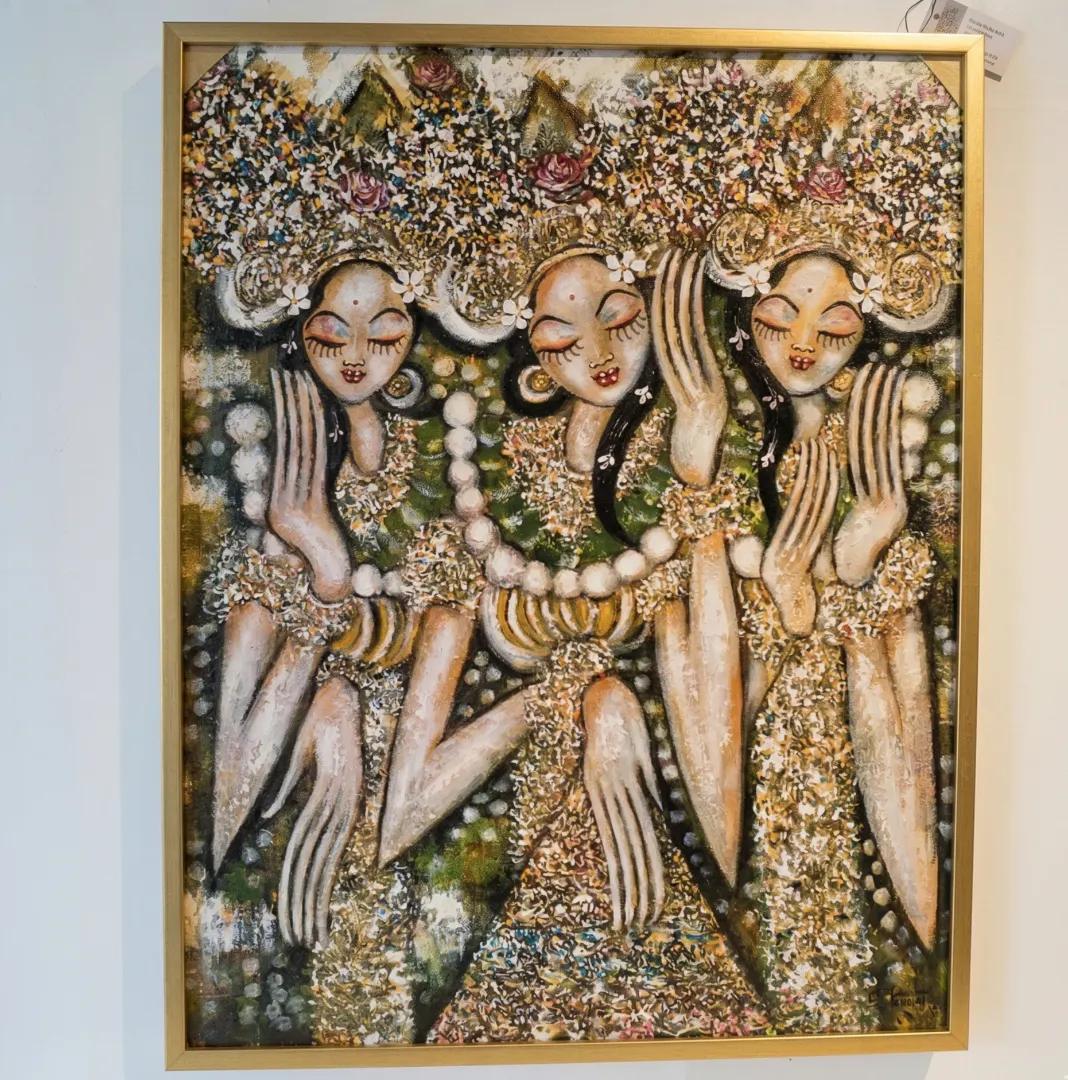
The most refined of Balinese dances. Two or three young female dancers in elaborate gold headdresses and layered ceremonial costume perform movements of extraordinary precision — eyes, fingers, and feet coordinated in a language that takes years to master. Legong paintings are characterised by grace, symmetry, and gold. The headdress alone — a towering structure of gilded leather, frangipani, and jewels — gives painters a subject of extraordinary visual complexity.
Barong
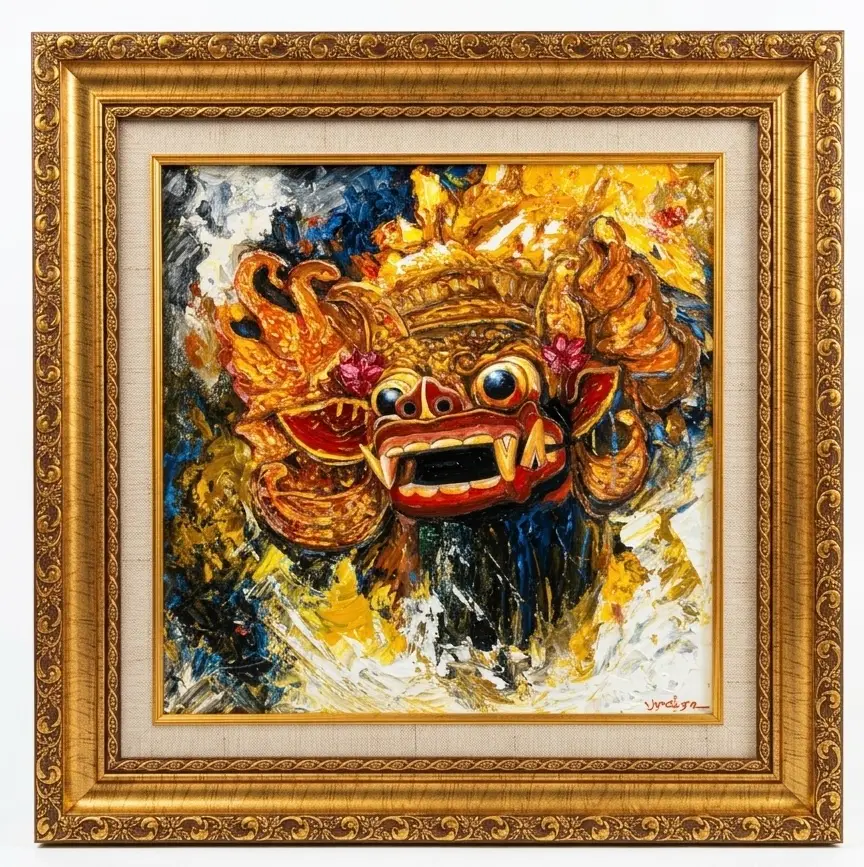
The mythological lion-dragon of Balinese cosmology, representing the eternal battle between order (dharma) and chaos (adharma). The Barong costume — a massive, elaborately carved and painted mask operated by two dancers — is one of the most visually dramatic subjects in all of Balinese art. Barong paintings carry bold energy, strong colour contrasts, and a symbolic depth that makes them powerful presences on any wall.
Kecak & Ramayana
The Kecak, sometimes called the “Monkey Dance,” depicts scenes from the Ramayana epic through a chorus of bare-chested men performing hypnotic chanting movements around a fire. Paintings of the Kecak are panoramic and dynamic — dozens of figures arranged in concentric rings, firelight, and dramatic gesture. They require significant canvas size to be read properly and are often commissioned as centrepiece works.
What Each Dance Looks Like on Canvas
Legong: Grace Frozen at Its Peak
A Legong dancer painting rewards close attention. The costume alone requires a painter of significant technical ability: the gold headdress, the layered silk, the floral offerings tucked into the belt, the white powder makeup with precise red and black facial lines. The Legong dance has been performed in Bali since at least the nineteenth century and is among the most recognised symbols of Balinese culture internationally.
In palette knife interpretations — which are the dominant contemporary form — the headdress becomes a study in texture. Gold paint is applied in thick slabs, then worked with the blade edge to suggest individual gilded flowers. The face is smoother, more deliberate. The hands, with their characteristic hyper-extended finger positions, often become the focal point of the composition because they communicate everything that Balinese dance communicates: complete attention, complete offering.
Barong: When Light and Dark Meet in Paint
The Barong is not simply a costume. In Balinese Hindu cosmology, the Barong is a protective spirit — one half of an eternal opposition with the witch-queen Rangda. The Barong dance performance is a ritual reenactment of this balance, not a resolution of it. This unresolved tension is what gives Barong paintings their unusual power as objects: they don’t illustrate a story with an ending. They hold a cosmological question permanently open.
Strong Barong paintings use dark backgrounds — deep black or espresso — to make the mask’s polychrome colours (red, gold, white) advance dramatically. The eyes, oversized and staring, are typically the compositional anchor. Painters who understand the Barong work with the mask the way portrait painters work with a human face: as a revelation of character, not merely of form.
Kecak: Scale and Collective Energy
If the Legong is a study in individual precision and the Barong in mythological force, the Kecak is about collective human energy — fifty or more men, arranged in circles, moving together in a state of ritual trance. Paintings of the Kecak are almost always wide-format because the circular arrangement of the chorus requires horizontal space to read correctly. The fire at the centre — always present in a Kecak performance — gives painters a natural light source around which to organise shadow and warm colour.
The Kecak was formalised in its current form in the 1930s in collaboration between the Balinese performer I Wayan Limbak and the German artist Walter Spies — a detail that places Balinese dance at the origin of the broader twentieth-century encounter between Western art culture and Bali’s visual traditions.
“The finest Balinese dancer paintings do not decorate a room. They change what the room is asking of you.”
Three Techniques That Define Balinese Dancer Paintings
The technique used to paint a Balinese dancer shapes everything: the mood of the piece, its visual weight on a wall, and its appropriateness for different interior contexts. Buyers who understand the three primary approaches make better choices — and understand why prices differ significantly between otherwise similar subjects.
Palette Knife Impasto
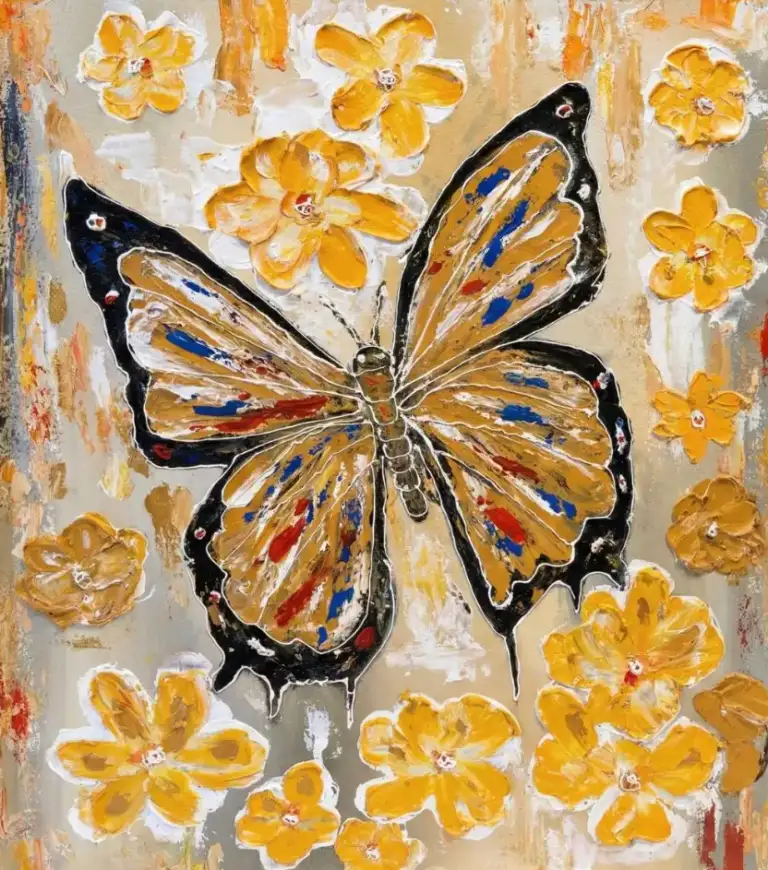
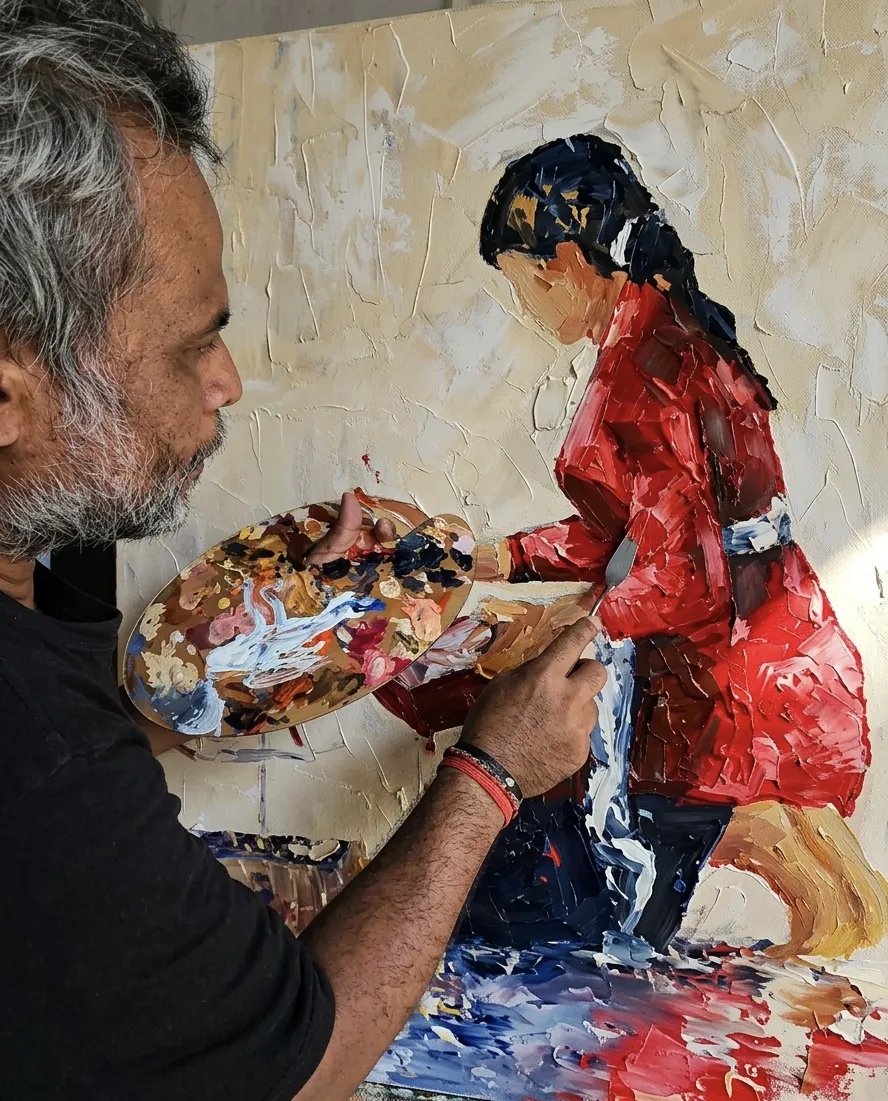
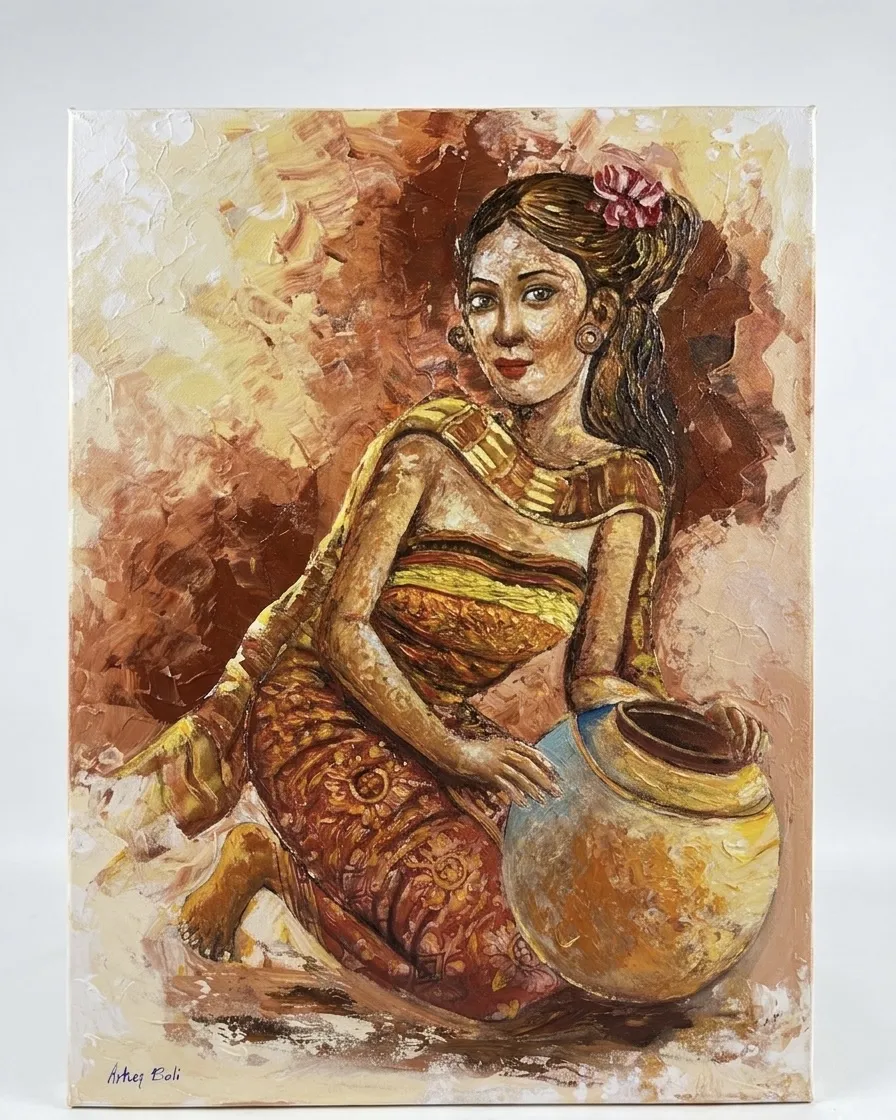
The dominant contemporary technique in fine art Balinese dancer painting, particularly at galleries on the Seminyak–Kuta corridor. A steel palette knife — rather than a brush — is used to apply thick oil paint directly to canvas, creating ridges and planes of colour that catch light and produce genuine three-dimensional texture. The effect is particularly effective for dancer subjects because the layered gold of the headdress, the silk of the costume, and the textured white powder of the makeup all translate naturally into impasto mark-making.
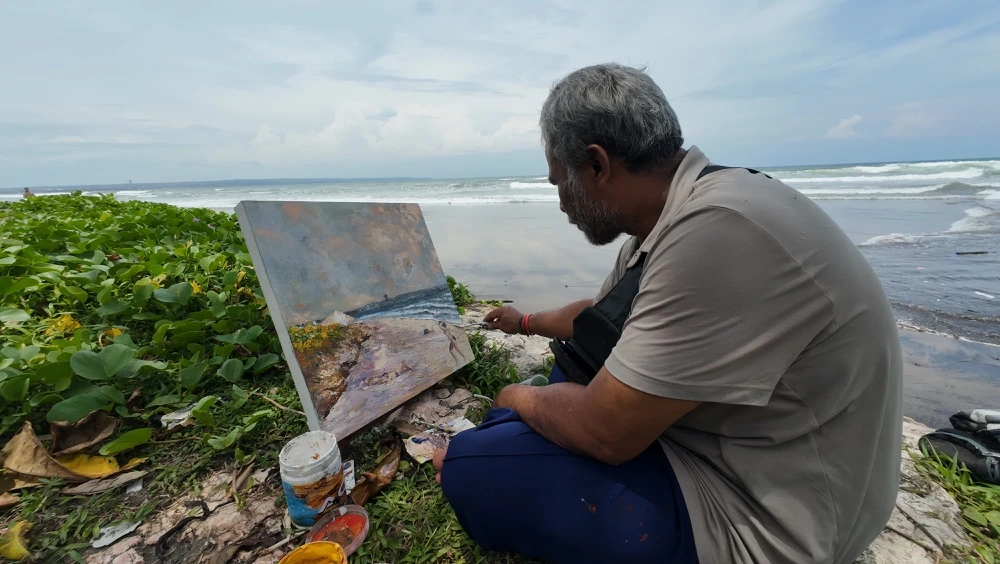
Artist Gandara, working at Arts of Bali, uses palette knife technique extensively for figurative subjects. Upeksa, originally from Nusa Penida, is the gallery’s specialist for heavily textured palette knife work in both figurative and wildlife subjects. On dancer paintings, the palette knife is never used mechanically — every mark is a decision about weight, direction, and the specific light condition of the subject being observed.
Gold Leaf Application
Gold leaf — either 22-karat genuine gold or high-quality imitation — is pressed onto pre-sized areas of the canvas to capture the shimmer of the Legong headdress in a way that paint alone cannot fully achieve. The technique is ancient: Kamasan painting, Bali’s oldest painting tradition, used natural pigments and outline figures without gold leaf, but the integration of gold into figurative painting has become a defining feature of contemporary Balinese collector art.
Gold leaf applications require precise execution — the gold must be applied to sized (adhesive) areas before it dries, then burnished, then protected with a matte fixative that preserves the warmth without creating excessive shine. Poorly applied gold leaf lifts, cracks, or turns brassy. In well-executed pieces, it reads as light rather than decoration.
Classical Fine Brush Painting
The older tradition, associated with the Ubud style and the Batuan school, uses fine sable or synthetic brushes to render intricate costume detail with flat or lightly modelled colour. This technique prioritises precision over texture — every petal of a headdress, every fold of silk, is drawn with a thin brushline before colour is applied. Classical brush-painted dancer works are more directly linked to the pre-colonial tradition of painting sacred figures on cloth and wood for temple use.
Note for collectors: Fine brush paintings and palette knife works are not ranked in quality — they represent different aesthetic traditions and suit different interior contexts. Palette knife works read strongly from distance and suit large contemporary spaces. Fine brush works reward close examination and suit more intimate settings where detail can be appreciated.
How to Recognise an Authentic Balinese Dancer Painting
The gap between an authentic, hand-painted Balinese dancer painting and a mass-produced print is significant — in cultural value, artistic merit, and long-term investment quality. These are the markers that distinguish one from the other.
- Visible texture: Any genuine palette knife or impasto work shows raised paint ridges that cast subtle shadows when light crosses the surface. Run a finger across the canvas (permission permitted): you will feel the paint’s physical presence.
- Named artist signature: Authentic gallery-quality works are signed by the artist, often with both a Balinese name and a date. The signature should be legible — not a rubber stamp or a printed facsimile.
- Accurate costume detail: A serious Balinese painter knows the anatomy of a Legong headdress, the specific hand positions (mudras) of each dance form, and the correct layering of ceremonial dress. Inaccuracies — wrong hand positions, generic headdresses, simplified costume — indicate a painter working from imagination rather than observation.
- Canvas, not print-on-canvas: Hold the work at an angle under a light source. Print-on-canvas products show a regular dot pattern (the inkjet grid) under close examination. Hand-painted works show irregular, organic mark-making with no repeating pattern.
- Gallery documentation: Reputable galleries provide a certificate of authenticity or at minimum a gallery label with artist name, title, medium, and size. At Arts of Bali, every work over a certain value is documented and can be reattributed upon resale.
- Avoid: Any work sold rolled in a tube without a stretcher frame at a street market price of under IDR 200,000 — these are almost universally mass-produced transfers, not hand-painted originals.
- Avoid: Works where the “artist” cannot be named, or where all paintings in a stall look identical in brushwork and colour palette — a sign of a single template reproduced by multiple people.
Sacred Dance. Living Canvas.
Balinese dancer paintings are not reproductions of something that happened once. The dances they depict are performed today, every week, at temples across the island. The painters who make these works have watched these dances their entire lives. When you bring one home, you are not buying nostalgia. You are carrying away a fragment of something still in motion.
Balinese Dancer Paintings at Arts of Bali, Seminyak
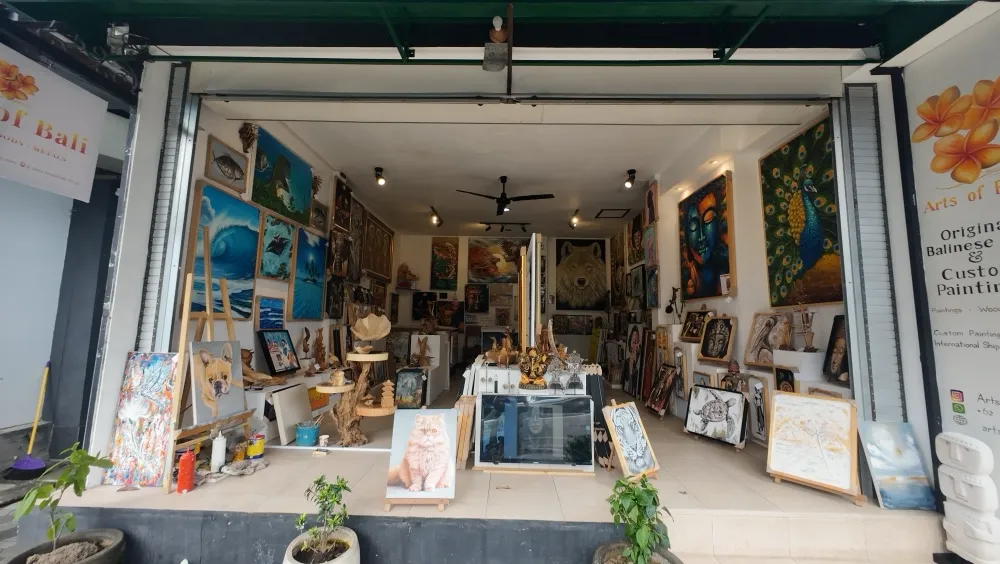
At Arts of Bali on Jalan Raya Seminyak No. 42, the dancer painting collection spans all three principal techniques — palette knife impasto, gold leaf, and classical fine brush — across a range of sizes suited to different interior applications. The gallery works with resident artists whose specialisations are clearly differentiated:
Upeksa brings a palette knife sensibility developed through years of figurative and wildlife painting, applying the same layered impasto logic to Legong subjects that he uses for animal portraiture — with results that are texturally rich and compositionally bold. Gandara, whose landscape palette knife work is documented in the artist feature on this site, approaches dancer subjects from his background in volcanic landscape: the figure emerges from a strongly atmospheric, earthy background rather than the decorative dark fields common in tourist-market work.
The gallery also carries a curated selection of gold-leaf Legong works and classical brush-painted Barong pieces sourced from master painters in the Ubud and Batuan traditions. Every work is documented, artist-attributed, and available for international shipping through the gallery’s professional roll-pack and wooden-crate delivery system.
Custom commissions are accepted for dancer paintings in any size, technique, or specific dance subject. The commission process takes 14 to 21 days and includes a digital work-in-progress image for client approval before completion. See the full process at How to Commission Art in Bali.
Expert AnswersFrequently Asked Questions
What is a Balinese dancer painting? ▼
A Balinese dancer painting depicts sacred ceremonial dances from Balinese Hindu tradition — primarily Legong, Barong, Kecak, and Janger — rendered by trained Balinese artists on canvas. These are not decorative subjects in the conventional sense: each dance is a spiritual act, and serious Balinese painter-practitioners treat the subject accordingly. Authentic examples are hand-painted (not printed), carry a named artist signature, and accurately render the costume detail of the specific dance depicted.
What is the difference between a Legong and a Barong dancer painting? ▼
Legong paintings depict refined female court dances performed by young dancers in elaborate gold headdresses — compositionally graceful, symmetrical, and gold-toned. Barong paintings depict the protective mythological lion-dragon of Balinese cosmology, typically shown as a dramatic mask with bold polychrome colour against a dark background. The mood difference is significant: Legong conveys refined devotion; Barong conveys protective spiritual force. Both are major collector subjects but suit different interior contexts.
How can I tell if a Balinese dancer painting is authentic? ▼
Authentic hand-painted Balinese dancer paintings show visible texture from brush or palette knife marks, carry a legible named-artist signature, and demonstrate accurate cultural knowledge in the costume detail (correct mudra hand positions, headdress structure, ceremonial dress layering). Under angled light, the surface is irregular and three-dimensional — unlike the regular dot grid visible on print-on-canvas reproductions. Gallery-quality works come with documentation or a certificate of authenticity.
What technique is used to paint Balinese dancers? ▼
Three techniques are used at the gallery level: (1) Palette knife impasto — thick oil paint applied with a metal blade, producing strong three-dimensional texture and bold colour suitable for large contemporary spaces; (2) Gold leaf application — real or high-quality imitation gold foil pressed onto canvas to replicate the shimmer of Legong ceremonial headdress; (3) Classical fine brush painting — the older Ubud and Batuan tradition, using thin brushlines to render intricate costume detail with precision. Each technique suits different aesthetic preferences and interior contexts.
Which Balinese dancer subject is most popular with international collectors? ▼
Legong dancer paintings are the most consistently requested subject among international collectors at Arts of Bali, followed by Barong compositions. Among techniques, palette knife Legong works with gold-accented headdress on dark backgrounds are particularly sought after for luxury villa and hotel interior applications. Kecak panoramic compositions are popular as large-format centrepiece commissions.
Can I commission a custom Balinese dancer painting from Arts of Bali? ▼
Yes. Arts of Bali accepts custom commissions for dancer paintings in any size, technique, dancer subject, and colour palette. The process begins with a WhatsApp consultation, proceeds through a 14–21 day painting period with one digital progress preview, and concludes with professional roll-pack and international shipping. Commission enquiries can be initiated via the gallery’s WhatsApp or through the commission guide on this site.
Explore the Balinese Dancer Painting Collection
Original palette knife, gold leaf, and classical brush-painted dancer works — all hand-painted by named Balinese artists. Available for gallery visit or international commission from Jl. Raya Seminyak No. 42, Bali.
View the Collection Commission a Custom Piece