“In Bali, flowers are not decoration. They are a language spoken toward the divine. When our artists paint them, they are not painting still life — they are painting devotion made visible.”— Putu Sucipta, Owner, Arts of Bali
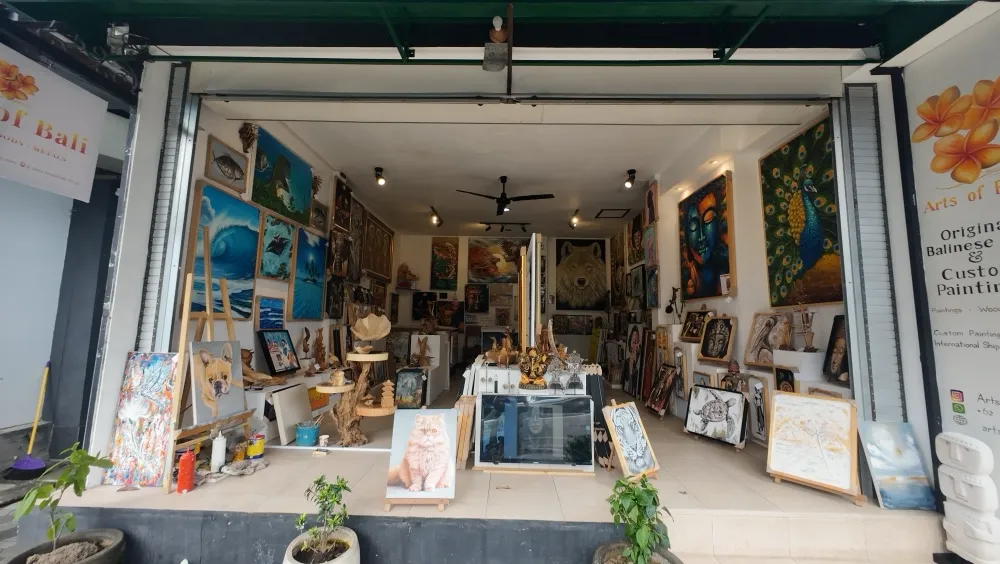
Flower painting Bali offers a broader range of styles than most collectors expect — from classic oil still-life to bold palette knife impasto and unique sculptural relief. The most distinctively Balinese subject is the frangipani (jepun) — the sacred flower used in daily Hindu offerings — painted by local artists in styles from photorealistic to expressionist. Arts of Bali in Seminyak carries original flower paintings in a range of sizes and techniques, all available for international shipping.
- Frangipani (jepun) is the defining flower of Balinese art — sacred, symbolic, and deeply local.
- The Arts of Bali logo features a white frangipani, representing art as devotion and sacred offering.
- Six original works in this collection span airbrush, classical oil, palette knife, and sculptural relief techniques.
- Named artists Alzen and Farfan created two of the six paintings featured here.
- All works are available for sale and international shipping from Seminyak, Bali.
Flowers have never been neutral objects in Bali. They are placed on temple steps before sunrise, woven into offerings at the base of trees, tucked behind the ear of a dancer before she walks onto stage. Every frangipani that falls from a branch in a temple compound in Ubud, Sanur, or Seminyak is understood — in Balinese Hindu tradition — as a completed prayer returning to earth. This is the context in which Balinese artists paint flowers. Not as arrangement. Not as decoration. As a continuation of the conversation that the island has always been having with the sacred.
The six paintings in this collection represent six different ways that conversation can look. A soft luminous white frangipani on dark teal. A vast purple frangipani spread across canvas without a frame to contain it. A classical European-style bouquet rendered in rich oil. Palette knife sunflowers committed stroke by stroke. A minimalist sculptural flower in cream relief. And a red poppy field under an orange sky, thick with paint and alive with energy. Each painting speaks differently. All of them say the same essential thing: beauty, made deliberately, is never merely decorative.
Why Balinese Artists Paint Flowers: Tradition, Offering, and the Jepun
The frangipani — called jepun in Balinese and kamboja in Indonesian — is the most important flower in Balinese Hinduism. It appears in every canang sari, the small daily offering of woven palm leaf and flowers that Balinese women place at doorways, on altars, at the base of statues, and in front of businesses every morning. The white variety, jepun putih, corresponds to Iswara — the directional deity of the East in the Nawa Sanga, the nine divine forces that govern Balinese cosmology — and signals purity and sacred intention. To paint the jepun is to paint the most spiritually loaded object on the island.
Beyond frangipani, Balinese artists work across a broad botanical vocabulary: lotus flowers as symbols of spiritual elevation rising from murky water; hibiscus (pucuk) as markers of the island’s abundant colour; sunflowers adopted from Western art and transformed by tropical light; poppies brought in by artists trained in European techniques and reinterpreted under Bali’s palette. What unifies all of these subjects in the hands of Balinese painters is the absence of casualness. Flowers here are painted with the kind of attention normally reserved for things that matter.
White Frangipani Painting — Jepun Putih: The Sacred Bloom at the Heart of Arts of Bali
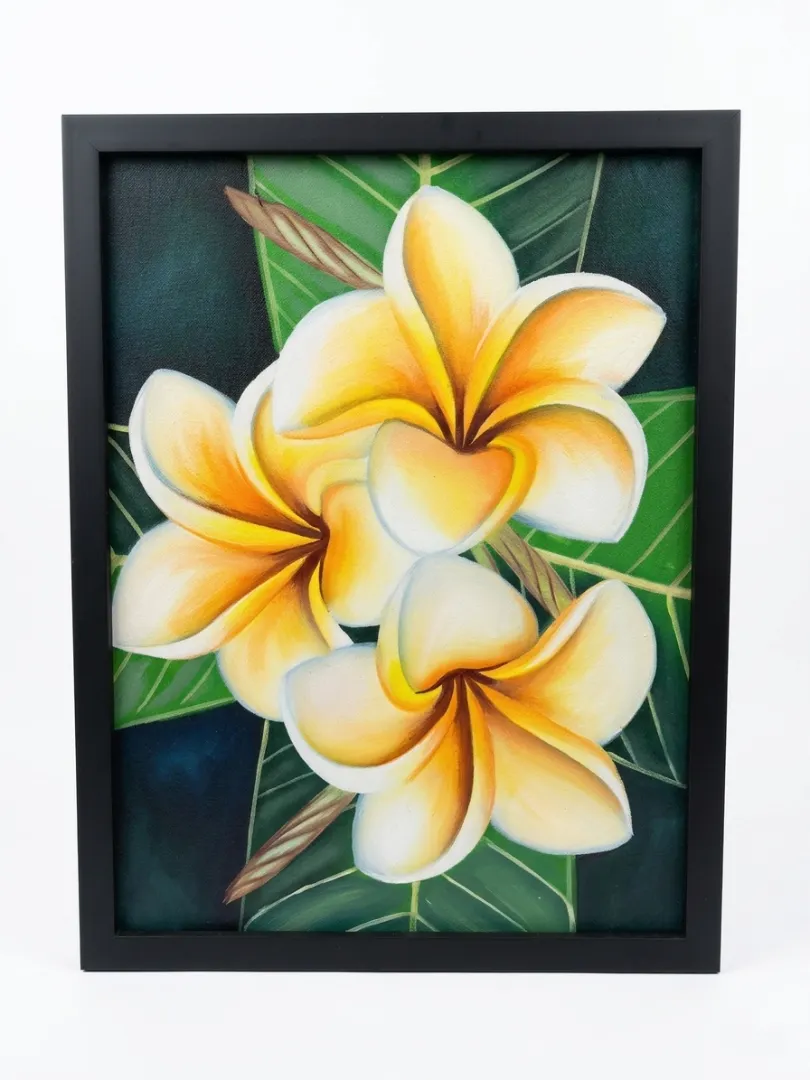
The Arts of Bali logo is a frangipani. This was not a design decision. It was recognition — a statement about what the gallery is and what it does. Of all the flowers that grow across this island, the jepun putih speaks most precisely about the act of making and holding art: it blooms from ancient bare wood without visible soil or nourishment, producing extraordinary beauty as an act of apparent devotion rather than material necessity. This is what artists do. This is what galleries do, when they are doing it honestly.
In Balinese cosmology, white corresponds to Iswara and the sacred East — the direction of the rising sun, of purity, of spiritual beginning. The white frangipani appears in the canang sari daily offering not as a beautiful addition but as a necessary one: it carries a specific prayer. This painting captures that flower in close study: three blooms rendered in soft, luminous detail against a deep teal-green that holds them in a kind of darkness from which they glow. The artist has not romanticised the subject. The petals have weight. The shadows fall correctly. This is a painting made by someone who has looked at this flower with the attention Bali requires of it.
“We chose the frangipani for the Arts of Bali logo because it grows from nothing and produces beauty as if it cannot help itself. That is the only kind of art that interests us.”
— Putu Sucipta, Arts of BaliThe black frame is deliberate — it restrains the image, forces the eye inward toward the three blooms, keeps the painting from expanding into decoration. Collectors looking for a work with direct symbolic connection to Balinese spiritual life, and to the identity of this gallery specifically, will find few paintings with a stronger claim to that resonance than this one.
Purple Frangipani Painting on Canvas — Rarity and Contemporary Vision
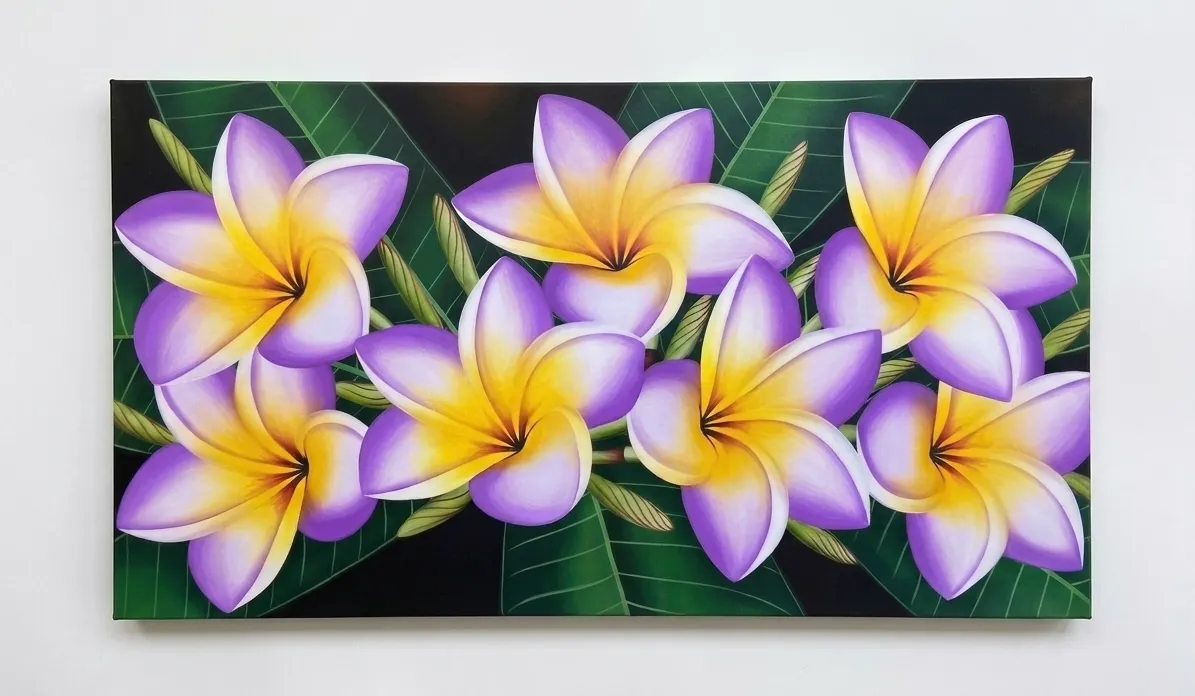
Where the white frangipani grows untended throughout every temple compound in Bali, the purple variety is a cultivated flower — it requires specific conditions, deliberate attention, a choice to grow something that would not arrive on its own. This distinction carries through into how the two flowers are experienced: the white jepun arrives with the quality of something inevitable, ancient, always-already present; the purple jepun feels chosen, specific, a statement of aesthetic intention.
This large unframed canvas presents nine purple blooms across a deep dark ground, rendered in smooth airbrush technique that achieves an almost photographic precision before it reveals itself, on closer inspection, to be entirely painterly. The petals carry gradient — lavender shifting toward deep purple at the petal base, yellow at the throat, white at the petal tip. The black background is not a backdrop. It is the space from which these flowers emerge, and it gives the painting the quality of something lit from within rather than illuminated from outside. Displayed without a frame, the painting has an openness that suits large contemporary interiors.
“The purple frangipani is rare enough in Bali that when you see one in a garden, you remember it. This painter understood that. The painting has the quality of a flower worth remembering.”
— Putu Sucipta, Arts of BaliFlower Bouquet Oil Painting — European Still Life Tradition Reinterpreted in Bali
The tradition of flower painting as an independent subject in Western art originates in the 17th-century Dutch and Flemish schools, where bouquets were assembled from reference drawings — botanically impossible arrangements that combined flowers from different seasons into a single painted moment of impossible perfection. Those paintings were about wealth, transience, and the virtuosity of rendering. When that tradition arrives in Bali and enters the hands of artists whose cultural formation comes from a completely different relationship to flowers — one of devotion and daily ritual rather than display — it changes.
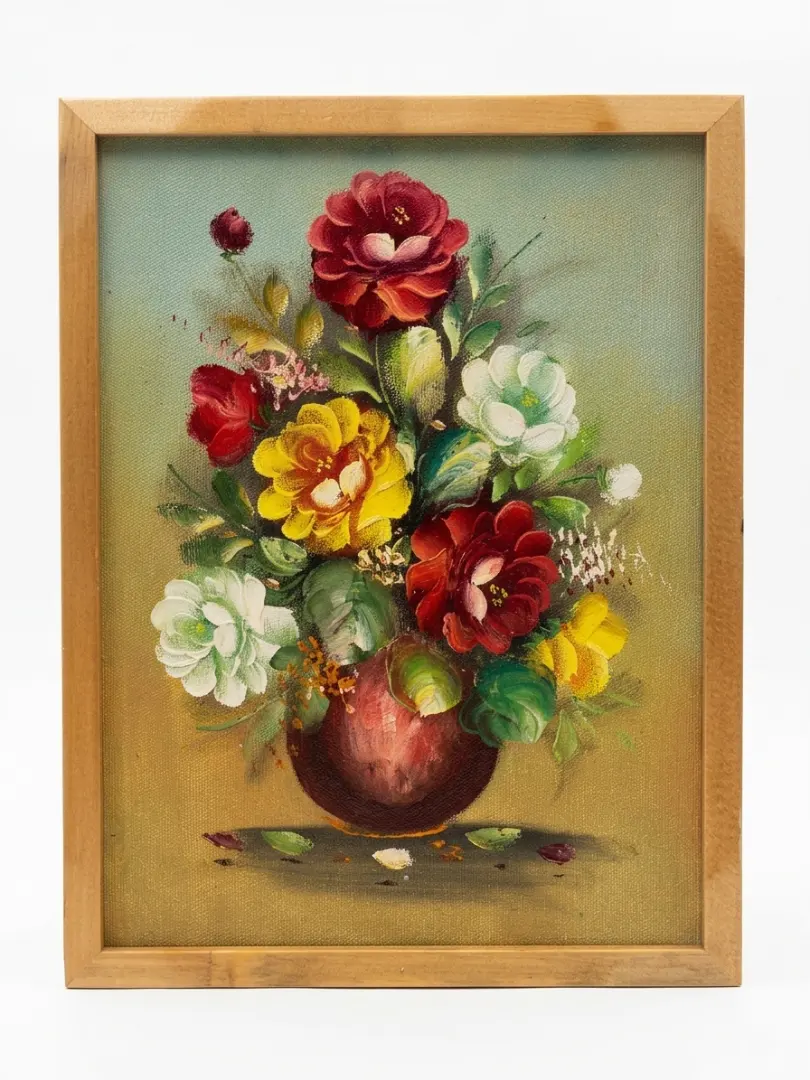
This bouquet is rendered in rich, traditional oil technique: dark vase, warm ochre ground, strong directional light that creates clear shadows and luminous highlights on the outermost petals. The roses are crimson, yellow, and white — a palette chosen for its tonal range as much as its symbolic content. Roses carry colour meaning in Western floriculture (red for love, yellow for friendship, white for purity) that Balinese audiences read with interest alongside their own botanical symbolism.
The natural wood frame is understated and correct. It holds the painting without competing with it, and will suit any wall that welcomes warmth.
“A good still life is still alive — the flowers are not dead in it, they are paused. This painting has that quality.”
— Putu Sucipta, Arts of BaliPalette Knife Sunflower Painting — Original Work by Alzen
Palette knife painting is not forgiving. Where a brush allows return and revision — softening an edge, blending a transition, correcting a tone — the palette knife places paint in a single committed action and leaves it. The mark that remains is the mark that was made. There is no ambiguity between intention and execution.
Working in palette knife impasto requires the artist to have already made every decision before touching the canvas. This is a demanding way to paint. It produces, when it works, a surface with a physical presence that no other technique can achieve: the paint has height, texture, directional energy, shadow cast by itself.
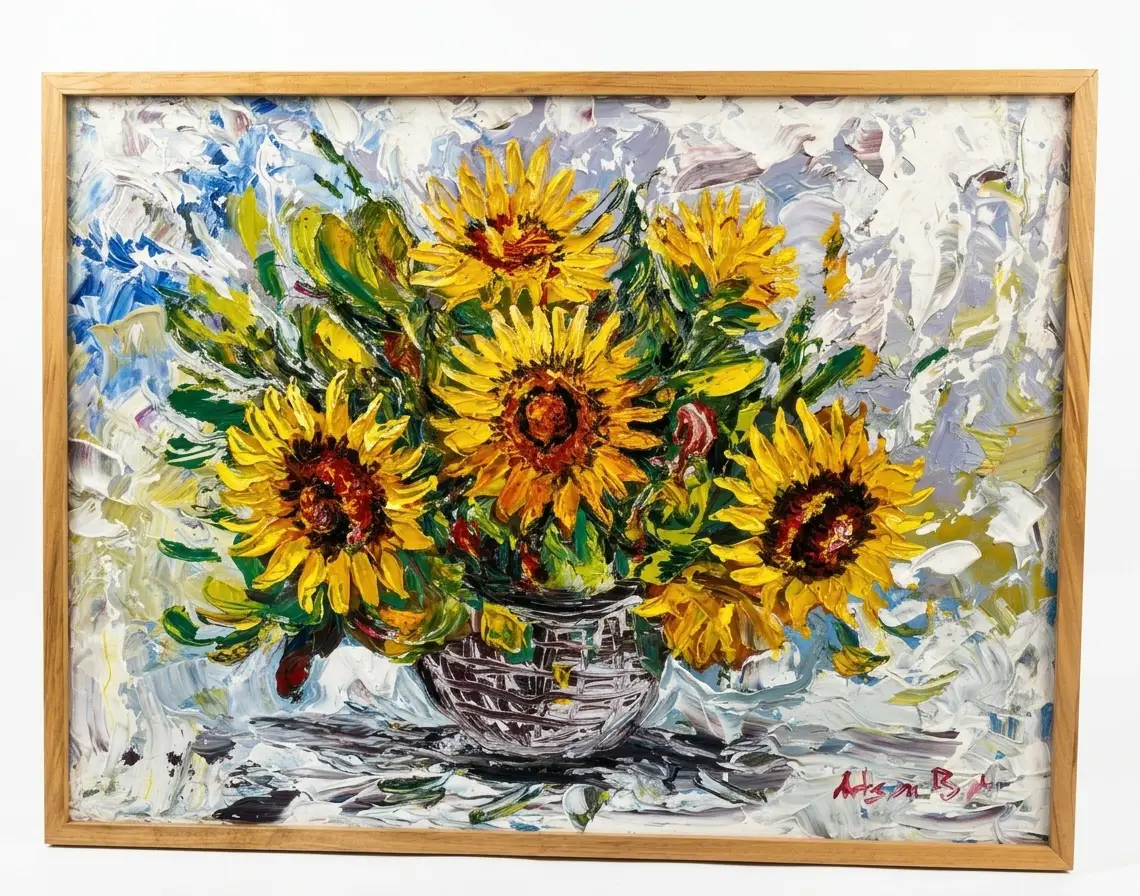
Alzen’s sunflowers demonstrate what that commitment looks like when it is made well. The blooms are rendered in warm ochres, golden yellows, and deep terra cottas; the centres in dense brown and black that anchor the composition; the stems and foliage in energetic greens laid in thick horizontal strokes that give the lower portion of the painting movement. The sunflower is a heliotropic plant — it follows the sun across the sky. There is something appropriate about painting it in a technique that demands the artist follow through without retreat. Signed works by named Balinese artists carry collectible value beyond their decorative quality: they belong to a specific maker, a specific moment of execution, a specific set of decisions made once and held.
“Alzen paints like someone who has already made up his mind. The palette knife does not allow second thoughts — only commitment. That is what gives his sunflowers their energy.”
— Putu Sucipta, Arts of BaliSculptural Relief Flower Painting — The Work That Resists Easy Description
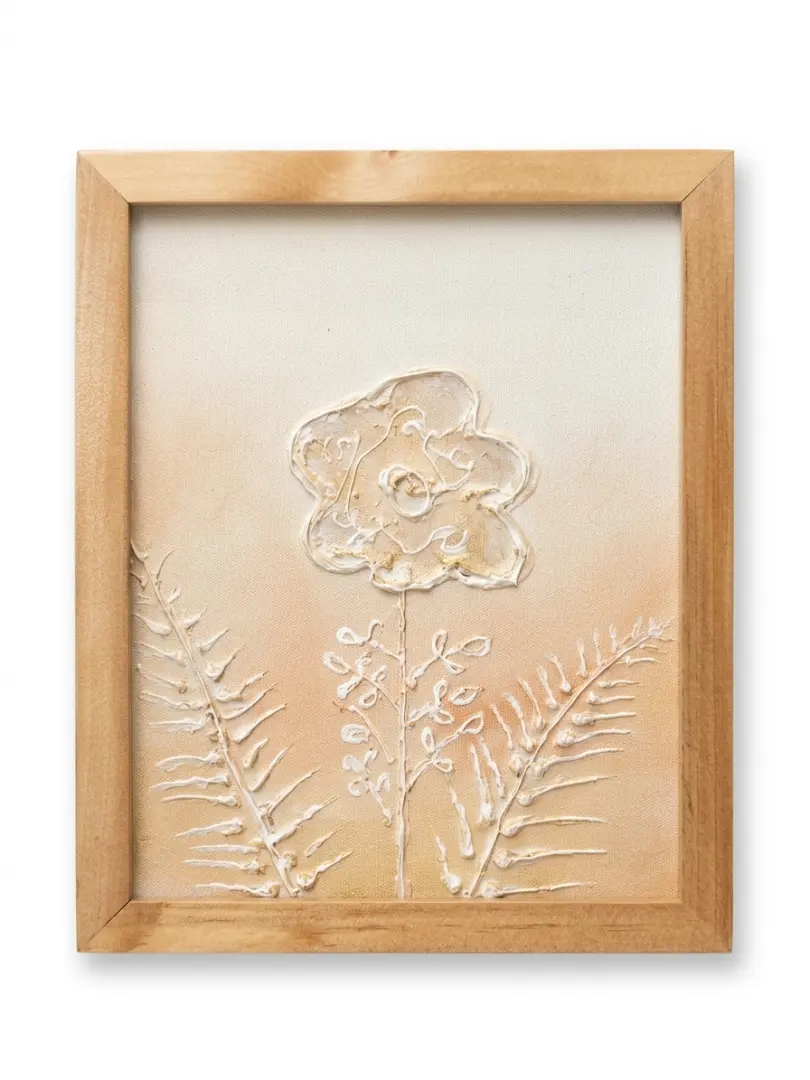
Of the six works in this collection, this one most resists a single description — not because it is obscure, but because it occupies a category most people do not have a ready word for. It is not quite a painting. It is not quite a sculpture.
It is a textured relief: the flower built up from the canvas surface in raised cream material that catches light differently depending on the angle of viewing. The botanical elements to either side — fern fronds in the same cream, delicate and precise — anchor the bloom in something that reads as garden but feels as minimal as stone.
This technique connects to a tradition that Bali understands well: the carved stone and sandstone reliefs on temple walls throughout Ubud, Gianyar, and the older compounds of Denpasar, where floral and botanical forms are the primary decorative vocabulary of sacred architecture. The artist here has taken that architectural approach and applied it to the domestic scale, producing something that changes with the light of the room. In morning sun it will look different from how it looks under evening lamp. Collectors who find that most paintings look the same regardless of conditions will find this one genuinely responsive to its environment.
“This is the piece I show to collectors who say they already have too many paintings. It is not, technically speaking, a painting.”
— Putu Sucipta, Arts of BaliPalette Knife Poppy Field Painting — Original Work by Farfan, 2026
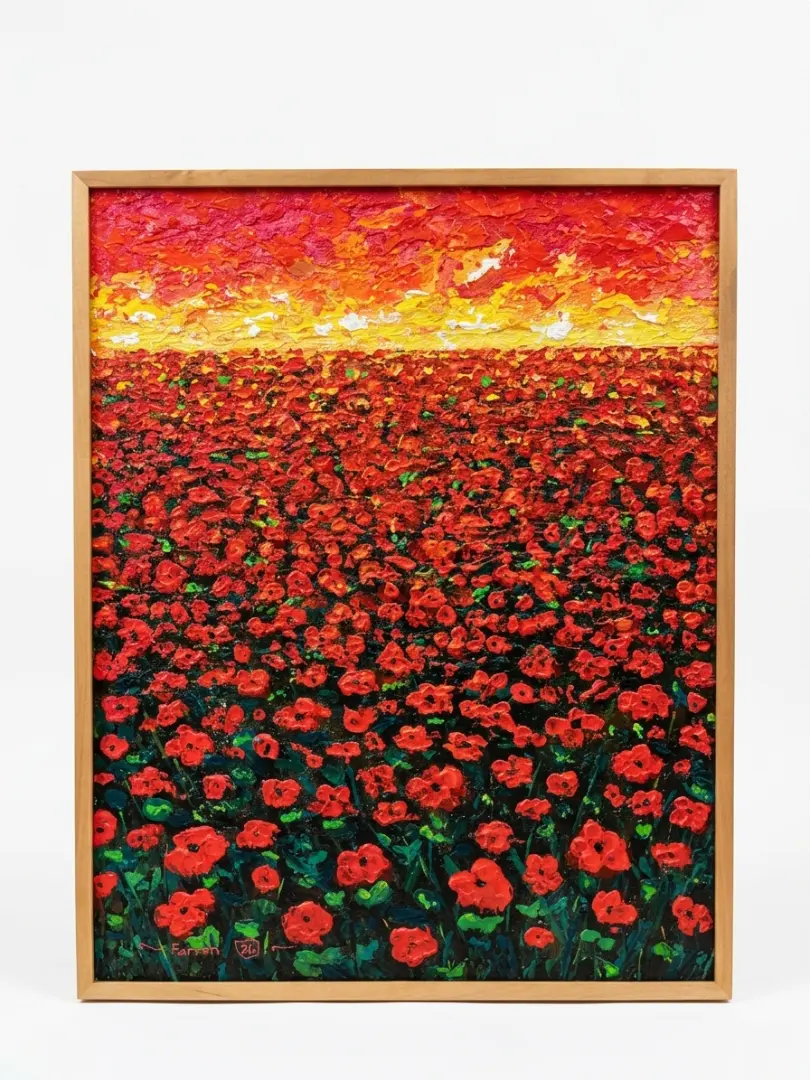
Farfan’s poppy field is an accumulation. Red upon red upon red — each palette knife mark containing the memory of the previous one, the surface building in layers that have physical depth as well as visual depth. The field does not extend to the horizon in any realistic sense; the composition is tight, almost claustrophobic in its density of blooms, the orange and gold sky pressing down from above while the red presses upward from below. Between those two forces the painting creates a band of intense colour energy that holds the eye in a state of productive tension.
The poppy is not a Balinese flower — it arrived in the island’s artistic vocabulary through European influence, through artists trained in post-Impressionist traditions who understood what Van Gogh and Monet found in the field. What a Balinese artist does with the subject is to bring to it the colour intensity of the tropical palette and the physical commitment of the palette knife technique: the result is a poppy field that is simultaneously recognisable as belonging to a European genre and completely native to the island that produced it. Signed and dated 2026, this is a contemporary work from an active Balinese artist. It will not become more available over time.
“Red in Bali is not the same red as anywhere else. The light here does something to warm colour that you cannot describe until you have lived with it. Farfan’s painting has that red.”
— Putu Sucipta, Arts of BaliA Collector’s Guide to Flower Painting from Bali
What to Look For: Technique, Subject, and Scale
Flower paintings from Bali span a wider technical range than collectors often expect. The most common distinction is between smooth technique (airbrush or fine brush, photorealistic finish) and textured technique (palette knife impasto, with physical paint surface). Smooth works integrate more easily into minimal or contemporary interiors. Textured works carry more physical presence and tend to dominate a wall rather than sit within it — a meaningful difference for rooms that already have strong architectural character.
Subject carries meaning in Bali specifically. Frangipani — any variety — signals direct connection to Balinese Hindu devotional tradition. Lotus signals spiritual elevation and is associated with Brahma and Saraswati. Sunflowers and poppies represent the contemporary Balinese artist’s engagement with international painterly tradition. Collectors seeking work with the deepest local resonance will typically find it in frangipani paintings. Collectors seeking work that demonstrates Balinese artists’ breadth within global art history will find it in the sunflower and poppy tradition.
Signed vs. Unsigned: What Provenance Adds
Two of the six paintings in this collection — Alzen’s sunflowers and Farfan’s 2026 poppy field — are signed. A signed work by a named artist carries collectible value that extends beyond its decorative quality: it belongs to a specific maker, a specific moment, a specific set of decisions that can be traced and documented. For collectors building a collection with long-term value in mind, signed contemporary works by active Balinese artists are worth prioritising. Prices for unsigned works from the same gallery reflect quality of execution rather than artist reputation, and often represent better value per square centimetre of painting.
Caring for Tropical Floral Paintings
Oil paintings on canvas: avoid direct sunlight, which fades pigment over time; keep away from high humidity and rapid temperature changes, which stress canvas and cause micro-cracking in paint layers. Hang on interior walls rather than exterior-facing walls where temperature variation is higher. Palette knife impasto works are particularly susceptible to impact — the raised paint surface can chip if struck. All works leave Arts of Bali in protective packaging appropriate for international air freight.
Three Botanical Moods: How to Choose the Right Painting for Your Space
For Stillness and Contemplation
The white frangipani and the sculptural relief flower both carry a quality of quiet that suits spaces intended for reflection — a home study, a bedroom, an entryway that sets the tone for the interior. These are paintings that reward looking at rather than glancing past. They do not demand attention loudly. They hold it gently, for a long time.
For Energy and Vitality
Farfan’s poppy field and Alzen’s sunflowers are paintings that change the temperature of a room. They carry the heat and saturation of the Balinese palette expressed through physical impasto technique — the paint has volume, the colours have intensity. These works suit living spaces, dining rooms, or any interior where the goal is activation rather than calm.
For Classic Elegance
The classical rose bouquet and the purple frangipani canvas both speak to a tradition of painting that is immediately legible across cultures: recognisable subject matter, accomplished technique, the kind of work that communicates confidence and connoisseurship without requiring explanation. These are paintings that integrate into sophisticated international interiors without asserting their origin.
Frequently Asked Questions
What is the significance of the frangipani flower in Balinese culture?
The frangipani (jepun) is Bali’s most sacred botanical symbol — placed in every daily canang sari offering, worn in ceremonies, and present in every temple compound. In Balinese Hindu cosmology, the white variety corresponds to the deity Iswara and represents purity and spiritual intention. It blooms from ancient bare wood, which Balinese tradition reads as a metaphor for devotion producing beauty without material explanation.
Why does the Arts of Bali logo feature a frangipani?
The frangipani was chosen for the Arts of Bali logo because it embodies the gallery’s purpose: creating beauty as an act of devotion rather than transaction. The flower grows from bare wood without apparent nourishment, producing extraordinary blooms as if it cannot help itself — a close description of what authentic artists do. It also connects directly to Balinese Hindu spiritual life, grounding the gallery in the island’s deepest cultural identity.
What is palette knife painting and how is it different from brush painting?
Palette knife painting applies paint with a flexible metal blade rather than a brush. Each stroke deposits thick impasto paint in a single committed action that cannot be blended or revised — resulting in a textured, three-dimensional surface with visible ridges and directional marks. The finish is physically different from brush painting: you can feel the topography of a palette knife canvas. Both Alzen and Farfan use this technique in their works at Arts of Bali.
Are the flower paintings at Arts of Bali originals or prints?
All flower paintings at Arts of Bali are original works — painted by hand, one of a kind, with no reproductions or print editions made. Signed works by Alzen and Farfan include the artist’s signature and, in Farfan’s case, the year of completion. Provenance documentation is available for all works on request.
Can I order a custom flower painting from Arts of Bali?
Yes. Arts of Bali works with Balinese artists on commission for collectors who want a specific subject, palette, scale, or technique. Common commissions include frangipani paintings in sizes suited to specific walls, and palette knife flower works in custom colour schemes. Lead time is typically three to six weeks depending on the artist and complexity. Contact via WhatsApp to discuss requirements.
How are paintings shipped internationally from Bali?
Arts of Bali ships paintings internationally using specialist art packaging: rolled canvas works are tube-shipped in protective crating; framed works are wrapped in acid-free tissue, foam-padded, and crated for air freight. Insurance and customs documentation are included. Delivery typically takes seven to fourteen days to most international destinations. Full shipping cost is confirmed at point of inquiry based on destination and painting dimensions.
What is the price range for original flower paintings at Arts of Bali?
Prices vary by size, technique, and whether the work is signed by a named artist. Smaller original works begin at accessible price points for collectors new to Balinese art; large-format or signed works by established artists carry higher valuations consistent with the international market for original Southeast Asian contemporary painting. Current pricing is available directly via WhatsApp or in-gallery visit at Seminyak.
Inquire About These Paintings
All six paintings are available for purchase and international shipping from Arts of Bali in Seminyak. Contact Putu Sucipta directly for pricing, dimensions, custom commissions, and shipping quotes.
Chat on WhatsApp Browse the Full Gallery