“Every painter in Bali eventually returns to the rice field. Not because it is easy to paint. Because it is impossible to leave behind.”
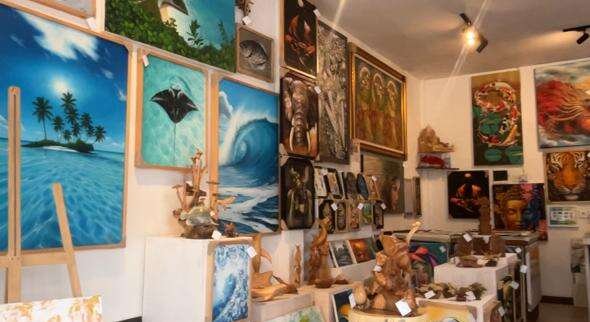
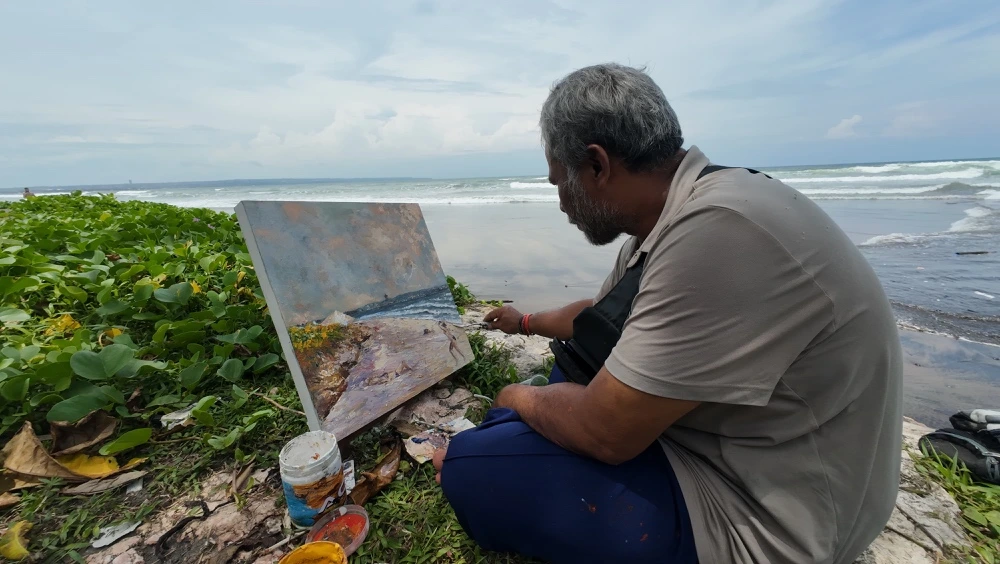
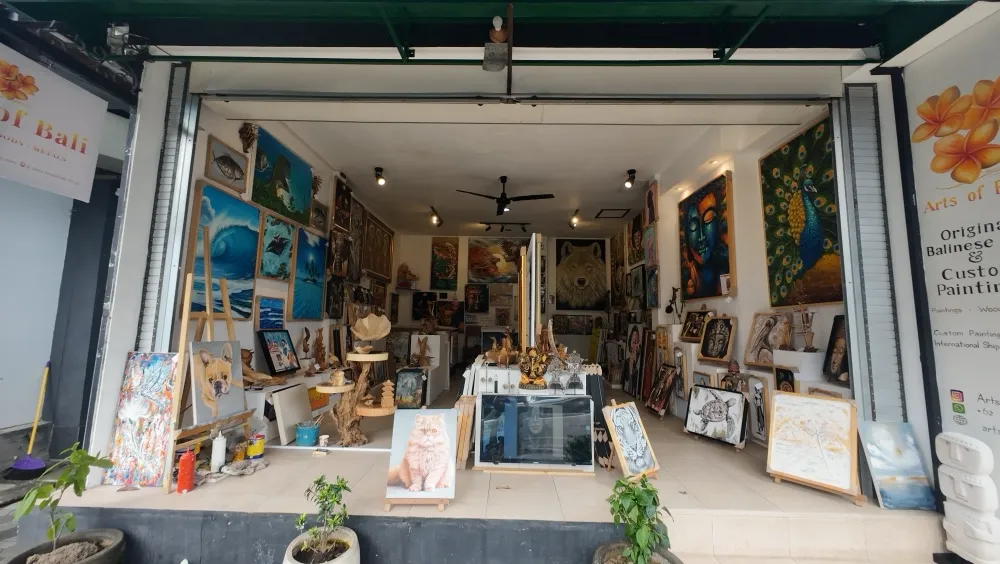
There is no more honest subject in Bali rice field painting than the sawah itself. Not the tourist version — the swing-and-Instagram terrace at golden hour — but the actual field: water-dark soil, bent figures under wide hats, the geometry of hand-cut terraces that have held their shape since the ninth century. The collection of Bali landscape paintings at Arts of Bali in Seminyak shows how artists have returned to this subject generation after generation, in styles that range from the figurative precision of a landscape painter to the thick impasto of a palette knife, because the rice field does not exhaust itself as a subject. It deepens.
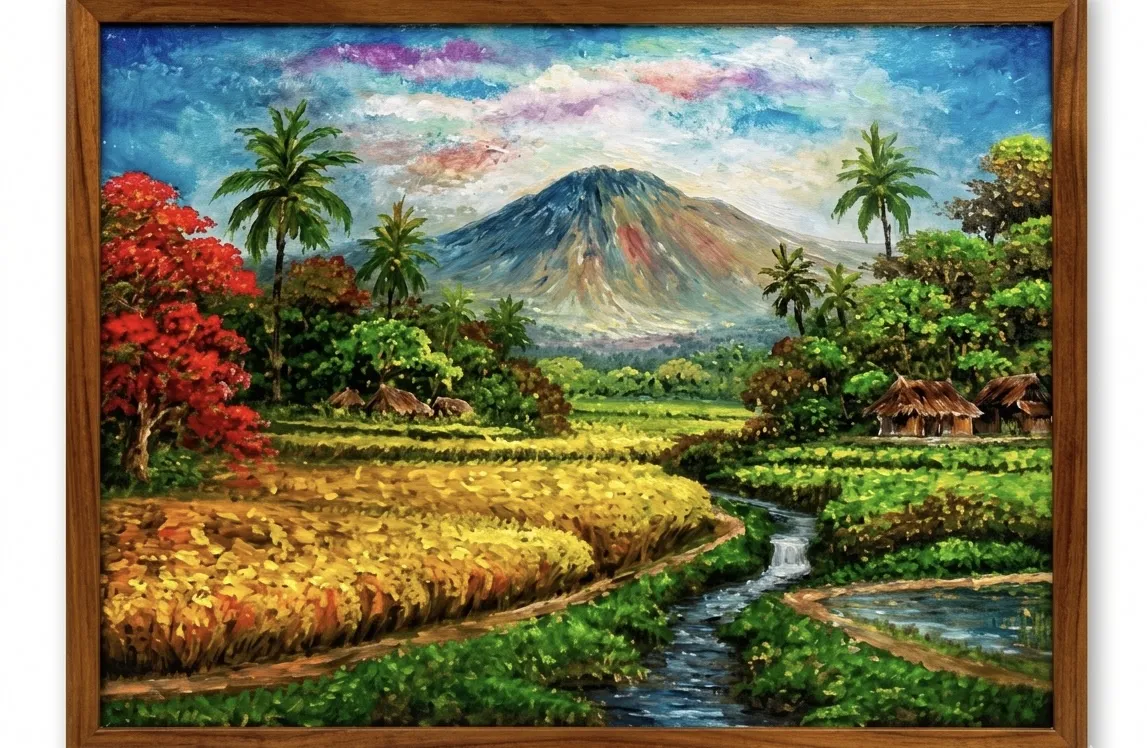
Why Bali Rice Field Painting Has Never Gone Out of Style
The rice terraces of Bali are not scenery. They are a civilisation. UNESCO recognised the Subak system of Bali’s rice fields as a World Heritage cultural landscape in 2012, acknowledging what the island’s farmers and temple priests have understood for a thousand years: that the sawah is not simply agricultural land but a living expression of the Balinese philosophy of Tri Hita Karana, the harmonious relationship between people, nature, and the divine. Water flows from sacred mountain springs through a network of temples, canals, and weirs down to the paddies, guided not by centralised authority but by the cooperative management of local subak groups who have maintained this system since at least the ninth century.
For painters, that layered history is not background information. It is the subject itself. A Bali rice field painting that knows this carries something that a generic landscape cannot: the sense that the field you are looking at is not accidental. Every terrace was cut by hand. Every water channel was agreed upon by a community. Every planting season begins with a ceremony to Dewi Sri, the goddess of rice and harvest, whose presence is believed to run through the fields as surely as the irrigation water does. When a painter records this landscape, they are not painting nature. They are painting culture that has taken the shape of nature.
“The rice terrace of Bali is not a landscape. It is a thousand years of human decision, held in water and earth.”
The Landscape and the Figure: Two Ways to Paint the Bali Rice Field
Painters who work with the rice field as their primary subject tend to divide into two camps, and both are well represented in the Arts of Bali collection. The first is the landscape approach: the wide view, the terrace as geography, the play of morning or afternoon light across the stepped green planes. The second is the figurative approach: the field worker rather than the field, the human presence that gives the landscape its scale and its meaning.
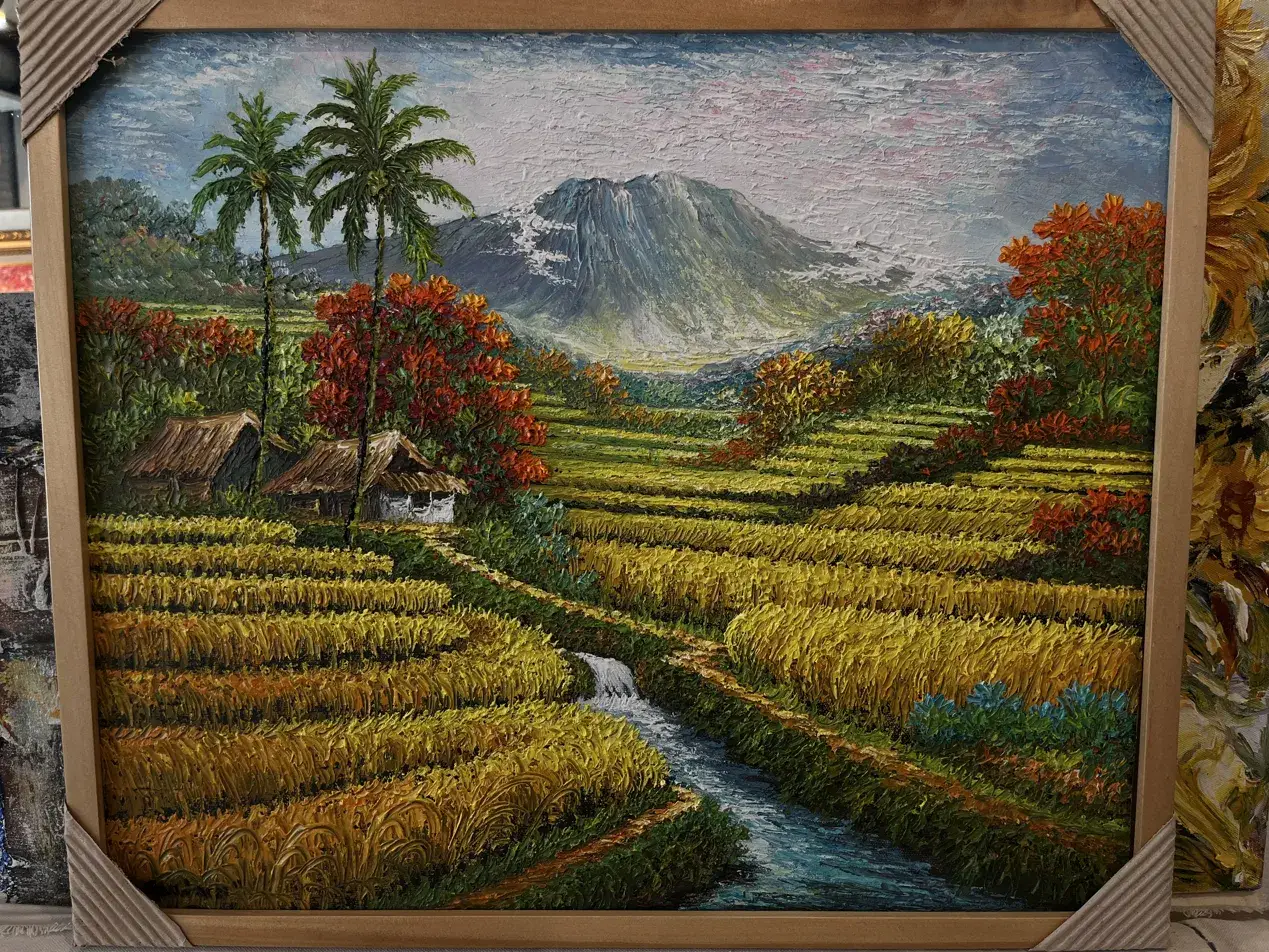
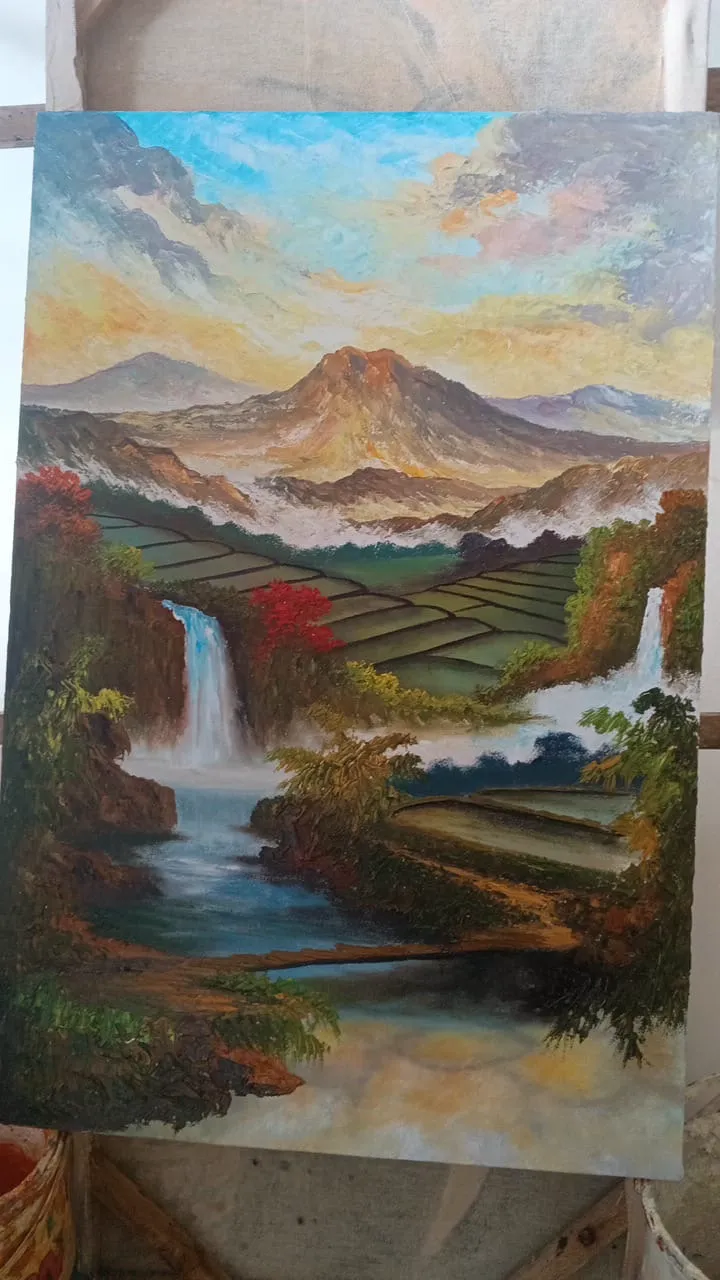
The landscape painters work with light as their primary instrument. The Tegalalang terraces north of Ubud catch morning sun on their western faces and fall into shadow by midday. The Jatiluwih terraces in Tabanan, broader and more gentle in their gradient, hold a softer quality of light that suits a more contemplative style of painting. Both locations have drawn artists for generations, and both appear in our collection of original Balinese art in versions ranging from intimate small-canvas studies to large-format works that carry the full panoramic quality of the view from the ridge.
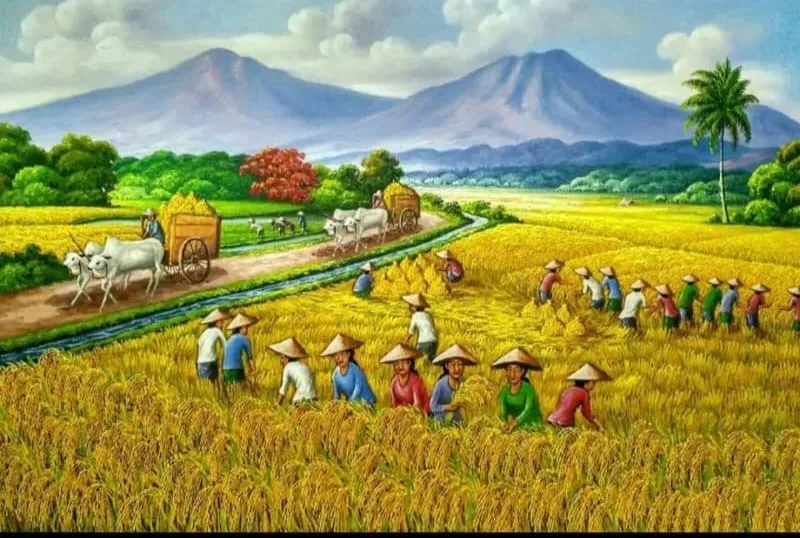
The figurative painters work differently. They are less concerned with the sweep of the landscape than with what the landscape is doing to the people inside it. A figure bent at the waist, knee-deep in flooded paddy water, hat angled against the sun, is not a romantic image of agricultural life. It is a record of labour that has not changed in a thousand years. The rice field workers painted in impasto grey and gold by Upeksa at Arts of Bali carry exactly this quality: not picturesque labour but actual weight.
What Separates an Authentic Bali Rice Field Painting from a Generic Landscape
The Bali rice field is one of the most painted subjects in Southeast Asian art, which means the market contains a wide range of quality. Understanding what makes one rice field painting significantly better than another is not complicated, but it requires knowing what to look for.
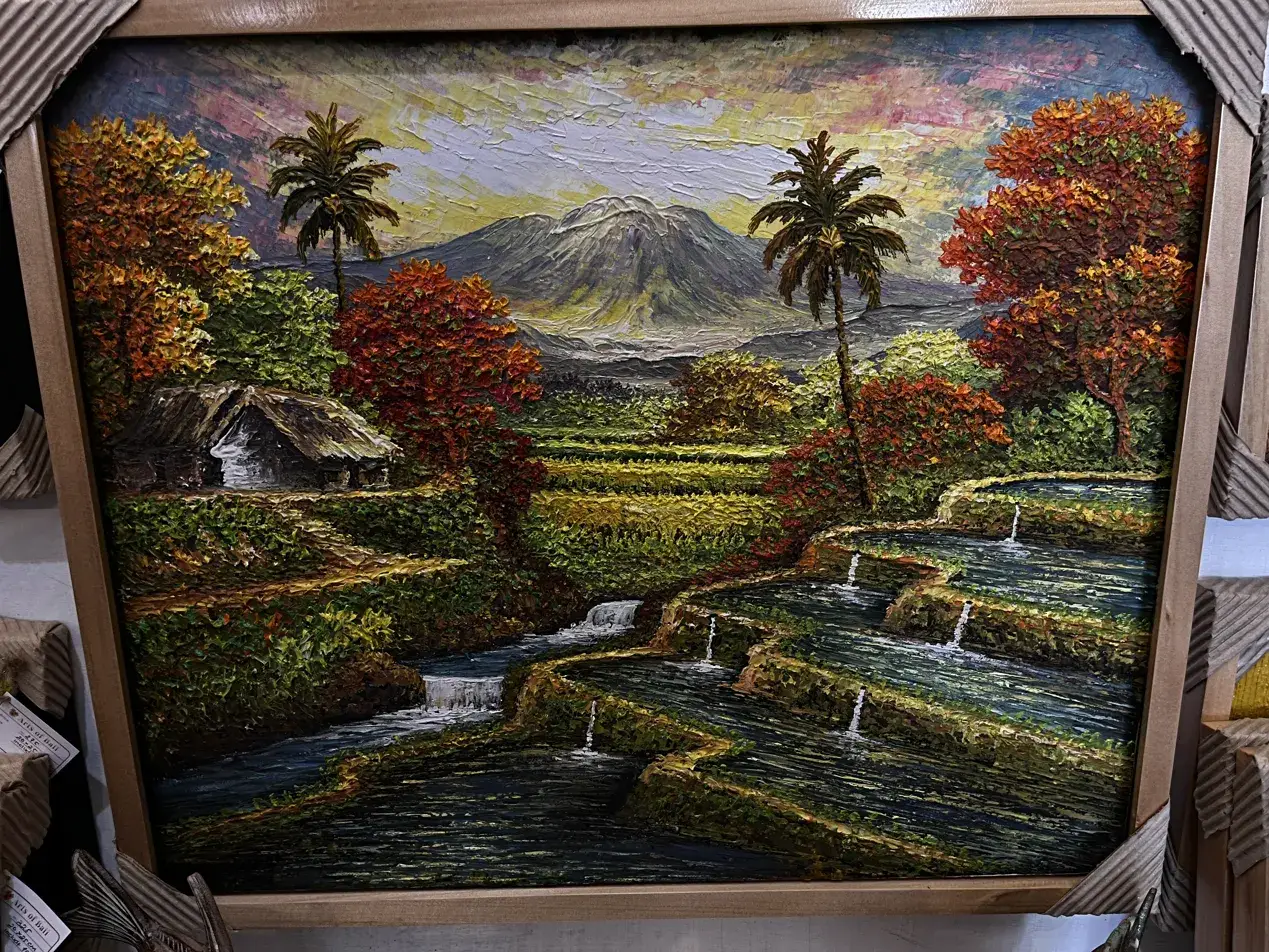
The most reliable indicator is specificity. A rice field painting that could be anywhere in tropical Asia is not a Bali rice field painting. The genuine article contains details that are particular to this island and its agricultural system: the precise angle of a terrace cut into a volcanic hillside, the presence of a small water temple at the field’s edge, the palm and banana trees that mark the boundary between cultivation and forest, the particular quality of Bali’s wet-season green that sits between emerald and jade in a way that tropical photographs rarely reproduce faithfully.
“A Bali rice field painting that could be set in Thailand or Java is not a Bali rice field painting. The island writes itself into the landscape if you look long enough.”
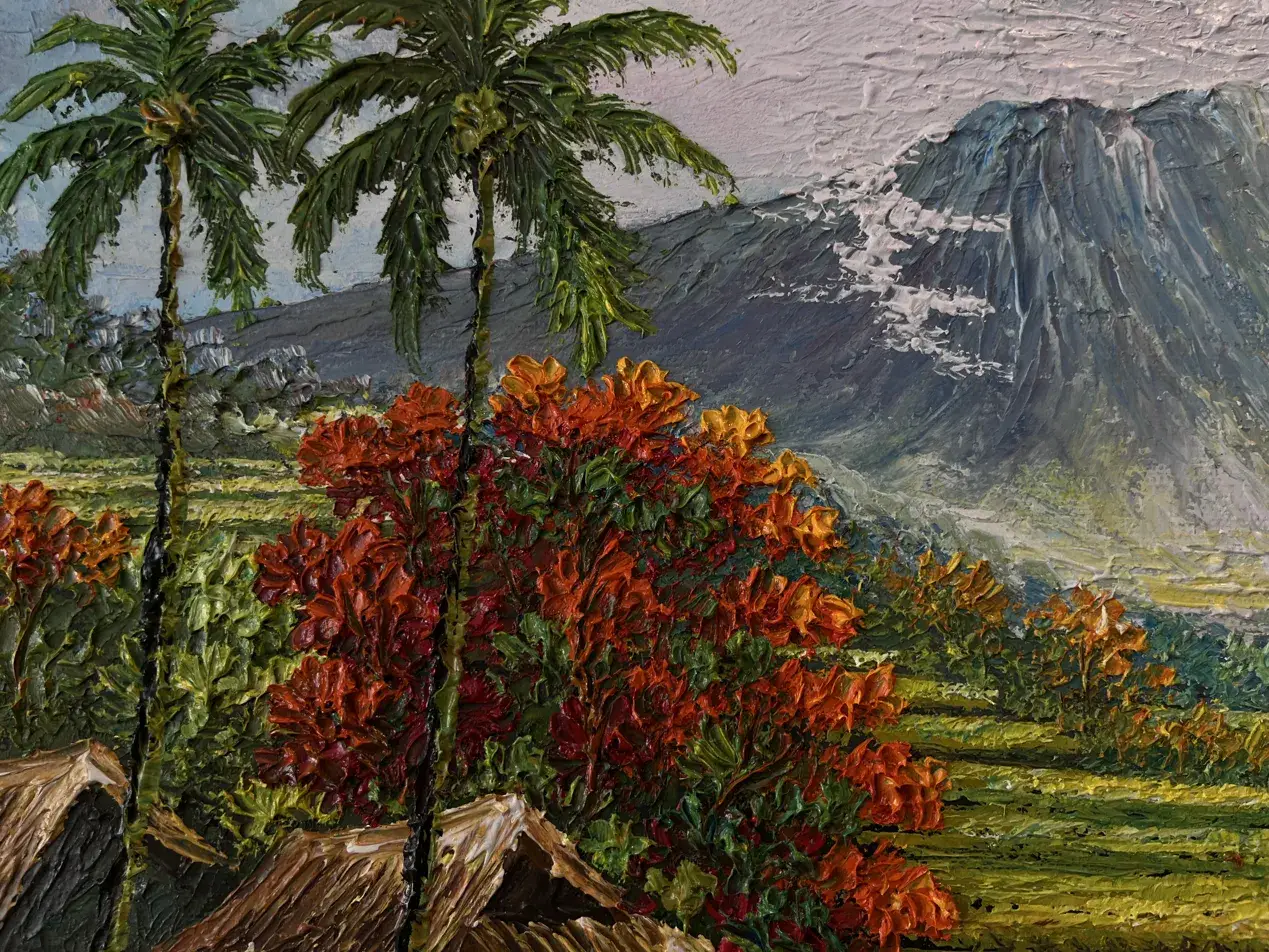
The second indicator is the painter’s relationship to the light. Bali’s rice fields change colour dramatically across the day and across the growing season. Early morning at Tegalalang has a blue-green quality that disappears entirely by eleven. The harvest season turns the terraces from green to gold in a matter of weeks. A painter who has spent real time in the fields will make a painting that holds a specific time of day and a specific season. That specificity is what makes the painting feel true rather than generic.
Bringing a Bali Rice Field Painting Home: What Collectors Ask Most
Practical Guide for Visitors Considering a Rice Field Painting
- Size and the wall it will hang on. Rice field paintings work differently at different scales. A small canvas, 40x50cm or similar, holds the terrace as an intimate detail. A large canvas, 80cm wide or more, holds the full panoramic quality of the view. Before choosing, think about which wall in your home you are painting for.
- Oil or acrylic. The Arts of Bali collection includes rice field paintings in both oil and acrylic. Oil paint has greater depth and a slower surface quality that suits the contemplative character of the subject. Acrylic dries faster and travels more easily. Both are archival when properly varnished.
- Framed or rolled. Larger canvases can be removed from their stretcher frames, rolled, and packed into a tube for international travel. This is a well-established practice that protects the canvas and avoids the baggage difficulties that a large framed work creates. The gallery team can advise on the best option for your destination.
- International shipping. If you prefer to collect your painting after returning home, the gallery ships rice field paintings worldwide. Each work is photographed, documented, and carefully packed before dispatch.
- Custom commissions. Through the Arts of Bali custom painting service, it is possible to commission a rice field painting to a specific size, colour palette, time of day, or location within Bali. Visitors who have a particular terrace in mind from their travels can bring a photograph and discuss the commission with the team directly.
The Rice Field That Stays With You After Bali
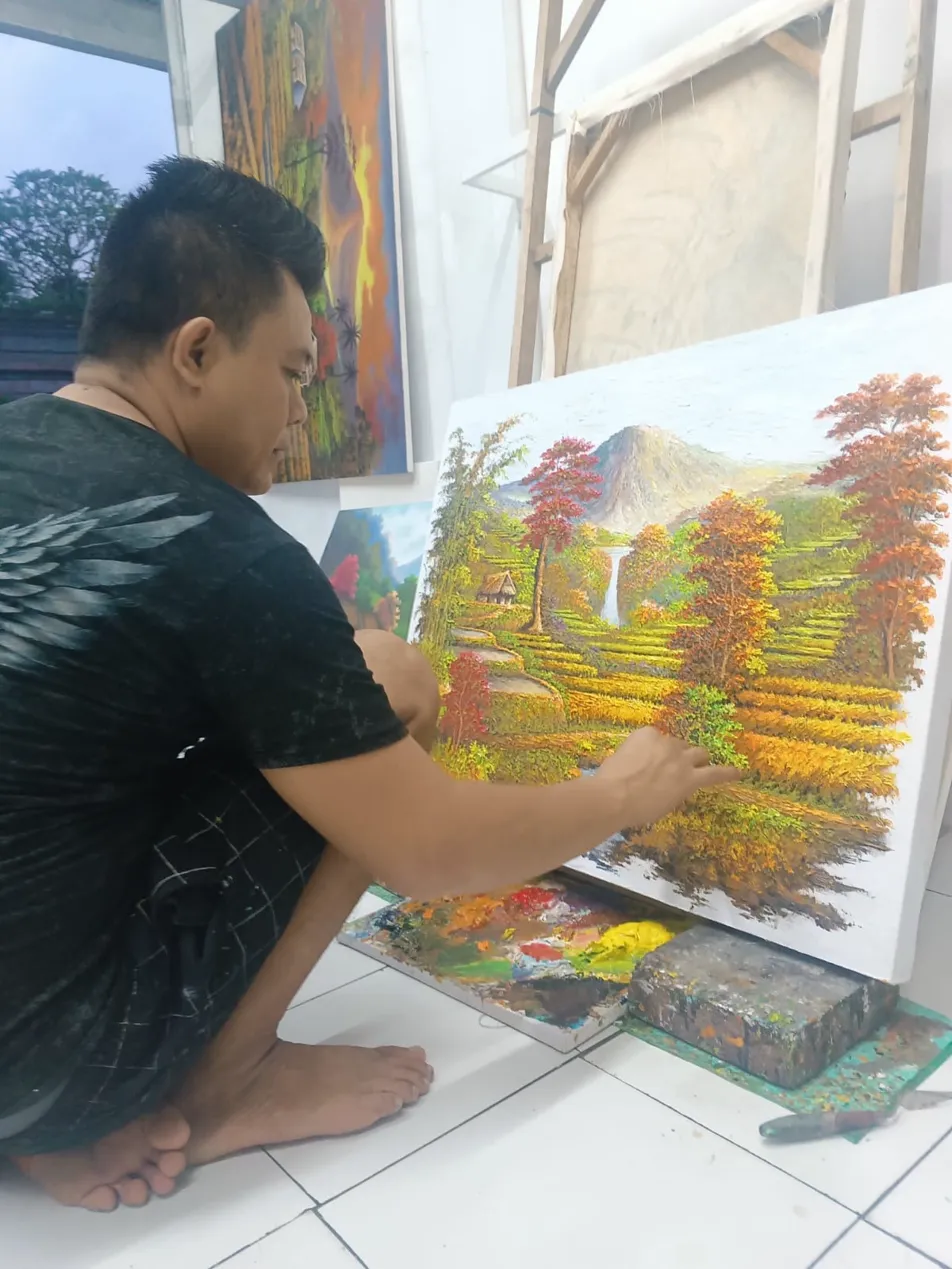
Most visitors to Bali photograph the rice terraces. The image stays on a phone, scrolled past eventually, outcompeted by the thousands of other photographs the trip produced. A Bali rice field painting, made by hand and specific to this landscape, does something else. It occupies a wall. It changes with the light in the room it hangs in. It is looked at every morning and every evening by whoever lives with it, and it carries none of the digital flatness that a photograph inevitably has.
The depth and continuity of Bali’s artistic tradition is documented across generations of painters who return to genuinely inexhaustible subjects. Whether it is capturing the ancient geometry of the sawah or the graceful movement of a Balinese dancer painting, this dedication is what makes a work from this island worth bringing home. The rice field, specifically, is a subject that has sustained a thousand years of actual human life on this island. A painting that holds that subject faithfully holds something of that life inside it. That is not a small thing to put on a wall.
The rice field paintings at Arts de Bali on Jalan Raya Seminyak No. 42 are available for viewing seven days a week. The collection spans landscape and figurative styles, multiple scales, and a range of techniques. The gallery team is happy to discuss which work suits your space and how it can travel home with you.
Visit Arts of Bali in Seminyak to see the rice field painting collection in person. Original works available for immediate purchase or custom commission.
View the Collection Commission a Painting