“Certaines œuvres d'art sont accrochées au mur et décorent une pièce. La peinture de Kamasan entre dans une pièce et la change. Vous la ressentez avant de la comprendre.”
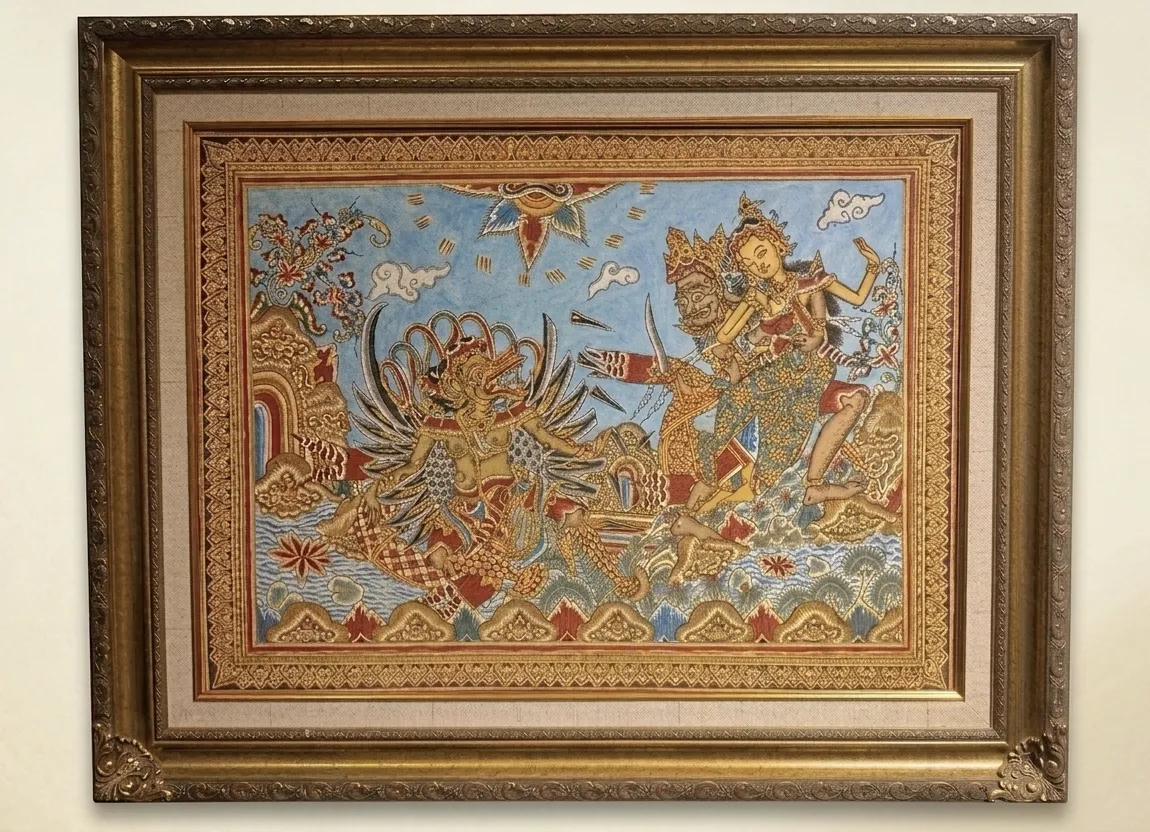
Il y a un petit village à l'est de Bali qui s'appelle Kamasan. Il se trouve tranquillement à côté de l'ancienne capitale royale de Klungkung, et n'est pas remarquable depuis la route si vous ne savez pas quoi chercher. Mais si vous pénétrez dans l'une de ses enceintes familiales, vous découvrirez des artistes en train de travailler sur un produit qui est fabriqué dans ce village depuis avant le XVIe siècle. Peinture Kamasan Bali est la plus ancienne tradition picturale vivante de l'île, la racine à partir de laquelle tous les autres styles de peinture balinais se sont développés, et elle reste plus vivante et plus belle que la plupart des gens en dehors de Bali ne le pensent.
Au Arts de Bali, Nous nous approvisionnons en peintures Kamasan authentiques directement auprès des maîtres artistes du village de Klungkung. Ce guide couvre tout ce dont vous avez besoin pour comprendre, apprécier et collectionner cette forme extraordinaire de peinture. peinture traditionnelle balinaise.
Qu'est-ce que le Kamasan Painting Bali ?
Peinture Kamasan Bali est un style de peinture traditionnelle en deux dimensions qui provient exclusivement du village de Kamasan dans la régence de Klungkung, à l'est de Bali. Ce style est également connu sous le nom de peinture de style wayang ou seni lukis klasik Bali, Les marionnettes de l'exposition ont été créées à partir d'un modèle de marionnettes d'ombre balinaises, le wayang kulit, dont les figures sont directement inspirées des personnages plats et de profil.
Tous les styles de peinture traditionnelle que l'on observe aujourd'hui à Bali sont issus de cette source unique. Le style Ubud, le style Batuan, le mouvement des jeunes artistes - tous sont des réponses, des départs ou des évolutions du langage visuel que le village de Kamasan a été le premier à établir. Pour comprendre Peinture Kamasan Bali est de comprendre où commence l'art balinais.
Contrairement à l'art contemporain où l'expression individuelle est la règle, Peinture traditionnelle balinaise Kamasan suit un ensemble de règles codifiées appelées uger-uger. Ces règles déterminent comment chaque figure est dessinée, quelles couleurs représentent quel rang social ou cosmique, comment la composition est structurée et quelles histoires sacrées peuvent être représentées. Le respect de ces règles n'est pas une contrainte pour l'artiste kamasan. C'est la discipline qui donne tout son sens à l'œuvre.
“La clé du sens de la beauté de la peinture kamasane réside dans la fluidité des lignes et la pureté de la figuration plane - un art où rien ne se détache ouvertement, et où pourtant tout se voit.” - Adrian Vickers, professeur d'études sur l'Asie du Sud-Est, Université de Sydney
En 2015, le gouvernement indonésien a officiellement inscrit la peinture wayang de Kamasan au patrimoine culturel immatériel. Elle a ensuite été soumise à l'UNESCO en vue d'une reconnaissance internationale en 2018 et 2022. Et dans le cadre d'un autre développement historique, Peinture Kamasan Bali est devenu le premier style de peinture en Indonésie à recevoir le statut d'indication géographique, ce qui signifie que seules les peintures produites dans le village de Kamasan selon des méthodes traditionnelles peuvent légalement porter le nom de Kamasan. Pour en savoir plus, consultez le site Ministère indonésien du tourisme et de l'économie créative.
Mille ans de peinture Kamasan à Bali
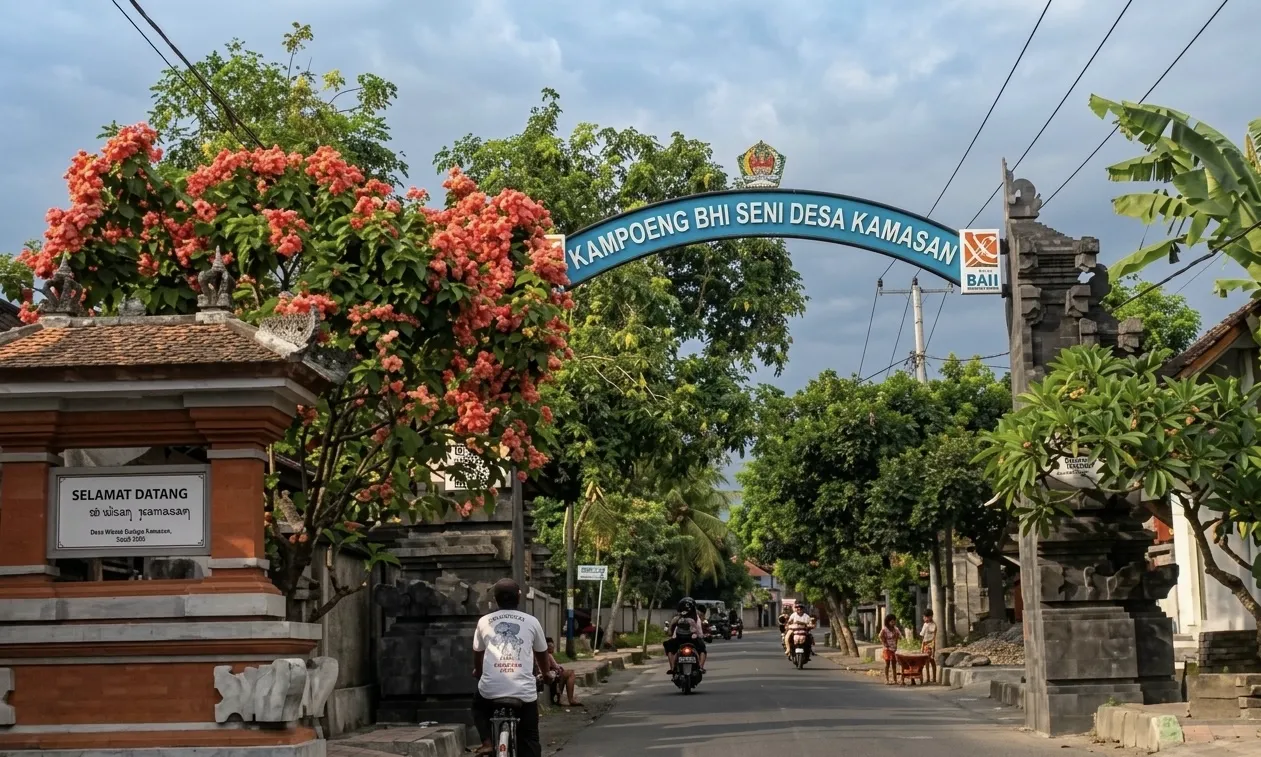
Le nom de Kamasan apparaît dans les documents historiques balinais dès 1072 après J.-C., sous le règne du roi Anak Wungsu. La tradition picturale telle que nous la connaissons aujourd'hui s'est développée sous l'influence de l'empire Majapahit, dont les artistes ont apporté leur langage visuel à Bali à la fin du XIIIe siècle. Au XVIe siècle, sous le règne du grand roi Klungkung, Dalem Waturenggong, Peinture Kamasan Bali était devenue l'expression artistique définitive des cours royales de l'île.
Pendant des siècles, les artistes de Kamasan ont travaillé exclusivement à l'invitation des rajas balinais, produisant des peintures qui ornaient les murs des palais, les plafonds des temples et les pavillons de cérémonie. Leurs œuvres n'étaient jamais signées. Une peinture Kamasan était une offrande communautaire, faite par le village au divin, le maître artiste guidant la composition tandis que les apprentis aidaient à la mise en couleur. Article de Wikipédia sur Kamasan documente cette histoire avec des détails utiles.
Le XVIIIe siècle a vu naître l'une des figures les plus célèbres de la tradition : Gede Marsadi, un peintre kamasan d'un talent si exceptionnel que le roi de Klungkung l'appela “Mudara”, du nom du personnage légendaire qu'il représenta dans une peinture wayang. Cette œuvre était si impressionnante que le roi a gardé le nom pour toujours. Dans le village de Kamasan, les descendants de ces artistes de la cour royale pratiquent toujours l'art du wayang. peinture traditionnelle balinaise Kamasan Aujourd'hui, ils forment leurs enfants aux mêmes techniques transmises depuis des dizaines de générations.
Kertha Gosa et le plus grand plafond Kamasan existant
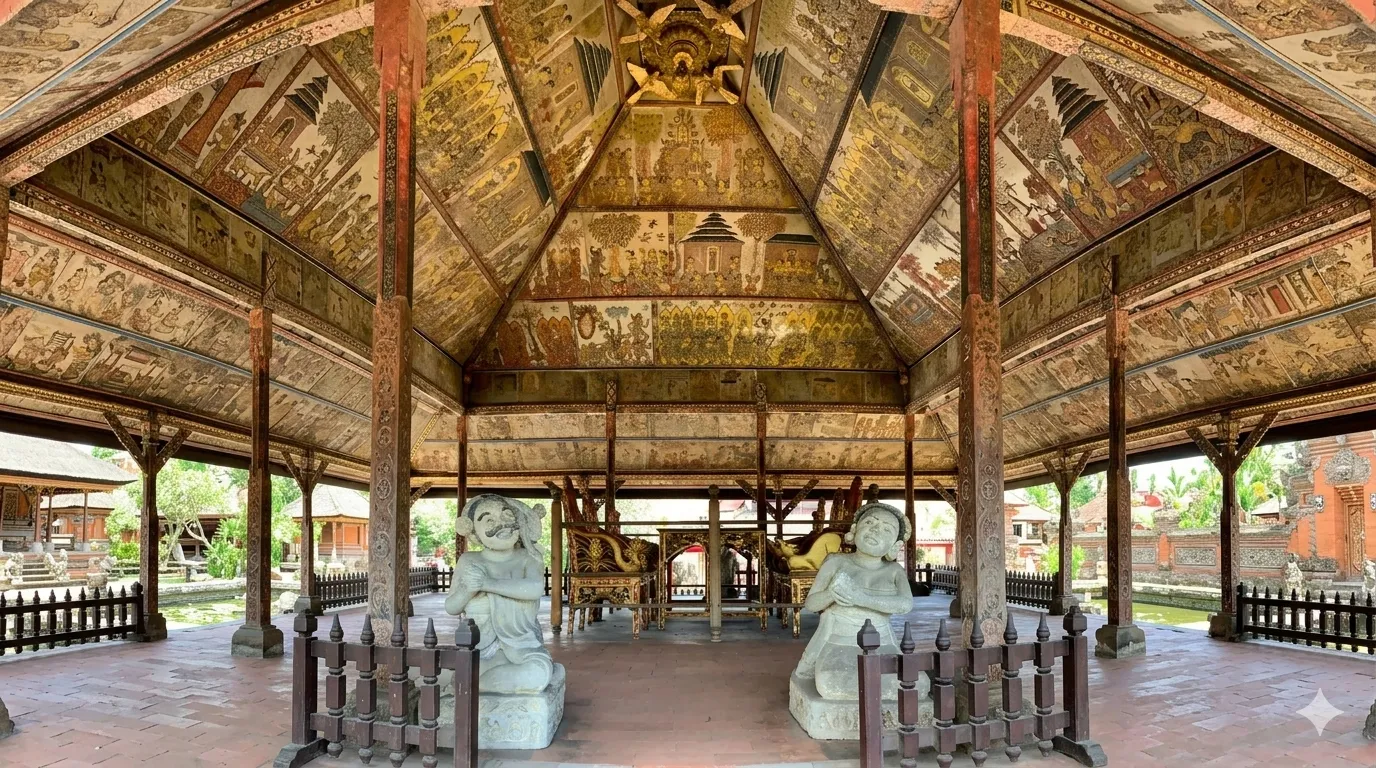
L'affichage unique le plus puissant de Peinture Kamasan Bali Le plafond de Kertha Gosa, à Semarapura, Klungkung, est l'un des plus beaux au monde. Construit au début du 18e siècle comme salle de justice du royaume de Klungkung, ce pavillon ouvert a tout son plafond rempli de peinture traditionnelle balinaise représentant des scènes de la Bhima Swarga qui suit le guerrier-héros Bhima dans son voyage à travers le monde souterrain pour sauver les âmes de ses parents.
Le choix du sujet était délibéré. Les juges siégeant sous ces panneaux étaient entourés de représentations graphiques des conséquences qui attendent ceux qui commettent des actes injustes dans cette vie. Les Peintures Kamasan Bali à Kertha Gosa fonctionnent à la fois comme de l'art sacré et de l'architecture civique, renforçant la compréhension balinaise selon laquelle la loi, la religion et l'expression artistique ne sont pas des domaines distincts.
Pour en savoir plus sur l'histoire de Kertha Gosa, consultez le site suivant Documentation de Google Arts et Culture sur le style Kamasan en partenariat avec le musée ARMA. Pour tous ceux qui visitent Bali et qui veulent comprendre ce qu'est la vie à Bali, le musée de l'ARMA. Peinture Kamasan atteint à sa plus grande échelle, Kertha Gosa est indispensable.
Fabrication d'un tableau Kamasan Bali
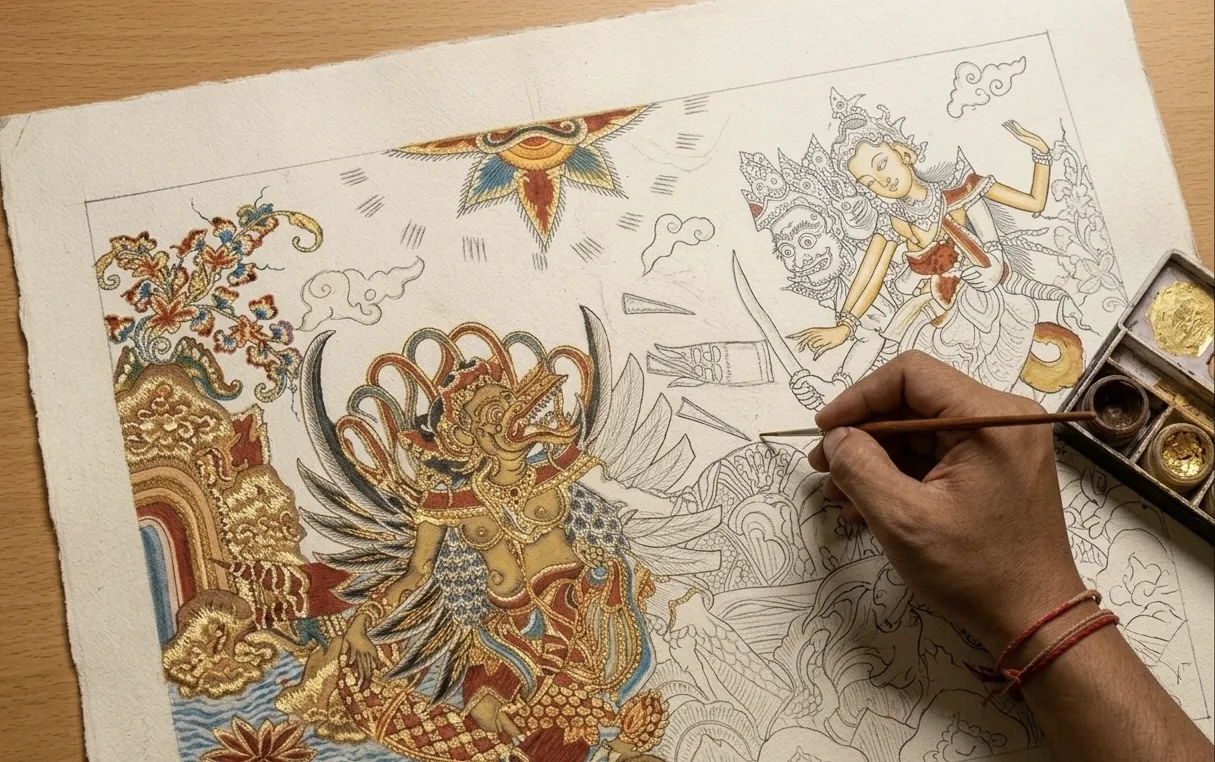
Créer un environnement authentique Peinture Kamasan Bali est un travail lent. Une seule grande composition peut prendre plusieurs semaines. Ce rythme fait partie de l'objectif. L'artiste kamasan n'est pas en train de courir vers l'achèvement. Il est en conversation avec l'histoire qu'il dépeint, avec les règles iconographiques qu'il suit et avec les générations d'artistes qui ont fait les mêmes gestes avant lui.
- Préparation de la toile Un tissu de coton grossier est tendu sur un cadre en bois et enduit à plusieurs reprises d'une pâte composée de farine de riz bouillie, d'eau et de colle naturelle. Chaque couche est laissée à sécher, puis lissée à la main jusqu'à ce que la surface soit ferme et uniforme. Ce tissu préparé est appelé kain kanvas tradisional et joue un rôle essentiel dans la longévité des peintures authentiques de Kamasan.
- Mise en place de la composition Le maître esquisse la scène complète au crayon léger, en travaillant de mémoire et à partir des règles iconographiques de l'art. Peinture traditionnelle balinaise Kamasan. Il n'y a pas de photographie de référence. Chaque placement de figure, chaque geste, chaque disposition spatiale suit une grammaire visuelle accumulée au fil des siècles.
- Dessiner les contours De fins contours à l'encre noire sont appliqués à l'aide d'un pinceau en poils. C'est le moment le plus marquant de l'histoire de la Peinture Kamasan Bali. La ligne noire, fluide et assurée, est ce qui distingue un maître d'un apprenti, et elle ne peut être corrigée une fois appliquée sur le tissu préparé.
- Application d'une couleur naturelle La couleur remplit chaque forme dans des champs purs et plats, sans ombrage ni perspective atmosphérique. Les figures existent dans un espace sacré et intemporel plutôt que dans un espace naturaliste. Cette convention visuelle n'est pas primitive mais intentionnelle. Elle place l'histoire en dehors du temps ordinaire.
- Finition à la feuille d'or La feuille d'or véritable ou la poudre d'or mélangée à un liant naturel est appliquée en dernier lieu sur les coiffes, les bijoux et les attributs divins. Cette dernière étape transforme les Peinture Kamasan d'une image narrative à quelque chose qui fonctionne comme une offrande en soi.
Des pigments naturels qui n'ont pas changé depuis des siècles
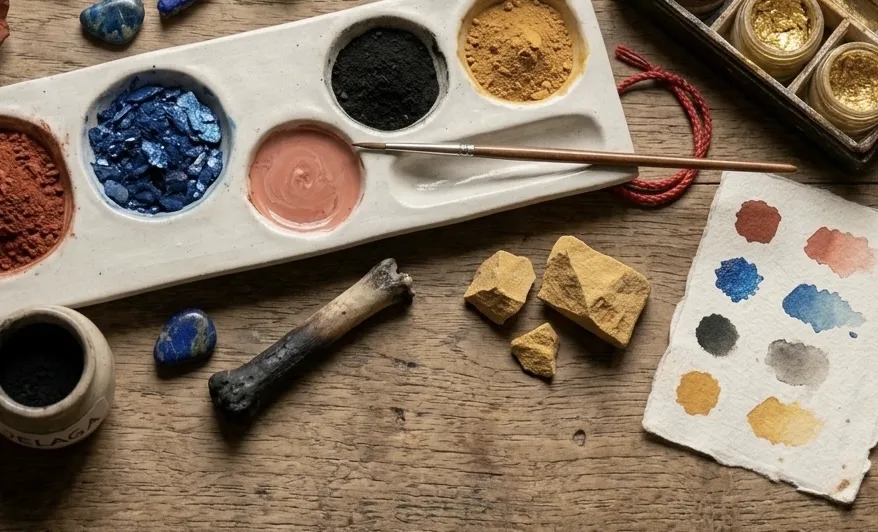
L'une des choses qui rend Peinture Kamasan Bali L'insistance sur les matériaux naturels est l'une des caractéristiques les plus remarquables des traditions artistiques mondiales. La palette des peinture authentique de Kamasan n'est pas choisi uniquement en fonction de l'effet visuel. Chaque matériau est porteur de sens, et la préparation des pigments fait elle-même partie de la pratique rituelle qui entoure l'œuvre.
Ces matériaux naturels produisent des couleurs que les peintures synthétiques peinent à reproduire. Les bleus ont de la profondeur. Les ocres sont chauds et vivants. Et comme les pigments sont d'origine minérale et végétale plutôt que synthétique, ils restent stables pendant des siècles dans des conditions appropriées. Qualité musée Peintures Kamasan Bali du début du 20e siècle conservent encore aujourd'hui leur éclat d'origine, ce qui constitue un témoignage remarquable de la durabilité de ces matériaux traditionnels.
Apprendre à lire un tableau Kamasan Bali
Une peinture Kamasan Bali complète dans son cadre doré. Le motif de la bordure est lui-même un élément sacré, et non un simple encadrement décoratif.
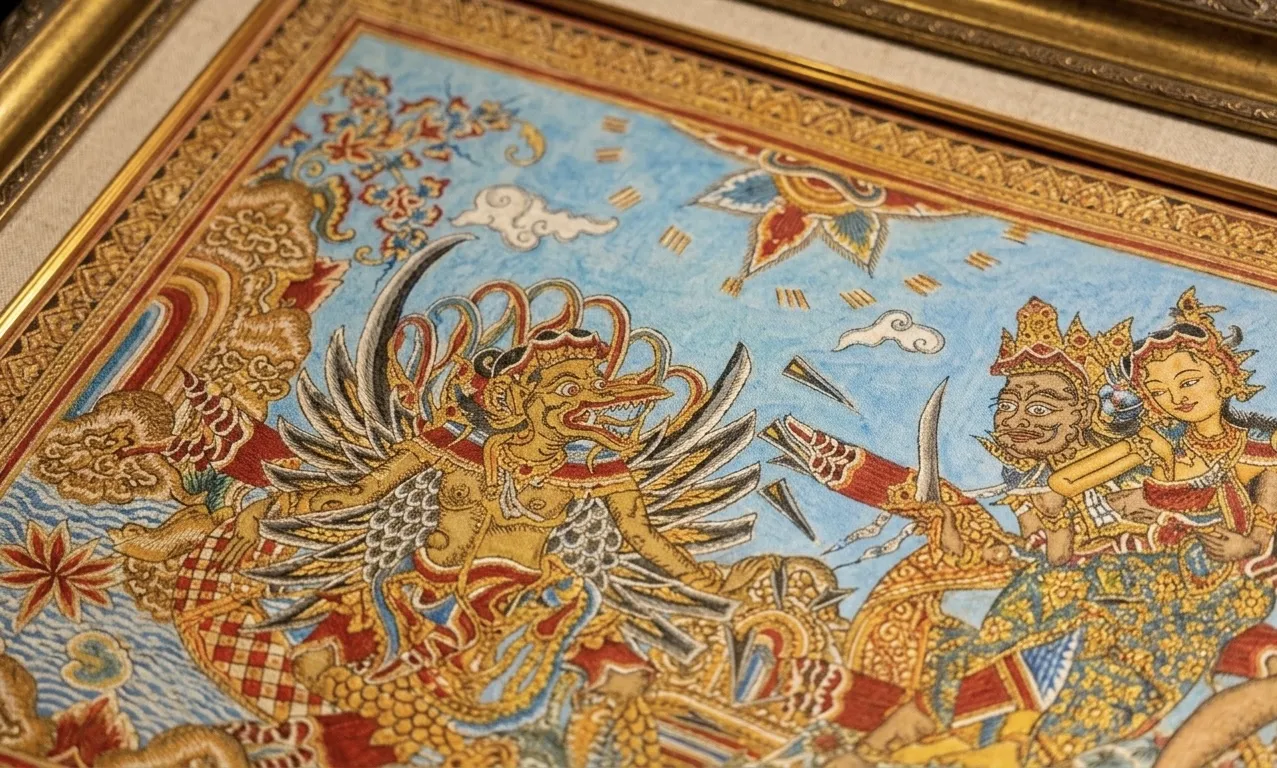
Détail en gros plan de la même peinture Kamasan Bali. À cette échelle, le travail individuel au pinceau des plumes de Garuda et les accents dorés de Prada deviennent visibles.
Pour un premier spectateur, Peinture Kamasan Bali peut sembler écrasante. La toile est dense. Les figures se chevauchent. Chaque centimètre est porteur d'informations visuelles. Il ne s'agit pas d'un échec de la composition. C'est le reflet exact de la manière dont les Balinais conçoivent les récits sacrés : de multiples histoires simultanées se déroulant dans un espace partagé, à la manière d'un dalang (maître des ombres) anime tout un cosmos derrière un seul écran.
Les trois zones cosmiques
Royaume supérieur - Swah Loka
Dieux, êtres célestes et symboles divins. Les figures ont la peau claire, des traits raffinés et des couronnes d'or élaborées. Elles occupent les panneaux supérieurs de chaque composition.
Royaume du milieu - Bwah Loka
Rois, guerriers et héros des grandes épopées. Rama, Arjuna, Bhima. Ces personnages sont représentés de profil, dans une posture élégante, selon des règles précises de gestuelle et de costume.
Royaume inférieur - Bhur Loka
Démons, ogres et antagonistes terrestres. Teintes de peau plus sombres, corps exagérés, expressions féroces. Leur rôle dans la composition ancre la leçon morale que porte le tableau.
Lire un Peinture Kamasan Bali signifie reconnaître ces zones, identifier les personnages qui s'y trouvent et comprendre quel épisode de quelle épopée sacrée est représenté. Les récits les plus souvent illustrés sont le Ramayana, le Mahabharata, le Sutasoma et le Bhima Swarga. Pour les visiteurs de Bali qui ont assisté à un wayang kulit ou assisté à une danse du feu Kecak, nombre de ces personnages vous seront déjà familiers.
Pourquoi la peinture Kamasan de Bali mérite-t-elle d'être collectionnée ?
La majorité des peintures vendues sur les marchés d'art de Bali sont des reproductions réalisées rapidement pour la consommation des touristes. Elles sont attrayantes mais pas significatives, décoratives mais pas durables. Un tableau authentique Peinture Kamasan Bali est tout le contraire. Sa fabrication est lente, son origine spécifique, sa tradition intacte depuis des siècles, et elle est protégée par une Indication Géographique qu'aucun autre style de peinture balinaise ne possède.
Le nombre de véritables maîtres kamasans diminuant de génération en génération, la pénurie de produits de qualité authentique s'accentue. peinture traditionnelle balinaise de Klungkung ne fera qu'augmenter. Les collectionneurs qui acquièrent aujourd'hui des œuvres authentiques font l'acquisition d'un produit qui deviendra de plus en plus difficile à trouver à ce niveau de qualité au cours des prochaines décennies.
Il y a aussi la question de l'effet de la peinture sur la pièce. A Peinture Kamasan Bali ne disparaît pas dans un mur. Elle attire l'attention, invite à une lecture attentive et change de caractère en fonction des variations de la lumière au cours de la journée. Les pigments naturels sur un tissu préparé réagissent à la lumière différemment de la peinture synthétique sur une toile commerciale. L'œuvre est vivante comme ne le sont jamais les reproductions.
Authentique peinture Kamasan Bali dans notre galerie
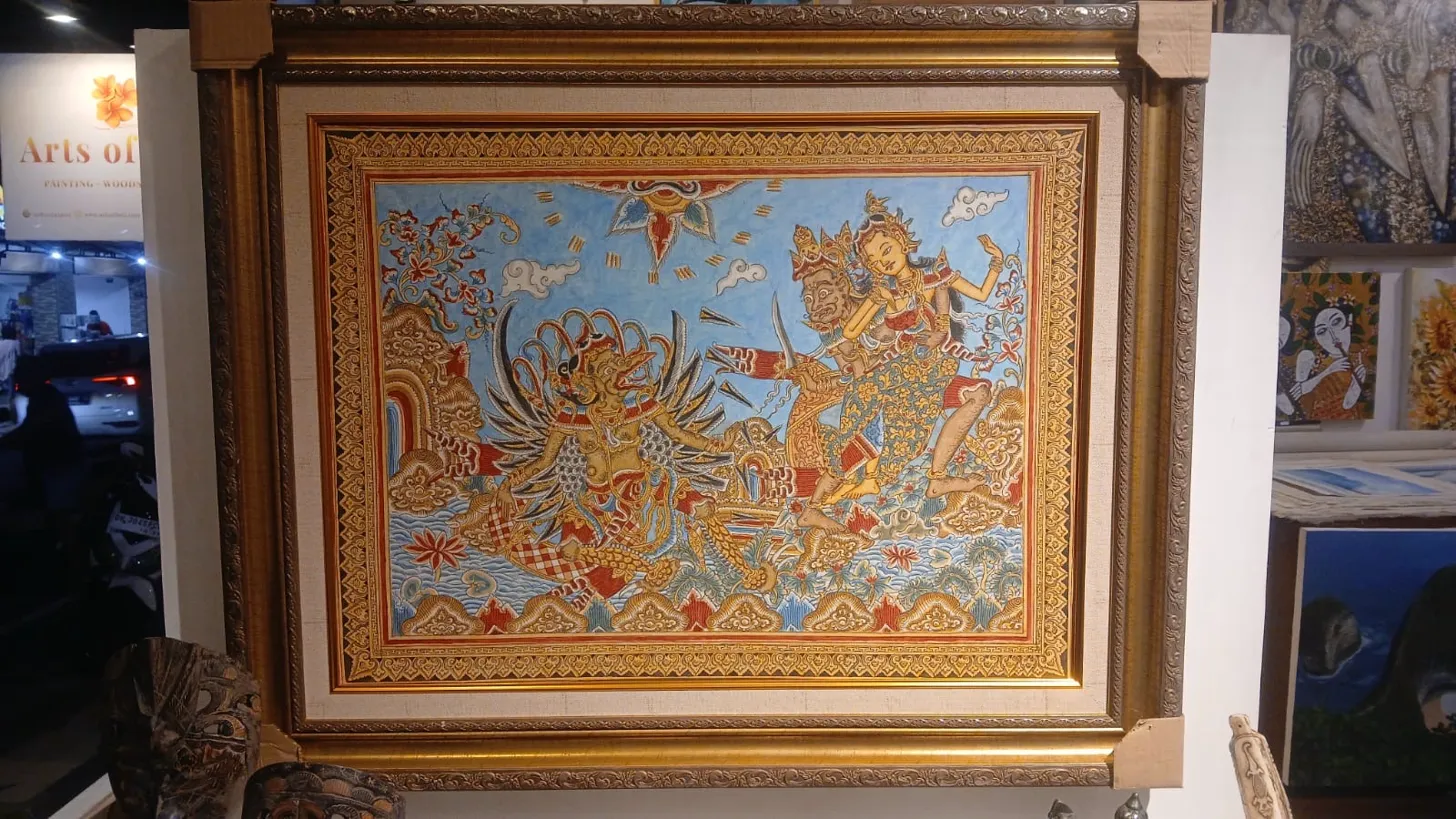
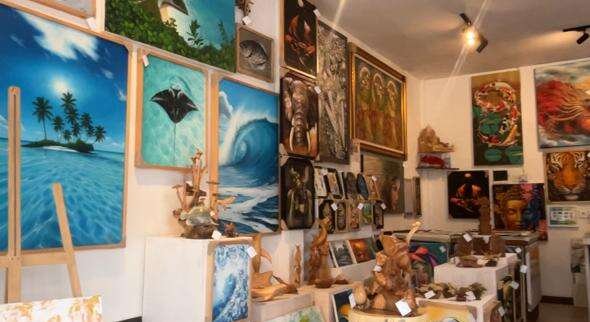
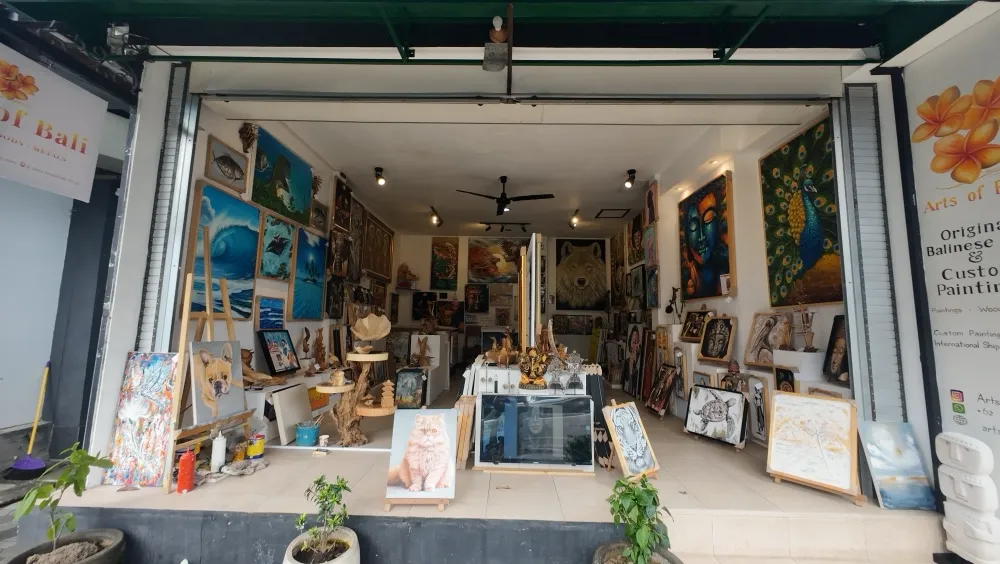
Au Arts de Bali, Nous travaillons directement avec les familles du village de Kamasan, qui produisent de l'huile d'olive et de l'huile d'olive. peintures authentiques de Kamasan depuis des générations. Nous n'achetons pas par le biais d'intermédiaires ou d'agrégateurs de marché. Chaque pièce que nous proposons a été vue en personne, sélectionnée pour la qualité de son travail au trait, la richesse de ses pigments naturels et la profondeur de son exécution iconographique.
Lors de l'acquisition d'un Peinture Kamasan Bali Grâce à notre galerie, vous recevez une documentation complète sur l'artiste, son village d'origine et les matériaux naturels utilisés. Vous n'achetez pas une peinture d'apparence balinaise. Vous achetez une œuvre spécifique, authentifiée, issue d'une tradition vivante dont l'histoire documentée remonte au XVIe siècle.
Nous expédions des marchandises à l'échelle internationale. Notre équipe a une grande expérience de l'emballage peinture traditionnelle balinaise Les œuvres sont expédiées sur des toiles préparées pour le transit international, ce qui garantit qu'elles arrivent dans le même état qu'elles ont quitté notre galerie. Pour les collectionneurs qui ne peuvent pas se rendre à Bali en personne, nous fournissons des photographies détaillées et sommes heureux d'organiser des consultations vidéo sur des œuvres spécifiques. Visitez notre boutique en ligne ou contactez-nous directement via WhatsApp.
Entretien de votre peinture Kamasan Bali
Les pigments naturels sur le tissu de coton préparé sont durables mais réagissent à leur environnement. Gardez la peinture à l'abri de la lumière directe du soleil, qui décolore les couleurs minérales au fil du temps. Maintenez l'humidité intérieure entre 45 et 60 %. Dépoussiérez délicatement avec une brosse douce et sèche, et n'appliquez jamais d'eau ou de produits de nettoyage directement sur la surface peinte. Encadrée derrière un verre protecteur contre les UV, une peinture bien entretenue est une œuvre d'art. Peinture Kamasan Bali conservera sa vitalité pendant des générations.
Chaque Peinture Kamasan Bali Les œuvres de notre collection sont fabriquées à la main par des maîtres artistes du village de Klungkung à l'aide de techniques séculaires de pigments naturels. Consultez notre sélection actuelle ou contactez-nous pour discuter d'une œuvre spécifique.
Parcourir notre collection KamasanVous souhaitez découvrir d'autres styles de peinture traditionnelle balinaise ? Lisez notre guide La peinture de style Ubud et la tradition Batuan, ou visitez notre site web Galerie d'art de Bali pour voir des peintures, des sculptures sur bois et des œuvres d'art en métal côte à côte.