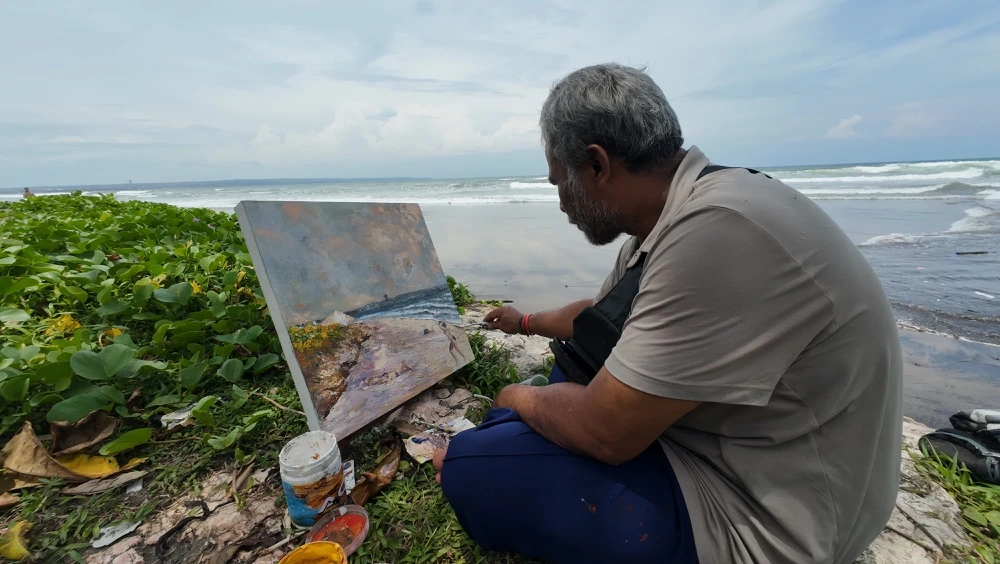
The ocean around Bali does not sit quietly at the edge of things. It moves, it breathes, it breaks and rebuilds. The painters who spend their lives watching it understand something that a photograph cannot hold — that the sea is never the same wave twice, and that capturing it in oil requires not just technical skill but genuine attention.
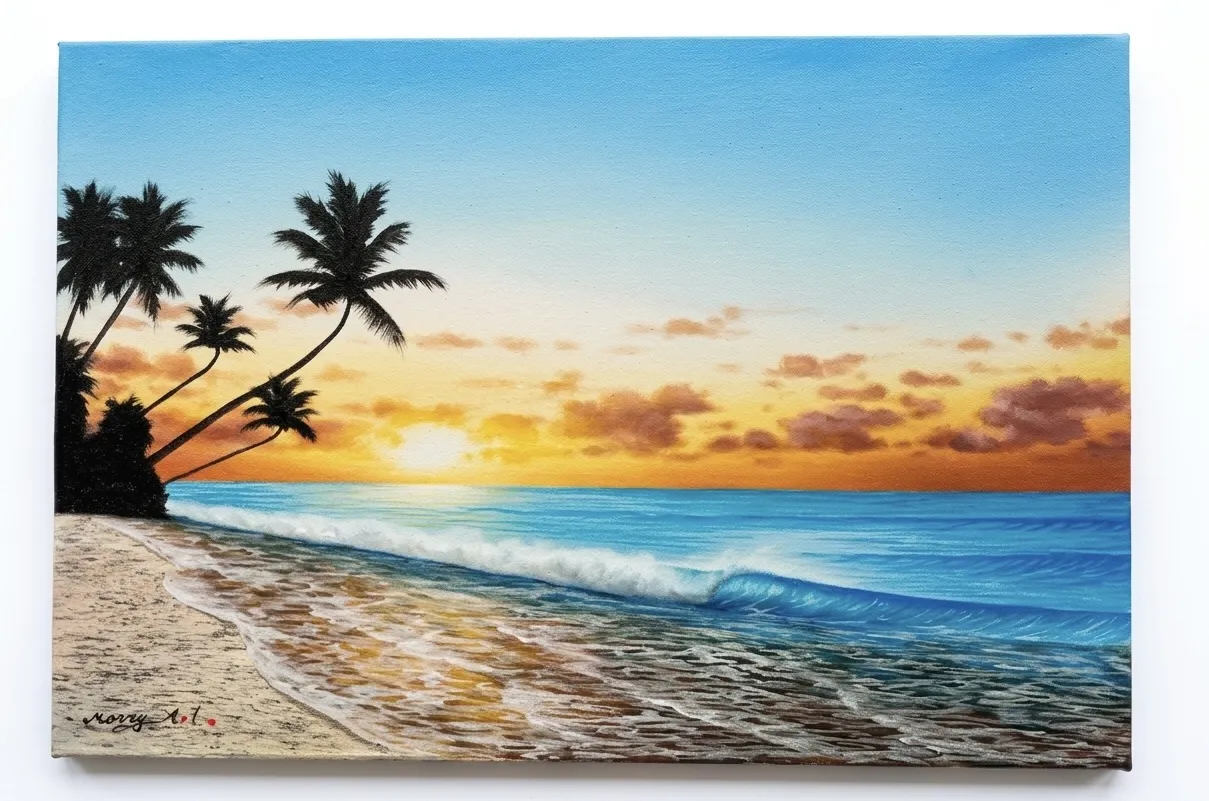
Ocean painting Bali is a category that tourists encounter casually — a beach sunset here, a decorative wave there — but rarely see taken seriously.
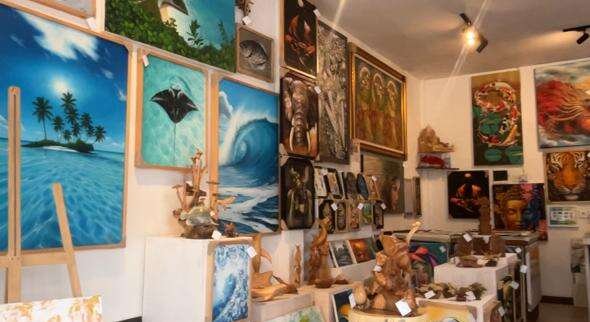
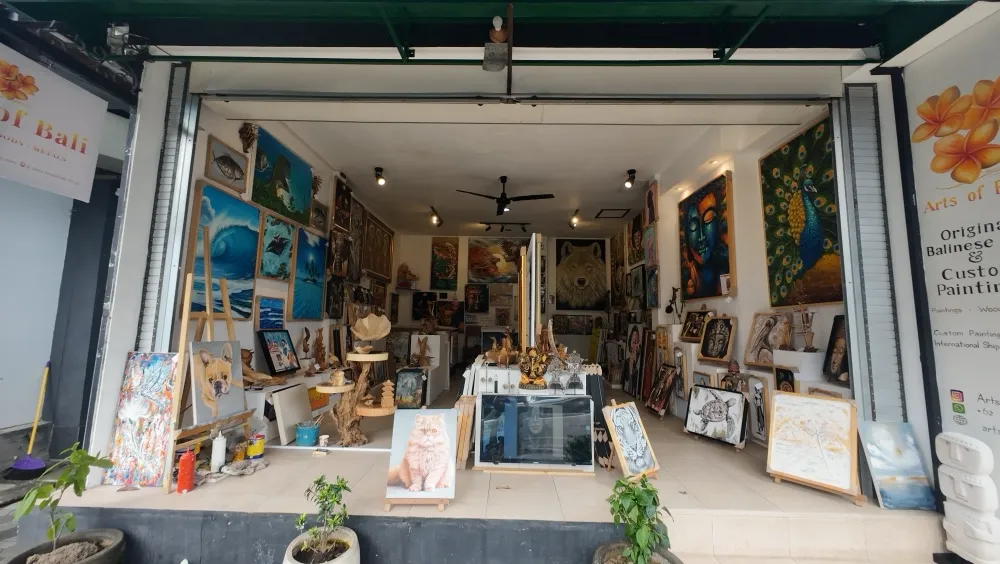
At Arts of Bali gallery on Jl. Raya Seminyak No.42, the marine collection is something different: original oil paintings of Bali’s coastal and underwater world executed with the same patience and technical ambition that the island’s finest portrait and landscape artists bring to their work on land.
Waves rendered with hyperrealist precision. Sea turtles painted with the specific physiological accuracy of someone who has spent time in the water watching them. A humpback whale that seems to carry its own weight in paint. These are not souvenirs. They are artworks that happen to be about the sea.
Why Ocean Painting Bali Has Become a Serious Art Form — Not Just a Tourist Category
Bali is an island. That fact shapes everything — the climate, the culture, the economy, and the visual imagination of the artists who grow up here.
The Bali Sea to the north and the Indian Ocean to the south give the island a maritime identity that its famous rice terraces and volcanic mountains sometimes overshadow in the minds of visitors. But for Balinese painters, the ocean has always been a subject of deep attention — not as postcard material, but as one of the most technically demanding and spiritually charged subjects an artist can attempt.
Water is difficult to paint honestly. It has no fixed form, no consistent colour, no stable surface. It is simultaneously transparent and opaque, calm and violent, intimate and vast.
A painter who can render ocean water convincingly — who can suggest the specific weight of a swell building before it breaks, or the strange filtered light of an underwater scene thirty metres below the surface — has solved problems that most art students spend years failing to crack. The ocean paintings in the Arts of Bali collection are the work of artists who have solved those problems.
Seminyak’s location on Bali’s southwest coast gives the gallery a particular relationship with this subject. The surf breaks of Seminyak, Kuta, and Canggu — recognised globally as some of the most consistent and visually dramatic waves in the world — have attracted surfers, divers, and ocean lovers for decades.
Many of the visitors who walk through the gallery’s doors at Jl. Raya Seminyak No.42 have spent their mornings in that water. They arrive already attuned to its qualities. When they stand in front of a painting that captures those qualities honestly, the recognition is immediate and visceral.
From Breaking Waves to Underwater Worlds: The Full Range of Ocean Painting Bali
The ocean painting collection at Arts of Bali does not limit itself to the surface. It moves through every visual register that Bali’s waters offer.
From the dramatic energy of a breaking barrel wave, to the otherworldly stillness of an underwater reef scene, to the intimate encounter with a creature that exists in a world entirely its own. Each subject demands a different approach from the painter, and the range of techniques visible across the collection reflects that demand honestly.
The Wave — Power and Precision
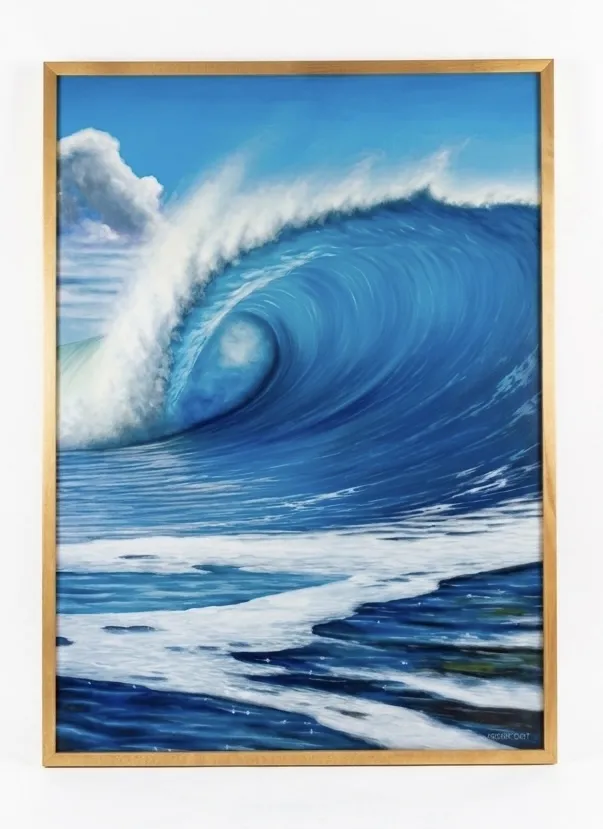
A breaking wave is one of the most technically unforgiving subjects in painting. It moves faster than the eye can fully process, its form is perpetually in transition, and its colour shifts from deep navy at the base through every shade of aquamarine to the brilliant white of the breaking crest.
The large-format wave painting in the gallery’s collection, executed by our resident specialist Alzen, confronts all of these challenges directly.
The barrel curl is rendered with the kind of hyperrealist precision that requires the painter to have spent real time at the water’s edge. This means studying how light refracts through the moving wall of water, how the foam patterns at the base relate to the smooth glass of the face above, and how a wave looks from ground level in the instant before it closes out. It is observed, understood, and rebuilt in paint.
Sea Turtles — Patience and Character
Bali’s waters serve as a vital sanctuary for several species of endangered sea turtles. Encounters with them — whether snorkelling at Amed or diving at Nusa Penida — are among the experiences visitors to the island remember most clearly.
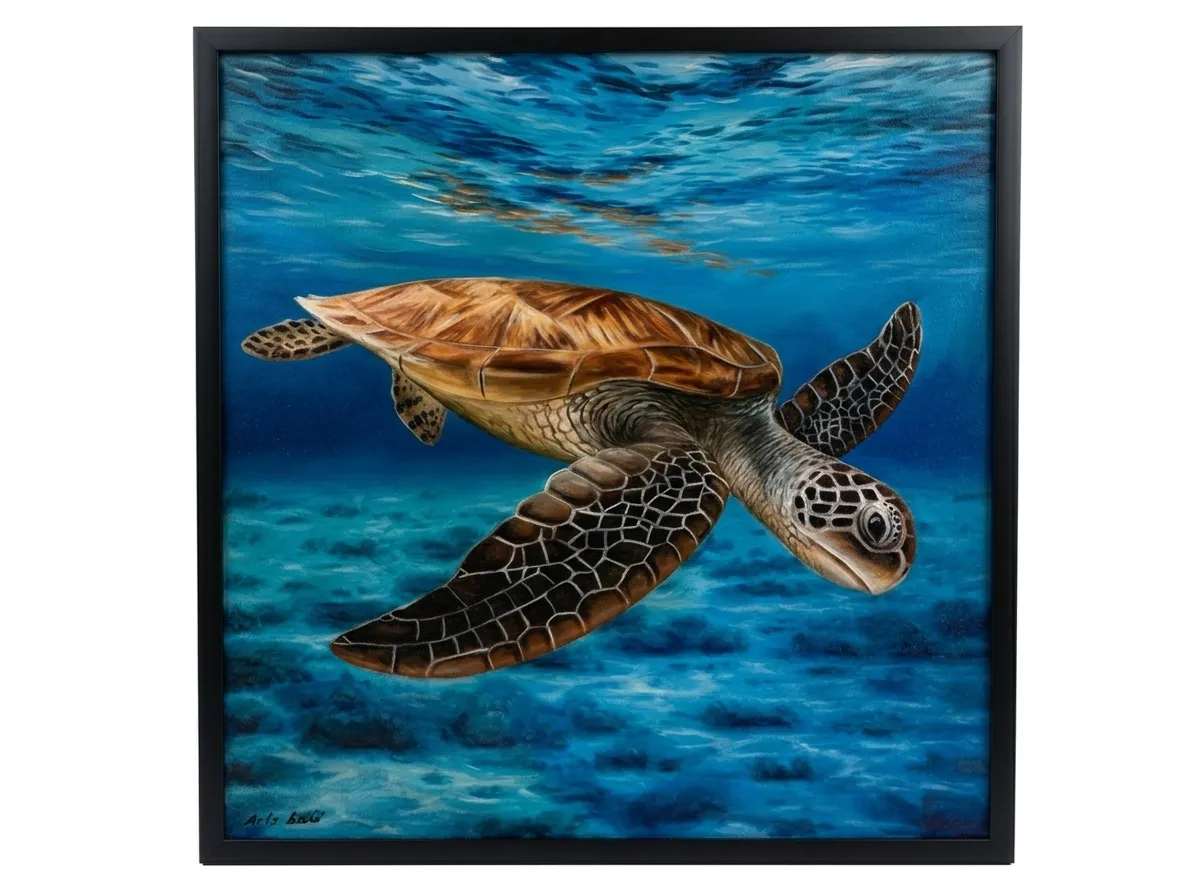
The sea turtle paintings in the Arts of Bali collection approach the same subject from different visual positions. One places the turtle in close-up against a dark ocean background, emphasising the extraordinary detail of the shell’s scute pattern and the distinctive markings of the flippers.
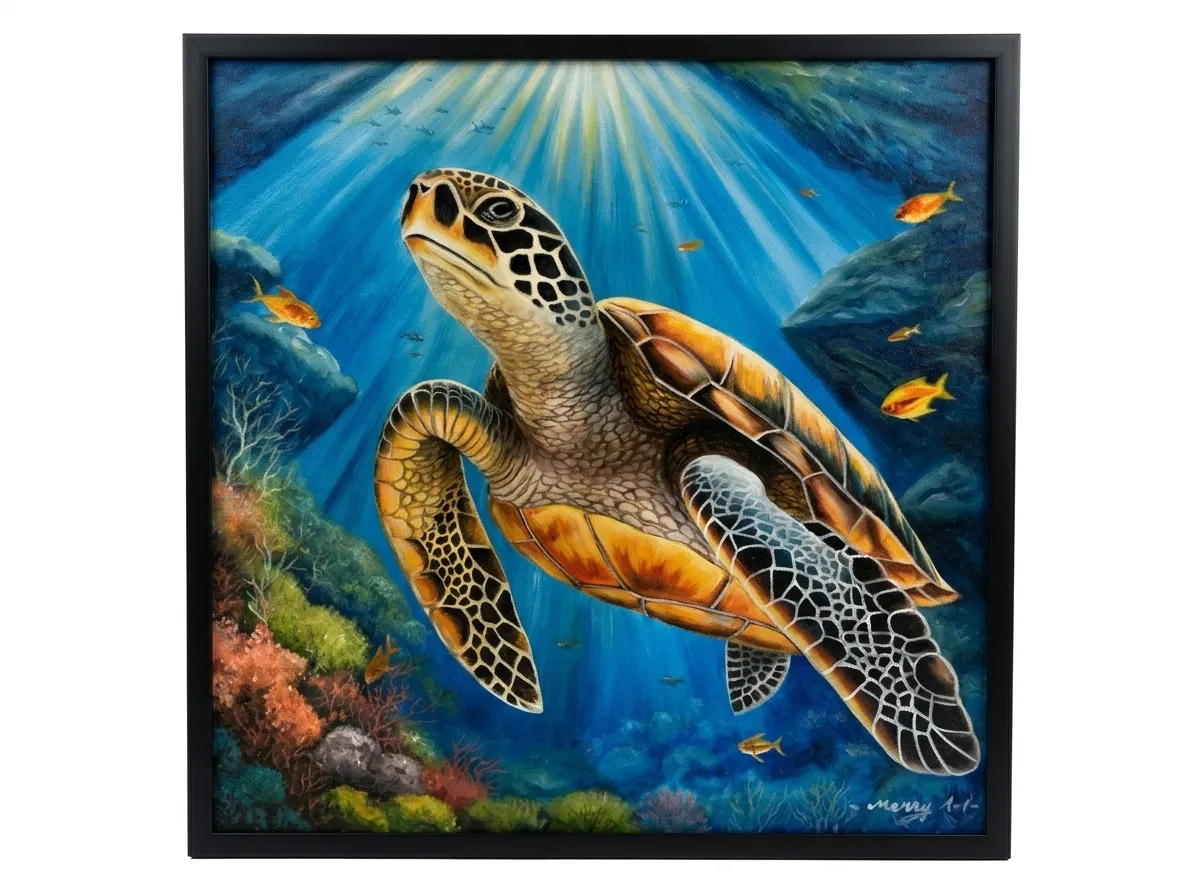
The other situates the turtle within a full reef environment: coral formations, shafts of light descending from the surface, small orange fish moving through the scene. Together they offer a complete picture of what it means to share the water with one of the ocean’s most ancient and quietly magnificent creatures.
A sea turtle has been navigating these waters for longer than any human civilisation has existed. A painting that renders one honestly carries that weight — it is not just a beautiful image, it is a record of a shared world.
Manta Rays and Humpback Whales: When Ocean Painting Bali Goes Beyond the Shore
Beyond the breaking wave and the reef encounter, the ocean painting collection at Arts of Bali reaches into encounters that most people who visit Bali will never have in person.
Paint can bring these moments within reach. Two works in particular stand at this frontier of the possible.
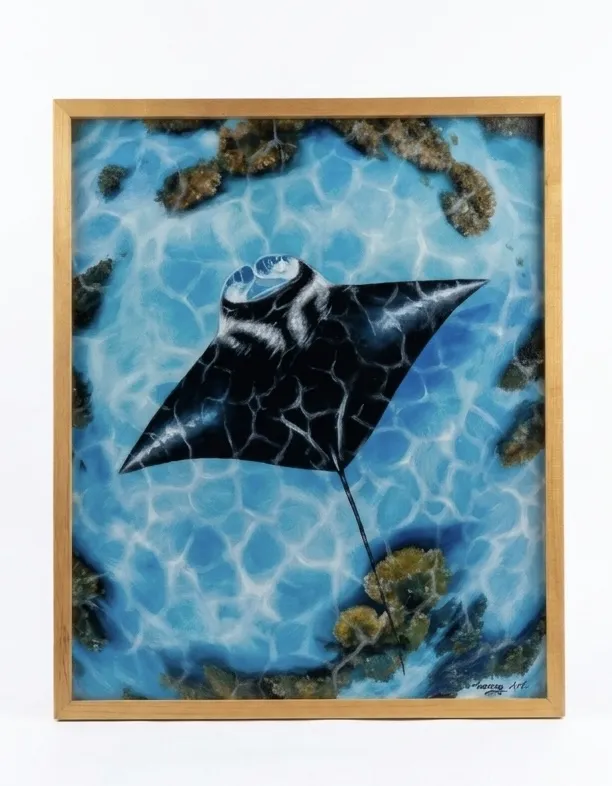
The manta ray painting occupies an unusual visual position — aerial, as if seen from above the water’s surface looking down through it. This is not a perspective that most ocean painters choose.
It requires the painter to solve two optical problems simultaneously: the refraction of light through shallow water, and the way that same light falls on the creature below. The result is a painting that feels more like a memory of a specific dive than a generic ocean scene.
Those who have snorkelled with mantas at Nusa Penida — one of Bali’s most celebrated marine encounters — will recognise the quality of light immediately.
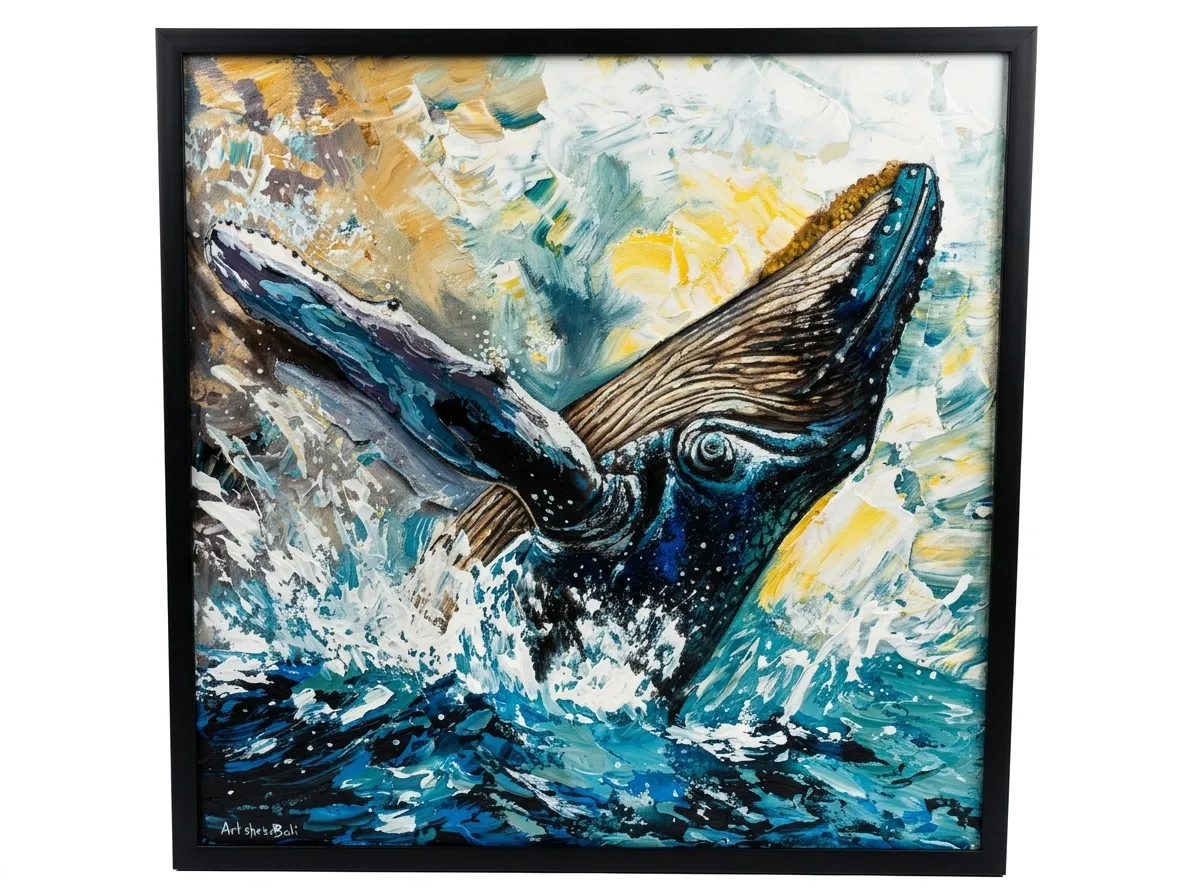
The whale painting takes a different approach entirely. Executed by resident artist Upeksa in palette knife technique — thick, textured oil applied with a blade rather than a brush.
It captures a humpback whale in the instant of a breach with a physicality that a smooth, photorealistic technique could not achieve. The paint itself becomes part of the subject. The churning water at the base of the breach is built from thick, overlapping strokes that carry the energy of the moment.
The whale’s skin is rendered in tones of deep blue, grey, and cream, with the barnacle textures of a real humpback suggested through the natural grain of the palette knife’s edge. This is ocean painting Bali at its most expressive — more committed to capturing the emotional weight of an encounter with a creature of that scale and that beauty.
Choosing the Right Ocean Painting: What to Look for Before You Buy
For visitors considering a purchase from the marine collection, a few practical observations are worth making. Ocean paintings reveal the difference between an artist who has genuinely studied their subject and one who is working from imagination alone. The quality signals are specific and learnable.
Water Colour & Light
The sea is never one colour. In a quality ocean painting, you should see a full tonal range — deep navy at depth, aquamarine in the mid-water, pale turquoise where light penetrates from above, white where foam catches direct sun. A painting that uses only one or two blue tones to represent the ocean has not been properly observed. Look for how the artist handles the transition between these zones.
Movement & Surface
Still water, moving water, and breaking water each have a distinct visual character. A painter who can differentiate between them — rendering the glassy calm of a deep-water scene differently from the kinetic white chaos of a breaking wave — has genuinely engaged with their subject. Look for evidence of observation, not convention. Does the water feel like it weighs something?
Marine Life Accuracy
For paintings featuring sea creatures, species accuracy matters — and is a reliable proxy for artistic seriousness. The shell pattern of a green sea turtle, the wingspan proportions of a manta ray, the barnacle distribution on a humpback whale: these details are either right or they are not. A painter who gets them right has done their research. That commitment to accuracy almost always extends to every other element of the work.
All ocean paintings in the Arts of Bali collection are original, hand-painted works on canvas. Sizes range from compact framed pieces suitable for apartment walls to large-format canvases that anchor an entire room.
The gallery team can advise on framing options, canvas rolling for airline travel, and international shipping for those unable to carry their purchase home in person. Custom ocean commissions — a specific wave location, a particular marine encounter, a scene from a dive or surf session — are also available through the gallery’s resident artists.
You can learn more about buying art in Bali and what the process involves on our dedicated guide page.
The Ocean Painting Bali Collection — Arts of Bali, Seminyak
The full marine collection is on display at Arts of Bali, Jl. Raya Seminyak No.42. Walk in any day — no appointment, no entry fee, no pressure. If you are looking for a specific subject, size, or colour palette, or if you would like to commission a custom ocean painting from your own reference, our team is ready to help. We ship internationally, and we pack with the care that original art deserves.
Find Your Ocean Painting at Arts of Bali
Visit us at Jl. Raya Seminyak No.42, Seminyak, Bali — or contact us directly via WhatsApp to ask about available works, custom ocean commissions, sizing options, and international shipping.
Browse the Collection WhatsApp Us