“Most of what we sell here was born on this island. This piece was not, and I think that is exactly why people stop in front of it. It reminds you Bali is one voice in a much larger conversation.”— Putu Sucipta, Owner, Arts of Bali
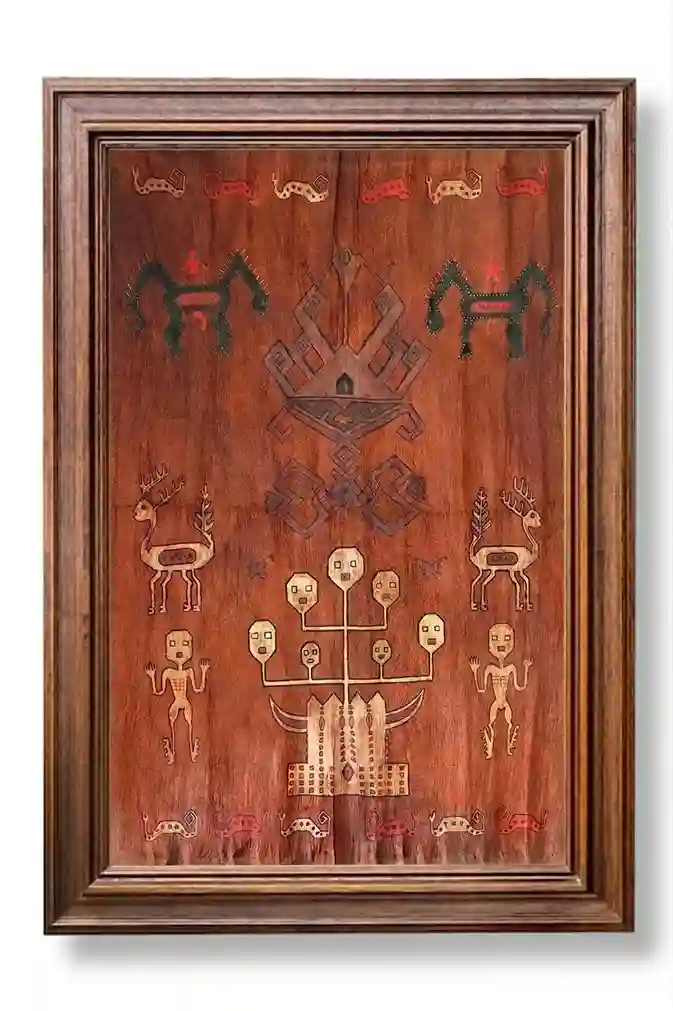
This Sumba barkcloth textile is the clearest reminder that not everything on the walls at Arts of Bali was painted in Bali: a sheet of hand-beaten tree bark from the island of Sumba in East Nusa Tenggara, carrying the Andung motif, a skull-tree figure at the center of Sumba’s oldest visual language, flanked by horses, deer, and a procession of ancestor figures. It is one piece, not a series, and it sits in the gallery’s collection of Indonesian tribal art alongside the Balinese paintings and carvings the gallery is better known for. This guide covers what the piece is made of, what its figures mean, and why an antique object like this can still hold its own in a contemporary room.
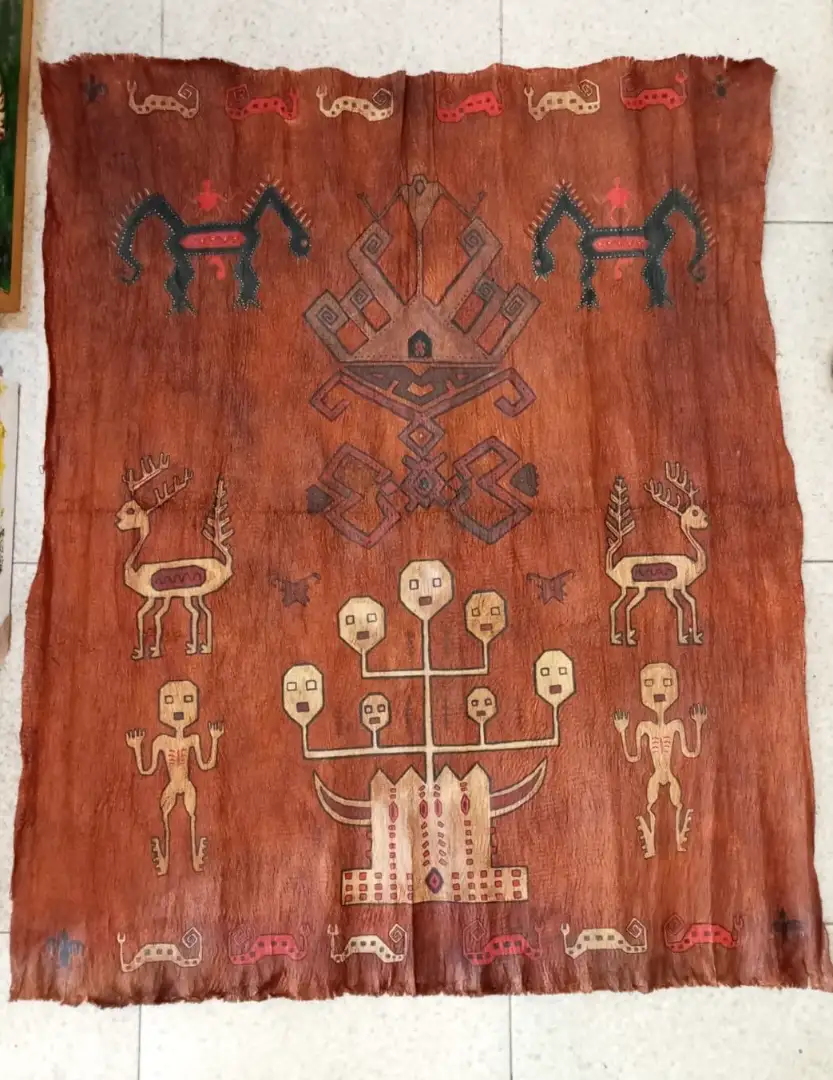
The complete composition, laid flat. Sumba barkcloth textile, Andung motif. Arts of Bali, Seminyak.
Kulit Kayu: Cloth Made From Bark, Not Thread
Barkcloth, known in Indonesian as kulit kayu, is one of the oldest textile techniques in the Indonesian archipelago, and it predates woven cloth by a wide margin. Instead of spinning fiber and passing it through a loom, makers strip the inner bark from a suitable tree, soak it until it softens, then beat it by hand with a wooden mallet until it spreads, thins, and holds together as a single flat sheet. The result is not woven at all. It is closer to paper or leather: pliable, fibrous, and textured with the grain of the wood it came from.
The craft survives today mainly in a handful of pockets across the archipelago. Central Sulawesi has the best-documented living tradition, where communities historically used bark from Ficus trees and, for finer ceremonial cloth, cultivated paper mulberry specifically for the purpose. Barkcloth traditions are also recorded in Papua around Lake Sentani, in parts of Kalimantan, and in the Mentawai islands and Bengkulu region of Sumatra, each with its own name, tree species, and use, from ceremonial garments to burial cloth. Every tradition shares the same basic method: bark, water, and repeated beating, with no thread involved at any stage.
This particular textile is made the same way, worked in deep terracotta and warm earth tones that come from the bark itself rather than applied dye, with the figures painted directly onto the beaten surface once it had dried and set.
Reading the Andung: Sumba’s Skull Tree
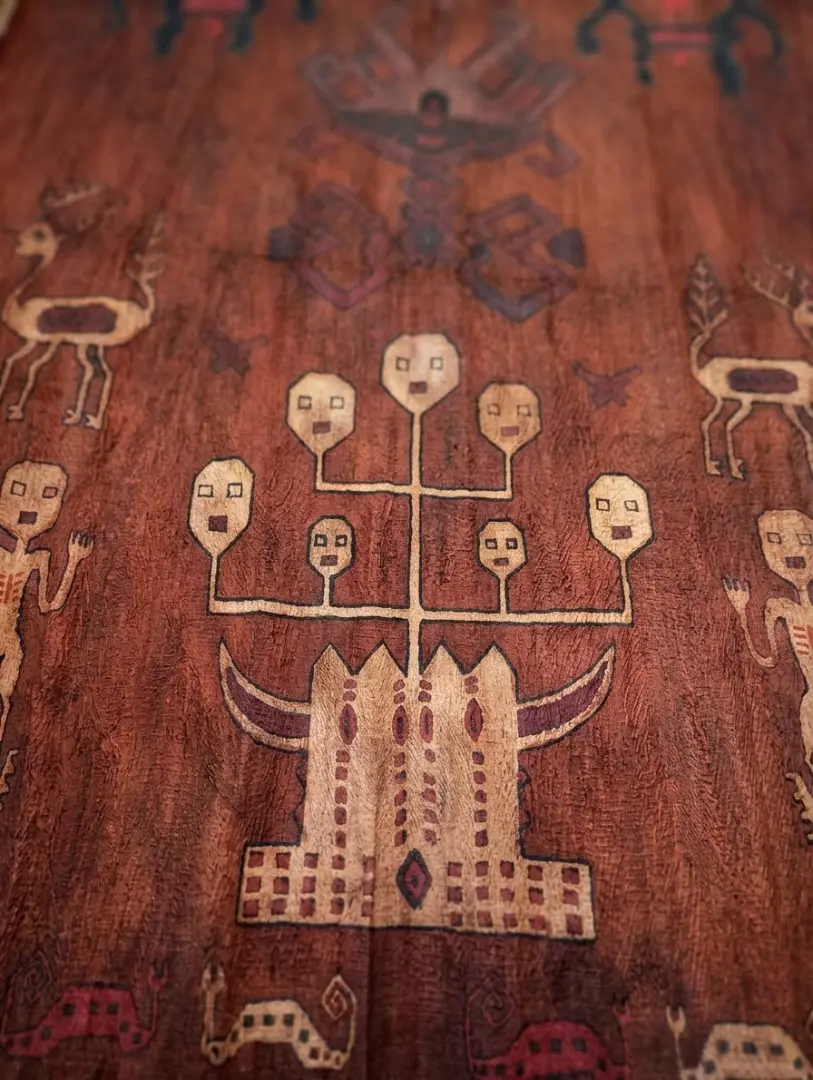
Detail of the Andung motif: stylized heads branching from a central trunk, set above a horned base. Arts of Bali, Seminyak.
At the center of the composition stands the Andung, rendered here as a branching trunk carrying seven stylized human heads and rising from a horned, tooth-edged base. In Sumba iconography the Andung, sometimes called the tree of life or skull tree, traces back to the island’s headhunting era, when war trophies were displayed on a wooden tree structure in the village. Over time the motif settled into a symbol read more broadly as courage, victory, and the strength and unity of a clan, and it remains one of the most recognizable figures in Sumba’s visual vocabulary. The number of heads on any given Andung is not fixed. Renderings across surviving textiles show anywhere from three to fifteen, and the variation is generally read as a matter of composition and status rather than a strict count with one meaning.
Flanking the Andung on this piece are two horses, rearing and spiked with what read as ceremonial trappings, and below them a pair of antlered deer with skeletal ancestor figures standing at their sides. In Sumba textile tradition the horse, or njara, is tied directly to status: horses were transport, war animals, currency, and a measure of a family’s standing, and they appear in Sumba marriage customs and death rituals alike, sometimes carrying the symbolic role of a vehicle for the dead. The border running along the top and bottom edges, small repeating creatures in cream, red, and rust, follows the same register as figures. Every element sits inside a shared visual system, not as separate decoration.
“A piece like this was never meant to be quiet. Every figure on it was doing a job: marking status, honoring the dead, keeping a clan’s story somewhere it could not be forgotten.”
— Putu Sucipta, Arts of BaliMarapu: Where Sumba’s Ancestors Still Speak
None of this iconography exists in isolation. Sumba’s traditional belief system, Marapu, centers on an ongoing relationship between the living and their ancestors, who are understood to remain present, watching, and capable of guiding or warning their descendants. Death in Marapu practice is treated as a transition rather than an ending, marked with elaborate funerary ceremony, and households maintain small ritual structures for offerings to those who came before. A textile carrying ancestor figures, a skull tree, and animals tied to death ritual reads, in this context, less like decoration and more like a document: a record of status and lineage meant to be seen and understood by anyone who knew how to read it.
Barkcloth and Ikat: Two Different Sumba Traditions
Sumba’s international reputation as a textile island rests almost entirely on ikat weaving, the resist-dye cotton cloth known as hinggi and lau, held in major museum collections worldwide and still woven by hand today. The Andung motif itself is best documented on exactly that kind of cloth. Barkcloth is a different medium, and it is not one commonly associated with Sumba in the textile literature we could verify. The well-documented barkcloth-producing regions of Indonesia are Central Sulawesi, Papua, parts of Kalimantan, and pockets of Sumatra, not Sumba.
We are noting this directly rather than smoothing it over. This piece came into the gallery’s collection attributed as Sumba barkcloth, and its motif, an Andung flanked by horses and ancestor figures, is unmistakably drawn from Sumba’s visual vocabulary. What we can confirm with confidence is the iconography and the construction method. What we present as the gallery’s attribution, rather than an established craft history we can independently source, is the specific claim that barkcloth was a widespread traditional medium on Sumba itself. For a collector, that makes this a rarer and more unusual object than a typical Sumba textile, precisely because it does not follow the island’s dominant, and far better documented, ikat tradition.
Why an Antique Piece Reads as Contemporary on a Wall
The Andung composition is built the way a modern graphic designer might build a poster: a strong central axis, mirrored figures on either side, and a restrained palette of terracotta, cream, and rust on a warm brown ground. That kind of symmetry and reduction is exactly what reads well against the pared-back, neutral interiors common in contemporary design. A piece like this does not need a room built around Balinese or Indonesian motifs to make sense on a wall. It works precisely because the graphic logic of tribal art, bold figures, flattened forms, high contrast, was already speaking a visual language that shows up again a century later in modern design and branding. Framed simply and given room to breathe, an antique barkcloth textile like this one sits comfortably in a minimalist living room, a study, or a gallery wall of mixed objects, without needing to compete with anything around it.
What to Know Before Acquiring Antique Barkcloth
Condition is part of the story
Antique barkcloth naturally darkens, creases, and shows fine surface cracking over time. These are marks of age and handling, not flaws to be restored away. A piece that looks freshly made has usually lost the surface history that makes it worth collecting in the first place.
Display away from direct light and humidity
Barkcloth is an organic material, closer in fragility to paper than to woven cotton. Keep it out of direct sunlight, away from air conditioning vents, and in a stable humidity environment. Framing behind UV-filtering glass, as this piece is shown, is the safest way to display it long term.
Ask what is confirmed and what is attributed
With tribal and antique textiles, origin is often passed down through the trade rather than documented at the point of making. A reputable seller will tell you plainly what is independently verifiable, such as material and technique, and what is attribution based on how the piece came into the collection. We aim to do the same here rather than presenting every detail as settled fact.
Sumba Barkcloth: Common Questions
What is Sumba barkcloth made from?
It is made from beaten tree bark, known in Indonesian as kulit kayu, rather than woven thread. The inner bark is soaked, then hand-beaten with a wooden mallet until it spreads into a single flat, fibrous sheet strong enough to paint on.
What does the Andung motif mean?
The Andung, or skull tree, is a Sumba motif tracing back to the island’s headhunting era, when trophies were displayed on a wooden tree structure. It is now read as a symbol of courage, victory, and the strength and unity of a clan, and appears most commonly on Sumba’s ikat textiles.
Is this piece Balinese art?
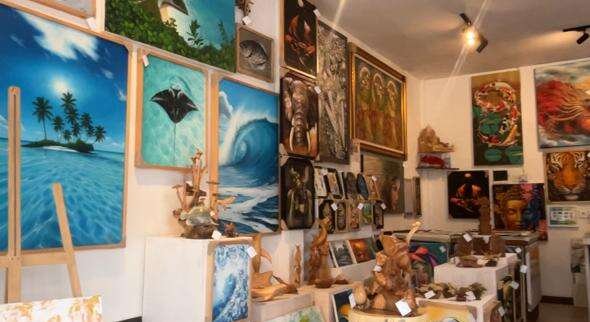
No. This textile is from Sumba, an island in East Nusa Tenggara, part of Indonesia’s wider archipelago of tribal and ceremonial art traditions. Arts of Bali carries it alongside its core collection of Balinese painting and carving, in the same way the gallery presents other non-Balinese Indonesian tribal pieces.
Why is barkcloth from Sumba unusual?
Sumba’s textile reputation is built almost entirely on ikat weaving. Barkcloth as a medium is better documented in Central Sulawesi, Papua, Kalimantan, and parts of Sumatra. That makes a Sumba-attributed barkcloth piece with Sumba iconography a rarer combination than a typical woven Sumba textile.
How should I care for an antique barkcloth textile?
Keep it out of direct sunlight and stable humidity, away from air conditioning vents. Framing behind UV-filtering glass is the safest long-term display option. Avoid cleaning products of any kind, since the surface pigment sits directly on the bark.
Can this piece be shipped internationally?
Yes. Arts of Bali ships internationally to over 40 countries and handles export documentation and customs declarations for antique and tribal pieces. Contact the gallery via WhatsApp to confirm current availability and shipping specifics for this piece.
See This Piece at Arts of Bali
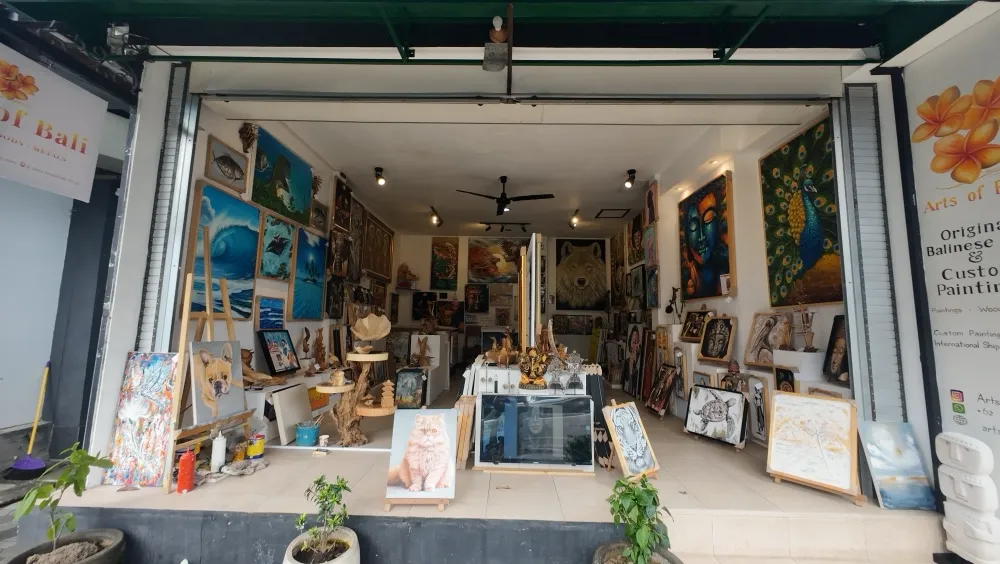
This Sumba barkcloth textile, priced at Rp12,000,000, is on view at Arts of Bali’s gallery on Jl. Raya Seminyak No. 42, Seminyak, Bali, alongside the gallery’s wider collection of Indonesian tribal and ceremonial art. Contact us via WhatsApp to confirm availability or ask about condition, framing, and shipping. For more on the gallery’s broader collection of tribal and ceremonial objects, see our guide to Indonesian metal art.
Chat on WhatsApp View This Piece & Price