Wood carved dog sculpture Bali pieces are hand-carved dog figures shaped from solid wood by artisans trained in Bali’s much older tradition of temple and mythological carving. In July 2026, Arts of Bali welcomed its first wood carved dog sculpture Bali arrivals, a French Bulldog in two finishes, a Dachshund, and a seated English Bulldog, joining a Woodcrafts collection that has, until now, focused on sacred deities, dancers, and mythological reliefs. This guide introduces the new pieces and traces the craft tradition connecting them to Bali’s oldest carving villages.
Key Takeaways
- Arts of Bali’s newest Woodcrafts arrivals are its first wood carved dog sculptures: a French Bulldog (two finishes), a Dachshund, and an English Bulldog.
- Balinese wood carving began as sacred temple and mythological art, centered on villages like Desa Mas in Gianyar.
- Animal-form carving isn’t new to Bali — Hanuman and Garuda are proof, both already sacred subjects.
- Pricing, exact size, and wood species for the new dog pieces are being finalized — contact the gallery for current availability.
- Custom pet-portrait commissions are not yet offered; these are existing, ready-made pieces.
Definition: A wood carved dog sculpture is a three-dimensional dog figure hand-shaped from solid wood using traditional carving tools, distinct from cast, molded, or 3D-printed replicas.
Search “wood carved dog sculpture bali” and the results are almost entirely marketplace listings, rows of French Bulldogs, Dachshunds, and Labradors in warm honey-toned wood, sold through Etsy and Novica as gifts for dog lovers. Nothing about those listings tells you where in Bali, who carved it, or why an island best known for temple guardians and Hindu deities is also, quietly, one of the world’s more active sources for hand-carved dog figurines.
This month, that question got a little more personal for us. Four wood carved dog sculptures, a French Bulldog in two different finishes, a Dachshund, and a seated English Bulldog, have joined the Woodcrafts collection at Arts of Bali. They are the gallery’s first pieces in this category, sitting alongside a collection that has, until now, been built entirely around sacred and mythological subjects.
This guide introduces the four new pieces, and explains the craft connection that makes them a natural extension of what Arts of Bali already does, rather than a departure from it.
Wood Carved Dog Sculpture Bali: What the Term Means
A wood carved dog sculpture Bali piece is a dog figure shaped entirely by hand from solid wood using chisels and carving knives, rather than molds, casts, or 3D printing. “Bali” matters because of where that hand-carving skill was originally developed, in a tradition documented by Indonesia’s own Ministry of Tourism and Creative Economy as one of Bali’s oldest craft exports, developed not for pets, but for temples.
The term gets used loosely by some resellers for pieces that are only partly hand-finished over a machine-roughed or resin base. The difference matters for both price and durability, and the checklist further down this guide covers exactly how to tell the two apart.
New ArrivalsThe Four New Dog Sculptures at Arts of Bali
This first wood carved dog sculpture Bali collection at Arts of Bali reads a different breed and a different finish in each piece, but all four share the same standing or seated full-round carving approach the gallery already uses for its statue-format sacred pieces.
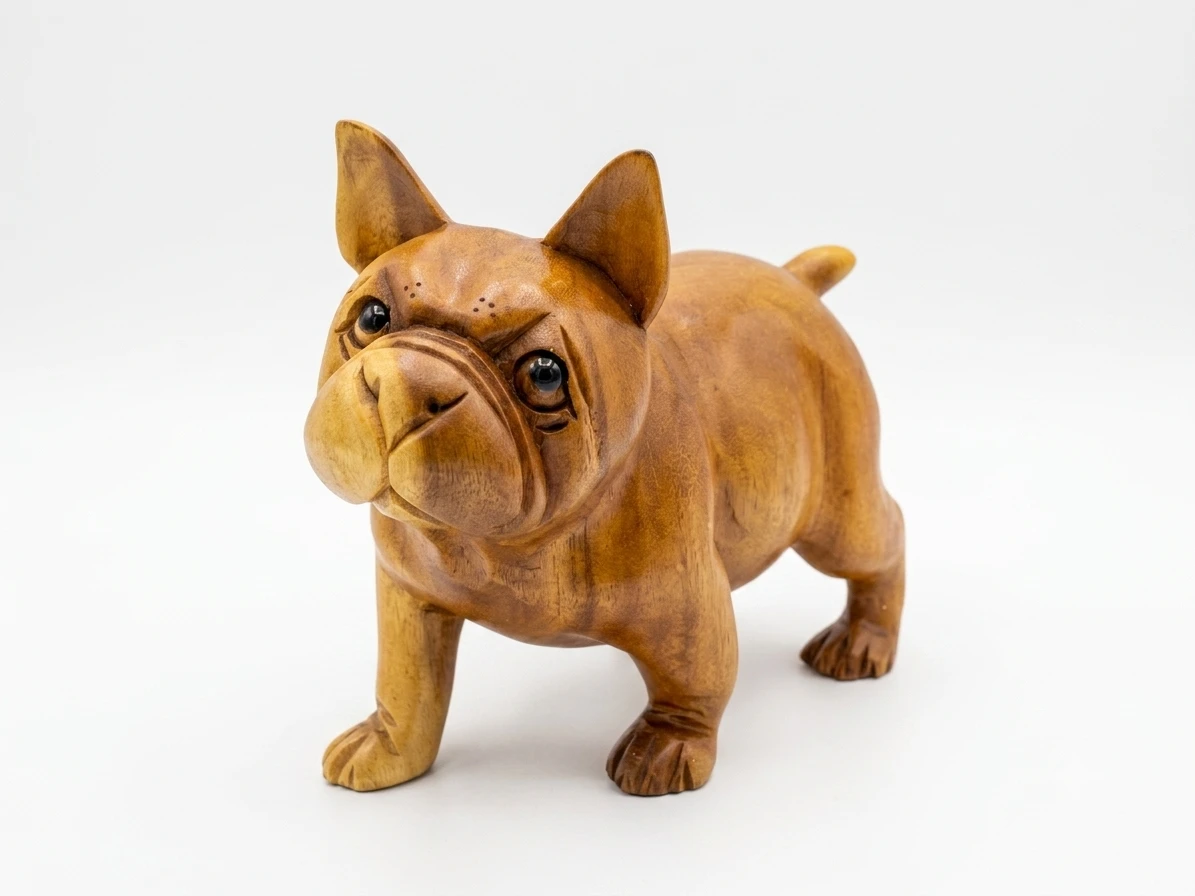
French Bulldog, Honey Finish (Standing)
Shown in the hero image above. A lighter, warmer wood tone brings out the carved detail in the ears, brow furrows, and paws, with a confident, alert expression and perked ears.
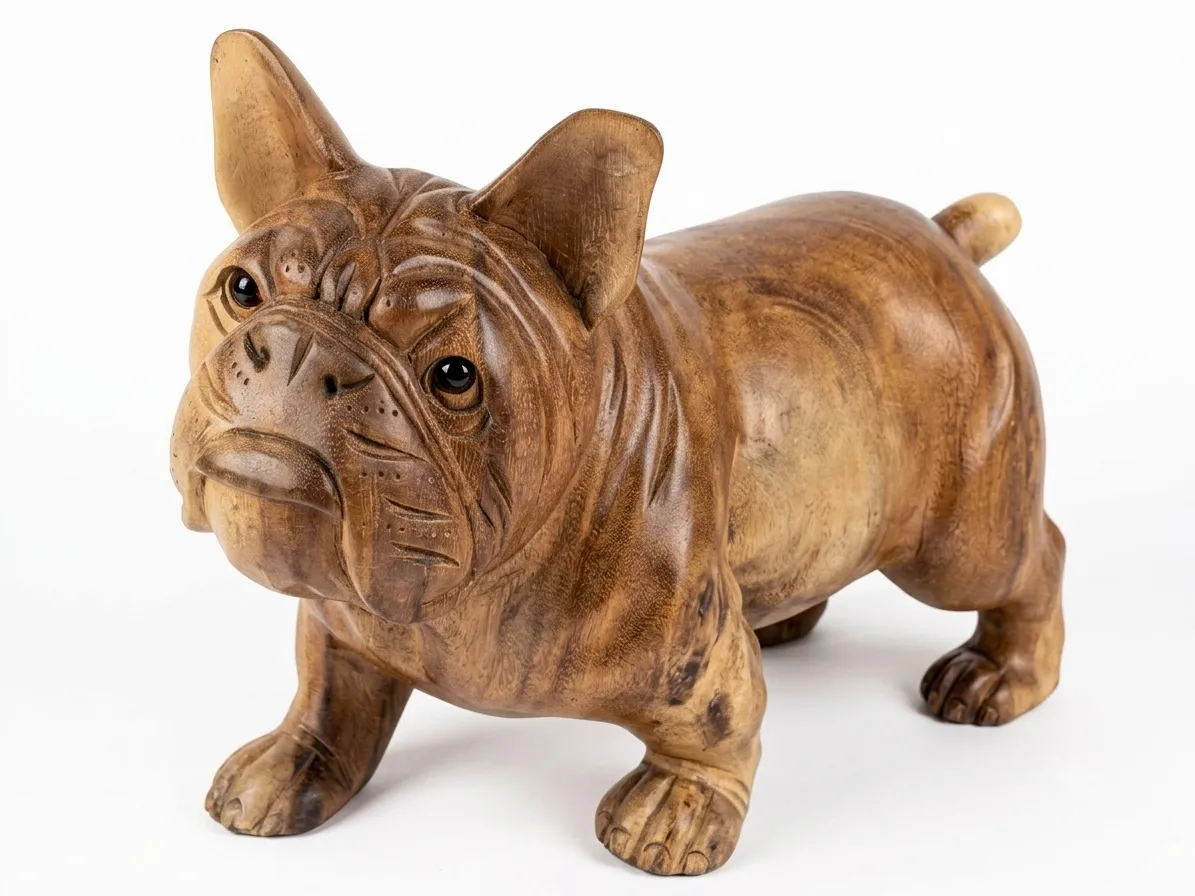
French Bulldog, Natural Grain Finish (Standing)
The same breed and standing pose as the piece above, carved with a more visible, matte wood-grain finish and deeper wrinkle detailing across the muzzle. Side by side, the two Frenchies make a clear case for how much finish alone changes a piece’s character.
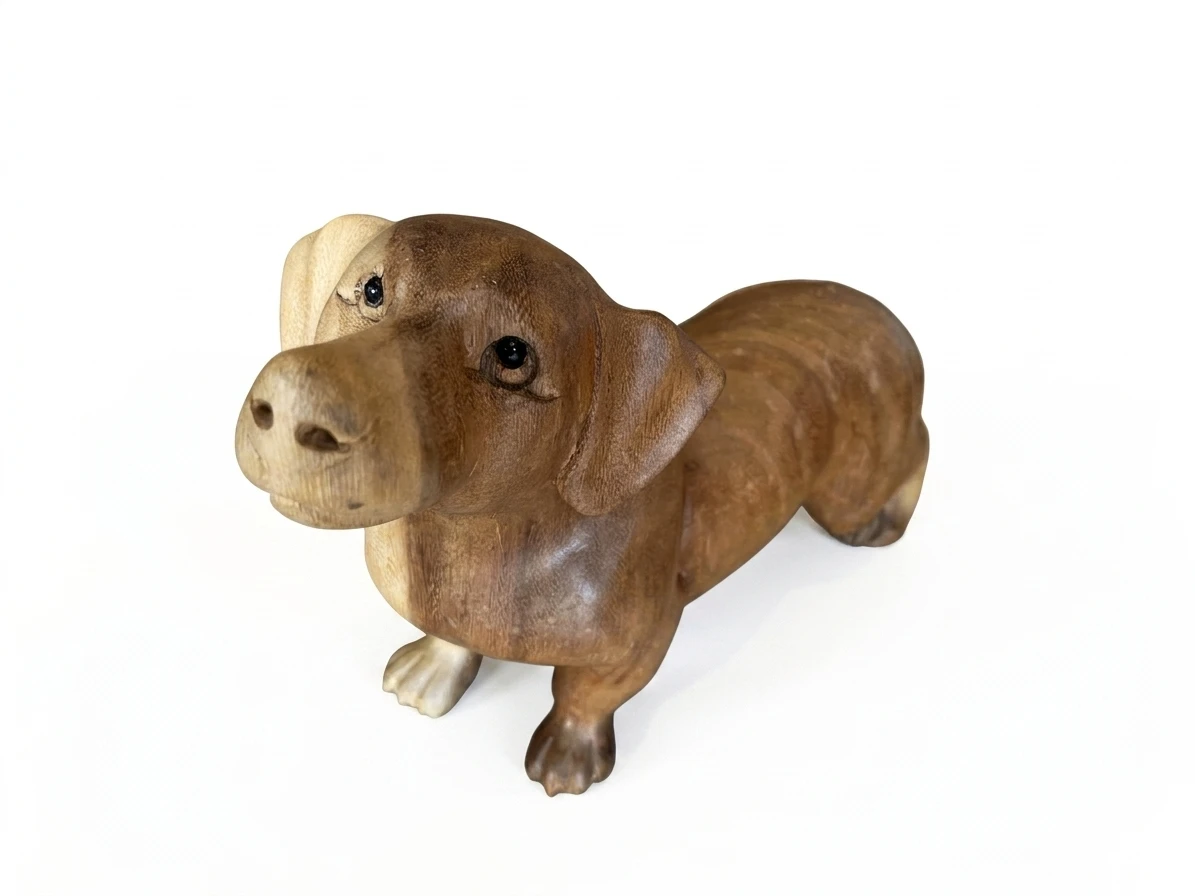
Dachshund, Two-Tone Finish (Standing)
The most technically distinct of the four: a long, low body carved in a deeper brown tone, with a lighter, contrasting wood used for the muzzle and paws. The two-tone approach is a departure from the single-tone finishes used across most of the gallery’s sacred pieces, and it is the detail most likely to stand out on a shelf.
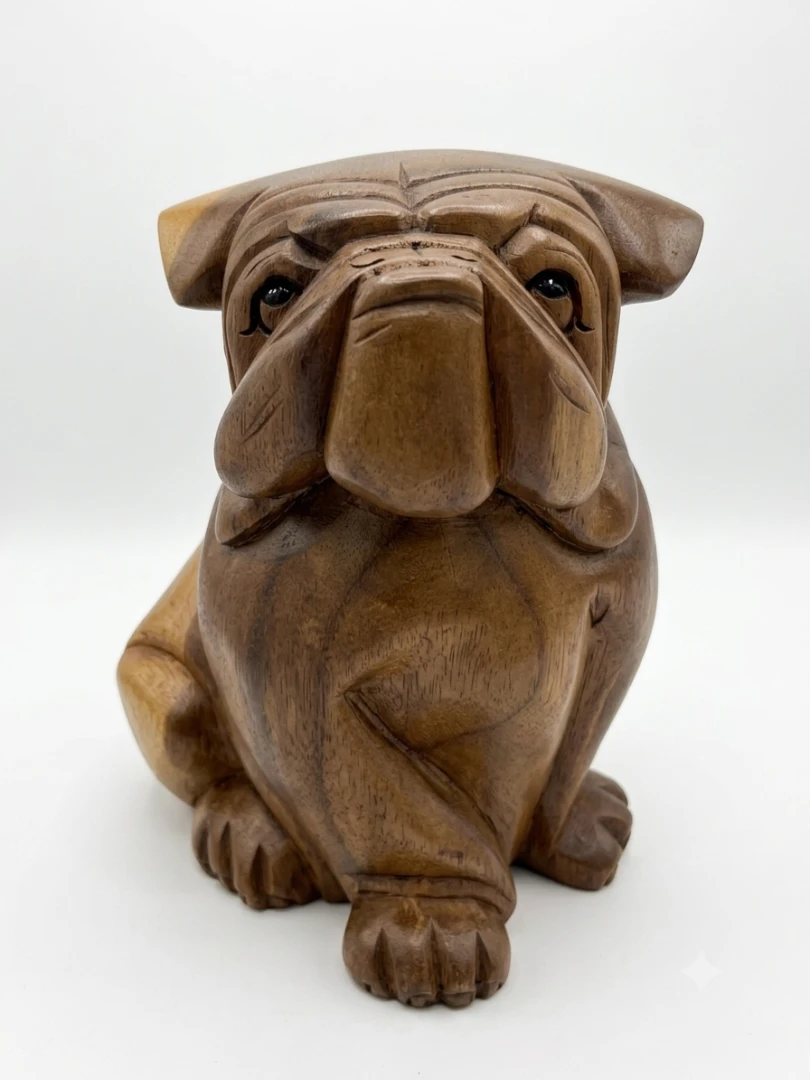
English Bulldog, Seated (Front-Facing)
The only seated piece of the four, carved to be viewed head-on, with heavy folded ears and a deeply furrowed brow carved at a scale that reads clearly even from across a room. Its front-facing pose suits a console or entry table more than a piece meant to be walked around.
Note on details: exact size, wood species, and pricing for all four pieces are still being finalized at time of publishing and are not listed here. Contact the gallery directly for current availability.
Not as New as It LooksBali’s Wood Carvers Already Carve Animals — Just Sacred Ones First
It’s easy to assume this wood carved dog sculpture Bali collection represents a break from Balinese wood carving’s sacred roots. It doesn’t, because animal-form subjects were never absent from Balinese art to begin with. Two of Hindu cosmology’s most carved figures in Bali are, in fact, animals: Garuda, the mythical eagle who carries Wisnu, and Hanuman, the monkey god from the Ramayana known for his devotion and strength. Our Garuda Wisnu Kencana wood carving guide covers Garuda in more depth.
Arts of Bali’s own Exclusive Sita and Hanuman Carving, shown below, has been part of the Woodcrafts collection well before the new dog sculptures arrived. The same anatomical demands, muscle structure, expression, proportion, that a carver resolves shaping Hanuman’s face and posture are close cousins to what’s required to carve a convincing, lifelike dog. The subject changed with these four new pieces. The underlying craft problem didn’t.
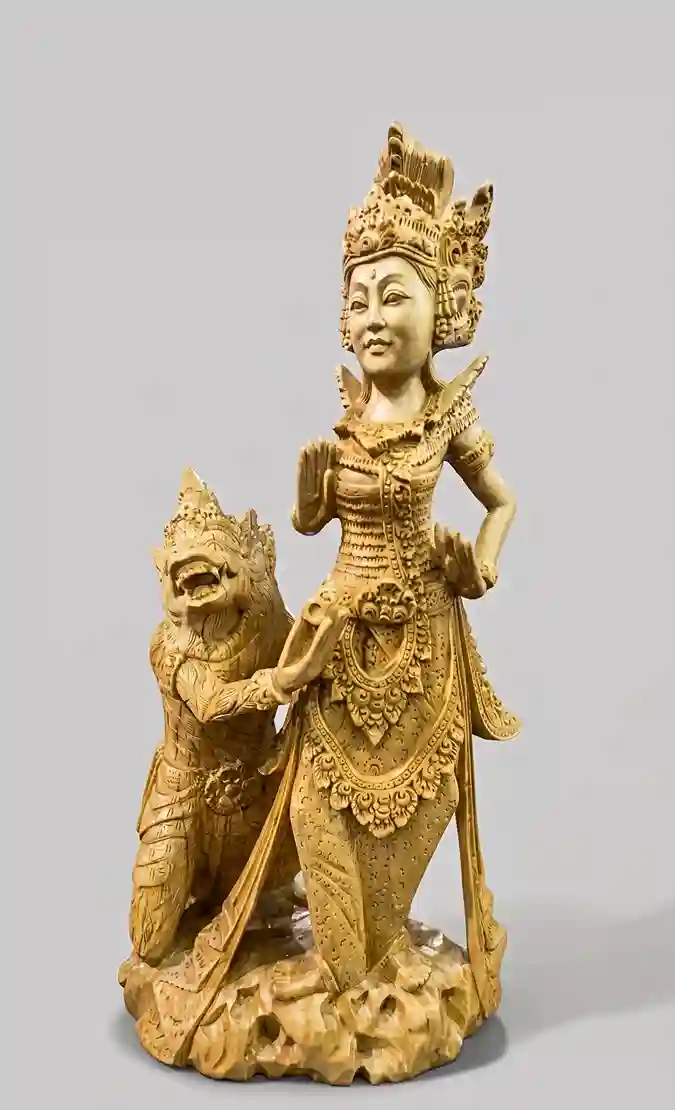
“The dog on a shelf and the guardian at a temple gate come from the same hand skill, reading the grain, finding the expression before you cut. That part doesn’t change just because the subject did.” — Putu Sucipta, Owner of Arts of Bali
Where the Demand Comes FromWhy the Craft Reached Beyond the Temple
Bali’s wood carving economy has always depended partly on export demand, and export buyers do not only want deities. International artisan marketplaces carry entire categories dedicated to hand-carved wooden dog sculptures sourced from Bali. On Novica, for instance, listings such as “Best Boy” and “Good Boy,” hand-carved wood dog sculptures attributed to a Balinese artisan, have appeared in the same catalog structure as more overtly cultural Balinese wood pieces.
A dog lover abroad is unlikely to want a temple guardian on their bookshelf, but they will pay for something hand-carved, tactile, and personal, a wooden dog that captures their own breed’s expression. Carvers whose training already included anatomically demanding, expressive subjects were well positioned to meet that demand, and it’s exactly that positioning that led to these four new pieces at Arts of Bali.
Freshness note: the Novica listings referenced above are cited as illustrative third-party market context as of July 2026. Pricing, artisan attribution, and availability on external marketplaces change over time and are not controlled by or affiliated with Arts of Bali.
Sacred vs. ContemporarySacred Motifs vs. Contemporary Animal Figures
Both branches share a carving skillset, but they diverge sharply in purpose, finish, and market.
| Aspect | Traditional Sacred Carving | Contemporary Animal Figurine |
|---|---|---|
| Subject | Hindu deities, Barong, dancers, Ramayana scenes (including animal-form deities like Hanuman and Garuda) | Dogs and other domestic or wild animals |
| Original purpose | Temple, ceremonial, or narrative display | Home décor, gifting, collecting |
| Finishing style | Aged, weathered, or symbolically significant patina | Smooth, warm-toned, realistic; two-tone finishes possible |
| Primary market | Collectors, cultural buyers, ceremonial use | International gift and home décor buyers |
| Example at Arts of Bali | Exclusive Sita and Hanuman Carving | French Bulldog, Dachshund, English Bulldog sculptures (new, July 2026) |
How to Judge an Authentic Hand-Carved Wood Sculpture
Whether the piece in front of you is a temple relief or a dog figurine, from any seller, the same signals separate genuine hand-carving from a mass-produced copy:
- Check for tool marks. Genuine hand-carving leaves subtle, irregular chisel marks; a mold-cast or 3D-printed copy looks uniformly smooth.
- Look at the grain. Real wood shows natural grain variation across the piece; resin or composite copies often have a flat, repetitive texture.
- Compare left and right sides. Hand-carved pieces are rarely perfectly symmetrical, that slight asymmetry is a sign of craftsmanship, not a flaw.
- Ask about the wood species. A seller who can name the wood and its origin is more likely sourcing from an actual carving workshop.
- Feel the weight. Solid wood carvings are noticeably heavier than hollow resin replicas of the same size.
Want to Know When These Four Are Ready to Order?
Size, wood species, and pricing for the French Bulldog, Dachshund, and English Bulldog sculptures are being finalized. Message the gallery to ask about availability, or to be notified when they’re listed.
Ask the GalleryCaring for a Hand-Carved Wood Sculpture
Wood carvings, sacred or secular, share the same basic care needs. Keep pieces out of direct, prolonged sunlight to prevent fading and cracking. Dust with a soft, dry cloth and avoid liquid cleaners on unsealed wood. Maintain moderate indoor humidity, since very dry air can cause fine cracks over time, particularly around thinner carved details like ears and paws. If a piece is oil-finished, an occasional light coat of natural oil helps preserve its tone.
For any wood piece shipped internationally, our guide to shipping art from Bali covers crating and the biosecurity documentation that applies to wood items entering countries like Australia, New Zealand, and the United States.
Common QuestionsFrequently Asked Questions About Wood Carved Dog Sculptures from Bali
Does Arts of Bali sell wood carved dog sculpture Bali pieces?
Yes, as of July 2026. Arts of Bali’s Woodcrafts collection now includes four hand-carved wood dog sculptures: a French Bulldog in two finishes, a Dachshund, and a seated English Bulldog. Size, wood species, and pricing are still being finalized, contact the gallery for current availability.
Is a wood carved dog sculpture from Bali always handmade?
Not always. “Bali wood carving” is sometimes used loosely by resellers for machine-finished or partly molded pieces. Check for irregular tool marks, natural grain variation, and slight asymmetry to confirm genuine hand-carving before buying, regardless of the seller.
Where in Bali are these sculptures traditionally carved?
Desa Mas, a village in Ubud, Gianyar regency, is historically Bali’s best-known wood carving center, home to generations of carvers trained in temple and mythological work that later extended into secular subjects like animal figurines.
Can I commission a custom wood carved dog sculpture from Arts of Bali?
Not currently. The four dog sculptures now in the collection are existing, ready-made pieces, not custom commissions, and Arts of Bali does not yet offer custom pet-portrait carving. Contact the gallery to ask about future custom availability.
Why do Balinese temple carvers also make animal figurines?
Export demand from international gift and home décor buyers grew alongside the temple-carving trade, and the underlying hand-carving skills, anatomy, expression, finishing, transfer directly from sacred subjects to secular ones like dogs. Animal forms were also never absent from sacred carving to begin with; Hanuman and Garuda are both animal-form deities.
How can I tell a real hand-carved sculpture from a mass-produced copy?
Look for irregular tool marks, natural wood grain, slight left-right asymmetry, and real weight. Mass-produced resin or 3D-printed pieces tend to be uniformly smooth, lighter, and perfectly symmetrical by comparison.
What breeds are available in Arts of Bali’s new dog sculpture collection?
The initial collection includes a French Bulldog (available in two finishes, honey-toned and natural grain), a Dachshund with a two-tone finish, and a seated English Bulldog. All four are hand-carved, one-of-a-kind pieces rather than a mass-produced series.
Ask About Arts of Bali’s New Wood Carved Dog Sculptures
Size, wood species, and pricing are being finalized for all four pieces. Reach out to the gallery to ask about availability or to see the sacred wood carving collection they now sit alongside.
Ask the Gallery Visit the Gallery in Seminyak