Garuda Wisnu Kencana wood carving depicts Lord Wisnu (Vishnu) riding the mythical eagle Garuda, one of the most recognized sacred images in Bali, hand-carved by local artisans as standing statues or as low-relief panels set into a carved forest scene. The same subject inspired Bali’s 121-meter GWK statue in Ungasan, though the wood pieces in this guide are independent gallery carvings, not replicas of that monument. This guide also covers a companion set of new Ramayana carvings, Rama and Shinta, and a relief panel of Goddess Saraswati, all released at Arts of Bali in July 2026.
Key Takeaways
- Garuda Wisnu Kencana wood carving shows Wisnu riding Garuda, the same image behind Bali’s 121-meter GWK statue in Ungasan.
- The Ramayana carvings show Rama and Shinta, including the golden-deer scene that starts Shinta’s abduction.
- A relief panel carves a full jungle scene into one flat board; a statue stands carved fully in the round.
- Prices across these 7 new pieces run roughly Rp 10,500,000 to Rp 21,000,000 (about USD 590–1,200), size dependent.
- Every panel is cut from a single block of wood, so no two carvings of the same design are ever identical.
Definition: A Garuda Wisnu Kencana wood carving is a hand-carved wooden statue or relief panel showing the Hindu deity Wisnu (Vishnu) mounted on Garuda, his mythical bird vehicle, a subject drawn from Balinese Hindu cosmology and carved using the same low-relief and figural techniques applied to Ramayana and other sacred scenes.
Most visitors who climb the steps at GWK Cultural Park in Ungasan are looking up. The statue is hard to look at any other way, 121 meters of copper and brass rising over the cliffs south of the airport, Wisnu seated on Garuda’s back, arms spread. Fewer visitors think to look for the same story at a much smaller scale, carved into wood, sitting on a shelf in a gallery in Seminyak. It is the same subject, the same god, the same bird, just told by a different hand and in a different material.
That is what this collection is. Seven pieces arrived at Arts of Bali in July 2026, and they split cleanly into three sacred threads: Garuda Wisnu Kencana in three formats, a set of new Ramayana carvings centered on Rama and Shinta, and a single relief panel of Goddess Saraswati. None of them are reproductions of the Ungasan statue. They are independent carvings that happen to draw on the same well of Balinese Hindu mythology that statue draws from, made by artisans working in a tradition that predates the monument by centuries.
This guide walks through each piece, the story behind it, and what actually separates a relief panel from a standing statue when you are deciding what belongs on your wall versus your shelf.
What Does Garuda Wisnu Kencana Actually Mean?
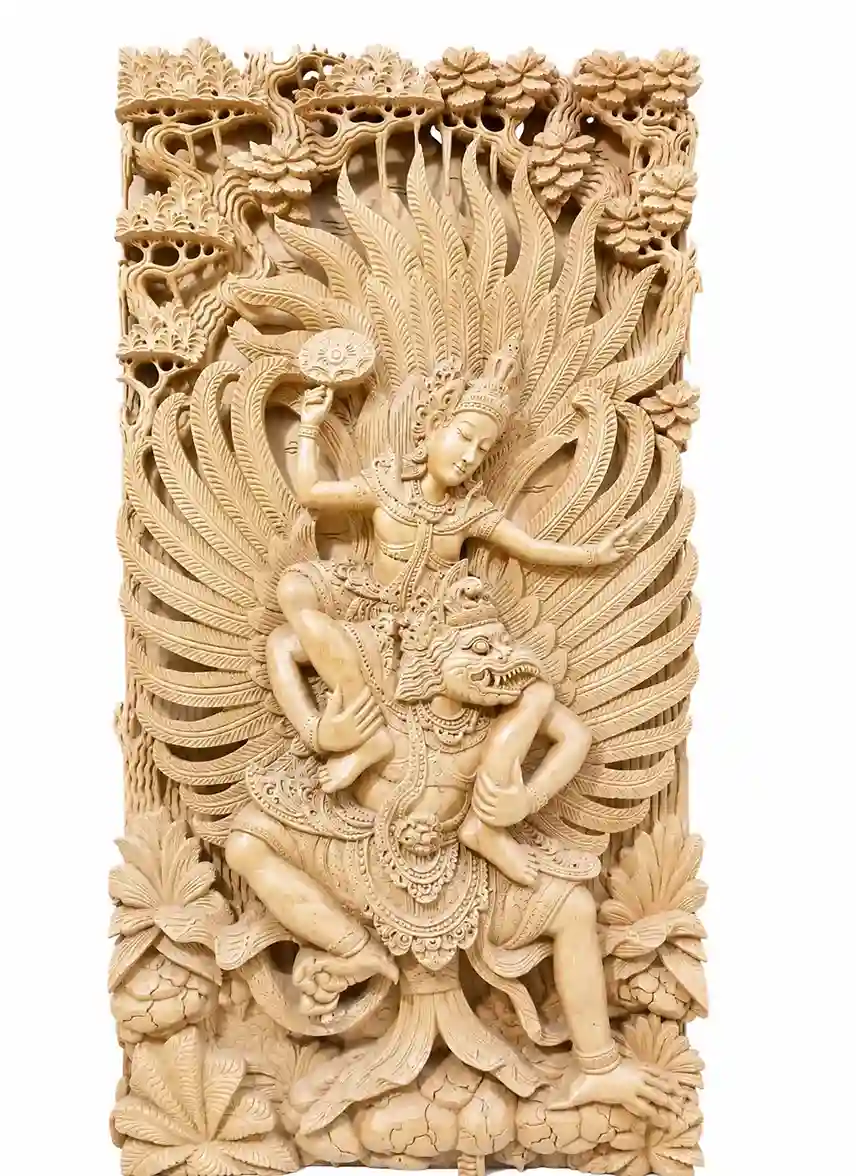
Garuda Wisnu Kencana names a single image: the god Wisnu (Vishnu), preserver of cosmic order in Hindu cosmology, mounted on Garuda, the mythical eagle-man who serves as his vehicle. The story behind their pairing comes from Garuda’s quest for amrita, the elixir of immortality, undertaken to free his mother from servitude. Garuda’s strength and devotion earned him a permanent role as Wisnu’s mount, and the combined image, kencana meaning golden, has become one of the most reproduced sacred subjects in Balinese art, appearing in temple carving, dance, painting, and now, in this collection, in wood relief.
The image reached its largest possible scale in 2018, when the Garuda Wisnu Kencana statue was completed at Garuda Wisnu Kencana Cultural Park in Ungasan, Badung. Designed by Balinese sculptor Nyoman Nuarta and standing 121 meters tall including its pedestal, it is assembled from 754 separate copper and brass modules and took decades to complete after construction stalled during the 1997 Asian financial crisis.
It is now one of the most visited landmarks in southern Bali, and it is very likely the reason most visitors recognize this image on sight, even if they could not previously name the two figures in it.
The wood pieces in this collection are not connected to the Ungasan monument or its studio. They are carved independently by artisans working in Bali’s long-standing wood relief tradition, telling the same mythological story at a scale meant for a home rather than a hilltop.
Three New CarvingsReading the New Garuda Wisnu Kencana Carvings
This collection carries Garuda Wisnu Kencana in three separate pieces, two standing statues and one relief panel, each reading the same subject at a different scale and in a different format.
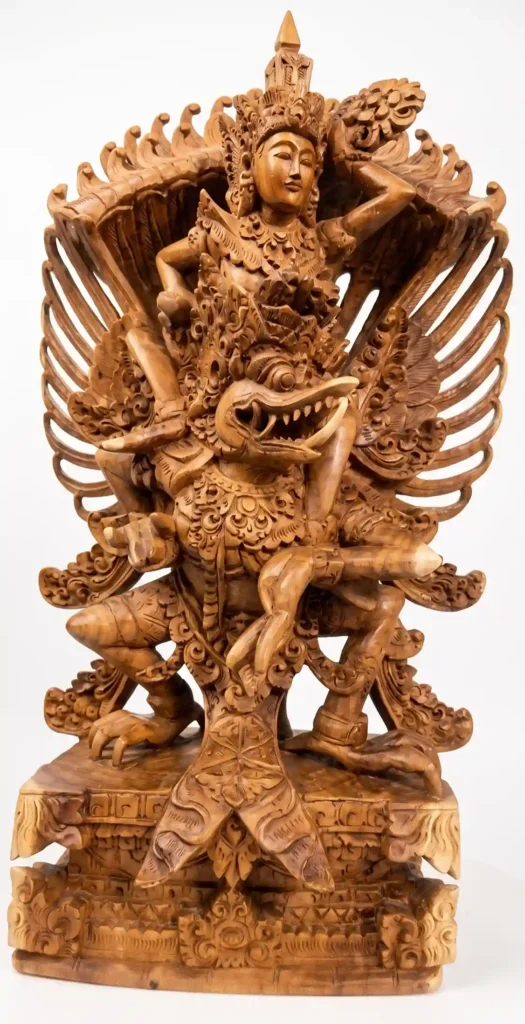
The Triumph of Garuda Wisnu Kencana (Standing Statue, 40 x 25 cm)
Carved fully in the round from natural, unstained wood, this piece shows Wisnu standing atop Garuda mid-flight, one arm raised, the eagle’s multi-layered wings fanning out behind them both. The wing carving is the technical centerpiece here: dozens of individually shaped feather layers, each cut with enough depth to cast its own shadow, giving the whole piece a sense of motion a flat panel cannot achieve. The lighter, honey-toned wood keeps the detail legible even in low light.
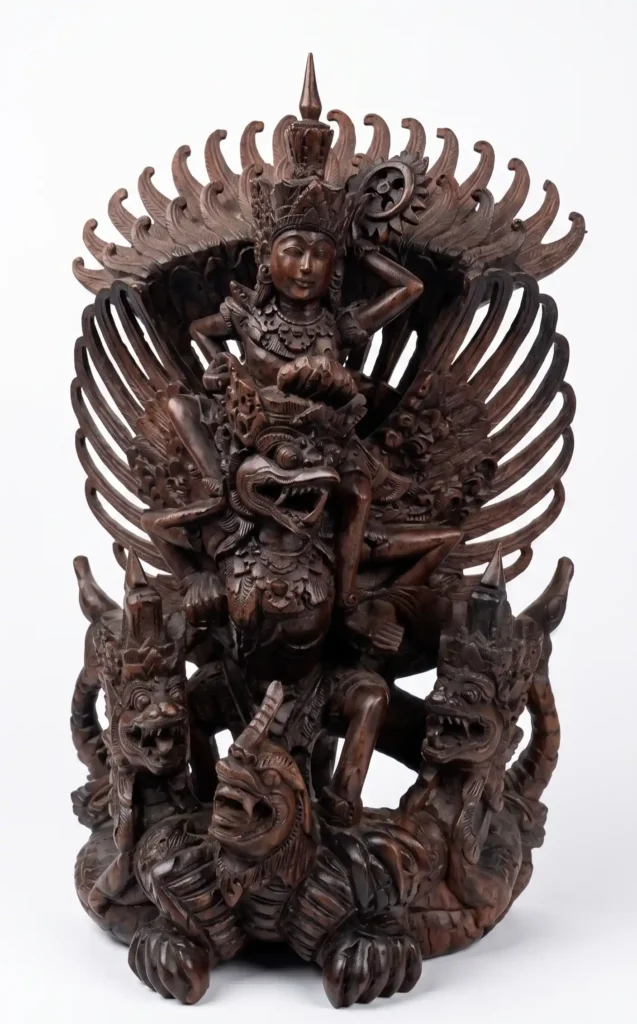
Lord Vishnu Riding Garuda Wooden Statue (Standing Statue, 40 x 25 cm)
The same subject and the same 40 x 25 cm scale as the piece above, carved instead in a deep, almost near-black antique finish that reads as older and heavier from across a room. Side by side, the two statues make the clearest possible case for how much finish alone changes a piece’s character: identical composition, identical wing structure, entirely different presence on a shelf.
Garuda Wisnu Kencana in the Sacred Forest (Relief Panel, 50 x 100 cm)
The hero image above this section, and the largest of the three Garuda Wisnu Kencana pieces. Where the two statues isolate Wisnu and Garuda against open air, this panel sets them inside a full jungle scene, layered foliage and openwork canopy carved above and around the central figures. It is the same “Sacred Forest” panel format the gallery has previously used for Ganesha and Krishna reliefs, applied here to Garuda Wisnu Kencana for the first time.
The Ramayana in WoodRama, Shinta, and the Golden Deer: The Ramayana Carvings
"(《世界人权宣言》) 罗摩衍那 follows Prince Rama, exiled to the forest with his wife Shinta (Sita) and brother Lakshmana, and the war he wages to recover her after the demon king Ravana abducts her. Three of the seven new pieces in this collection carve different moments of that story, and one of them, unusually for decorative wood carving, captures the exact scene that sets the whole abduction in motion.
Rama and Shinta with the Golden Deer (Relief Panel, 40 x 70 cm)
In the story, Ravana’s uncle Maricha transforms into a dazzling golden deer and grazes near Rama and Shinta’s forest dwelling. Shinta, enchanted, begs Rama to catch it for her. He gives chase, and the moment he and Lakshmana are drawn away, Ravana appears and takes Shinta.
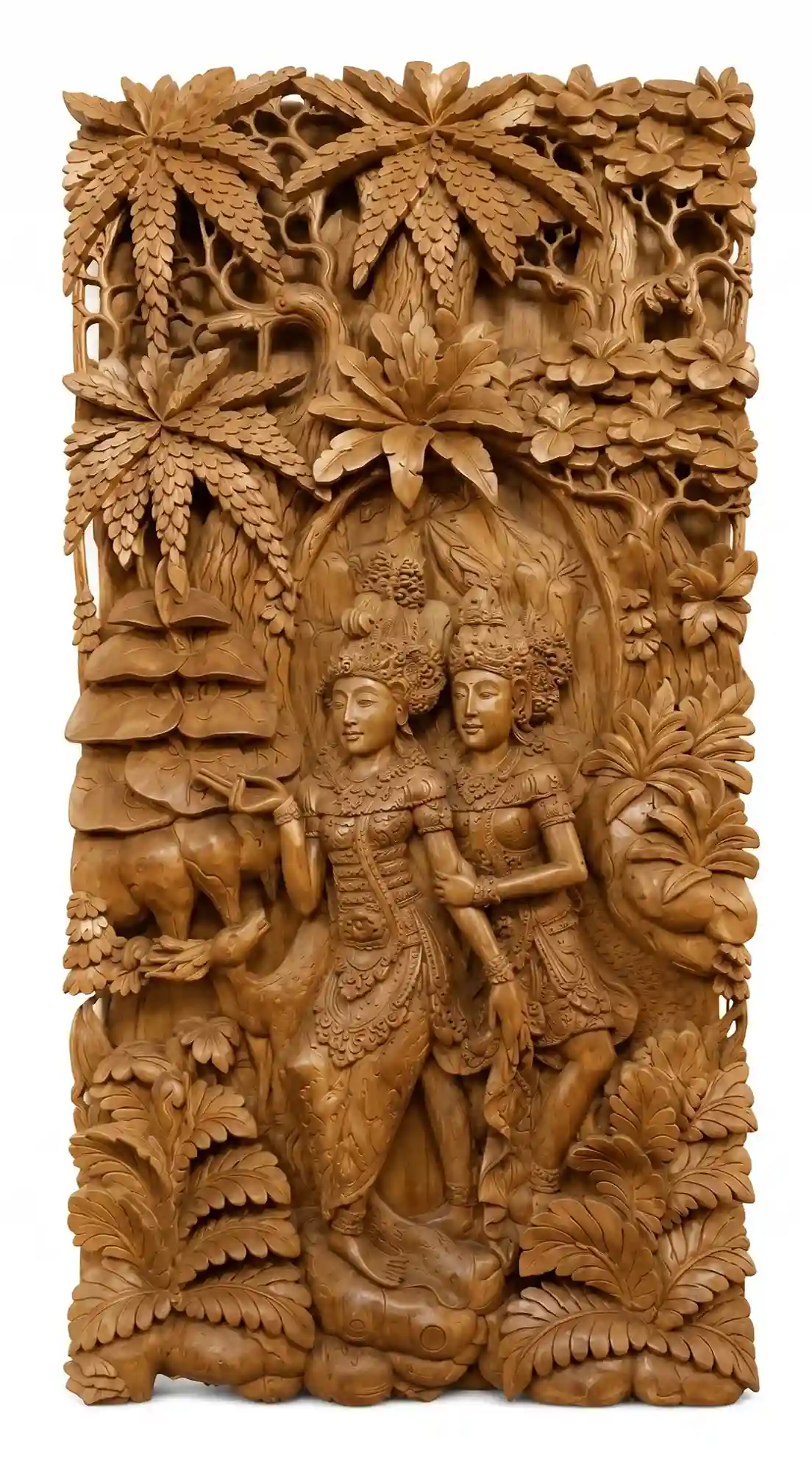
This panel carves the temptation itself, Rama and Shinta standing together as the deer appears at the edge of the scene, rather than a static portrait of the couple. It is a more narrative choice than most decorative Ramayana carving attempts, and it is worth knowing the story before you see the piece, since the deer’s presence reads very differently once you know what it’s about to cause.
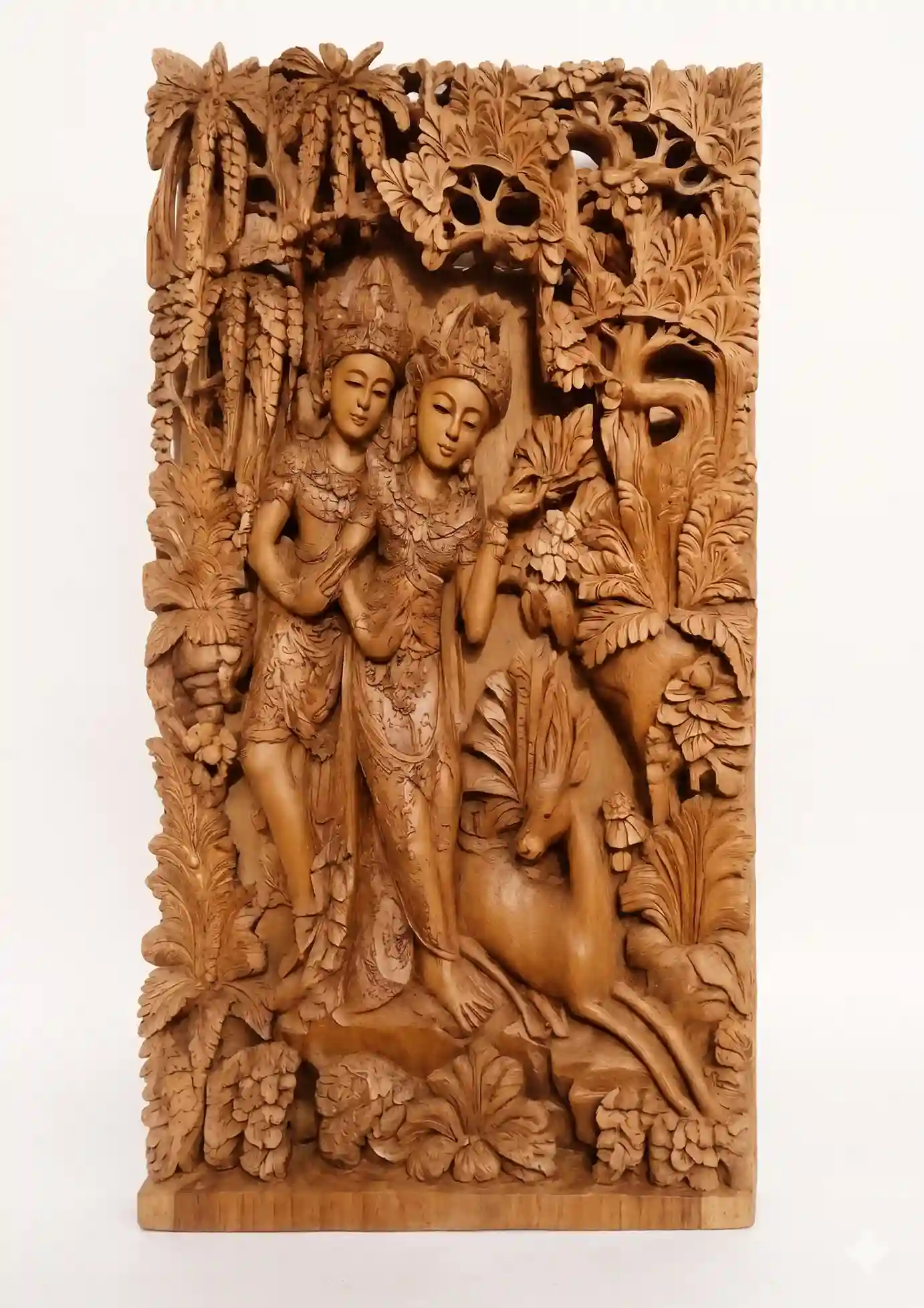
Rama and Shinta in the Sacred Forest (Relief Panel, 40 x 70 cm)
A quieter companion piece to the golden-deer panel, showing the couple standing together within the same dense forest setting, without the narrative tension of the deer scene. Where the golden-deer panel is a moment, this one is closer to a portrait, better suited to a buyer who wants the couple’s devotion as the subject rather than the story’s turning point.
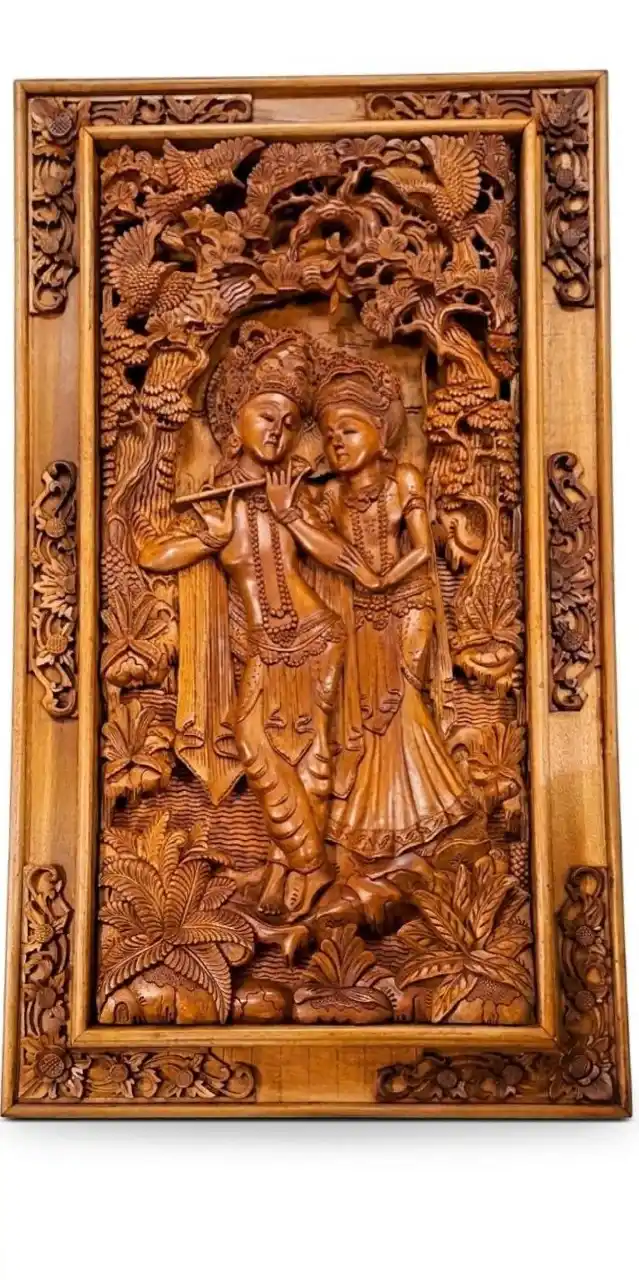
The Authentic Balinese Rama and Shinta Relief Carving Artifact (Antique Style, 60 x 100 cm)
The largest of the three Ramayana pieces, and the only one finished in an antique-style stain rather than natural wood tone. The composition sits within an integrated wooden border rather than an open frame, and the darker finish gives it a weight and age-signaled presence the two lighter panels don’t attempt. At 60 x 100 cm it is also the single largest piece in this entire collection, GWK panel included.
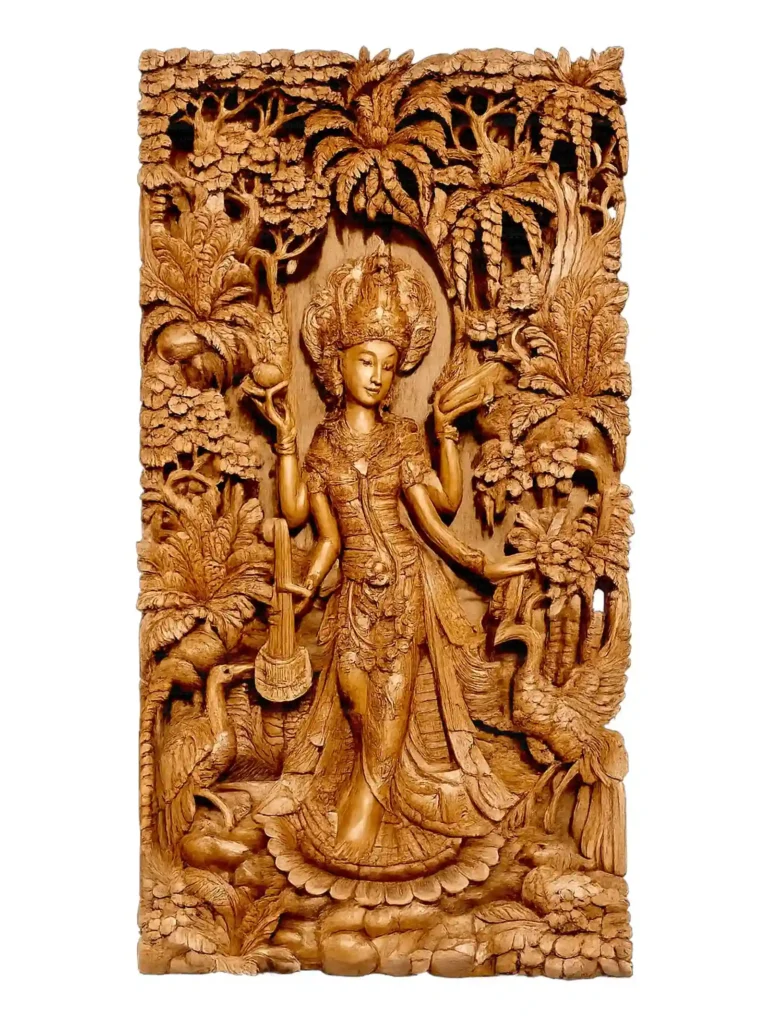
Goddess Saraswati in the Sacred Forest
The seventh piece in this collection steps outside both the Ramayana and the Garuda Wisnu Kencana story. Saraswati governs knowledge, music, and the arts in Hindu cosmology, and in this panel she stands within the same “Sacred Forest” jungle setting used across the collection, holding a veena, the stringed instrument tied to her role as patron of music, with a sacred swan carved among the surrounding foliage.
Where the Ramayana and Garuda Wisnu Kencana pieces carry narrative tension, this panel is closer to a devotional portrait, still and composed, which makes it the natural choice for a study, studio, or creative workspace rather than a room built around drama.
“Three different gods, three different roles, and the same block of wood as the only thing they have in common. That’s the interesting part of a collection like this, not the individual pieces but what carving them side by side tells you about the range one tradition can hold.” — 普图·苏西普塔,“巴厘岛艺术”店主
Format GuideRelief Panel or Standing Statue: Which of These 7 Fits Your Wall?
A relief panel is a flat wood surface carved to a shallow depth, closer in spirit to a sculpted painting than to a freestanding figure; it hangs on a wall and reads as a single scene. A standing statue is carved fully in the round and needs to hold up to inspection from every side; it sits on a shelf, console, or plinth rather than a wall.
Four of the seven pieces in this collection are panels: both Rama and Shinta forest scenes, the golden-deer scene, and the Garuda Wisnu Kencana forest panel, plus the antique Rama and Shinta piece, which functions as a panel despite its sculptural depth. The remaining two, the Garuda Wisnu Kencana figures, are standing statues. For a closer look at how mask-format carving compares to both, see our guide to Balinese wood carving masks and relief panels, which covers the same “Sacred Forest” panel format applied to Ganesha and Krishna.
| Piece | Subject | Format | Size | Price (IDR) |
|---|---|---|---|---|
| The Triumph of Garuda Wisnu Kencana | Wisnu riding Garuda | Standing statue, natural finish | 40 x 25 cm | Rp 10,500,000 |
| Lord Vishnu Riding Garuda Wooden Statue | Wisnu riding Garuda | Standing statue, dark antique finish | 40 x 25 cm | Rp 10,500,000 |
| Garuda Wisnu Kencana in the Sacred Forest | Wisnu riding Garuda | Relief panel | 50 × 100 厘米 | Rp 21,000,000 |
| Rama and Shinta with the Golden Deer | Ramayana — the temptation scene | Relief panel | 40 x 70 cm | Rp 12,000,000 |
| Rama and Shinta in the Sacred Forest | Ramayana — devotional portrait | Relief panel | 40 x 70 cm | Rp 12,000,000 |
| The Authentic Balinese Rama and Shinta Relief Carving Artifact | Ramayana — devotional portrait | Antique-style relief sculpture | 60 x 100 cm | Rp 21,000,000 |
| Goddess Saraswati in the Sacred Forest | Saraswati with veena and swan | Relief panel | 40 x 70 cm | Rp 12,000,000 |
IDR to USD is approximate and shifts with the exchange rate; using the site’s existing conversion reference, Rp 21,000,000 is roughly USD 1,180–1,200, Rp 12,000,000 roughly USD 675–685, and Rp 10,500,000 roughly USD 590–600. Confirm the exact figure with the gallery before ordering.
How a Forest Scene Gets Carved Into One Block of Wood
A relief panel like the four “Sacred Forest” pieces in this collection starts as a single slab of wood, not a frame with a separate carved insert. The carver works in layers: the background canopy and openwork foliage are cut deepest and thinnest, almost lace-like in places, to let light pass through and separate it visually from the mid-ground figures.
The central figures, Wisnu and Garuda, Rama and Shinta, Saraswati, sit at the shallowest depth and the highest relief, which is what makes them read clearly from across a room even though the whole panel is carved from wood no more than a few centimeters thick at its deepest point.
Bali’s most established centers for this kind of figural and relief wood carving are the villages of Mas and Kemenuh in Gianyar regency, long-standing hubs for carvers working in local hardwoods. The Victoria and Albert Museum’s sculpture collection, which includes figural and devotional carving from across South and South East Asia, offers useful context for understanding how the technique used in these panels connects to a much older regional tradition, not something invented for the tourist trade.
The two statue-format Garuda Wisnu Kencana pieces work differently. Because they stand in the round, the carver has to resolve Garuda’s wings, Wisnu’s raised arm, and the negative space around both figures from every viewing angle, not just the front. That is part of why the two statues, despite sharing a composition, come across as heavier technical achievements than a single panel of the same size, even though the panel is larger.
购买指南Choosing, Placing, and Caring for These Pieces
Choosing by story. If the mythology itself is the draw, start with what you want the piece to say: triumph and protection points toward Garuda Wisnu Kencana, devotion and loyalty points toward the Rama and Shinta forest panel, narrative tension points toward the golden-deer scene, and knowledge or creative pursuit points toward Saraswati.
Choosing by placement. The four relief panels are wall pieces first; at 40 x 70 cm and 50 x 100 cm, they need a wall that can hold their visual weight without competing furniture nearby. The two 40 x 25 cm statues suit a console, sideboard, or plinth where their full-round carving can actually be walked around and appreciated from the side, not just head-on.
Care. All seven pieces are unfinished or lightly finished hardwood. Keep them out of direct sunlight and away from constant air-conditioning airflow, both of which dry the wood unevenly over time and can cause fine cracking at the thinnest carved sections, particularly the openwork canopy on the relief panels. A light application of natural oil once a year, buffed off with a soft cloth, keeps the tone even. Do not use water-based cleaners or wax on raw wood.
Shipping. The four large relief panels ship in custom-built wooden crates rather than boxed or rolled, given their dimensions and carved depth, the same approach used for any sculptural wood piece of this scale. Our guide to shipping art from Bali covers crating, courier options, and the biosecurity documentation that specifically applies to wood items entering Australia, New Zealand, and the United States.
Not Sure Which of the 7 Pieces Fits Your Space?
Tell us the wall or shelf it needs to fill, and whether the story or the finish matters more to you, and our team will help you choose between the Garuda Wisnu Kencana, Ramayana, and Saraswati pieces in person or by message.
Ask the GalleryThis Collection at Arts of Bali, Seminyak
All seven pieces are part of the Woodcrafts collection at Arts of Bali, alongside the standing dance and epic figures covered in our broader wood carving guide and the masks and earlier relief panels covered in our wood carving mask guide. If you’d rather see these same two epics rendered in paint, our guide to Balinese mythology painting covers Kamasan-style and contemporary Barong and Ramayana canvases. For the same deities cast in metal instead of carved in wood, see our Bali bronze statue guide, which includes both Wisnu and Saraswati.
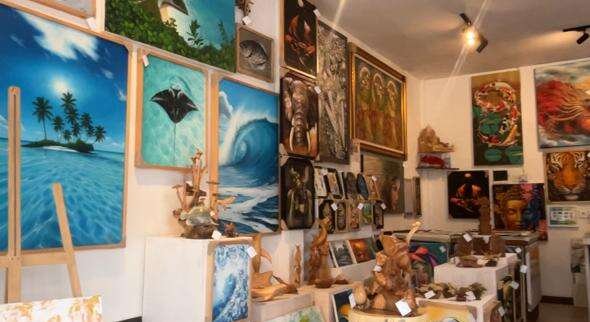
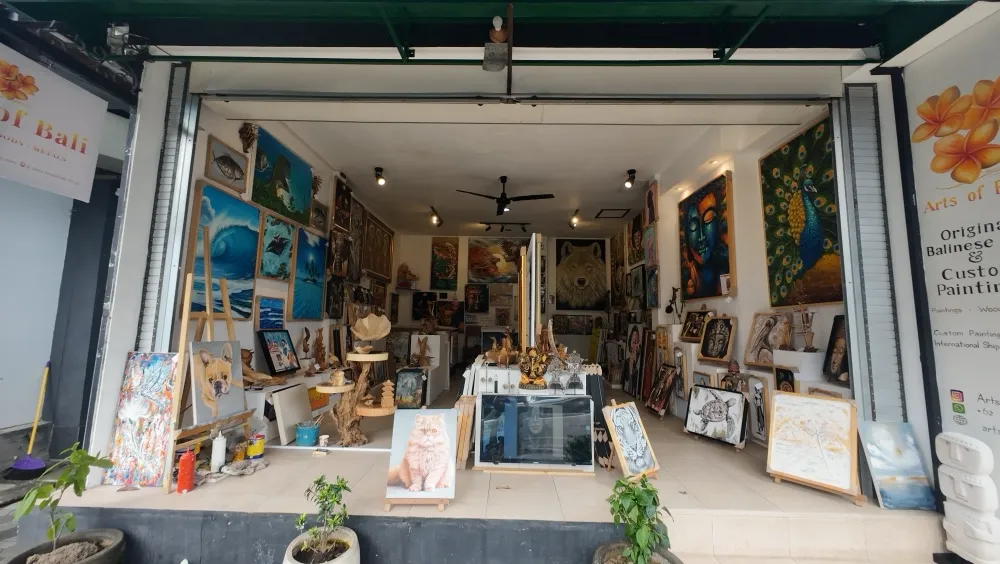
Each piece is available for viewing in person at the Seminyak gallery, where the depth of the relief carving and the weight of the two statues are far more legible than in a photograph.
Common QuestionsFrequently Asked Questions About Garuda Wisnu Kencana and Ramayana Wood Carving
What does Garuda Wisnu Kencana mean?
Garuda Wisnu Kencana refers to the Hindu deity Wisnu (Vishnu) riding his mythical bird vehicle, Garuda. Kencana means golden. The pairing comes from Garuda earning the role of Wisnu’s mount after a quest to win amrita, the elixir of immortality, and it is one of the most widely depicted sacred images in Balinese art, painting, dance, and carving alike.
Are these wood carvings related to the giant GWK statue in Bali?
No. The 121-meter Garuda Wisnu Kencana statue at GWK Cultural Park in Ungasan was designed by sculptor Nyoman Nuarta and completed in 2018. The wood pieces in this collection are independent carvings from Arts of Bali’s own artisans, depicting the same mythological subject in an entirely different medium and scale, with no affiliation to the Ungasan monument.
What is the golden deer story in the Ramayana?
In the Ramayana, the demon Maricha transforms into a beautiful golden deer at Ravana’s request, luring Rama away from their forest dwelling while Shinta watches, enchanted. With Rama and Lakshmana drawn off in pursuit, Ravana appears and abducts Shinta, setting the epic’s central war in motion. The golden-deer relief panel in this collection carves that exact temptation scene.
What is the difference between a wood relief panel and a wood statue?
A relief panel is carved into a flat wood surface at shallow depth and reads as a single scene from the front, made to hang on a wall. A standing statue is carved fully in the round and needs to hold up from every angle, made to sit on a shelf, console, or plinth. In this collection, four pieces are panels and two are standing statues.
How much do these Garuda Wisnu Kencana and Ramayana wood carvings cost?
Prices across the 7 pieces run from Rp 10,500,000 for the two 40 x 25 cm Garuda Wisnu Kencana statues to Rp 21,000,000 for the largest relief panels at 50 x 100 cm and 60 x 100 cm, roughly USD 590 to USD 1,200 at current exchange rates. Confirm the exact converted figure with the gallery, since rates shift.
Who is Goddess Saraswati and why is she part of this collection?
Saraswati is the Hindu goddess of knowledge, music, and the arts, shown here holding a veena within the same carved forest setting used for the Ramayana and Garuda Wisnu Kencana panels. She rounds out the collection as a third, calmer devotional subject alongside the two narrative-driven epics, suited to a study or creative workspace.
Can I commission a custom Ramayana or Garuda Wisnu Kencana wood carving?
Yes. Arts of Bali accepts custom commissions specifying subject, scale, wood finish, and format, panel or standing statue, for both Ramayana and Garuda Wisnu Kencana subjects, as well as other Hindu deities. Contact the gallery directly via WhatsApp to discuss turnaround time and pricing for a custom carved piece.
How do I care for and ship a large wood relief panel?
Keep the panel out of direct sunlight and constant air-conditioning airflow, and apply a light coat of natural oil once a year. Large panels ship internationally in custom-built wooden crates rather than rolled or boxed, with biosecurity documentation required for destinations including Australia, New Zealand, and the United States.
See the Full Garuda Wisnu Kencana and Ramayana Collection in Seminyak
Visit Arts of Bali to see all seven pieces in person, compare the natural and antique finishes side by side, and feel the depth of the relief carving before you choose.
参观画廊 Read Our Wood Carving Guide