A large painting doesn’t simply fill a wall. It anchors a room, sets a mood, and carries the full weight of where it came from. In Bali, that weight is centuries deep.
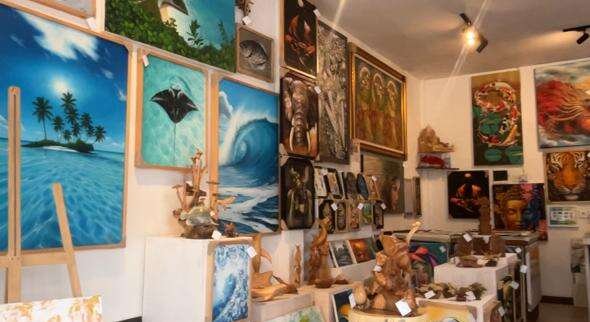
Every large painting from Bali that leaves our gallery at Jalan Raya Seminyak No. 42 is an original — not a print, not a reproduction, not a factory canvas shipped from a warehouse. When interior designers and collectors search for large wall art in Bali, they’re rarely looking for decoration. They’re looking for presence — something that communicates the same energy a room holds, or the energy they want it to hold. A hand-painted canvas measuring 80×100cm or larger, built with palette knife or traditional Balinese brushwork, does something a print never can: it brings the artist’s physical gesture permanently into the space.
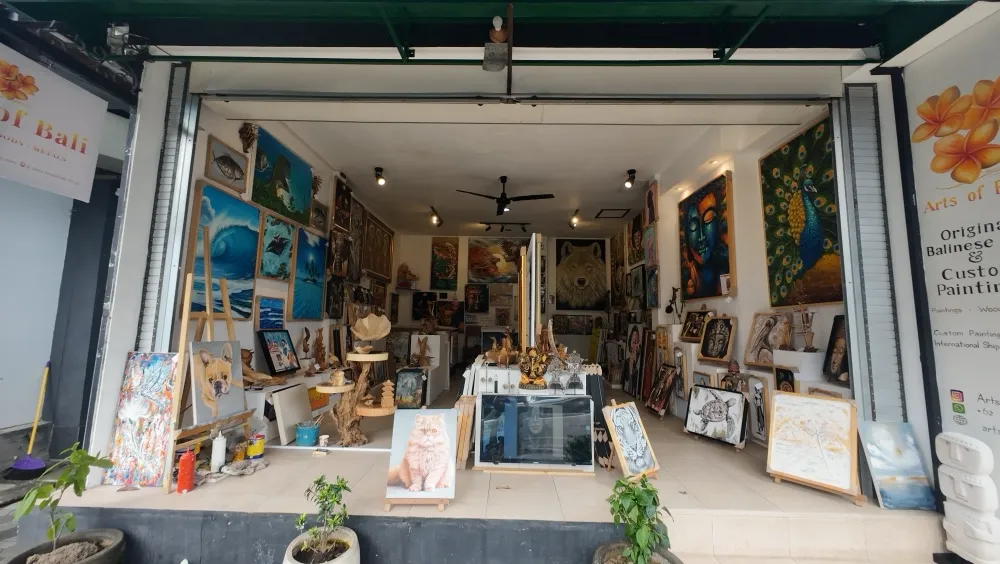
Arts of Bali has represented Balinese artists for collectors across more than 30 countries, shipping original works from our Seminyak gallery to private homes, boutique hotels, and interior design projects throughout Europe, North America, Australia, and Asia. Every work in this collection is painted by hand on premium canvas or velvet using professional-grade acrylic, and finished with layered impasto texture that only comes from a practiced palette knife. This page introduces five current large-format works, explains how scale and technique interact in Balinese painting, and gives you the proportional guidelines to match the right dimensions to your specific wall.
Last updated: June 2026
In gallery and collector conventions, a large-format Balinese painting typically measures at least 80cm on its longest side. Works above 100cm are considered statement-scale. Anything above 120cm on either dimension enters architectural territory — appropriate for hotel lobbies, villa foyers, or floor-to-ceiling feature walls. All five works presented on this page fall within the 60×120cm to 85×135cm range, placing them firmly in gallery large-format classification.
Why Large Balinese Paintings Work Differently in Modern Interiors
Interior architects working in Bali regularly face a specific challenge: how to give a contemporary villa the depth and warmth that matches the island’s natural environment, without making the space feel cluttered or deliberately “themed.” Original large-format paintings solve this more consistently than almost any other single design decision. The reason comes down to what large-scale palette knife technique does with light.
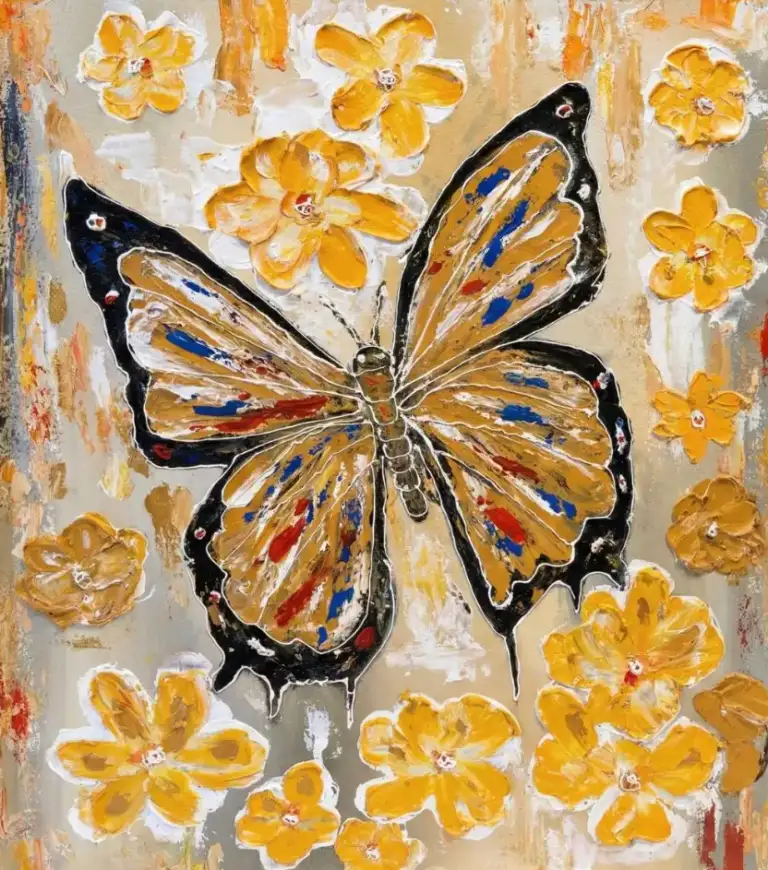
A 70×90cm textured canvas — particularly one with raised impasto layers of 3 to 5mm — catches ambient light differently at every hour of the day. Morning light rakes across the ridges and makes the texture legible. Late afternoon turns the same surface golden. This dynamic quality simply isn’t achievable with a flat print or a mass-produced canvas reproduction. The Art Basel & UBS Global Art Market Report has consistently documented growing collector demand for original mid-to-large format works in Southeast Asia, driven in part by the expansion of luxury villa developments across Bali where large, uninterrupted walls require art that holds its visual weight as a single piece. One original large Balinese painting achieves this more effectively than a gallery wall of smaller works — and often at a comparable or lower total cost.
The cultural dimension matters too. 巴厘岛绘画 has been central to the island’s identity for centuries, rooted in Hindu mythology and transformed by the island’s encounter with modernity from the early 20th century onward. When a large original Balinese canvas occupies a feature wall, it isn’t making a decorative statement — it’s making a cultural one. That specificity is precisely why serious collectors and interior designers choose original over reproductions.
The CollectionFive Large Original Paintings — Currently Available at Arts of Bali
Each of the following is an original, one-of-a-kind canvas. No prints, no reproductions, no editions. Every work ships worldwide from Seminyak, crated and insured. Prices are available on request via WhatsApp — works in this size range are typically priced between USD 350 and USD 950 depending on dimensions, ground material, and complexity of execution.
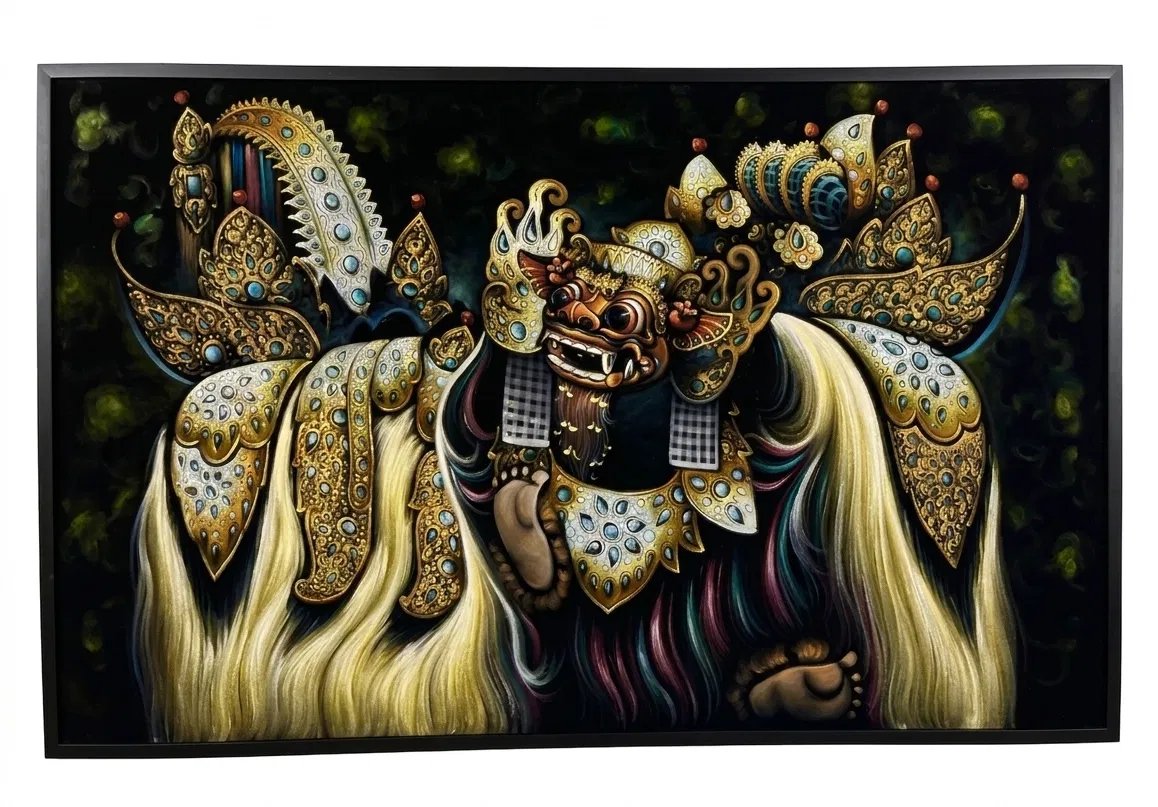
The Mystic Barong Majesty
The largest work in this collection and the most architecturally commanding. Barong — the mythological lion-guardian deity of Bali, representing the eternal struggle between good and evil — is depicted here with extraordinary ornamental detail. Layers of gold pigment, turquoise inlay patterns, and the deity’s ceremonial long white hair are rendered in traditional palette work against a deep forest-green field that reads almost like lacquer at distance. At 85×135cm on premium velvet, this painting was built for a feature wall. Velvet absorbs light differently from woven canvas: applied pigment develops a soft luminosity that flat canvas doesn’t replicate, which makes the gold tones glow rather than glare. This is a painting for collectors who understand that Barong isn’t decoration — placing it in a space carries deliberate cultural intent.
Professional acrylic on premium velvet
85 × 135 cm
Traditional palette, hand-painted
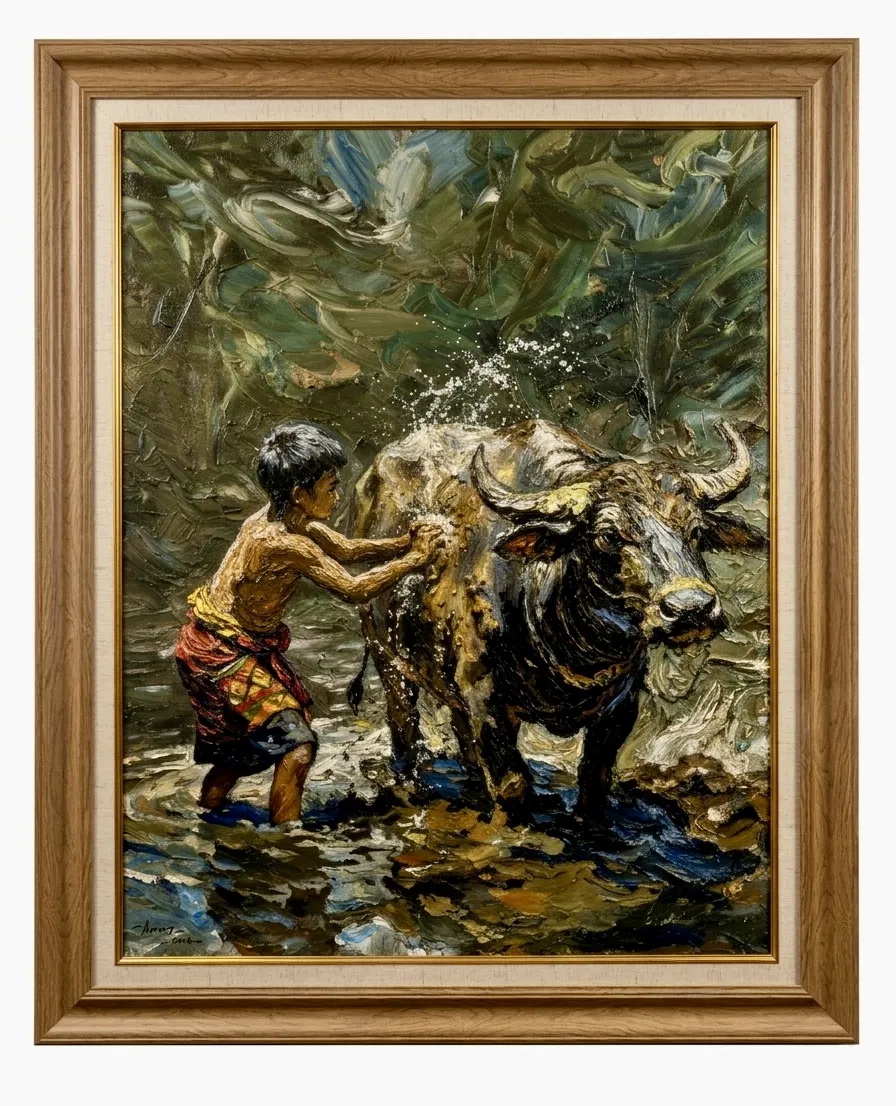
Serene Bond: Boy and Water Buffalo
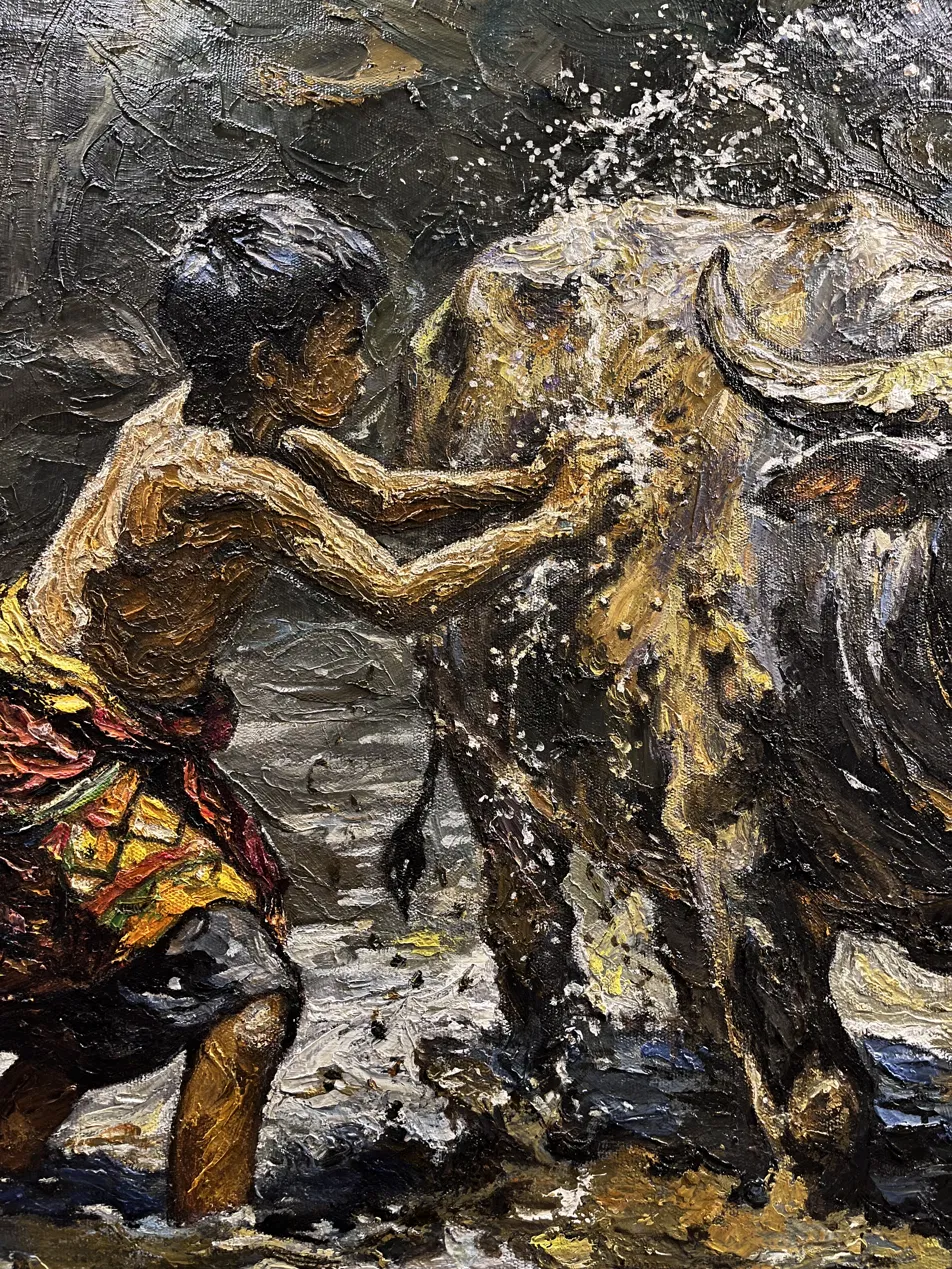
One of the most emotionally direct works in the gallery. A Balinese boy washes a water buffalo in a shallow river — a scene once common across Bali’s agricultural villages and now increasingly rare, which gives the painting the character of both portraiture and documentation. The palette knife technique here is exceptional up close: water droplets are rendered as raised white impasto points, the boy’s sarong is built from overlapping strokes of red, yellow, and green, and the buffalo’s wet hide catches light through layered browns and warm ochres. The composition fills 80×100cm without feeling dense — there’s genuine breathing room in the water, the foliage, the motion of the figures. This painting works equally well in a living room, a boutique hotel corridor, or a private study.
Professional acrylic on Marsoto canvas
80 × 100 cm
Palette texture, hand-painted
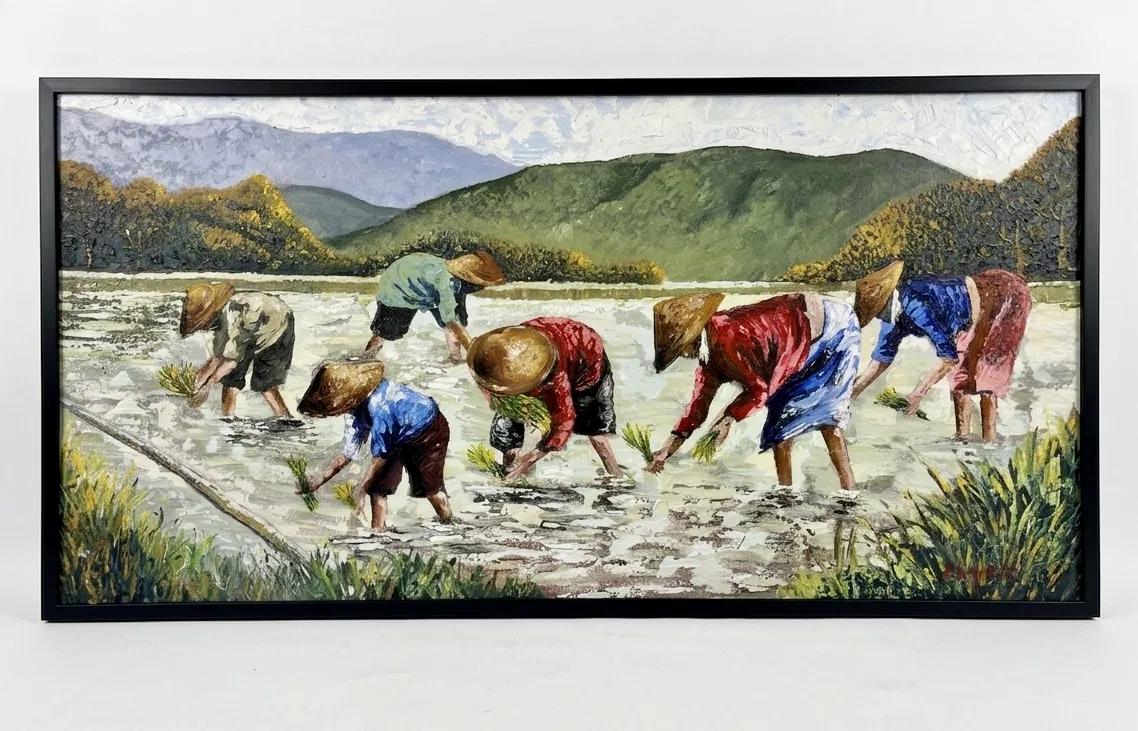
Symphony of the Rice Terraces
A wide panoramic format — 60cm tall, 120cm across — designed for the long horizontal walls found in dining rooms, corridors, and open-plan living spaces. Seven farmers plant rice in a flooded paddy field with the Balinese mountains rising behind them in layered greens and grays. The composition echoes the scale and rhythm of the subak cooperative irrigation system, recognized by UNESCO as an Intangible Cultural Heritage of Bali. For collectors who want a painting that documents a living tradition, not just represents a landscape, this is a strong choice.
Acrylic on Marsoto canvas | 60 × 120 cm | Palette texture
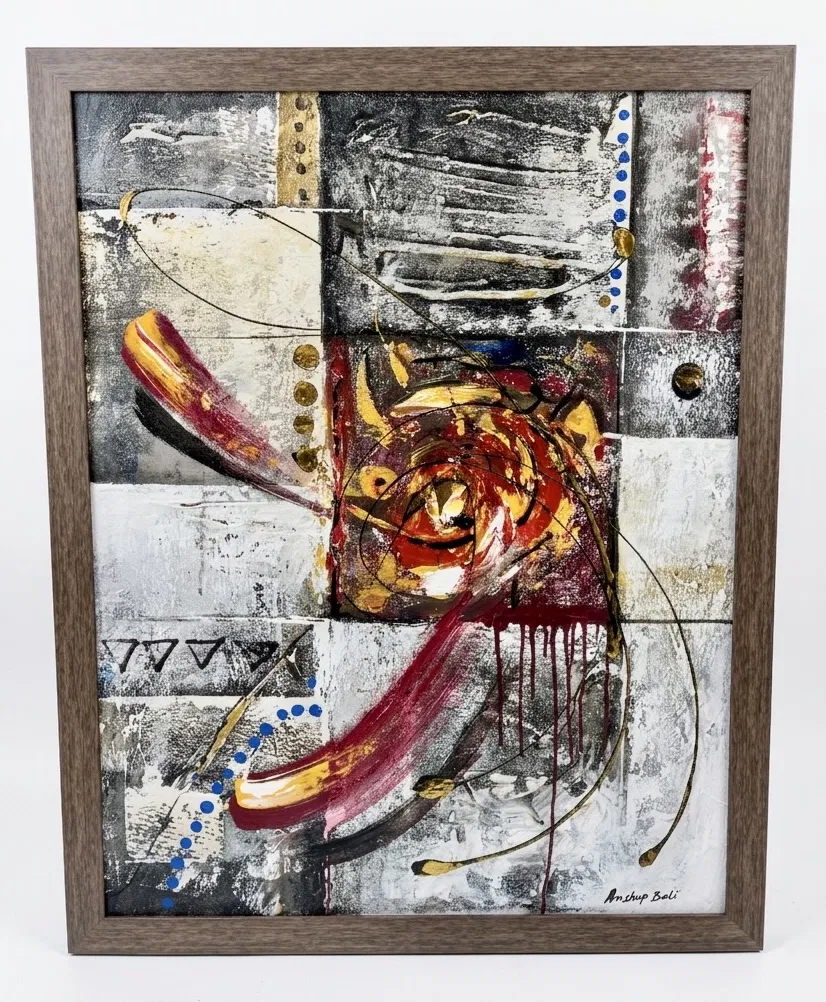
Infinite Horizon
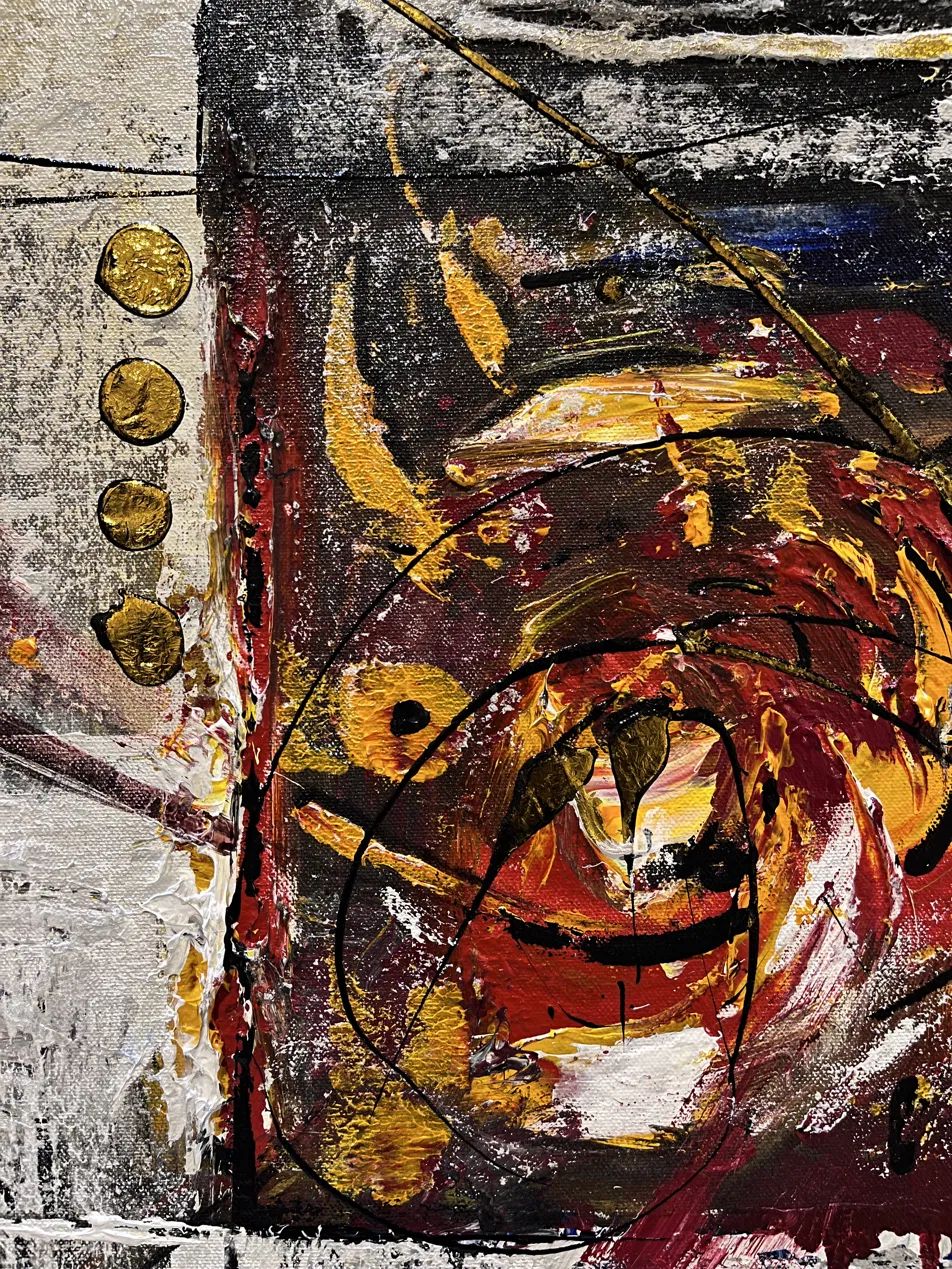
The most contemporary work in this collection, and the one most consistently requested by interior designers working with minimalist, industrial, or monochrome aesthetics. Artist Anchup Bali layers gray and white grounds with geometric grid sections, then cuts through the composition with sweeping arcs of deep crimson and gold. Gold-leaf dots punctuate the vertical axis with calm deliberateness. The result reads as sophisticated and restrained from across a room, but rewards closer attention with considerable painterly energy. Works equally well as a standalone statement in a neutral-toned bedroom or as the visual anchor in a curated two-piece arrangement.
Acrylic on Marsoto canvas | 70 × 90 cm | Palette texture, gold leaf | Signed: Anchup Bali
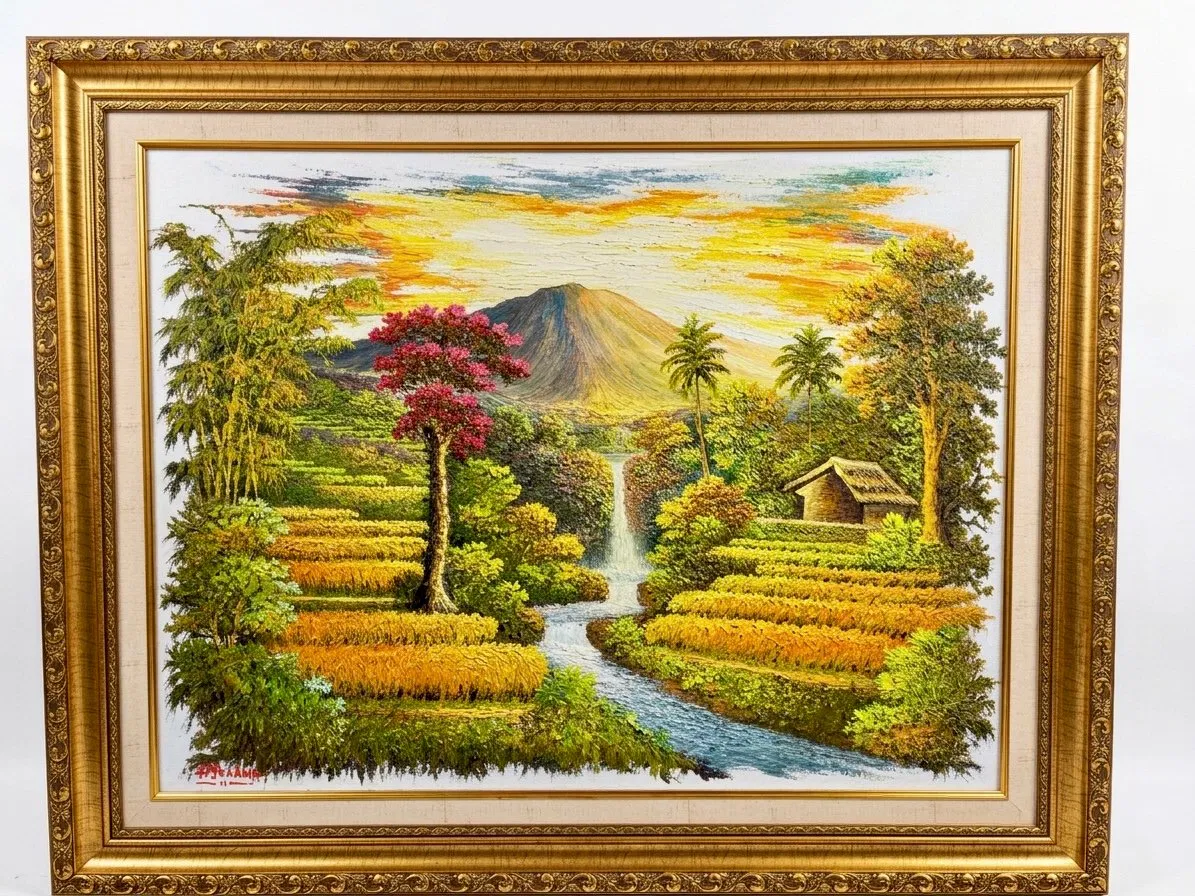
Rice Field Indonesian Culture
A classical Balinese landscape in the tradition that made the island’s painting schools internationally recognized — a river-fed rice field, cascading waterfall, lone thatched structure, and a volcano presiding under a golden sunset sky. The ornate gold frame bridges traditional Indonesian visual culture with Western framing conventions familiar to international collectors. The palette technique brings unusual depth to the vegetation: each tree is rendered in layered strokes rather than flat fill, so the eye keeps discovering detail at any distance.
Acrylic on cotton canvas | 70 × 90 cm | Palette texture, ornate gold frame
Why Palette Knife Painting Gains Power at Large Scale
“At 70 centimeters or more, the palette knife’s geometry becomes architectural. Each stroke is a plane, not a line. The painting stops being an image and becomes a surface.”
— Arts of Bali gallery team, on large-format impasto techniqueMost of the paintings on this page use palette knife as the primary application tool — either exclusively or in combination with conventional brushwork. Understanding why this matters at large scale helps explain why buyers who view these works in person consistently describe the experience as fundamentally different from viewing the same piece in a photograph.
Palette knife impasto builds paint in three-dimensional layers rather than flat film. In a standard large-format work, the highest ridges of paint project 3 to 5mm above the canvas surface. This means that ambient light — from windows, ceiling spotlights, or natural side-lighting — rakes across the surface at a low angle and creates shifting shadows and highlights throughout the day. A painting that reads as predominantly dark at noon can appear luminous and warm by late afternoon. This property is particularly valuable in Bali interiors, where light quality changes significantly between wet and dry season, and between indoor and outdoor living areas separated only by open walls or glass.
The Marsoto canvas used in several of these works is a commercial-grade heavy linen that accepts thick impasto without warping over time. For the Barong work on velvet, the plush ground absorbs paint differently: strokes build softly rather than sharply, which suits the ceremonial richness of the subject.
Buyer’s GuideHow to Choose the Right Size Painting for Your Wall
Matching painting dimensions to wall dimensions is the most common practical question buyers bring to the gallery. The following proportional guide is based on the conventions used by interior designers working with large-format art in Bali villas and private residences. All five works described on this page are referenced by name where they correspond to each category.
The general rule applied by most interior designers: a painting should cover roughly 60 to 75 percent of the available wall width. For a sofa arrangement — one of the most common placement scenarios — the art or grouping should be no wider than the sofa, and ideally 5 to 10cm shorter on each side. Hanging height matters just as much as width: the visual center of the painting should sit approximately 145 to 150cm from the floor, corresponding to the average standing eye level of an adult.
材料Canvas, Cotton, Marsoto, and Velvet — What the Ground Material Means for Large Works
Large-format paintings place more physical demand on their ground material than smaller works. The weight of layered impasto, the stress of stretching a large canvas across wooden bars, and the humidity cycles of Bali’s tropical climate all affect how a painting ages over decades. The five works here use three different ground materials — each with specific properties worth understanding before you buy.
Marsoto canvas is a heavy-weight linen-cotton blend with a pronounced surface tooth — the texture that determines how much paint the ground can hold before each layer needs to dry. For palette knife impasto at this scale, Marsoto provides the structural stability needed to prevent cracking in raised paint layers, even in changing humidity conditions. Symphony of the Rice Terraces, Serene Bond, and Infinite Horizon are all on Marsoto for this reason.
Cotton canvas is lighter and more flexible, making it well suited to landscapes where finer detail work is more central to the technique than dramatic surface relief. Rice Field Indonesian Culture uses cotton canvas: the palette texture is present but controlled, with less pronounced physical height than the Marsoto works. The cotton ground also receives color with slightly more warmth, which suits the golden-toned sunset sky in this painting.
Premium velvet is the most unusual ground in this collection, used exclusively for The Mystic Barong Majesty. Velvet’s pile absorbs paint differently from any woven canvas — it creates a soft, luminous quality in applied pigment and gives ceremonial subjects a visual richness that flat grounds don’t replicate. Velvet grounds are not common in Balinese gallery painting. Their use here is a deliberate material choice made to complement the spiritual weight of the Barong subject, not a decorative flourish.
International DeliveryShipping Large Paintings from Bali to Any Country
Shipping large original paintings internationally requires more preparation than smaller works, but it is a routine process at Arts of Bali. Every large work ships in a custom wooden crate built to the painting’s dimensions, with foam corner protection and acid-free tissue lining the interior surface. Insurance is included for the declared artwork value on all international shipments. Delivery to Europe, North America, and Australia typically takes 7 to 14 business days. For architectural-scale commissions above 100×150cm, sea freight via specialist art logistics can be arranged on request — this is sometimes the more practical option for very large formats and comparable in cost to air freight for equivalent weight.
If you are visiting Bali and prefer to carry a smaller work home personally, our team prepares travel-ready packaging suitable for aircraft hold luggage for works up to approximately 70×90cm. For everything above that size, shipping from the gallery is the more practical choice. For the full process — crating, insurance, customs documentation — see our guide to shipping paintings from Bali. Most buyers who purchase large-format works in person choose gallery shipping as the delivery method, treating the gallery visit as the selection experience and arranging delivery separately.
真实性How to Identify an Authentic Large Balinese Painting
The Bali art market contains a wide range of quality levels — from mass-produced tourist canvases to gallery-grade originals by named professional artists. Understanding the difference matters especially for large-format purchases, where the investment is more substantial and the painting will occupy a prominent position in a home or commercial space for decades.
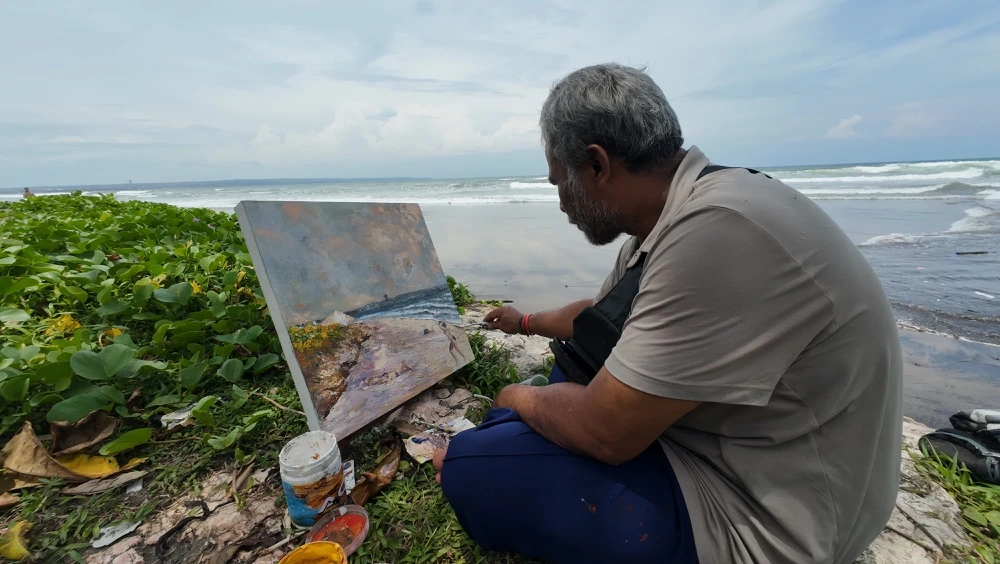
An authentic original large painting from a reputable Balinese gallery will have several verifiable characteristics. The paint surface has physical dimensionality: on a palette knife work, you can feel — and see in raking light — the ridges and edges of individual strokes. The canvas is mounted on a rigid wooden stretcher bar system, not glued to cardboard or rolled thin like a poster print. The artist’s signature is applied directly in paint to the canvas, not printed. Works from Arts of Bali come with a certificate of authenticity documenting the artist name, technique, medium, dimensions, and gallery provenance. On request, the gallery can provide photographic documentation of the work in progress and the artist at work.
One practical test when viewing a large Balinese painting in person: hold a light source at a low angle to the canvas surface. A genuine impasto palette knife work will cast visible micro-shadows across the paint ridges. A printed canvas — even one with a simulated texture coating — will show no directional shadow variation because the surface is essentially flat. This physical test is reliable even for works behind glass.
Frequently Asked Questions About Large Paintings from Bali
What is considered a large painting in Bali’s art market? ▼
Can large Balinese paintings be shipped to Europe, Australia, or the USA? ▼
What painting size works best for a large villa feature wall in Bali? ▼
Are the large paintings at Arts of Bali original or printed reproductions? ▼
How long does a custom large painting commission take from Arts of Bali? ▼
What hanging system is recommended for large original paintings? ▼
Inquire About a Large Painting
All five works on this page are available for purchase and international delivery. Large-format originals in this collection are priced between USD 350 and USD 950 depending on size, material, and complexity. For pricing details, custom commissions, or sizing consultations, contact the gallery directly via WhatsApp.
在 WhatsApp 上聊天 Browse Full Collection