Balinese art symbols are the recurring figures and motifs, deities, guardians, sacred marks, and fertility icons, that appear again and again across painting, wood carving, and temple architecture on the island. The ones collectors and visitors ask about most often include Garuda (the eagle mount of the god Vishnu), Naga (the serpent tied to water and the underworld), Ganesha (the elephant headed remover of obstacles), Kala and Bhoma (the guardian faces carved above temple gates), the swastika (an ancient symbol of wellbeing, unrelated to and far older than the 20th century symbol it’s sometimes confused with), and the lotus (a symbol of purity and spiritual awakening). Once a handful of these are familiar, a painting or carving that looked purely decorative starts to read like a sentence.
Key Takeaways
- Ten recurring symbols show up across nearly every school of Balinese painting and wood carving, so learning a handful makes almost any piece easier to read.
- Garuda and Naga are traditionally shown as rivals in the same composition, a detail rooted in a specific myth rather than two unrelated animals placed side by side.
- The swastika seen on Balinese temples, textiles, and offerings is an ancient Hindu symbol of wellbeing that is thousands of years older than, and visually distinct from, the 20th century symbol some Western visitors associate it with.
- Not every symbol on this list has a matching painting in a gallery collection. Cili, for example, shows up mainly in ceremonial offerings and craft rather than framed art, at least in Arts of Bali’s current collection.
- Barong, one of Bali’s most recognized guardian figures, already has a dedicated guide on this site, so this glossary focuses on two guardian figures that haven’t had a full write-up yet: Kala and Bhoma, and the trisula.
Definition: Balinese art symbols are recurring deities, guardians, sacred marks, and fertility figures used across Balinese painting, carving, and temple architecture, each carrying a specific meaning rooted in Balinese Hindu belief.
Ask a visitor what they remember from a Balinese temple gate or a gallery wall, and the answer is rarely the brushwork. It’s a face with wide eyes and bared fangs above a doorway. A snake carved along a staircase railing. A bird with a king riding on its back. Balinese art is dense with recurring figures, and once a handful of them are familiar, paintings and carvings that looked purely decorative start to read like sentences.
This guide walks through ten of the symbols collectors and visitors ask about most: what each one represents, where it actually shows up (painting, wood carving, or temple architecture), and, where Arts of Bali has a piece that features it, an example from our own Seminyak collection. Our complete guide to Balinese art touches on four of these symbols in a few short lines. This guide goes deeper, symbol by symbol.
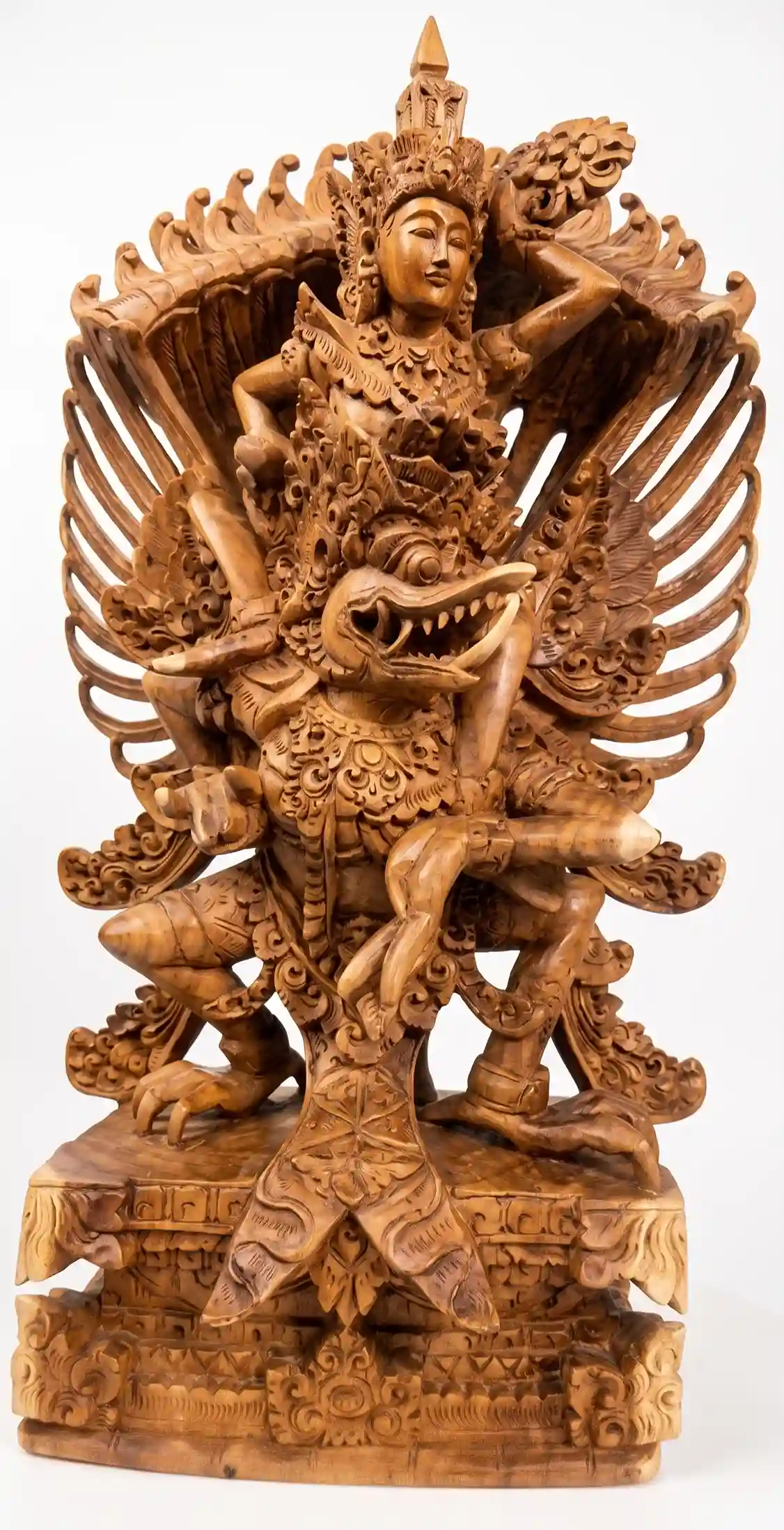
Deities & Mythical CreaturesGaruda: The Eagle Mount of Vishnu
Garuda is a mythical eagle, part bird and part man in most depictions, who serves as the mount, or vahana, of the Hindu god Vishnu. In the wider Hindu tradition, Garuda is also the king of birds, said to have won that standing by battling the gods themselves to free his mother from slavery, a story most often told through his search for amrita, the nectar of immortality. Vishnu was impressed enough by Garuda’s strength to choose him as his mount, an alliance still shown constantly across Balinese temple carving and painting today, usually as Vishnu standing or seated on Garuda’s back or shoulders.
In Bali specifically, Garuda carries an extra layer of meaning as a national symbol. Garuda Pancasila, Indonesia’s coat of arms, is a stylized Garuda, and Garuda Wisnu Kencana, the giant statue overlooking the south of the island near Uluwatu, has made the image locally iconic well beyond its religious origin. That double meaning, sacred mount and national emblem, is part of why Garuda is usually the first symbol a visitor learns to recognize.
Read our full guide on Garuda Wisnu Kencana wood carving for the Ramayana story behind the newest relief panels in the collection.
Naga: The Serpent of Water and the Underworld
Naga is a serpent deity associated with water, rivers, and the underworld realm of Patala. Naga figures guard temple staircases and gateways across Bali, often carved as long serpent bodies running down a balustrade, and they appear constantly in Kamasan style narrative painting, where entire epics play out with Naga as a recurring character rather than a background detail.
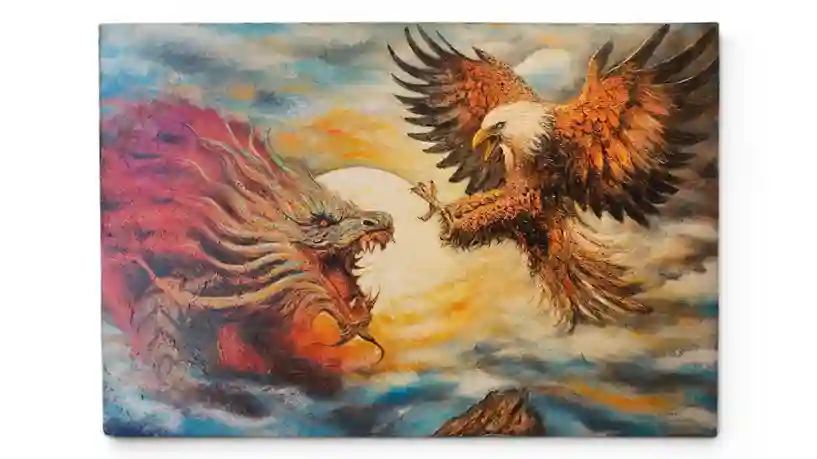
Naga and Garuda are traditionally shown as rivals, not simply two unrelated animals that happen to appear in the same piece. According to the myth, Garuda’s mother was enslaved to the nagas, and Garuda’s fight to free her is what set the two families against each other. Seeing both in the same composition, an eagle bearing down on a serpent, is usually a direct reference to that story, and to the wider idea of tension between sky and water, or above ground and underworld.
Arts of Bali’s Legendary Dragon & Eagle Spirit Painting depicts almost exactly this myth, a large scale battle between a dragon like serpent and an eagle rendered in bold palette knife texture, even though it’s listed under a more general title rather than the word Naga itself. If a piece that reads specifically as this myth is what you’re after, that’s the one in the current collection worth asking about.
Ganesha: The Remover of Obstacles
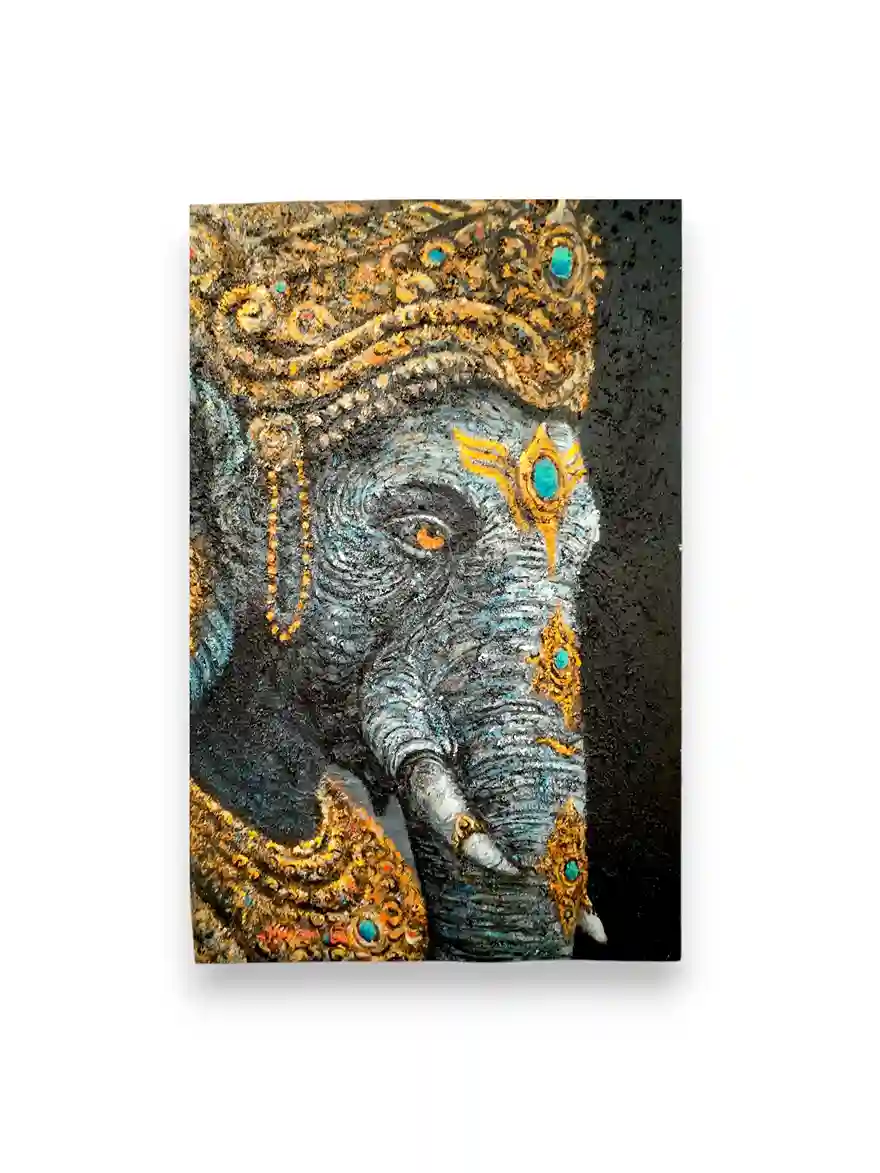
Ganesha is the elephant headed son of Shiva and Parvati, and one of the most widely recognized deities across Hindu traditions, Bali included. He’s known primarily as Vighnaharta, the remover of obstacles, which is why Ganesha is traditionally invoked before starting something new, a journey, a building, a business, rather than at the end of one.
In Balinese art, Ganesha shows up across mediums, from classical Kamasan style narrative painting to contemporary sand texture work to wood relief carving. Our Kamasan Ganesha Painting guide covers the classical technique in depth if that’s the style you’re drawn to. Arts of Bali’s current collection also includes a contemporary sand texture piece, Sacred Textured Ganesha Divinity Painting, for a more modern, sculptural take on the same figure.
Kala and Bhoma: The Guardian Face Above the Gate
Two more figures worth knowing guard the threshold rather than ride into battle. You’ll also come across Barong, the lion-like protective spirit with the fierce mask and shaggy mane, in temple ceremony and in painting across the island. Barong already has a full guide of its own on this site, so rather than repeat that story here in miniature, this section covers two guardian figures that haven’t had a dedicated write-up yet: the face above the temple gate, and the weapon carried by the goddess who fights beside it.
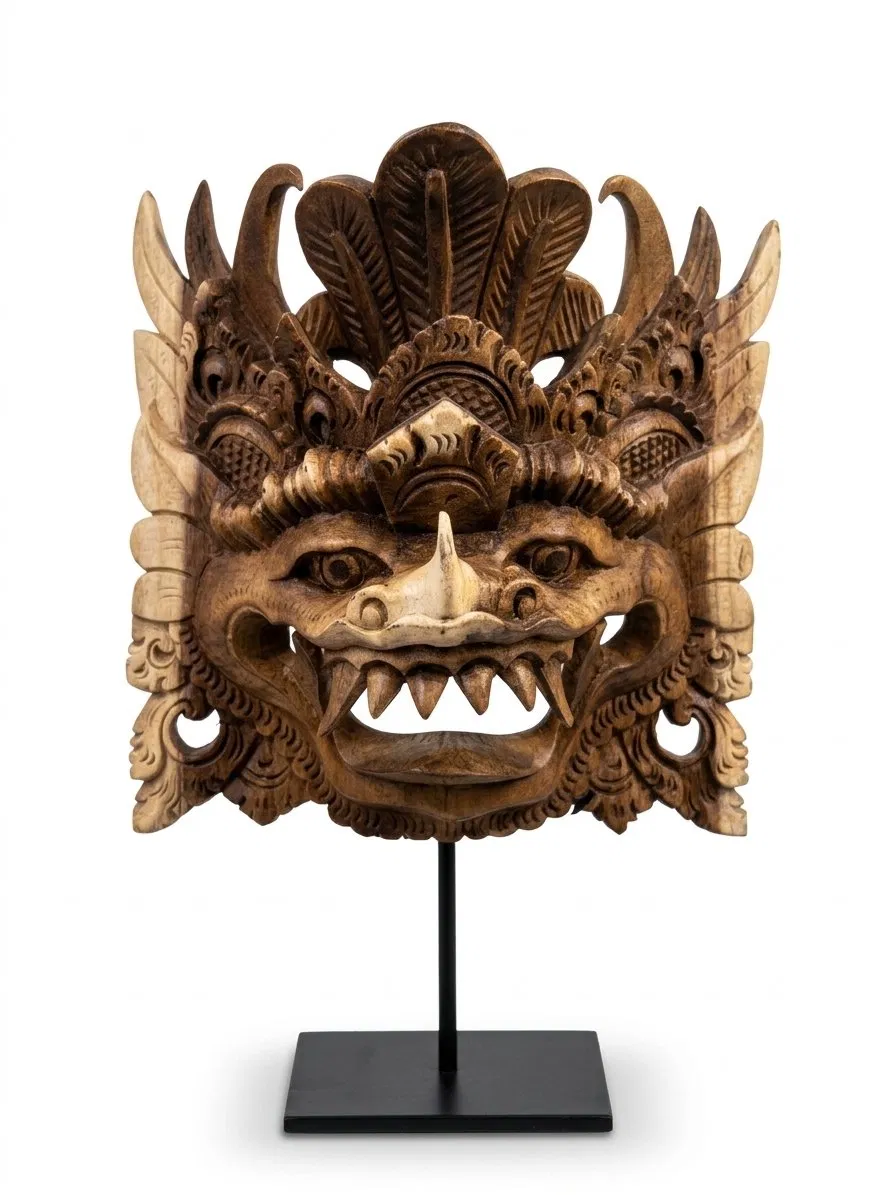
Look above almost any Balinese temple gate, the split candi bentar gate or the roofed kori agung entrance, and there’s a wide eyed, fanged face carved directly into the stonework or woodwork above the opening. That face is usually identified as Kala, sometimes as Bhoma (also spelled Boma), names that are often used interchangeably in gate ornamentation even though they come from slightly different corners of the mythology. The purpose stays consistent either way: a fierce guardian face meant to ward off harmful spirits before they cross the threshold.
Notre Balinese Temple Gate Wood Carving guide covers the candi bentar and meru shrine forms these faces typically sit above, if you want the fuller architectural picture. In the current collection, the closest piece to this figure is the Balinese Bomo Wooden Mask, an antique style hand carved mask that the listing itself describes as capturing Bhoma, the sacred guardian of nature and holy spaces, with the dramatic fangs and crown that mark the type.
Trisula: The Three-Pronged Weapon of Shiva and Durga
Trisula is the trident carried by Shiva and, in her demon slaying form, by the goddess Durga. In Bali it shows up less often as a standalone painting subject and more as an architectural detail, mounted as a finial on top of a padmasana shrine or a temple roofline, and as an attribute held in the hand of Durga or Shiva figures in relief carving and statuary.
Arts of Bali doesn’t currently have a piece built specifically around the trisula as its own subject, the way the collection has dedicated Garuda or Ganesha pieces. If it’s a detail you’re specifically hunting for, it’s worth asking directly, since it does turn up as an attribute within broader Durga and Shiva pieces rather than as a title of its own.
Sacred SymbolsThe Swastika: An Ancient Symbol of Wellbeing
The swastika predates its 20th century association in the West by roughly three thousand years, and in Bali it carries none of that later meaning. It’s an ancient Hindu, Buddhist, and Jain symbol representing wellbeing, good fortune, and the cyclical nature of existence, and it appears on Balinese temple walls, in offering design, and occasionally in textile pattern, drawn in a form that’s visually distinct from the tilted, unadorned hooked cross used as a 20th century hate symbol in Europe. The Hindu version is typically upright rather than rotated 45 degrees, and is often shown with a dot in each of the four quadrants.
This is genuinely one of the more sensitive symbols on this list for a Western visitor to encounter without context, since the two visual forms can look similar at a glance despite carrying opposite meanings, one ancient and auspicious, the other a 20th century symbol of hate. If you’re a collector considering a piece that includes it, understanding that context upfront, rather than after the fact, is worth the extra minute.
Om and Padmasana: The Syllable and the Empty Throne
Om, written Ongkara in Balinese script, is the sacred syllable representing the sound of creation in Hindu philosophy, and it shows up carved or painted at the top of shrines and in spiritual artwork across the island. Padmasana, literally lotus throne, is the tallest and most sacred shrine structure in a Balinese temple compound, built as an empty seat rather than a housed statue, because the supreme god in Balinese Hinduism, Sang Hyang Widhi or Acintya, is considered formless and beyond representation.
The two are frequently paired: the Ongkara symbol carved into the top of the padmasana shrine itself, marking the empty throne as the seat of a god who isn’t given a face or a body elsewhere in Balinese art. It’s a useful pairing to know if you’re looking at temple photography or shrine focused artwork and wondering why the most important seat in the compound appears to have nobody sitting in it.
Wisdom & PurityAngsa (Hamsa): The Swan That Carries Saraswati
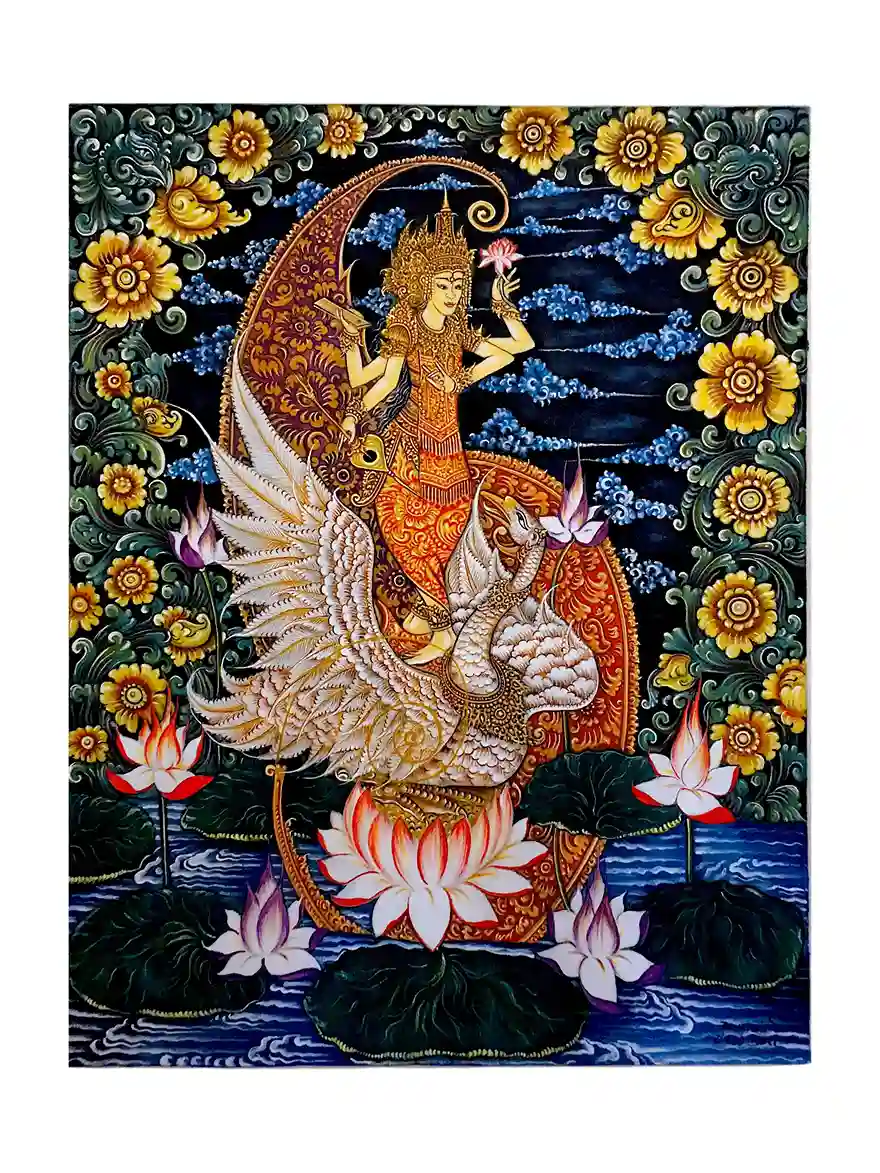
Angsa, also known by the Sanskrit term hamsa, is the swan that serves as the vehicle of Saraswati, the goddess of knowledge, music, and the arts. Beyond simply being her mount, the hamsa carries its own symbolism in Hindu thought as a figure of discernment, traditionally said to be able to separate milk from water, a metaphor for the ability to separate truth from illusion.
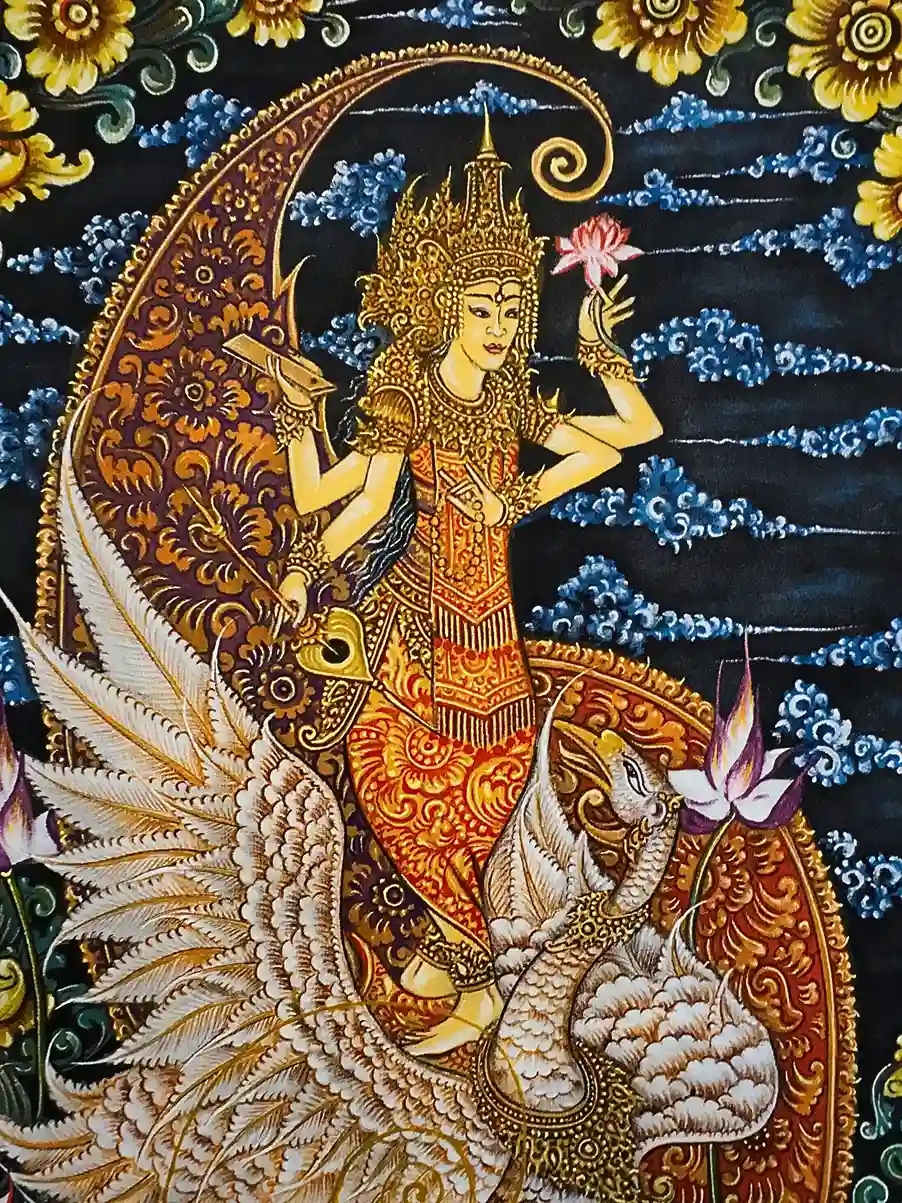
Arts of Bali’s Goddess Saraswati on Sacred Swan Traditional Ubud Painting shows the pairing directly: Saraswati seated on her swan, painted in the fine brushwork of the classical Ubud style, surrounded by the lotus blooms she’s traditionally shown among.
Lotus (Padma): A Recurring Symbol of Purity
The lotus grows rooted in mud, underwater, and rises to bloom clean above the surface, which is why it’s read across Hindu and Buddhist art alike as a symbol of purity and spiritual awakening rising out of difficult or imperfect conditions. Several deities, Saraswati among them, are traditionally shown seated on or surrounded by lotus blooms, and the padmasana shrine discussed above takes its name directly from padma, the lotus itself.
It rarely appears in Balinese art as a lone subject the way Garuda or Ganesha might headline a painting. It shows up instead as a recurring motif within a larger scene, decorative gold work, a throne, the ground a deity stands on, which is exactly how it appears in the detail work of the Saraswati painting above.
Cili: The Rice Goddess Figure Behind Every Offering
Cili is a stylized feminine figure, an hourglass shaped body topped with an elaborate fan shaped headdress, that represents Dewi Sri, the goddess of rice and fertility, or fertility and prosperity more broadly. Unlike most of the figures on this list, Cili is less a painting subject and more a folk art form in its own right, most commonly woven from young palm leaf (janur) into offering decorations, cut into rice cake shapes, or carved into wood and stone at temple and market entrances.
If you’ve noticed the decorative fan shaped figures worked into a lamak, the woven strip that hangs from an offering shrine, or into ceremonial gate decoration during a temple anniversary, that was very likely a Cili. Arts of Bali’s current painting and carving collection doesn’t include a dedicated Cili piece, since the form belongs more to ceremonial craft than gallery art, but it’s one of the symbols visitors and researchers ask about most once they start noticing it in daily Balinese ceremony.
At A GlanceQuick Identification: 10 Balinese Art Symbols
| Symbol | Represents | Where You’ll See It |
|---|---|---|
| Garuda | Vishnu’s eagle mount; strength and devotion | Statues, relief carving, painting, national emblem |
| Naga | Serpent of water and the underworld | Staircase and gate carving, Kamasan narrative painting |
| Ganesha | Remover of obstacles; wisdom | Painting, wood relief carving, entrances |
| Kala / Bhoma | Guardian face warding off harm | Carved above temple gates (candi bentar, kori agung) |
| Trisula | Weapon of Shiva and Durga | Shrine finials, Durga and Shiva statuary |
| Swastika | Ancient symbol of wellbeing | Temple walls, offering design, textile pattern |
| Om (Ongkara) / Padmasana | The sacred syllable and the empty throne of the supreme god | Carved atop padmasana shrines |
| Angsa (Hamsa) | Saraswati’s swan; discernment | Painting of Saraswati, temple carving |
| Lotus (Padma) | Purity, spiritual awakening | Decorative motif within larger scenes and thrones |
| Cili | Dewi Sri; rice and fertility | Woven offerings (lamak), rice cakes, ceremonial carving |
This is a starting reference, not an exhaustive list. Balinese art includes many more recurring figures than the ten covered here.
Questions fréquemment posées
What are the most common symbols in Balinese art?
What does Garuda mean in Balinese art?
Why are Garuda and Naga often shown fighting each other in the same piece?
Is the swastika seen in Balinese temples related to the symbol used in Nazi Germany?
What’s the difference between Kala and Bhoma?
Does a painting need to include one of these symbols to be considered good Balinese art?
Where can I see the Cili figure if it doesn’t usually appear in paintings?
Curious What a Symbol in a Piece You’ve Seen Actually Means?
Send us a photo of the painting or carving you’re looking at and we can help identify what’s depicted and why. For the wider picture of Balinese painting, carving, and craft styles, our complete Balinese art guide is a useful starting point too.
Discuter sur WhatsApp Parcourir la galerie