“A brush apologises for its marks. A palette knife does not. That is why I chose the knife.”
There is a particular kind of painting that you do not simply look at. You feel an impulse to reach out and touch it, to see if the ridge of red along a Legong dancer’s sleeve is as raised as it appears, or if the intricate gold pattern of a Barong mask actually extends from the canvas the way your eye insists it does.
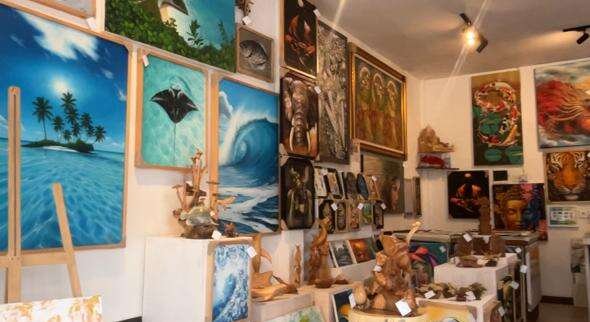
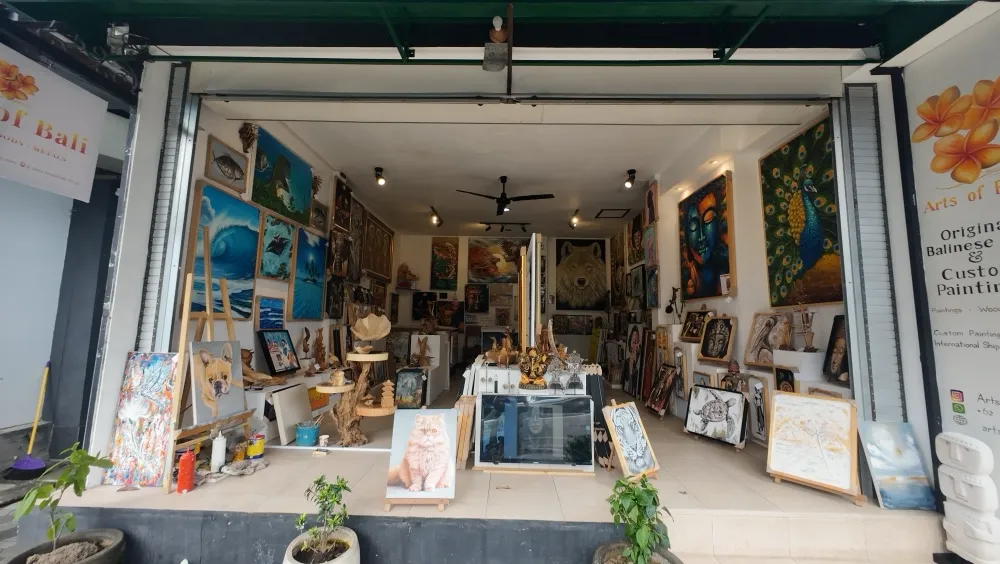
For the finest palette knife painting Bali has to offer, Arts de Bali in Seminyak is the place to find it, expressed through the language of one artist in particular: Upeksa. His work does not describe Bali. It sculpts Bali, layer by accumulated layer, in paint thick enough to cast its own shadow.
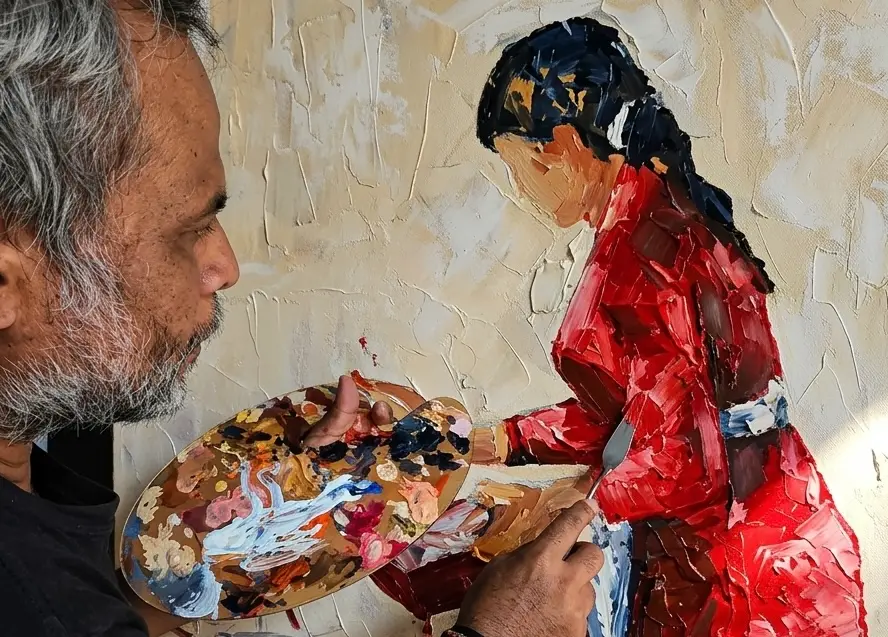
What Palette Knife Painting Actually Is — and Why It Feels Different From Everything Else
Most people encounter the term for the first time in front of a painting that stops them. They are looking at a canvas that seems wrong in the best possible way: too textured, too raised, too physically present to be a flat surface.
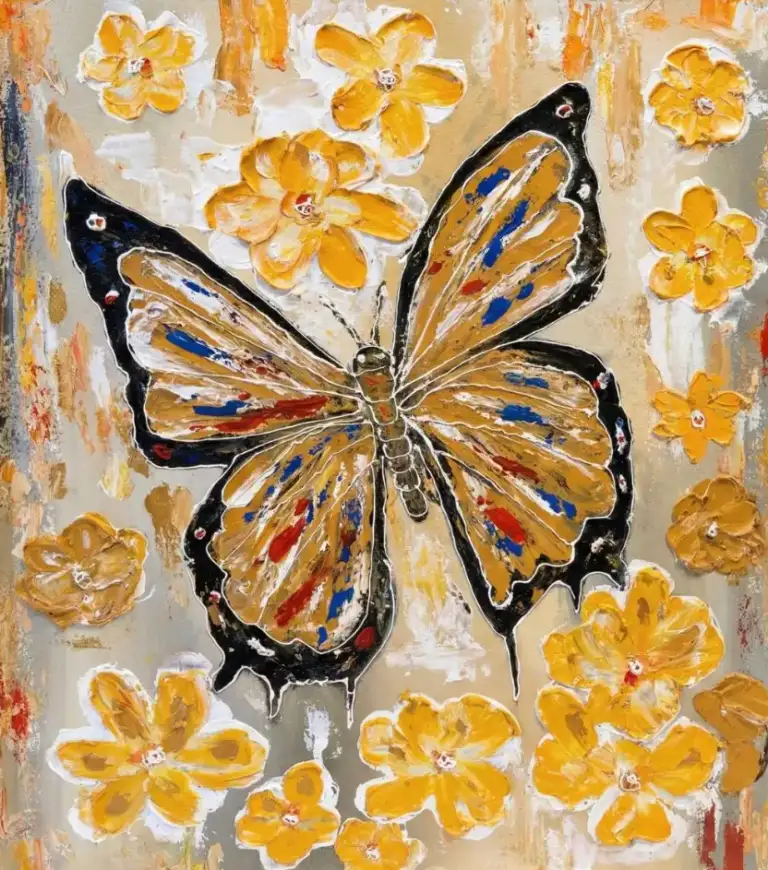
The paint is not smooth. It sits on the canvas in ridges and peaks and compressed planes, catching light at one angle and shadow at another, changing as you move around it. What they are looking at is the impasto technique, applied with a palette knife rather than a brush.
As defined by Tate, impasto is an area of thick paint or texture in a painting where the surface carries its own reality rather than acting as a smooth window into an illusionist world. The word comes from the Italian for “dough” or “mixture” — and the analogy holds: palette knife painting is to conventional painting what sculpture is to drawing.
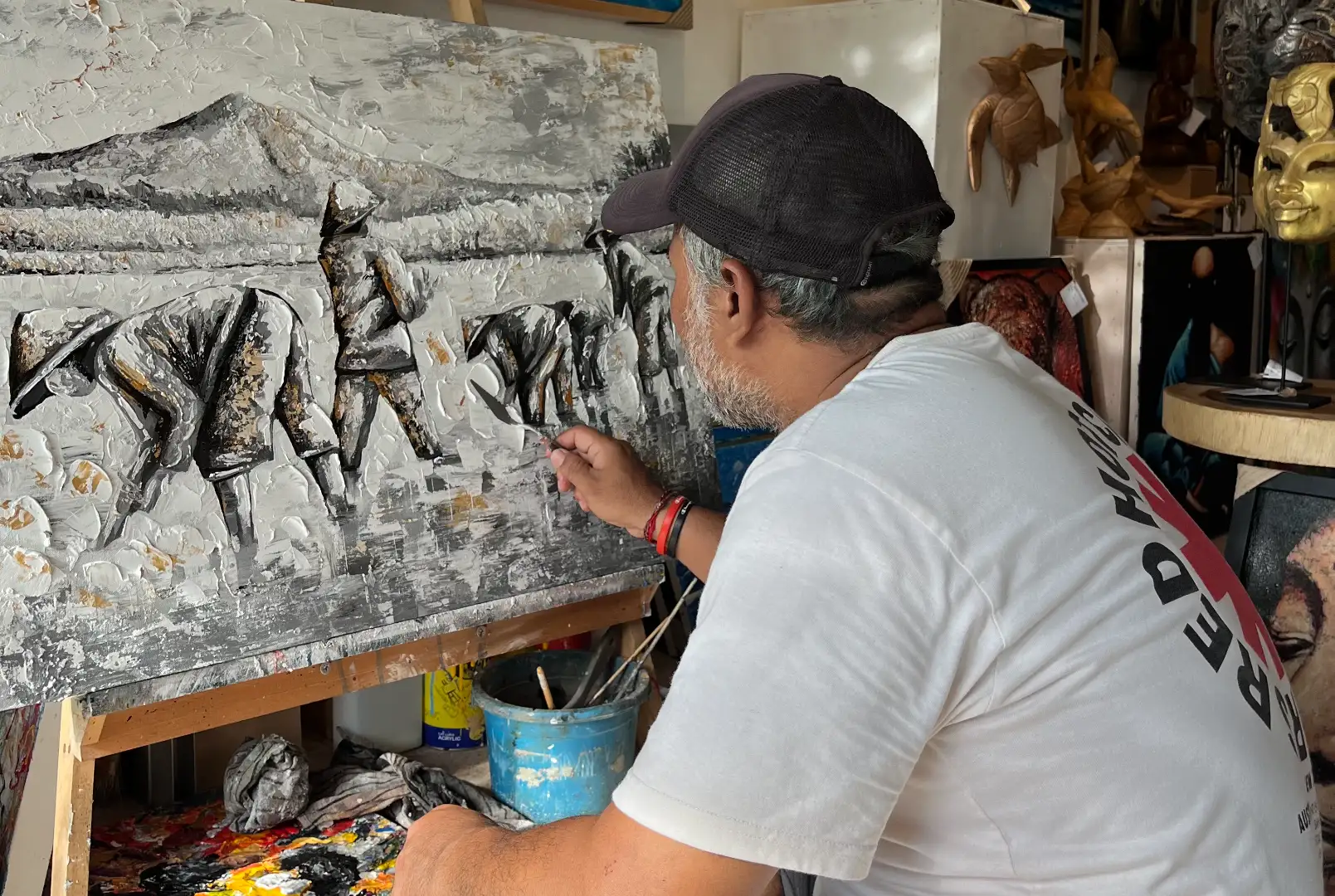
The artist does not describe a form. They build it. Paint is loaded onto a steel blade and laid onto the canvas in one decisive movement, or scraped back, or pressed flat, or drawn to a point. There is no going back over a wet stroke the way a brush allows. Each mark is a commitment.
The technique has a lineage stretching back to the Venetian Renaissance, with Titian and Tintoretto among the first to exploit paint’s capacity for physical thickness. Rembrandt used it to make jewellery gleam and fabric fold. Van Gogh carried it furthest, applying paint so heavily in works like Starry Night that the surface seems to move in real light, the night sky churning in thick directional ridges that no flat brush could produce.
What is remarkable is that this same technical impulse has found a natural home here. It has transformed the island’s sacred imagery, making palette knife painting Bali a distinct and powerful genre in the hands of local artists.
“The impasto technique has a lineage from Titian to Van Gogh. In Bali, Upeksa carries it forward into subjects those masters never imagined.”
Upeksa: The Balinese Artist Who Chose the Blade
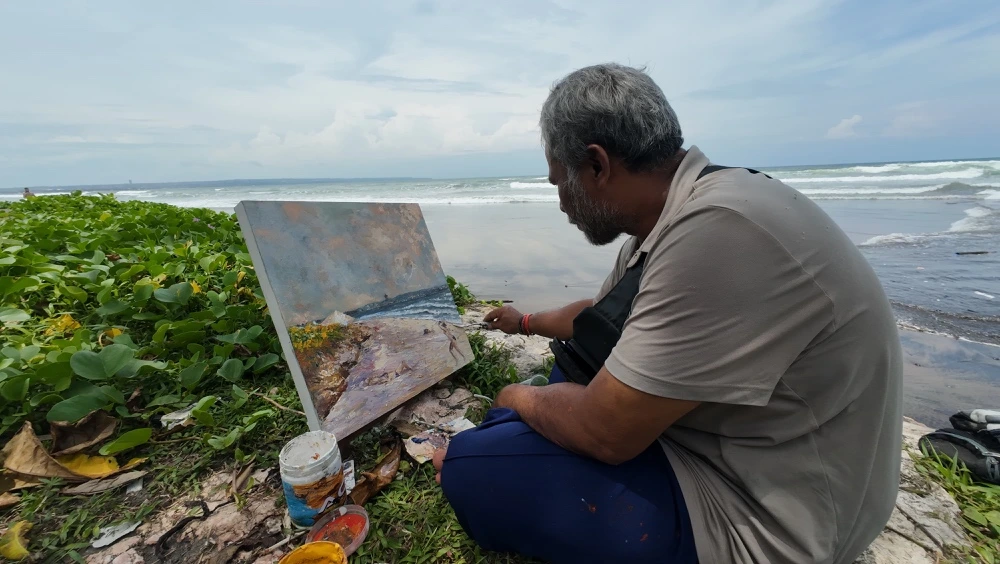
Upeksa is a master of peinture à la palette bali, working in a tradition that stretches back centuries. In the broader story of Balinese art as documented by National Geographic, artists who work across the full range of Balinese subjects have built a tradition that continues to evolve. Upeksa is one such artist, working across sacred and everyday imagery with equal commitment. He brought a palette knife with him.
His choice of technique is not an accident or an aesthetic preference in the decorative sense. It is a position. Where the brushed line must negotiate between intention and surface, the palette knife does not negotiate. It applies, or it does not. The paint either holds its ridge or it collapses.
There is an honesty to the result that Upeksa finds essential, particularly when the subject is Balinese. When the painting deals with a ceremony, a dancer, or a spirit figure whose energy is large and immediate and physically present in the world, the technique has to match. For Upeksa, mastering peinture à la palette bali is the only way to authentically capture this energy.
His subjects are the subjects Balinese painting has always claimed as its own: the dancer, the ceremony, the sacred creature, the rice field, the everyday. What changes is the medium’s relationship to the subject. A finely brushed Legong dancer is beautiful. A palette knife Legong dancer, built from impasto layers of vibrant red and blue, has a presence that goes beyond beauty.
The textured surface catches real light from whatever room it hangs in and behaves differently across morning and evening and lamplight. The painting is not static. It continues to participate in the light around it long after the artist has put the knife down.
What Happens When Palette Knife Painting Meets the Sacred Imagery of Bali
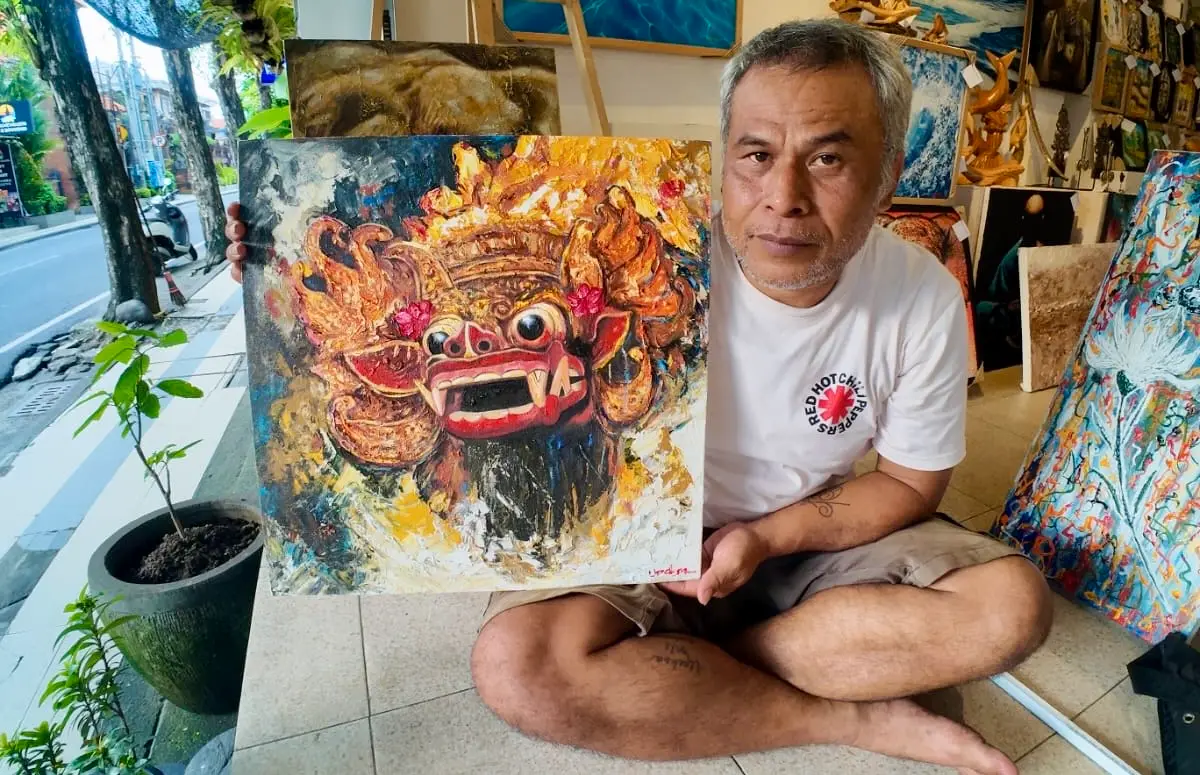
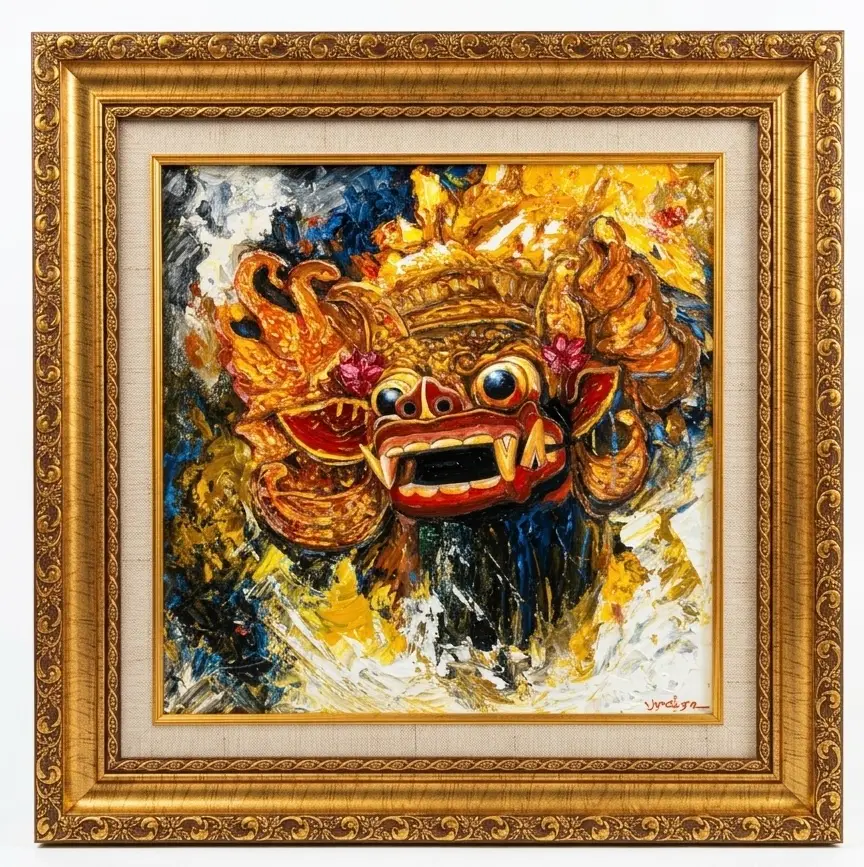
There is no Balinese subject that palette knife painting does not serve. But there are subjects it serves with a particular power, and Upeksa has found them. The Barong, the great lion-spirit of Balinese mythology, protector of villages, symbol of the good that must always resist the dark, is one.
His face, red and wild-eyed and crowned in gilded ornament, demands a painting technique equal to his energy. Smooth paint cannot hold Barong, but impasto can. This is why palette knife painting Bali has become the perfect medium for capturing the island’s most intense spiritual figures.
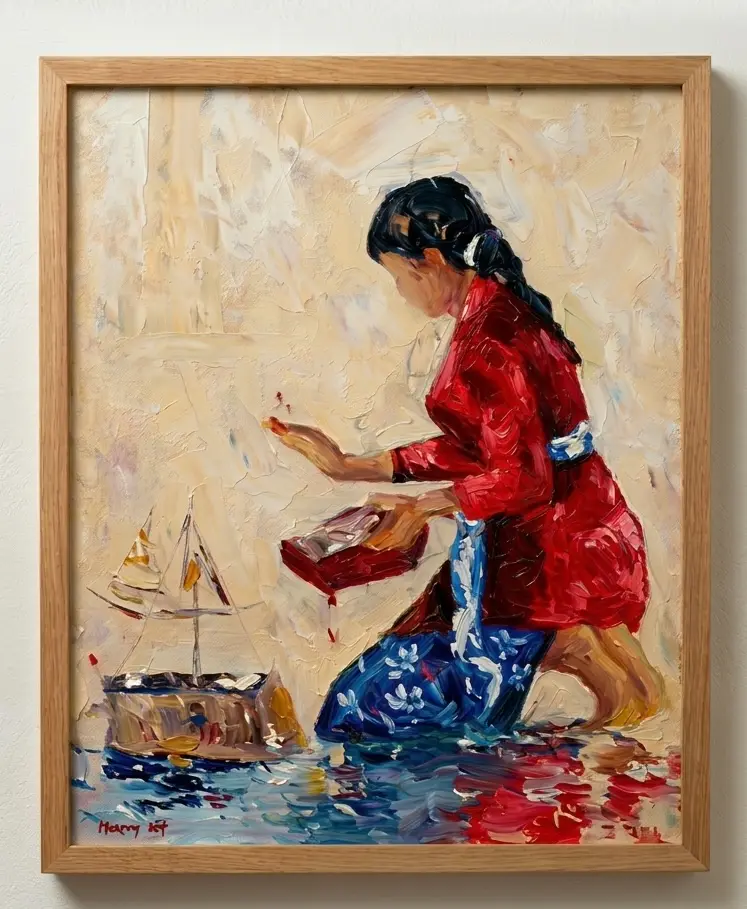
The everyday life paintings present a different kind of challenge. Where the Barong demands force and a dancer demands elegance, a rice field painting demands endurance. Four workers bent over the flooded paddies, wide-brimmed hats hiding their faces, water breaking around their ankles.
It is quiet work, repeated across generations, and Upeksa renders it in a powerful monochrome technique using grey, white, and gold impasto. The palette knife builds the workers from the same decisive blade pressure it applies to Barong. The subject is ordinary. The paint refuses to be.
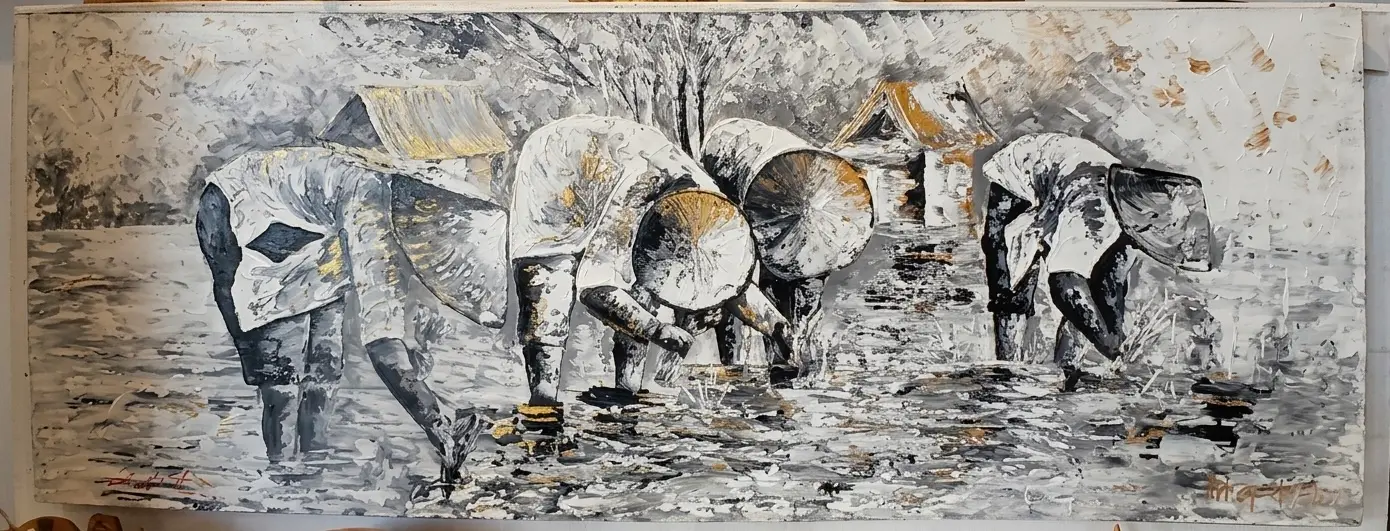
“The rice field and the Barong are the same subject to me. Both are things Bali does every day. Both deserve paint that is equal to what they carry.”
How to Stand in Front of a Palette Knife Painting and Actually See It
Most paintings reward a single viewing angle. Palette knife painting in Bali rewards movement. When you stand directly in front of an Upeksa canvas, you see the composition: the shape of the figure, the arrangement of color, the subject itself. When you shift to the side so that light rakes across the surface at an angle, something else appears entirely.
The ridges of paint reveal themselves as physical objects casting actual shadow. A stroke of gold that read as color from the front reads as relief from the side: a raised edge, a compressed plane, a texture that has nothing to do with representation and everything to do with the material fact of oil paint at its maximum thickness.
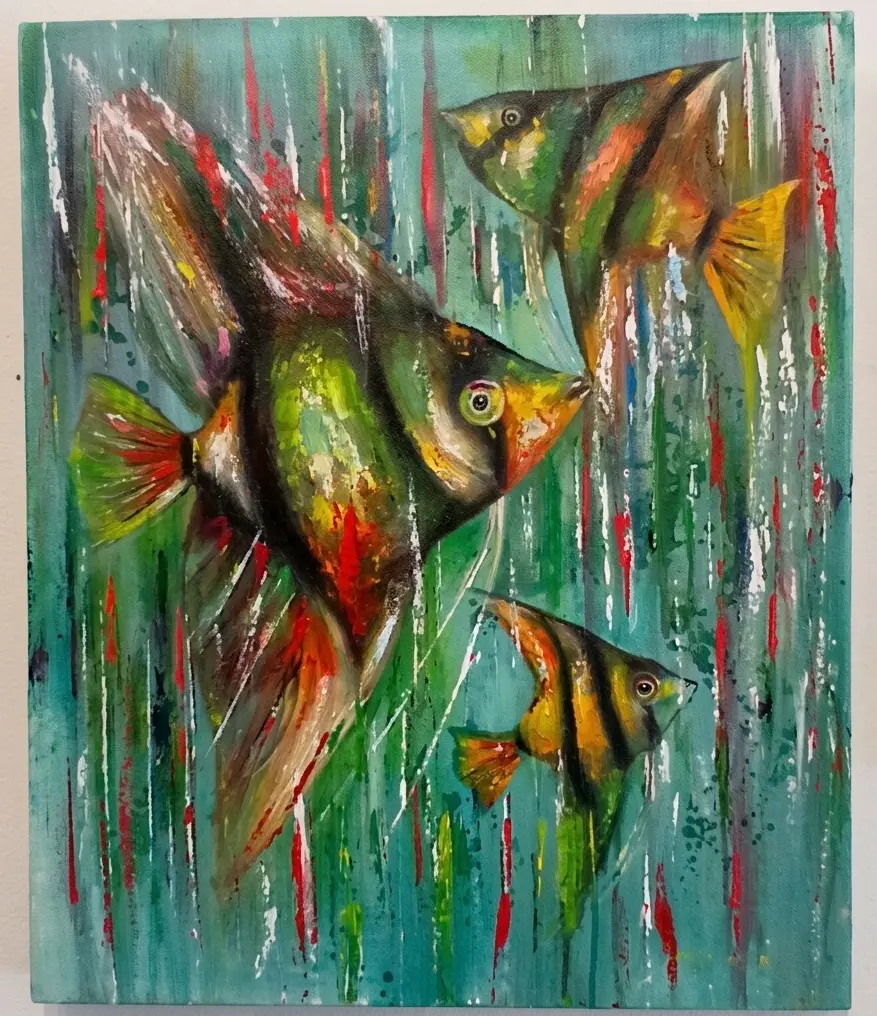
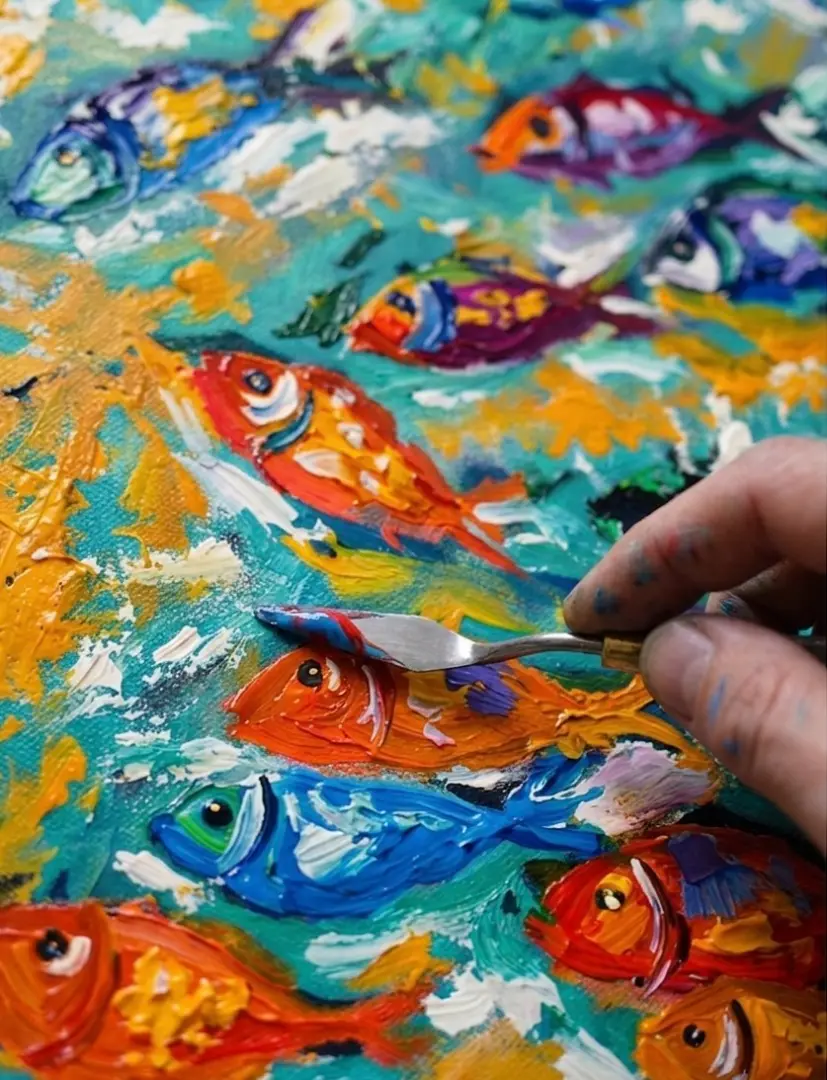
This is also the quality that makes palette knife painting in Bali impossible to reproduce faithfully. A photograph of an Upeksa canvas captures the colors and the composition, but it flattens the surface. The texture is gone. The light-catching ridge becomes a printed pattern.
What you see in a photograph of palette knife painting is a shadow of the actual work, which is one of the most reliable arguments for seeing it in person, and one of the reasons that collectors who visit Arts de Bali in Seminyak so often describe the experience of encountering the originals as a surprise, even when they arrive having already seen images online.
A Collector’s Guide to Palette Knife Painting Bali
Visitors who have not encountered palette knife painting before sometimes mistake the technique’s forcefulness for simplicity. The marks are bold and the paint is thick, so many assume the work must be faster or easier than finely brushed portraiture. The reverse is true. Each stroke of the blade deposits and sets paint in a way that cannot be easily corrected.
Upeksa does not use a brush to clean up what the knife leaves behind. The knife’s mark is the final mark. This demands a particular kind of visual confidence: the ability to commit to a color and a direction before the paint is on the canvas, because there is no adequate way to retrieve a wrong decision after the blade has passed.
What Makes an Original Palette Knife Painting Worth Collecting
- Physical texture you can verify. Run your eye across the painting at an angle to the light source. In a genuine palette knife painting, the surface is three-dimensional. Ridges cast measurable shadow. A reproduction or a printed copy will be completely flat regardless of how detailed the image appears from the front.
- No hidden brushwork. In Upeksa’s paintings, the palette knife is the primary instrument from the first layer to the last. There are no brushed edges softening the knife marks or filling in detail the blade could not reach. The mark of the knife is everywhere, and it is consistent.
- Color that changes with the light. Original impasto oil paint has a depth that shifts as ambient light changes. A painting that looked predominantly gold in morning light may show more ochre and shadow by afternoon. This is not inconsistency. It is the behavior of real paint surface, and it is one of the most characteristic pleasures of living with an original palette knife work.
- Size matters differently here. Original peinture à la palette bali pieces scale exceptionally well to larger formats. The physical presence of a large Upeksa canvas is significantly more powerful than a small one, because the impasto surface has more room to develop the rhythm and direction of the blade marks across the composition.
- Custom commissions are possible. Through the Arts of Bali custom painting service, it is possible to commission an Upeksa palette knife painting to a specific subject, size, and color palette. Visitors who commission during a Bali stay typically receive progress photographs and can collect the completed work before flying home.
Why Palette Knife Painting Belongs in Bali
The palette knife is a European invention. Its serious use as a painting tool rather than a mixing tool began with Gustave Courbet in the 19th century and reached its most famous expression in Van Gogh’s Provence landscapes and night skies. It traveled with oil painting into every tradition that absorbed Western influence in the 20th century.
What is particular about its arrival in Bali is that it found subjects that fit it entirely: a visual culture defined not by subtlety and restraint but by intensity, color, ceremony, and the energetic presence of figures from a mythology that is still actively practiced in the world rather than commemorated in museums.
The impasto technique thrives on subjects that carry physical energy. A Barong mask in palette knife paint has the same relationship to its subject that Starry Night has to the night sky: the texture of the paint does not merely represent the energy of the thing. It enacts it. This is why palette knife painting in Bali feels so natural, so inevitable, when you stand in front of Upeksa’s work for the first time.
It is not a Western technique applied to a Balinese subject. It is two traditions finding that they serve the same impulse: the desire to make paint do something more than illustrate, to make it participate in what it depicts.
Upeksa’s collection at Arts de Bali on Jalan Raya Seminyak represents the full range of his subjects: Barong, dancer, ceremony, offering, and others that find their way from the island’s daily visual life onto his canvas. Every painting in the collection is an original, worked entirely by hand, and available for viewing and purchase. If you are looking for the most striking palette knife painting Bali has to show, walking into a room where an Upeksa canvas is hanging is one of the clearest ways to find it.
Upeksa’s palette knife paintings are on display at Arts of Bali, Jalan Raya Seminyak No. 42, Seminyak, Bali. Custom commissions are welcome. One conversation with the gallery team is all it takes to begin.
View the Collection Commission a Painting