A gebogan bali is a towering offering built from fruit, rice cakes, and flowers, stacked in a cone shape on a wooden base and carried on a woman’s head to the temple. It is not simply decorative: every layer, from the woven palm base to the flower crown, follows a specific order, and the cone itself is built to echo Mount Meru, the cosmic mountain at the center of Hindu cosmology. This article goes past the short definition already given elsewhere on this site and into the part usually left out: how a gebogan is actually built, what each layer means, and where it sits inside Bali’s larger system of offerings.
Key Takeaways
- A gebogan bali is assembled in a fixed order: a wooden or palm base (dulang), a bamboo or banana-trunk support pole, a fruit layer, a layer of rice cakes, and a crown of flowers and canang.
- The cone shape is deliberate. It represents Mount Meru (Mahameru), the cosmic mountain of Hindu cosmology, and some sources read it as an emblem of Siwa as well.
- Gebogan sits at the top of a four-step offering hierarchy that starts with the small daily canang sari and moves up through household and ceremonial banten before reaching gebogan or pajegan.
- Gebogan and pajegan are the same offering under two regional names, not two different objects.
- Carrying a 5 to 15 kg gebogan on the head through a mapeed procession, most visibly during Melasti, takes real physical training, and building one is usually a communal task rather than an individual one.
Definition: Gebogan bali refers to a hand-built, cone-shaped Balinese Hindu offering of fruit, rice cakes, and flowers, carried on the head to temple ceremonies, and ranked as the largest tier in Bali’s offering hierarchy.
If you have spent five minutes on this site before, there is a fair chance you already ran into the word gebogan. It shows up in our guide to Balinese women painting as one of the subjects women carry to temple, and again in our temple ceremony painting guide as the banten type behind those panoramic Melasti beach photographs. Both articles give the short version: a tall stacked offering of fruit and flowers, carried by women, one of Bali’s most photographed cultural sights. This article is not the short version. It is the part usually left out: what actually goes inside a gebogan bali, in what order, why the shape is a cone rather than a basket, and how it compares to the smaller offerings Bali makes every single day.
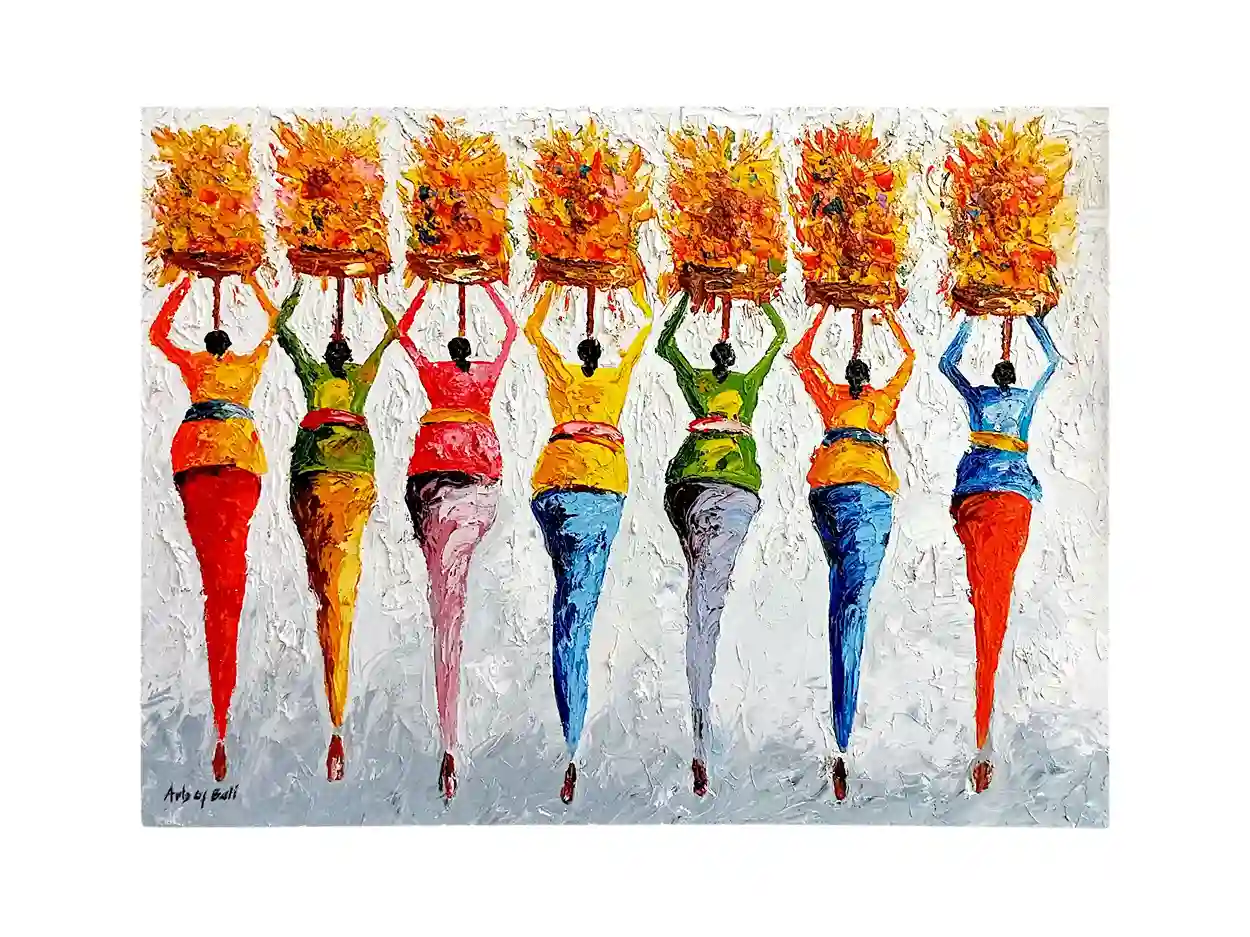
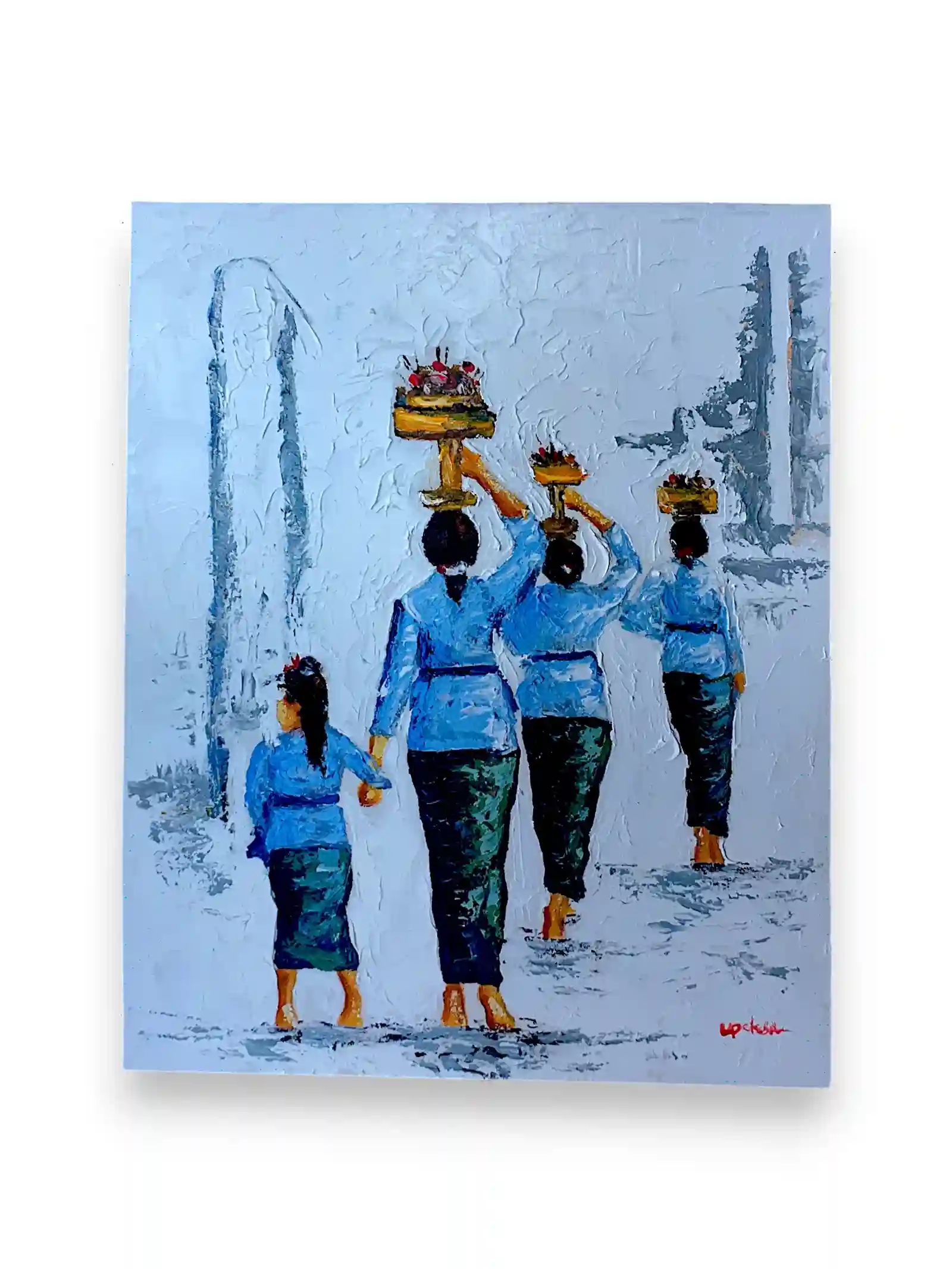
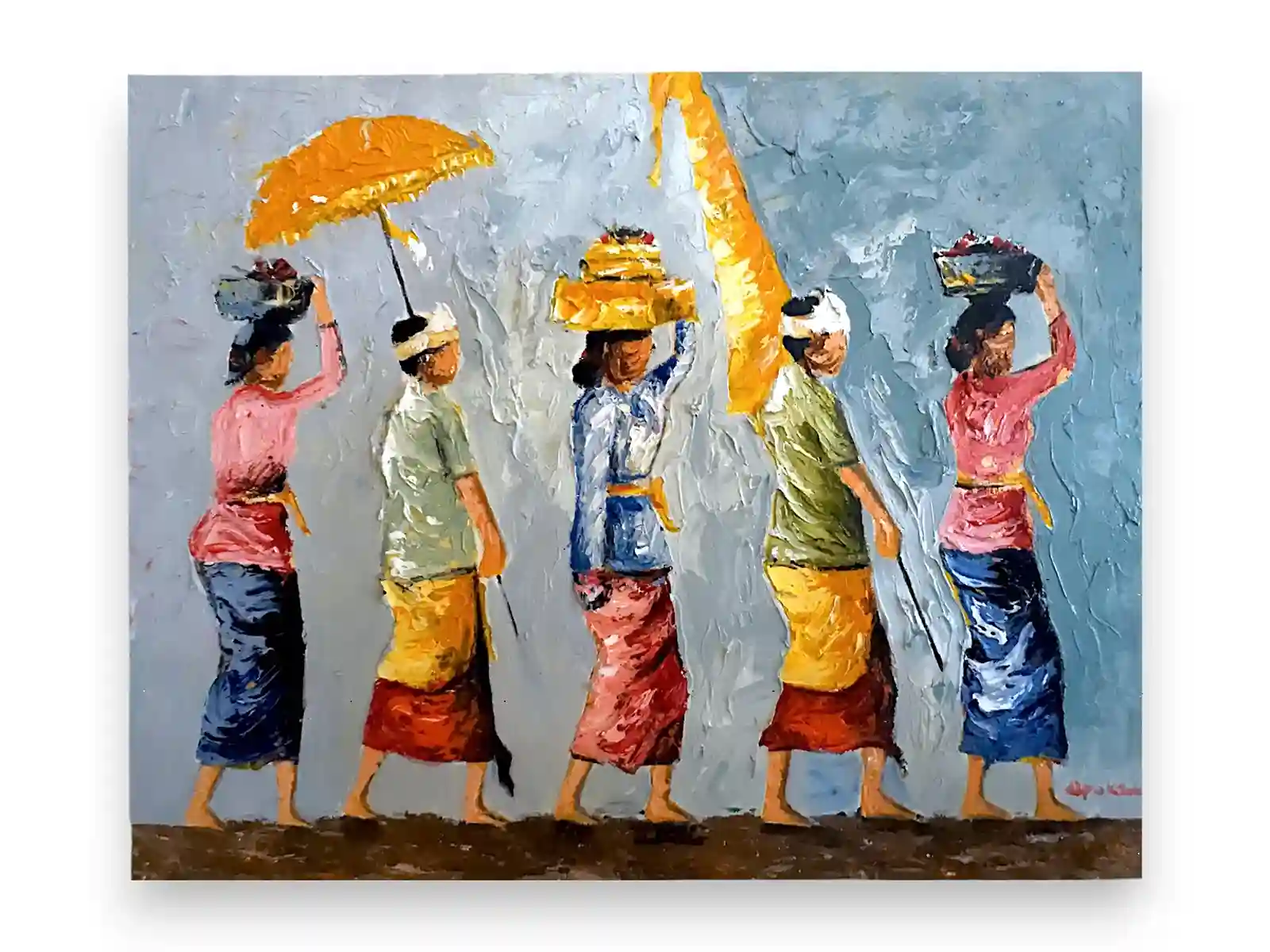
The occasion for writing it now is a new painting in the gallery’s collection, Balinese Women Procession Palette Painting, depicting seven women in kebaya carrying gebogan toward a ceremony. It joins two earlier pieces already in the collection, Original Sacred Melasti Journey and The Sacred Journey: Balinese Devotees, both showing the same subject in different light and palette. Three paintings of the same act was reason enough to explain the act properly.
Gebogan Bali: The Layer-by-Layer Structure of Bali’s Offering Tower
A gebogan bali is not stacked at random. It starts with a base called a dulang, a round wooden or woven-palm tray, often raised on short legs, that gives the whole structure a stable footing. From the center of that base rises a support pole, usually a length of bamboo or a section of banana trunk, tall enough to carry the full height of the tower and sturdy enough to hold its weight as fruit and flowers are packed around it in rings.
The lower rings are built from fresh fruit: bananas, oranges, mangosteen, snake fruit, mango, and jackfruit are common choices, arranged in circular tiers so the tower widens and narrows in a controlled rhythm rather than bulging unevenly. Above the fruit comes a layer of traditional snacks, sticky rice cakes such as jajan uli, begina, and dodol, wedged in to fill gaps and add color and texture. The uppermost section is flowers: frangipani, marigold, jasmine, and roses, chosen as much for color and shape as for scent, finished with a sampian, a small woven ornament of young coconut leaf, and a canang offering placed right at the very top. Finished, a gebogan can stand anywhere from around 50 cm to well over a meter tall, and weigh 5 to 15 kg once fully loaded.
Why the Cone Shape: Mount Meru, Siwa, and the Idea of Yadnya
The shape is not a side effect of stacking round fruit. Balinese Hindu tradition reads the cone as a deliberate echo of Mount Meru, or Mahameru, the cosmic mountain believed in Hindu cosmology to be the dwelling place of the gods. Some accounts also connect the same conical form to Siwa, reading it as a fertility and creation symbol layered on top of the mountain reference. Either way, the gebogan is not meant to be seen as a fruit basket. It is a small, edible mountain, built by hand and then given away.
That act of giving sits inside a specific concept in Balinese Hinduism: yadnya, a sincere offering made without expectation of anything in return. Building and carrying a gebogan is one expression of yadnya, alongside the broader philosophy of Tri Hita Karana, the balance between the human world, the natural world, and the divine. The fruit and flowers packed into a gebogan come from the same land its makers live on, and offering them back is treated as gratitude for that land’s abundance, not a transaction for future favor.
Not Just Any Offering: Where Gebogan Sits in Bali’s Offering Hierarchy
Bali makes offerings at several different scales, and gebogan is only the largest and most visible of them, not a stand-alone tradition. The smallest and most frequent is canang sari, the small palm-leaf basket of betel leaf, flowers, and a pinch of rice placed outside homes and shops every morning across the island, one of the most photographed everyday sights in Bali. One step up is banten saiban or jotan, small household portions of prepared food set aside for household spirits before a family eats. Above that sits banten pejati, a more complex, formally arranged offering built for significant life events such as weddings or tooth-filing ceremonies. Gebogan, also called pajegan in some regions, a regional name for the same object rather than a different one, sits at the top: the largest, most labor-intensive tier, reserved for major temple festivals rather than daily or household use.
| Offering | Scale | Typical Occasion | Who Makes It |
|---|---|---|---|
| Canang sari | Small, daily | Every morning, outside homes and shops | One person, at home |
| Banten saiban / jotan | Small, household | Before family meals | One person, at home |
| Banten pejati | Mid-size, ceremonial | Weddings, tooth-filing, life events | Family, sometimes with a priest |
| Gebogan / pajegan | Large, towering | Galungan, Kuningan, piodalan, Melasti | A group of women, together |
The Skill of the Bearer: Carrying a Gebogan Through a Mapeed Procession
Once built, a gebogan still has to get to the temple, and it travels the way it has for generations: balanced on top of a woman’s head, no hands, for however far the procession runs. This organized walk to the temple is called mapeed, and it is at its largest and most visually striking during Melasti, the island-wide purification ceremony held in the days before Nyepi. During Melasti, communities walk from village temples to the sea or another water source, women in kebaya carrying gebogan at the front of the line, men carrying pratima, the shrines holding sacred effigies, alongside them, with umbrellas and gamelan music accompanying the whole procession. The goal of Melasti is to purify both the sacred objects and, by extension, the self, using the sea as a source of amreta, the water of life in Balinese Hindu belief.
Carrying 5 to 15 kg on the head for that distance, without a hand steadying it, takes real physical skill: a straight spine, a level stride, and a calm, practiced sense of balance that is not something most people can do on a first attempt. Balinese girls typically grow up watching and eventually helping with this before they carry a full gebogan themselves, so what looks effortless in a photograph or a painting is, in practice, a learned skill passed down within families and villages.
Community in the Making: Why Women Build Gebogan Together
Building a gebogan is rarely a solo task. In the days before a major temple festival, women in a household or banjar (neighborhood association) typically gather to select fruit and flowers together, choosing pieces for color, shape, and how well they hold their form once stacked, then work side by side to build several gebogan at once. Older women pass construction knowledge to younger ones during this process: which fruit sits well on a curve, how tightly to wedge the rice cakes, how to keep the whole tower from leaning as it grows. The result is as much a social and intergenerational occasion as a devotional one, in keeping with the wider Balinese practice of gotong royong, mutual community work done together rather than paid for or done alone.
Seeing It on Canvas: Gebogan in Palette Knife Painting at Arts of Bali
The three procession paintings in the current collection each capture a different moment of this act. Balinese Women Procession Palette Painting shows seven women in vibrant kebaya, gebogan balanced on their heads, rendered in thick palette-knife strokes against a textured white ground. Original Sacred Melasti Journey widens the scene to a full mapeed procession, golden umbrellas and all, against a cool textured sky. The Sacred Journey: Balinese Devotees narrows back in, a mother and village women walking together in soft blue tones toward the temple gate. None of the three is a documentary photograph; each is an original, hand-painted interpretation of a scene that plays out across Bali several times a year. For a single close-up bearer portrait done in a different, more elongated figurative style, our Balinese women painting guide covers that piece and the rest of that collection specifically.
See the gebogan and procession paintings in person, or ask which pieces in the current collection show this subject.
Chat on WhatsApp View Balinese Women Procession PaintingFrequently Asked Questions
What is a gebogan bali?
A gebogan bali is a cone-shaped Balinese Hindu offering built from fruit, traditional rice cakes, and flowers stacked on a wooden or palm base around a central support pole, then carried on a woman’s head to the temple during major ceremonies.
How is a gebogan actually built, layer by layer?
Construction starts with a base tray (dulang) and a central bamboo or banana-trunk support pole. Fresh fruit is stacked in circular tiers around the pole, followed by a layer of sticky rice cakes, then a top layer of flowers finished with a woven coconut-leaf ornament and a canang offering at the very top.
What does the cone shape of a gebogan symbolize?
The cone represents Mount Meru (Mahameru), the cosmic mountain considered the dwelling place of the gods in Hindu cosmology. Some sources also read the same shape as an emblem connected to Siwa. Building it is an expression of yadnya, a sincere offering given without expecting anything back.
Is gebogan the same thing as pajegan?
Yes. Gebogan and pajegan refer to the same towering fruit-and-flower offering; pajegan is simply a regional name used in some parts of Bali for the identical object.
What is the difference between canang sari and gebogan?
Canang sari is a small daily offering placed outside homes and shops every morning. Gebogan sits at the opposite end of the same offering system: a large, towering, labor-intensive offering built and carried only for major temple festivals such as Galungan, Kuningan, piodalan, and Melasti.
How much does a gebogan weigh, and how tall is it?
A fully built gebogan typically stands between roughly 50 cm and over a meter tall and weighs between 5 and 15 kg, all balanced on the bearer’s head without the use of hands.
What is a mapeed procession?
Mapeed is the organized walking procession in which communities carry gebogan, pratima shrines, and other ceremonial items from the village temple to a destination such as the sea. It is most visible during Melasti, the island-wide purification ceremony held before Nyepi.
Where can I see gebogan depicted in original Balinese art?
Arts of Bali gallery in Seminyak carries several original palette knife paintings depicting gebogan and procession scenes, including Balinese Women Procession Palette Painting, Original Sacred Melasti Journey, and The Sacred Journey: Balinese Devotees. Message the gallery on WhatsApp or visit the product pages for current price and availability.