“The Barong doesn’t need translation. You know, the moment you stand in front of it, that this is a painting about something larger than decoration — larger than art, really. It’s about how the world stays in balance.”
Every culture has its sacred stories — the ones that explain why good and evil stay in permanent tension, why the harvest comes or doesn’t, why the world holds together at all. In Bali, those stories get painted. And not just painted — they’re worn, danced, carved into temple gates, and performed in the village square after dark. A Lukisan mitologi Bali isn’t an illustration of something that happened once in the distant past. It’s a living document of a worldview that still governs how Balinese people understand time, ritual, and the cosmos itself. When you take one home, you’re not just buying a picture. You’re carrying away a fragment of that entire system — the oldest, most continuously practised visual tradition in Southeast Asia.
Lukisan mitologi Bali depicts sacred stories and characters from Balinese Hindu cosmology — primarily the Hindu epics Ramayana and Mahabharata, along with figures including Barong (the sacred protective lion), Rangda (the witch queen), Garuda (the divine bird of Vishnu), and Dewi Sri (the rice goddess). The tradition originates in the classical Kamasan school of Klungkung, dating to the sixteenth century. Today it continues across multiple styles — from cloth painting using natural earth pigments to contemporary oil and mixed media interpretations — carried by artists working in Bali’s galleries and studios.
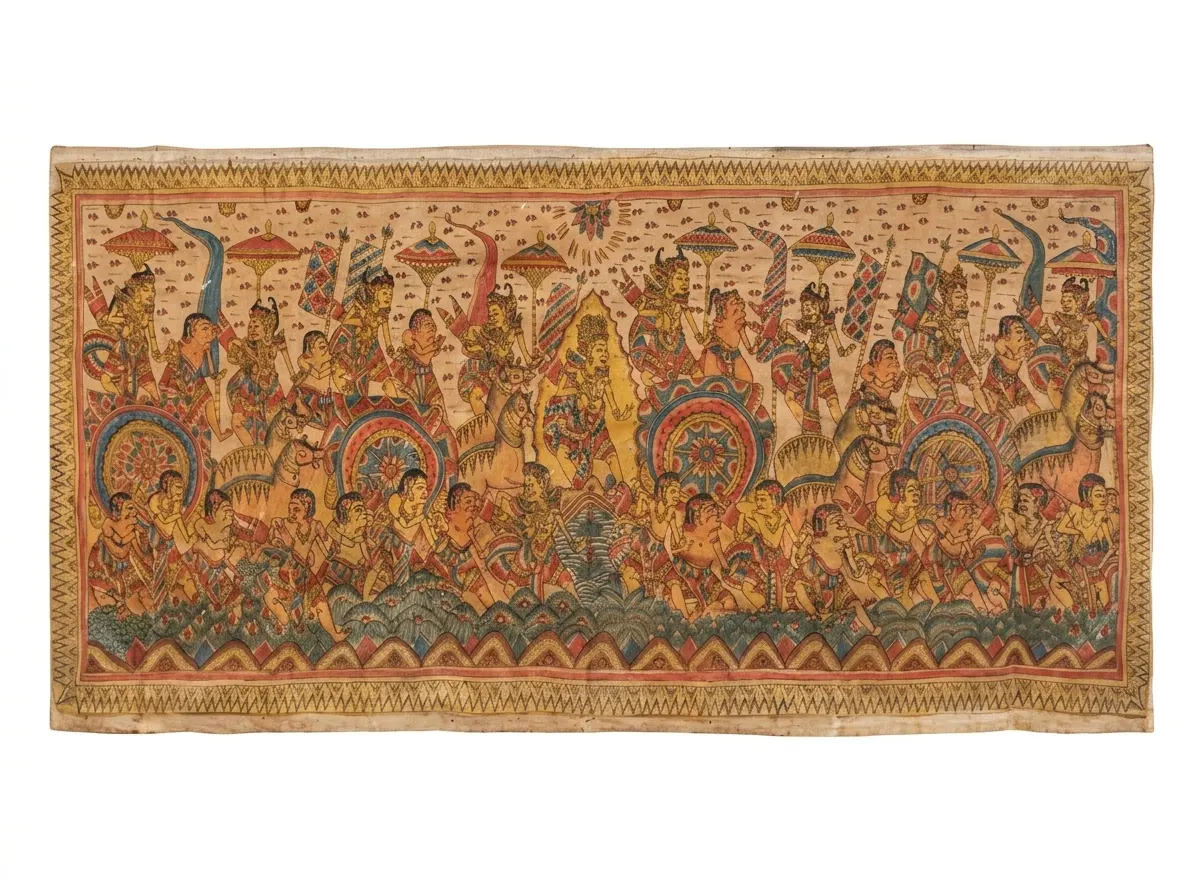
The Oldest Balinese Mythology Paintings Were Never Made for Walls
The oldest Balinese mythology paintings weren’t made to be looked at. They were made to be used. Hung in temples, unrolled during ceremonies, consulted as visual texts that told the community which part of the Ramayana or Mahabharata was being enacted in a ritual. The Balinese Hindu understanding of art is fundamentally different from the Western gallery model — art isn’t separate from life, it participates in it.
The earliest surviving examples come from the village of Kamasan in Klungkung, East Bali — the same village where the tradition is still practised today by hereditary painter-priests. These works were painted on cloth or bark paper using natural pigments: red ochre, black soot, indigo blue, and the ochre yellow of volcanic rock. The figures follow strict iconographic rules — which posture means which character, which headdress marks which deity, which direction a figure faces and what that implies about their moral standing. It took years to learn. And the Australian Museum’s collection of Balinese Kamasan paintings, some dating to the early nineteenth century, gives an idea of how extraordinary the tradition was at its height.
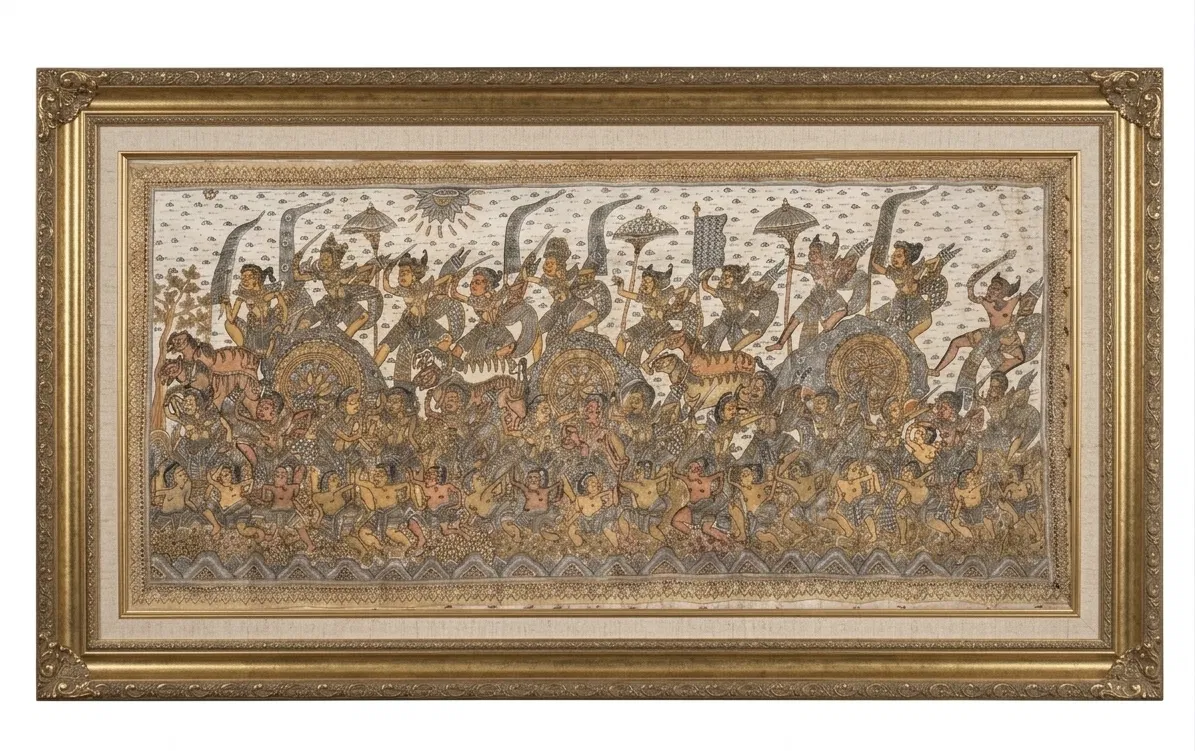
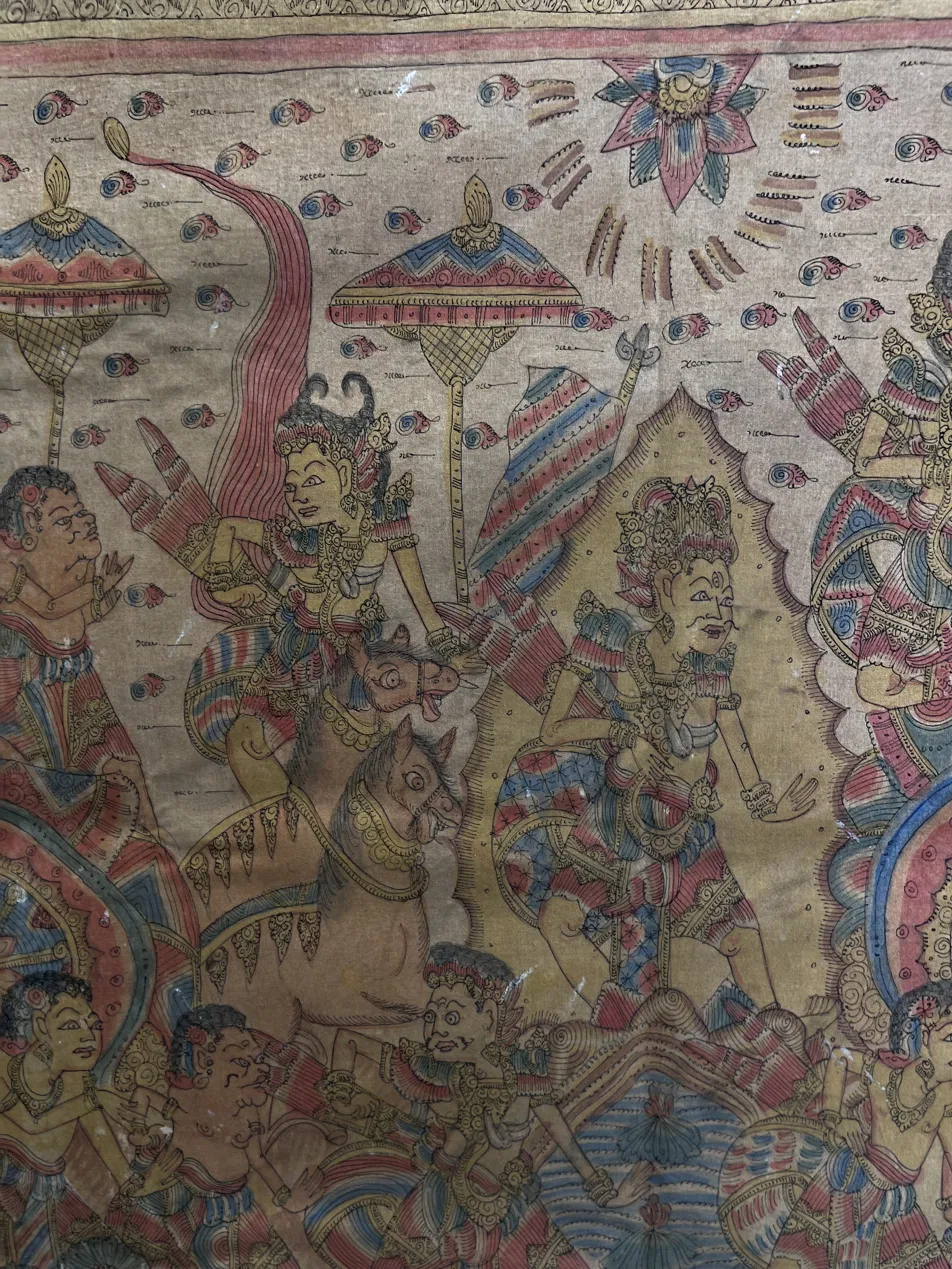
Mahabharata — The War That Explains the World
The Mahabharata is one of the two great Hindu epics — an 18-book Sanskrit narrative of the war between two royal families, the righteous Pandawa brothers and their cousins the Kurawa. In Balinese mythology painting, Mahabharata scenes are recognisable by the massive battle formations: warriors on horseback, chariot wheels (ratha) marking the commanders, royal ceremonial umbrellas indicating rank, and the dense crowd of foot soldiers filling every inch of the composition. It is not a gentle narrative. It is about what happens when a kingdom chooses power over dharma. And Balinese painters, for five centuries, have found it endlessly worth painting.
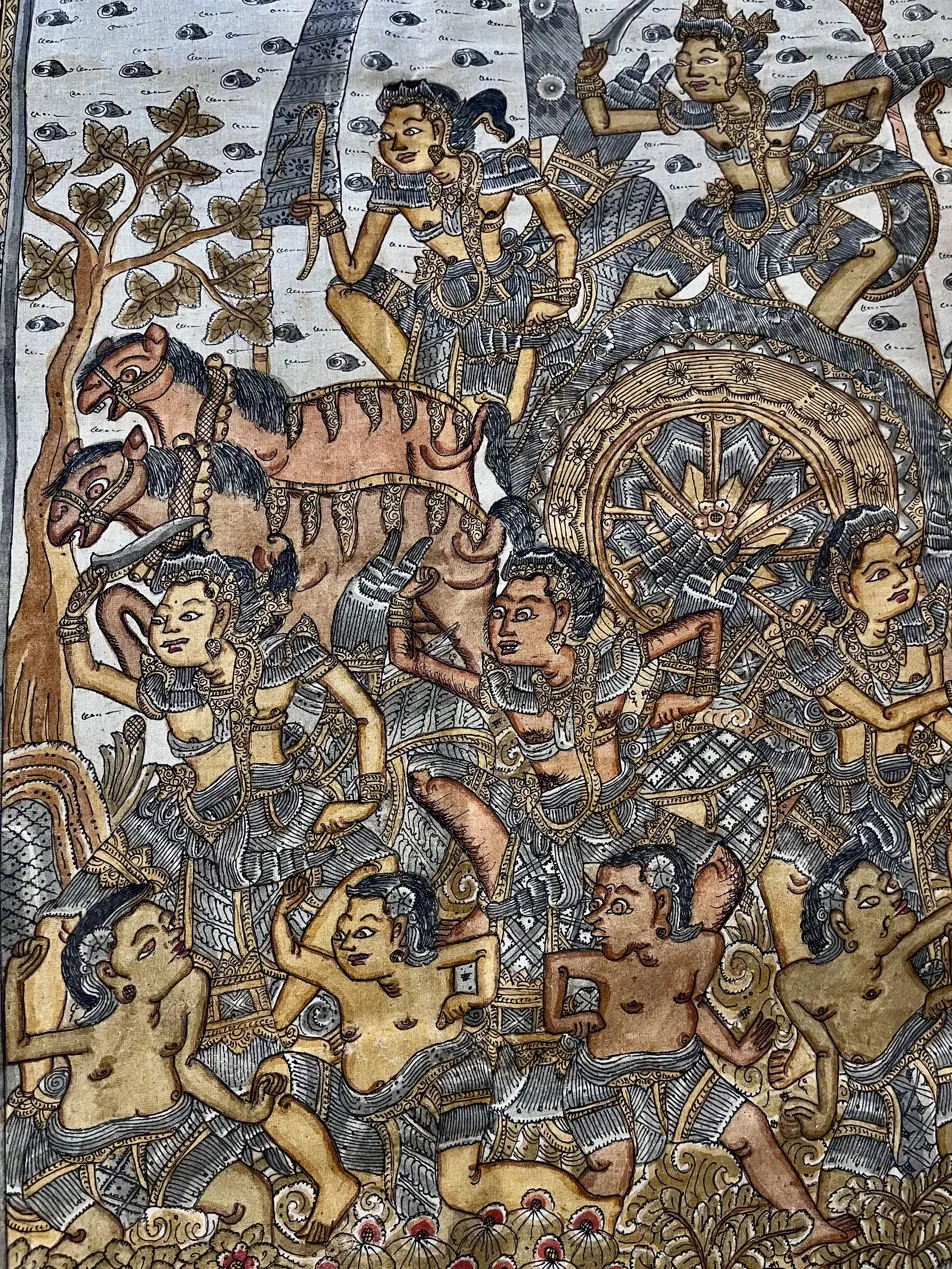
“In Balinese mythology, nothing is only what it appears to be. The lion is also a protector. The battle is also a moral argument. The painting is also a prayer.”
Barong — The Most Painted Figure in Balinese Mythology
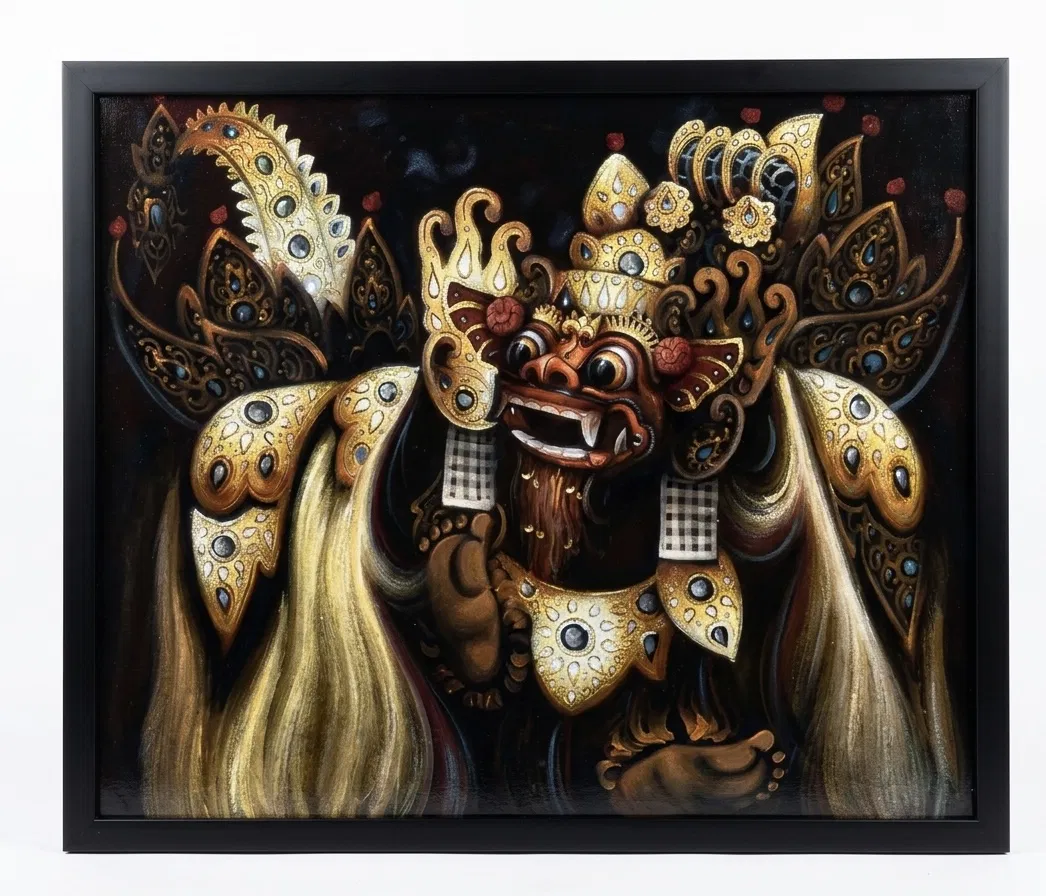
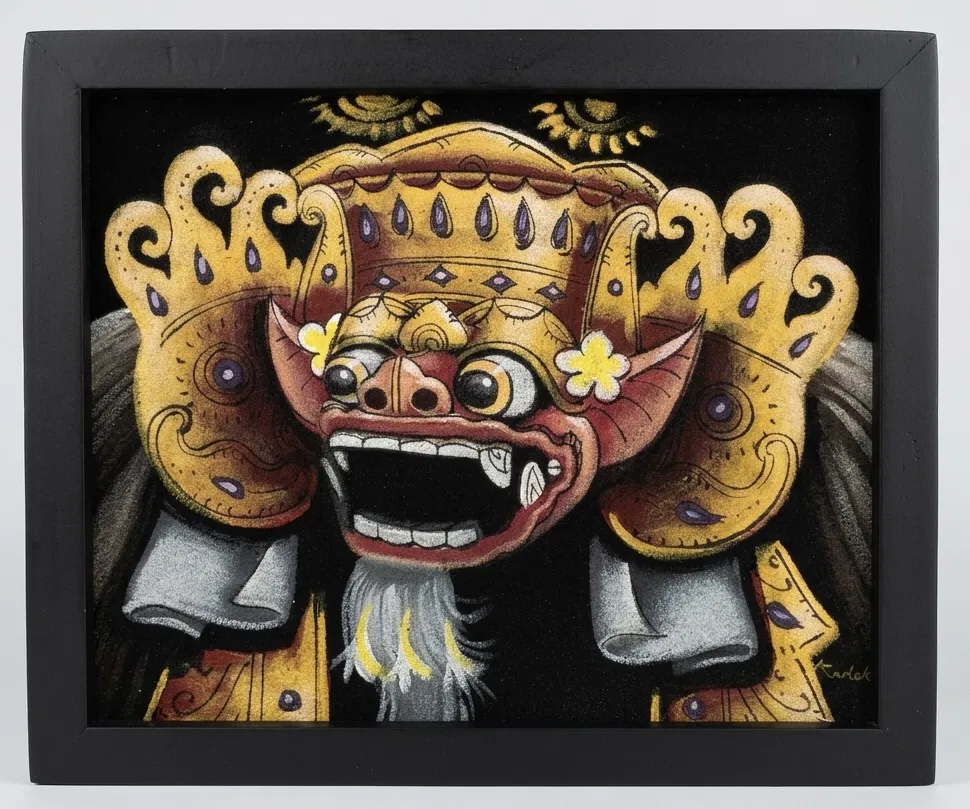
If you’ve spent any time in Bali, you’ve seen the Barong — on keychains, on t-shirts, in the lobby of every resort. But those reproductions don’t prepare you for the real thing. The painted Barong, done properly, is one of the most visually overwhelming subjects in Southeast Asian art. Gold headdress blazing against a black ground, frangipani flowers tucked behind the ears, the long white beard hanging in thick ropes, the ornamental wings spread wide on either side. It fills the canvas completely. There’s no background to retreat into. Just the Barong, looking directly at you.
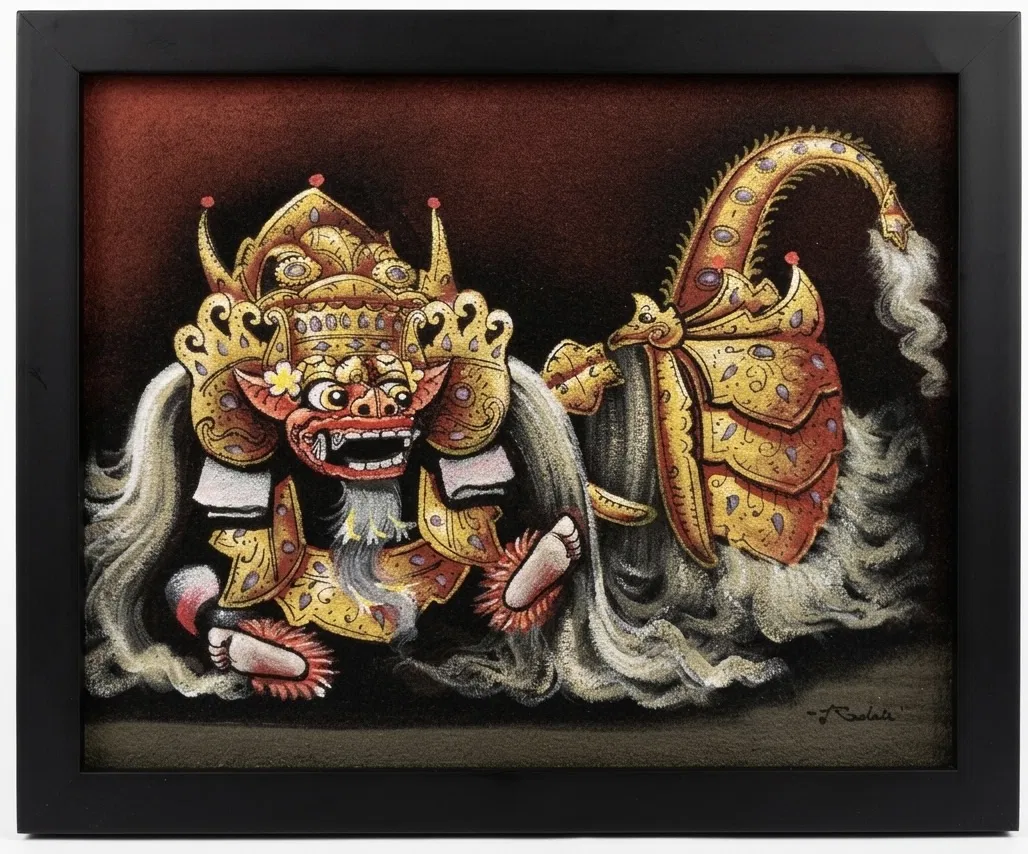
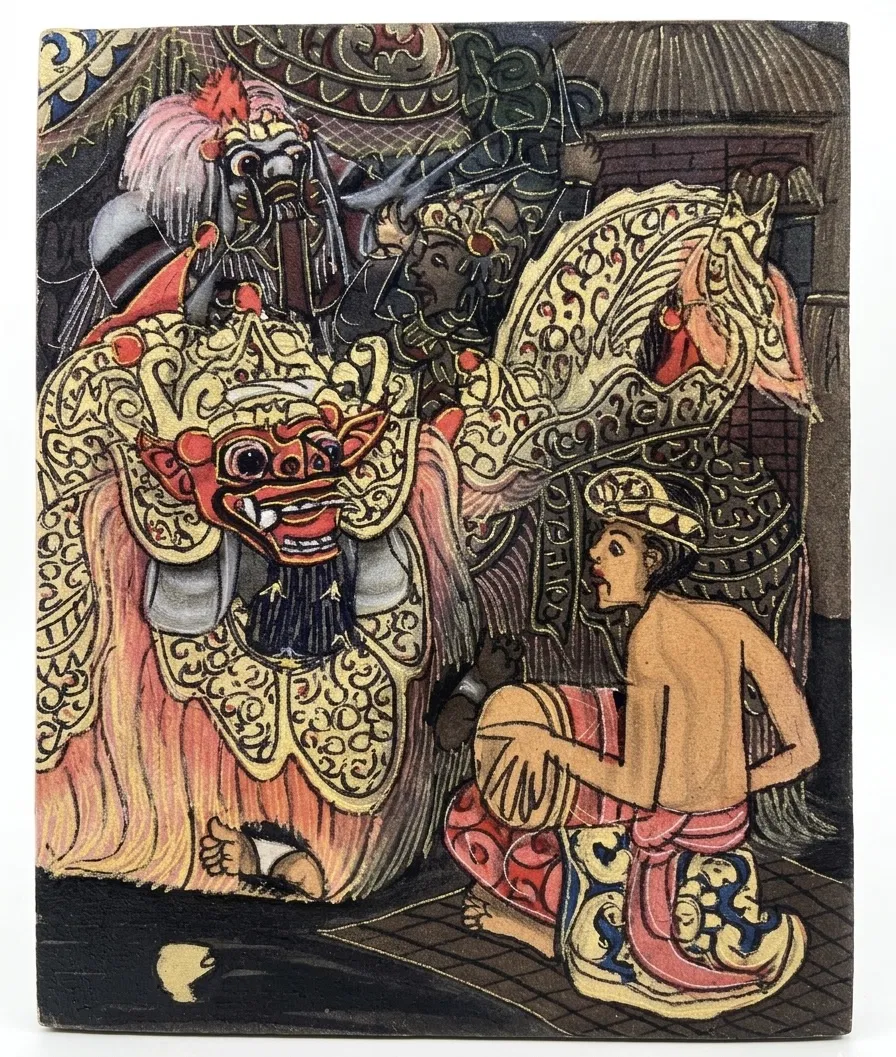
The Barong is the protective spirit of Balinese Hindu cosmology — the guardian force that stands between a village and the destructive power of Rangda, the witch queen. Their conflict is not a story with a beginning and an end. It is an eternal, ongoing condition. Which is why the Barong appears not just in paintings but in the Calonarang dance drama performed at night in village temples, in the masks kept in sacred storehouses, in stone carvings above every significant gateway. To paint the Barong is to participate in this ongoing act of protection.
Barong & Rangda — Why the Battle Never Ends
In Balinese mythology, the conflict between Barong dan Rangda — the protective lion spirit and the witch queen — has no resolution. It is not a story with a winner. Every performance of the Calonarang dance drama ends with both forces intact, their balance restored but not resolved. This is deliberate. Balinese Hinduism understands the cosmos as a system in which good and evil are not opposites but complementary forces — each requiring the other to exist. The painting of Barong, then, is not a victory image. It is an image of eternal vigilance. That is what gives it weight, decade after decade, painting after painting.
Ramayana Painting in Bali — A Story That Never Gets Old
The Ramayana is 24,000 verses long in its original Sanskrit form. Balinese painters have been summarising it — selectively, brilliantly — for five centuries. The story follows Prince Rama, heir to the kingdom of Ayodhya, exiled to the forest with his wife Sita and his brother Lakshmana. When the demon king Rawana abducts Sita, Rama builds an army — with the help of Hanuman, the white monkey general — crosses the sea, and wages war until she is recovered. But it’s not really about the rescue. It’s about what dharma — righteous duty — requires of a king, a husband, a warrior, and a person.
In Balinese painting, you can identify a Ramayana scene by its cast: Rama and Lakshmana are usually golden-skinned princes in elaborate costume; Hanuman appears as a white monkey figure; Rawana is recognisable by his multiple heads and demon features; and the sea crossing is rendered as a massed army of monkey warriors. In the Tradisi Kamasan, these characters follow prescribed physical rules — there was a right way to paint Rama’s nose, Rawana’s crown, Hanuman’s posture. Every painter who learned the tradition understood this grammar before they were allowed to make their own choices within it.
How Contemporary Bali Artists Reinterpret Mythology Today
The mythology didn’t stay locked in the past. It moved with the artists who inherited it — into new materials, new formats, new visual languages that would have surprised the painter-priests of Kamasan but wouldn’t have confused them about the subject matter.
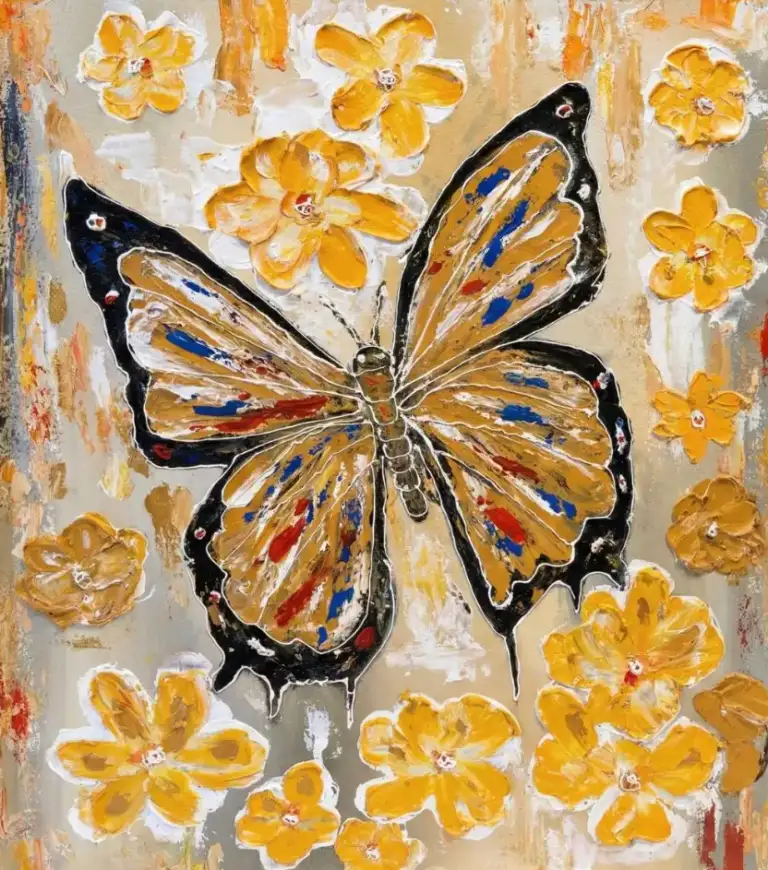
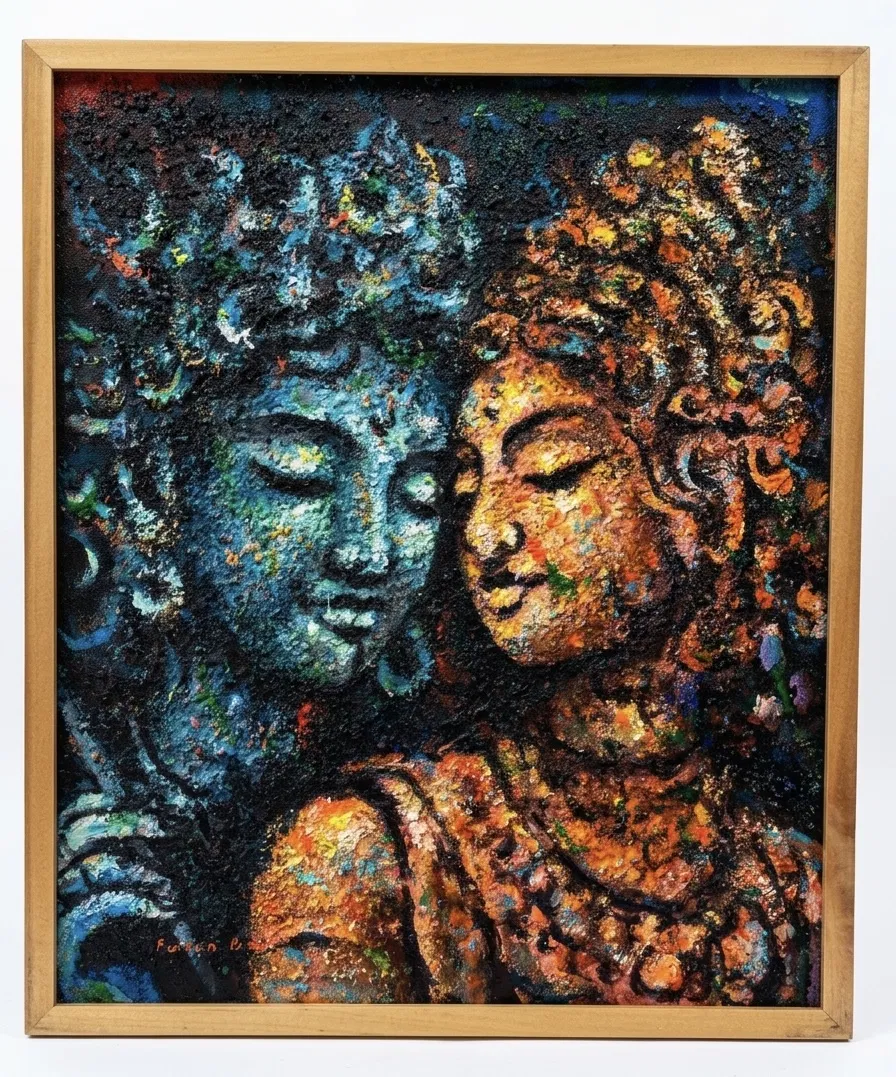
The most interesting contemporary mythology paintings in Bali are the ones that carry the iconographic rules forward while doing something completely unexpected with surface and technique. Textured and mixed-media approaches have found a particular affinity with mythology subjects — the raised, sculpted quality of sand and mixed pigment suits sacred figures well. A deity depicted in thick, layered texture reads differently from a flat drawing; there is a physical presence to it that flat painting can’t achieve.
The contemporary Kamasan movement is producing some of the most internationally noticed Balinese art of the decade. Artist Citra Sasmita — born in Bali in 1990 — has taken the traditional Kamasan form and filtered it through a feminist perspective, showing Balinese women as central rather than peripheral figures in the epics. Her work has been shown at the Barbican in London and at the 2025 Sharjah Biennial. It represents a broader truth: the great Balinese artists were never simply preservers of tradition. They were always transforming it.
Balinese Mythology Painting — Three Distinct Approaches
Classical Kamasan — The Original Visual Language
Painted on cloth or bark paper using natural pigments, following strict iconographic rules. Warriors in precise profile, flat perspective, dense narrative composition. No individual artistic ego — the tradition is the point. Kamasan works in museum collections and private hands are among the most historically significant Balinese objects in existence. Read our full Kamasan painting guide.
Contemporary Sacred Subjects — Oil & Canvas
The same mythology subjects — Barong, Ramayana, divine figures — rendered in oil on canvas with a full contemporary painter’s toolkit: light and shadow, depth, texture, scale. The iconographic rules still apply but the visual language has expanded. Works like the Barong portraits in Arts of Bali’s collection sit in this category. Original, documented, signed by named artists.
Mixed Media & Textured Interpretation
Sand, mixed pigment, raised surfaces, sculptural quality. Mythology subjects rendered through textured mixed media techniques that give sacred figures a physical presence that flat painting can’t achieve. Farfan’s work at Arts of Bali is a prime example — deity faces in textured blue and gold that read as both painting and low relief sculpture.
Balinese Mythology Painting in Our Gallery — What’s Available
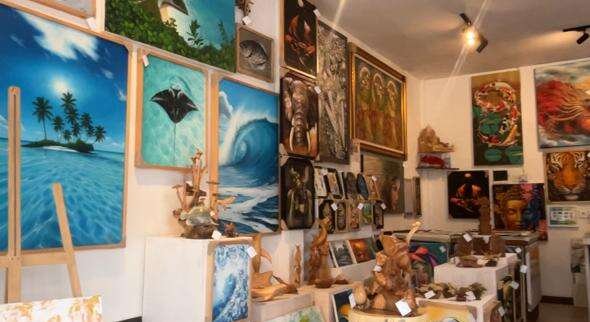
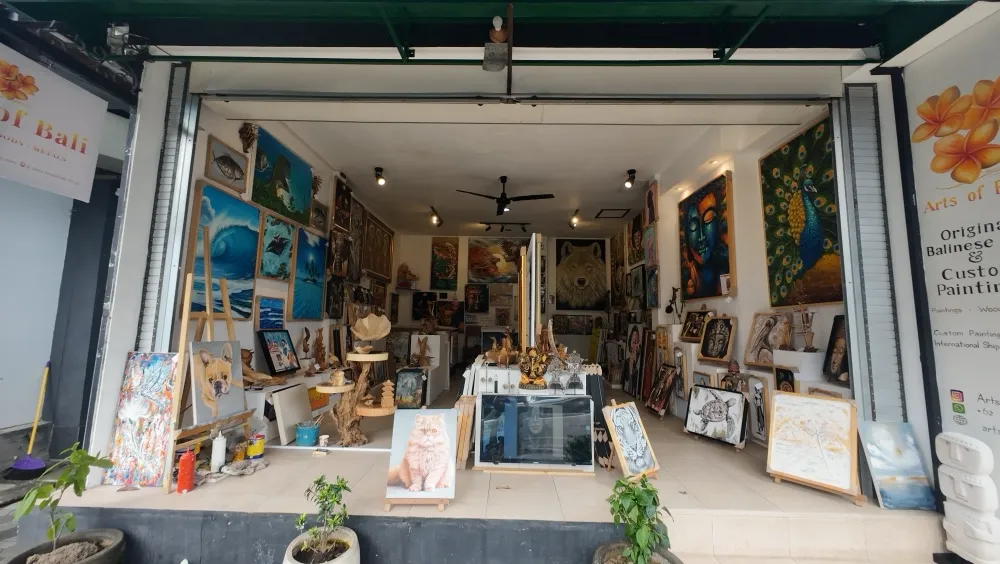
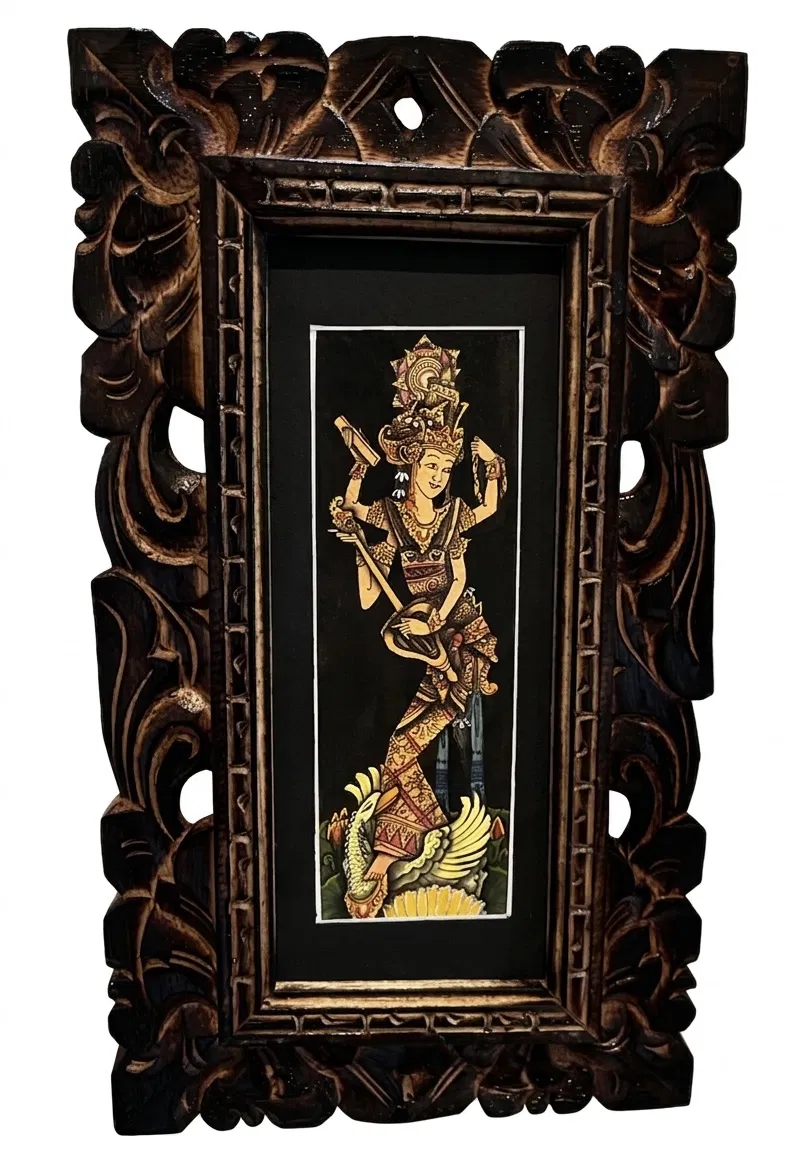
The collection at Galeri Seni Bali di Jalan Raya Seminyak No. 42, Kuta, Bali 80361 includes mythology paintings across the full range described in this guide — from classical Kamasan-style cloth works to large-format contemporary Barong portraits, from sand-texture deity paintings by Farfan to small traditional panels in carved wooden frames.
Each work in our gallery is original and documented. For classical works, provenance and any available artist attribution are recorded. For contemporary pieces, the artist signs the work and a certificate of authenticity is issued. If you’re looking for a specific mythological subject — a particular Ramayana scene, a Barong in a specific scale and style, or a custom commission of a deity figure — contact us on WhatsApp and we can discuss what’s currently available and what can be made. See our complete painting price guide for price range context, and our panduan pengiriman internasional for delivery information.
If you want to understand where these paintings sit in the full arc of Balinese art — from the seniman Bali yang terkenal of the Pita Maha era to the contemporary gallery scene in Seminyak — our complete guide to Balinese art styles covers every tradition and how they connect.
See Mythology Paintings in Person at Arts of Bali
A mythology painting does things in person that a photograph simply can’t show. The way the gold in a Barong headdress catches gallery light differently from every angle. The texture in a sand-technique deity face that you can almost feel before you touch it. The sheer density of a Kamasan cloth painting that you keep finding new details in the longer you look. Come to Arts of Bali on Jl. Raya Seminyak No. 42, Kuta, Bali — our team is always happy to explain every figure, every iconographic element, and the story each painting is actually telling.
Common Questions About Balinese Mythology Painting
What is Balinese mythology painting? ▼
What stories are depicted in Balinese mythology paintings? ▼
What is a Barong painting? ▼
What is the difference between Ramayana and Mahabharata paintings? ▼
How old is the mythology painting tradition in Bali? ▼
Where can I buy Balinese mythology paintings in Bali? ▼
What makes Balinese mythology paintings valuable? ▼
Can I commission a custom Balinese mythology painting? ▼
Find Your Balinese Mythology Painting at Arts of Bali
Whether you want a Barong for a specific wall, a Ramayana scene painted to a particular scale, or you just want to come in and see what mythology looks like when it’s taken seriously by working artists — Arts of Bali is on Jl. Raya Seminyak No. 42, Kuta, Bali 80361. We’re open daily. Our team knows every painting and every story it tells. WhatsApp us with what you’re looking for and we’ll let you know what’s available and what can be made.
Mengobrol Dengan Kami di WhatsApp