Every temple in Bali starts with a threshold.
Now it fits on a shelf.
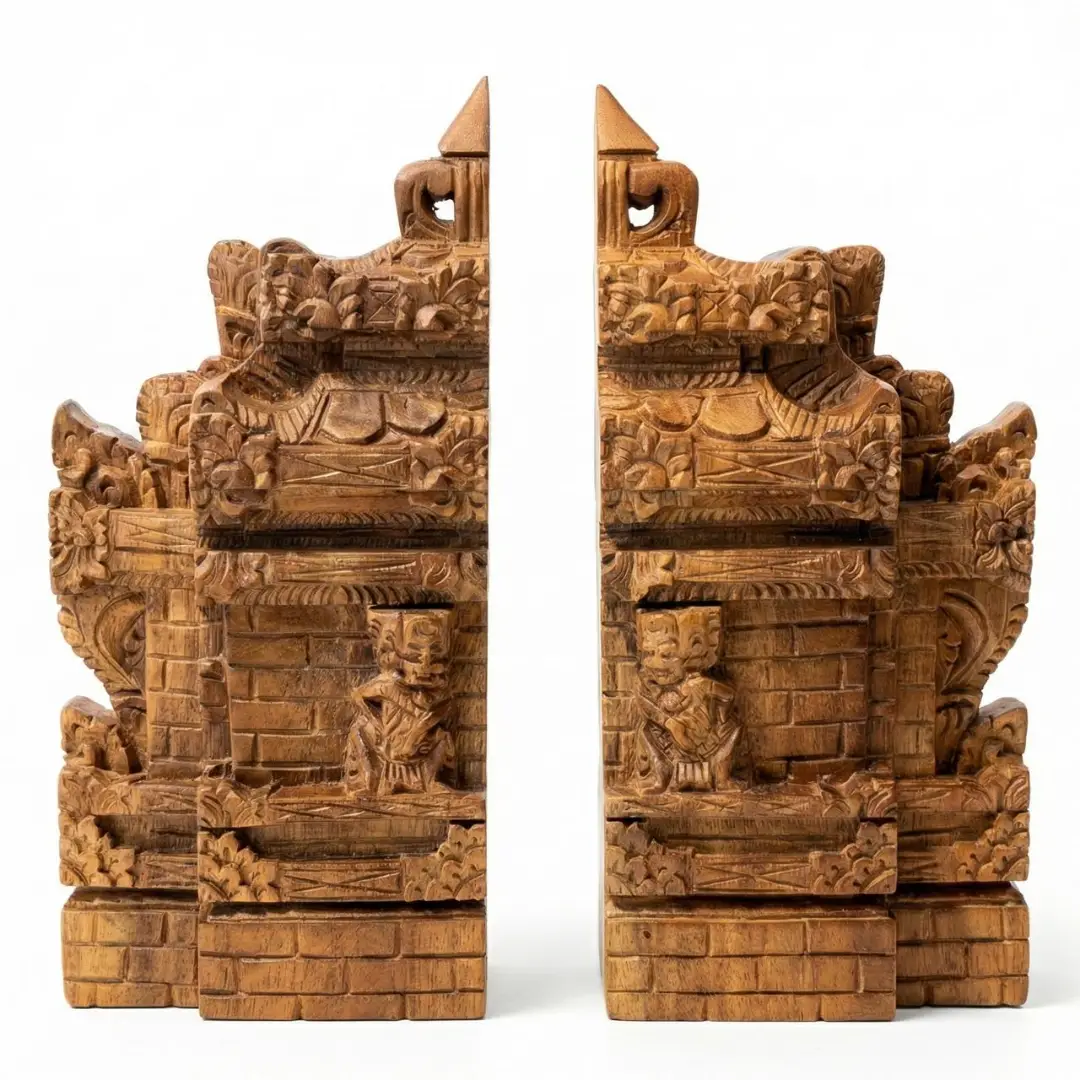
Quick Answer: Balinese temple gate wood carving refers to hand-carved suar wood pieces — most often paired with meru shrine carvings — that reproduce two of the island’s most recognizable sacred structures: the candi bentar, a split gateway marking the entrance to a temple or home compound, and the meru, a multi-tiered shrine representing the cosmic mountain. Arts of Bali currently carries one carving of each, priced at Rp2,500,000 for the split gate and Rp1,850,000 for the meru shrine, both decorative pieces rather than functioning ritual structures.
- 2 original pieces in stock: a candi bentar split-gate carving and a meru shrine carving.
- Prices are Rp2,500,000 for the gate and Rp1,850,000 for the shrine.
- The candi bentar design traces to the Hindu Majapahit era of the 13th and 14th centuries.
- These are decorative pieces for a shelf, altar corner, or entryway — not consecrated temple structures.
- Custom sizes or finishes can be commissioned directly through the gallery.
A Balinese temple architecture wood carving is a hand-carved wooden reproduction of a sacred Balinese structure — most commonly the candi bentar split gate or the meru tiered shrine — made as a decorative object for the home rather than a functioning ritual structure, carved by artisans trained in the island’s wood-carving tradition.
Most of what we cover in this gallery’s wood carving guides is figural — masks, dancers, deities. This one is architectural. Two pieces reproduce structures rather than figures: the split gate every visitor to Bali has walked through without necessarily knowing its name, and the tiered shrine that rises over almost every family compound on the island. If you’ve read our guides to Balinese masks atau Garuda Wisnu Kencana relief carving, this is the same carving tradition turned toward buildings instead of faces.
Two Structures, Two Roles
The candi bentar and the meru serve different roles in Balinese temple architecture — one marks a threshold, the other marks a destination.
Candi Bentar
A split gateway carved as a single piece cut symbolically in two, reproducing the entrance structure found at nearly every Balinese temple and family compound.
Meru Shrine
A tiered pagoda-form shrine carving, reproducing the multi-roofed structure that represents the cosmic mountain in Balinese Hindu temples.
The Full Collection at a Glance
Both pieces currently available, with their approximate price and best use.
| Piece | Structure Type | Approx. Price | Terbaik untuk |
|---|---|---|---|
| Balinese Wooden Gate (Suar Wood) | Candi Bentar split gate | Rp 2,500,000 | Bookend pair, entryway accent |
| Balinese Temple For Decorate (Suar Wood) | Meru shrine | Rp 1,850,000 | Altar corner, meditation space |
Prices as of early August 2026; both are small-batch carvings from the gallery’s current stock. Exact dimensions vary by piece — confirm with the gallery via WhatsApp before ordering.
Where These Two Forms Come From
The candi bentar is one of the most recognizable structures in Balinese architecture, and one of the oldest in design. Its split-in-two form traces back to the Hindu Majapahit era of Java in the 13th and 14th centuries, later adopted and refined by Balinese artisans as the standard entrance to temples, palaces, and family compounds across the island. The split symbolizes a sacred mountain divided into two mirrored halves, with the gap between them read as the passage from the outer, everyday world into consecrated space — a threshold rather than a barrier.
The meru follows a different logic. Rather than marking an entrance, it marks a destination: a multi-tiered shrine, built with successively smaller thatched or shingled roofs stacked upward, known individually as tumpang. A meru can carry anywhere from one to eleven tiers, always an odd number, and represents Gunung Meru, the cosmic mountain at the center of Hindu cosmology. Full-scale meru shrines are substantial, costly structures generally reserved for significant temples rather than every household compound — which is part of what makes a carved tabletop version a way to bring the form’s symbolism into a home without the structure itself.
Of the two forms, the candi bentar is the one most visitors to Bali have already seen without knowing its name — it’s the split gateway at nearly every temple entrance and many hotel driveways on the island.
The Candi Bentar Carving
As a Balinese temple gate wood carving, the Balinese Wooden Gate reproduces the split-gate form as a single hand-carved suar wood piece, sized for a shelf, desk, or console rather than a doorway. The carving keeps the candi bentar’s defining asymmetry: two matching towers, ornately carved on their outward faces, left plain on the inward-facing sides that would form the actual passage in a full-scale gate. It works equally well as a single sculptural accent or, in pairs, functions as a set of bookends — a practical use that plays on the gate’s original role of framing an opening.
Because the candi bentar has no interior chamber or altar space, unlike the meru, it carries a more architectural than devotional character — it’s a threshold form rather than a housing for offerings, which is part of why it translates comfortably into a secular decor object without the same considerations that apply to carvings of consecrated shrine structures.
The Meru Shrine Carving
The Balinese Temple For Decorate carving reproduces the meru’s stacked-roof profile in miniature, tapering from a wider base to a narrow peak across several tiers. In a full-scale temple, each tier of a meru is built and blessed separately, with the number of tiers reflecting the status of the deity the shrine honors. This carved version doesn’t replicate that ritual construction process, and doesn’t function as an actual place of worship — it’s a decorative object that borrows the meru’s recognizable silhouette rather than its religious apparatus.
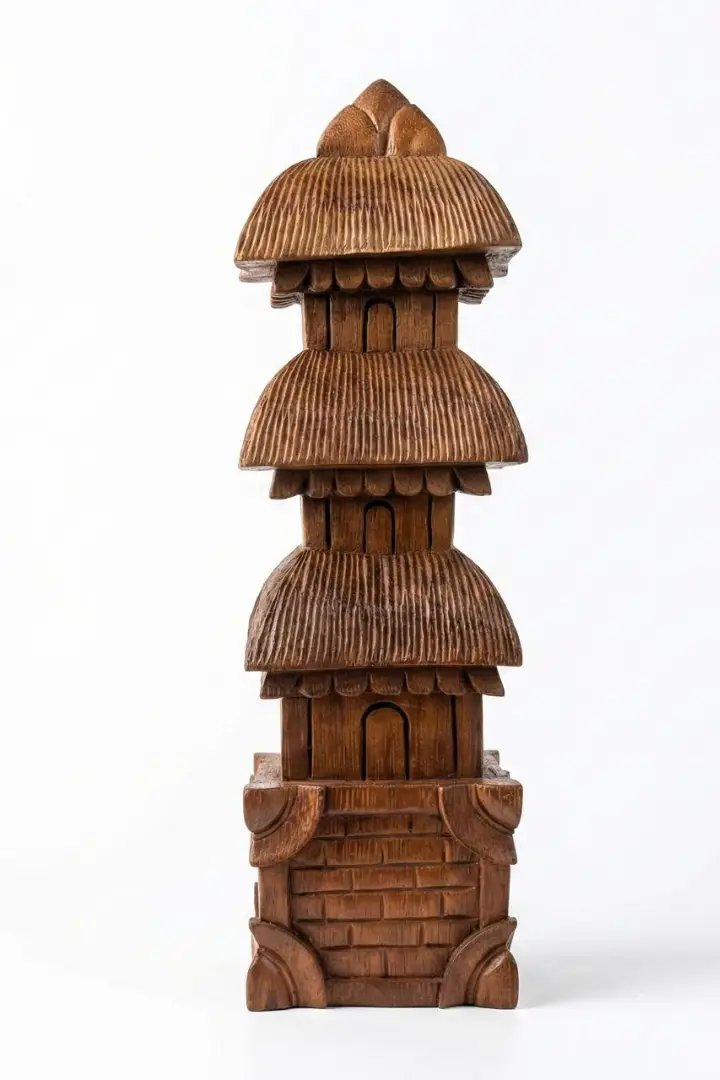
Buyers most often place it as a focal point in a meditation corner or alongside other Balinese pieces on an entryway console, where its tiered silhouette reads clearly even at a small scale — the same visual logic that makes the full-size structure recognizable from a distance across a temple courtyard.
How to Display Either Piece
Both pieces read best with some visual breathing room rather than crowded among smaller decor objects, since their value is largely in their silhouette. The candi bentar’s split form benefits from being viewed straight-on, where the gap between its two halves is legible; angled or corner placement can flatten that effect. The meru’s tiered profile is more forgiving of viewing angle, since the stacked-roof shape reads clearly from most sides.
Displaying the two together is reasonable, since both draw from the same architectural tradition, but they don’t need each other to make sense individually — each carries its own complete symbolism as a single piece.
Caring for and Shipping a Temple Architecture Carving
Both pieces are carved from the same suar wood covered in our broader wood carving guide: keep them out of direct sun and away from constant air-conditioning airflow, and apply a light coat of natural oil once a year to protect the finer carved edges of the gate’s towers and the shrine’s roof tiers from drying and cracking.
Both are compact enough to ship in a padded box, keeping shipping costs modest. Our guide to shipping art from Bali covers courier options and the customs paperwork that applies to wood items entering countries like Australia, New Zealand, and the United States.
Browse or Commission a Balinese Temple Gate Wood Carving
Both pieces in this collection are small-batch carvings, so current stock is the fastest-changing part of this guide. Check availability and current pricing over WhatsApp, or browse the full gallery online. A different scale, tier count, or finish can be discussed as a custom commission.
Mengobrol di WhatsApp Jelajahi Galeri