Tiger painting Bali refers to original tiger portraits created by artists working in Bali, most often in sand-texture or realist oil and acrylic techniques. Arts of Bali currently holds four such pieces: The Majestic Tiger Portrait Painting (sand texture, Rp2,800,000), Tiger Face Painting (large-scale sand texture, Rp3,700,000), Tiger Face on Blue Eye Painting (realism, Rp1,100,000), and a new monochrome textured arrival still being priced. None depict Bali’s own tiger subspecies, which has been extinct since the mid-20th century — a fact that gives the subject unusual weight on an island that lost its own.
Key Takeaways
- Arts of Bali holds 4 tiger paintings: 3 priced and in stock, 1 new monochrome arrival still being finalized.
- Techniques span sand texture, realism, and textured monochrome — three different hands, three different answers.
- Bali had its own tiger subspecies, Panthera tigris balica, extinct since the mid-20th century.
- The Sumatran tiger is the closest surviving relative, now grouped with the Bali and Javan tiger under Panthera tigris sondaica.
- This guide is a species-specific companion to our broader Wildlife Painting Bali collection guide, which does not cover tigers.
Definition: A tiger painting Bali piece is an original, hand-painted tiger portrait produced by an artist working in Bali, distinct from mass-printed or AI-generated wildlife art.
There is no tiger left on Bali. The island had its own subspecies once, Panthera tigris balica, hunted and pushed out of its habitat until the last confirmed animal was gone by the mid-20th century. No zoo holds one. No forest on the island has one to lose again. What Bali has instead, now, are paintings.
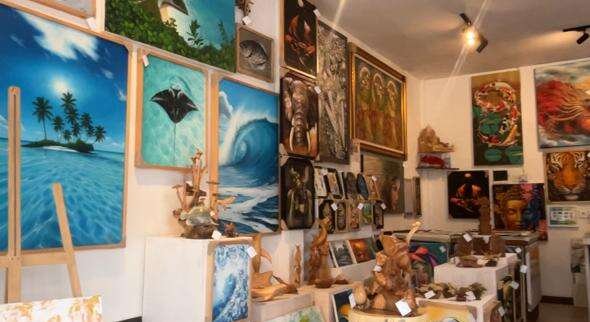
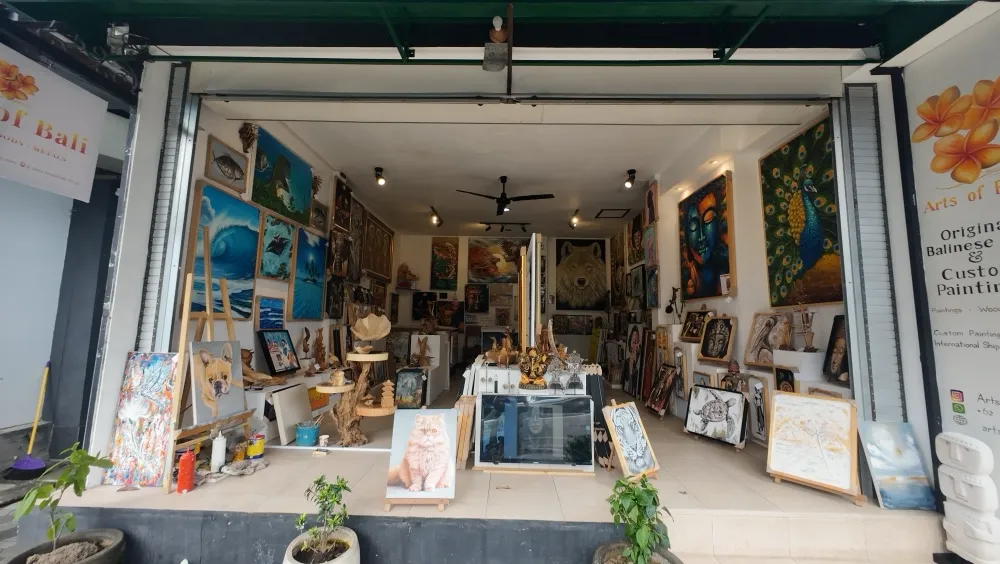
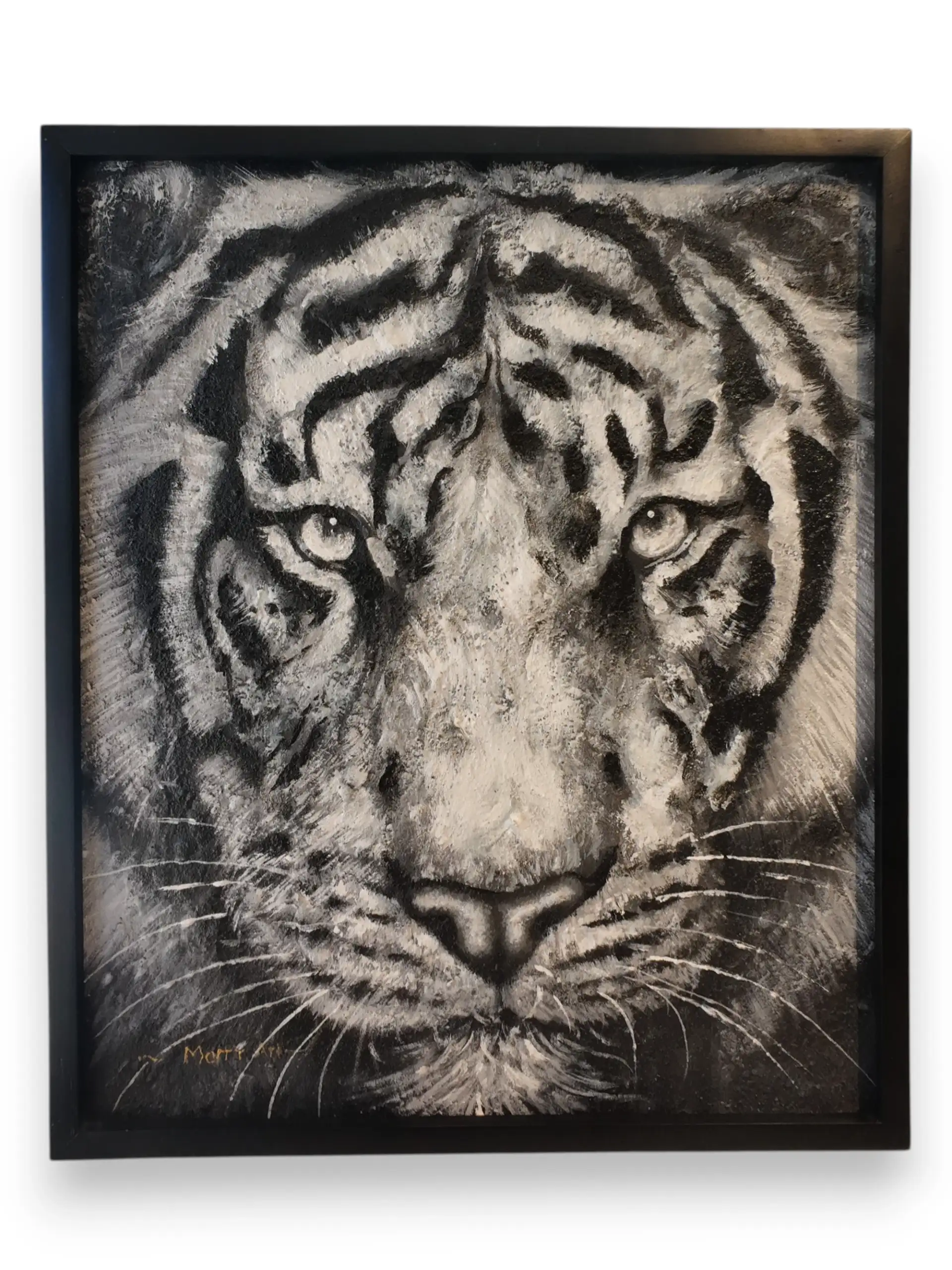
Tiger painting Bali is not a single style or a single hand. At Arts of Bali, four tiger portraits currently share wall and shelf space: two built from thick, granular sand texture, one rendered in careful realist detail around a startling blue eye, and one brand-new monochrome arrival worked entirely in black, white, and grey. Three have prices and product pages. One arrived too recently to have either yet.
This guide walks through all four, the techniques behind them, and the reason a tiger painted in Bali carries a different weight than a tiger painted almost anywhere else.
Tiger Painting Bali: Why This Subject Carries Extra Weight Here
A tiger painting Bali piece means something slightly different from a tiger painting made anywhere else, because Bali is one of the few places on earth where the local tiger is not endangered, it is gone. The Bali tiger, once classified as its own subspecies, Panthera tigris balica, was hunted and displaced until it disappeared from the island by the mid-20th century. A 2017 taxonomic revision folded it, along with the extinct Javan tiger, into the same lineage as the Sumatran tiger, Panthera tigris sondaica, the only member of that group still alive today and listed as Critically Endangered.
None of the four paintings in this collection claim to depict the Bali tiger specifically, and this article makes no claim that they do. But painting a tiger on an island that lost its own is not a neutral choice. It is closer to a memorial than a decoration, whether or not the artist intended it that way.
The CollectionThe Four Tiger Paintings at Arts of Bali
This tiger painting Bali collection spans three distinct techniques across four pieces, three already priced and in stock, one a brand-new arrival.
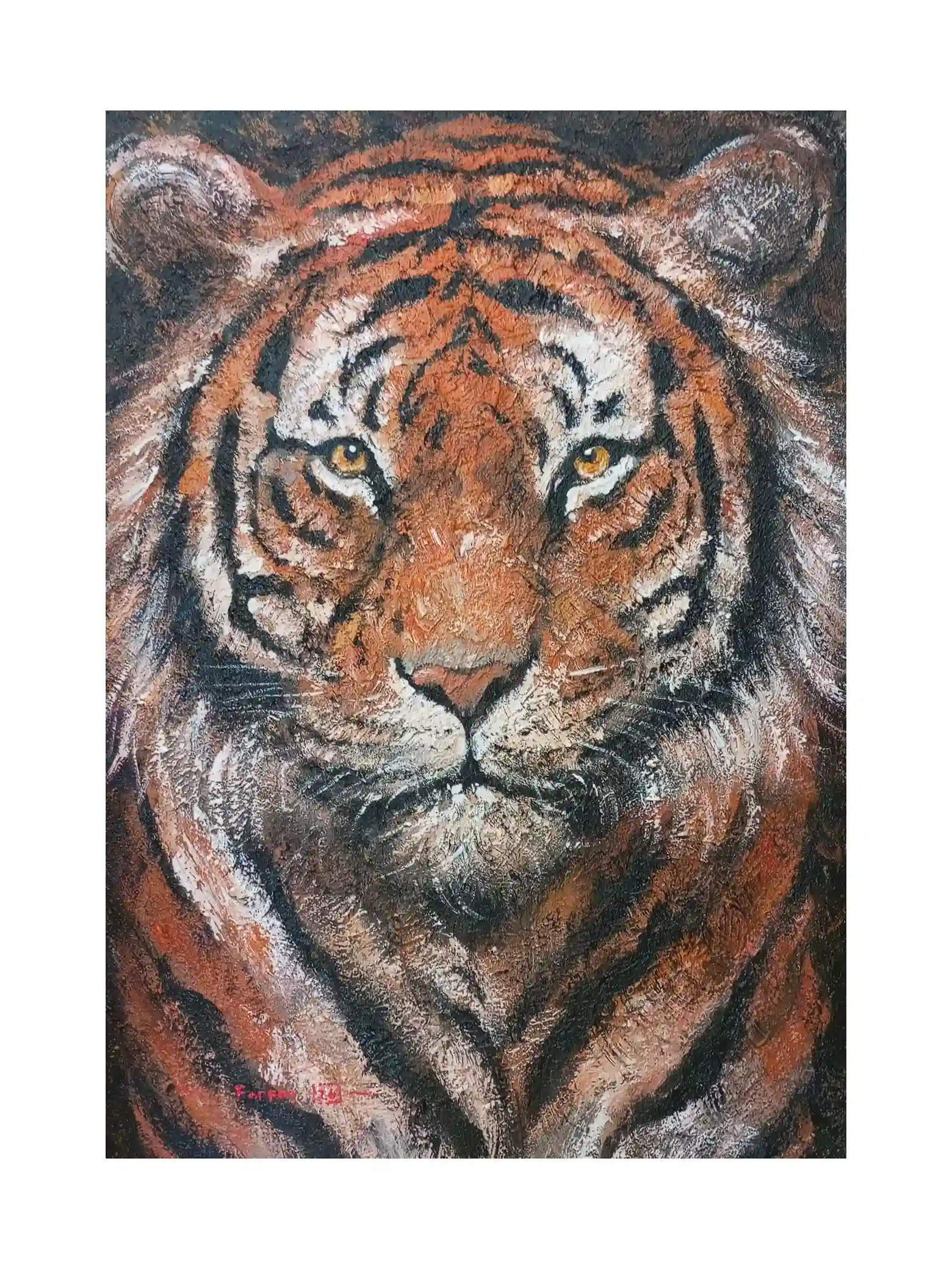
The Majestic Tiger Portrait Painting — Sand Texture, Rp2,800,000
A vertical 40 × 70 cm canvas built from heavy, granular sand texture in warm orange, black, and white. The technique gives the tiger’s fur a raised, physical surface rather than a flat painted one, and the eyes are worked to hold direct, steady contact with the viewer.
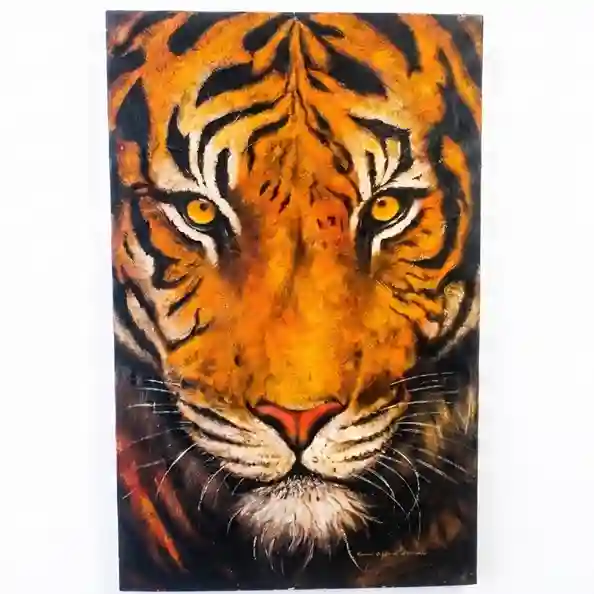
Tiger Face Painting — Sand Texture, Rp3,700,000
The largest of the four at 85 × 135 cm, and the most physically commanding. The same sand-texture approach as the piece above is scaled up considerably here, giving the fur and mane an almost sculptural presence from across a room.
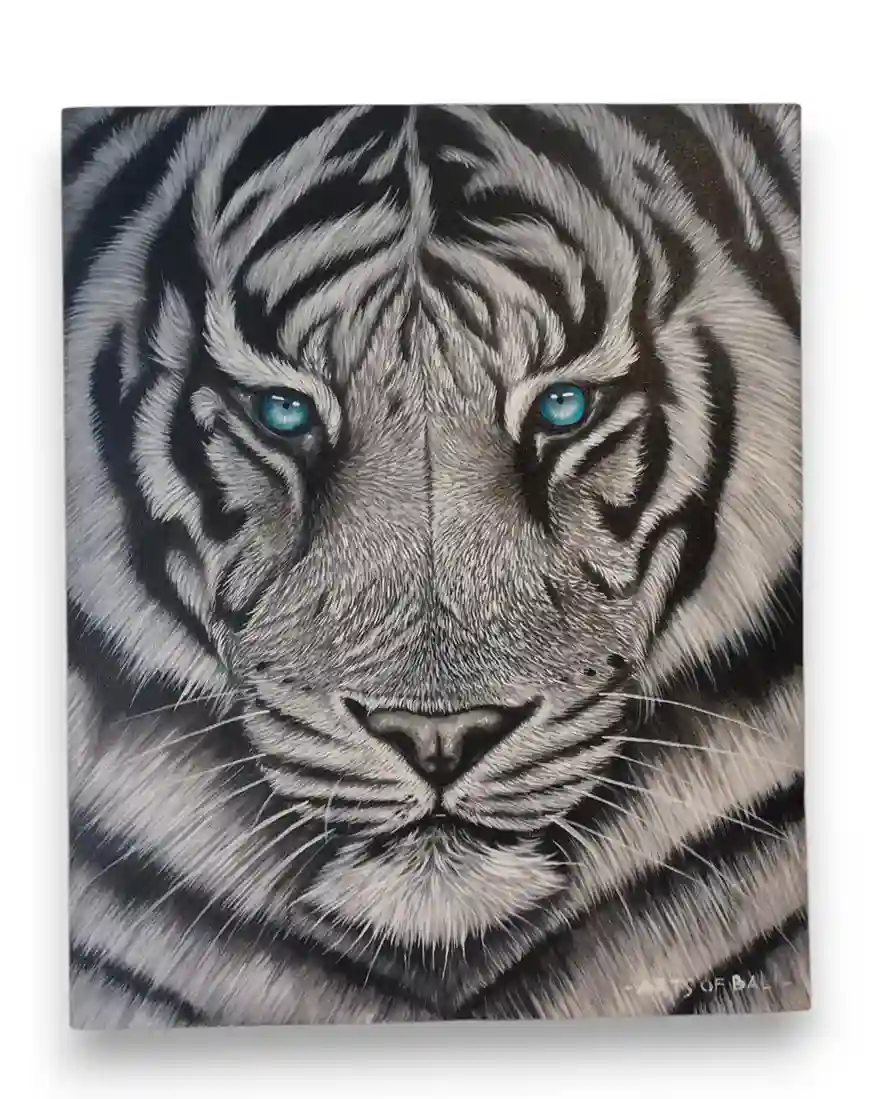
Tiger Face on Blue Eye Painting — Realism, Rp1,100,000
A smaller 43 × 53 cm canvas and the one clear departure from sand texture in this collection, painted in acrylic realism rather than built-up material. The tiger’s natural amber gaze is replaced with a striking blue, a deliberate, modern choice rather than an attempt at biological accuracy.
The New Monochrome Arrival
Shown in the hero image above. Where the other three pieces lean into color, orange fur, amber or blue eyes, this new piece strips the tiger down to black, white, and grey, built up with the same textured, tactile approach as the sand-texture pieces but without their warmth. Size, medium, and pricing are still being finalized.
Note on details: size, medium, and price for the new monochrome tiger painting are not yet confirmed and are not listed here. Contact the gallery directly for current availability.
Sand Texture vs. RealismThree Techniques, One Subject: Comparing the Four Tiger Paintings
Placed side by side, these four pieces make a useful case study in how differently the same animal can be approached.
| Piece | Technique | Size | Price |
|---|---|---|---|
| The Majestic Tiger Portrait Painting | Sand texture, acrylic | 40 × 70 cm | Rp2,800,000 |
| Lukisan Wajah Harimau | Sand texture, acrylic | 85 × 135 cm | Rp3,700,000 |
| Lukisan Wajah Harimau dengan Mata Biru | Realism, acrylic | 43 × 53 cm | Rp1,100,000 |
| New monochrome tiger painting | Textured monochrome | TBD | TBD — contact gallery |
Prices as listed at time of publishing (July 2026) and subject to change. Confirm current price and availability with the gallery before ordering.
Sand texture dominates this particular collection, two of the three priced pieces use it, which says something about how well the technique suits a subject built from muscle, mass, and dense fur. The realist blue-eye piece proves the opposite works too: a flatter, more controlled surface can carry just as much presence when the color choice is bold enough to do the work instead.
Panduan PembelianChoosing a Tiger Painting: What to Look for
The same signals that apply to any original wildlife painting apply here, with a couple of tiger-specific details worth knowing before you buy any tiger painting Bali piece, from this collection or elsewhere.
- Check the stripe pattern for consistency. A tiger’s stripes should read as a coherent system across the face and body, not as disconnected marks added after the fact.
- Look at the eyes first. As with any animal portrait, the eyes carry the emotional weight of the piece; they should have visible depth, not a flat painted surface.
- Feel for texture, if the technique claims it. A genuine sand-texture piece has real physical relief you can see catching light at an angle; a flat print pretending to be textured will not.
- Ask what medium was actually used. A gallery that can specify acrylic, sand texture, or oil, and the canvas type, is describing real inventory, not a stock description.
- Confirm size against your wall before ordering. The size range in this single collection, from 43 × 53 cm to 85 × 135 cm, shows how much scale changes a tiger painting’s presence in a room.
All four pieces are original, hand-painted works. For general guidance on evaluating any painting before you buy, see our guide to choosing art in Bali.
Want to See These Four Tiger Paintings in Person?
All three priced pieces are in stock at the gallery now, and the new monochrome arrival can be viewed on request while its details are finalized. Message us to check current availability.
WhatsApp the GalleryHow This Fits Into the Wider Wildlife Painting Bali Collection
These four tiger paintings are a species-specific slice of a larger collection. Our Wildlife Painting Bali guide covers the gallery’s lion, wolf, horse, butterfly, bison, and puppy portrait works in depth, including the two very different hyperrealist and sand-texture approaches used across that collection. None of the pieces described there are tigers, this guide exists specifically to fill that gap.
Read that guide alongside this one for the fuller picture of how the gallery approaches wildlife as a subject, and how techniques like sand texture and hyperrealism carry across species.
AftercareCaring for a Tiger Painting
Sand-texture and acrylic realist paintings share similar care needs. Keep the canvas out of direct, prolonged sunlight to prevent fading, especially on the warm orange tones used across this collection. Dust gently with a soft, dry brush rather than a cloth, since sand-texture surfaces can be delicate to the touch. Avoid hanging in direct airflow from air conditioning, which can dry and crack heavier textured surfaces over time.
For international orders, our guide to shipping art from Bali covers packing and crating for canvas works, including the larger 85 × 135 cm piece in this collection.
Common QuestionsFrequently Asked Questions About Tiger Painting Bali
Does Arts of Bali sell tiger paintings?
Yes. Arts of Bali currently holds four tiger paintings: The Majestic Tiger Portrait Painting (Rp2,800,000), Tiger Face Painting (Rp3,700,000), Tiger Face on Blue Eye Painting (Rp1,100,000), and a new monochrome arrival still being priced. All are original, hand-painted works.
Is the Bali tiger extinct?
Yes. The Bali tiger, once classified as its own subspecies, Panthera tigris balica, disappeared from the island by the mid-20th century due to hunting and habitat loss. It is now taxonomically grouped with the extinct Javan tiger and the surviving, Critically Endangered Sumatran tiger.
Do any of these paintings depict the extinct Bali tiger specifically?
No. These four paintings are tiger portraits in a general sense, not documented reconstructions of the extinct Bali tiger subspecies. The connection drawn in this guide is about the weight of painting any tiger on an island that lost its own, not a claim about the specific animal depicted.
What technique is used in these tiger paintings?
Three techniques appear across the four pieces: heavy sand texture (two pieces), acrylic realism (one piece), and a new textured monochrome approach (one piece). Sand texture builds a raised, physical surface; realism keeps the surface flat and controlled.
How is this different from the Wildlife Painting Bali collection?
Our Wildlife Painting Bali guide covers the gallery’s lion, wolf, horse, butterfly, bison, and puppy portrait works, but includes no tigers. This guide exists specifically to cover the gallery’s separate tiger painting collection in full depth.
Can I commission a custom tiger painting from Arts of Bali?
The gallery accepts custom wildlife and animal portrait commissions generally, as noted in our Wildlife Painting Bali guide. For a tiger-specific commission, contact the gallery directly via WhatsApp to discuss technique, size, and timeline.
How much does a tiger painting from Bali cost?
The three priced pieces in this collection range from Rp1,100,000 for a 43 × 53 cm realist piece to Rp3,700,000 for an 85 × 135 cm sand-texture canvas. Price scales mainly with size and technique. The new monochrome piece is not yet priced.
See the Tiger Painting Bali Collection at Arts of Bali, Seminyak
Visit the gallery to compare the sand-texture, realism, and new monochrome tiger paintings in person, or reach out to ask about pricing, sizing, and international shipping.
Jelajahi Koleksi Read Our Wildlife Painting Guide