Kecak dance is a Balinese Hindu dance-drama in which a circle of men chants “cak” in coordinated rhythm to act out scenes from the Ramayana, with a coconut oil lamp at the center and, in the best-known scene, fire. It was popularized in the 1930s and grew out of sanghyang, an older trance ritual. This guide covers where kecak came from, who gets the credit and why that is disputed, how a performance unfolds, where to watch it, and how Balinese painters put the chanting circle on canvas.
Key Takeaways
- Wikipedia describes kecak as a Balinese Hindu dance popularized in the 1930s and based on the Ramayana, traditionally performed in temples and villages.
- It has roots in sanghyang, a trance-inducing exorcism dance with a male chorus, so the chanting circle began as a ritual, not a show.
- Who created kecak is contested. Walter Spies and the dancer Wayan Limbak are credited with popularizing it, while I Wayan Dibia argues the Balinese were already developing the form before Spies arrived.
- A performance runs about an hour. Wikipedia says shows usually start daily at 6 pm Bali time at temples such as Uluwatu and Tanah Lot, so confirm the schedule with the venue.
- Our gallery lists one original kecak canvas, The Sacred Kecak Fire Dance Painting, 85 × 135 cm, at Rp12,500,000.
What Is Kecak Dance? The Ramayana Monkey Chant Explained
Search for kecak dance Bali and most results are ticket pages for a sunset show. That is useful if you are booking, but it skips the question we care about as an art gallery: where did this come from, and what are you looking at when fifty or more men sit in a circle and chant?
Wikipedia’s Kecak entry says the name is also spelled kécak, ketjak, or kechak. The chorus plays the vanaras, Rama’s army of apes, and the rakshasas, Ravana’s demons, which is why people also call it the monkey chant. Wikipedia’s Balinese dance entry lists it as the Ramayana monkey chant dance.
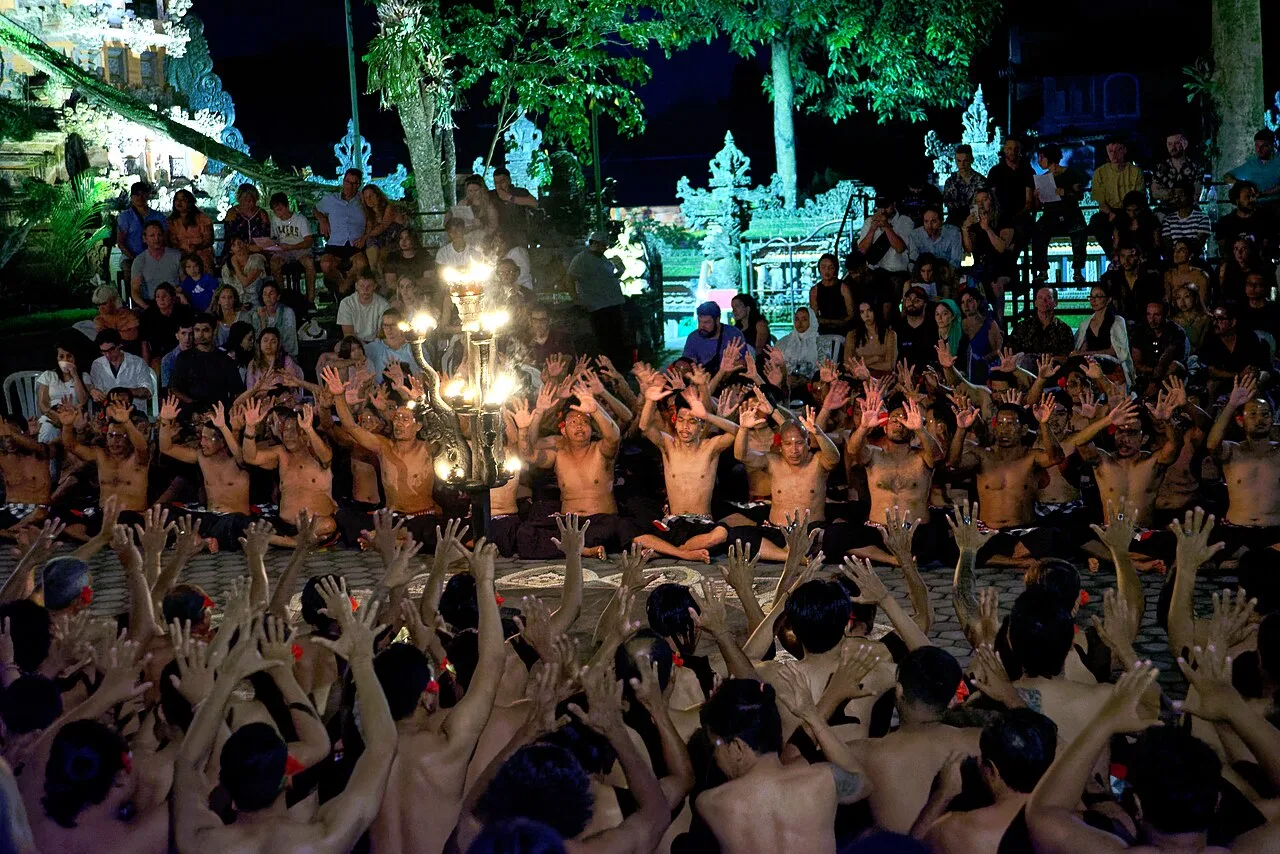
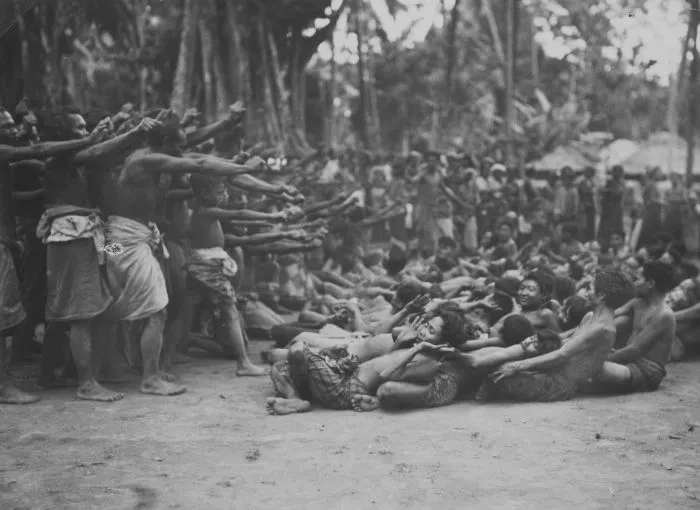
A typical performance has about fifty to one hundred men, although the same article’s introduction says as many as 150. They sit or stand in concentric circles around a traditional coconut oil lamp, sway left and right, and chant “chak” in a rhythm that starts slow and speeds up, hands raised and trembling. Wikipedia describes the dance as performed without musical instruments, so the chorus is the orchestra.
Inside that sound a few people have special jobs. One man keeps the beat with “po-po-po-po,” a leader starts and stops the chant, a singer adds melody, and a dalang, the narrator, tells the story, usually in Balinese and Sanskrit. The dancers are typically local villagers with other main jobs, and ticket sales are what pay them.
The HistoryKecak Dance History: Sanghyang Roots and the Walter Spies Question
Kecak grew out of sanghyang, a trance-inducing exorcism dance that was originally performed with a male chorus, according to Wikipedia. The best-known sanghyang is Sanghyang Dedari. The Balinese dance entry describes it as a sacred trance dance performed by two young girls in Karangasem, meant to invoke benevolent hyang spirits and counteract negative supernatural forces. It falls under wali, the category of sacred Balinese dances, and the same entry lists it among the sources Legong developed from.
The point for kecak is simple. The circle of chanting men did not begin as entertainment. It began as a ritual.
Then came the 1930s. Wikipedia says the German painter and musician Walter Spies, living in Bali at the time, became interested in the ritual and adapted it into a Ramayana dance-drama for Western tourist audiences. He worked with the dancer Wayan Limbak, who popularized the dance by arranging international tours for Balinese groups. The Kecak article adds that Limbak had already worked baris movements into the role of the cak leader in the 1920s, and that Spies then suggested a Ramayana spectacle with a cak chorus in place of a gamelan.
| Name | Role in the kecak story |
|---|---|
| Sanghyang | Older trance exorcism dance with a male chorus, the ritual root kecak grew from. |
| Wayan Limbak | Dancer who worked with Spies, popularized kecak, and arranged touring performances abroad. Credited with baris movements in the cak leader role in the 1920s. |
| Walter Spies | German painter and musician who, per Wikipedia, adapted the ritual into a Ramayana dance-drama for tourists and suggested a cak chorus instead of gamelan. |
| I Wayan Dibia | Argues the Balinese were already developing the form before Spies arrived. |
Source: Wikipedia’s Kecak entry, which itself asks for more citations in several sections. Read the table as who the sources credit, not as settled history.
So who invented kecak? It depends who you ask. Wikipedia notes that the anthropologist James Clifford reads kecak as part of a modern art-culture system in which the West adopts, transforms, and consumes non-Western elements, while Dibia says the form was already taking shape in Bali. We use the word popularized, because that is the word the sources agree on, and we are not going to name a single inventor.
Spies is also remembered as a co-founder of the Pita Maha artists’ cooperative. Wikipedia says he was born in Moscow in 1895, moved to Bali in 1927, and lived at Campuan in Ubud. If you want the painting side of Ubud, start with our guide to Ubud style painting.
How a Kecak Performance Unfolds: Rama, Sita, Hanuman and the Fire
The performance lasts about an hour and follows the Ramayana, the Sanskrit epic. Wikipedia lists the sequence like this: Sita and Rama’s exile in the Dandaka jungle, the Golden Deer, Ravana’s abduction of Sita, the battle between Ravana and Jatayu, Hanuman’s search for Sita, and the final battle between Rama and Ravana. The chorus plays both armies, the apes and the demons, so the same men change role as the story moves.
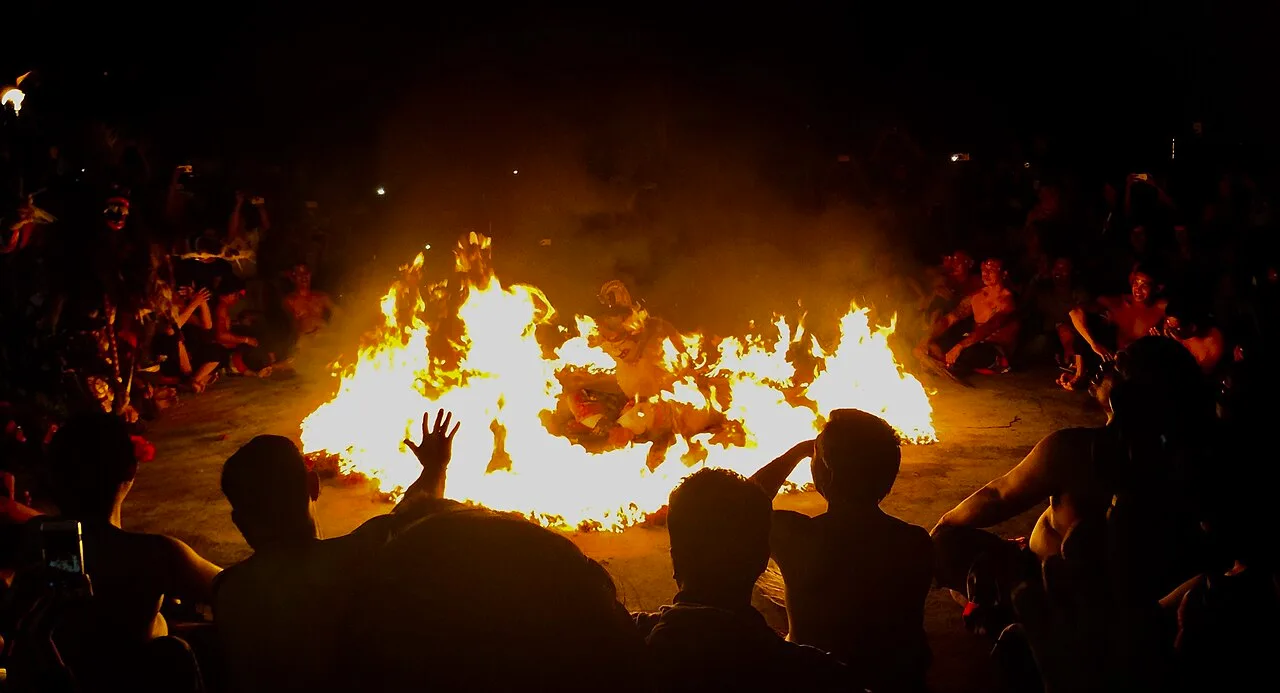
The circle
The chorus sits in concentric rings around the lamp. The shape is the stage, so the dancers act inside it and the audience watches from outside.
The chant
The chant is the music. The “chak” rhythm speeds up, the hands lift and tremble, and the group starts to sound like one instrument.
The fire
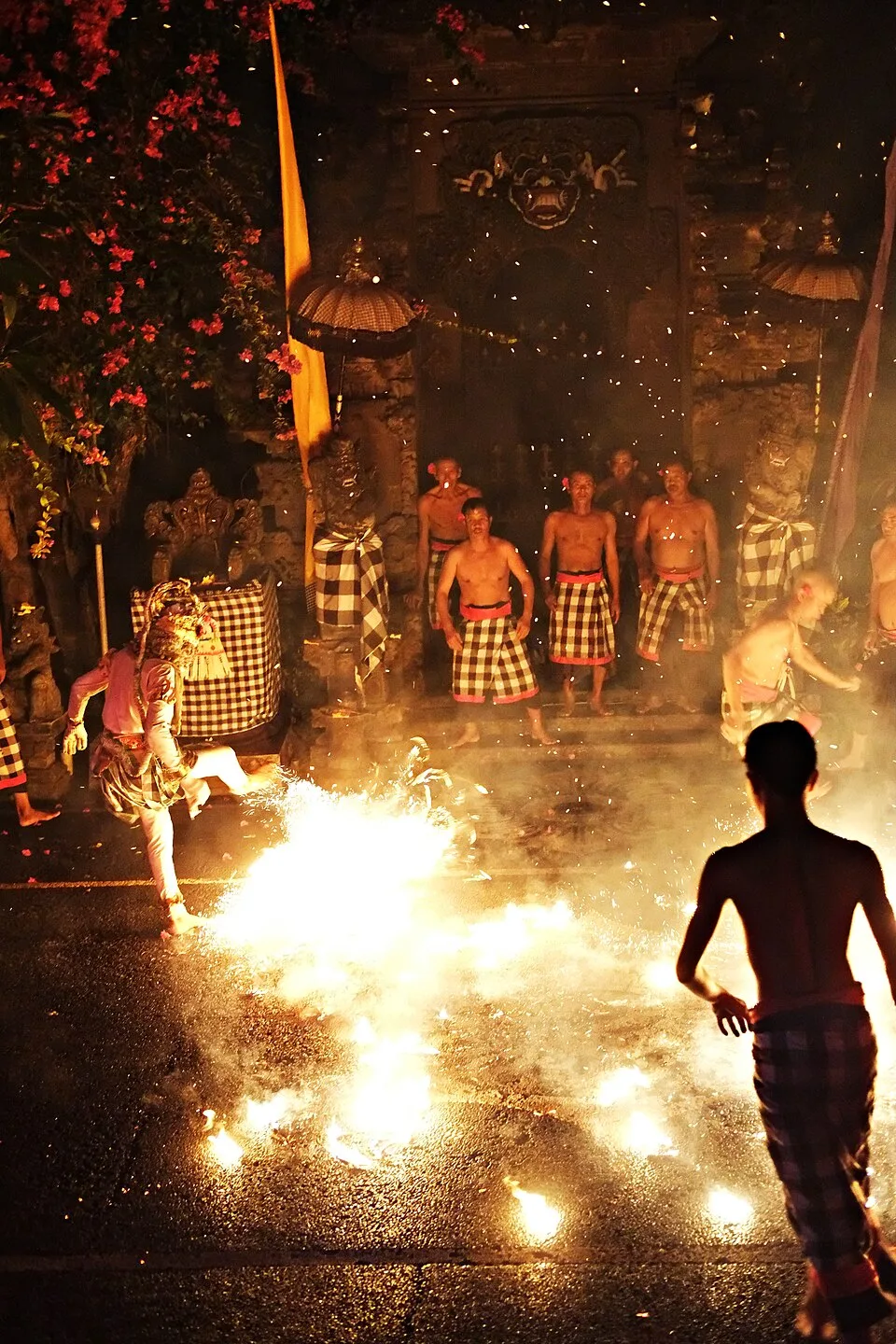
In the scene of Hanuman’s burning, Wikipedia says a priest blesses the Hanuman dancer, who enters a trance for the fire-kicking dance.
The cast
The main roles are Sita, Rama, Lakshmana, Ravana, Hanuman, and Jatayu. The first women’s kecak group started in 2006.
Visitors often search for the Balinese fire dance, and what they usually mean is this scene, the kecak fire dance with Hanuman. Wikipedia adds that the dancer feels no pain because he is in trance, but that sentence has no citation. We treat it as the belief around the dance, not a fact we can confirm.
Where to Watch Kecak Dance in Bali
According to Wikipedia, performances usually take place daily at 6 pm Bali time at temples such as Uluwatu Temple and Tanah Lot, and Uluwatu is the most popular venue. Dedicated kecak stages exist in Ubud, Garuda Wisnu Kencana, Batu Bulan, and Pandawa Beach. The opening photo in this article comes from an open stage in Ubud.
| Venue | What Wikipedia says |
|---|---|
| Uluwatu Temple | The most popular venue, with shows usually daily at 6 pm Bali time. |
| Tanah Lot | Temple venue with the same usual daily 6 pm slot. |
| Dedicated stages | Ubud, Garuda Wisnu Kencana, Batu Bulan, and Pandawa Beach. |
Source: Wikipedia’s Kecak entry. Times, prices, and venues change, so confirm with the venue or your hotel before you go. We are a gallery with no ticket desk.
If you only see one performance, pay attention to the chorus more than the fire. The fire is the headline, but the chorus is the dance.
On CanvasHow Balinese Painters Put Kecak on Canvas
Painting a sound is hard, so painters paint bodies. A kecak canvas usually gets its power from repetition: rows of men with arms raised, packed around a center where the story happens. Compare that with Baris dance, Bali’s warrior dance, which has a solo form as well as a group ritual form, or with Calon Arang, built around the witch queen Rangda. Kecak is the crowd one: many bodies, one shape.
Painters have taken up all of these performances. Our guide to Balinese dancer painting covers sacred ceremonial dances like Legong, and Balinese mythology painting covers the Barong and the Ramayana as painted stories. For the wider map of styles, see Balinese art styles. The street version of performance as ritual is the ogoh-ogoh parade the night before Nyepi.
From Our SideWhat We Know and What We Defer On
We are a gallery, not a dance company. What we write here comes from the published sources named in this post and from the pieces in our own collection. On points of ritual, we defer to the people who perform kecak. If you spot something we should correct, tell us and we will fix it.
In the GalleryThe Sacred Kecak Fire Dance Painting
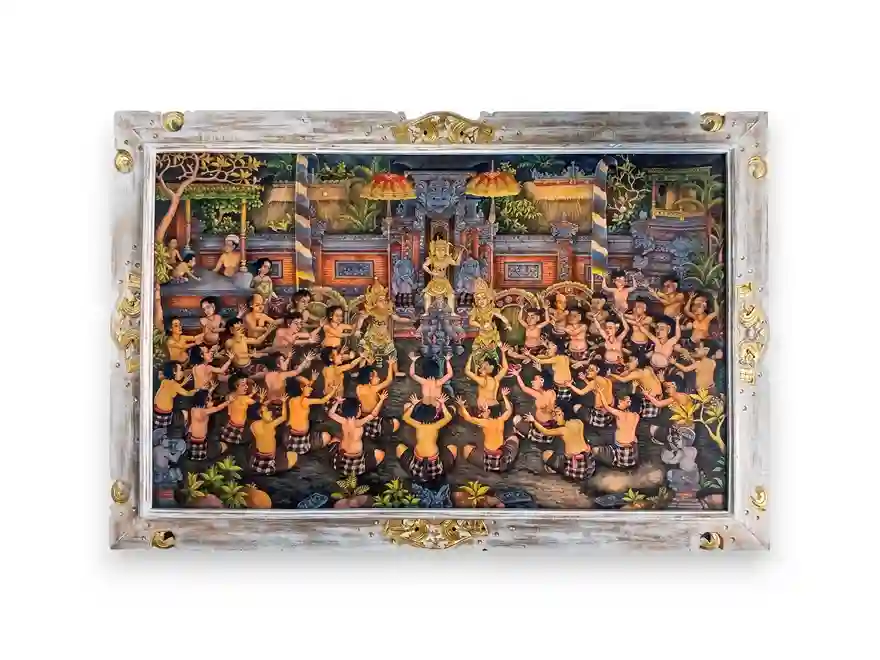
The Sacred Kecak Fire Dance Painting is listed as an original acrylic on cotton canvas, 85 × 135 cm, hand-painted in the traditional Ubud painting technique, priced at Rp12,500,000. The listing describes a panoramic scene: the synchronized upraised hands of the chorus, the architecture of a temple courtyard, and the Ramayana characters at the center of the ring. It does not name the painter, so we do not either.
| Detail in the canvas | What it refers to |
|---|---|
| Rows of men in checked cloth with raised arms | The cak chorus, the heart of the dance |
| Gilded figures at the center | The Ramayana characters in the ring, as the listing describes |
| Temple gate and walls behind the circle | Temples and villages, where Wikipedia says kecak is traditionally performed |
Details are from the product listing and our own photographs, checked on 14 October 2026. In those photographs the focus is the chorus and the central figures, not flames. Price and availability can change.
Ask About the Kecak Painting
Tell us the wall you have in mind and we will send close-up photos, the exact size on canvas, and shipping options for The Sacred Kecak Fire Dance Painting. We ship worldwide.
Chat on WhatsAppView the Kecak Fire Dance Painting