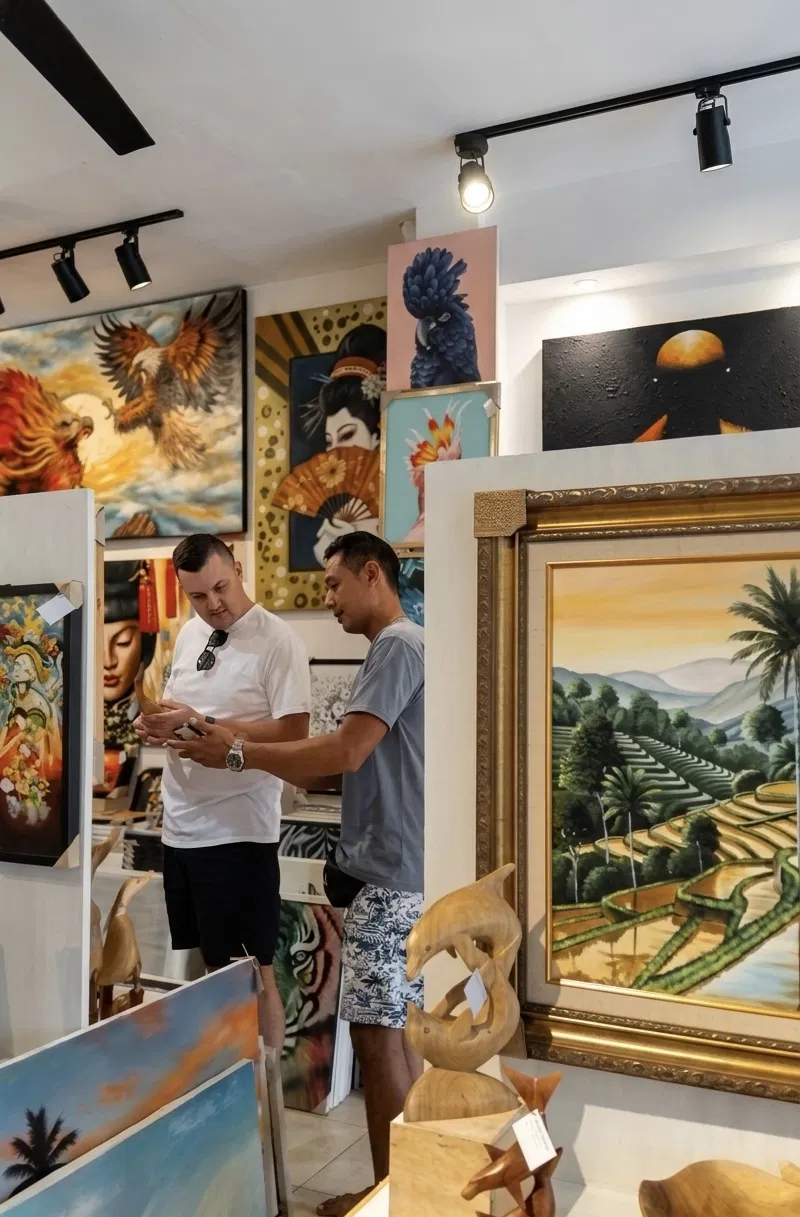
“Buying art in Bali should feel like an encounter, not a transaction. The right painting chooses you as much as you choose it — and the process of getting it home should be the least complicated part of the whole experience.”— Putu Sucipta, Owner, Arts of Bali
Buying art in Bali is straightforward when you work with a reputable gallery. The process involves choosing a work, agreeing on price, arranging payment (cash or bank transfer), and confirming shipping details — the gallery handles everything from packing to customs documentation. Arts of Bali at Jl. Raya Seminyak No. 42 ships original paintings and tribal art to 40+ countries, with delivery typically taking 7–14 business days. Entry is free and no appointment is needed.
- The full buying process — from choosing a work to having it on your wall — takes 1–3 weeks for international buyers.
- Payment: cash (IDR or USD) or bank transfer. No credit card fees on standard transactions.
- All shipping includes custom packing, export documentation, and insurance — managed entirely by the gallery.
- Buying in the gallery gives you provenance documentation, artist context, and physical inspection — none of which online-only purchasing provides.
- Customs duties vary by destination country; Arts of Bali advises on this at point of purchase.
People come to Bali with paintings on their mind more often than they admit. They arrive intending to buy something — a memory they can hang, a piece of the island that survives the return flight. Then they walk down Jl. Raya Seminyak and the sheer volume of it becomes the problem: a hundred shops, a thousand images, and no obvious way to know which of them is worth taking seriously. This guide is for those people. It covers how to buy art in Bali without making the mistakes that experienced collectors have already made, what the process of getting your purchase home actually looks like, and why the difference between buying at a serious gallery and buying at a roadside stall matters for something other than price.
It is also honest about what buying art in Bali involves — the real numbers, the real timeline, and the situations where things go wrong and how to avoid them.
Where to Buy Art in Bali: Ubud, Sukawati, Seminyak — and the Differences That Matter
Bali has three distinct art-buying destinations, each with a different character, price range, and level of collector seriousness. Understanding which suits your purpose saves significant time — and prevents the particular disappointment of spending two hours in the wrong place.
🏔 Ubud — The Cultural Centre
Ubud is historically the heart of Balinese fine art — the village where the island’s classical painting traditions developed through the 1930s in dialogue between Balinese artists and visiting Western painters like Walter Spies and Rudolf Bonnet. The Художественный музей Нека, the Музей Пури Лукисан, and galleries on Jl. Raya Ubud carry the deepest inventory of serious Balinese painting. If you are interested in traditional Batuan or Ubud-style work, or in understanding Balinese art historically before you buy, Ubud is where that education happens. Prices range from IDR 150.000 for small market pieces to tens of millions for significant documented works at established galleries. The traffic getting there is real; allow two hours from Seminyak.
🛕 Sukawati — The Volume Market
Pasar Seni Sukawati in Gianyar is Bali’s largest traditional art market — two floors of stalls selling batik, wood carving, painting, and decorative craft at prices that reward serious bargaining. This is the right destination if you want: inexpensive decorative pieces, souvenirs at volume, traditional craft items (fans, puppets, printed batik). It is not the right destination if you want original paintings with documented provenance or signed works by named artists. The quality range is enormous; the floor is low. Budget IDR 20.000–300.000 for most items here. Go early — by 10:00 the tourist coaches arrive.
🌊 Seminyak — Contemporary & Collector-Ready
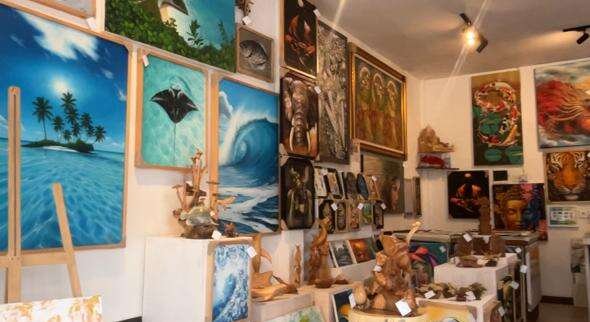
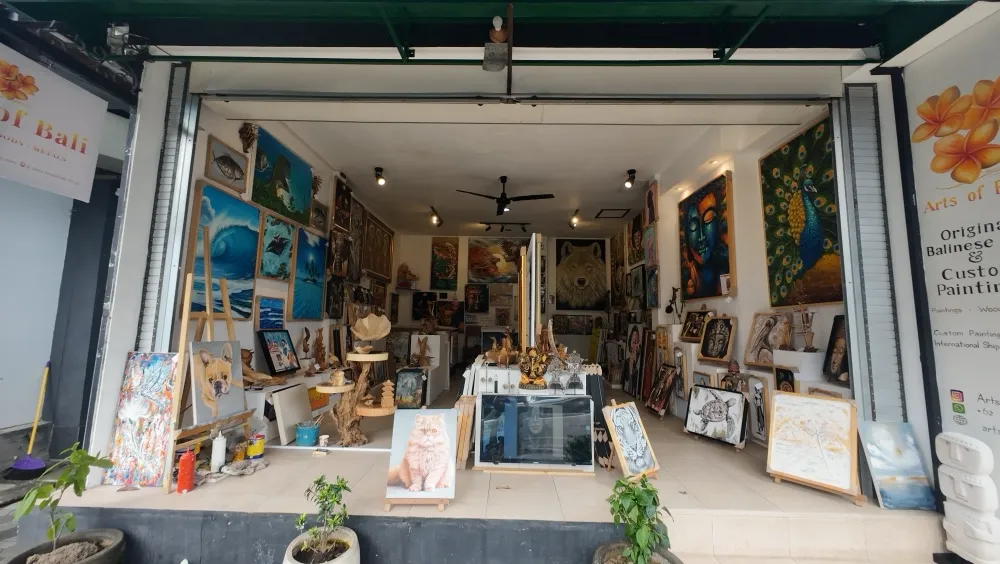
Seminyak’s gallery scene is younger than Ubud’s but more oriented toward the international collector — buyers who want original work, professional packing, reliable international shipping, and documented provenance. Jl. Raya Seminyak concentrates several serious galleries within walking distance. Arts of Bali at No. 42 specialises in original Balinese painting across techniques (oil, acrylic, palette knife impasto) alongside Indonesian tribal and ceremonial art — categories rarely found together outside of Seminyak’s better galleries. Price range: IDR 500.000 for small original works up to IDR 25+ million for large signed canvases. The advantage here over Ubud: longer opening hours, proximity to hotels, and infrastructure built for international shipping.
Gallery vs. Online: Where Should You Actually Buy Art from Bali?
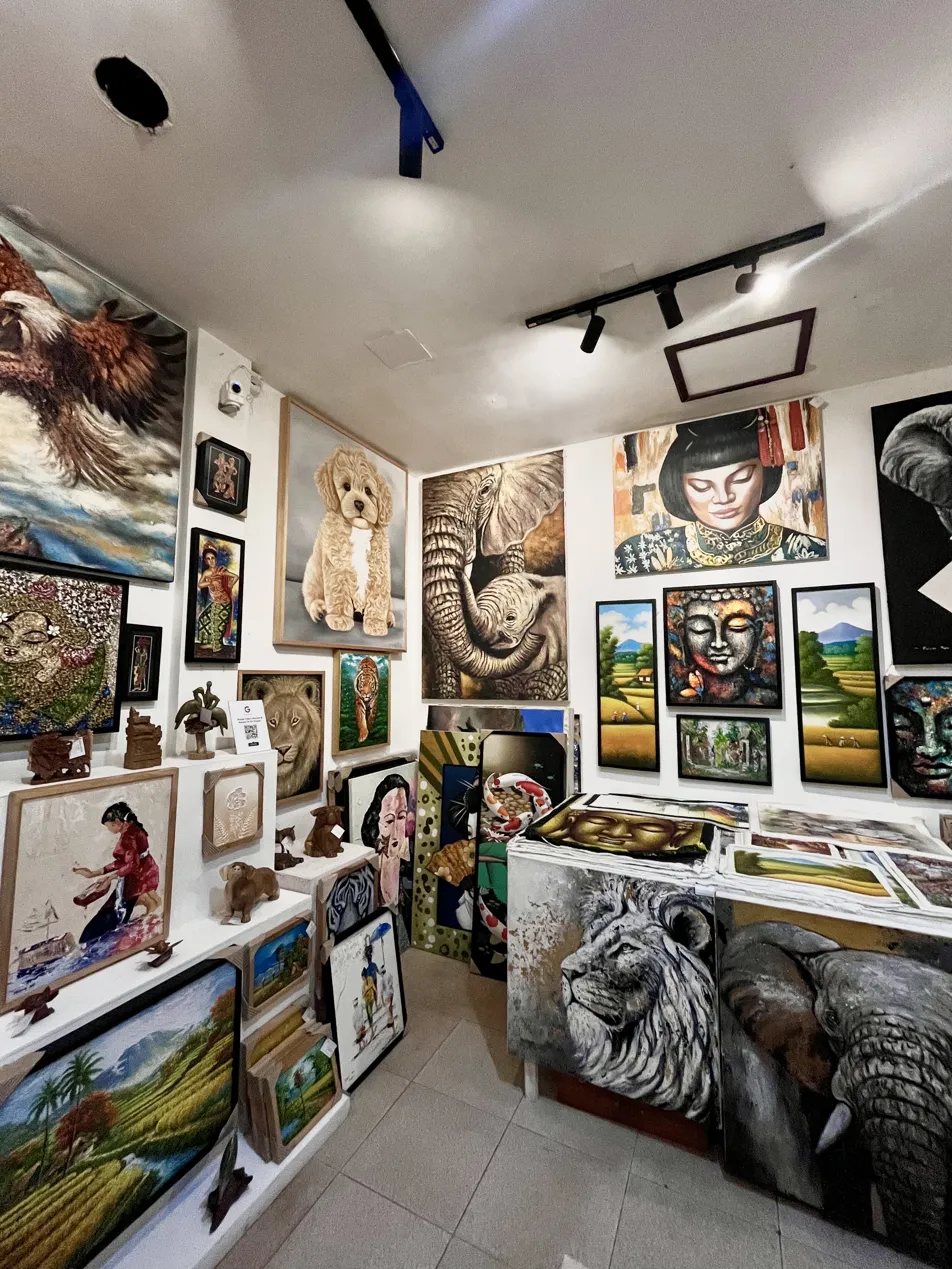
This question gets asked often, and the honest answer is that they serve different needs. Neither is categorically better. The question is what you are buying and what you need to know before you commit.
| 🏛 In-Gallery (Arts of Bali) | 🌐 Online / Remote Purchase | |
|---|---|---|
| See actual scale & texture | ✅ Yes — physically inspect the work | ❌ Photos flatten scale and gloss over texture |
| Artist context & story | ✅ Curated by owner, who knows each artist | ⚠️ Depends entirely on platform / seller |
| Provenance documentation | ✅ Provided for every work sold | ⚠️ Not guaranteed — ask before purchasing |
| Custom commission | ✅ Discuss brief in person, WhatsApp follow-up | ✅ Via WhatsApp/email — works well |
| Price negotiation | ✅ In-person — natural conversation | ⚠️ Possible but less fluid |
| Not in Bali currently | ❌ Requires physical visit | ✅ WhatsApp video call + photos available |
| Risk of misrepresentation | ✅ Very low — you see what you pay for | ⚠️ Higher — depends on seller’s integrity |
The short version: if you are in Bali, visiting the gallery in person is almost always worth doing — even if you ultimately buy online later. Seeing a painting in real light, at real scale, with someone who can tell you who made it and why, is information that no product page replaces. For collectors who cannot visit, Arts of Bali offers WhatsApp video consultations where specific works are held up and walked around under gallery lighting. It is not the same as being there, but it is considerably more than scrolling a website.
How to Buy Art in Bali: A Step-by-Step Buyer’s Guide
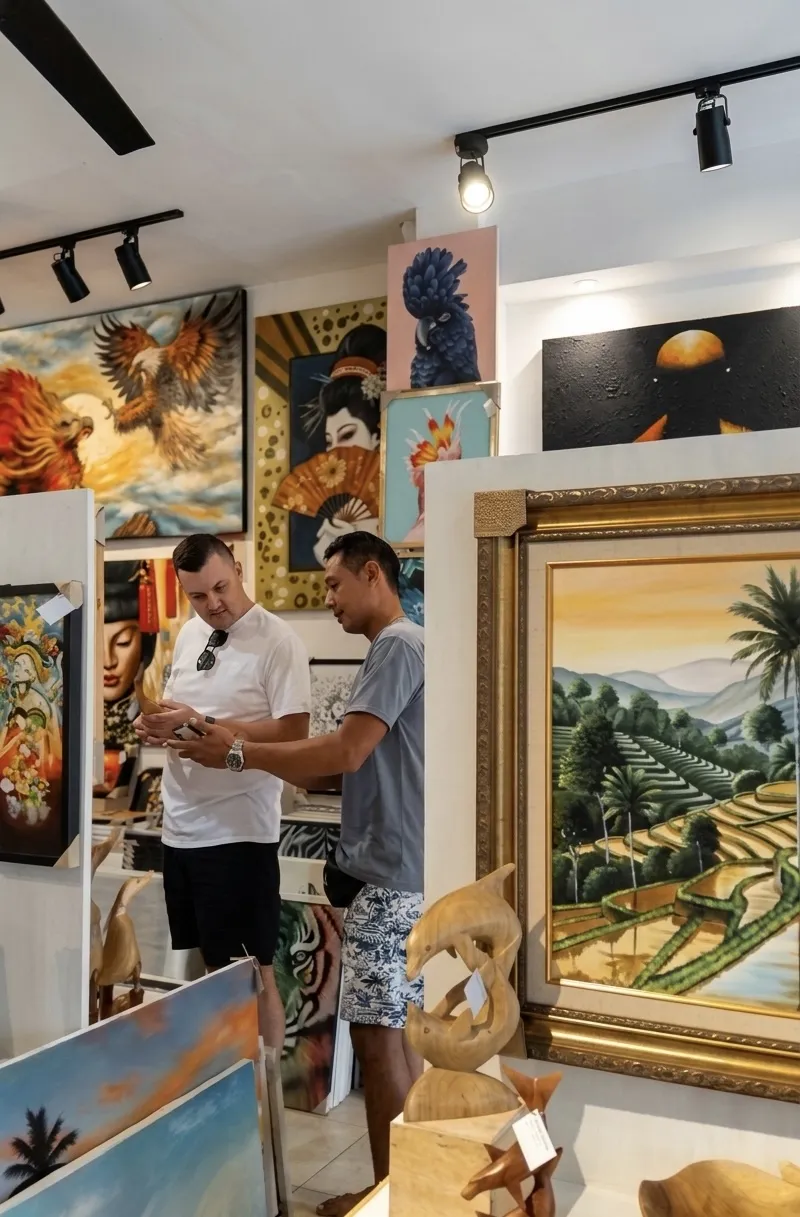
Most people underestimate how simple the process is, and a few overestimate it in ways that create unnecessary anxiety. Here is exactly how it works at Arts of Bali, from first visit to painting on your wall.
Browse Without Pressure
Walk in. Entry is free. Nobody follows you. The gallery is open daily from 09:00 to 21:00 at Jl. Raya Seminyak No. 42 — a 12-hour window that accommodates both the early risers and the people who remember they meant to buy something at 19:30 on their last evening. Take your time. Most first visits last 30–45 minutes. Some run considerably longer. The work rewards looking, not scanning.
Ask About What Interests You
When something catches your eye, ask. Putu Sucipta or his team can tell you who painted it, in what tradition, with what technique, and when. This is not a sales pitch — it is context. Understanding what you are looking at changes what you see. A palette knife impasto sunflower stops being a pretty painting and becomes a specific decision made by a specific artist on a specific afternoon. That specificity is part of what you are buying.
Agree on Price
Prices at Arts of Bali are set by the work’s scale, technique, and whether it is a signed original by a named artist. Price discussion is straightforward and expected — this is Bali, and the culture around negotiation is not adversarial. What is not negotiable: authenticity. The price reflects what the work is, not what someone thinks a tourist will pay for it. If a price seems too low for what you are being shown, ask why. At a serious gallery, the answer should be specific.
Payment
Arts of Bali accepts cash in Indonesian Rupiah (IDR) and US Dollars (USD), and bank transfer in IDR. Payment is made in full at the time of purchase for in-stock works. For custom commissions, a 50% deposit secures the commission and the balance is due on completion, before shipping. There is no surcharge for USD cash payment at the current exchange rate.
Packing & Export Documentation
Once payment is confirmed, the gallery prepares the work for shipping. Unframed canvases are rolled onto a protective tube and placed inside a reinforced aluminium or PVC shipping tube. Framed works travel in custom-built timber crates with foam padding cut to the exact dimensions of the frame. Export documentation — including the commercial invoice, packing list, and where required, cultural export declarations — is prepared by the gallery. You provide your delivery address and contact details. Everything else is handled.
Delivery & Tracking
The gallery sends a tracking number once the shipment leaves Bali. Most international shipments use DHL or FedEx — both provide live tracking from Bali to your door. Delivery typically takes 7–14 business days to Australia and Southeast Asia, 10–16 days to Europe and North America. Your painting arrives. You unpack it. That is the end of the process.
“We have sent paintings to 40-something countries. The most common thing buyers say when they contact us after delivery is that it was easier than they expected. That is exactly what we are aiming for.”
— Путу Сучипта, «Искусство Бали»How Much Does Original Art in Bali Cost?
Price is the question most buyers are reluctant to ask directly. The honest answer: original Balinese art has a genuinely wide range, and understanding what sits in each tier prevents both overpaying and the confusion of comparing a signed museum-quality canvas with a decorative souvenir piece.
At Arts of Bali, the mid-range accounts for the majority of purchases. Most international buyers — those who are serious about what they’re taking home — spend between IDR 3–6 million for a single work. That range covers a framed, signed, documented original with full provenance and international shipping included in the quoted price. Prices in USD are available on request and calculated at the mid-market rate on the day of purchase.
International Shipping: Costs, Timelines, and What the Price Includes
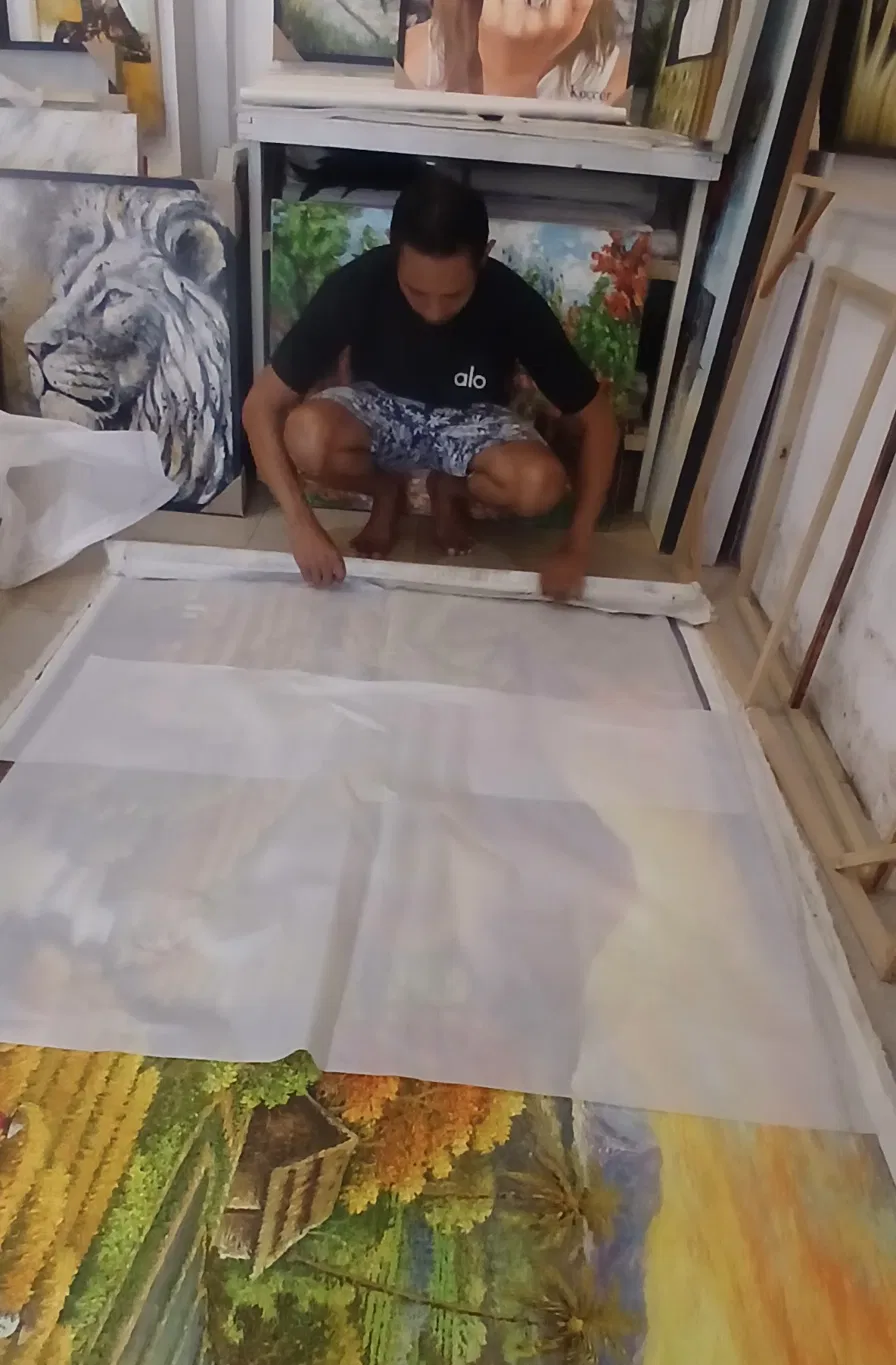
Shipping from Bali costs more than shipping within Indonesia — this is not a surprise, but the actual numbers are worth knowing before you fall in love with a 150 × 200 cm landscape painting. The figures below are approximate ranges; the gallery provides an exact quote based on final dimensions, weight, and destination at the time of purchase.
| Destination | Small Work (tube / <50×60cm) | Medium Work (50–100cm) | Large Work (>100cm / crated) | Est. Transit |
|---|---|---|---|---|
| Australia / NZ | USD 35–55 | USD 65–110 | USD 140–280 | 5–9 days |
| Singapore / Malaysia | USD 25–40 | USD 50–85 | USD 110–210 | 3–6 days |
| Europe (UK, DE, NL, FR…) | USD 55–85 | USD 95–155 | USD 200–400 | 8–14 days |
| USA / Canada | USD 60–90 | USD 100–165 | USD 220–440 | 9–16 days |
| Middle East (UAE, KSA) | USD 45–70 | USD 80–130 | USD 170–320 | 6–10 days |
| Japan / South Korea | USD 40–65 | USD 70–120 | USD 150–290 | 5–10 days |
* Estimates based on DHL Express and FedEx International Priority published dimensional weight rates, Denpasar (DPS) origin, June 2026. Actual cost varies by exact dimensions, weight, and fuel surcharge at time of booking.
Note: Figures are approximate ranges for 2026. Fuel surcharges and dimensional weight calculations affect final cost. The gallery provides a firm quote before shipping confirmation.
What the Shipping Price Includes
The shipping cost covers more than courier fees. Built into every shipment: professional packing materials (acid-free tissue, foam padding, reinforced tube or custom timber crate), the gallery’s packing labour, export documentation from the Indonesian side, insurance for the declared value of the work during transit, and tracking. What it does not cover: destination-country customs duties or import taxes, which are the buyer’s responsibility and vary significantly by country and declared value. Arts of Bali advises on likely customs implications for your specific destination at the time of purchase — and for a detailed breakdown of the full shipping process, see the gallery’s dedicated shipping guide.
Carrying Your Purchase on the Plane
For smaller unframed works, carrying the tube on the plane is often simpler than shipping — a 70cm rolled canvas fits in most overhead compartments and most airlines treat it as carry-on. Check your airline’s policy on tube dimensions before you pack. Framed works or anything over 100cm almost always need to be shipped rather than carried. If you are flying home with a purchase, the gallery can roll and tube-pack any unframed canvas in under an hour while you wait.
Is It Safe to Buy Art in Bali? Transaction Security, Insurance & What Can Go Wrong
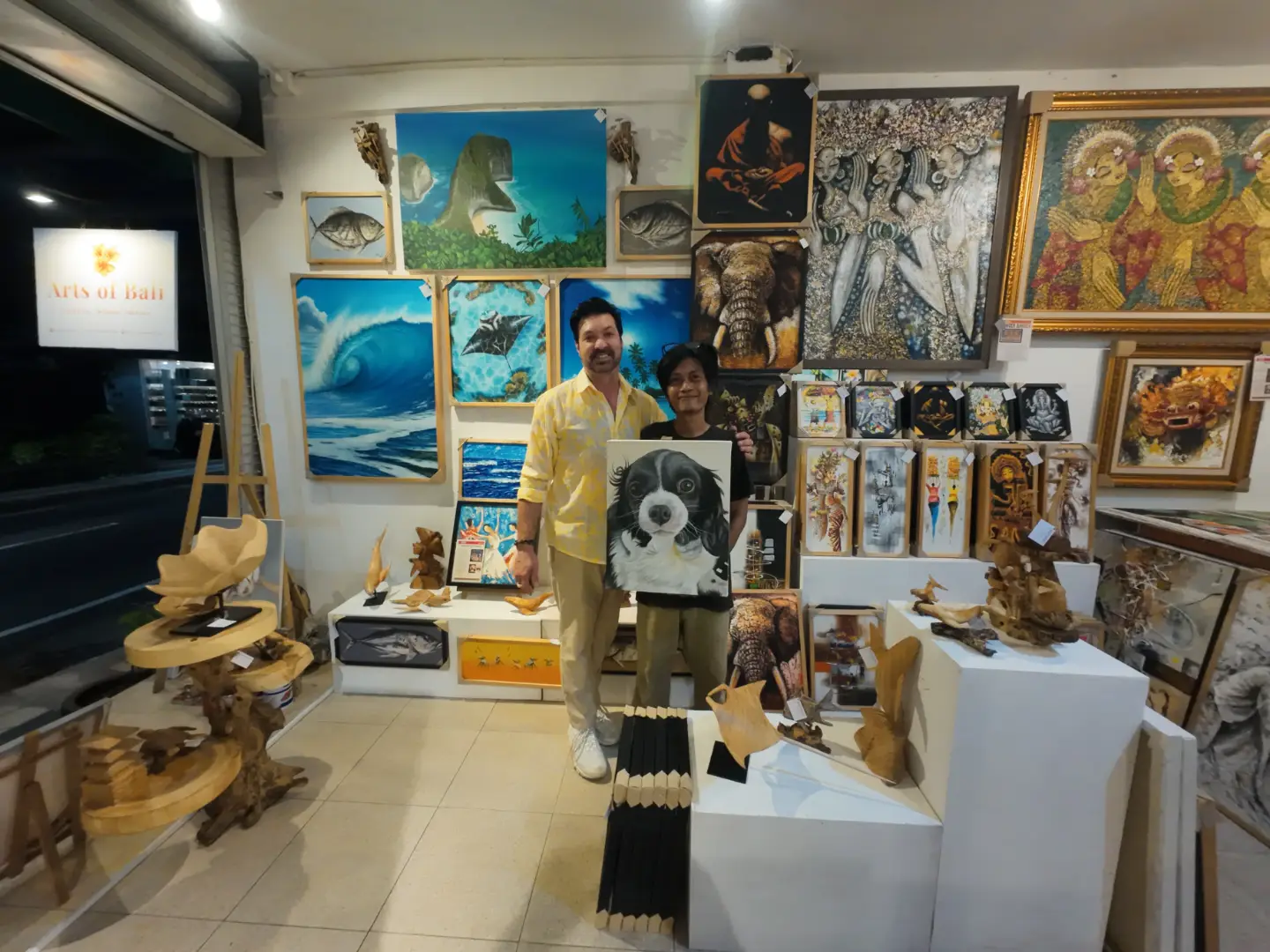
The honest answer is: it depends entirely on where you buy. There is no regulation governing the use of the word “gallery” in Bali — anyone can put the word on a shopfront. What separates a serious gallery from a tourist-market operation is not always visible from the outside. Here is what to look for.
Signs of a Trustworthy Gallery
A gallery worth buying from can tell you who made every work on its walls. Not “a Balinese artist” — a specific person, with a name, a background, and ideally a signature on the work. It can provide provenance documentation: a record of the work’s title, medium, dimensions, artist, and date of sale. It has a fixed address you can return to if something goes wrong. And it handles its own shipping rather than outsourcing it to a third party you’ve never heard of.
Arts of Bali has been at Jl. Raya Seminyak No. 42 for over a decade. The gallery is managed by one person — Putu Sucipta — who buys directly from artists and knows the provenance of everything on the walls. That accountability is not common. It is worth paying for.
Insurance During Shipping
All shipments from Arts of Bali are insured for the declared value of the work. If a piece is damaged in transit — which is rare but does happen — the insurance claim is handled by the gallery on the buyer’s behalf. The practical requirement from the buyer: keep the original packaging until you have inspected the work. If damage is visible on delivery, photograph it before unwrapping and contact the gallery within 48 hours. Claims outside this window are significantly harder to process with carriers.
Customs and Import Duties
This is the area buyers most frequently ask about and most frequently get wrong advice on. The key facts: Indonesia does not impose export duties on original artworks for personal use. Your destination country may impose import duties or VAT depending on the declared value and local regulations. The European Union applies reduced VAT (typically 5–10%) on original artworks rather than standard goods rates. US Customs (CBP) allows original artworks to enter duty-free under HTS code 9701. Australian customs allows artworks under AUD 1,000 declared value to enter without duty. Arts of Bali declares all works accurately — we do not under-declare to reduce customs exposure, because the risk of seizure is not worth the saving.
“We declare everything accurately. The occasional buyer asks us to write a lower value. We always decline. A painting held at customs is worth nothing to either of us.”
— Путу Сучипта, «Искусство Бали»What Collectors Say: Experiences Buying Art from Bali
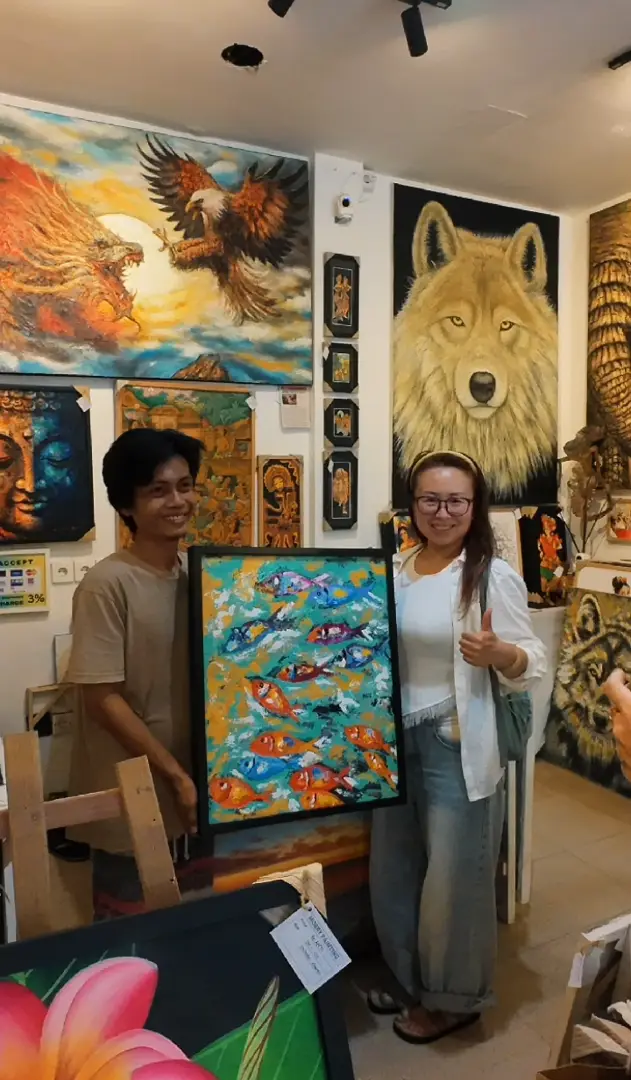
The gallery does not manufacture testimonials. What follows are representative experiences — described accurately from the types of conversations that happen regularly at and after a visit to Arts of Bali. Names and identifying details are omitted.
A Buyer from Melbourne, Australia
“I walked in on my last full day in Bali with about two hours before I needed to be at the airport. I hadn’t planned to buy anything — I was just looking. Putu showed me a large frangipani canvas I hadn’t noticed on the first pass. I asked about it, he told me the story of the artist and the flower’s significance, and I bought it. It was rolled and tubed while I waited. It arrived in Melbourne eight days later, in perfect condition. I’ve since commissioned two more works. I’ve never seen the gallery again in person — we do everything on WhatsApp now.”
Illustrative example representative of buyer experience — details anonymised.
A Collector from Amsterdam, Netherlands
“I was nervous about buying something large enough to actually look good on a Dutch wall — most Bali art feels like it was made for rooms smaller than ours. But Arts of Bali had a 150 × 100 cm palette knife landscape that was exactly the scale I needed. The gallery shipped it crated, with full documentation. Dutch customs applied the reduced art VAT rate, which Putu had mentioned would likely happen. The crate arrived undamaged, the painting was exactly as I’d seen it in the gallery. I’ve recommended Arts of Bali to three other people since.”
Illustrative example representative of buyer experience — details anonymised.
A Remote Buyer from Singapore
“I’ve never actually been to the gallery — I found it while researching original Balinese art online and contacted via WhatsApp. We did a video call where Putu walked me through five different pieces, moving them into different light angles so I could see the palette knife texture. I bought two works. They arrived in Singapore in six days. The provenance documents were inside the crate. I plan to visit the gallery in person next time I’m in Bali.”
Illustrative example representative of buyer experience — details anonymised.
What Experienced Collectors Know That First-Time Buyers Learn the Hard Way
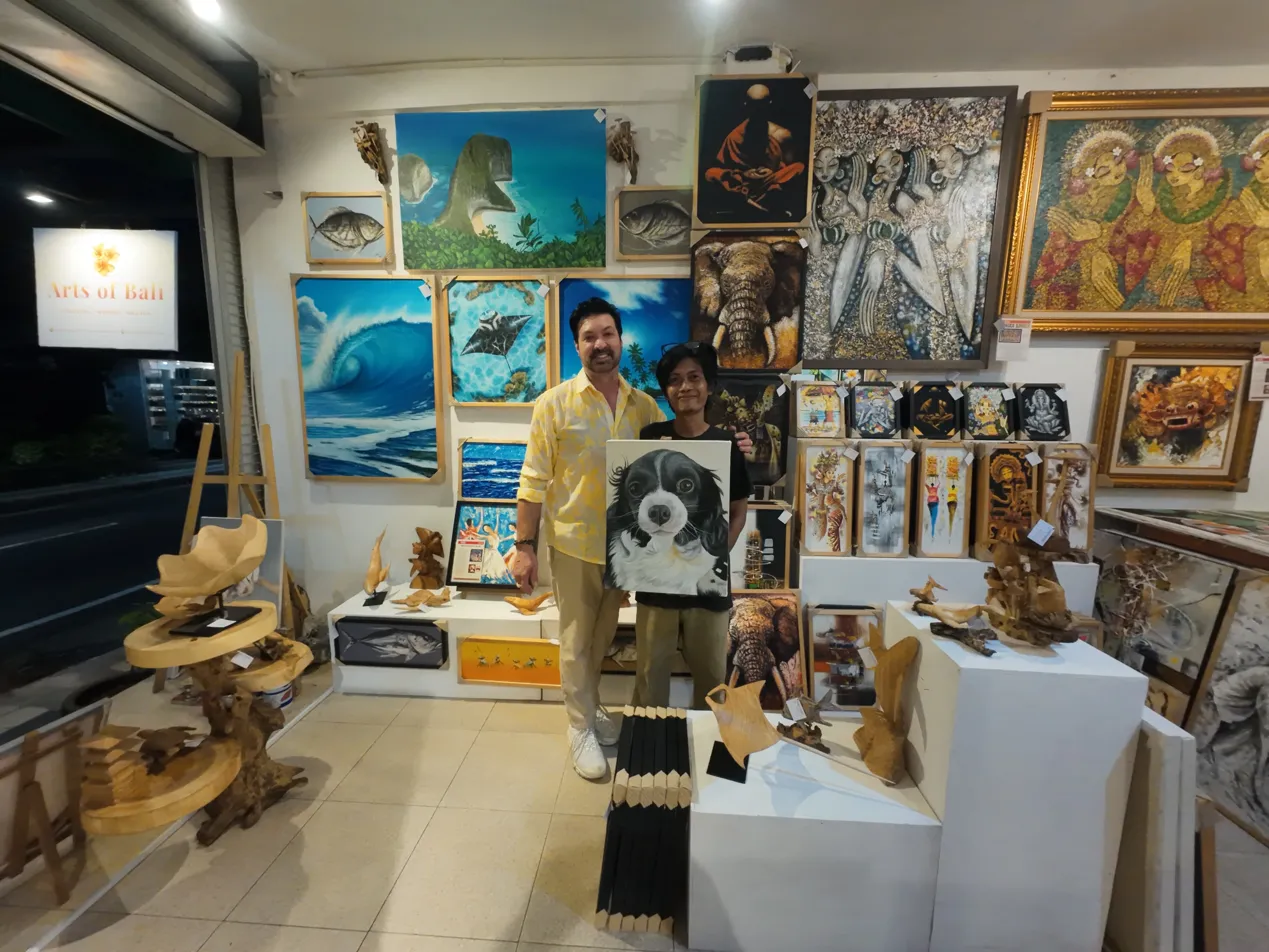
The Price of a Painting Is Not Its Value
A IDR 200,000 painting and a IDR 8,000,000 painting can sit 30 centimetres apart on the same wall. One was produced in a workshop at volume. The other was made once, by one artist, with no possibility of repetition. The difference is not always visually obvious to someone who has not been told which is which. This is why the question “who made it?” matters more than the number on the tag.
Size Is Not a Proxy for Quality
Some of the most collectible works at Arts of Bali are small — 30 × 40 cm pieces by artists whose skill is visible at any scale. A large mediocre painting remains mediocre at 200 cm. Buy what moves you at the scale it exists, not the scale you think you need to justify the price.
Buying on the Last Day Is Fine — Buying in a Rush Is Not
Many buyers make their best purchases on their last day in Bali, when the pressure of limited time sharpens the eye. What doesn’t work is buying in the twenty minutes before the taxi arrives. If you think you want something from a gallery, come back the next day and look at it again. If you can’t, ask the gallery to hold it via WhatsApp while you decide. Most serious galleries will hold a work for 24–48 hours for a buyer who has physically been in and expressed genuine interest.
Bali’s Art Market vs. the Market for Balinese Art
These are not the same thing. Bali’s art market — the collective commercial activity of selling paintings in Bali — includes everything from factory-produced tourist decoration to museum-quality originals. The market for Balinese art — collectors internationally who seek documented, attributed original works — operates at a completely different level and applies different criteria. If you are buying to decorate a holiday apartment, the first market serves you. If you are building a collection, the second is the one that matters. Arts of Bali operates in the second.
How to Identify Tourist-Grade Art Before You Buy
This is the section most guides skip because it makes the market look bad. It doesn’t — it just makes you a more informed buyer. Here are the specific physical and contextual tells that experienced collectors use:
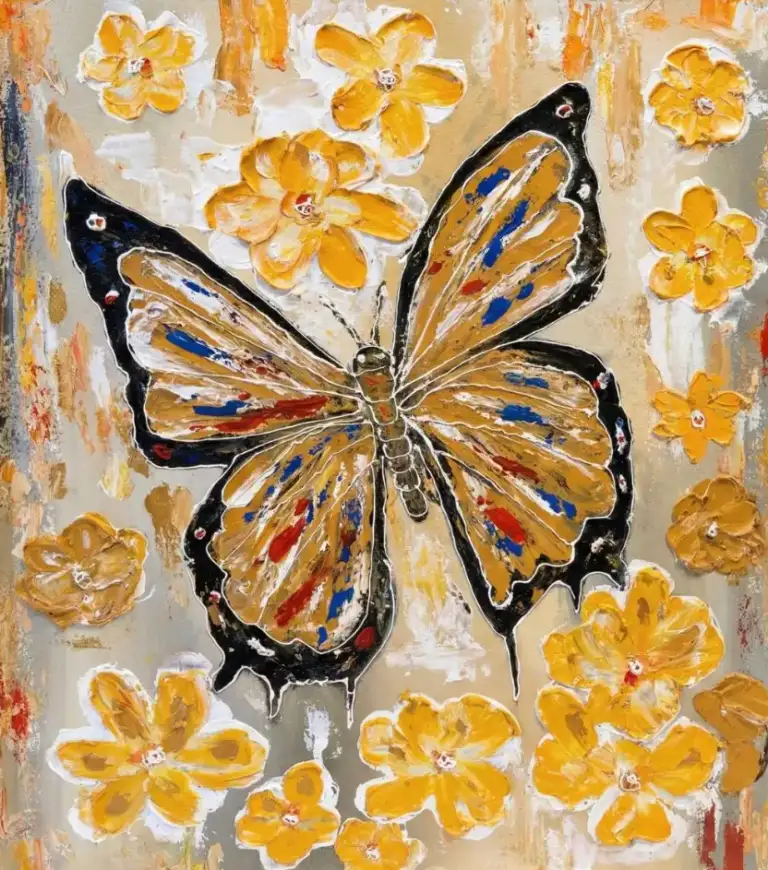
- Uniform texture across the entire surface. Run your fingertip lightly across the canvas. A printed giclée or factory-produced copy is flat — no variation. An original oil or acrylic has perceptible texture where paint was applied and bare canvas where it wasn’t. Palette knife work is unmistakable: thick ridges you can feel without pressing hard.
- Identical compositions across multiple canvases in the same shop. If you see ten versions of the same rice-paddy scene at different sizes, those are workshop pieces produced to template. That’s not inherently dishonest — but it is not original art in the collector sense. One artist, one composition, one canvas: that is the baseline.
- No artist name, and no one can tell you who made it. Every original work should have an attributed maker. “Balinese artist” is not attribution. If the gallery staff cannot tell you the artist’s name, the village they work in, and what medium the piece uses, that is a strong signal the work is unsigned and unattributed — fine for decoration, not appropriate for a collection.
- Sealed frames that obscure the back of the canvas. Backboards that have been permanently fixed over the canvas stretcher often hide staple-free commercial printing. Ask to see the back before buying any framed work. A hand-painted canvas will show brush marks on the underside of the stretcher bars and sometimes the artist’s name or date written in pencil or paint.
- Aggressive discount offers immediately on walking in. A gallery that opens with “special price for you, fifty percent off” on items whose original price you never saw is pricing theatrically. This does not mean the work is fake — but it means price is being used as the primary sales tool, which is a different experience from a gallery where the conversation starts with the work itself.
- Varnish that looks like lacquer. Some tourist-grade pieces apply a thick glossy varnish to simulate the depth of oil paint. Tilt the work at an angle under light — deep, layered oil paint catches light differently at different angles. Lacquer gives you one reflection plane.
At Arts of Bali, every work in the collection is documented before it enters the gallery. Artist name, medium, approximate date, and technique are recorded for each piece. Provenance documentation is provided with every sale. If you have questions about any work in the collection, the owner can answer them specifically — not generally.
Frequently Asked Questions: Buying Art in Bali
How do I know if a painting is an original or a reproduction?
Ask directly: is this painted by hand, or is it a print? At a reputable gallery, the answer comes immediately with context — who painted it, in what medium, and whether it is signed. Physical tells: original oil and acrylic paintings have visible brushstroke or palette knife texture; reproductions are flat to the touch. If a work is presented as original but has no artist name attached and no variation in surface texture, treat that as a red flag.
Can I pay in USD or Australian dollars at Bali art galleries?
Arts of Bali accepts IDR and USD cash, and IDR bank transfer. Many Seminyak galleries also accept USD cash; rates vary. For large purchases, ask the current exchange rate before agreeing — the difference between a generous and a punishing rate can add 5–8% to the effective price of a significant work. Paying in IDR cash at the mid-market rate is generally most favourable.
What happens if my painting is damaged during shipping?
All shipments from Arts of Bali are insured for the declared value of the work. Photograph any damage before fully unpacking and contact the gallery within 48 hours of delivery. Keep the original packaging until the claim is resolved — carriers require it for inspection. The gallery handles the claim process with the courier on the buyer’s behalf. Damage during transit is uncommon but not unknown; the insurance exists precisely for this.
Do I need to pay customs duty when my painting arrives?
Possibly, depending on your country and the declared value. The US allows original artworks entry duty-free. The EU applies a reduced art VAT rate (typically 5–10%). Australia has a de minimis threshold of AUD 1,000 below which no duty applies. Singapore has a GST threshold of SGD 400. Arts of Bali advises on likely customs treatment for your destination country at the time of purchase — and always declares accurately.
How long does it take to receive my painting after buying in Bali?
For in-stock works: packing takes 1–2 days, then 5–16 business days transit depending on destination — Australia typically 5–9 days, Europe 8–14 days, North America 9–16 days. Custom commissions add 3–10 weeks before shipping begins. You receive a tracking number once the shipment departs Bali.
Can I commission a painting before I arrive in Bali?
Yes. The gallery handles commissions entirely via WhatsApp for buyers who prefer to begin the process before their trip — or who are not visiting Bali at all. Common remote commissions: portrait from a supplied photograph, large-format landscape in specified dimensions, palette knife abstract in client-specified colour palette. A 50% deposit confirms the commission; balance is due before shipping. Completed works are photographed and sent for approval before they leave the studio.
Is it better to carry a painting home or ship it?
For unframed works under roughly 70cm, carrying in a tube as hand luggage is often simpler and faster. Check your airline’s carry-on tube dimensions before flying. For framed works, large canvases, or anything where in-transit damage would be a significant loss, shipping in a custom crate is safer. The gallery can roll and tube any unframed canvas for hand carry in about an hour while you wait.
Does Arts of Bali ship to my country?
Arts of Bali ships to over 40 countries including Australia, New Zealand, Singapore, Malaysia, the United Kingdom, Germany, the Netherlands, France, Spain, Switzerland, the United States, Canada, Japan, South Korea, UAE, and Saudi Arabia. If your country is not on this list, contact via WhatsApp — most destinations are serviceable, and the gallery will advise on any restrictions specific to your location.
Ready to Buy Art in Bali?
Arts of Bali is open daily 09:00–21:00 at Jl. Raya Seminyak No. 42, Seminyak, Bali. Walk in and browse — no appointment, no entry charge. For remote purchases, commissions, or questions before you visit, contact Putu Sucipta directly on WhatsApp. Most questions get a same-day response.
Чат в WhatsApp Browse the Gallery Online