Batik cendrawasih painting is a wax-resist textile artwork depicting the cendrawasih, or bird of paradise, Indonesia’s most recognized bird and a cultural symbol most closely tied to Papua and the Maluku Islands. The design is drawn by hand with hot wax using a tool called a canting, then dyed in stages so the waxed areas resist color, a process called batik tulis. This guide covers the meaning behind the bird, how the technique works, and what to look for when choosing a piece.
Key Takeaways
- Cendrawasih is the Indonesian name for the bird of paradise, a bird native to Papua and the Maluku Islands.
- The cendrawasih motif’s roots are in Papuan batik and craft, not classical Balinese painting.
- Batik tulis (hand-drawn batik) uses a canting to apply hot wax before each dye stage.
- Fine dot detailing, called cecek, is what gives the feathers their shimmering, layered look.
- All species of bird of paradise are now protected; every feather in a batik piece is drawn, not real.
Definition: Batik cendrawasih painting is a hand-drawn (batik tulis) wax-resist textile artwork depicting Indonesia’s bird of paradise, created by applying hot wax with a canting before dyeing the cloth in successive color stages.
Most people meet batik on a shirt or a sarong. Fewer expect to find it framed on a wall, telling a single, deliberate story rather than repeating a pattern across a bolt of cloth. That’s what happens with a batik cendrawasih painting: the same hot-wax, hand-drawn technique used for clothing and ceremonial cloth, redirected toward one composition, one bird, held still long enough to be studied.
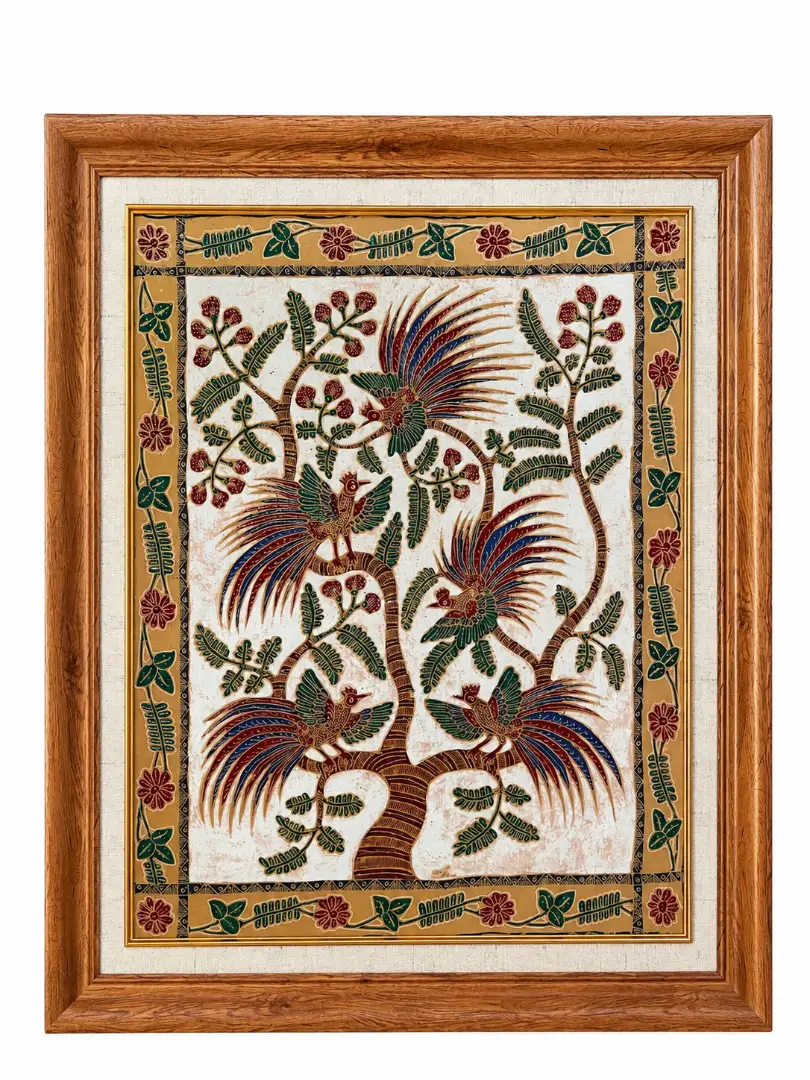
The piece behind this guide shows a flowering tree carrying several birds of paradise, each with a long, radiating tail rendered in deep red, blue, and gold against a cream ground, bordered with a dotted floral pattern and set in a wood frame. Every line in it, down to the smallest dot on a tail feather, was drawn by hand before any dye touched the cloth.
This guide covers what the bird actually means in Indonesian culture, how a batik painting like this is technically made, and what to think about before choosing one for your own wall.
What Is Cendrawasih, and What Does It Mean?
Cendrawasih is the Indonesian name for the bird of paradise, a family of birds (Paradisaeidae) known for elaborate plumage and equally elaborate courtship displays. Indonesia is home to the great majority of the world’s bird-of-paradise species, with most of them, close to thirty, found only in Papua and the Maluku Islands, several found nowhere else on earth. The bird’s image carries enough national weight to appear on Indonesian currency, and it functions as a cultural symbol of Papua specifically, tied to identity, prosperity, and the region’s forests, before it functions as a decorative motif anywhere else.
That distinction matters for a piece like this. The cendrawasih motif’s deepest roots are in Papuan batik and craft traditions, not in the classical schools of Balinese painting covered elsewhere on this site, Kamasan, Ubud, Batuan, and the rest. A batik painting of the bird of paradise, made and sold in Bali, is best understood as an Indonesia-wide subject rendered in a widely practiced Indonesian technique, rather than a piece of specifically Balinese iconography. It’s a distinction worth knowing before you go looking for meaning in the wrong tradition.
Every species of bird of paradise is now protected, and international trade in the actual birds or their feathers is illegal. That fact sits quietly behind every batik or textile depiction of the bird: nobody’s feathers were harmed to make this artwork. The whole point of drawing the plumage in wax and dye is that you get the spectacle without touching the bird at all.
技术What Is Batik, and What Makes Batik Tulis Different?
Batik is a wax-resist dyeing technique: wax is applied to cloth in a pattern, the cloth is dyed, and the waxed areas resist the dye and keep their original color. Repeat that with different wax patterns and different dye baths, and a multi-color image builds up in layers. Batik is practiced across Indonesia, most famously in Java’s Yogyakarta, Solo, and Pekalongan, and it is recognized by UNESCO as part of the world’s intangible cultural heritage.
Within batik, there’s an important split. Batik cap uses a carved copper stamp to apply wax quickly, suited to producing yardage and repeating patterns at speed. Batik tulis, “written” or hand-drawn batik, uses a canting, a small handheld tool with a copper reservoir and a fine spout, to trail hot wax across the cloth freehand, line by line. A batik cendrawasih painting made this way is batik tulis: no two lines are ever mechanically identical, because no stamp was involved.
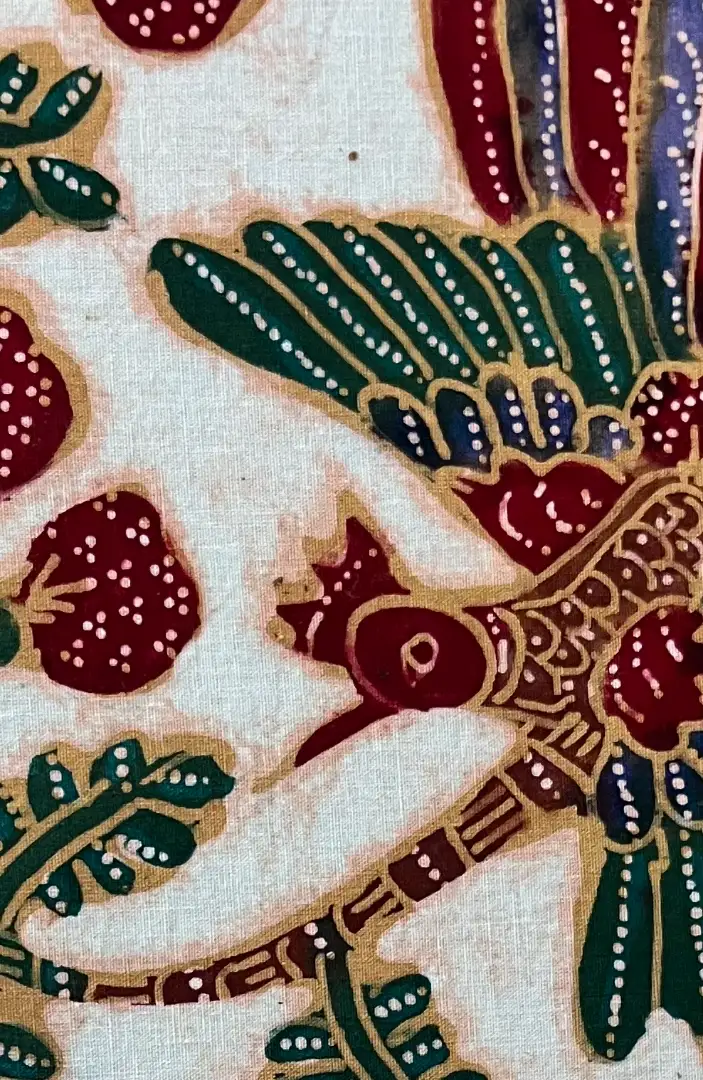
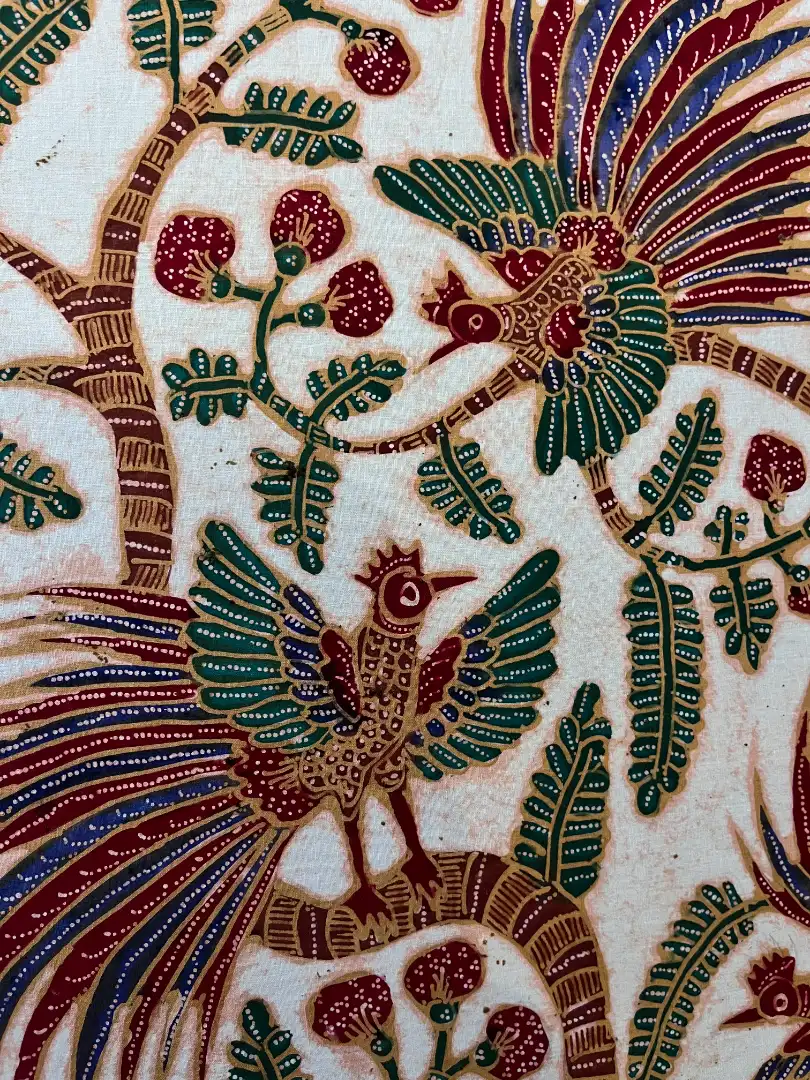
Look closely at the tail feathers in a piece like this and you’ll see rows of small, evenly spaced dots running along each line, a detailing technique called cecek. Cecek is applied with a canting fitted with the finest spout available, and it’s what gives batik featherwork its shimmer, since each dot is a tiny reserved point of the base cloth color sitting inside a field of dye. It is slow, exacting work, and it’s the single most reliable visual sign that a piece was actually hand-drawn rather than printed to look like batik.
How a Batik Painting Like This Gets Made
The process runs in a fixed order, and the order is what makes the layered color possible.
| Step | What Happens |
|---|---|
| 1. Sketch | The composition, birds, branches, flowers, and border, is drawn onto plain cloth in pencil. |
| 2. First wax pass | A canting applies hot wax over every line and area meant to stay the base cloth color. |
| 3. First dye bath | The cloth is dyed in the lightest color first; waxed areas resist and stay pale. |
| 4. Additional wax and dye passes | More wax is added over areas meant to keep the current color, then the cloth is dyed again in a darker shade. Repeated for each color, red, blue, gold, in this piece. |
| 5. Cecek detailing | Fine dot work is added with a narrow-spouted canting for texture and shimmer on feathers and foliage. |
| 6. Wax removal | The finished cloth is boiled or scraped to remove all remaining wax, revealing the full multi-layer color. |
| 7. Mounting | The cloth is stretched over a wooden frame or backing board and set into a finished frame for display. |
Because each color requires its own wax-and-dye cycle, a piece with three or four distinct colors, as this one has, represents multiple full passes across the entire cloth, not one sitting.
Reading the PieceWhat’s Actually Happening in This Composition
The piece shows a single flowering tree carrying four birds of paradise, positioned at different heights and angles rather than mirrored or repeated, which is typical of a hand-composed batik painting rather than a stamped repeating pattern. Each bird’s tail is rendered as a radiating fan of red, blue, and gold, distinct from the smaller wings and body, which stay in more muted brown and gold tones, echoing the real bird’s contrast between showy display feathers and plainer body plumage.
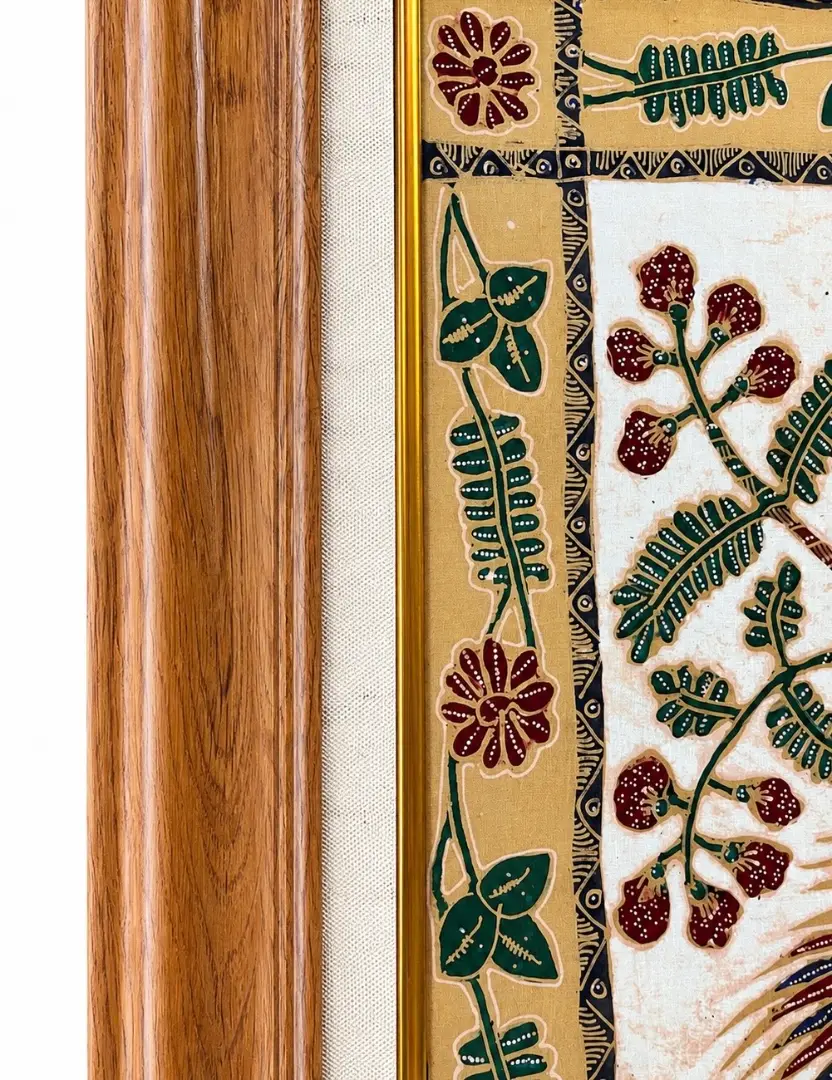
The border carries its own detail: a repeating floral and fern motif on a gold ground, bounded by a dark dotted geometric strip. Borders like this serve the same function a painted frame-within-a-frame serves in classical Balinese cloth painting, they separate the central scene from the world outside it and give the eye a place to rest before returning to the birds.
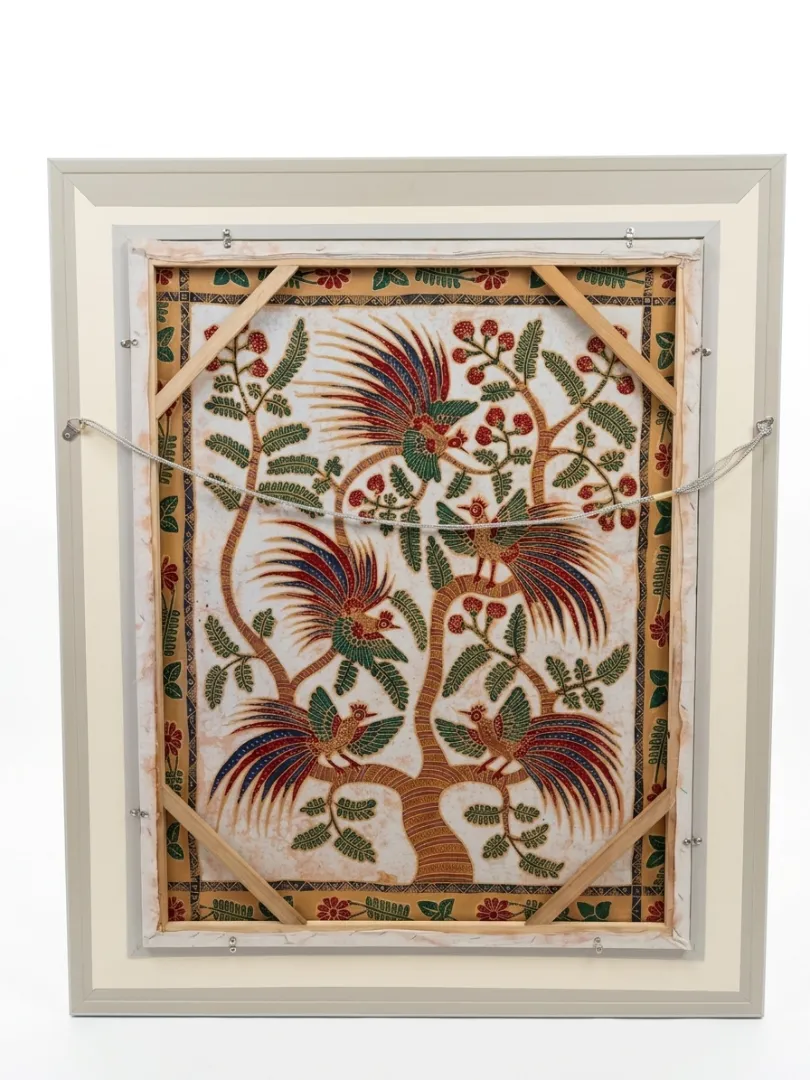
Turned over, the piece shows what an actual hand-mounted textile looks like: cloth stretched and secured over a wooden support frame with visible corner bracing, not a printed canvas stapled flat. If you’re comparing pieces in person, checking the back is one of the fastest ways to see how a work was actually constructed.
Choosing, Placing, and Caring for a Batik Painting
What to check before buying. Look for irregular, slightly imperfect linework and dot spacing, that’s the sign of a hand-drawn canting rather than a stamp or a print. Turn the piece over if you can; a genuine stretched batik shows cloth grain and wax residue traces on the back, not a flat printed surface. Ask directly whether a piece is batik tulis (hand-drawn) or batik cap (stamped), since both are legitimate but priced differently, and a seller should be able to answer without hesitation.
Placing it. The warm reds and golds in a piece like this sit well against neutral walls, white, cream, or pale grey, where the color has room to read clearly. Because the composition is vertical and figure-focused rather than a wide landscape, it suits a hallway, a reading corner, or a wall where a single vertical anchor point is more useful than a wide horizontal statement.
Care. Batik is a dyed textile, not an oil painting, and it should be treated more like a valuable fabric than a canvas. Keep it out of direct sunlight, which fades dye over time faster than it fades oil paint. Avoid humid, unventilated spaces, which can encourage mildew on cloth. Dust the glass or frame gently; never apply cleaning products directly to the cloth itself. If the piece is framed under glass, that glazing is already doing most of the protective work for you.
For collectors ordering from overseas, our guide to shipping art from Bali covers the general crating and documentation process; framed textile pieces are packed similarly to framed paintings, flat and rigid, rather than rolled.
Curious Whether a Batik Cendrawasih Piece Is Available?
This particular piece is new to the gallery and availability can change quickly. Message us on WhatsApp for current stock, size, and price, or to ask about a custom batik commission.
Ask on WhatsAppBatik at Arts of Bali
This is the gallery’s first batik painting covered on the blog, sitting alongside the classical and contemporary painting styles described in our guide to Balinese art styles, and it makes a natural companion piece to our wildlife painting 和 flower painting collections, both of which share its interest in Indonesia’s plant and animal life as subject matter, in oil rather than wax and dye. Like the gallery’s Indonesian metal art and tribal artifacts collection, it represents craft traditions from beyond Bali itself, curated and sold through a Seminyak gallery.
Visit in person to see the dot work and layered dye up close, details that don’t fully translate in photographs. Our guide to choosing art in Bali covers the same principles of scale, color, and placement that apply here.
Common QuestionsFrequently Asked Questions About Batik Cendrawasih Painting
What does cendrawasih mean?
Cendrawasih is the Indonesian name for the bird of paradise, a family of birds known for elaborate plumage, found mostly in Papua and the Maluku Islands. The bird is a cultural symbol of Papua specifically and appears widely across Indonesian art, textiles, and currency as a broader national symbol.
Is the bird of paradise motif originally Balinese?
No. The cendrawasih motif’s roots are in Papuan batik and craft traditions, since the bird is native to Papua and the Maluku Islands, not Bali. A batik cendrawasih painting sold through a Bali gallery is best understood as an Indonesia-wide subject in a widely practiced Indonesian technique, not classical Balinese iconography.
What is the difference between batik tulis and batik cap?
Batik tulis is hand-drawn using a canting, a small tool that applies hot wax freehand, resulting in slightly irregular, unique linework. Batik cap uses a carved copper stamp to apply wax quickly and consistently, suited to producing repeating patterns at speed. Both are legitimate batik; tulis simply takes far longer to make.
How can I tell if a batik painting is genuinely hand-drawn?
Look closely for slightly irregular linework and uneven dot spacing in fine detailing (cecek), signs of a freehand canting rather than a stamp or print. Checking the reverse side helps too: genuine stretched batik shows real cloth grain and wax traces, not a flat printed surface.
Were real bird feathers used to make this artwork?
No. Every species of bird of paradise is now protected, and trade in the actual birds or feathers is illegal. The plumage in a batik cendrawasih painting is entirely hand-drawn in wax and dye; no real feathers are involved at any stage.
How do I care for a framed batik painting?
Treat it as a dyed textile rather than an oil painting: keep it out of direct sunlight, which fades dye faster than oil paint, and away from humid, poorly ventilated spaces that can encourage mildew. Dust the glass or frame gently and never apply cleaning products directly to the cloth.
Is this specific batik cendrawasih painting available to buy now?
This piece is newly arrived at the gallery, so availability, exact size, and price were not yet confirmed at the time of writing and can change quickly once it’s listed. Message Arts of Bali directly on WhatsApp for current status and pricing, or to ask about commissioning a similar batik cendrawasih piece.
See Batik and Beyond-Painting Work at Arts of Bali, Seminyak
Visit the gallery to see this piece and the wider collection in person, or message us on WhatsApp to check current availability before you visit.
参观画廊 Ask on WhatsApp