A Kamasan Ganesha painting depicts the elephant-headed Hindu deity Ganesha using the classical wayang-style technique of Kamasan village, Klungkung — flat profile figures, natural pigments, and gold leaf, following the same visual rules used for Bali’s epic paintings. At Arts of Bali, the subject also exists in a second, contemporary form: a sand-texture relief painting that renders the same deity in raised, sculptural acrylic. Both are original, both are in stock, and both answer the same question in different centuries.
Key Takeaways
- Ganesha is honored across Hindu traditions, including Balinese Hinduism, as remover of obstacles.
- Kamasan Ganesha painting uses the same wayang technique as Bali’s Ramayana and Mahabharata cloth paintings.
- A second technique, sand-texture relief, renders Ganesha as raised, sculptural acrylic on canvas.
- Both pieces are currently in the Arts of Bali collection: 25×30cm classical and 60×90cm textured.
- Neither technique is “more authentic” than the other — one is centuries-old, one is a living reinterpretation.
Definition: A Kamasan Ganesha painting is a hand-painted depiction of the elephant-headed deity Ganesha using the flat-profile wayang visual language and natural pigments of the Kamasan classical school of Klungkung, Bali.
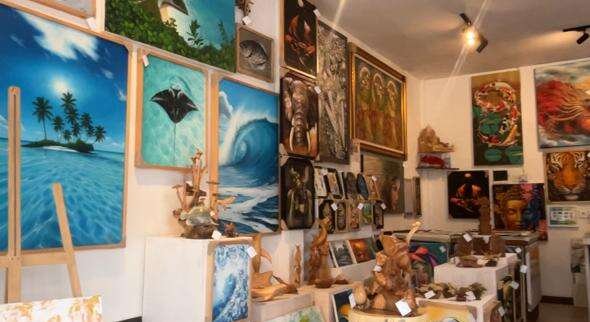
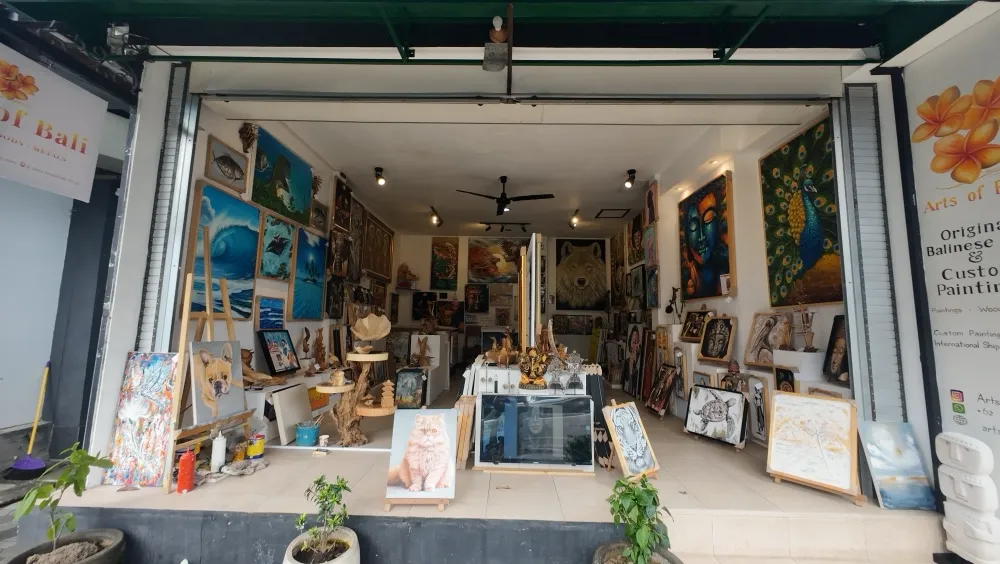
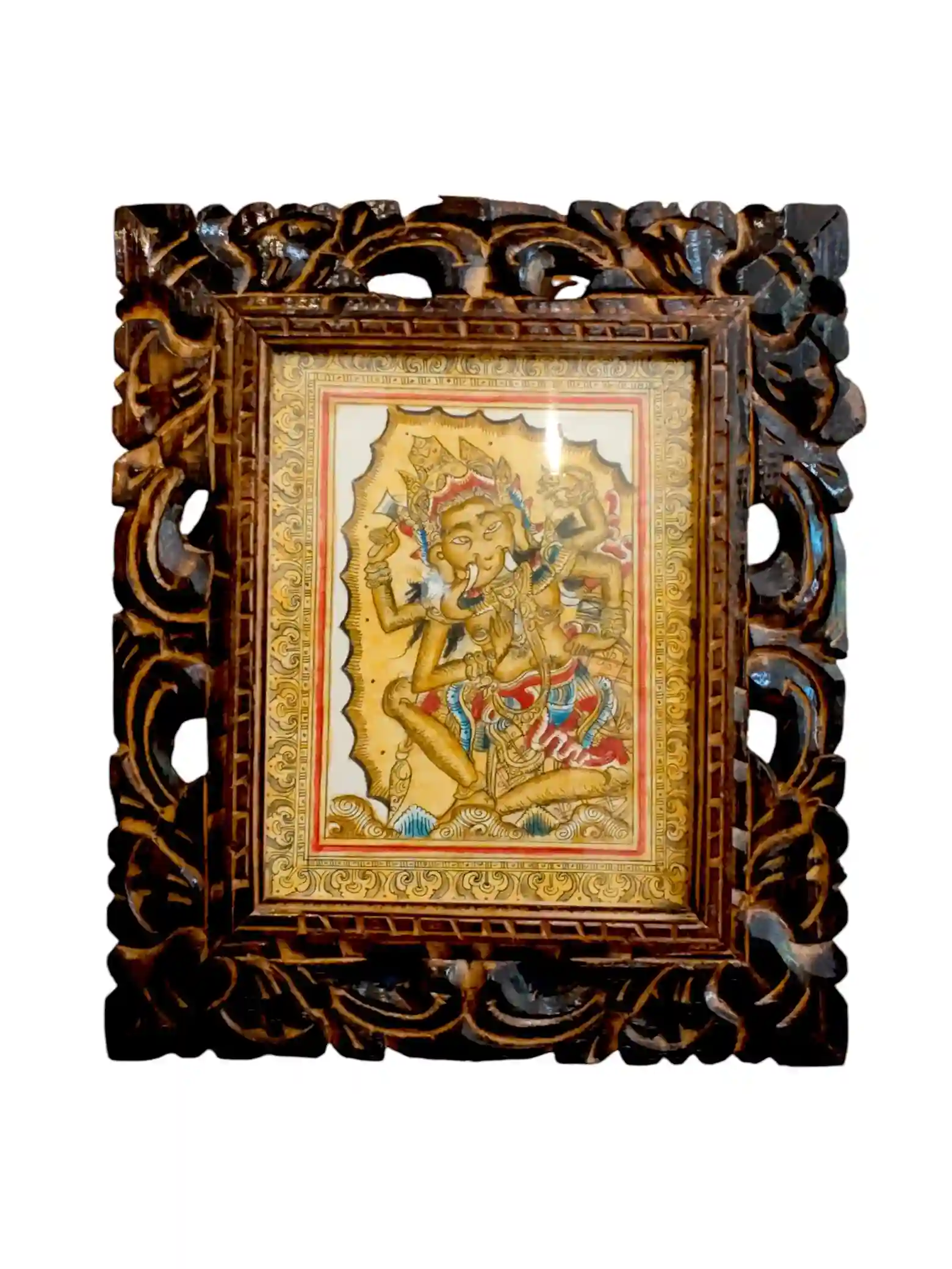
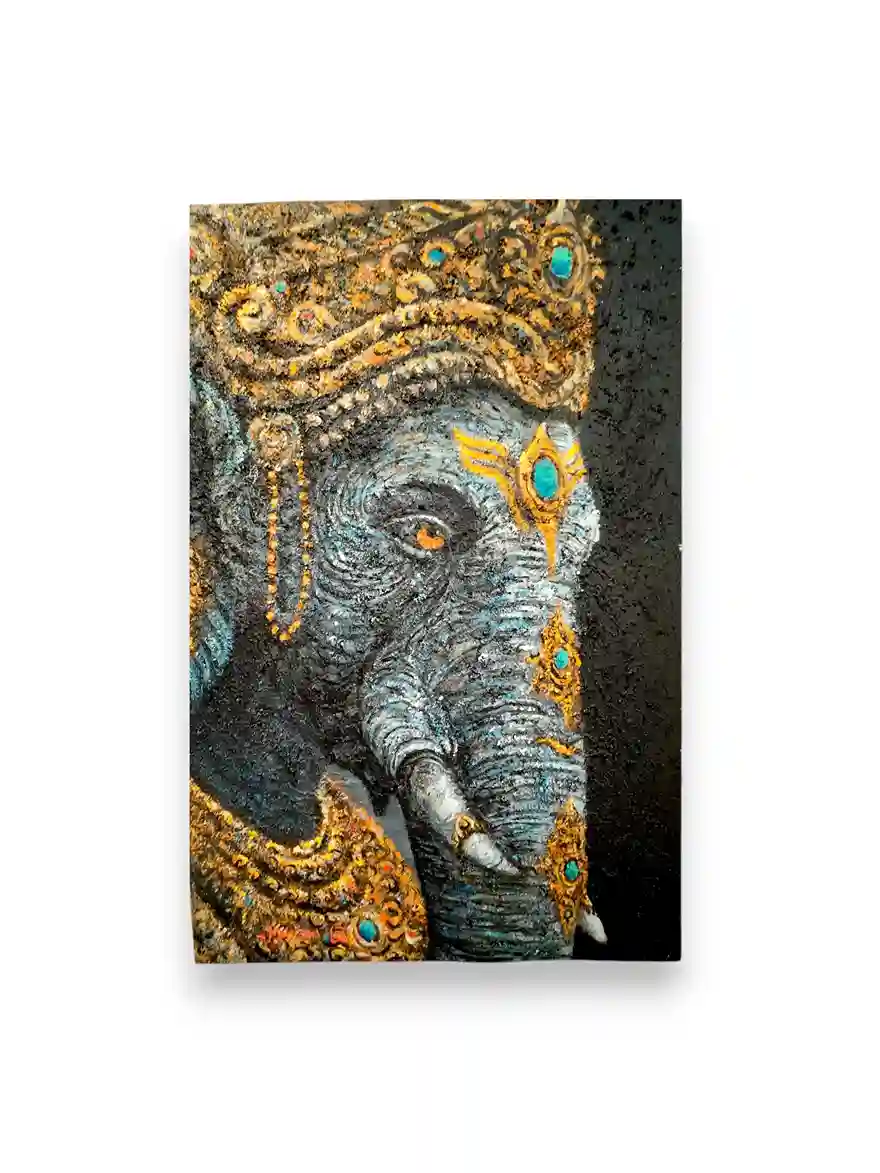
Walk through the gallery in Seminyak and you’ll find Ganesha twice, in two rooms that don’t look like they belong to the same century. In one frame, a small classical piece: gold-toned, flat, kneeling on a wave-carved base inside a heavily carved dark wood frame, the elephant head turned in the same strict profile you’d see on a Kamasan Ramayana panel. A few steps away, a much larger canvas: the same god, but rendered as if carved from stone and then painted, a jeweled crown catching light off ridges of raised sand and acrylic, the whole face lit against black.
Neither piece is trying to out-authenticate the other. One belongs to a technique that has been practiced in a single Klungkung village for five centuries. The other belongs to a technique that didn’t exist a generation ago. Both are original. Both are for sale. And until now, this specific pairing hadn’t been the subject of a single article on this site.
This guide covers what Ganesha means in a Balinese Hindu context, how the two techniques behind these specific pieces actually work, and how to think about choosing between a centuries-old visual grammar and a contemporary one.
Who Is Ganesha in Balinese Hindu Art?
象头神 is the elephant-headed deity honored across Hindu traditions as the remover of obstacles and the patron of wisdom, learning, and new beginnings. In most tellings he is the son of Shiva and Parvati, and it is customary in many Hindu communities to invoke him before starting something important, a journey, a building, a book, because he is understood to clear the way for what comes next.
Bali’s own religious tradition, Balinese Hinduism, developed its own emphasis within the broader Hindu cosmology, centered on Shiva and a dense local pantheon of ancestral and territorial deities. Ganesha is honored within this system too, referred to in Balinese contexts as Bhatara Gana, though he sits differently in the hierarchy than he does in parts of India where entire sects (Ganapatya traditions) are built around his worship specifically. What stays consistent wherever he appears is the core symbolism: an obstacle cleared, a threshold crossed, wisdom asked for before a beginning.
According to a well-known Hindu legend, Ganesha broke off one of his own tusks and used it as a pen to write down the Mahabharata as the sage Vyasa dictated it, too fast for any ordinary pen to keep pace. It’s this story, not a historical record, that explains why so many Ganesha images, including both pieces described in this guide, show him with one full tusk and one broken.
Two TechniquesTwo Ways to Paint Ganesha at Arts of Bali
Most galleries in Bali sell one version of a popular deity. Arts of Bali currently holds two, made using techniques separated by roughly five hundred years of art history, and reading them side by side says more about how Balinese sacred art works than either piece could say alone.
| The Sacred Kamasan Ganesha Painting | Sacred Textured Ganesha Divinity Painting | |
|---|---|---|
| Technique | Classical Kamasan wayang style, hand-painted | Sand-texture relief, hand-painted |
| Medium | Paint on cotton canvas | Acrylic paint on Marsoto canvas |
| Size (framed) | 25 × 30 cm | 60 × 90 cm |
| Visual language | Flat profile, gold-toned palette, dense linework, wayang iconography | Raised sculptural surface, dark ground, jeweled crown detail, near-photoreal face |
| Frame | Hand-carved dark wood, ornamental openwork | Light wood frame |
| Tradition age | Technique practiced since at least the 16th century | Contemporary technique, part of a living, current movement |
| Price | Rp1.150.000 | Rp4.800.000 |
The Sacred Kamasan Ganesha Painting
This piece follows the same wayang-style visual grammar used across 卡马桑绘画‘s epic scenes: flat profile figuration, no shading, natural pigments in ochre and gold tones, a composition built from line rather than light. Ganesha kneels on a carved wave base inside a flame-shaped aureole, one arm raised holding what reads as an axe (parashu in the wider Hindu iconographic vocabulary, a tool associated with cutting away attachment), his trunk curled toward his mouth, one tusk visibly shorter than the other. The gold-leaf finishing that marks a completed Kamasan work catches the light differently depending on where you stand, the same effect described in our full guide to the Kamasan tradition.
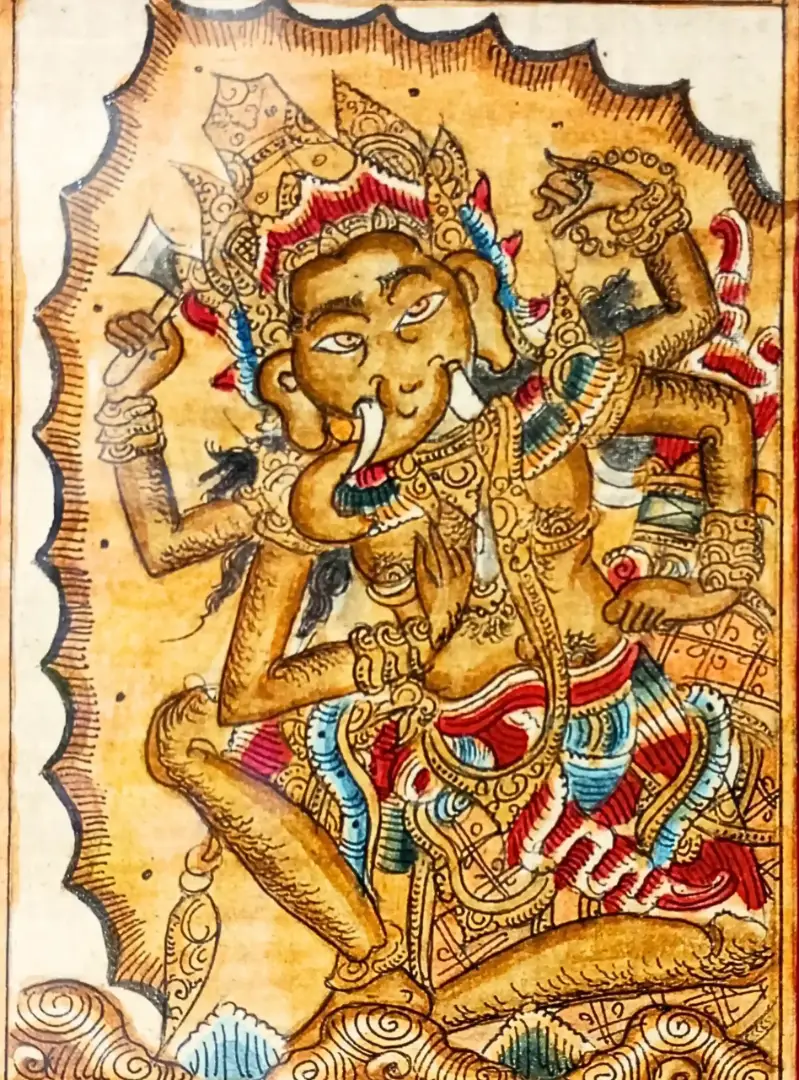
At 25 × 30 cm including its frame, this is a small piece by gallery standards, closer in scale to a devotional object than a statement wall piece. That’s intentional in the classical tradition: Kamasan works were never made to dominate a room. They were made to be looked at closely, read like a text, and returned to.
Sacred Textured Ganesha Divinity Painting
This piece belongs to a completely different visual family. Where the Kamasan work is flat and linear, this one is built up in physical relief, a heavy sand-texture technique applied in acrylic on Marsoto canvas until the crown, jewelry, and facial contours stand off the surface with real depth, closer to a carved temple relief than a painted portrait. The composition crops in tight on Ganesha’s head and shoulders against a near-black ground, the trunk curling down past a jeweled tilaka mark on the forehead, turquoise stones set into a warm gold crown that catches light at a raking angle the way the Kamasan gold leaf catches it flat-on.
This technique sits in the same family covered in our guide to textured painting in Bali, which follows a separate, cooler-toned Ganesha interpretation not currently listed for sale — a reminder that this sand-relief technique gets applied to the same deity more than once, each time with its own palette and mood. Sacred and mythological subjects have a particular affinity with raised, sculptural surfaces generally, because the physical presence of the technique suits a subject that’s already meant to feel larger than decorative.
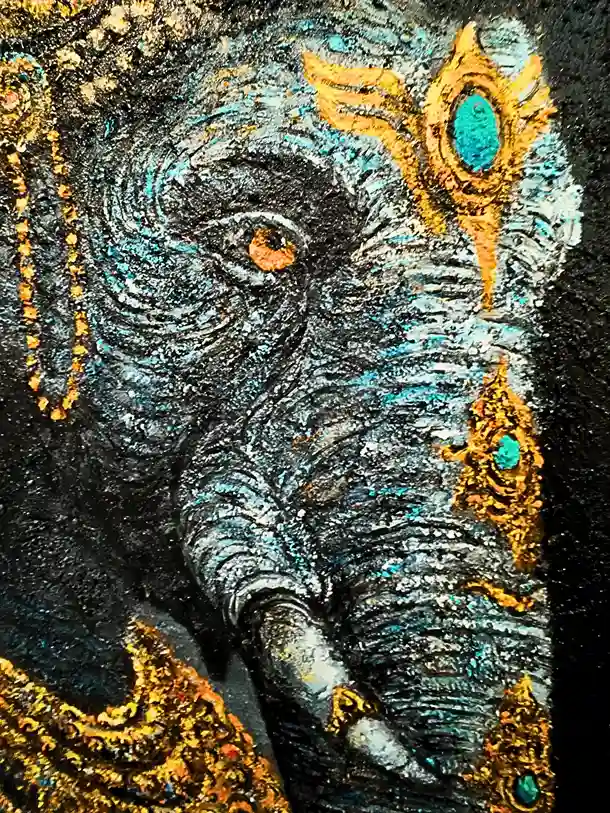
At 60 × 90 cm, this piece is scaled to anchor a wall on its own, the way the large-format contemporary Barong portraits described in our mythology painting guide are meant to be seen from across a room before they’re seen up close.
ChoosingWhich One Should You Choose?
Choose the Kamasan piece if you want an object with direct lineage to a specific, documented, five-century-old technique, and you’re placing it somewhere it will be seen up close, a reading nook, a desk, a small dedicated wall, rather than across a large room. It rewards close, repeated looking more than it rewards visual impact from a distance.
Choose the textured piece if you want a single wall anchor with immediate visual weight, somewhere it will be seen from several meters away under changing light, a living room, an entryway, a villa lobby. Its relief surface is built specifically to catch and shift with light rather than sit flat under it.
There is no wrong answer between “older technique” and “newer technique” here. A Kamasan work is not more authentic than a textured one; it is differently authentic; each represents real, hand-executed skill within its own visual system, made by artists working within a real tradition rather than copying one from a photograph.
Both Pieces Are Currently in the Gallery
The Sacred Kamasan Ganesha Painting and the Sacred Textured Ganesha Divinity Painting are both in stock as of this writing. Message us on WhatsApp with questions about either piece, or to ask about a custom Ganesha commission in a specific technique or scale.
Ask on WhatsAppCaring for Each Technique
These two pieces need different care, because they are, physically, very different objects. The Kamasan piece uses natural pigments and gold leaf on prepared cloth: keep it out of direct sunlight, which fades mineral pigments over time, maintain moderate indoor humidity, and dust gently with a soft dry brush. Never apply water or cleaning products directly to the surface. The textured piece is acrylic paint built up in physical relief: it’s more resistant to fading than natural pigment but the raised surface collects dust in its ridges, so a soft brush or low-suction vacuum attachment used gently, rather than a cloth that could catch and lift the texture, works best. Keep both out of direct, prolonged sun exposure and away from high-humidity spaces.
For collectors ordering from overseas, our guide to shipping art from Bali covers crating and documentation for both framed textile-style and framed canvas pieces.
Where This FitsGanesha at Arts of Bali
This is the gallery’s first article to compare two Ganesha paintings side by side, sitting alongside our broader coverage of Balinese mythology painting (Barong, Ramayana, and Mahabharata subjects) and the classical Kamasan tradition both pieces draw from or extend. If you’re drawn to the sand-texture technique specifically, our guide to textured painting in Bali covers the method in more depth, including a separate Ganesha interpretation in cooler tones. Ganesha also appears elsewhere in the gallery’s collection in a completely different medium, cast bronze, covered in our guide to Bali bronze statues, for anyone comparing the same deity across painting and sculpture.
New to Balinese art generally? Our complete guide to Balinese art styles covers every tradition on this site and how they connect to each other.
Common QuestionsFrequently Asked Questions About Kamasan Ganesha Painting
What does Ganesha symbolize in Balinese art?
Ganesha symbolizes the removal of obstacles and the presence of wisdom before a new beginning, a meaning shared across Hindu traditions. In Balinese Hinduism he is honored as Bhatara Gana within a Shiva-centered local pantheon, carrying the same core symbolism of a cleared path and a considered start.
Is Ganesha part of Balinese Hinduism, or only Indian Hinduism?
Ganesha is honored within Balinese Hinduism too, referred to locally as Bhatara Gana, though Bali’s tradition centers more heavily on Shiva and a dense local pantheon of ancestral and territorial deities. He does not hold the same dedicated-sect status he holds in parts of India, but the core symbolism carries across both traditions.
What is the difference between Kamasan and textured Balinese painting?
Kamasan painting is a classical technique from Klungkung using flat wayang-style figures, natural pigments, and gold leaf on prepared cloth, practiced since at least the 16th century. Textured painting is a contemporary technique using sand and acrylic built up in physical relief on canvas. Both are hand-executed original art; they simply belong to different eras of the same visual tradition.
Why does Ganesha have a broken tusk in these paintings?
According to a well-known Hindu legend, Ganesha broke off one tusk to use as a pen, writing down the Mahabharata as fast as the sage Vyasa could dictate it. This story, not a historical event, is why Ganesha is traditionally shown with one full tusk and one shortened one in most artistic traditions, including both pieces described here.
How much does an original Ganesha painting from Bali cost?
At Arts of Bali, prices currently range from Rp1.150.000 for the small 25×30cm classical Kamasan Ganesha painting to Rp4.800.000 for the larger 60×90cm contemporary sand-texture piece. Price generally reflects size, technique, and time invested rather than the subject itself, and can change as stock changes.
Is the Kamasan Ganesha painting handmade and original?
Yes. It is hand-painted using classical Kamasan traditional techniques on cotton canvas, finished with gold-leaf detailing, and sold as a 100% original piece rather than a print or reproduction. The textured piece is equally original, hand-built in sand and acrylic rather than printed or mass-produced.
Can I commission a custom Ganesha painting in either technique?
Yes. Arts of Bali accepts custom commissions for Ganesha in classical Kamasan style, contemporary sand-texture relief, or other painting styles carried by the gallery, in a range of sizes. Contact us on WhatsApp to discuss scale, technique, and timeline before placing a commission request.
How do I care for a Ganesha painting once I bring it home?
Keep either piece out of direct sunlight and high humidity. The Kamasan piece, natural pigment on cloth, should only be dusted with a soft dry brush. The textured acrylic piece can be dusted gently or cleared of dust in its ridges with a low-suction vacuum brush attachment. Avoid liquid cleaners on either surface.
See Both Ganesha Paintings in Person at Arts of Bali, Seminyak
Visit the gallery to compare the classical Kamasan piece and the contemporary textured piece side by side, or message us on WhatsApp to check current availability before you visit.
参观画廊 Ask on WhatsApp