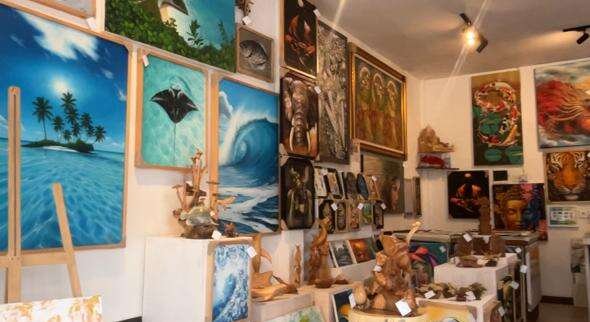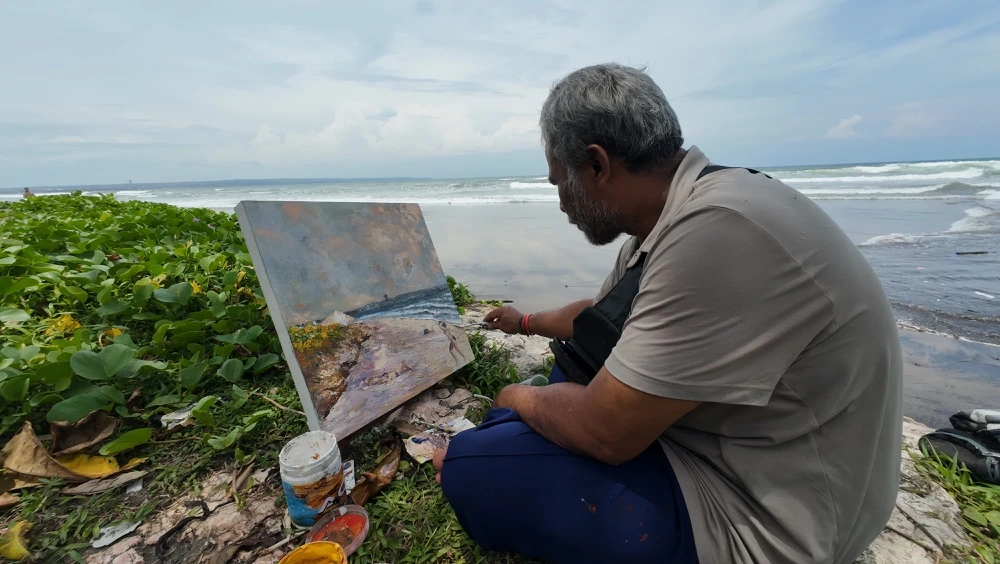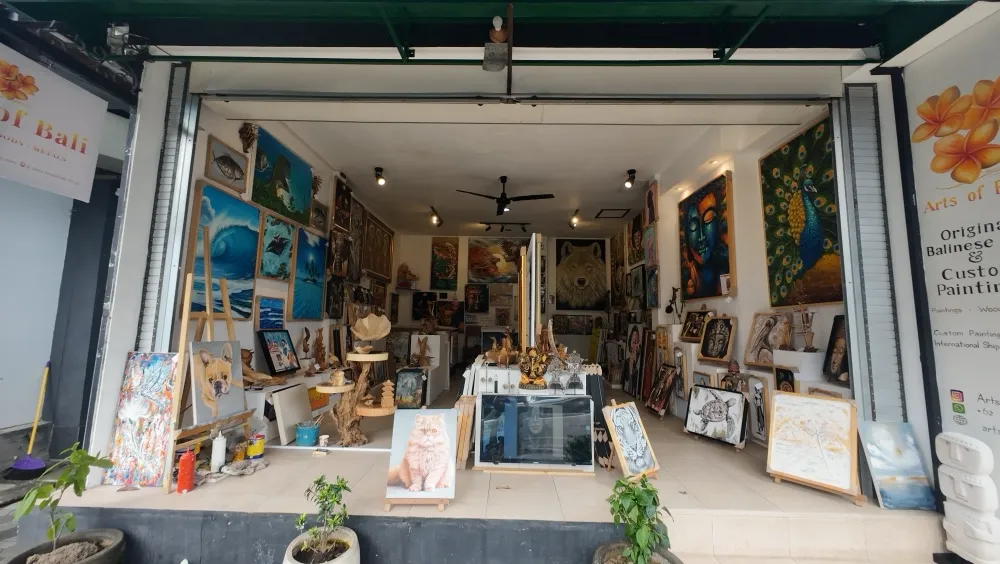
Sunset painting in Bali is one of the most collected forms of original Balinese art — and one of the most varied. Original sunset painting Bali artists produce spans photorealistic oil on canvas, textured palette knife impasto, and loose abstract expressionist work. The subject draws from specific beaches and bays across the island: Jimbaran, Kuta, Echo Beach in Canggu, and the temple-rock silhouette of Tanah Lot. Arts of Bali gallery in Seminyak carries original Bali sunset paintings across all styles, directly from the artists who made them.
Key Takeaways
- Palette knife impasto is the most commonly used technique for Bali sunset paintings — and the most expressive
- Original sunset paintings capture the specific quality of Bali’s equatorial light in ways photography cannot
- The fishing boats (jukung) on the horizon are a uniquely Balinese detail that separates local sunset art from generic tropical imagery
- Works range from intimate 40 × 50 cm studies to large 150 × 200 cm statement canvases
- Every original at Arts of Bali is signed by the artist and comes with a certificate of authenticity
Definition: A sunset painting Bali artists produce is an original fine art work depicting the golden hour light over Bali’s coastline, beaches, or ocean — rendered in oil, acrylic, or mixed media on canvas by a named Balinese artist.
There are ten thousand photographs taken of the Kuta sunset every evening. Almost none of them capture it.
The problem is not the photographer. The problem is that Bali’s golden hour is not primarily a visual event — it is a light event. The way the sky burns from orange to deep red while simultaneously reflecting on every wet surface of the beach. The way a single palm tree silhouette becomes the whole composition. The way the air itself seems to change color in the ten minutes before the sun disappears below the Indian Ocean.
A phone camera records what is there. A painter decides what matters.
That distinction is why Bali sunset painting has its own tradition — separate from tourist photography, separate from decorative print markets, and more alive than both. The Balinese artists whose work hangs at Arts of Bali gallery in Seminyak have spent years learning how to make a canvas hold what the camera misses. Some do it with a palette knife and thick impasto oil. Some work in photorealistic precision. Some reduce the whole thing to pure movement and color.
This is a guide to sunset painting in Bali for anyone who has stood on that beach and felt it. What makes each approach different. What to look for in the image. How to find the work that carries that light home.
Why Bali’s Sunset Produces Great Paintings
Bali sits at approximately 8 degrees south of the equator. That position means the sun does not set at an angle — it drops almost vertically, and it drops fast. The golden hour in Bali is compressed into something closer to twenty minutes of rapidly changing light. Painters who work outdoors here learn to read the sequence quickly: first the sky turns amber, then the ocean reflects it, then the palm trees become pure silhouette, then the color in the sky intensifies for one or two minutes before the whole thing dims into blue. The speed is part of what makes it difficult to paint — and part of what makes a good painting so powerful to look at. It captures a moment that even people who were present remember imperfectly.
The other factor is the Balinese coast itself. Bali’s southern shores face west across the Indian Ocean with almost nothing between them and the horizon. Jimbaran Bay is the classic location — a curved bay where fishing boats moor close to shore and the seafood restaurants on the sand have faced the same sunset for generations. Kuta’s beach is wider and more open; the horizon there seems further away. Echo Beach in Canggu catches a different angle, with reef breaks visible as dark lines in the water. Tanah Lot adds the silhouette of the sea temple, one of the most painted structures on the island.
Each of these locations has a different visual character, and painters who know them paint them differently. A Jimbaran sunset has a sense of scale that an Echo Beach sunset does not. A Tanah Lot scene includes architecture. A Kuta scene includes surf, foam, and the wide flat beach that reflects the sky like a second canvas.
Bali’s golden hour is not primarily a visual event — it is a light event. A painter’s job is not to record it but to hold it still long enough for someone who wasn’t there to feel it.
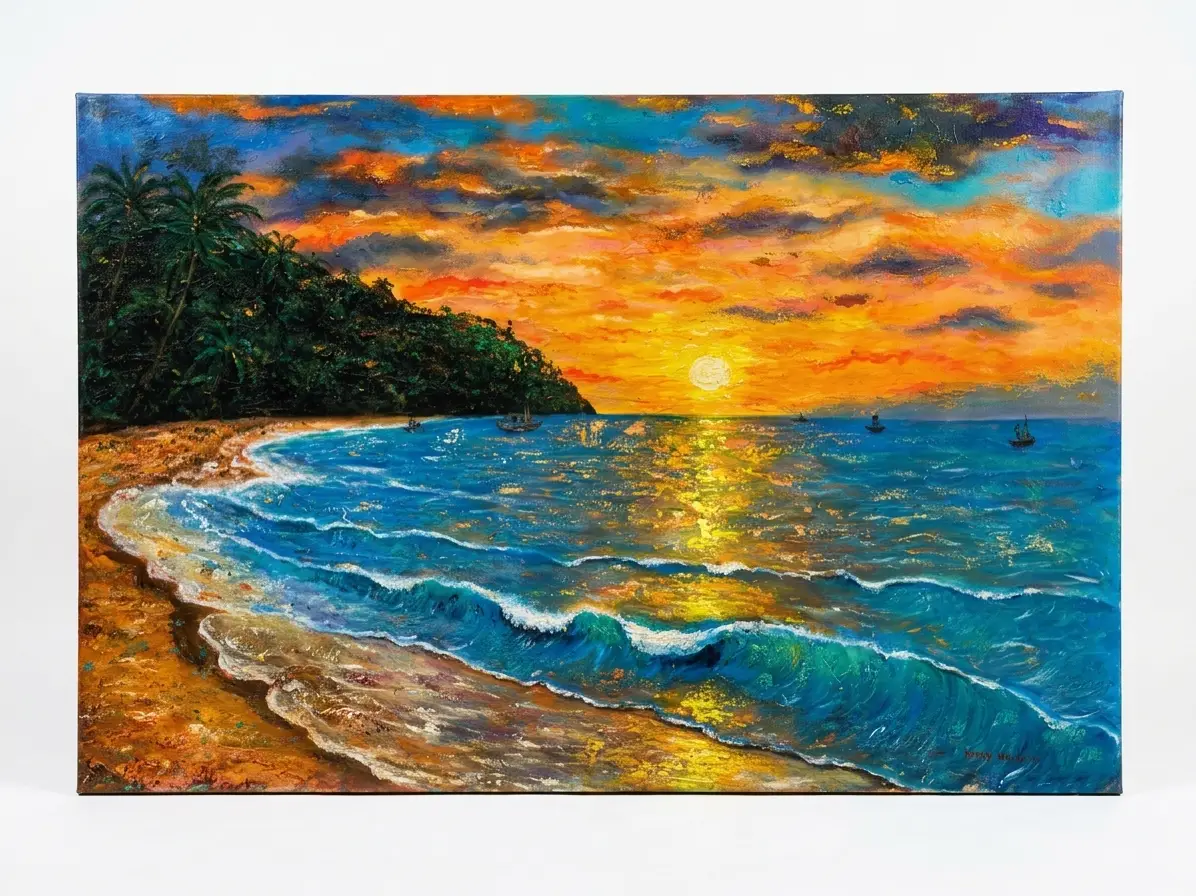
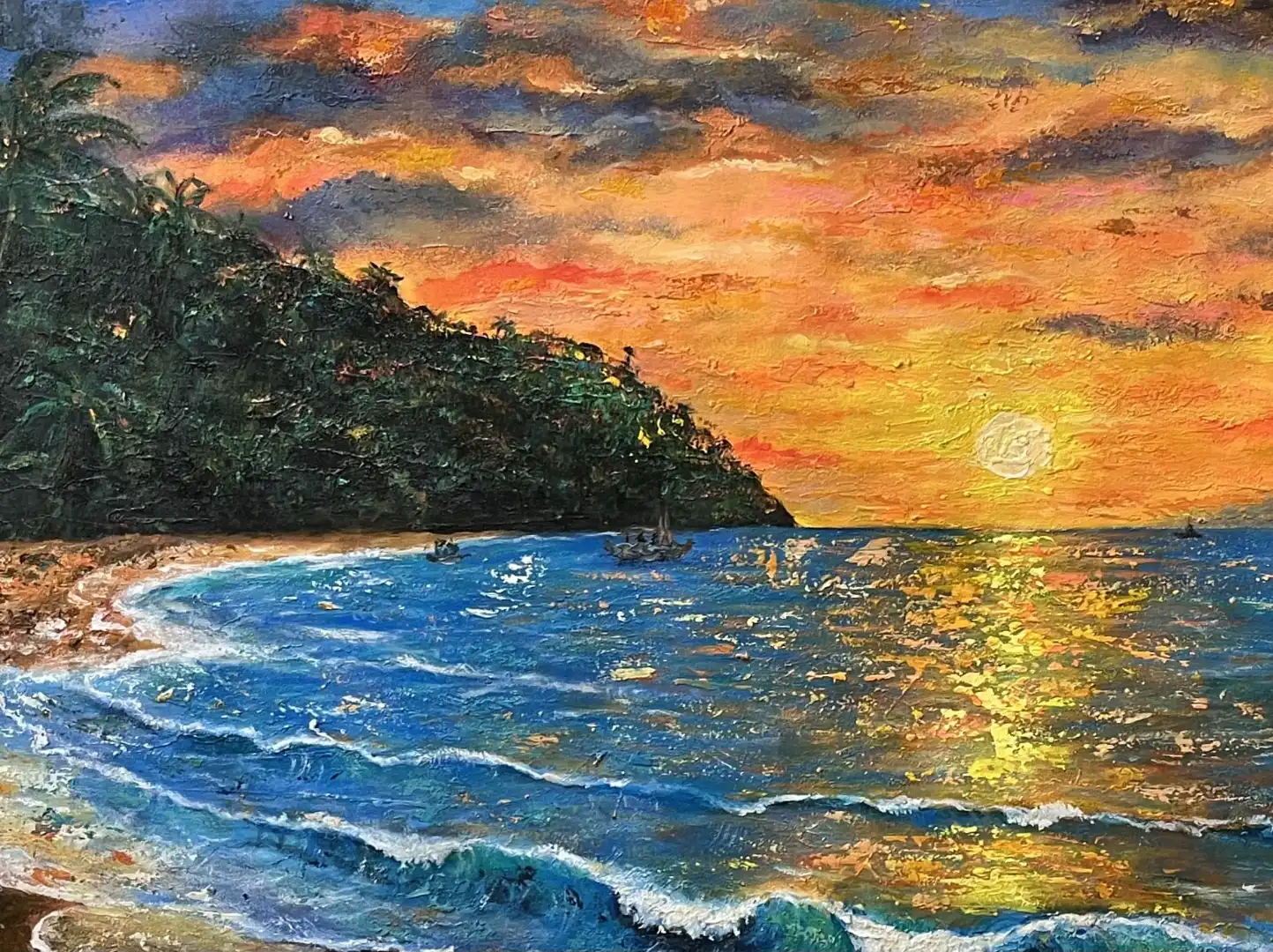
The detail view shows what makes Balinese sunset art distinctive in ways a tourist photograph rarely is: the small silhouettes of traditional jukung fishing boats on the open water. These double-outrigger canoes are part of Bali’s coastal life, returning with the tide in the late afternoon — which means they are consistently present on the horizon at golden hour. Painters who know the coast include them almost automatically. They are a detail that is specifically and unmistakably Balinese, and their presence in a painting is one of the clearest markers of an artist who has actually stood on that beach and looked outward. From two metres away, these boats read as atmosphere. Walk closer and they become people going home.
Explore more Balinese landscape works: palette knife painting Bali and our broader guide to buying original art in Bali.
Artistic ApproachesFour Ways Balinese Artists Paint the Sunset
Bali sunset painting is not a single style. The subject attracts artists working across very different techniques, and the same beach at golden hour looks completely different depending on who is painting it and how.
Palette Knife and Impasto: The Most Balinese Approach
If there is a dominant technique in Balinese sunset painting, it is the palette knife. Artists working in this tradition apply oil paint directly with a steel blade — scraping, pressing, layering — rather than with a brush. The result is a surface where the sky is not a smooth wash of color but a physical object: ridges of orange paint catching the gallery light from above, valleys of dark crimson that you can see change tone depending on where you stand.
The reason palette knife work suits the Bali sunset specifically is that the subject is fundamentally about energy and speed. A brush painting of a sunset can look composed, measured, almost planned. A palette knife painting of the same scene looks like the painter was racing the light — which they usually were. The improvised decisions (this stroke of yellow here, this scrape of blue through the orange there) are preserved in the paint surface permanently. When you look at a palette knife Bali sunset painting from close range, you can see the decisions the artist made in the moment.
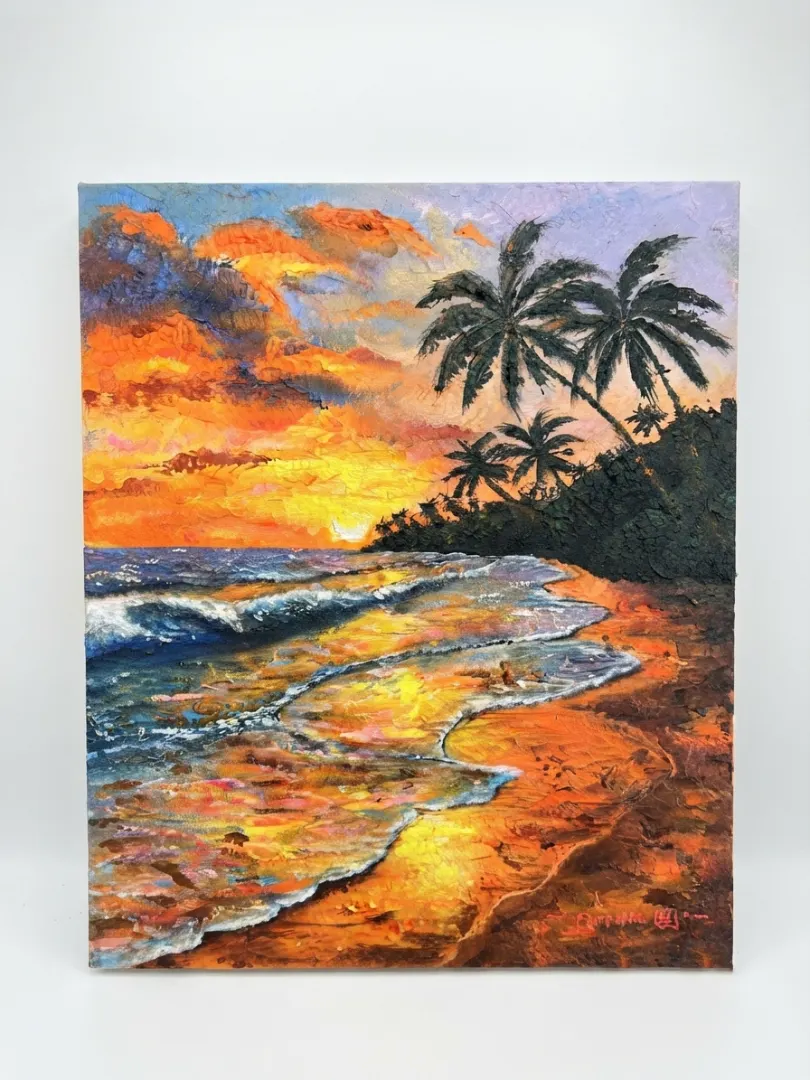
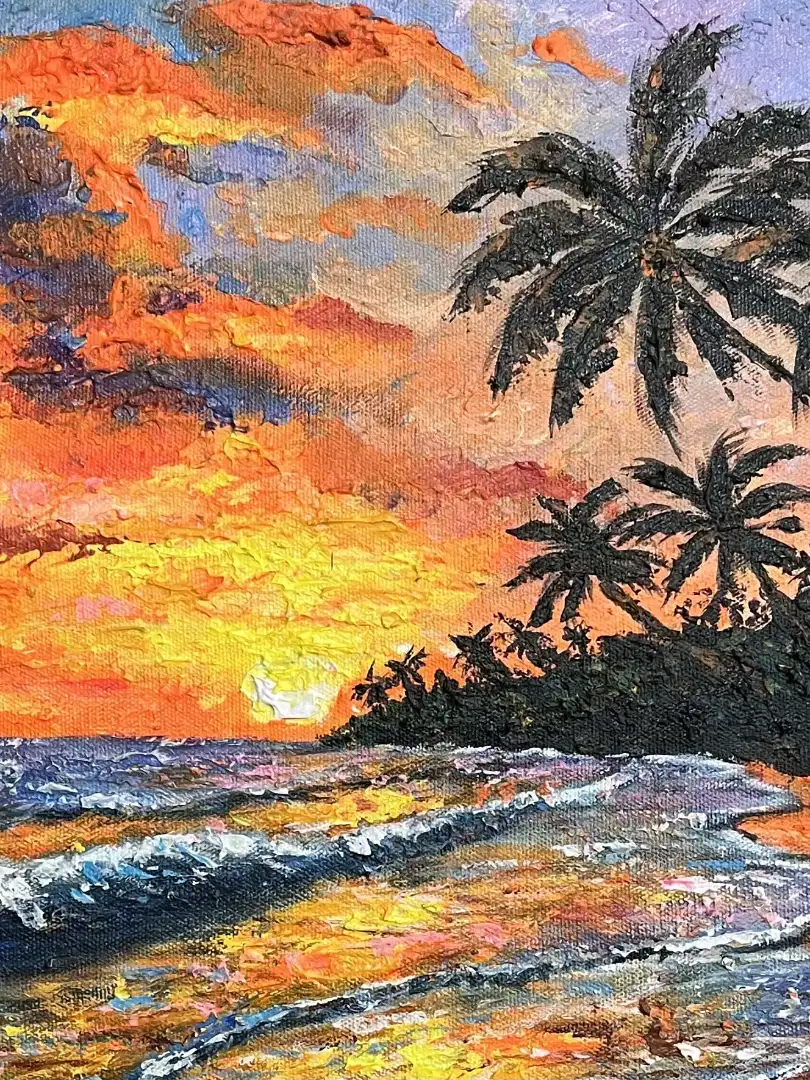
The detail view reveals what you cannot fully appreciate from two metres away: the physical architecture of impasto oil painting. Each ridge of orange-red paint is a single palette knife stroke, preserved exactly as the painter left it. The dark lines between the raised paint are not drawn — they are shadows cast by the texture itself, and they shift as the gallery lighting moves. This is what collectors mean when they say a palette knife painting “changes throughout the day.” The work is three-dimensional in a way a brush painting almost never is.
See more in this technique: 巴厘岛纹理画.
Photorealism: What the Camera Cannot Quite Do
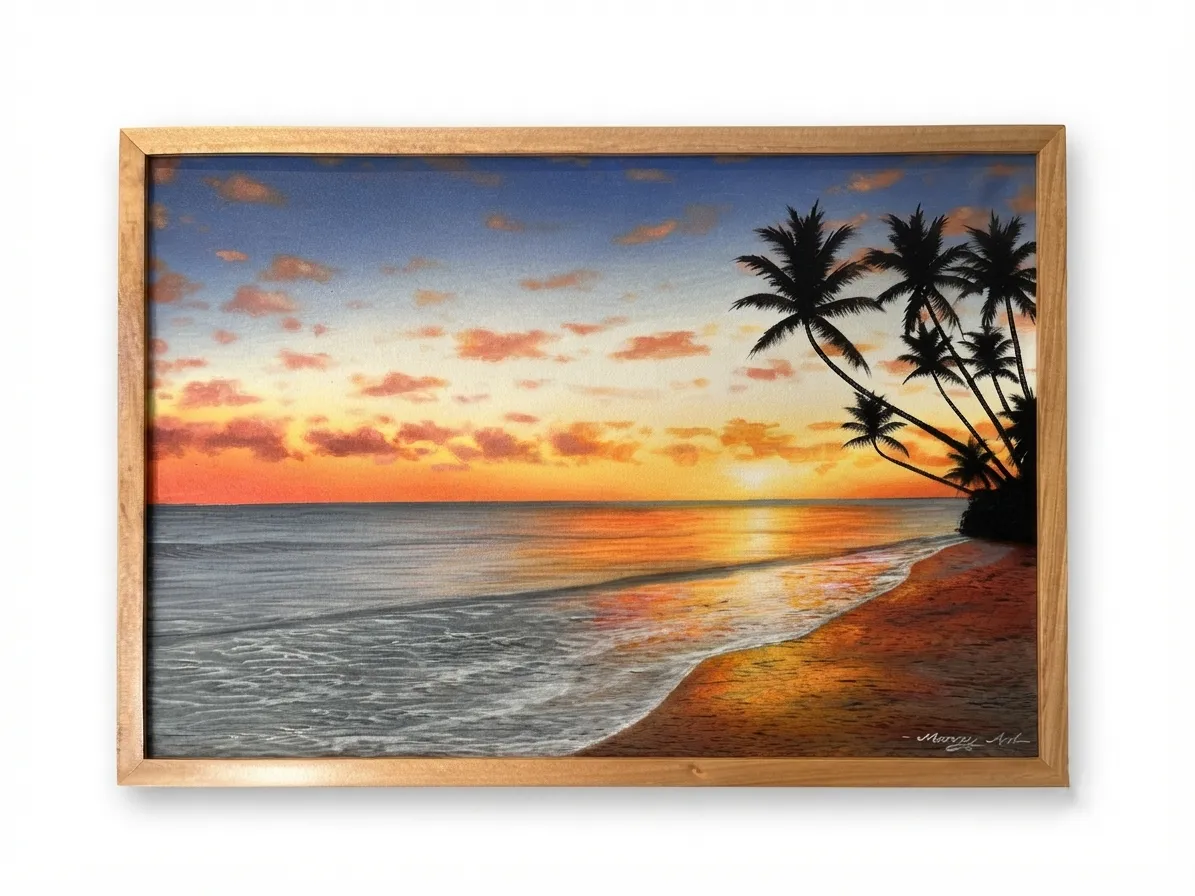
At the other end of the technical range from palette knife sits photorealistic oil painting — and the difference is not just aesthetic, it is philosophical. A hyper-realist painter of the Bali sunset is trying to achieve something a camera almost achieves: exact reproduction of light on surface. The almost is important. The painting at the top of this article — calm ocean, palm silhouettes, golden hour reflected on the water — is an example of this approach: rendered in oils, painted to a degree of finish that rewards close inspection.
What a good hyper-realist painter can do that a camera cannot is choose which light to render. A photograph of a Bali sunset is necessarily simultaneous — every part of the image was exposed at the same moment, with the same settings. A hyper-realist painter can make the reflection on the wet sand near the shore as luminous as the sky itself, which in reality would require two different exposures. They can make the foam on the waves white without bleaching the orange of the sand. They are compositing a better truth than the camera records.
See more in this approach: oil painting Bali.
Abstract Expressionist: The Feeling Without the Scene
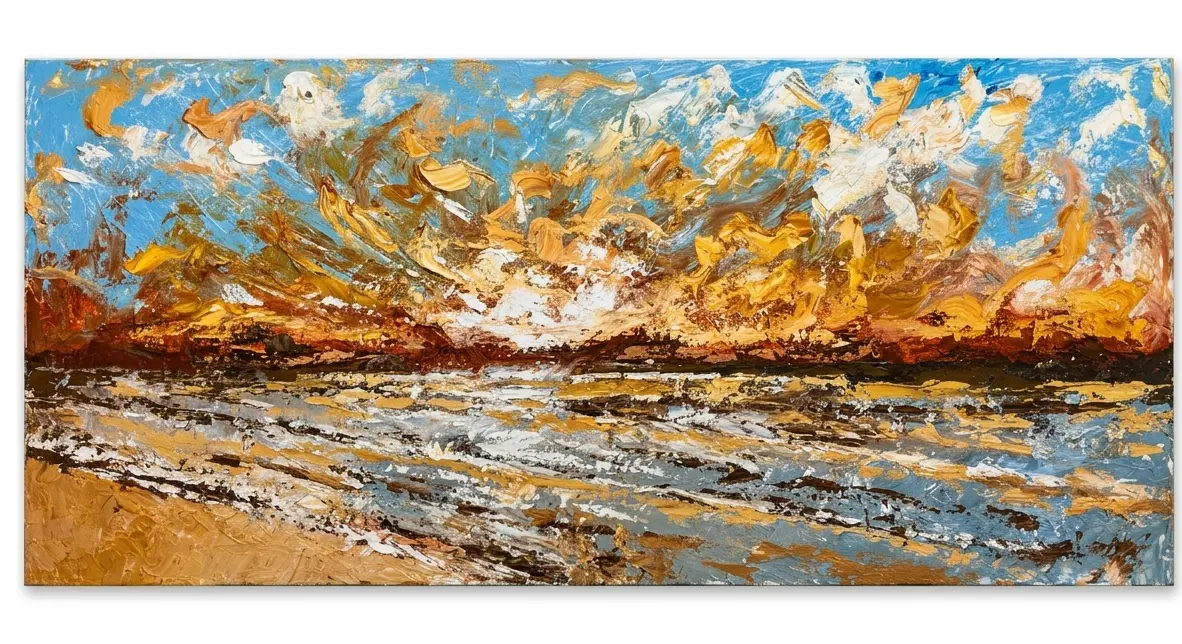
The panoramic abstract above is a different kind of painting entirely. You will not find a recognizable palm tree in it. The horizon line is suggested rather than stated. What you find is an accumulation of marks — thick gold, white, dark brown, slate blue — that together produce the sensation of standing on a Bali beach when the light is doing something unreasonable.
These works are harder to explain to someone who has not seen Bali’s sunset in person. For those who have, they often provoke an immediate and irrational recognition: yes, exactly. The abstract approach suits collectors who want the emotional experience of a place without the literalism of a representational image. They also work particularly well in contemporary interiors where a more traditional landscape might feel out of place.
Beyond the Golden Hour: Contemplative Coastal Scenes
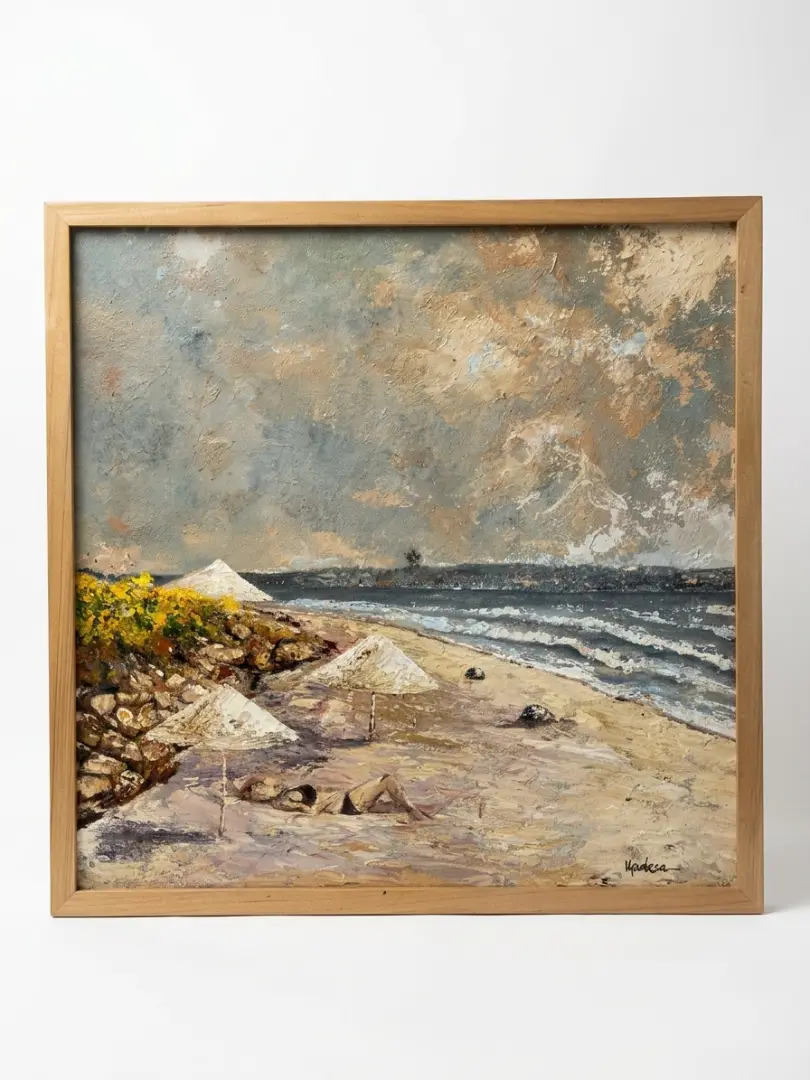
Not every significant Bali beach painting is a sunset. This work by Upeksa — a Balinese painter who signs in that compact, confident hand at the lower right — shows a beach in flat gray afternoon light. Beach umbrellas. A figure sunbathing. A rocky wall with small yellow wildflowers. The waves are dark and actual rather than golden and theatrical.
It is, in some ways, a harder painting to make than a sunset. There is no drama to rely on. Upeksa has to find the painting in what is simply there — and the result is the kind of quiet coastal work that tends to outlast the dramatic sunset pieces in a collection. It lives with you differently. Collectors who know Bali recognize the specific tone of an overcast south Bali afternoon instantly. Those who don’t will discover it.
收藏指南Reading a Bali Sunset Painting: What to Look For
The best sunset painting Bali produces rewards looking slowly. These are the elements that separate a strong work from a decorative one.
The horizon line. Where the painter places the horizon determines everything about the painting’s emotional register. A low horizon (sky fills most of the canvas) emphasizes atmospheric drama — you are in the light. A high horizon (ocean or beach dominates) emphasizes space and reflection. A mid-canvas horizon is the most common and the least interesting. Notice which choice the painter made, and whether it feels deliberate.
The reflection. On a wet beach or calm ocean, the sunset reflects downward. A technically strong painter renders this reflection with the same intensity as the sky itself, and with the correct color shift — the reflection is always slightly darker and more gold than the source. In palette knife work, this often appears as a single confident scrape of yellow-white paint across the surface of the water.
The silhouette detail. Palm trees in silhouette at sunset are one of the most used images in tourist art. What separates a serious painting from a decorative one is how much individuality the silhouette carries. Does the tree have weight? Do the fronds move in a specific direction? Or does it look like a symbol for “palm tree” rather than a specific tree at a specific moment? Artists who have drawn from life rather than from reference photographs get this right. The difference is visible.
The color range. A real Bali sunset is never just orange. The sky directly above the horizon is orange-gold. As you move upward, it shifts through red, deep crimson, then purple, then the dark blue of the sky that is still afternoon while the horizon is already evening. A sunset painting that uses only warm tones is a simpler painting than what the sky actually offers. Look for painters who held onto the blue.
For an introduction to the broader vocabulary of Balinese fine art, see our guide to Balinese mythology painting — a different subject entirely, but a useful frame for understanding how Balinese painters think about composition and meaning. Also see our guide to Barong painting Bali for context on how the same artists approach sacred subject matter.
购买指南How to Choose a Bali Sunset Painting for Your Space
For a modern interior (white walls, concrete floors, minimal furniture): An abstract expressionist or strongly gestural palette knife work reads well in this context. The energy of the paint surface adds warmth without competing with clean architecture. A panoramic format (roughly 2:1 wide) works particularly well on a long horizontal wall.
For a warm tropical interior (rattan, wood, batik textiles): A representational sunset in warm golds and reds — either palette knife or hyperrealist — will sit naturally within this environment. Avoid very small formats here; the warm palette works best when the painting has enough scale to compete with the surrounding textures.
For a hotel suite, resort villa, or guest room: The classic framed sunset in natural wood is the right choice — familiar enough to be immediately readable to guests from any culture, technically strong enough to be worth looking at. The hyper-realist approach handles this brief particularly well because it invites close inspection and rewards it. For large spaces, a statement canvas 120 × 80 cm or larger is appropriate. See our guide to large painting Bali for this category.
For a private collection: Look for a signed work by a named artist where you can see a specific decision in the painting — a color choice, a compositional risk, a texture that shouldn’t work but does. These are the Bali sunset paintings that appreciate over time, because they carry a maker’s intelligence rather than a genre’s formula. The most valuable sunset painting Bali collectors invest in is always one where you can feel the painter in it.
The large-format landscape shown earlier in this article — turquoise ocean, tropical headland, jukung fishing boats on the golden horizon — is a good illustration of what this subject looks like when a painter commits to scale. The headland on the left grounds the composition. The turquoise of the ocean (that specific Bali blue, which photographers frequently over-saturate in post-processing and which a palette knife painter achieves with two or three confident strokes of viridian and white) holds the foreground. The boats on the horizon give the eye a destination. It is a complete idea, painted large enough to fill a room without dominating it — which is the correct brief for most private collection purchases.
For pricing across all sizes and techniques, see our Bali painting price guide. For collectors purchasing from abroad, our guide to shipping art from Bali covers crating, documentation, and delivery.
画廊Original Bali Sunset Paintings at Arts of Bali, Seminyak
Arts of Bali gallery in Seminyak carries an original sunset painting Bali artists produce across every approach described in this guide: photorealistic oil on canvas, palette knife impasto in both dramatic and restrained registers, abstract expressionist panoramics, and contemplative coastal scenes. Every piece is from a named Balinese artist. The gallery does not carry unsigned or anonymous work.
Every painting comes with a certificate of authenticity and full artist background. For collectors purchasing internationally, the gallery team coordinates crating and export documentation — a process we have managed for buyers across Australia, Singapore, Europe, and the United States.
Arts of Bali does not sell prints or reproductions. Every sunset painting in the gallery is a unique original work.
If you have stood on a Bali beach at golden hour and wanted to take that light home, the gallery in Seminyak is the right place to look. Learn more about Arts of Bali gallery in Seminyak, or start with our broader guide to buying art in Bali.
Find Your Bali Sunset
Visit the gallery in Seminyak or reach out to our team. We work directly with Balinese artists across every style — and we will help you find the original sunset painting that belongs on your wall.
Contact the GalleryFrequently Asked Questions About Sunset Painting Bali
What makes a Bali sunset painting different from other tropical sunset art?
Several things: the specific equatorial light quality of Bali’s south coast, the recognizable geography (Jimbaran Bay, Tanah Lot temple silhouette, Kuta’s flat beach), and the presence of jukung traditional fishing boats on the horizon — a distinctly Balinese detail. Artists trained in Bali paint these elements from direct observation, which is immediately visible in the result.
What is the best painting technique for a Bali sunset?
Palette knife impasto is the most widely used technique for Bali sunset painting, and many collectors consider it the most expressive — the texture in the paint surface captures the energy of the scene in a way smooth brush painting cannot. Photorealistic oil on canvas works best for collectors who want literal accuracy. The right choice depends on the space and how you want to live with the painting.
Which Bali beach sunsets appear most often in original paintings?
Jimbaran Bay is the most commonly depicted — its curved bay, calm water, and moored fishing boats make it a natural compositional subject. Kuta Beach appears frequently in wide-format panoramic works. Tanah Lot’s temple silhouette is a recurring motif. Echo Beach in Canggu is increasingly painted by younger Balinese artists.
How much does an original Bali sunset painting cost?
Original Bali sunset paintings at Arts of Bali range from smaller signed works (40 × 50 cm) to large statement canvases (150 × 200 cm and beyond). Price depends on size, technique, and artist. Palette knife impasto and hyperrealist detail work carry a higher price point due to time investment. Visit our Bali painting price guide for a full breakdown.
What size sunset painting works best for a villa or hotel room?
For a standard hotel room or guest suite, 80 × 60 cm to 100 × 70 cm is the most versatile range — large enough to have presence but not so large it dominates a smaller space. For a lobby, villa living room, or corridor feature wall, 120 × 80 cm to 150 × 100 cm is more appropriate. See our guide to large painting Bali for statement formats.
Can I commission a custom Bali sunset painting with a specific location?
Yes. Arts of Bali works with Balinese artists on commissioned sunset paintings — you specify location (Jimbaran, Kuta, Tanah Lot, a private beach), size, technique, and color palette. If you have photographs from a specific evening or a specific place, artists can work from these as reference. Commission timelines typically range 3 to 6 weeks. Visit our guide to commissioning art in Bali to begin.
How do I care for an original palette knife or oil sunset painting from Bali?
Oil paintings on canvas are stable and long-lived if kept away from direct sunlight, extreme humidity, and rapid temperature changes. For palette knife impasto works, avoid wiping the raised paint texture — dust with a very soft dry brush if needed. Arts of Bali provides care instructions with every purchase. For works shipped internationally, we also recommend having the painting re-stretched by a local framer after arrival if the canvas has shifted in transit.
Find Your Original Bali Sunset Painting in Seminyak
Visit Arts of Bali gallery to see the full collection — palette knife impasto, photorealistic oil, and abstract expressionist sunset paintings by named Balinese artists. Every work is an original, signed, and available with a certificate of authenticity.
参观画廊 Commission a Custom Sunset Painting