Quick Answer: Ubud’s art market is a cluster of stalls and small shops built around bargaining, with inventory that ranges from genuine village-school paintings to mass-produced decorative pieces sold side by side. A Seminyak gallery like Arts of Bali works differently, fixed marked pricing, a curated selection, and resident artists who often paint the piece in front of you. Neither location is objectively better, the right one depends on whether you want to browse and negotiate or want a shorter, more predictable path to a documented original.
- Ubud’s market runs on negotiation, Seminyak galleries like Arts of Bali use fixed, marked prices.
- Market inventory mixes genuine originals with decorative reproductions, ask before assuming either.
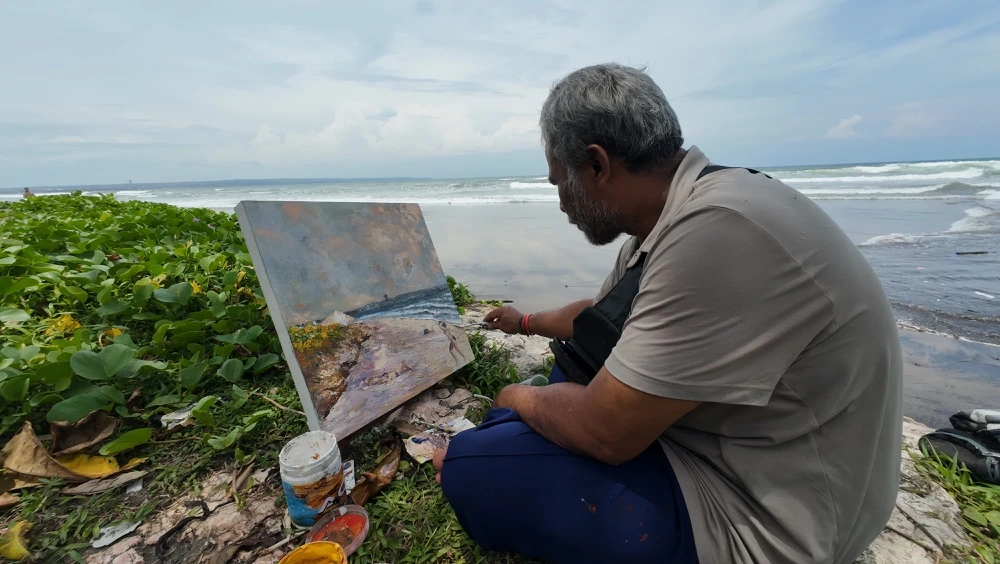
- A working gallery lets you watch the artist paint the piece you are considering.
- International shipping is more predictable from an established gallery than from a market stall.
- Visiting both in one trip works well, Ubud for culture and browsing, Seminyak for a documented purchase.
Definition: Ubud’s art market refers to the open-air stalls and small shops clustered around Ubud’s town center that sell paintings and crafts at negotiable prices, while a Seminyak gallery like Arts of Bali is a fixed-location business with marked prices, named resident artists, and on-site production.
Ubud vs Seminyak art market is the real decision anyone planning to buy an original painting in Bali eventually has to make. Ubud is the island’s historical center for painting, dense with market stalls, small galleries, and museums built around a century of village-school tradition. Seminyak, closer to the coast, has grown into a different kind of art destination, fewer stalls, more fixed-location galleries where the work is curated and priced before you ever walk in.
Both places sell real Balinese art. The difference is not authenticity in the abstract, it is how much certainty you get before you pay. A market stall in Ubud can hand you a genuinely hand-painted piece for a fraction of a gallery price, if you know what to look for and are comfortable negotiating. A gallery like Arts of Bali removes most of that guesswork by fixing the price and showing you exactly who painted the piece, at the cost of some of the market’s spontaneity.
This guide compares both experiences directly, pricing, negotiation culture, authenticity risk, curation, artist access, and international shipping, so you can decide which one actually fits the kind of trip and the kind of purchase you want to make.
Ubud vs Seminyak Art Market: What Actually Separates Them
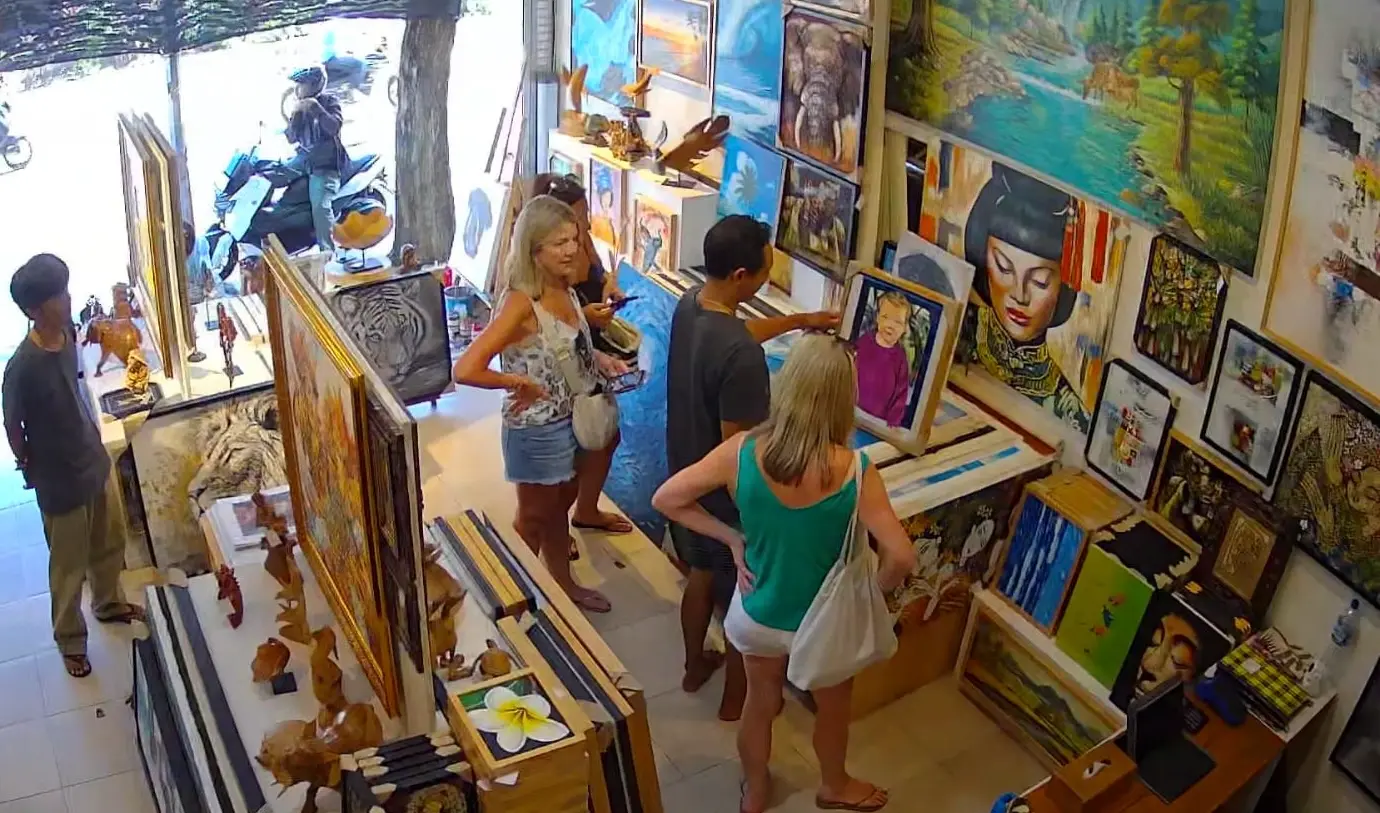
Ubud’s art market grew up around the village schools that surround it, Kamasan, Batuan, and the fine detail work associated with Ubud itself. Walking through it, you pass stalls stacked floor to ceiling with paintings, some hand-painted originals from local artists, others printed or semi-mass-produced pieces aimed squarely at tourist budgets. Prices are rarely marked, and the opening price is understood by both sides to be a starting point, not a final number.
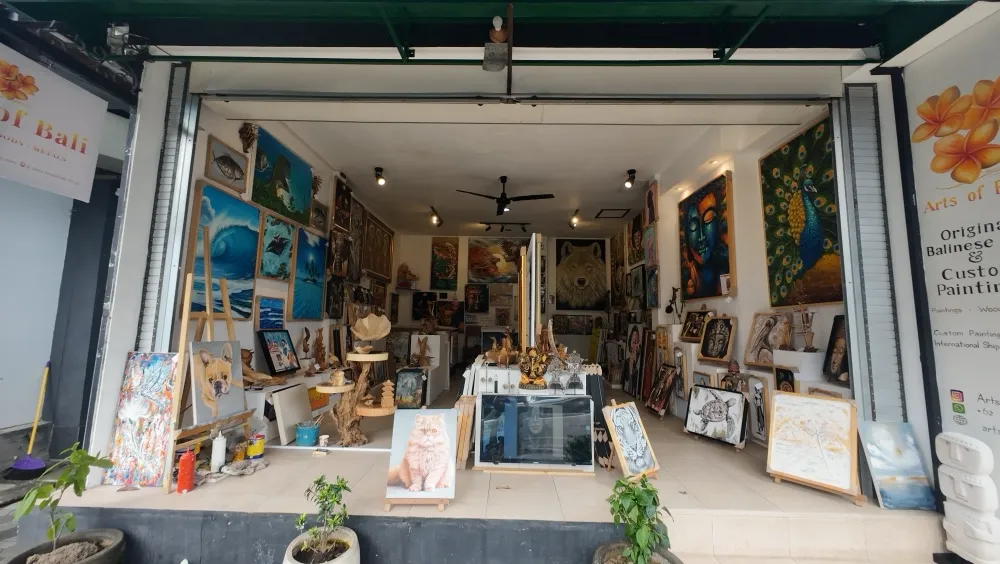
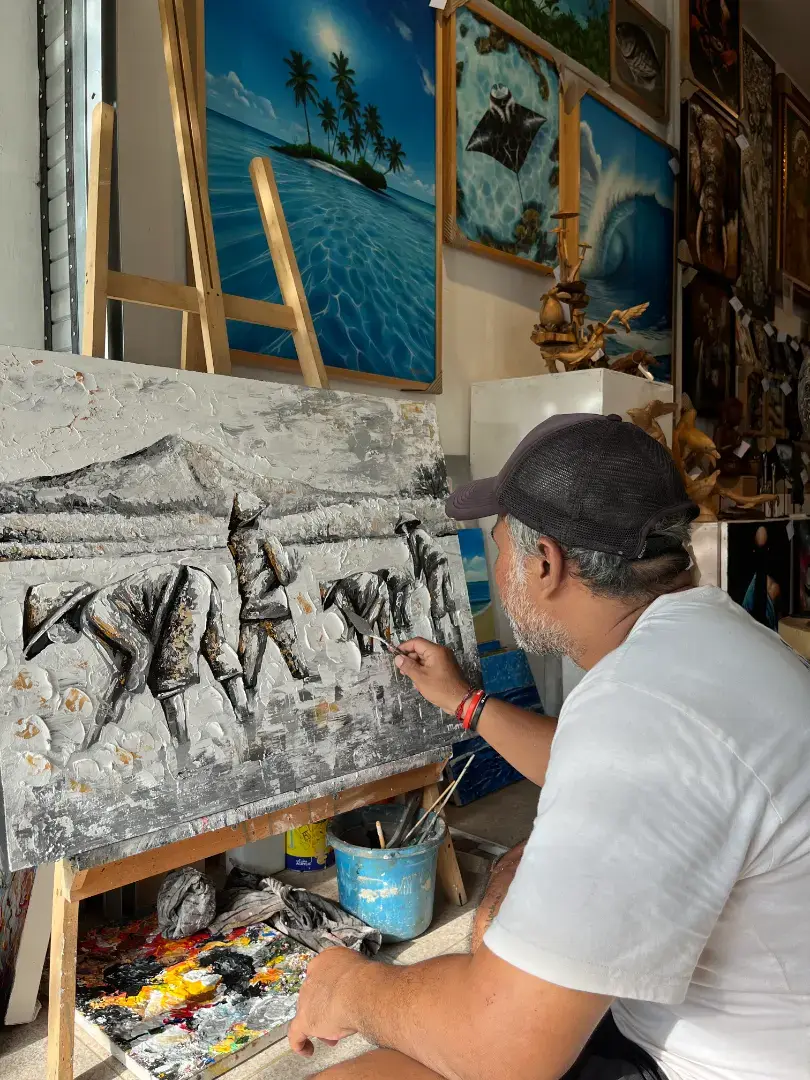
A Seminyak gallery like Arts of Bali is built on a different model entirely. Every piece has a fixed price attached before a customer ever asks. The selection is smaller and curated rather than exhaustive, and resident artists frequently work on-site, so a piece you are considering may still be wet on the easel a few meters away. That on-site production is the single biggest structural difference: it turns “is this really hand-painted” from a question you have to investigate into something you can watch happen.
Why This Isn’t About One Being More Authentic
It is tempting to frame this as market equals authentic and gallery equals commercial, but that framing does not hold up. Ubud’s market includes real, skilled, hand-painted work, and Seminyak galleries are still run and staffed by Balinese artists, not imported decoration. The honest distinction is about certainty and process, not authenticity in the abstract. A market rewards buyers who already know how to evaluate a painting. A gallery does more of that evaluation for you, in exchange for a fixed, generally higher price.
Four Things That Actually Differ
The diagram below narrows the comparison to the four factors that matter most when deciding where to buy: how prices are set, how much authenticity risk you’re taking on, how the selection is curated, and how easy it is to get a piece home.
Bargaining at Ubud’s Market: What Actually Happens
Negotiation at an Indonesian market, including Ubud’s art market, follows a fairly predictable rhythm. A vendor names an opening price aimed at a first-time visitor, the buyer counters lower, and both sides move toward a middle point over one or two rounds of back and forth. It is a normal, expected part of the transaction, not an adversarial one, and vendors generally expect it rather than resent it.
The practical challenge is not the negotiation itself, it is knowing what a fair price actually is before you start, since the same painting subject and size can be priced very differently from one stall to the next. Buyers who are new to this often end up anchored to the vendor’s opening number instead of an independent sense of value. That is the trade-off worth knowing before you go: the market can be genuinely good value, but only if you are willing to compare a few stalls and negotiate rather than accept the first number.
Fixed-Price AlternativeFixed-Price Galleries in Seminyak: What You Get Instead
A gallery like Arts of Bali removes the negotiation step entirely. Every piece carries a marked price, set in advance rather than adjusted per customer, which means two buyers pay the same amount for the same painting regardless of how the conversation goes. For visitors who find bargaining stressful or simply do not have time to compare multiple vendors, this is the main appeal.
The other structural advantage is proximity to the artist. Because resident artists paint on-site, a customer can see the exact working process behind a piece, brush technique, layering, how long a section takes, rather than relying on a vendor’s description of who made it. That is not a claim that market vendors are dishonest, it is simply a different level of first-hand verification available at a working gallery that a market stall generally cannot offer.
For a deeper look at how to check whether a piece is genuinely hand-painted rather than a print or reproduction, wherever you end up buying, see our guide to spotting an original Bali painting.
Side by SideUbud Art Market vs Seminyak Gallery at a Glance
| Factor | Ubud Art Market | Seminyak Gallery (Arts of Bali) |
|---|---|---|
| Pricing | Negotiable, opening price is a starting point | Fixed and marked in advance |
| Authenticity Risk | Mixed, originals and reproductions sold together | Lower, named resident artists working on-site |
| Curation | Broad and dense, quality varies by stall | Smaller, selected, more consistent quality |
| Meeting the Artist | Sometimes, depends on the stall | Regularly, artists often paint on-site |
| 国际航运 | Rare, informal at best | Established, handled routinely |
| 最适合 | Browsing, culture, buyers who enjoy negotiating | Buyers who want a documented original with less guesswork |
Want to See the Difference in Person?
Message us before you visit and we can have specific pieces ready to compare, fixed price, artist on-site, certificate included.
WhatsApp the GalleryWhat You’ll Actually Find in Each Place
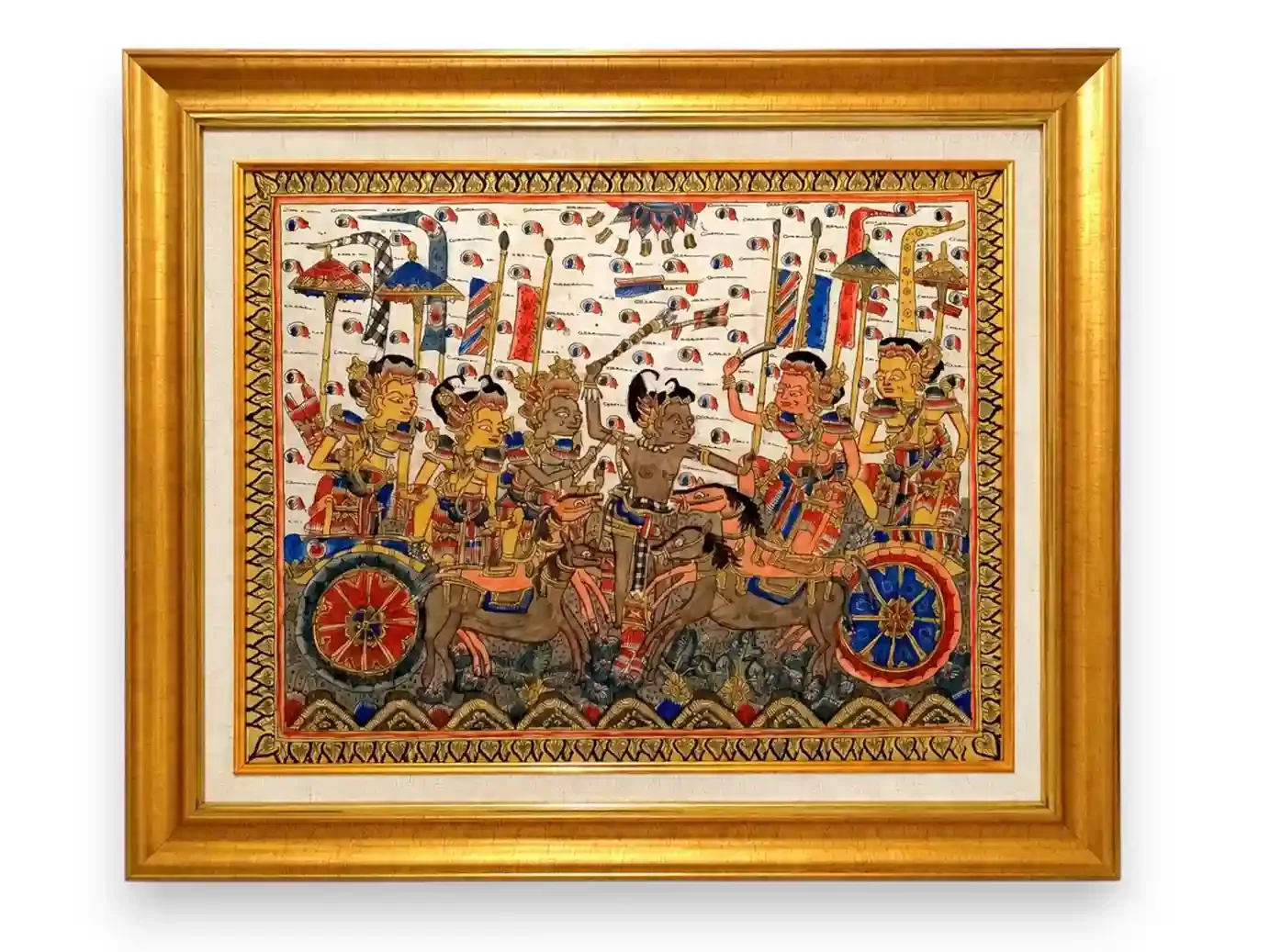
Ubud’s market inventory leans heavily toward landscape and village-life scenes, along with classical school subjects like Kamasan wayang figures and Batuan-style dense compositions, alongside a large volume of decorative, tourist-priced pieces aimed at quick sales. Quality genuinely varies stall to stall, and the same subject can appear painted by hand in one stall and printed in the next.
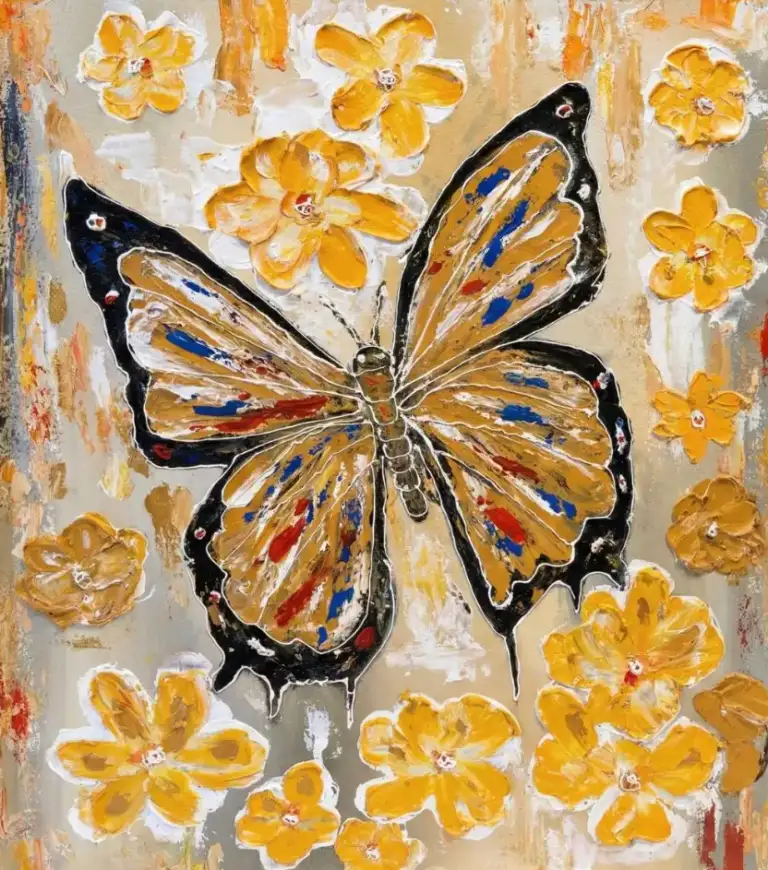
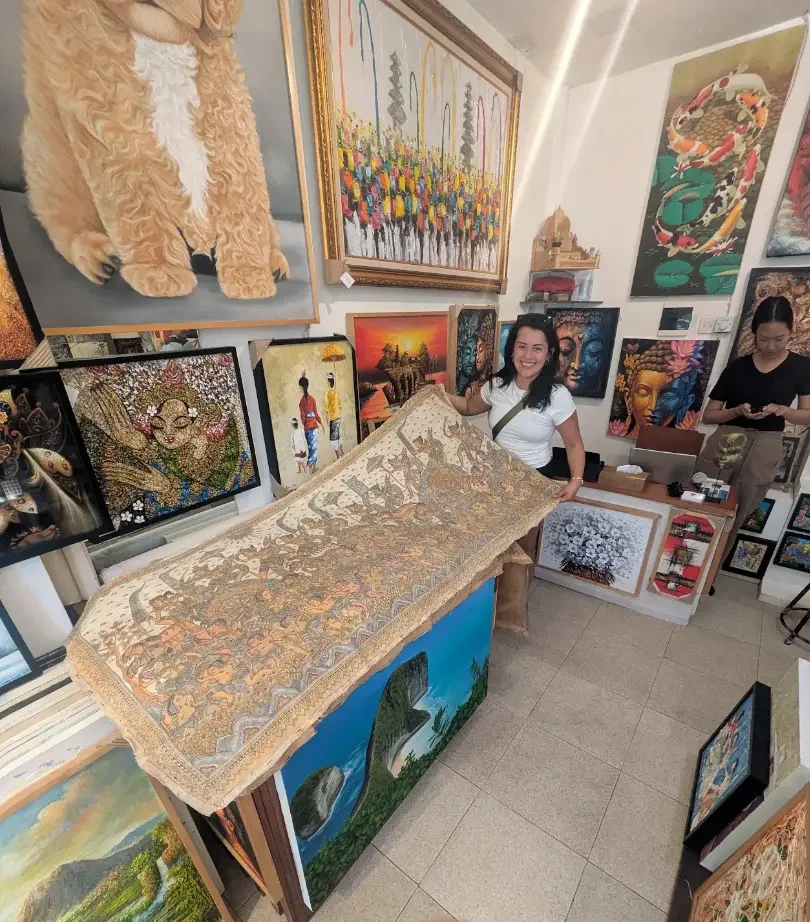
A Seminyak gallery narrows that range deliberately. At Arts of Bali, the collection spans classical schools, spiritual and wildlife subjects, and contemporary sand-texture or palette-knife work, each piece already vetted for the gallery floor rather than left for the buyer to sort out. For a broader look at how these classical schools and genres relate to each other, see our complete guide to Balinese art.
One specific example worth noting: a painting of Ubud’s market itself, The Vibrant Traditional Ubud Market Painting, is currently available at Arts of Bali for Rp2,000,000, an original depiction of the very market this guide compares it to, priced and documented the fixed-gallery way.
Shipping and Buying From Abroad
If you are buying to take home in a suitcase, either location can work for a small piece. If you are buying something larger, or buying while already planning to ship internationally, the two locations diverge sharply. Market stalls in Ubud generally do not offer formal packing or export services, buyers are usually left to arrange their own courier or freight after the fact. An established gallery builds this into the purchase itself.
Our full 装运指南 covers exactly how paintings are packed, rolled, or crated for international delivery, along with realistic cost and timeline expectations, for readers who know before visiting that shipping will be part of the decision.
Decision FrameworkWhich One Should You Actually Visit?
Choose Ubud’s art market if you enjoy negotiating as part of the experience, have time to compare several stalls, and are comfortable evaluating a painting’s quality yourself before agreeing on a price. It rewards patience and a bit of market savvy, and a full afternoon there is also a cultural experience in its own right, not just a shopping errand.
Choose a Seminyak gallery like Arts of Bali if you want a shorter, more predictable path to an original piece, want to see the artist working before you commit, or know in advance that you will need international shipping handled properly. Many visitors do both on the same trip, treating Ubud as a cultural stop and Seminyak as where the actual purchase happens. For more on evaluating a piece regardless of where you buy it, our decor and collector’s guide and our honest pricing guide cover what to check and what to expect to pay. Readers who want the museum side of Ubud specifically, rather than the market, can also see our guide to Bali’s best galleries and museums.
常见问题常见问题
Should I buy art in Ubud or Seminyak?
It depends on what you value more. Ubud’s market suits buyers who enjoy negotiating and have time to compare stalls, while a Seminyak gallery like Arts of Bali suits buyers who want a fixed price, a documented original, and the option to watch the artist work before they commit to buying.
Is bargaining expected at Ubud’s art market?
Yes, bargaining is a normal and expected part of buying at Ubud’s market. Vendors typically open with a higher price aimed at first-time visitors, and both sides move toward a middle point over one or two rounds. It is not considered rude, it is simply how the transaction works there.
Can I negotiate the price at a Seminyak gallery like Arts of Bali?
Prices at Arts of Bali are fixed and marked in advance, so negotiation is not part of the standard process the way it is at a market stall. This trades away some flexibility on price, but means two buyers pay the same amount for the same piece regardless of how the visit goes.
Is everything sold at Ubud’s art market original?
No, not everything. Ubud’s market sells genuine hand-painted originals alongside printed or mass-produced decorative pieces, often in the same stall. Check for real paint texture and brush variation up close, our authenticity guide covers the specific checks in more detail before you buy anywhere.
Which is easier for international shipping, a market stall or a gallery?
A gallery is significantly easier. Established galleries like Arts of Bali handle packing, rolling, and export documentation as a routine part of the sale. Individual market stalls in Ubud generally do not offer this, leaving buyers to arrange their own courier or freight after the purchase.
Can I visit Ubud’s art market and a Seminyak gallery on the same trip?
Yes, and many visitors do exactly this. A common pattern is treating Ubud as a cultural half-day, browsing the market and nearby museums, then visiting a Seminyak gallery separately when it is time to make an actual documented purchase with fixed pricing and shipping support.
Does Arts of Bali sell the same kind of paintings found in Ubud’s market?
Many of the same subjects and classical schools appear in both places, including Kamasan and Batuan-style work. Arts of Bali even carries an original painting depicting Ubud’s market itself, currently priced at Rp2,000,000, the same subject shown the fixed-price, documented way.
How much more should I expect to pay at a gallery than at a market stall?
There is no fixed markup, it depends on size, technique, and how well a buyer negotiates at the market. As a general pattern, gallery pricing reflects a fixed, pre-vetted cost, while market pricing can end up lower or higher than that depending on negotiation skill and starting offers.
Skip the Guesswork, See Original Pieces Priced and Ready
Arts of Bali in Seminyak has a curated collection of original paintings, fixed pricing, and artists working on-site, so you know exactly what you’re buying before you commit.
WhatsApp the Gallery Shop the Ubud Market Painting