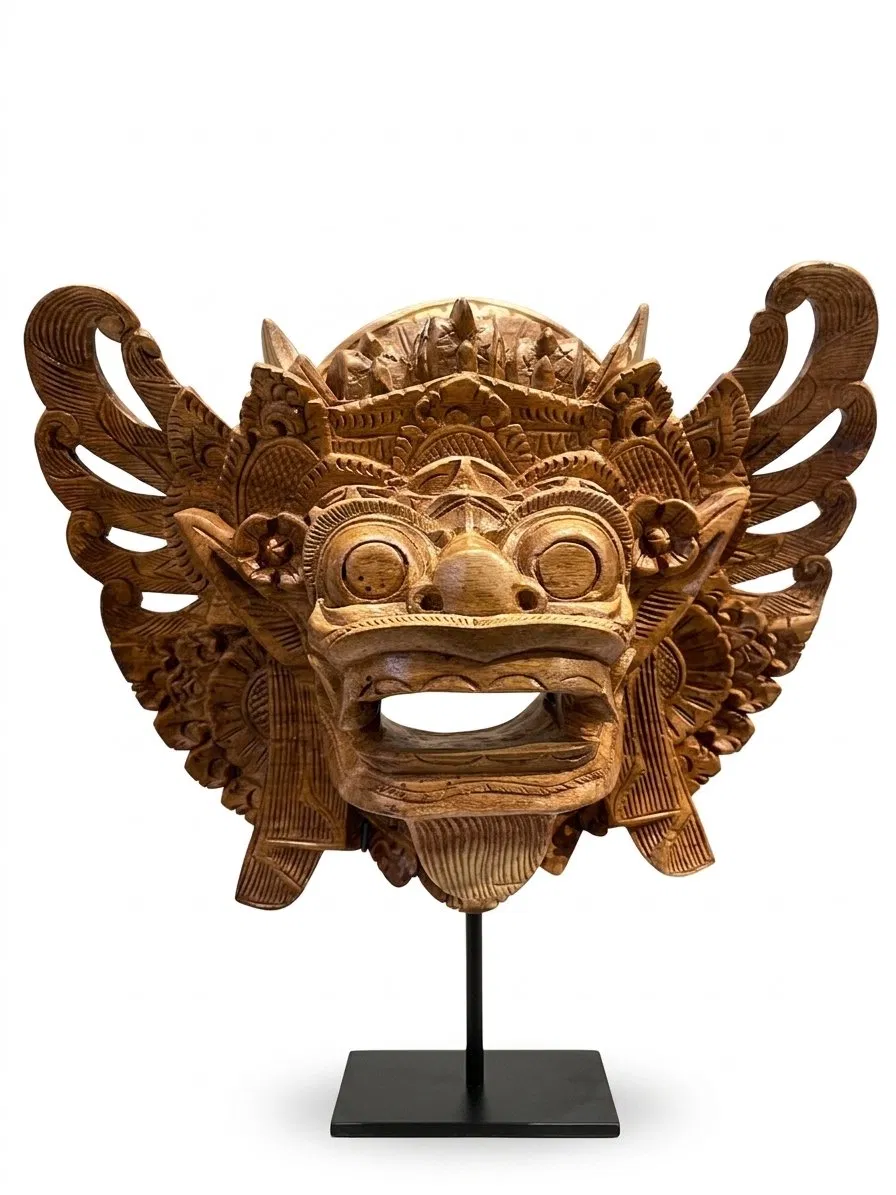
Faces carved to guard a doorway.
Now carved to guard a wall.
A standing figure gives you time to walk around it and take in the story. A mask doesn’t have that luxury — it has to read in a single glance, which is really the whole design problem a carver is solving before the first cut goes into the wood.
A Balinese mask, sometimes shortened to just a Bali mask, sits in a different part of the gallery from the standing dancers and mythological figures most visitors expect to see first. Where a standing carving asks you to walk around it, a mask asks you to look it in the eye and decide, almost instantly, whether it is protecting you or warning you.
This guide covers six original Balinese masks currently at Arts of Bali, all hand-carved from wood, plus two large relief panels, Ganesha in the Sacred Forest and The Divine Melody of Krishna, that take the same carving tradition and apply it to a flat wall format instead. If you have already read our broader wood carving guide covering standing figures like the Janger dancer and the Sita and Rama portrait, this post picks up where that one stops.
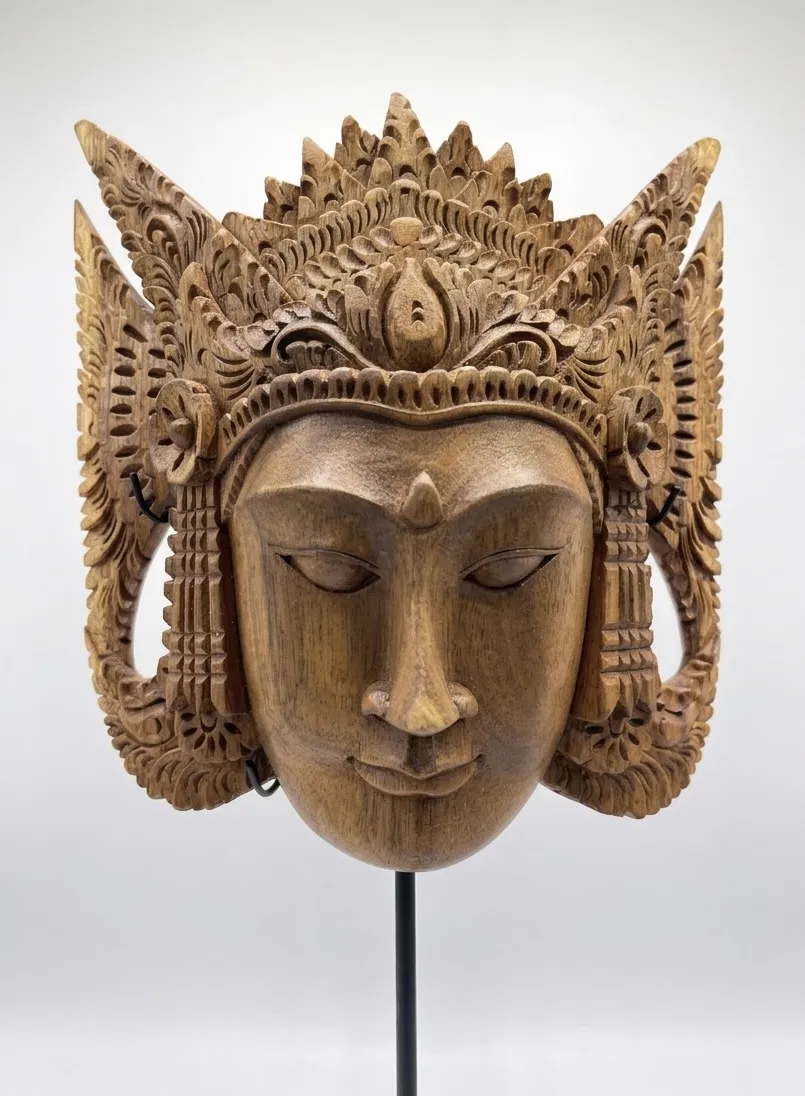
A Balinese mask is a hand-carved wooden face, traditionally rooted in topeng (the Balinese mask tradition used in sacred dance-drama) and in temple guardian imagery, now produced as a standalone decorative object for wall or stand display. Masks generally fall into two visual families: fierce guardian faces with bared fangs and bulging eyes, associated with protective spirits such as Barong, and serene, composed faces with elaborate radiating crowns, associated with refined deities and noble characters. The same carving tradition also produces flat relief panels, larger wood pieces carved in low relief like a picture rather than a freestanding face, typically depicting figures from Hindu mythology such as Ganesha or Krishna.
- Six original Balinese masks and two large relief panels are in stock now, all hand-carved wood, none antique or pre-owned.
- Guardian-style masks (Barong faces) suit a single bold wall or entryway; serene deity masks work better in quiet rooms.
- The two relief panels are 50 x 100 cm and priced at Rp 21,000,000 each; mask prices vary by piece.
- No Rangda mask is currently in the collection, but a Rangda-style piece can be custom-commissioned.
- Masks are decorative only — not consecrated or used in real ceremonies — and need just a yearly wipe of natural oil.
The Tradition Behind the Balinese Mask
Topeng is the general Balinese word for mask, and it names a living performance tradition as much as an object. In Topeng dance-drama, performed at temple ceremonies and village celebrations, dancers wear carved wooden masks to take on specific character types: refined nobles who move slowly and speak little, comic servants who carry most of the dialogue, and fierce or grotesque figures whose masks cover the entire face with exaggerated, often frightening features. A skilled mask carver has to think like a costume designer and a sculptor at once, because the mask needs to read clearly from a distance, under temple torchlight or daylight, to an audience that already knows the character by sight before a word is spoken.
Separately, and just as deeply rooted, Balinese building tradition places guardian faces above doorways and gates, carved directly into stone or wood, meant to confront anyone who approaches and ward off harmful spirits before they cross the threshold. These guardian faces share visual language with the most dramatic stage masks: wide eyes, bared teeth, often a protruding tongue or tusks.
Many of the standalone masks sold today, including the pieces in this collection, draw on both traditions at once. They are not stage props pulled from an actual performance, and they are not temple gate carvings removed from a building — they are decorative objects made specifically for display, carved by artisans trained in the same visual vocabulary that both traditions share.
Any discussion of Balinese mask tradition eventually reaches Barong and Rangda, the two figures most associated with the form outside Bali. Barong, the protective lion-spirit, and Rangda, the demon queen who opposes him in the Barong dance, together stage a conflict that Balinese Hinduism treats as ongoing and unresolved rather than a story with a final winner — good and destructive force held in balance rather than one defeating the other.
Rangda’s mask carries its own visual code: wild hair, bulging eyes, a long tongue, and pendulous breasts, distinct from the fanged but more contained face typical of a Barong mask. The pieces described below draw mainly on the Barong and guardian side of this pairing; a Rangda-style mask can be discussed as a custom commission for collectors specifically drawn to that half of the story.
Mask Carving Versus Standing Figure Carving
The technical demands of mask carving differ from the figural carving covered in our wood carving guide. A standing figure, like the Janger dancer or the Pengantin couple described there, is carved in the round: the back, sides, and front all need to hold up to inspection.
A mask is carved to be seen from the front and slightly from the sides, with the back left comparatively plain, which lets the carver put nearly all of the wood’s volume into the face itself. This is part of why mask carving can achieve such dramatic depth in the eyes, brow, and mouth: every bit of material that would otherwise go toward a torso or a base in a standing figure goes into the face instead.
These masks are not used in actual ceremonies or performances. What carries over from that world is the visual language — exaggerated features built to read clearly from a distance — adapted here for a wall instead of a stage or a temple gate.
Reading the Guardian Masks: Barong-Style Faces in the Collection
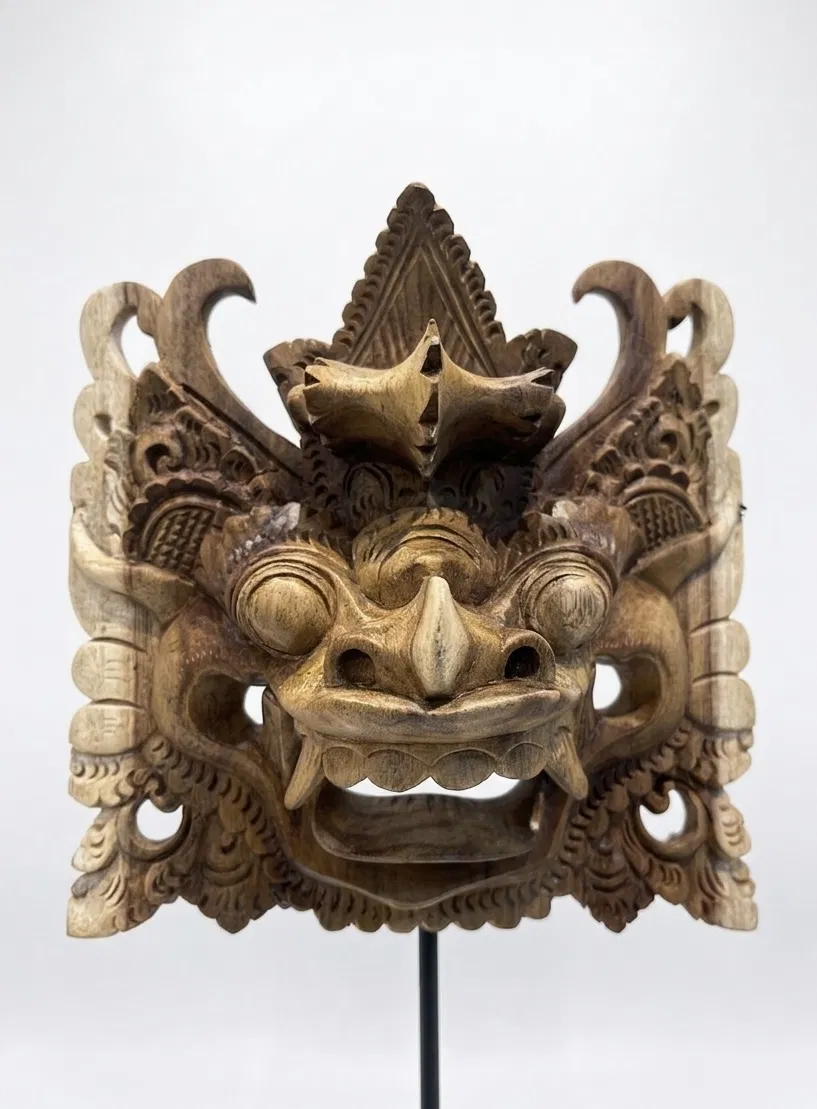
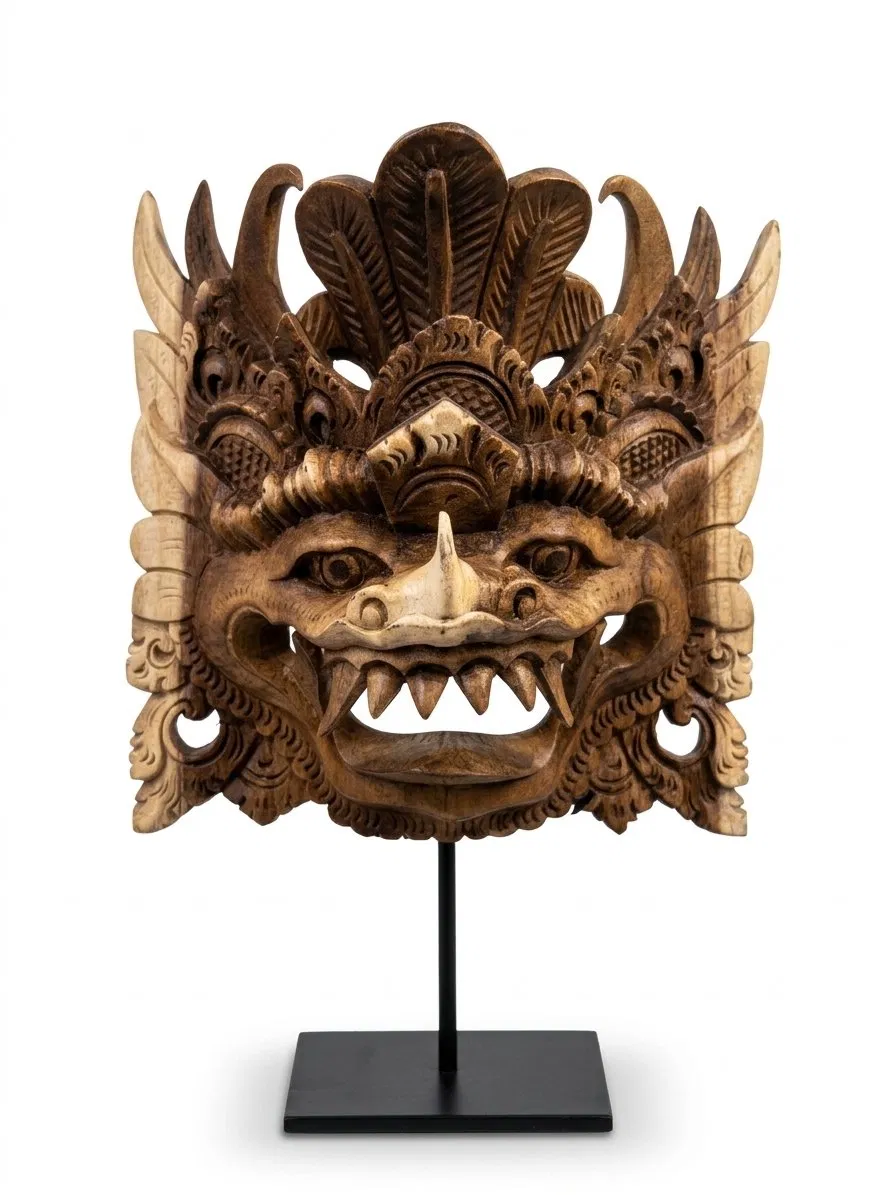
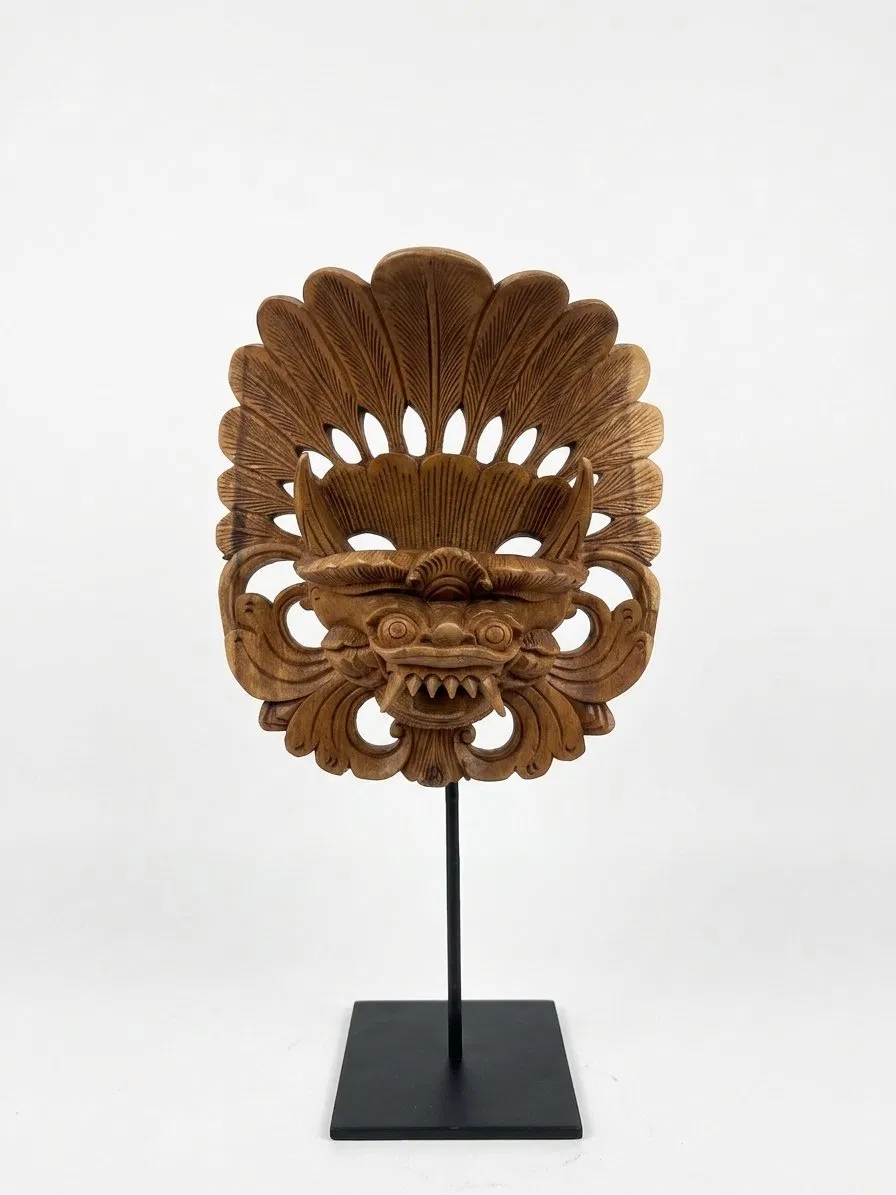
Three pieces in this collection belong to the fierce, protective category most people picture when they hear “Balinese mask”: round, bulging eyes, and teeth bared in a wide grin rather than a snarl, which is part of what separates a guardian figure from a true monster in Balinese visual language — the expression reads as powerful rather than purely hostile. Carved manes, feathered crowns, or wing-like flares extend outward from the face, multiplying its visual size well beyond the actual dimensions of the wood.
One piece takes this furthest, with full carved wings spreading on either side of the face and a protruding tongue, a combination of features that pulls from both Barong (the protective lion-spirit central to Barong dance) and the winged guardian imagery found elsewhere in Balinese temple carving. Another, smaller in scale, uses a tusk-like carved nose ridge and a feathered crown to achieve a similarly commanding presence with a more compact silhouette. A third uses a simpler, more geometric crown structure, letting the face itself — round eyes, flat nose, bared teeth — carry most of the visual weight.
The Refined Masks: Deity and Noble Character Faces
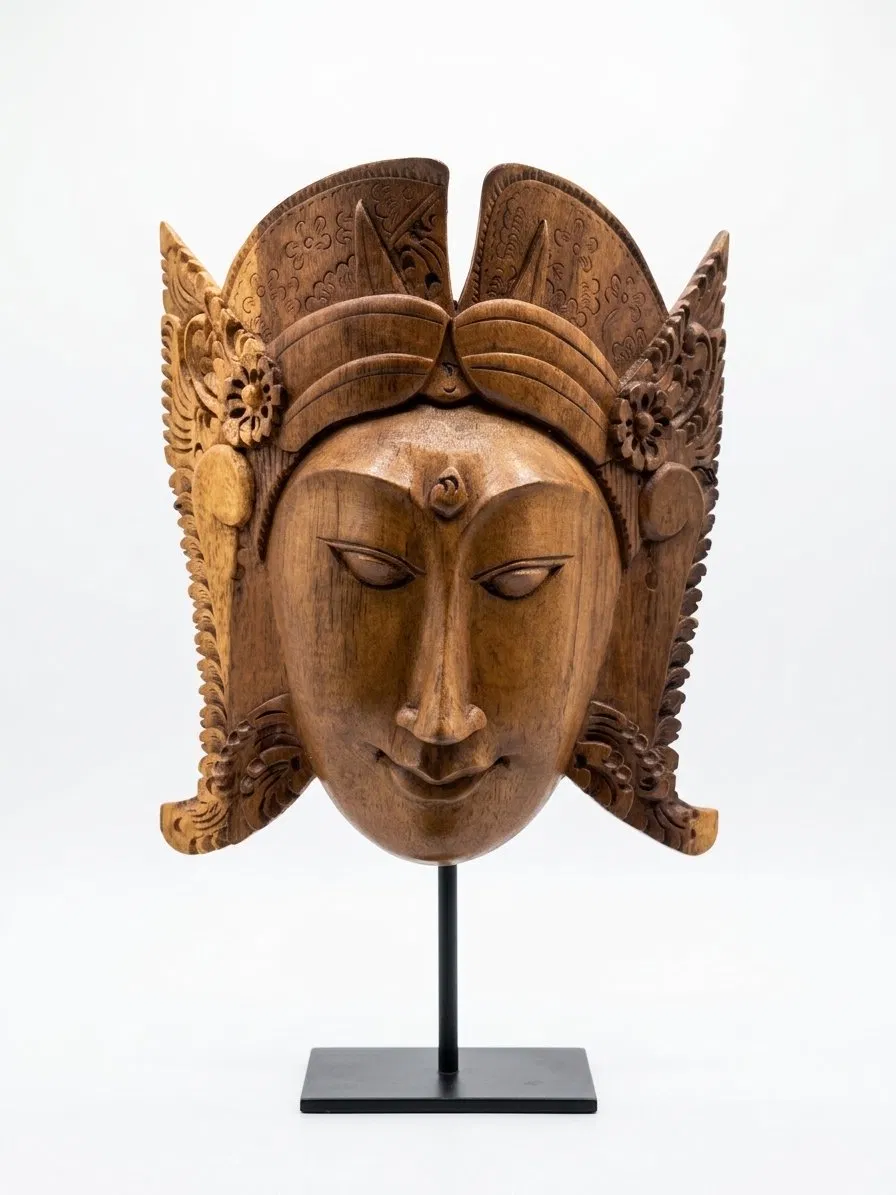
Set against the guardian masks, the collection also holds two pieces in the opposite register: composed, symmetrical faces with closed or half-lowered eyes, framed by tall, elaborately carved crowns that rise well above the face itself rather than spreading outward from it. These belong to the refined character family in Balinese mask tradition — noble figures, deities, characters whose authority comes from stillness rather than display.
The carving challenge here is almost the inverse of the guardian masks. There’s no fang, no bulging eye, no exaggerated feature to anchor the viewer’s attention. Everything depends on proportion: the exact tilt of the eyelid, the precise width of the mouth, the angle at which the crown sits above the brow. A carver working in this style has very little room for error, since the entire effect rests on subtlety rather than drama. One piece in the collection uses a tall, flame-like radiating crown with floral ear pieces; another uses a more compact, wing-shaped crown that curves forward over the temples — both reach the same quiet authority through different crown structures.
Balinese Wood Carving Mask: Three Ways to Collect
Guardian and Protective
Fierce faces with bared teeth, bulging eyes, and dramatic crowns or wings. These pieces carry the most visual energy in the collection and work best as a single focal object: an entryway, a stairwell landing, a wall that benefits from one strong gesture rather than a grouping. At roughly 15 to 20 centimeters, they read clearly even from across a room.
Refined and Serene
Composed deity and noble faces with closed or lowered eyes and tall, precisely carved crowns. These work well in quieter spaces — bedrooms, reading corners, meditation rooms — where a fierce guardian face would feel like the wrong register entirely. They also pair well in a small grouping with each other, since their visual quietness doesn’t compete the way guardian masks tend to.
Relief Panel Format
A different format entirely: large flat panels carved in low relief, depicting full mythological scenes rather than a single face. The two relief panels in this collection, Ganesha in the Sacred Forest and The Divine Melody of Krishna, are both 50 by 100 centimeters, making them substantial wall pieces in their own right rather than accent objects. Detailed further below.
Beyond the Mask: Wood Relief Panels at Arts of Bali
Where a mask carves a single face, a relief panel carves an entire scene into a flat wood surface, closer in spirit to a sculpted painting than to a sculpted face. The two panels currently available at Arts of Bali are both carved at 50 by 100 centimeters, which puts them among the largest carved wood pieces in the gallery, and both are priced at Rp 21,000,000 — approximately USD 1,150 to 1,170 at the exchange rate in early August 2026 (around Rp 18,000 to the dollar). Rates move daily, so treat that conversion as a rough guide and confirm the exact figure with us directly before ordering.
Ganesha in the Sacred Forest
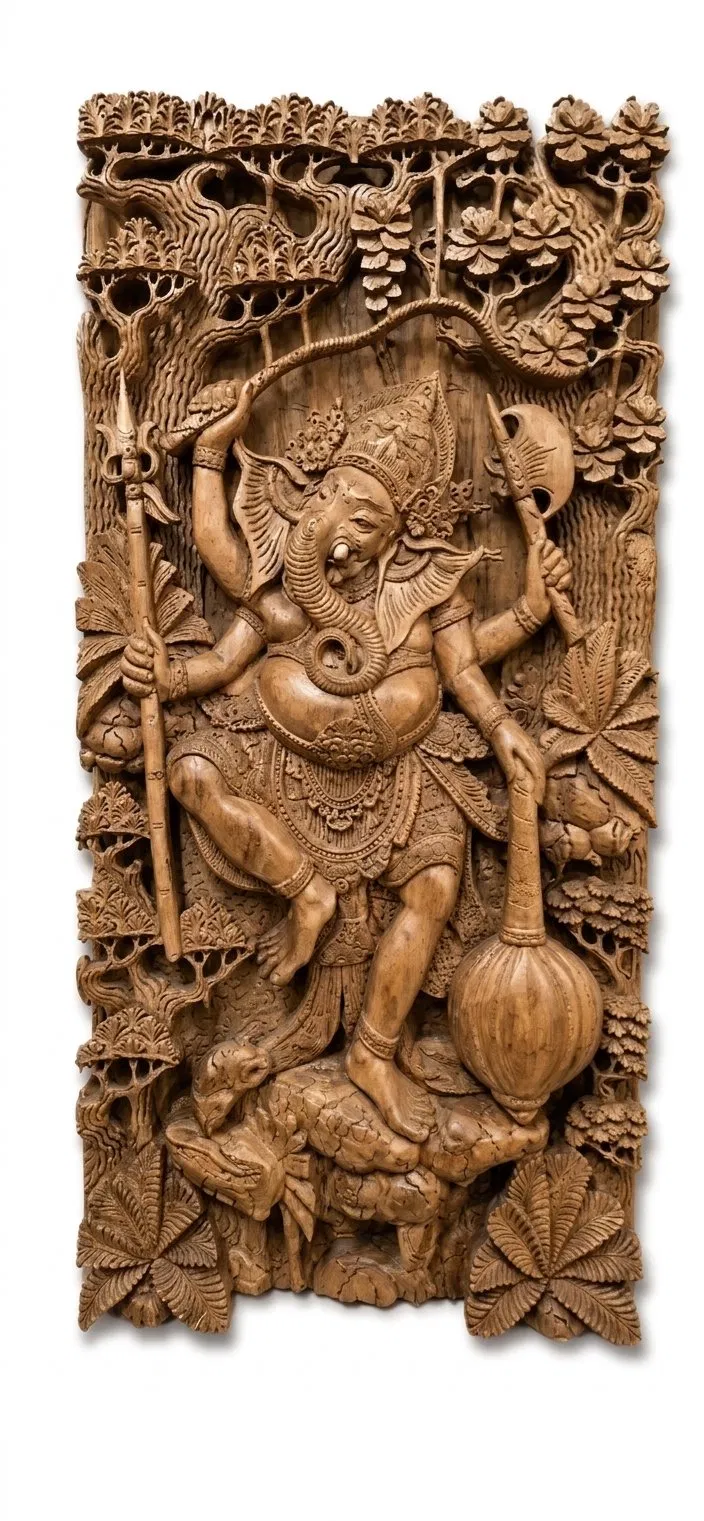
Ganesha, the elephant-headed son of Shiva and Parvati in Hindu mythology, is venerated across Bali’s distinct form of Hinduism as Vighnaharta, the remover of obstacles, and as a patron of intellect, learning, and the arts.
This panel places Ganesha within a densely carved forest setting: layered pine-like foliage and flowering branches fill the upper register of the panel, while Ganesha himself stands below holding ceremonial objects, rendered with the same density of ornamental detail (crown, jewelry, sash) found in the gallery’s finest figural carving. The forest framing is what distinguishes this piece from a simpler standalone Ganesha figure — the deity is shown within a setting, not isolated against a plain background, which gives the panel a sense of place a single carved figure can’t achieve on its own.
This piece is available directly through our shop: Ganesha in the Sacred Forest, wooden relief panel.
The Divine Melody of Krishna
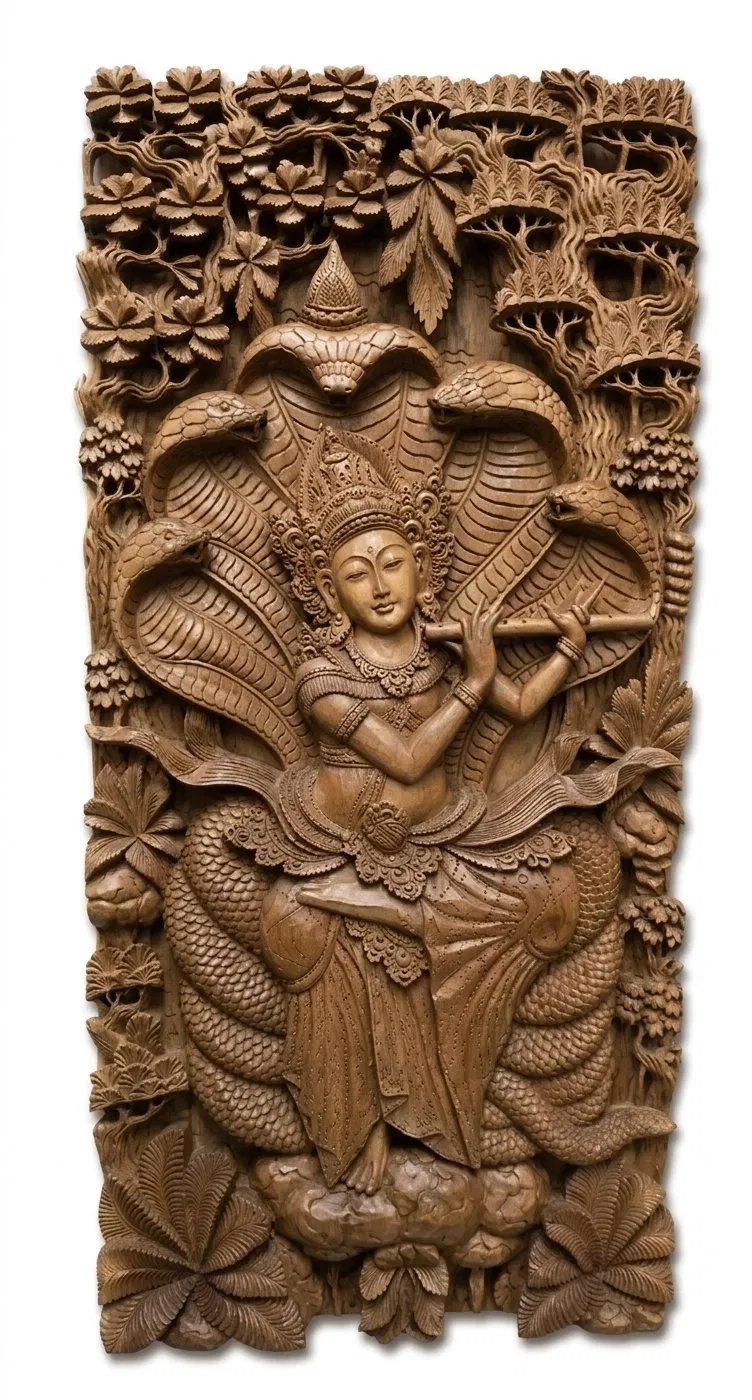
The second panel depicts Krishna, an avatar of Vishnu, playing his flute while a multi-hooded serpent rises in a fan behind him. Carvings of this kind commonly draw on the story of Krishna and Kaliya, the serpent king whose presence had poisoned a stretch of the Yamuna river: in the most familiar version of the tale, Krishna dances upon the serpent’s many hoods, subduing Kaliya through the dance itself rather than through force, restoring the river.
Whether or not this specific panel was carved with that exact episode in mind, the visual elements — the flute, the calm expression, the fan of cobra hoods — place it clearly within this strand of Krishna iconography. The serpent’s scales and the surrounding forest canopy are carved with the same density and precision found in the Ganesha panel, and the two pieces are meant to be read as a pair.
You’ll find this one in the shop as well: The Divine Melody of Krishna, wooden carving panel.
The Metropolitan Museum of Art’s Asian art collection holds numerous historical depictions of both Ganesha and Krishna across South and Southeast Asian sculpture — useful context for how widely these two figures recur across Hindu visual tradition, well beyond Bali alone.
Choosing Between a Mask, a Relief Panel, and a Standing Figure
With three distinct wood carving formats now available across the gallery, the choice usually comes down to scale and the role the piece needs to play in a room.
A mask at 15 to 20 centimeters works as an accent: a single strong gesture on a wall that already has other elements around it, or grouped in twos and threes along a stairwell or hallway. A relief panel at 50 by 100 centimeters is a different kind of commitment entirely — it functions as the dominant visual element of whatever wall it occupies, closer to how a large painting would be used than how a small decorative object would be used.
Standing figures, covered in our wood carving guide, sit somewhere between the two in visual weight but occupy floor or shelf space rather than wall space, which makes them the right choice when the room calls for a three-dimensional presence rather than a flat one.
For most collectors furnishing a single room, one relief panel as the anchor piece, with two or three smaller masks placed elsewhere in the same space, gives a coherent sense of the same carving tradition working at different scales without every piece competing for the same wall.
Caring for and Shipping Wood Carving Masks and Panels
Both masks and relief panels are unfinished or lightly finished hardwood, the same material covered in our wood carving guide. Keep pieces out of direct sunlight and away from constant air conditioning airflow, both of which dry the surface unevenly over time. A light application of natural oil once a year, buffed off with a soft cloth, maintains the tone.
The smaller masks ship easily in padded boxes, since their compact size keeps both cost and risk low. The large relief panels, given their dimensions and the depth of their carved relief, ship in custom-built wooden crates rather than rolled or boxed loosely, the same approach used for any sculptural or textured wood piece. Our guide to shipping art from Bali covers crating, courier options, and customs documentation in detail, including the biosecurity notes that apply specifically to wood items entering Australia, New Zealand, and the United States.
Buy or Commission a Wood Carving Mask or Panel
The two relief panels described in this post, Ganesha in the Sacred Forest and The Divine Melody of Krishna, are available directly through our shop. For the masks, current availability and pricing are confirmed fastest over WhatsApp, since pieces in this size range turn over quickly. Custom mask and panel commissions are also accepted.
Chat on WhatsApp Browse the Gallery