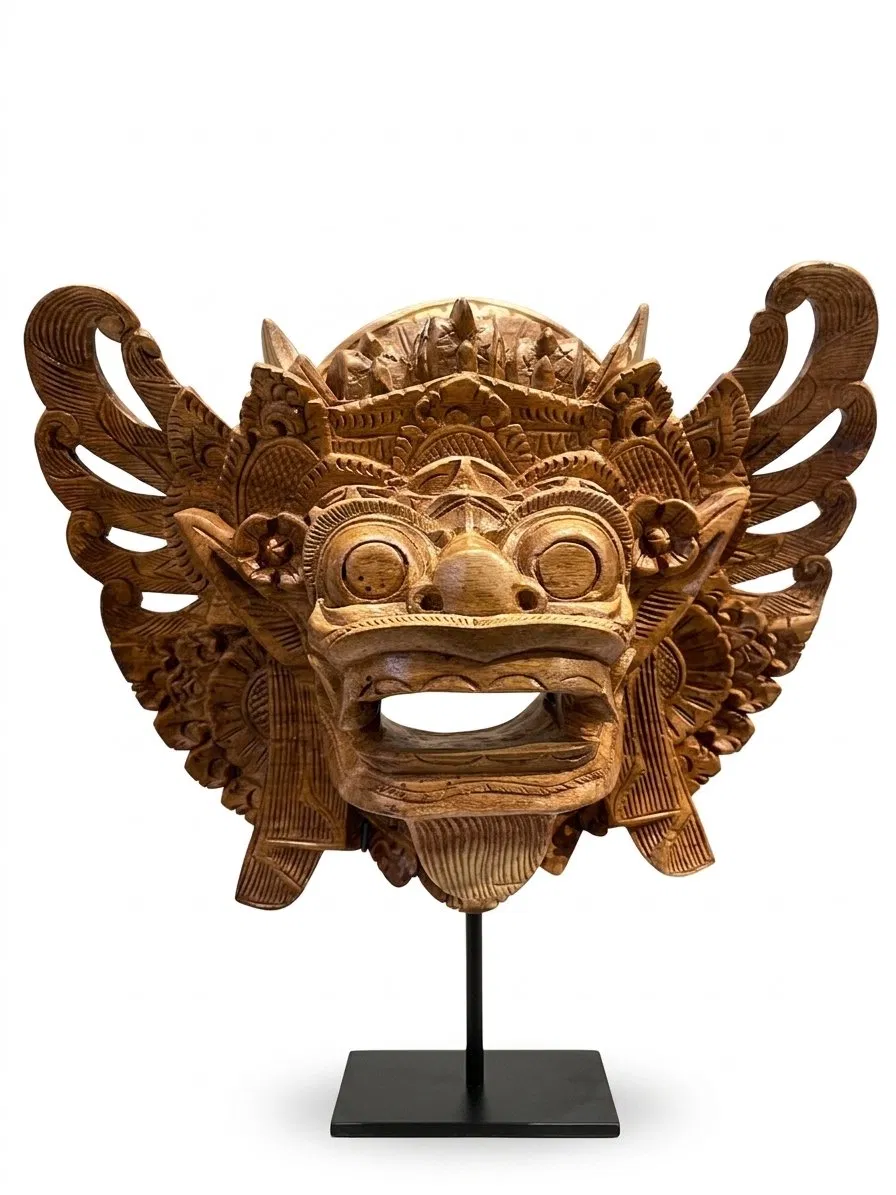
Des visages sculptés pour garder une entrée.
Désormais sculpté pour orner un mur.
A standing figure gives you time to walk around it and take in the story. A mask doesn’t have that luxury — it has to read in a single glance, which is really the whole design problem a carver is solving before the first cut goes into the wood.
A Balinese mask, sometimes shortened to just a Bali mask, sits in a different part of the gallery from the standing dancers and mythological figures most visitors expect to see first. Where a standing carving asks you to walk around it, a mask asks you to look it in the eye and decide, almost instantly, whether it is protecting you or warning you.
This guide covers six original Balinese masks currently at Arts of Bali, all hand-carved from wood, plus two large relief panels, Ganesha in the Sacred Forest and The Divine Melody of Krishna, that take the same carving tradition and apply it to a flat wall format instead. If you have already read our broader Guide de sculpture sur bois Abordant des figures debout telles que la danseuse Janger et le portrait de Sita et Rama, cet article reprend là où le précédent s'est arrêté.
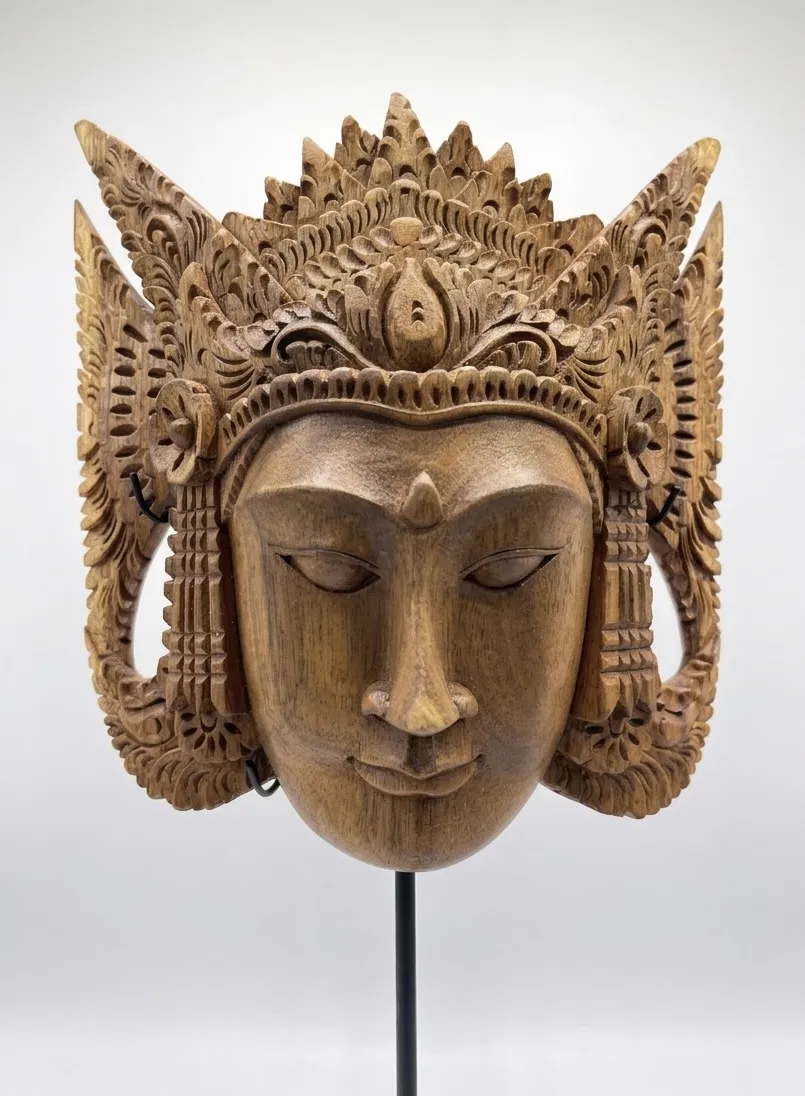
A Balinese mask Il s'agit d'un visage en bois sculpté à la main, dont les racines traditionnelles remontent au « topeng » (la tradition balinaise des masques utilisés dans les danses sacrées) et à l'imagerie des gardiens des temples, aujourd'hui fabriqué comme objet décoratif autonome destiné à être accroché au mur ou posé sur un socle. Les masques se répartissent généralement en deux catégories visuelles : les visages de gardiens féroces, aux crocs dénudés et aux yeux exorbités, associés à des esprits protecteurs tels que le Barong, et les visages sereins et posés, coiffés de couronnes rayonnantes élaborées, associés à des divinités raffinées et à des personnages nobles. Cette même tradition de sculpture produit également des panneaux en relief plat, des pièces de bois de plus grande taille sculptées en bas-relief à la manière d’une image plutôt que d’un visage autonome, représentant généralement des figures de la mythologie hindoue telles que Ganesha ou Krishna.
- Six original Balinese masks and two large relief panels are in stock now, all hand-carved wood, none antique or pre-owned.
- Guardian-style masks (Barong faces) suit a single bold wall or entryway; serene deity masks work better in quiet rooms.
- The two relief panels are 50 x 100 cm and priced at Rp 21,000,000 each; mask prices vary by piece.
- No Rangda mask is currently in the collection, but a Rangda-style piece can be custom-commissioned.
- Masks are decorative only — not consecrated or used in real ceremonies — and need just a yearly wipe of natural oil.
The Tradition Behind the Balinese Mask
« Topeng » est le terme balinais général désignant le masque ; il désigne autant une tradition scénique vivante qu’un objet. Dans le théâtre dansé Topeng, présenté lors des cérémonies dans les temples et des fêtes de village, les danseurs portent des masques en bois sculpté pour incarner des types de personnages spécifiques : des nobles raffinés qui se déplacent lentement et parlent peu, des serviteurs comiques qui assument l’essentiel des dialogues, et des figures féroces ou grotesques dont les masques recouvrent entièrement le visage avec des traits exagérés, souvent effrayants. Un sculpteur de masques expérimenté doit penser à la fois comme un costumier et comme un sculpteur, car le masque doit être clairement reconnaissable de loin, à la lueur des torches du temple ou à la lumière du jour, pour un public qui connaît déjà le personnage de vue avant même qu’un mot ne soit prononcé.
Separately, and just as deeply rooted, Balinese building tradition places guardian faces above doorways and gates, carved directly into stone or wood, meant to confront anyone who approaches and ward off harmful spirits before they cross the threshold. These guardian faces share visual language with the most dramatic stage masks: wide eyes, bared teeth, often a protruding tongue or tusks.
Many of the standalone masks sold today, including the pieces in this collection, draw on both traditions at once. They are not stage props pulled from an actual performance, and they are not temple gate carvings removed from a building — they are decorative objects made specifically for display, carved by artisans trained in the same visual vocabulary that both traditions share.
Any discussion of Balinese mask tradition eventually reaches Barong and Rangda, the two figures most associated with the form outside Bali. Barong, the protective lion-spirit, and Rangda, the demon queen who opposes him in the Barong dance, together stage a conflict that Balinese Hinduism treats as ongoing and unresolved rather than a story with a final winner — good and destructive force held in balance rather than one defeating the other.
Rangda’s mask carries its own visual code: wild hair, bulging eyes, a long tongue, and pendulous breasts, distinct from the fanged but more contained face typical of a Barong mask. The pieces described below draw mainly on the Barong and guardian side of this pairing; a Rangda-style mask can be discussed as a custom commission for collectors specifically drawn to that half of the story.
La sculpture de masques face à la sculpture de figures debout
Les exigences techniques de la sculpture de masques diffèrent de celles de la sculpture figurative abordée dans notre Guide de sculpture sur bois. A standing figure, like the Janger dancer or the Pengantin couple described there, is carved in the round: the back, sides, and front all need to hold up to inspection.
A mask is carved to be seen from the front and slightly from the sides, with the back left comparatively plain, which lets the carver put nearly all of the wood’s volume into the face itself. This is part of why mask carving can achieve such dramatic depth in the eyes, brow, and mouth: every bit of material that would otherwise go toward a torso or a base in a standing figure goes into the face instead.
These masks are not used in actual ceremonies or performances. What carries over from that world is the visual language — exaggerated features built to read clearly from a distance — adapted here for a wall instead of a stage or a temple gate.
À la découverte des masques du Guardian : les visages de style Barong de la collection
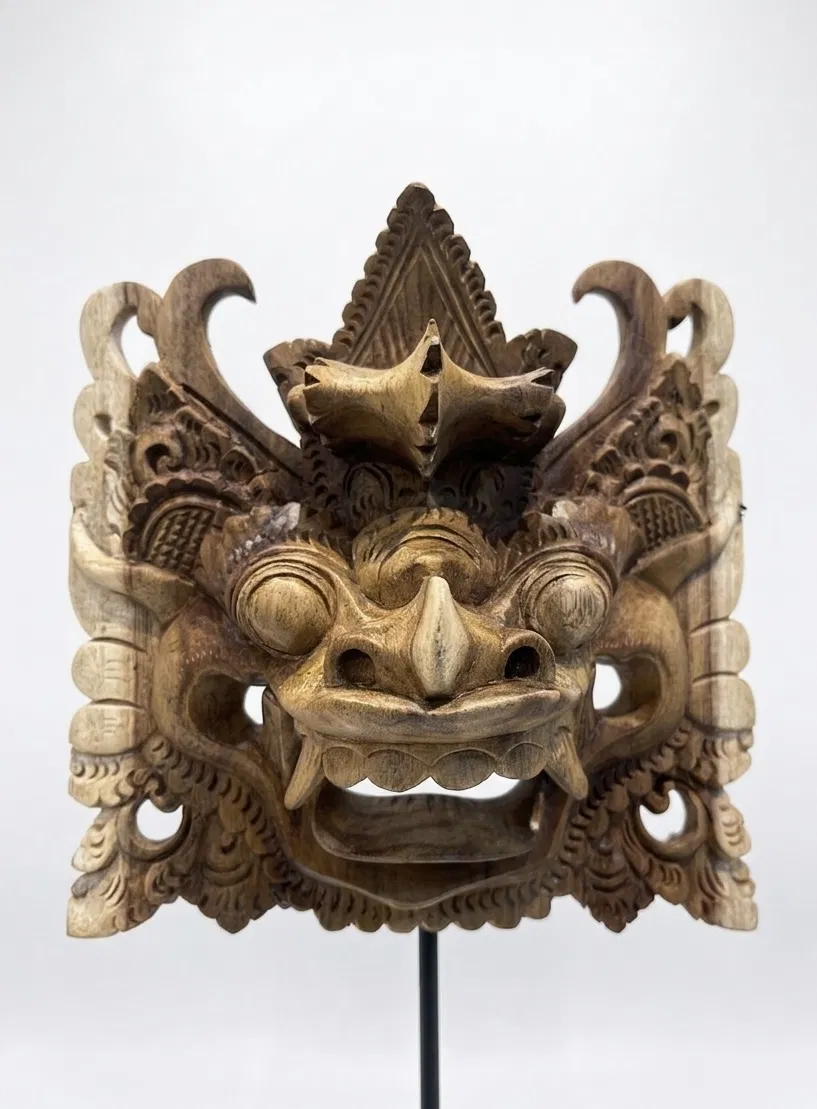
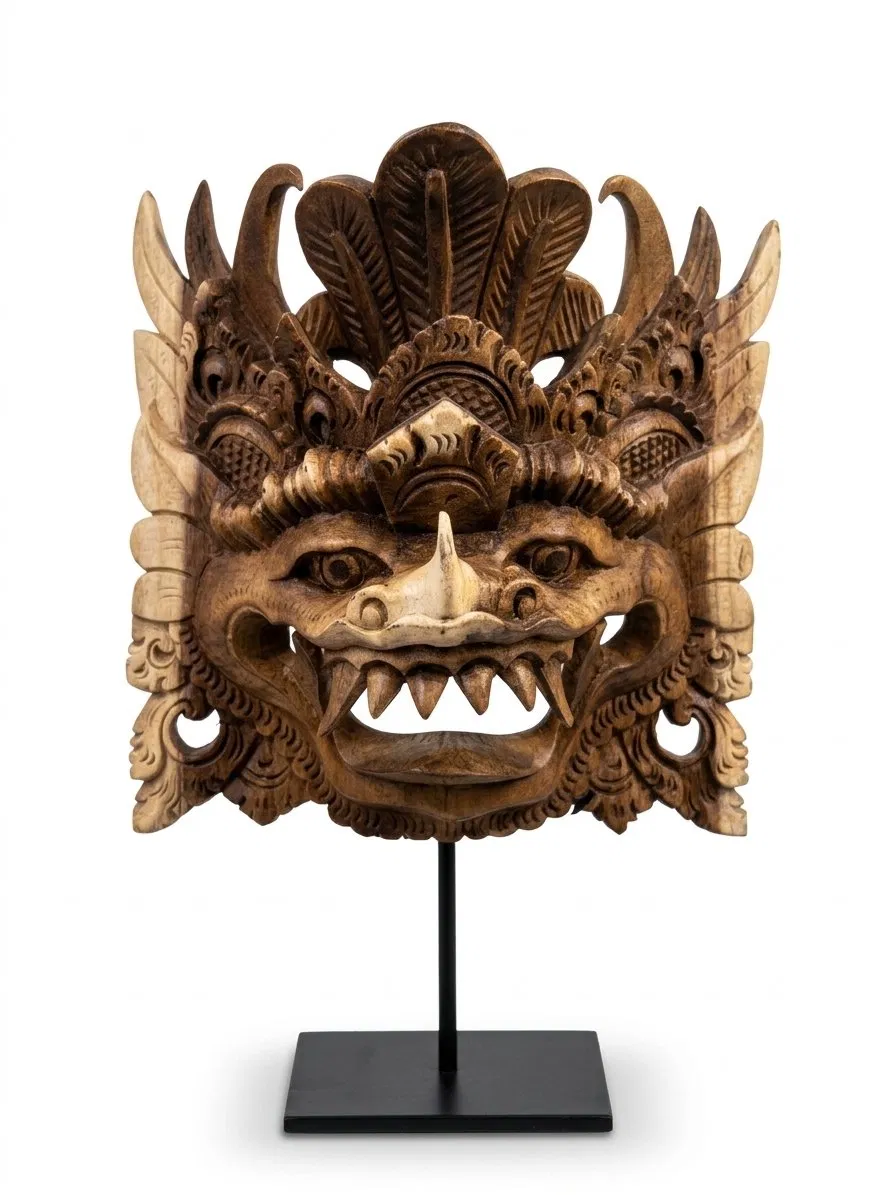
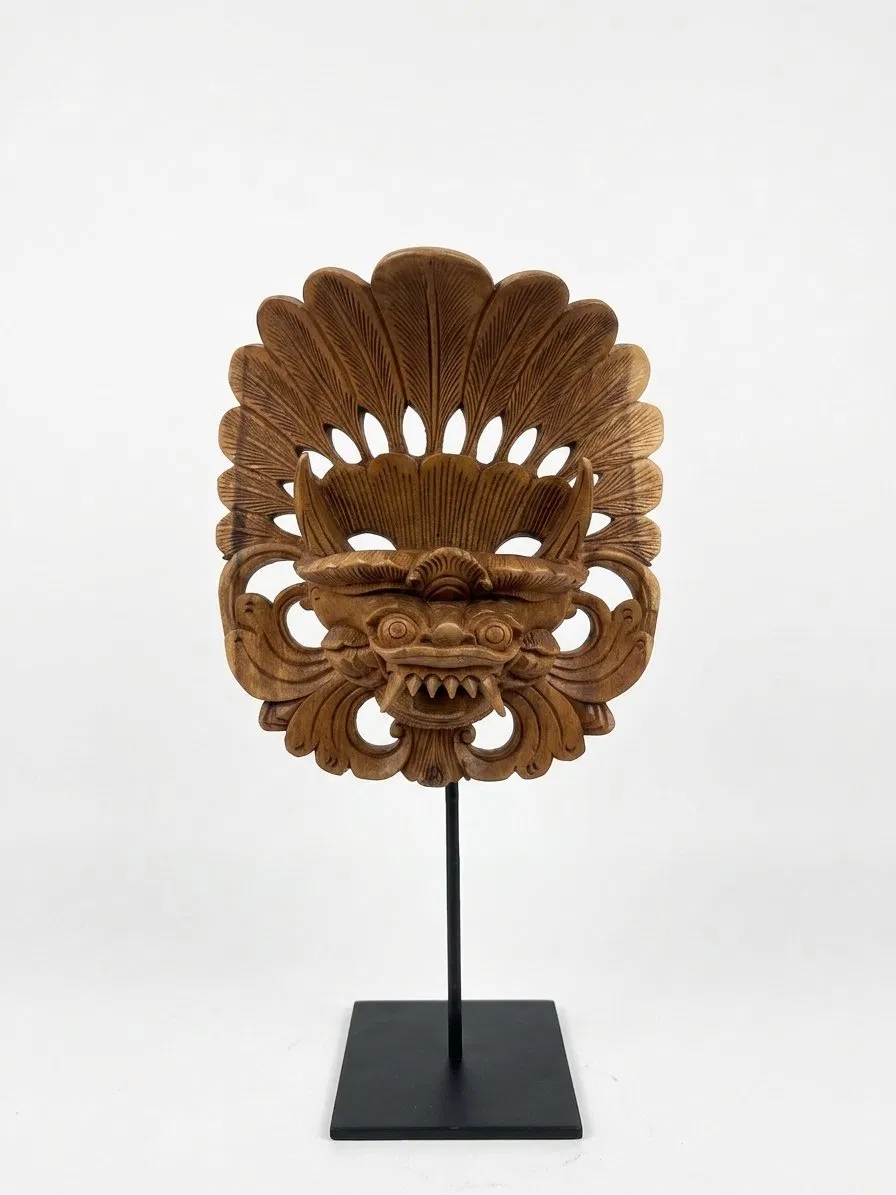
Three pieces in this collection belong to the fierce, protective category most people picture when they hear “Balinese mask”: round, bulging eyes, and teeth bared in a wide grin rather than a snarl, which is part of what separates a guardian figure from a true monster in Balinese visual language — the expression reads as powerful rather than purely hostile. Carved manes, feathered crowns, or wing-like flares extend outward from the face, multiplying its visual size well beyond the actual dimensions of the wood.
One piece takes this furthest, with full carved wings spreading on either side of the face and a protruding tongue, a combination of features that pulls from both Barong (the protective lion-spirit central to Barong dance) and the winged guardian imagery found elsewhere in Balinese temple carving. Another, smaller in scale, uses a tusk-like carved nose ridge and a feathered crown to achieve a similarly commanding presence with a more compact silhouette. A third uses a simpler, more geometric crown structure, letting the face itself — round eyes, flat nose, bared teeth — carry most of the visual weight.
Les masques raffinés : visages de divinités et de personnages nobles
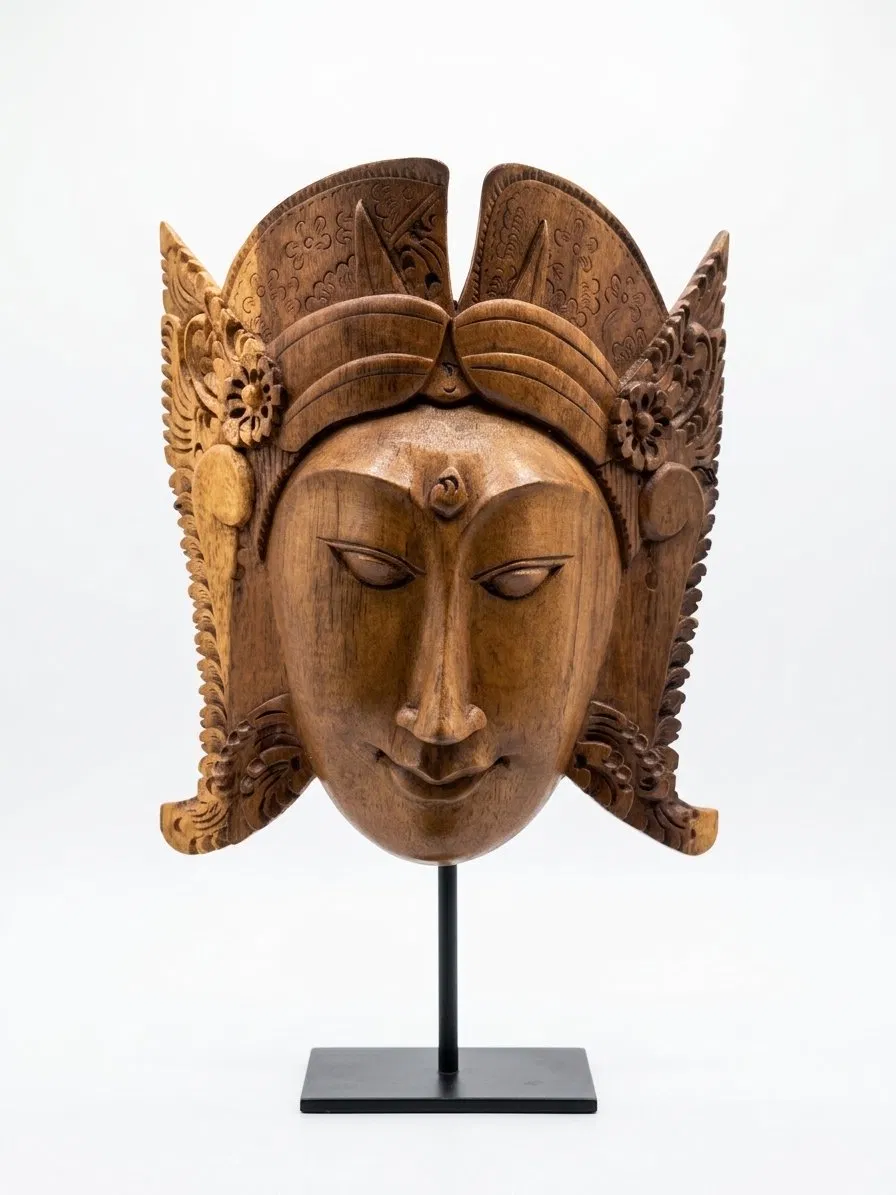
Set against the guardian masks, the collection also holds two pieces in the opposite register: composed, symmetrical faces with closed or half-lowered eyes, framed by tall, elaborately carved crowns that rise well above the face itself rather than spreading outward from it. These belong to the refined character family in Balinese mask tradition — noble figures, deities, characters whose authority comes from stillness rather than display.
The carving challenge here is almost the inverse of the guardian masks. There’s no fang, no bulging eye, no exaggerated feature to anchor the viewer’s attention. Everything depends on proportion: the exact tilt of the eyelid, the precise width of the mouth, the angle at which the crown sits above the brow. A carver working in this style has very little room for error, since the entire effect rests on subtlety rather than drama. One piece in the collection uses a tall, flame-like radiating crown with floral ear pieces; another uses a more compact, wing-shaped crown that curves forward over the temples — both reach the same quiet authority through different crown structures.
Masque balinais sculpté dans le bois : trois façons de le collectionner
Gardien et protecteur
Des visages féroces aux dents découvertes, aux yeux exorbités, ornés de couronnes ou d’ailes spectaculaires. Ces œuvres sont celles qui dégagent le plus d’énergie visuelle dans la collection et s’imposent comme objets centraux à part entière : dans une entrée, sur le palier d’un escalier, sur un mur qui gagne à être mis en valeur par un geste fort plutôt que par un ensemble. D'une taille d'environ 15 à 20 centimètres, elles se distinguent clairement même depuis l'autre bout de la pièce.
Raffiné et serein
Composed deity and noble faces with closed or lowered eyes and tall, precisely carved crowns. These work well in quieter spaces — bedrooms, reading corners, meditation rooms — where a fierce guardian face would feel like the wrong register entirely. They also pair well in a small grouping with each other, since their visual quietness doesn’t compete the way guardian masks tend to.
Format des panneaux en relief
Un format tout à fait différent : de grands panneaux plats sculptés en bas-relief, représentant des scènes mythologiques complètes plutôt qu’un simple visage. Les deux panneaux en bas-relief de cette collection, « Ganesha dans la forêt sacrée » et « La mélodie divine de Krishna », mesurent tous deux 50 sur 100 centimètres, ce qui en fait des œuvres murales de grande envergure à part entière plutôt que de simples objets décoratifs. Plus de détails ci-dessous.
Au-delà du masque : panneaux en relief sur bois chez Arts of Bali
Where a mask carves a single face, a relief panel carves an entire scene into a flat wood surface, closer in spirit to a sculpted painting than to a sculpted face. The two panels currently available at Arts of Bali are both carved at 50 by 100 centimeters, which puts them among the largest carved wood pieces in the gallery, and both are priced at Rp 21,000,000 — approximately USD 1,150 to 1,170 at the exchange rate in early August 2026 (around Rp 18,000 to the dollar). Rates move daily, so treat that conversion as a rough guide and confirm the exact figure with us directly before ordering.
Ganesha dans la forêt sacrée
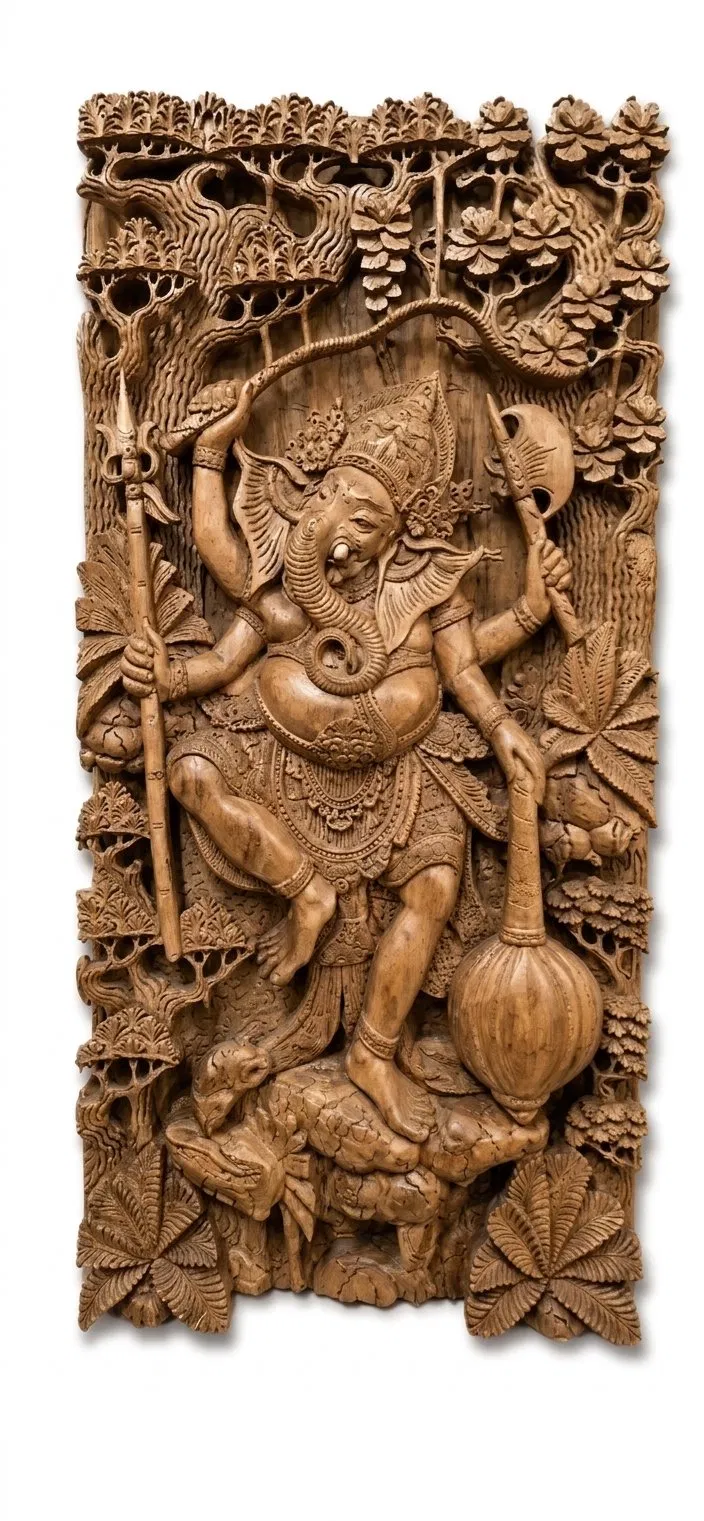
Ganesha, the elephant-headed son of Shiva and Parvati in Hindu mythology, is venerated across Bali’s distinct form of Hinduism as Vighnaharta, the remover of obstacles, and as a patron of intellect, learning, and the arts.
This panel places Ganesha within a densely carved forest setting: layered pine-like foliage and flowering branches fill the upper register of the panel, while Ganesha himself stands below holding ceremonial objects, rendered with the same density of ornamental detail (crown, jewelry, sash) found in the gallery’s finest figural carving. The forest framing is what distinguishes this piece from a simpler standalone Ganesha figure — the deity is shown within a setting, not isolated against a plain background, which gives the panel a sense of place a single carved figure can’t achieve on its own.
Cet article est disponible directement dans notre boutique : Ganesha dans la forêt sacrée, panneau en bois en relief.
La mélodie divine de Krishna
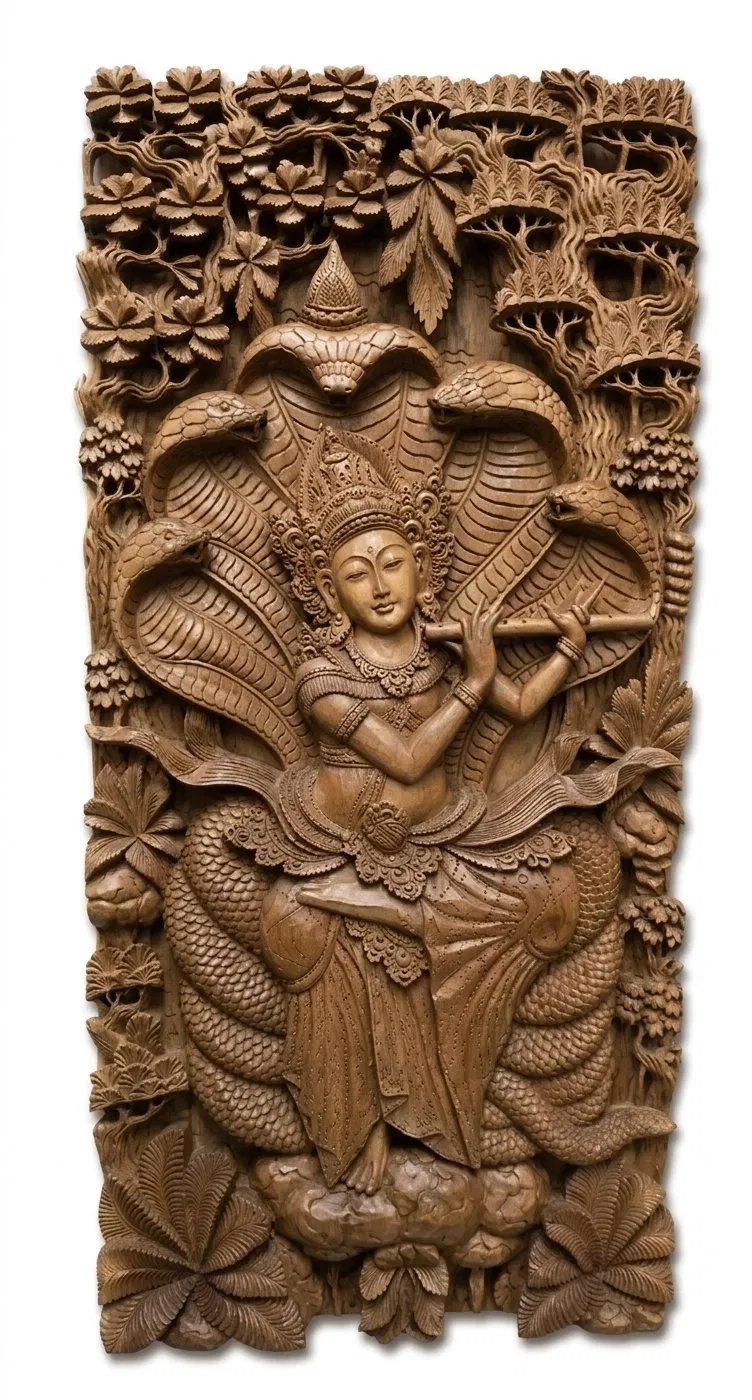
The second panel depicts Krishna, an avatar of Vishnu, playing his flute while a multi-hooded serpent rises in a fan behind him. Carvings of this kind commonly draw on the story of Krishna and Kaliya, the serpent king whose presence had poisoned a stretch of the Yamuna river: in the most familiar version of the tale, Krishna dances upon the serpent’s many hoods, subduing Kaliya through the dance itself rather than through force, restoring the river.
Whether or not this specific panel was carved with that exact episode in mind, the visual elements — the flute, the calm expression, the fan of cobra hoods — place it clearly within this strand of Krishna iconography. The serpent’s scales and the surrounding forest canopy are carved with the same density and precision found in the Ganesha panel, and the two pieces are meant to be read as a pair.
You’ll find this one in the shop as well: La mélodie divine de Krishna, panneau sculpté sur bois.
Le Metropolitan Museum of Art Collection d'art asiatique holds numerous historical depictions of both Ganesha and Krishna across South and Southeast Asian sculpture — useful context for how widely these two figures recur across Hindu visual tradition, well beyond Bali alone.
Choisir entre un masque, un bas-relief et une statue
Avec trois formats distincts de sculptures sur bois désormais disponibles dans la galerie, le choix se résume généralement à la taille et au rôle que l'œuvre doit jouer dans une pièce.
A mask at 15 to 20 centimeters works as an accent: a single strong gesture on a wall that already has other elements around it, or grouped in twos and threes along a stairwell or hallway. A relief panel at 50 by 100 centimeters is a different kind of commitment entirely — it functions as the dominant visual element of whatever wall it occupies, closer to how a large painting would be used than how a small decorative object would be used.
Standing figures, covered in our Guide de sculpture sur bois, se situent à mi-chemin entre les deux en termes d'impact visuel, mais occupent davantage l'espace au sol ou sur une étagère que sur un mur, ce qui en fait le choix idéal lorsque la pièce nécessite une présence en trois dimensions plutôt qu'une présence à plat.
Pour la plupart des collectionneurs qui aménagent une seule pièce, un panneau en relief servant de pièce maîtresse, accompagné de deux ou trois masques plus petits disposés ailleurs dans le même espace, permet de créer une impression cohérente de la même tradition sculpturale déclinée à différentes échelles, sans que chaque pièce ne se dispute la même place sur le mur.
Entretien et expédition des masques et panneaux sculptés dans le bois
Les masques et les panneaux en relief sont tous deux en bois dur brut ou légèrement traité, le même matériau que celui abordé dans notre guide de sculpture sur bois. Évitez d'exposer ces pièces à la lumière directe du soleil et au flux d'air constant de la climatisation, car ces deux facteurs assèchent la surface de manière inégale au fil du temps. Une légère application d'huile naturelle une fois par an, suivie d'un polissage à l'aide d'un chiffon doux, permet de préserver la teinte du bois.
Les masques de petite taille s'expédient facilement dans des cartons rembourrés, car leurs dimensions réduites permettent de limiter à la fois les coûts et les risques. Les grands panneaux en relief, compte tenu de leurs dimensions et de la profondeur de leur sculpture, sont expédiés dans des caisses en bois fabriquées sur mesure plutôt que roulés ou emballés sans protection particulière, selon la même approche que celle utilisée pour toute pièce sculpturale ou en bois texturé. Notre Guide pour l'expédition d'œuvres d'art depuis Bali aborde en détail la mise en caisse, les options d'expédition et les formalités douanières, y compris les consignes de biosécurité qui s'appliquent spécifiquement aux articles en bois entrant en Australie, en Nouvelle-Zélande et aux États-Unis.
Acheter ou commander un masque ou un panneau sculpté sur bois
Les deux panneaux en relief décrits dans cet article, Ganesha dans la forêt sacrée et La mélodie divine de Krishna, sont disponibles directement dans notre boutique. En ce qui concerne les masques, c’est via WhatsApp que l’on peut obtenir le plus rapidement des informations sur la disponibilité et les prix, car les articles de cette gamme de tailles partent très vite. Masques et panneaux sur mesure commissions sont également acceptées.
Discuter sur WhatsApp Parcourir la galerie