The mountain that every Balinese compass points to.
“Ask a Balinese painter to draw a mountain and they will draw Agung, even if they have never set foot on it. It is not a mountain in our paintings. It is the direction everything faces.”
— Putu Sucipta, Owner of Arts of Bali
When searching for a Mount Agung painting Bali visitors often expect a simple postcard view. What they find instead, in painting after painting across the Arts of Bali gallery, is something closer to a recurring character: a volcano rendered in a dozen different lights, ringed by rice terraces, framed by flame trees, appearing in every version of the island’s landscape tradition because it has occupied that role for as long as the tradition has existed. This guide looks at why, and walks through six original paintings currently in the collection that each take their own approach to it.
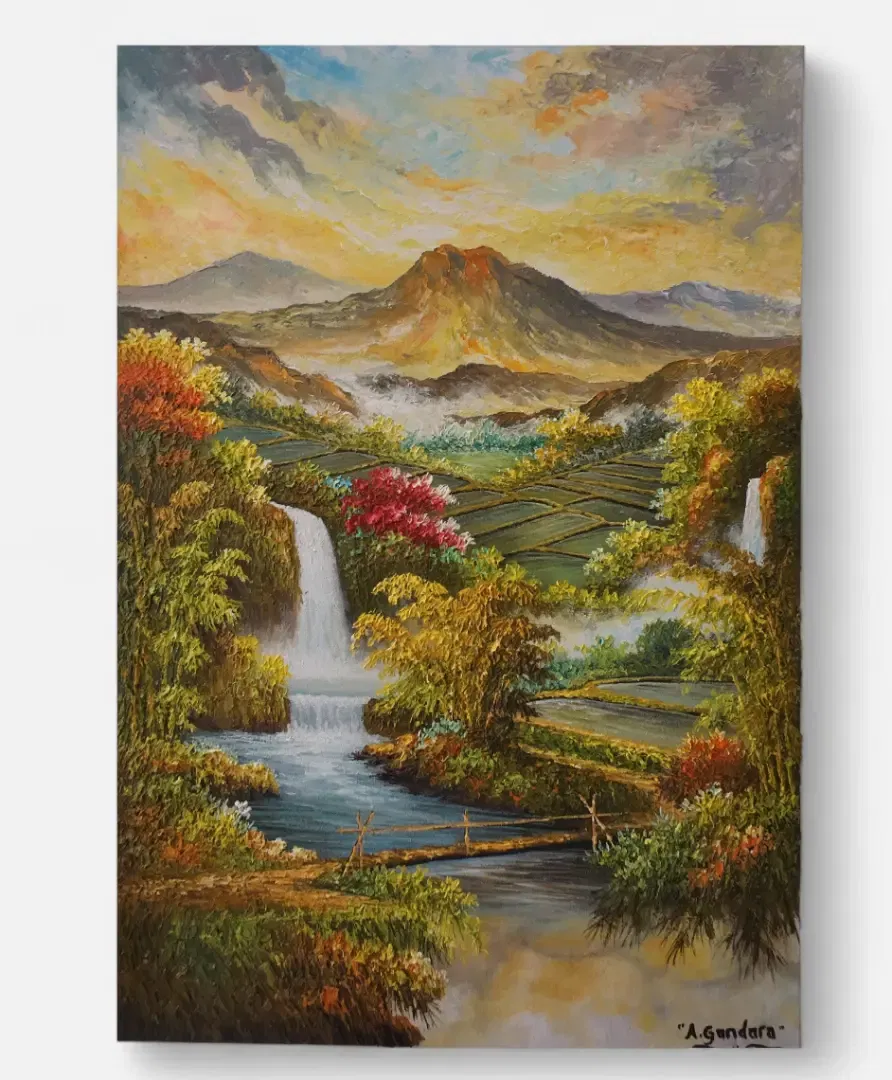
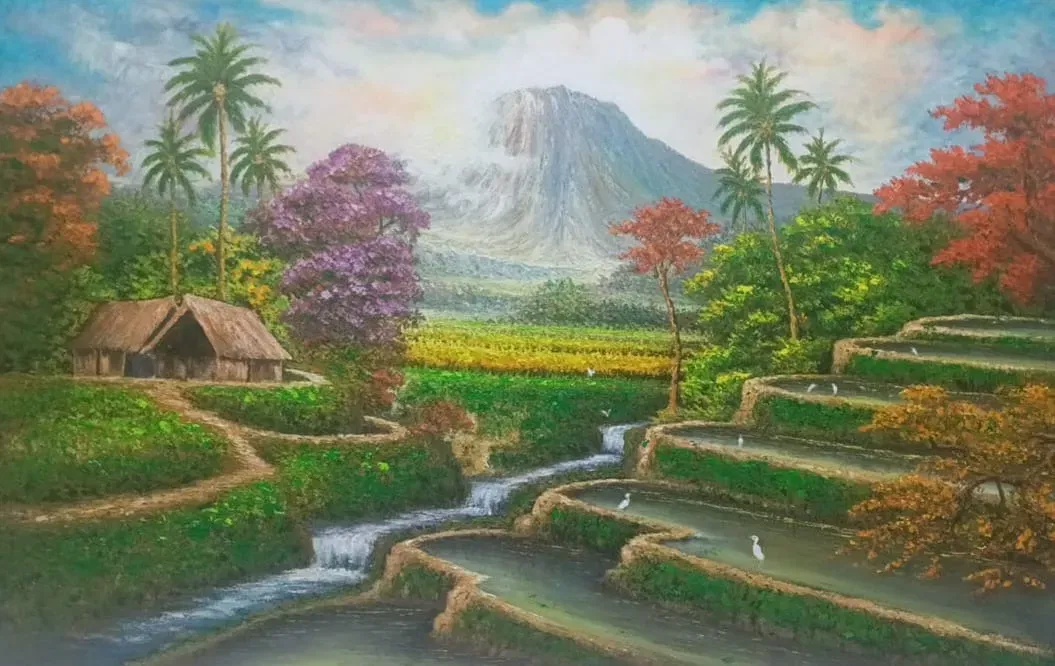
A Mount Agung painting is a landscape artwork centered on Gunung Agung, the active volcano in eastern Bali that is the island’s highest point and most sacred natural landmark in Balinese Hinduism. In Balinese landscape painting, Mount Agung typically appears as a central peak rising above tiered rice terraces (the subak irrigation system), framed by palm trees and flame trees (flamboyan), often with a stream or waterfall running through the foreground. The composition recurs across generations of painters because the mountain itself holds a fixed place in Balinese cosmology, not because the scene is copied from a single photograph.
Mount Agung: Why This Volcano Defines Bali’s Landscape Art
Mount Agung, known locally as Gunung Agung, rises to roughly 3,031 meters in the Karangasem regency of eastern Bali. It is the island’s highest point by a wide margin, and on a clear morning it is visible from much of the island, including the hills above Ubud and parts of the south coast. The Smithsonian Global Volcanism Program’s record for Agung documents an eruption history stretching back to the early 19th century, including the catastrophic 1963 to 1964 eruption and the more recent 2017 to 2019 sequence that closed the island’s airport for several days. As of early 2026, the volcano’s alert level sits at Normal, the lowest of Indonesia’s four-tier scale, though it remains an active, monitored volcano.
None of that history is what most visitors think about when they see a Mount Agung painting on a gallery wall. What they respond to is the silhouette: a broad-shouldered cone, sometimes sharp, sometimes softened by cloud, sitting above a patchwork of green and gold. That silhouette is recognizable to anyone who has spent even a few days in Bali, which is part of why it appears in painting after painting. It is the island’s skyline.
The Mountain That Decides Which Way Is Sacred
In Balinese spatial thinking, every direction carries meaning relative to two points: the mountain and the sea. Kaja, the direction toward the mountains, is associated with purity, the gods, and the sacred. Kelod, the direction toward the sea, is associated with the impure and with spirits that need to be appeased rather than worshipped. House compounds, temples, and even the layout of a bed are oriented according to this axis, and for most of Bali, kaja points toward Mount Agung specifically, since it is the highest and most central of the island’s peaks.
On the southwestern slopes of Agung sits Pura Besakih, often called the Mother Temple of Bali: the largest and holiest temple complex on the island, and the spiritual anchor for a network of temples that radiates outward across Bali. A painting of Mount Agung is, in a quiet way, a painting of the place every other sacred site on the island orients itself toward. That context does not need to be stated inside the painting for it to be felt. It is built into why the subject keeps being painted.
“A buyer once told me he wanted the painting because it reminded him of his hotel view in Ubud. I did not correct him. The mountain in the painting and the mountain he saw from his balcony were very likely the same one.”
— Putu Sucipta, Arts of Bali
How Balinese Artists Paint Mount Agung: The Recurring Elements
Look at enough Balinese landscape paintings and a pattern becomes obvious. The mountain sits roughly center or center-left, usually receding into haze or cloud at its upper slopes. Below it, the land drops away in tiers. In front of that, closer to the viewer, color and detail intensify: trees, water, structures, sometimes figures working the fields. This is not a formula artists are following lazily. It mirrors how the land actually sits, and each element carries its own role in the composition.
Terraced Rice Fields and the Subak System
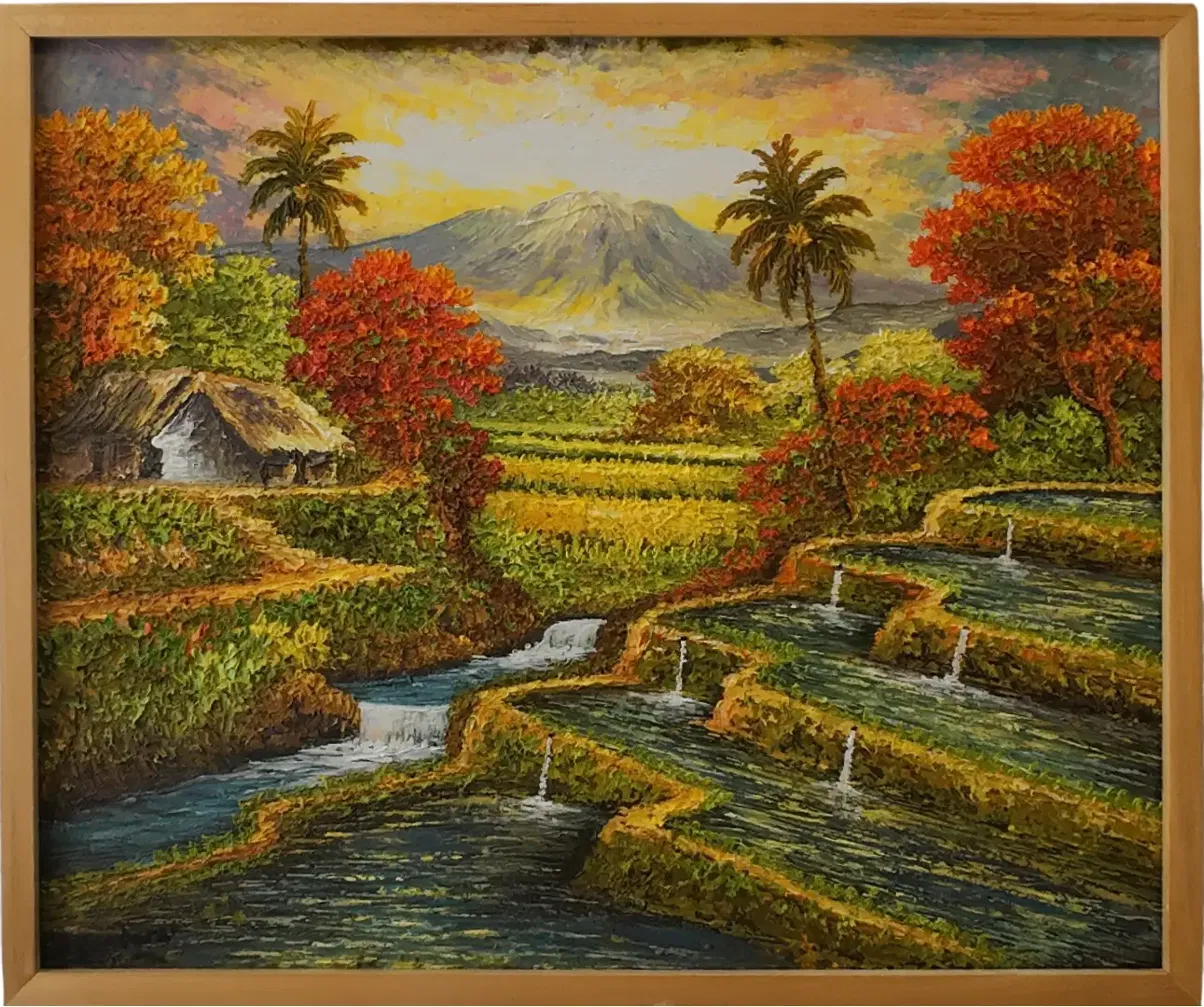
The stepped green and gold fields beneath the mountain are not generic farmland. They follow the subak system, the cooperative irrigation network that has shaped Bali’s terraced landscape for over a thousand years, channeling water from mountain springs down through successive paddies by gravity alone. When a painting shows water cascading from one terrace level to the next, often rendered as small white waterfalls between fields, it is depicting this system in motion. The water that falls on Mount Agung’s slopes is, quite literally, the water that floods the terraces painted beneath it.
Flame Trees, Palms, and the Color Logic of the Composition
The bursts of red and orange foliage that appear in nearly every version of this scene come from flamboyan, the flame tree, which flowers in vivid red against green canopy and gives painters a way to anchor warm color in the foreground without it competing with the mountain’s cooler tones. Palm trees provide vertical lines that lead the eye upward and break the horizontal bands of the rice terraces. Thatched huts, when present, are small and placed low in the composition. They establish scale: the mountain reads as large partly because the hut beside it reads as small.
Mount Agung Painting Bali: Three Moods Found in This Collection
The same mountain, painted by different hands at different hours, produces noticeably different paintings. Three pieces currently in the collection show how much the time of day and weather conditions change the feeling of an otherwise familiar scene.
Morning Mist
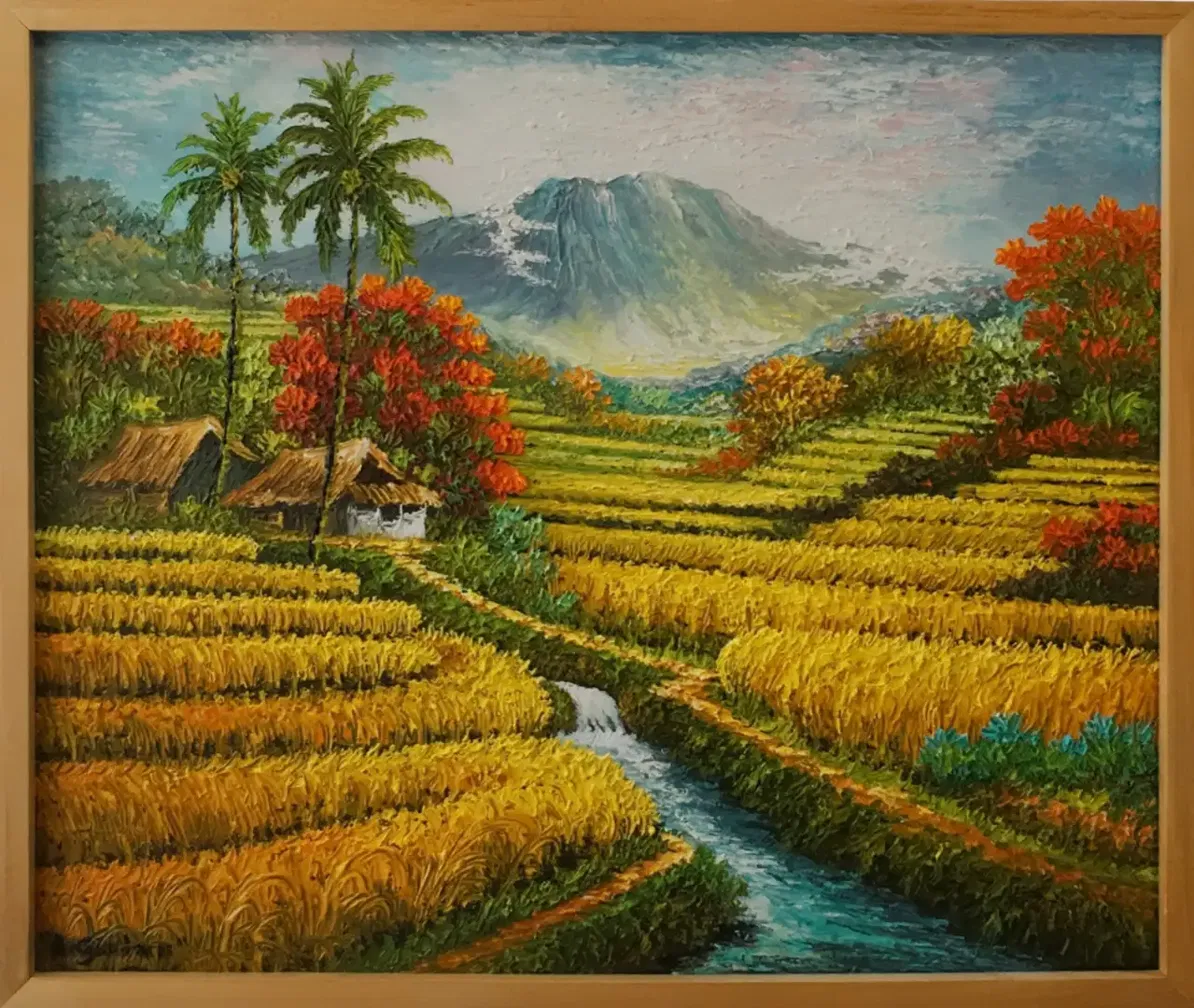
A grey-blue Agung wrapped in haze, its lower slopes softened to almost nothing. The rice terraces below are fully lit in gold, creating contrast between a mountain that feels distant and fields that feel immediate. This is the version closest to what an early riser actually sees from the hills around Ubud or Sidemen before the day’s heat clears the air.
Golden Sunset
The mountain takes on warm tones itself, brown and amber rather than grey, set against a sky that has turned orange and gold. Water features (waterfalls, streams, bamboo bridges) become focal points, catching the warm light. These pieces tend to feel less like a wide view and more like a single moment, the kind of light that lasts a few minutes.
Clear Day Harvest
Blue sky, scattered pastel clouds, and a mountain rendered with crisp edges rather than haze. These versions emphasize the rice itself, often shown ready for harvest in deep gold, with flame trees in full red bloom. Of the three moods, this is the most saturated and the most immediately legible from across a room.
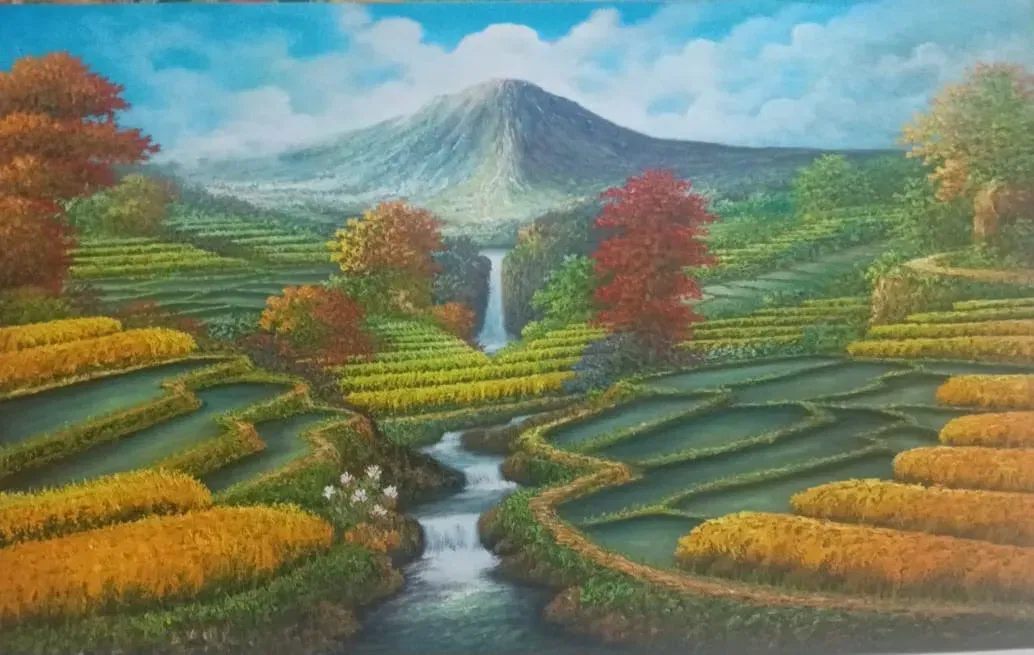
Mount Agung under clear sky, panoramic format, original oil on canvas. Available at Arts of Bali, Jl. Raya Seminyak No. 42.
Choosing a Mount Agung Painting for Your Home
Because this subject appears in such different light and color treatments, the first question is not really about the mountain at all. It is about which version of it suits the room.
Cool Versus Warm Palettes
The misty, blue-grey versions of Mount Agung work as a calming presence: they read as distant and quiet, and they sit comfortably in bedrooms, studies, or any room that already has warm materials (timber, rattan, terracotta) that benefit from a cool counterpoint. The golden sunset versions do the opposite. They bring warmth into a room and work well against white walls, concrete, or other neutral surfaces that could otherwise feel sterile. The clear-day, high-saturation versions are the most assertive of the three and tend to work best as a single statement piece rather than alongside other busy artwork.
When Wildlife Details Matter
Some versions of this landscape include small details that reward a second look: white egrets standing in a flooded terrace, barely visible until you are close. These details do not change the overall composition, but they change how long someone spends looking at the painting, and they connect this landscape genre to the gallery’s broader wildlife painting collection, where birds and animals are the primary subject rather than a detail within a larger scene.
For a broader look at how rice terraces function as a subject in their own right, separate from the volcano above them, our rice field painting guide and rice harvest painting guide cover that ground in more depth. And for the artist behind the golden sunset version shown earlier in this post, the Gandara landscape painting profile goes into his background and other work.
Commissioning a Mount Agung Painting
If none of the available pieces match what you have in mind, Mount Agung is one of the most straightforward subjects to commission, precisely because the conventions are well established. You can specify the time of day, the dominant palette, the size of the canvas, and whether you want the terraces shown dry (harvest gold) or flooded (planting season, with reflective water). Most landscape commissions in this style take two to four weeks.
Because these paintings often carry texture in the sky and mountain (visible brushwork in clouds and rock face), large pieces typically ship crated rather than rolled. Our guide to shipping art from Bali covers what that looks like in practice, including costs and customs documentation for international delivery.
The commission process starts with a free WhatsApp consultation. Browse current availability in the full gallery collection or visit in person at Jl. Raya Seminyak No. 42.
See the Mount Agung Collection in Person
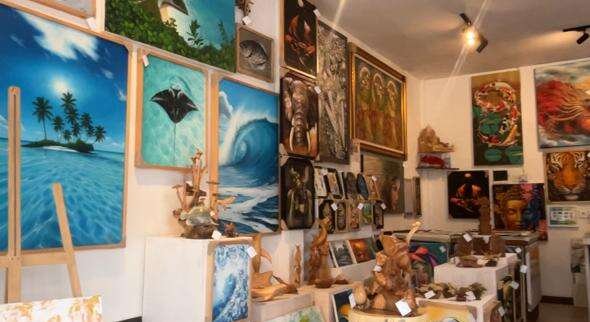
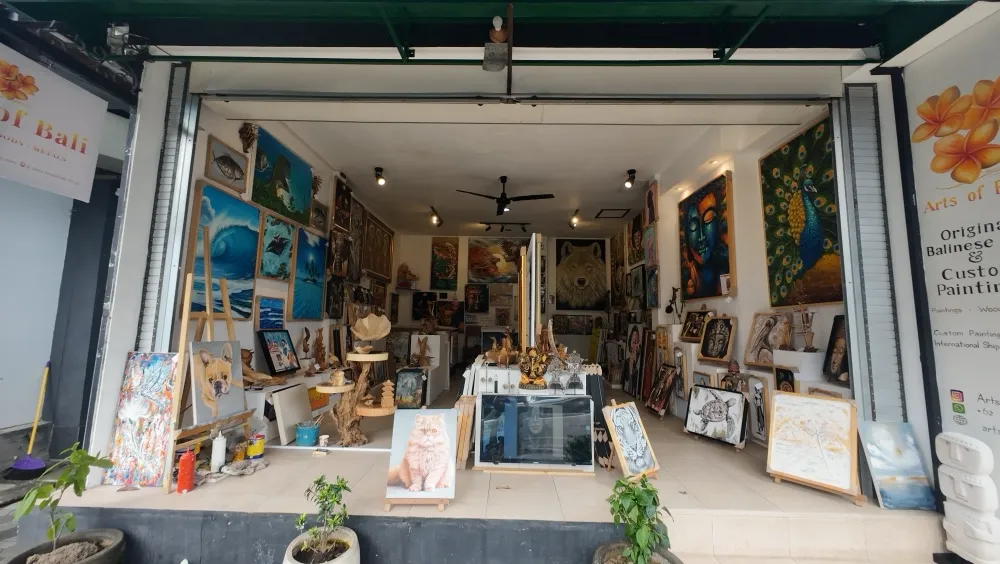
Several originals in the styles described here are currently on display at Arts of Bali, Jl. Raya Seminyak No. 42, Kuta, Badung, Bali 80361. Contact us on WhatsApp to confirm what’s available before visiting, or to start a custom commission in the palette and size you need.
Chat on WhatsApp Browse the Gallery