The Balinese rooster tradition is the island’s long practice of raising, grooming, and bonding with prized fighting cocks, a custom that runs far deeper than sport. At its most sacred, it surfaces in tabuh rah, a Hindu Balinese temple ritual meaning “pouring blood,” performed to restore cosmic balance during ceremonies. Away from the temple, the same birds are also staged in tajen, a secular gambling match that has been illegal in Indonesia since 1981. The two practices share a bird and a history, but not a purpose, and this article keeps that distinction clear throughout.
Key Takeaways
- The Balinese rooster tradition centers on sabung, a word that means both “rooster” and “hero” or “warrior,” tying the bird directly to its owner’s identity and pride.
- Tabuh rah (“pouring blood”) is a sanctioned Hindu Balinese ritual, part of the wider system of purification offerings, performed inside a temple’s wantilan pavilion during ceremonies.
- Tajen, the secular gambling version of the same match, has been illegal in Indonesia since a 1981 government ban, though it persists informally outside temple grounds.
- Cockfighting in Bali traces back roughly a thousand years, with the wantilan pavilion still standing as the only legally sanctioned venue for it today.
- Anthropologist Clifford Geertz’s influential 1972 essay “Deep Play” described Balinese roosters as extensions of their owners’ selves, groomed and discussed with the same care given a family member.
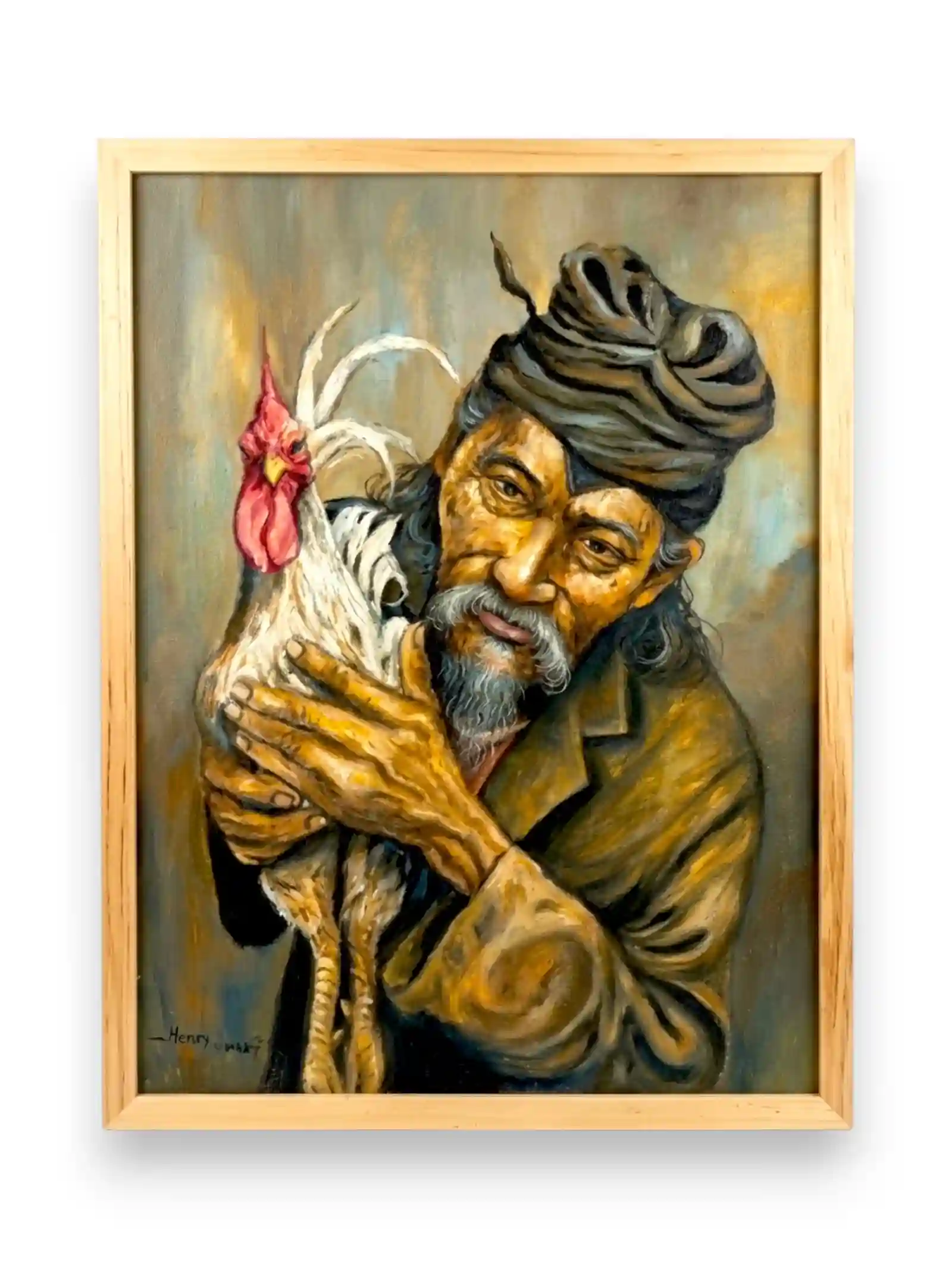
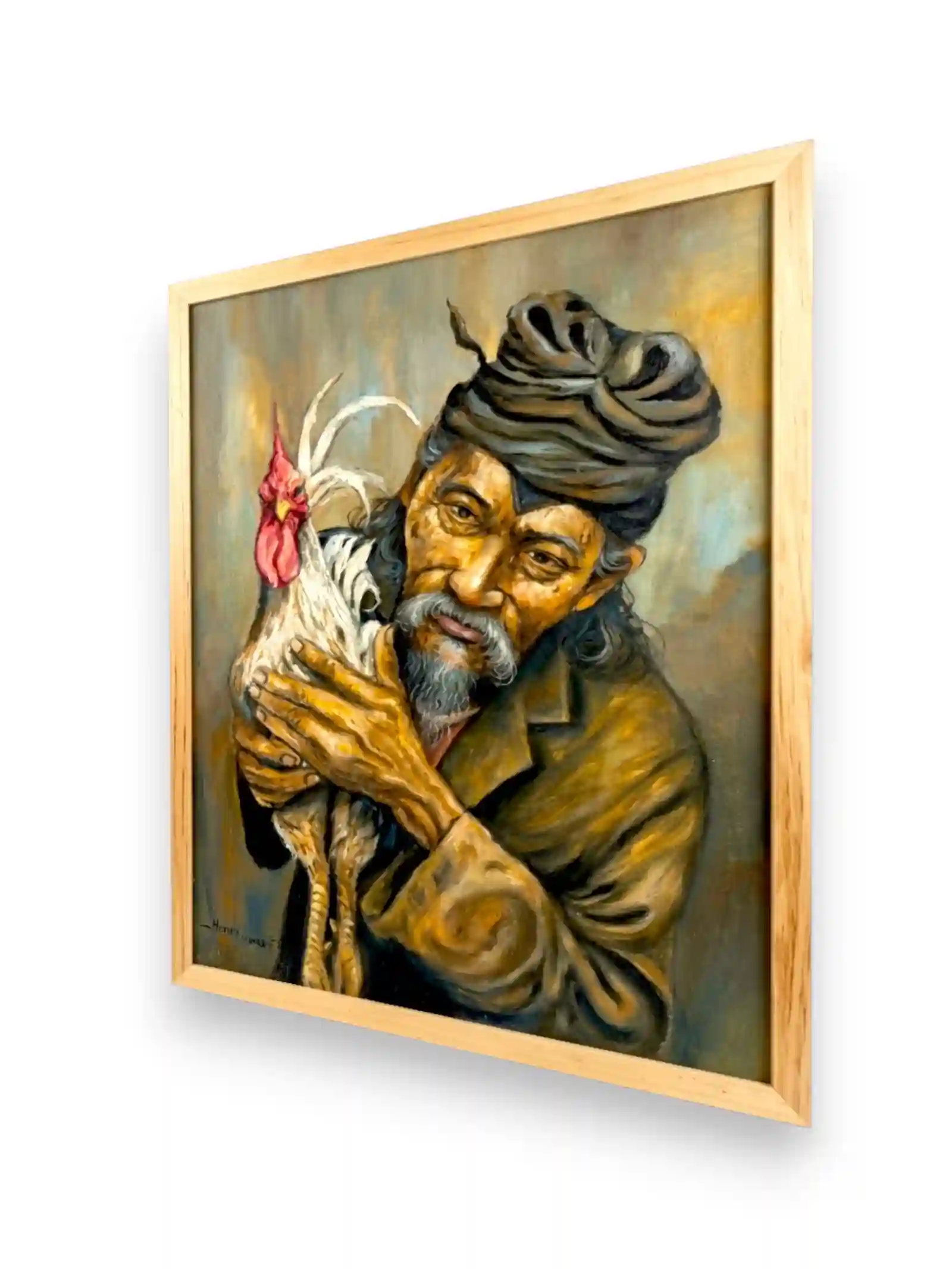
- The Arts of Bali painting “The Bond of Tradition” depicts this relationship directly: an elder in a traditional udeng headscarf cradling his rooster, rendered in expressive palette knife strokes.
Walk through almost any Balinese village at dawn and you will hear it before you see it: roosters calling from bamboo cages set along the roadside, each one groomed, fed, and handled with a level of attention that has nothing to do with the dinner table. This is the Balinese rooster tradition, a custom of raising and caring for fighting cocks that has shaped village life, vocabulary, and religious practice for centuries. It is also, depending on where and why a rooster ends up in the ring, either a sacred act or a banned one, and understanding that difference is the key to understanding the tradition honestly.
Arts of Bali’s painting “The Bond of Tradition: Balinese Elder with Rooster” captures the gentler, more private side of this custom: not the ring, but the relationship. An elderly man in a traditional udeng headscarf cradles his bird with visible tenderness, rendered in heavy, tactile palette knife strokes on marsoto canvas. This article looks at what that bond is actually built on, from the everyday pride of rooster-keeping to the sacred ritual of tabuh rah, and draws a clear, honest line between the tradition’s religious meaning and the gambling practice it is often confused with.
The Balinese Rooster Tradition: A Mark of Pride, Not Just a Pet
In everyday Balinese life, a prized rooster is rarely just livestock. Owners, most often men, spend hours each day feeding, bathing, and massaging their birds, watching their posture and temperament the way a breeder studies a prize animal anywhere else in the world. This attentiveness is built into the language itself: the Balinese and Indonesian word sabung means “rooster,” but it doubles as a term for “hero” or “warrior.” A man’s bird is not separate from his own standing in the community. A well-kept, confident rooster reflects directly on the patience, skill, and status of the person who raised it.
That closeness is exactly what “The Bond of Tradition” sets out to paint. The rooster in the piece is not shown mid-fight or straining against a handler. It rests against the elder’s chest, held the way a person might hold something they have raised from a chick and grown genuinely attached to. This is the ordinary, daily reality of the Balinese rooster tradition for most owners: care, routine, and quiet pride, whether or not the bird ever enters a ring.
Tabuh Rah: The Religious Ritual Behind Bali’s Rooster Culture
The most serious role a Balinese rooster ever plays is not entertainment or wagering. It is tabuh rah, literally “pouring blood,” a Hindu Balinese ritual in which a small amount of a rooster’s blood is offered to the earth as part of a wider purification ceremony. The practice sits within Bhuta Yadnya, the category of Balinese Hindu ritual devoted to restoring balance between good and destructive forces, the same broad tradition that includes offerings like the towering gebogan and the purification rites performed before major temple festivals. Cockfighting’s presence in Balinese ritual life is old: historical accounts trace the practice back roughly a thousand years, making it one of the island’s oldest continuous customs.
Tabuh rah is performed inside a wantilan, a large, wall-less pavilion with a distinctive multi-tiered roof that stands in the outer courtyard of many Balinese temples, close to the main gate. Two or three roosters are matched in a brief, ritually supervised bout, and the blood that reaches the ground is treated as an offering meant to appease and settle bhuta kala, the unseen destructive forces that Balinese cosmology holds must be honored, not ignored, if a community is to stay in balance. The ceremony typically happens during a temple’s odalan, its anniversary festival, and is understood by practitioners as a religious obligation rather than a form of amusement.
Not Every Rooster Match Is Sacred: Tabuh Rah vs. Tajen
Here is where the Balinese rooster tradition is most often misunderstood, and where this article chooses to be direct rather than vague. Tajen is the secular version of the same match: a cockfight staged for entertainment and betting, entirely separate from any temple ceremony. Tajen has been illegal under Indonesian law since a 1981 government ban classified it as gambling, and it has carried that legal status through Dutch colonial rule and the Indonesian republic alike, even though informal matches are still reported taking place away from official view. Tabuh rah, by contrast, remains the one context in which a cockfight is openly and legally sanctioned in Bali today, precisely because it happens inside a temple’s wantilan as a religious act, not a wager.
This distinction matters for anyone encountering Balinese rooster culture through a painting, a temple visit, or a conversation with a local guide. The birds, the vocabulary, and even the pavilion architecture are shared between the two practices. The intention behind them is not. A responsible account of the tradition, the kind this article aims for, names that difference plainly instead of letting the sacred and the illegal blur into one romanticized custom.
“People ask us if this painting is about cockfighting. It isn’t. It’s about the hours before any of that, the quiet care an old man puts into an animal he’s raised by hand. That part of the story deserves to be seen on its own.”
— Putu Sucipta, Gallery Owner, Arts of Bali (placeholder quote, pending confirmation)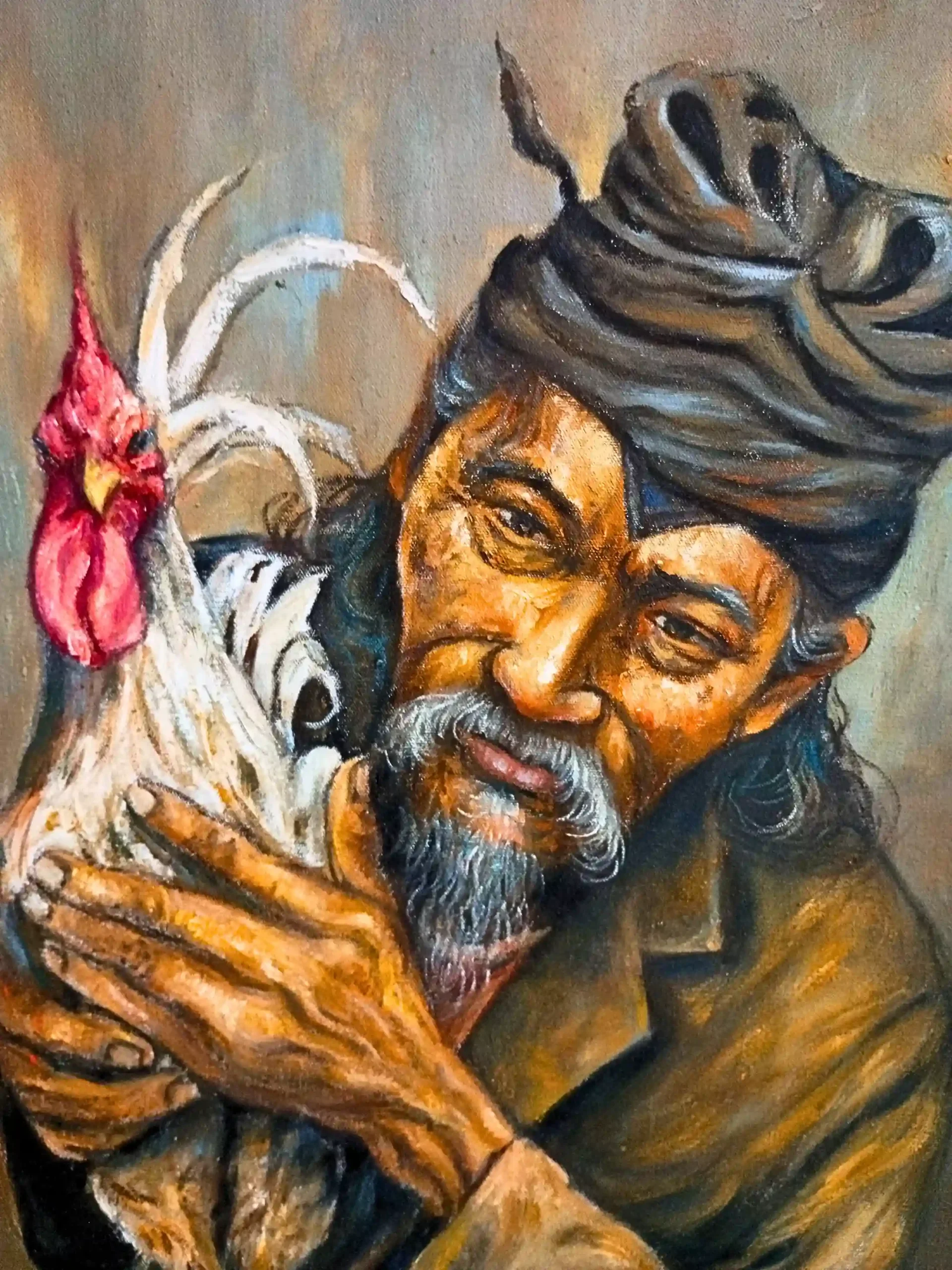
Sabung: Why the Balinese Language Ties the Rooster to the Warrior
The American anthropologist Clifford Geertz spent extended time in Bali studying this custom, and his 1972 essay “Deep Play: Notes on the Balinese Cockfight” remains the most cited academic account of what a rooster actually represents to its owner. Geertz argued that a man’s cocks function as an extension of his own identity, what he called “symbolic expressions or magnifications of their owner’s self.” The care an owner puts into feeding, grooming, and simply sitting with his bird is, in Geertz’s reading, also a form of self-regard: a well-presented rooster reflects a well-regarded man.
That reading helps explain why “The Bond of Tradition” frames its subject the way it does. The painting is not a document of a match. It is a portrait of ownership in its most personal, unguarded form, an elder and the animal he has spent years shaping, painted at the moment of contact rather than conflict. The udeng he wears, the same simple cloth headscarf seen across Balinese ceremonial and daily dress, marks him as a man rooted in tradition, and the rooster resting against him is presented as an extension of that same rootedness rather than a prop for a fight that the painting never shows.
Sacred Ritual
Tabuh rah (“pouring blood”) is a Hindu Balinese purification offering performed inside a temple’s wantilan pavilion, part of the Bhuta Yadnya tradition of restoring cosmic balance. It is the one context in which a cockfight is legally sanctioned in Bali.
Terminology
Sabung means both “rooster” and “hero” or “warrior” in Balinese and Indonesian, linking a man’s standing directly to the bird he raises. The connection was documented in depth by anthropologist Clifford Geertz.
Legal Status
Tajen, the secular gambling version of cockfighting, has been illegal in Indonesia since a 1981 government ban. It is a separate practice from tabuh rah, even though both use the same birds and pavilion architecture.
See “The Bond of Tradition” in Person
Arts of Bali carries this original palette knife painting of an elder and his prized rooster, 60 × 80 cm on marsoto canvas, priced at Rp3,500,000.
Discuter sur WhatsApp View the Painting