“The oldest objects in this collection have outlasted every empire that once ruled the islands they came from. That is not coincidence. That is what happens when something is made with complete seriousness of purpose.”— Putu Sucipta, Owner, Arts of Bali
At Arts of Bali, most visitors arrive expecting paintings. Canvas, oil, colour in layers — the tradition this gallery is known for. But walk past the first wall and something else catches you: a silver comb under gallery light, a carved Batak horn on a black iron stand, a tribal necklace whose weight you can guess from across the room. Indonesian metal art and traditional tribal artifacts from across the archipelago carry a different kind of presence from painting. They are three-dimensional, they interact with light differently at every hour of the day, and many carry cultural meaning that no single painting tradition can fully hold. This guide covers five pieces currently at Arts of Bali — one silver filigree comb, one Batak carved horn, one tribal necklace from Eastern Indonesia, one shell relief sculpture, and a pair of Balinese silver ceremonial objects — and what each of them means as a collectible.
Why Indonesian Metal Art Is the Most Underestimated Category
Walk through any serious auction house handling Southeast Asian art and you notice something: the lots that routinely exceed their estimates are not always the paintings. A single Balinese silver ceremonial piece from the 18th century, a Batak carved horn with intact geometric patterning, a tribal necklace from Sumba with its original cord — these command prices that surprise first-time buyers but make complete sense to anyone who understands what they are looking at.
The reason is scarcity combined with cultural specificity. Indonesian tribal and ceremonial metalwork was never made for export. It was made for use: for ceremony, for burial rites, for marriage negotiation, for royal investiture. The pieces that survive represent a fraction of what was once made, and every piece that reaches the collector’s market carries the accumulated weight of every ceremony it witnessed.
At Arts of Bali’s Seminyak gallery, we apply the same criteria to these objects that we apply to painting: provenance matters, condition matters, and cultural context matters more than either. For context on how these pieces sit within the broader tradition of Balinese and Indonesian art, our guide to Les styles artistiques balinais covers the visual and cultural lineages that connect painting, sculpture, and ceremonial craft across the island.
The Silver Filigree Hair Comb — When Ceremony Sits in Your Hair
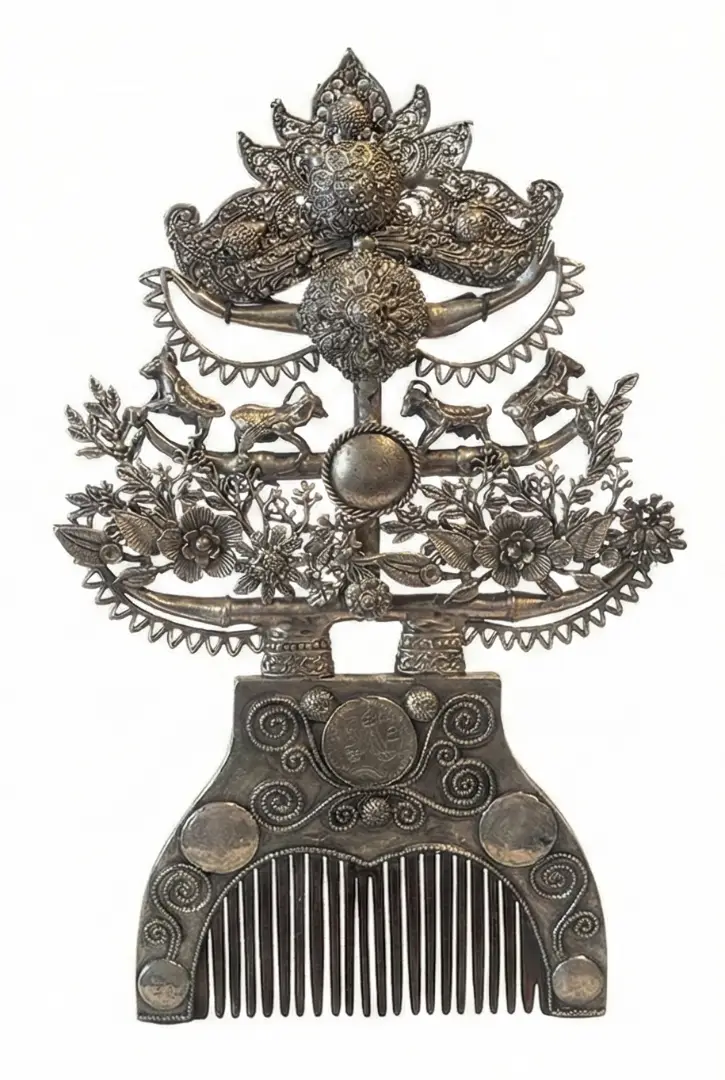
The most immediately arresting piece in this collection is an elaborate silver ceremonial hair comb that rewards close examination for longer than most people expect to stand still in front of it.
At the crown sits a lotus in full bloom — the Buddhist and Hindu symbol of spiritual purity that appears in sacred art from Bali to Borobudur. Flanking the central stem, two confronting birds with wings spread are rendered entirely in filigree wirework: not cast, not pressed, but built from individually bent silver threads, each joint soldered without visible interruption to the pattern. Below them, a band of deer moves through a garden of branching flowers. At the functional comb base, spiral scrollwork alternates with circular coin-shaped medallions that carry their own layer of symbolic reference.
In the court and ceremonial tradition this piece comes from, a woman’s hair — and specifically what adorned it — communicated her family’s status, her ritual role in ceremony, and her relationship to the divine feminine. This comb was not worn on ordinary days. It came out for weddings, for royal audiences, for the festivals that structured the year. The filigree technique itself reflects a coastal silversmithing tradition that flourished in Java and Bali under the convergence of Hindu-Buddhist kingdoms and later Chinese trade relationships. Each wire bent by hand. Each joint soldered clean. That level of refinement is not purely skill — it is devotion made visible in metal.
Silver filigree ceremonial hair comb — lotus crown, confronting birds, hand-bent wirework throughout. Arts of Bali, Seminyak.
“Filigree is not a technique you rush. It requires a particular kind of patience — not the patience of waiting, but the patience of absolute, sustained attention.”
— Putu Sucipta, Les arts de BaliThe Batak Carved Horn — A Library Written in Bone
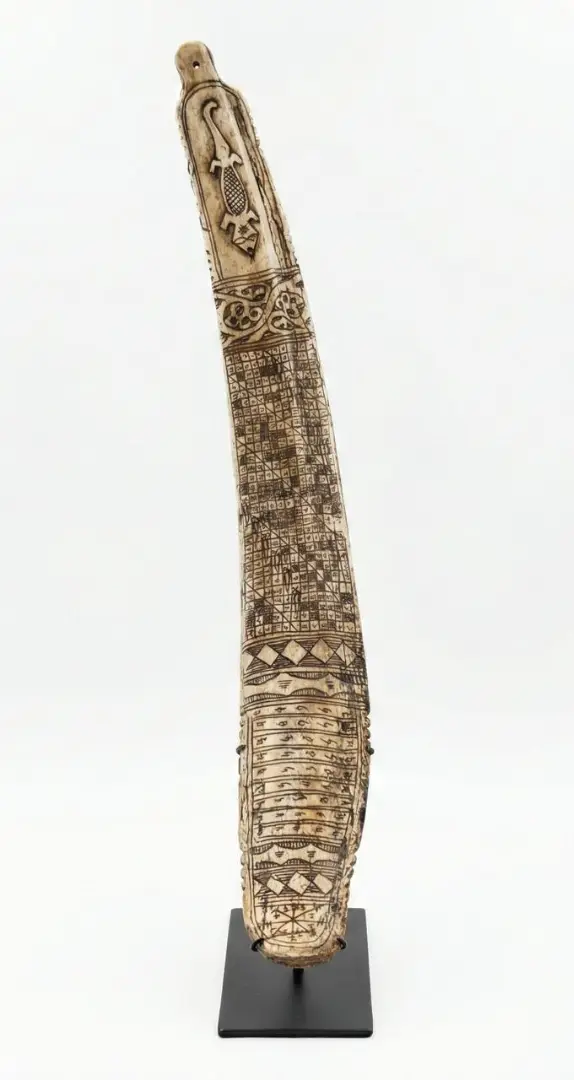
Batak carved ceremonial horn, North Sumatra — gorga geometric patterning throughout, boraspati lizard at the tip. Arts of Bali, Seminyak.
This piece requires a different kind of attention. It is not metal in the conventional sense — it is carved horn, most likely water buffalo horn, mounted on a minimal black iron stand that allows the object to be read from every angle. And reading is exactly the right word.
The entire curved surface is covered in geometric pattern: crosshatched grids, diamond lattices, bands of parallel lines interrupted by triangular forms. Near the handle end, a carved lizard figure emerges from the tip — precise, confident, unmistakable. This is the boraspati ni tano: the gecko of the earth, a protective spirit in Batak cosmology associated with the safety of the home and the prosperity of those who live within it. Its placement at the point of the object’s most active use is not ornamental. It is the intentional positioning of a guardian where a guardian is needed.
The Batak people of North Sumatra — among them the Toba Batak, whose visual traditions are among the most extensively documented of any Indonesian ethnic group — produced objects of this kind as ceremonial instruments within a cosmological system where geometric pattern functions as language rather than ornament. The diamond grid references agricultural cycles. The triangular sequences map the cardinal directions of the Batak world. The interlocking lines encode the relationship between the three tiers of Batak cosmology: banua ginjang (upper world), banua tonga (middle world), and banua toru (lower world) — a complete cosmological map pressed into the surface of a single horn.
What makes these pieces extraordinary as collectibles is precisely what makes them difficult for the first-time eye: there is no single focal point. The meaning is distributed across the entire surface. The beauty is cumulative. You have to spend time with it, the way you spend time with writing that reveals more on the second reading than the first.
The Tribal Necklace — Weight, Status, and the Language of Bronze
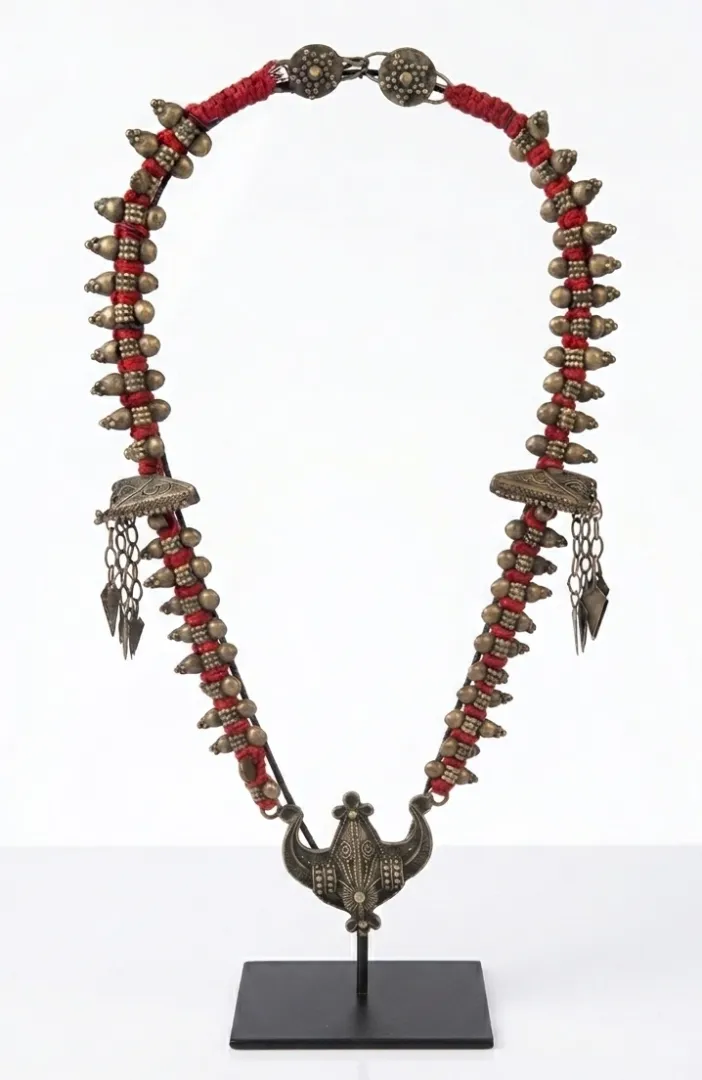
Eastern Indonesian tribal necklace — bronze torpedo beads on crimson cord, crescent moon lotus pendant. Arts of Bali, Seminyak.
Some objects announce themselves the moment they enter a room. This tribal necklace — bronze and silver-toned torpedo-shaped beads strung on crimson cord, anchored at the centre by a crescent moon pendant with a lotus motif, flanked by triangular pendants on fine chain — is one of them.
The torpedo beads are cast in a style consistent with the metalwork traditions of Eastern Indonesia, where the islands of Sumba, Flores, and the Nusa Tenggara chain produced jewellery of remarkable sophistication despite — or perhaps because of — their geographic isolation from the great court centres of Java and Bali. The aesthetic language here is more direct than court silverwork: weight is prestige, repetition is power, and the pendant at the centre is not an afterthought but a statement about the wearer’s position in a cosmological order.
The crescent moon with its upturned horns carries dual significance across the archipelago — a symbol of female fertility in one reading, a marker of the transitional space between the living world and the world of ancestors in another. The lotus at the pendant’s centre bridges Hindu influence with indigenous animist belief in the way that characterises so much of Indonesian religious art: not a surface mixing of traditions, but a genuine layering where each adds depth to the other rather than cancelling it out.
The Shell Relief — Patience Made Visible
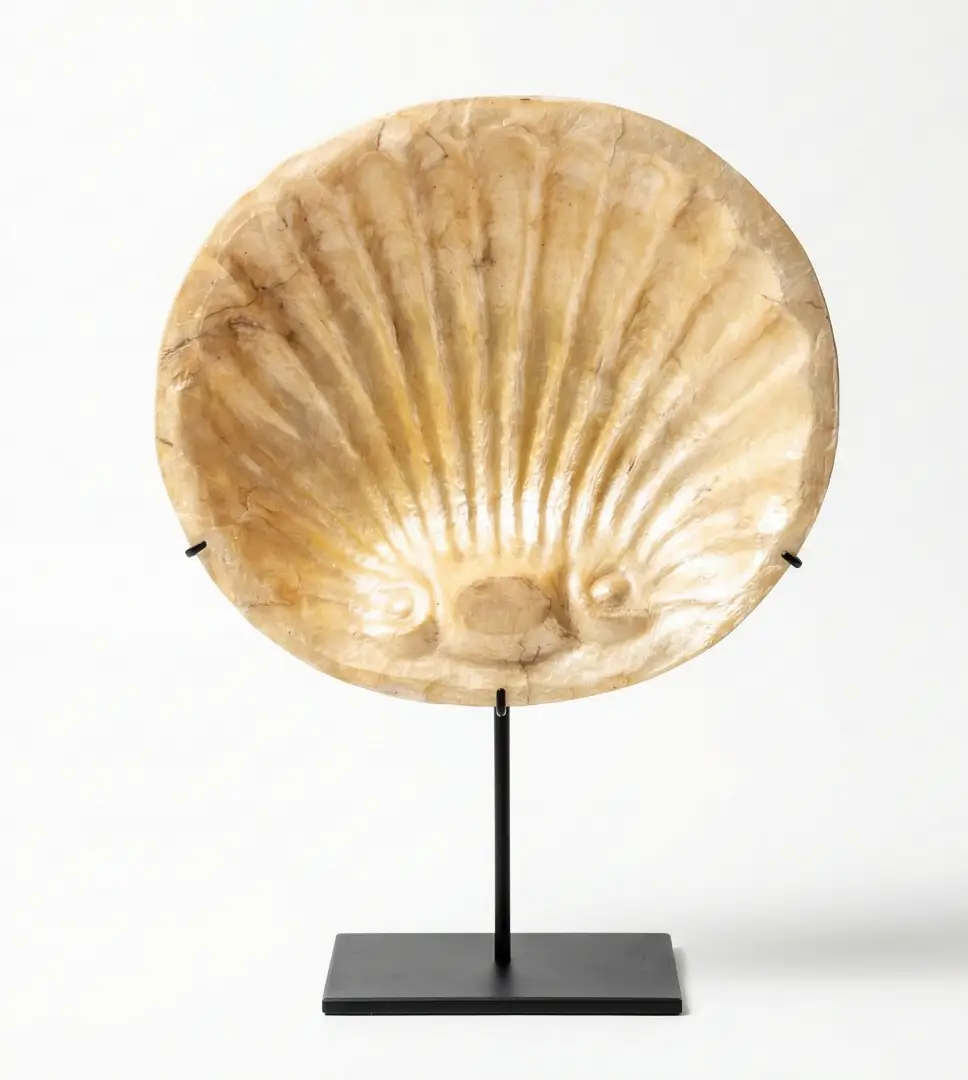
Shell relief sculpture — scallop form carved in three dimensions, mounted on black iron stand. Arts of Bali, Seminyak.
Not every piece in this collection is metal. The shell relief sculpture represents a parallel tradition in Indonesian craft: the carving of organic material with the patience and precision that other cultures reserve for stone.
This large circular form, mounted on a black iron stand, renders a scallop shell in three dimensions with extraordinary fidelity — the radiating ribs, the slight asymmetry of the valve, the gentle curvature that suggests the living creature the shell once housed. The material carries the warm cream tone of aged ivory: something that has been in the world a long time and is entirely at peace with that fact.
Shell carving of this scale sits in an unusual position between craft and sculpture. The object is too large to be purely functional, too specific in its subject to be purely abstract. What it represents — the sea, the tidal boundary between land and water — places it within a broader Indonesian tradition of objects that mark transitions. Between the visible and the invisible. Between the world of the living and what persists. In a designed interior this piece works with exceptional range: against dark walls it glows; on stone it resonates; alongside the metal objects in this collection it introduces visual relief in both senses of the word.
The Paired Silver Ceremonial Objects — Sacred Symmetry
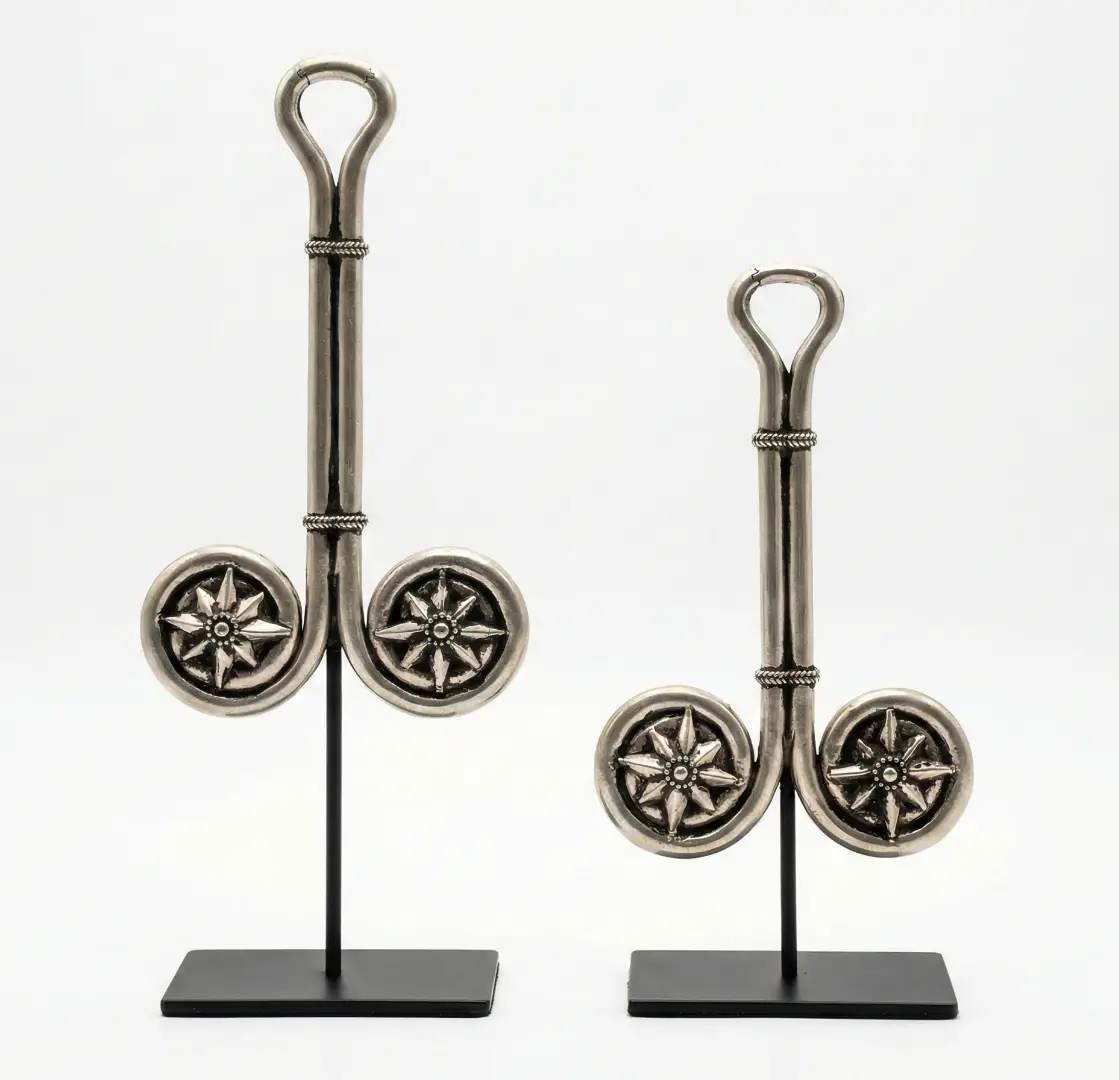
Paired silver ceremonial objects — eight-pointed star medallions, made to be used and displayed together. Arts of Bali, Seminyak.
The final pieces in this collection arrive together, and they insist on being understood together. Two matching silver ceremonial objects, each consisting of a long straight handle terminating in a loop at the top, with two circular disc medallions at the base — each disc engraved with a precise eight-pointed star.
Paired ceremonial objects appear throughout Balinese and broader Indonesian ritual practice because the pairing itself carries the meaning: balance, duality, the complementary forces — male and female, sun and moon, seen and unseen — that structure Balinese Hindu cosmology. A single object of this type exists, but a pair carries a different charge entirely. These were made to be used together, placed symmetrically, activated by the symmetry they create between them.
The eight-pointed star engraved on each medallion is one of the most widely distributed symbols in Indonesian decorative tradition, appearing in batik, in kris handles, in temple architecture across Bali. Its eight points reference the eight cardinal and intercardinal directions — the full compass of the world, the completeness of a ritual space properly constituted.
“Pairs carry a different weight than singles. These were not made separately and matched later. They were conceived together — one meaning only fully present when both are placed.”
— Putu Sucipta, Les arts de BaliWhat Every Buyer of Indonesian Metal Art Should Know
Collecting in this category requires a different set of questions than collecting painting. The principles below apply across all five pieces described here, and across the broader category of Indonesian tribal and ceremonial art.
Understand the tradition before you assess the object
A Batak carved horn looks nothing like Balinese silver filigree, and applying the criteria of one tradition to the other produces only confusion. Each object deserves to be understood within its own cultural framework first — before any question of price, condition, or placement is introduced. Our guide to artistes balinais célèbres offers context on how specific visual lineages develop and why attribution matters.
Patina is biography, not damage
In tribal and ceremonial metalwork, the oxidation that accumulates over decades of use is part of the object’s record. A piece that looks too clean has typically been overcleaned — and overcleaning removes both the patina and a significant portion of the object’s authenticity and value. The warm oxidation on the bronze necklace and the aged surface of the Batak horn are features, not flaws.
Provenance adds meaning as well as value
Knowing where a piece came from — which island, which tradition, which ceremonial context — is not merely authentication. It recovers the context that gives the object its full cultural weight. At Arts of Bali, documentation is provided for every piece in the collection. For guidance on the broader process of acquiring authentic art in Bali, see our complete guide to acheter des œuvres d'art à Bali.
Consider how the piece lives in light
Metal and mixed-media objects interact with light in ways canvas never does. A silver comb on a dark shelf catches afternoon light differently from morning light. A carved horn creates shadow at carved depths that change as the day moves. Think about where an object will live and how the light in that space moves before you acquire it. Our guide to how to choose art in Bali covers placement principles that apply equally to three-dimensional work.
Shipping from Bali
All five pieces described here ship internationally from Arts of Bali. Smaller objects such as the necklace and paired ceremonial pieces travel in padded boxes with custom foam inserts. Larger or more fragile objects such as the shell relief sculpture travel in reinforced timber crates built to the dimensions of the individual piece. We handle all export documentation and customs declarations from our end. For a full breakdown of the process, see our Guide pour l'expédition d'œuvres d'art depuis Bali.
Indonesian Metal Art: Three Categories for Every Collector
Court and Ceremonial Silver
Filigree combs, ceremonial instruments, and silver objects made for royal and religious ceremony. The most technically refined work in the collection — precision measured in individual wire diameters and solder joints. Works best as a single focal object in a quiet, well-lit interior.
Tribal and Ritual Objects
Batak carved horns, Eastern Indonesian necklaces, and ceremonial pieces made within indigenous traditions outside the Hindu-Buddhist court lineage. These carry the most direct cosmological content — every mark a meaning, every form a function. Rewards collectors willing to invest time in understanding what they are looking at.
Organic and Mixed Media
Shell carvings, bone objects, and mixed-material pieces that sit between sculpture and craft. Works at any scale and in any interior register — from a single shelf piece to a large wall-mounted statement. Often the entry point for collectors new to Indonesian tribal art who want presence without the cultural research commitment of ceremonial metalwork.
Indonesian Metal Art: Common Questions
What is Indonesian metal art, and how does it differ from decorative metalwork?
Indonesian metal art encompasses ceremonial, ritual, and tribal objects made from silver, bronze, brass, and mixed materials across the archipelago. Unlike purely decorative metalwork, these pieces carry specific cultural, spiritual, and social functions — worn in ceremony, used in ritual, or displayed as markers of status and cosmological alignment. That purposefulness is what gives them their distinctive presence as collectibles.
What are Batak gorga patterns and what do they mean?
Gorga are the geometric decorative motifs of the Batak people of North Sumatra, traditionally rendered in red, black, and white on carved wood and ceremonial objects. Common forms include interlocking spirals, diamond grids, and triangular sequences. Each pattern encodes cosmological meaning — referencing the three-tiered Batak universe, agricultural cycles, and clan identity. On carved ceremonial horns, gorga are not ornament but encoded language.
What is the boraspati and why does it appear on Batak ritual objects?
The boraspati ni tano — the gecko of the earth — is a protective spirit in Batak cosmology associated with the safety of the home and the prosperity of its inhabitants. Its appearance at the tip of a carved ceremonial horn functions as a placed guardian at the point of most active use, not as decoration. The gecko figure on the Batak carved horn in this collection follows this tradition directly.
Is traditional Indonesian tribal jewelry wearable today?
Many pieces are, depending on construction and condition. Tribal necklaces from Eastern Indonesia are typically robust enough for occasional wear. Delicate filigree pieces — particularly antique ceremonial combs — are better displayed than worn. At Arts of Bali, condition guidance is provided for every piece in the collection.
How do I care for traditional silver, bronze, and carved bone objects?
Silver: keep away from humidity and direct sunlight; use a soft dry cloth, not chemical cleaners, as these strip patina. Bronze and brass: occasional neutral-pH conservation wax, buffed lightly. Carved bone and horn: keep away from direct heat and rapid humidity changes, which cause micro-cracking at thin carved sections over time.
Do I need export documentation to take Indonesian artifacts out of Bali?
Export requirements depend on the age and cultural classification of each piece. Objects classified as cultural heritage may require Indonesian government documentation. Arts of Bali handles all export paperwork for pieces sold through the Seminyak gallery, including customs declarations and permits where applicable. We ship to over 40 countries and can advise on destination-specific requirements.
Can the value of Indonesian tribal and ceremonial art increase over time?
Well-documented pieces from recognised traditions have consistently appreciated in the international art market as the supply of intact, authenticated objects contracts. Provenance, condition, and cultural significance matter more than age alone. We recommend collecting first for personal resonance, and treating investment potential as a secondary consideration.
Enquire About These Pieces at Arts of Bali
The five pieces described in this guide are available to view in person at Arts of Bali’s gallery on Jl. Raya Seminyak No. 42, Seminyak, Bali. We invite collectors and anyone with a serious interest in Indonesian tribal and ceremonial art to come and spend time with these objects. International shipping available to over 40 countries. Contact us via WhatsApp to confirm current availability, discuss specific pieces, or arrange export documentation. For more on acquiring original art through our gallery, see our commission guide.
Discuter sur WhatsApp