“The difference between a house and a home is often just one painting on the right wall — and in Bali, you don’t just buy the painting. You bring home the island.”
Figuring out how to choose art in Bali is one of those problems that sounds simple until you’re actually standing in a gallery with fifteen options and a return flight in two days. The island throws a lot at you at once — roadside stalls selling prints for 80,000 rupiah, fine art galleries with signed originals, everything in between.
Most buyers make the same two mistakes: they choose something too small for the wall they have in mind, or they pick something that felt right under the gallery’s warm spotlights and looks completely wrong in the cooler light of their living room at home.
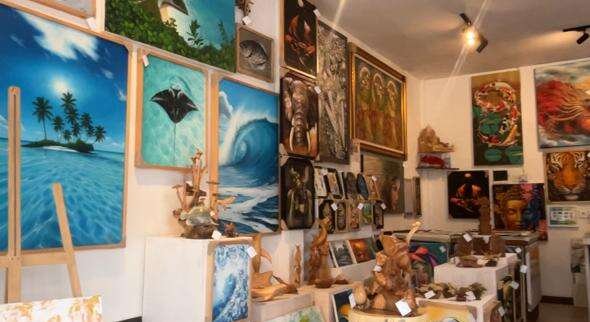
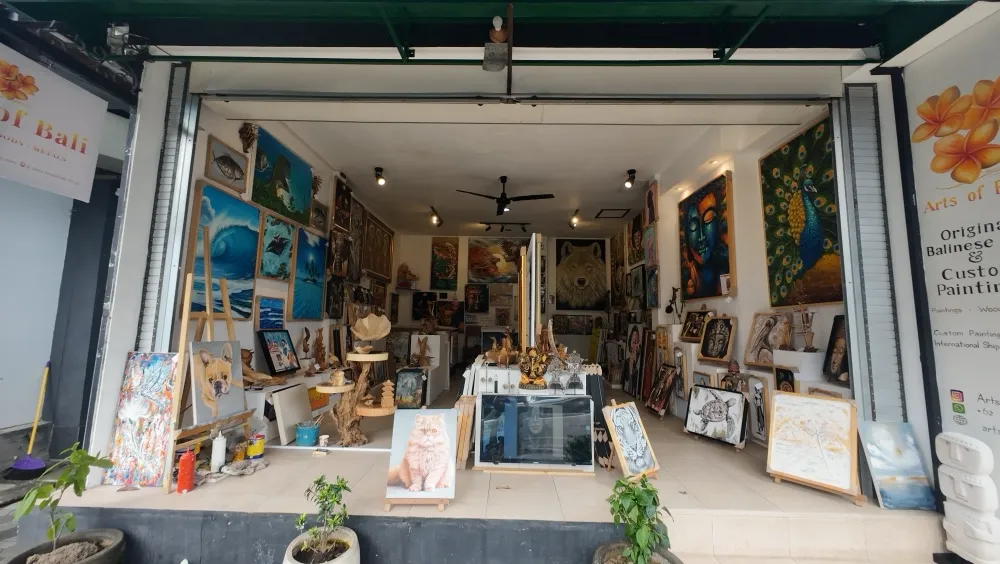
This guide is written from experience at our gallery on Jalan Raya Seminyak — where we’ve helped thousands of visitors navigate exactly this decision — and it covers the practical rules that actually make a difference when you’re back home looking at a blank wall.
How to choose art in Bali: The three factors that matter most are scale (your painting should fill 60–75% of the empty wall space above your furniture), style alignment (matching the painting’s mood and palette to your room’s existing character), and authenticity (buying original, signed works from a gallery with proper documentation, not mass-produced market prints). Always consider your room’s dominant colors and light direction before committing. See our complete price guide for budget context.
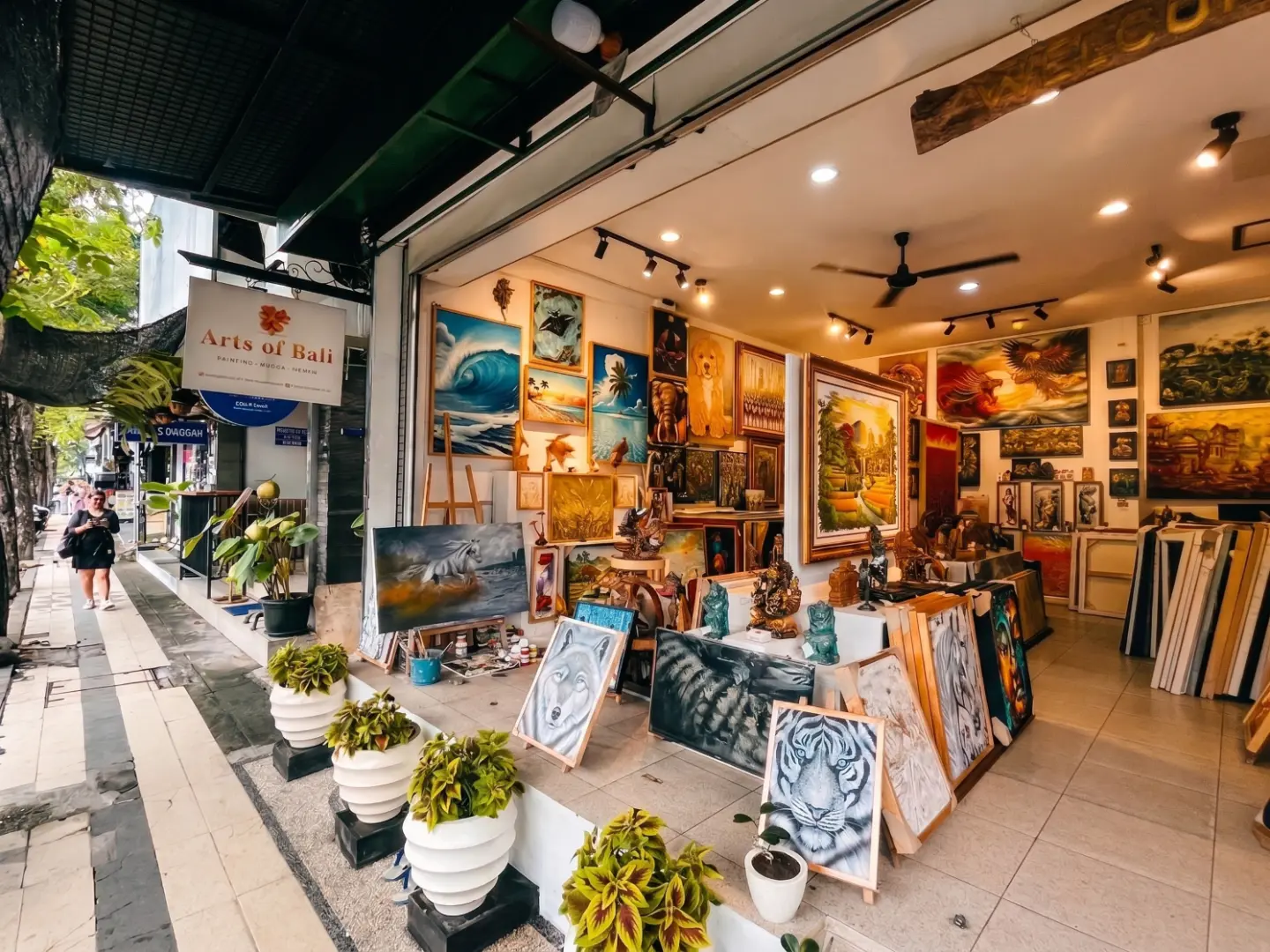
Go Bigger: Why Most Buyers Choose a Canvas That’s Too Small
The most consistent complaint we hear from clients who’ve bought art elsewhere: “I got it home and it just disappeared into the wall.” Nine times out of ten, the painting is fine. The wall is simply too large for it. This is the scale problem, and it’s easy to get wrong because gallery lighting and the presence of other artwork around a piece can make any canvas feel substantial — until it’s hanging alone on a white wall in an empty room.
Good interior design practice puts it plainly: artwork above furniture should fill somewhere between 60% and 75% of the available wall space. Not the total wall — the space above the specific piece of furniture it’s hanging over. Below a sofa, that means a canvas roughly two-thirds the width of the sofa. Above a bed, the painting should sit comfortably within the headboard width. Above a console table or sideboard, it should be wider than the table is tall and cover most of the wall above it.
- Above a 2m sofa: Aim for a canvas 130–150 cm wide, or a grouping that spans that range
- Above a king-size bed: 100–140 cm wide, centred on the headboard
- Above a console table: Width similar to or slightly narrower than the table; height no more than 3/4 of the table’s width
- Large statement wall (3m+): Either one very large canvas (150×120 cm and above) or a considered grouping — never one small piece alone
- Staircase wall: Large format works well because the eye travels along the wall as you climb — the painting needs to be readable from multiple distances
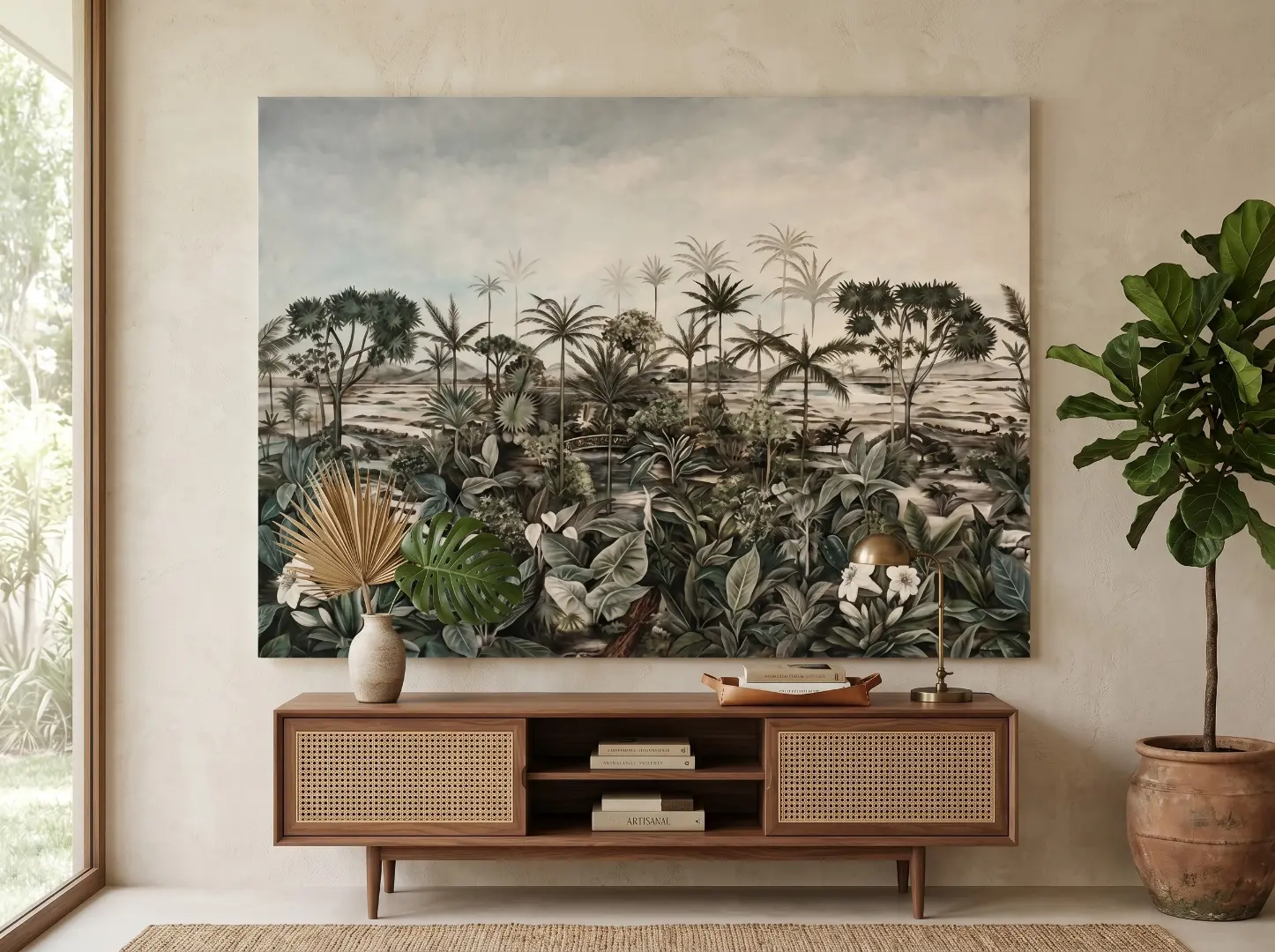
Don’t Let Size Stop You from Buying What You Actually Want
A lot of buyers shy away from large paintings because they’re worried about getting them home. Don’t let that limit your decision. Large canvases can be removed from their stretcher bars, rolled in archival layers, and shipped inside rigid PVC tubes — it’s a completely standard process at Arts of Bali, and the paintings arrive flat and undamaged. Once home, any local framer can re-stretch and re-frame the canvas. The full logistics are covered in our international shipping guide. Buy what the wall needs, not what fits in your suitcase.
Matching Painting Style to Room Character — What Actually Works
Bali produces an unusually wide range of painting styles — from classical Kamasan mythology on cloth to contemporary palette knife impasto, from hyper-realism to sand and mixed-media texture. Not all of them work in every room. The right choice depends on your room’s existing character — its architecture, its light, its dominant colors — rather than which painting you find most beautiful in isolation.
A good starting framework: think about the room’s energy. Is it calm and controlled, or does it have drama and movement? Is the furniture low-profile and organic, or is there height, contrast, and architectural interest? The painting should either echo that energy or provide a considered counterpoint to it. A room that’s already busy needs something that settles it. A room that’s very neutral and blank needs something that gives it a reason to exist.
Modern Coastal and Minimalist Spaces
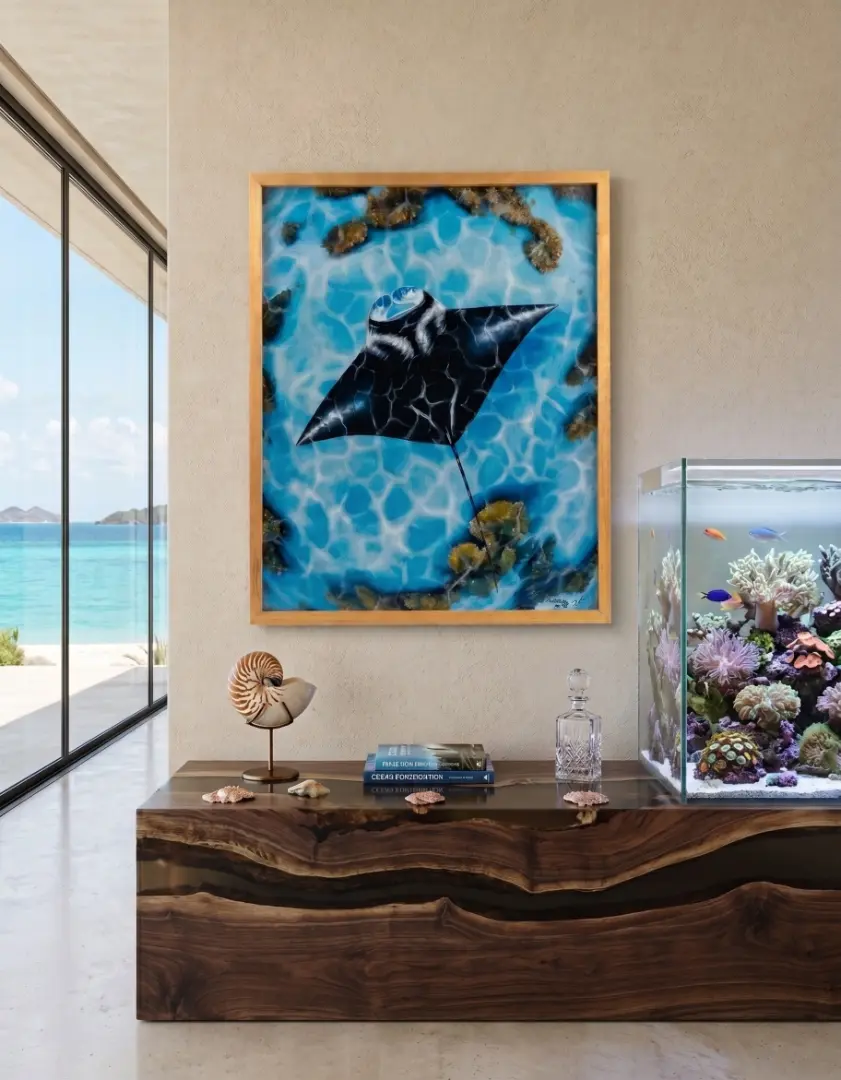
Clean lines, neutral walls, natural materials — rooms like this need art that brings depth and color without clutter. Hyper-realistic ocean paintings work particularly well here because they function like windows: they introduce a vivid, saturated world without adding visual noise. The ocean painting and marine life tradition in Bali is strong, with artists working in photorealistic detail that reads differently from different distances.
Dramatic Entryways, Stairwells, and Double-Height Walls
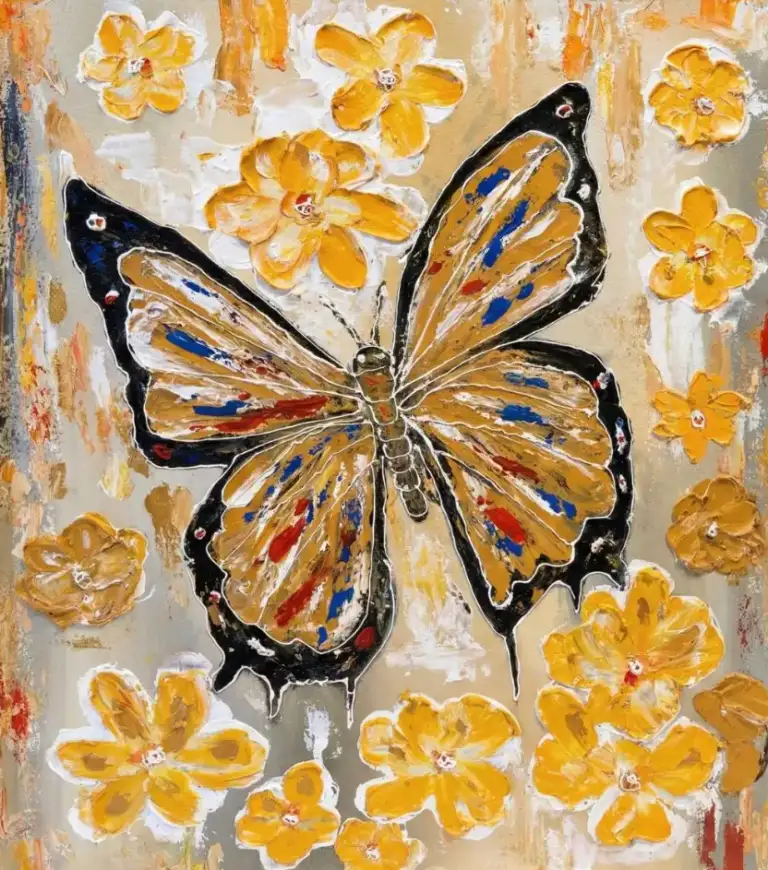
Transitional spaces — hallways, foyers, staircase walls — are where bold, high-impact art belongs. These are the places you pass through quickly, and the art needs to stop you. This is where heavily textured palette knife and mixed-media paintings by artists like Farfan and Upeksa come into their own. The thick impasto ridges catch light from different angles as you move through the space, so the painting reads differently depending on where you are. It’s not a static experience. Large-format wildlife paintings — a lion face, a tiger portrait — work well here too, because they have immediate visual authority.
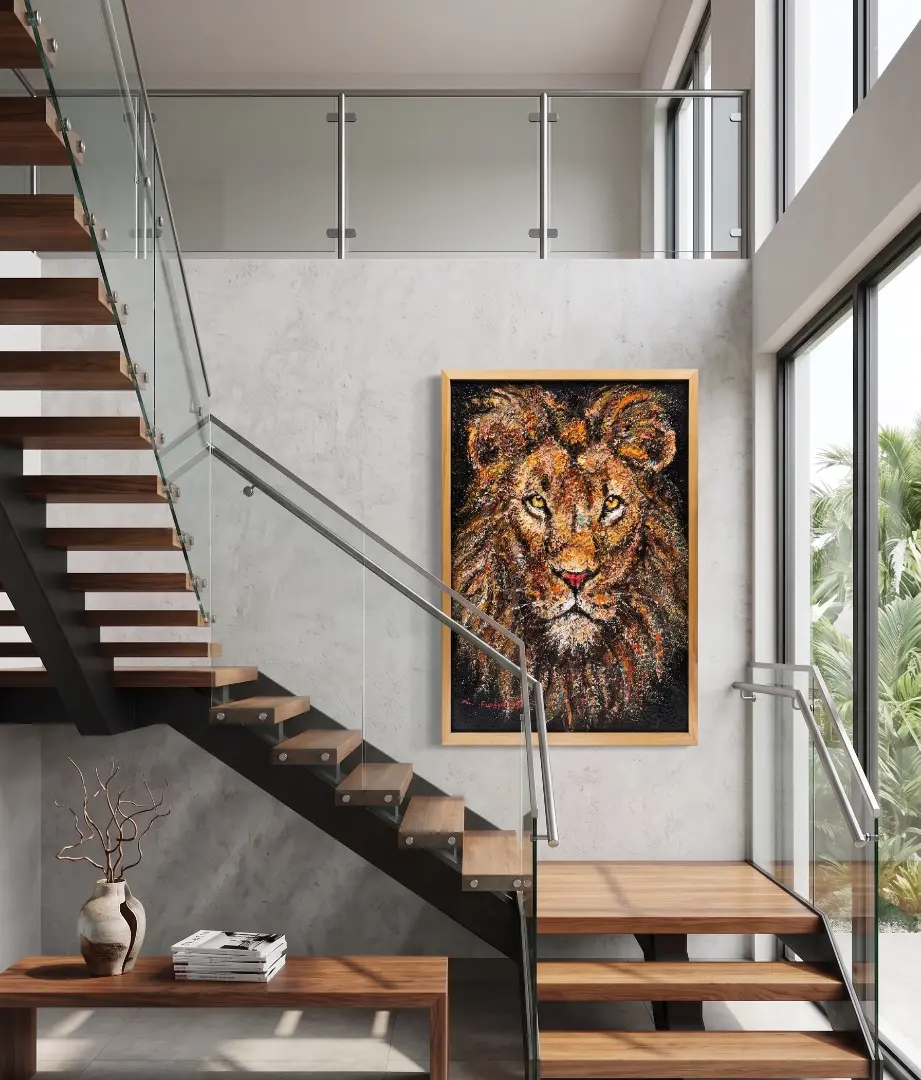
“The question isn’t which painting you love most. It’s which painting will still be working for the room ten years from now.”
How to Match a Balinese Painting to Your Room’s Color Palette
Color is where most buyers overthink it. The underlying logic of color theory applied to interior art selection is actually straightforward: either match one dominant hue from the painting to an existing color in your room, or choose a painting whose palette is the opposite of your room’s dominant tones. Both approaches work. The one that doesn’t work is ignoring color entirely and hoping for the best.
Rooms with warm timber, terracotta, and earth tones pair naturally with Bali’s landscape tradition — the golden ochres of rice field paintings, the warm earth palette of Kamasan classical work, and the deep amber and sienna of Batuan school mythology paintings. Rooms with cool grey or white walls work well with the opposite: ocean blues, contemporary monochrome palette knife works in white and gold, or mythology paintings on dark grounds where the black background reads as a neutral.
Traditional Balinese Art in a Modern Home — Why the Contrast Works
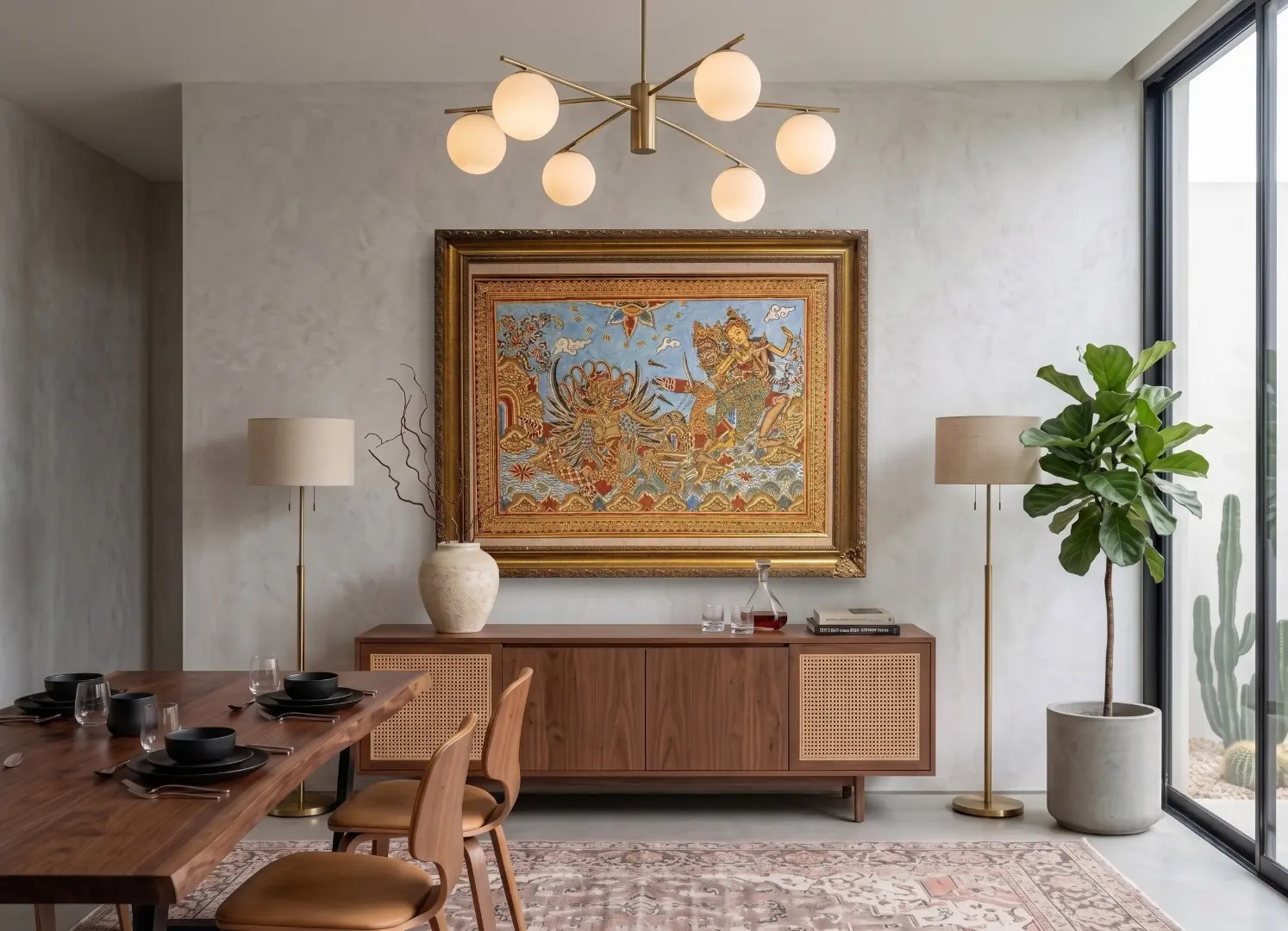
You don’t need a traditional Joglo or a room full of rattan furniture to make classical Balinese mythology painting work. Some of the most considered interior design choices place ancient art — pieces with real historical depth and complex cultural narrative — inside spare contemporary settings. The contrast is the point. A Balinese mythology painting in an elaborate gold frame, hung above a simple mid-century sideboard in a room with concrete and steel, tells you immediately that the person who lives there has taste and knowledge beyond the obvious choices.
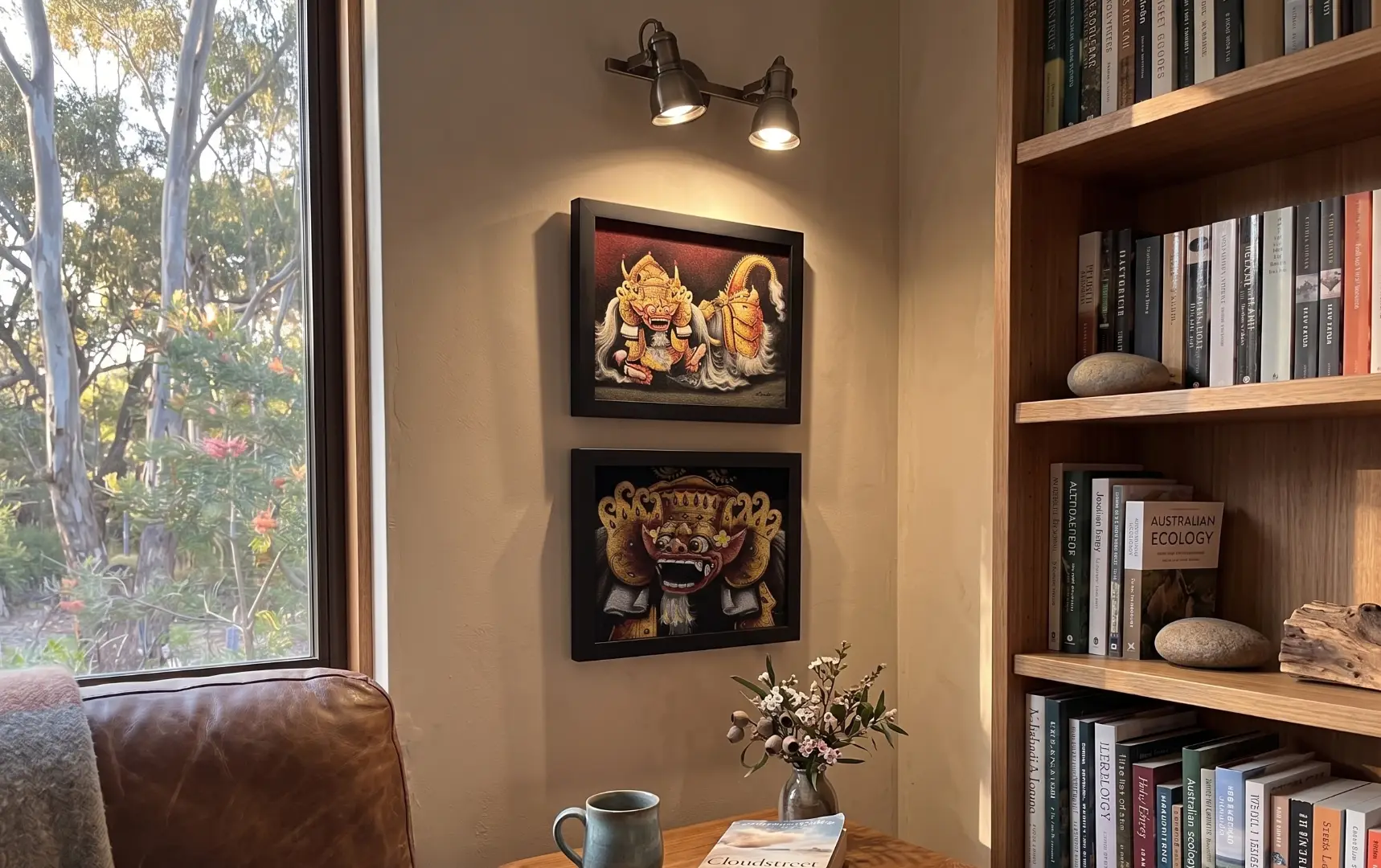
The vertical arrangement of smaller works — two or three paintings stacked above each other, or arranged in a considered grouping — solves the narrow-wall problem that stumps a lot of buyers. A tall, narrow wall between a window and a bookshelf isn’t a space where a single landscape will work. But two portrait-format works stacked, with consistent framing, becomes a deliberate gallery arrangement that defines the wall rather than fighting with it.
If you want to understand the full range of Balinese art styles before deciding what direction to take, our complete style guide covers every tradition from Kamasan to contemporary palette knife. And if you want guidance on what different styles cost, our Bali painting price guide covers the full market — from souvenir tier to gallery original. For everything about getting the work home safely, the international shipping guide has everything you need.
Common Questions About Choosing Art in Bali
How do I choose the right size painting for my wall? ▼
What type of Balinese art works best in a modern minimalist home? ▼
Can I ship a large canvas painting from Bali internationally? ▼
Should I buy a painting rolled or framed in Bali? ▼
How do I match a Balinese painting to my room’s existing colors? ▼
Can traditional Balinese art work in a modern contemporary interior? ▼
Where is the best place to buy authentic wall art in Bali? ▼
Bring a Photo of Your Wall — We’ll Help You Find the Right Painting
The single most useful thing you can do before buying art is take a photo of the empty wall — with the furniture in frame — and bring it to the gallery. It takes thirty seconds, and it makes every conversation about scale, proportion, and color much more concrete. Visit us at Jl. Raya Seminyak No. 42, Kuta, Bali, or send us the photo on WhatsApp and we’ll give you our honest advice before you even arrive.
Send Us Your Wall Photo on WhatsApp