Bhoma Bali temple gates almost always carry the same fierce carved face above the lintel: bulging eyes, bared fangs, and a mouth caught mid-roar. That face has a name. Bhoma is the guardian figure Balinese carvers place above temple thresholds to stand between the sacred and the ordinary world, a role tied to a specific myth about the child of Wisnu and the earth goddess Dewi Pertiwi.
Key Takeaways
- Bhoma is a fierce guardian face carved above Balinese temple gateways, most often the inner kori agung/paduraksa gate rather than the outer split candi bentar.
- According to Balinese tradition, Bhoma is the son of Wisnu, who took the form of the boar Waraha, and Dewi Pertiwi, goddess of the earth, which is why his name traces to the Sanskrit word for “earth.”
- Bhoma is Bali’s regional version of a much older guardian-face motif found across Hindu and Buddhist temple architecture in Asia, generally traced back to Kirtimukha, the “Face of Glory.”
- Java has its own parallel figure, Kala, used the same way above temple lintels; the two names are sometimes used interchangeably even though they come from slightly different corners of the mythology.
- Bhoma is a carved head only, not a full standing body, which is what separates it from “dwarapala,” the broader Hindu-Buddhist term for full-figure door guardians found across South and Southeast Asia.
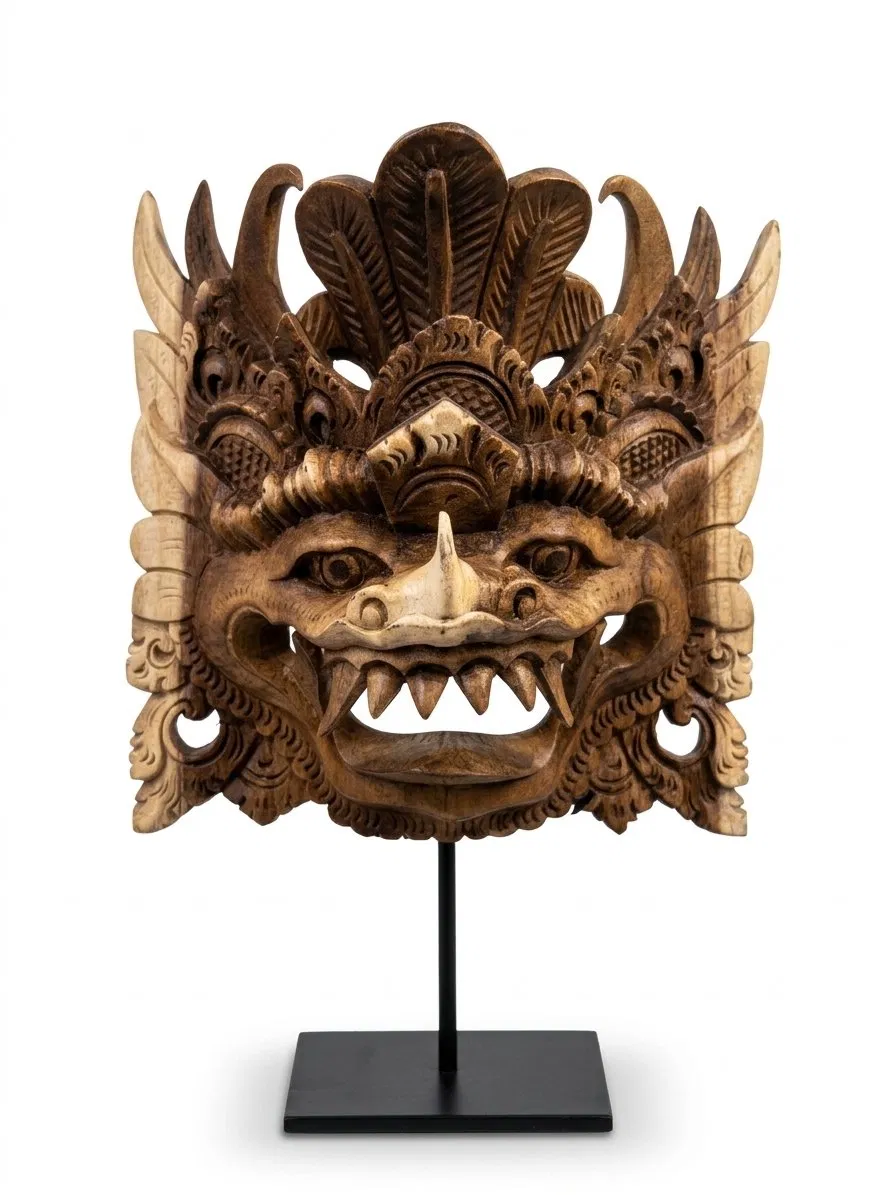
- Arts of Bali carries an original hand-carved wooden Bhoma mask, sold as wall or stand decor rather than as a temple fitting.
Definition: Bhoma is the fierce guardian face Balinese tradition carves above temple gateways, son of Wisnu and the earth goddess Dewi Pertiwi, placed there to ward off harmful spirits before they cross the threshold.
Walk toward the inner gate of almost any temple in Bali and something looks back at you before you reach it. A wide-eyed, fanged face stares down from above the doorway, teeth bared, sometimes framed by carved leaves and vines. Most visitors photograph it without knowing its name. Balinese Hindus generally do not need to ask.
This guide covers who Bhoma actually is: the myth behind his birth, why his face specifically is the one carved above the gate, how he relates to Java’s own version of the same idea, and how the same fierce face has found its way from temple architecture into a piece of wood carving Arts of Bali currently has on display.
Bhoma Bali: Who Is This Temple Guardian Face?
In Balinese temple architecture, Bhoma is the name for the wide-eyed, fanged face carved directly above a gateway, usually looking straight down at anyone about to pass beneath it. Unlike most figures in Balinese religious art, Bhoma is not shown with a body. He appears as a head only, often ringed with carved foliage, standing in for the idea that the earth itself, wild, fertile, and untamed, is what watches over the boundary between the ordinary world outside a temple and the sacred ground within it.
That placement is specific. Balinese temple compounds are typically entered through more than one gate: an outer split gate, the candi bentar, that simply frames the approach without a lintel to carve a face onto, and one or more inner gates, the kori agung or paduraksa, built as a single roofed tower with a doorway cut through the middle. It’s this inner, roofed gate that carries Bhoma’s face above the opening, marking the more sacred threshold rather than the first one a visitor crosses.
The MythBhoma’s Origin Myth: A Child of Wisnu and the Earth
Balinese and wider Indonesian tradition describes Bhoma as the son of Wisnu and Dewi Pertiwi, the goddess of the earth. In the version most commonly told, Wisnu had taken the form of Waraha, a boar, and in that form met Dewi Pertiwi, resulting in Bhoma’s birth. The name itself supports this: Bhoma derives from the Sanskrit root “bhauma,” meaning of or belonging to the earth, the same root that gives Bhoma his strong association with soil, fertility, and the wilder edges of the natural world rather than with the sky or the sea.
That earthy origin is part of why Bhoma’s face is so often surrounded by carved leaves, vines, and floral crowns in temple carvings and in decorative pieces like wooden masks: he is not a sky god or an ocean deity, but a guardian whose authority comes specifically from the ground he was born of.
Bali And JavaBhoma and Kala: The Same Idea, Two Islands
Bhoma has a close relative one island over. Javanese temple architecture, going back to the great Hindu-Buddhist candis of the seventh through fifteenth centuries, places a comparable fierce face above its own gateways, there usually called Kala. The two names are often used as if they were interchangeable, and functionally they are: both sit above a threshold, both wear a fierce expression, and both exist to guard the doorway. Scholars generally trace both back further still, to Kirtimukha, or “Face of Glory,” a much older guardian-face motif found across Hindu and Buddhist temple art throughout South and Southeast Asia, from India through Cambodia and Thailand as well as Java and Bali.
The classical legend behind Kirtimukha, as it’s commonly told, involves the asura king Jalandhara sending his messenger Rahu to challenge Shiva and demand his consort Parvati; an angered Shiva responded by creating a ravenous, lion-faced being, and once Rahu was spared, the creature, left with nothing else to consume, is said to have devoured its own body. Shiva rewarded what remained by naming it “Face of Glory” and decreeing it should always guard the doorways of his temples. Bali’s Bhoma and Java’s Kala are generally read as regional descendants of that same idea, adapted over centuries into their own local names, features, and mythology, which is why the two guardian faces look and function so much alike while still coming from what tradition treats as slightly different corners of the story.
Two islands, two names, one job: a fierce face fixed above the doorway, built to be the first thing that meets you and the last thing anything unwelcome gets past.
Bhoma Is Not “Dwarapala”: A Common Mix-Up
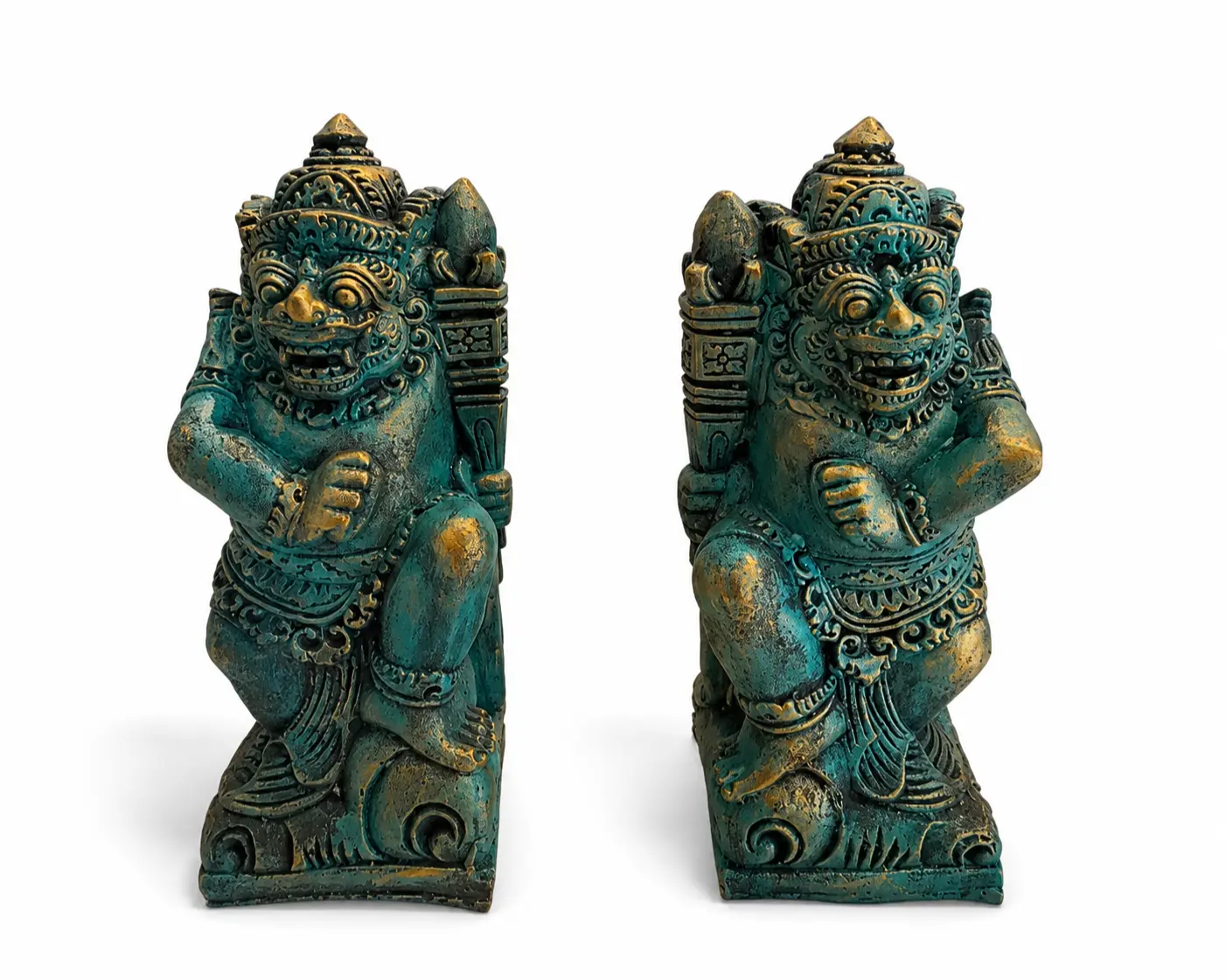
Shoppers searching for Balinese temple guardians online often type “dwarapala,” and it’s worth clearing up what that word actually covers. Dwarapala is the broader Hindu and Buddhist term for door-guardian figures generally, most often full standing bodies, usually shown in pairs flanking an entrance, holding a club or weapon, found in temple traditions from India to Cambodia to Java. In Bali specifically, dwarapala consistently means this kind of full statue, giant and muscular in build, never a carved head alone. Bhoma is something narrower and specifically Balinese: a single carved head, not a full figure, fixed above the gate rather than standing beside it. A Bhoma mask and a dwarapala statue can serve a similar protective purpose in the broadest sense, guarding a threshold, but they are not the same object, and a genuinely Balinese piece described as “Bhoma” or “Boma” is the more accurate term for the guardian face carved above a temple lintel.
Why the Face Looks Fierce: The Logic Behind Bhoma’s Design
Most Bhoma carvings share the same fierce features: bulging, wide-open eyes, a broad nose, and a mouth pulled back to show fangs or tusks, sometimes with a tongue or additional carved detail spilling from it. A minority of depictions soften the expression instead, closer to watchful than threatening, read by some sources as reflecting the dual nature of the earth Bhoma represents, wild and untamed on one side, fertile and nurturing on the other. The fierce version is by far the more common one, though, and it isn’t decoration for its own sake. In Balinese belief, a threshold is a genuinely vulnerable point, the place where negative forces or wandering spirits are most likely to try to slip into consecrated ground, and a guardian built to look more frightening than whatever it’s meant to repel is doing exactly the job it was carved for. The fierce expression is a functional design choice before it’s an artistic one.
The foliage that typically surrounds Bhoma’s face, carved leaves, vines, sometimes small floral crowns, reinforces the same earth-born identity established in his origin myth. Where a deity face in Balinese carving might wear a tall, refined crown to signal serenity and status, Bhoma’s framing stays rooted in vegetation, a visual reminder that his authority comes from the wild ground itself rather than from a heavenly court.
The MaskBhoma in Wood: From Temple Gate to Wall Decor
The same face that has guarded temple lintels for centuries has a long-running second life as a standalone piece of wood carving, sold as protective wall or entryway decor for houses, shops, and galleries rather than fixed above a consecrated gate. Arts of Bali’s version is a 20cm hand-carved wooden Bhoma mask on a metal stand, showing the fangs, bulging eyes, and an elaborate winged, feathered crown carved in relief around the face, the crown a decorative flourish rather than a literal depiction of any single temple’s ironwork.
Buying a Bhoma mask this way is a common, low-stakes way collectors bring a piece of Balinese temple iconography into a home or office without installing anything structural: it reads as a striking, conversation-starting object first, and as a piece of religious architecture translated into portable form second.
In The GalleryBhoma Alongside Arts of Bali’s Other Guardian Figures
Bhoma is one entry in a wider family of Balinese guardian imagery Arts of Bali carries. Our guide to Balinese wood carving masks covers the broader guardian and deity mask tradition Bhoma belongs to in visual terms, fierce protective faces on one side, serene deity faces on the other, without naming Bhoma specifically. Our Balinese art symbols guide touches on Kala and Bhoma briefly as one entry among ten recurring motifs; this guide is the deeper dive into that single figure specifically. For the guardian spirit most visitors confuse Bhoma with at first glance, see our guide to Barong painting in Bali, and for the architecture Bhoma’s face is carved onto, our guide to Balinese temple gate wood carving.
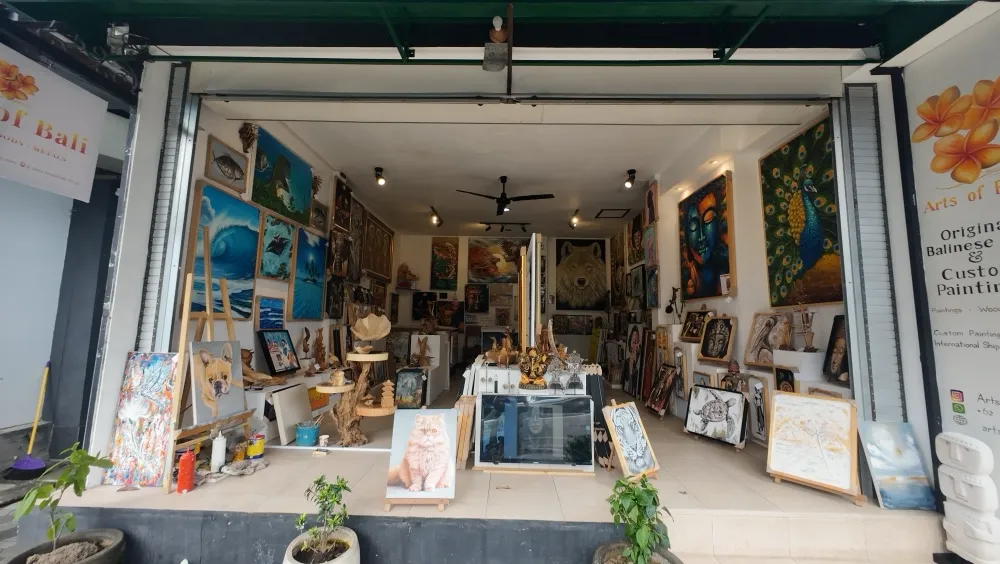
Arts of Bali’s Bhoma mask is on display now at Jl. Raya Seminyak No. 42, Seminyak, alongside the gallery’s wider collection of hand-carved Balinese masks.
An Original Hand-Carved Bhoma Guardian Mask
Arts of Bali’s Bhoma mask is a 20cm hand-carved wooden piece on a metal stand, part of the gallery’s current Seminyak collection.
Mengobrol di WhatsApp View This Mask & PricePertanyaan yang Sering Diajukan
Who is Bhoma in Balinese mythology?
Bhoma is the fierce guardian face Balinese tradition carves above temple gateways. He is described as the son of Wisnu, in his boar form Waraha, and Dewi Pertiwi, goddess of the earth, and his role is to guard sacred thresholds from harmful spirits.
Why is Bhoma’s face carved above temple gates?
Balinese tradition treats a temple threshold as a vulnerable point where negative forces could slip through. Bhoma’s fierce expression, bulging eyes, and bared fangs are meant to confront and repel anything harmful before it crosses into sacred ground.
Is Bhoma the same as Kala?
Bhoma is Bali’s version of a guardian face that Java calls Kala, used the same way above temple lintels. The two names are often used interchangeably since they serve an identical function, though tradition treats them as coming from slightly different corners of the mythology.
Is Bhoma the same as a dwarapala statue?
No. Dwarapala is the broader Hindu and Buddhist term for full standing door-guardian figures, usually shown in pairs flanking an entrance. Bhoma is a single carved head placed above a gate, not a full body, and is the more accurate term for this specific Balinese guardian face.
Where does the name Bhoma come from?
Bhoma derives from the Sanskrit root “bhauma,” meaning of or belonging to the earth. The name reflects his birth from Dewi Pertiwi, the earth goddess, and his strong association with soil, fertility, and untamed nature.
What is Kirtimukha, and how does it relate to Bhoma?
Kirtimukha, or “Face of Glory,” is an older guardian-face motif found across Hindu and Buddhist temple art in South and Southeast Asia. Bali’s Bhoma and Java’s Kala are generally read as regional descendants of that same guardian-face tradition.
Does Bhoma have a body, or just a face?
Bhoma is shown as a head only, typically surrounded by carved leaves and vines. This is one of the clearest ways to tell him apart from full-figure guardian statues found elsewhere in Hindu and Buddhist temple traditions.
Which gate does Bhoma’s face appear on in a Balinese temple?
Bhoma is generally carved above the inner gate, the kori agung or paduraksa, a roofed tower gateway with a lintel to carve a face onto, rather than the outer split gate, or candi bentar, which has no lintel.