A. Gandara has spent years developing his own language within Balinese landscape painting — a practice rooted not in technique alone, but in lived memory of the land itself.
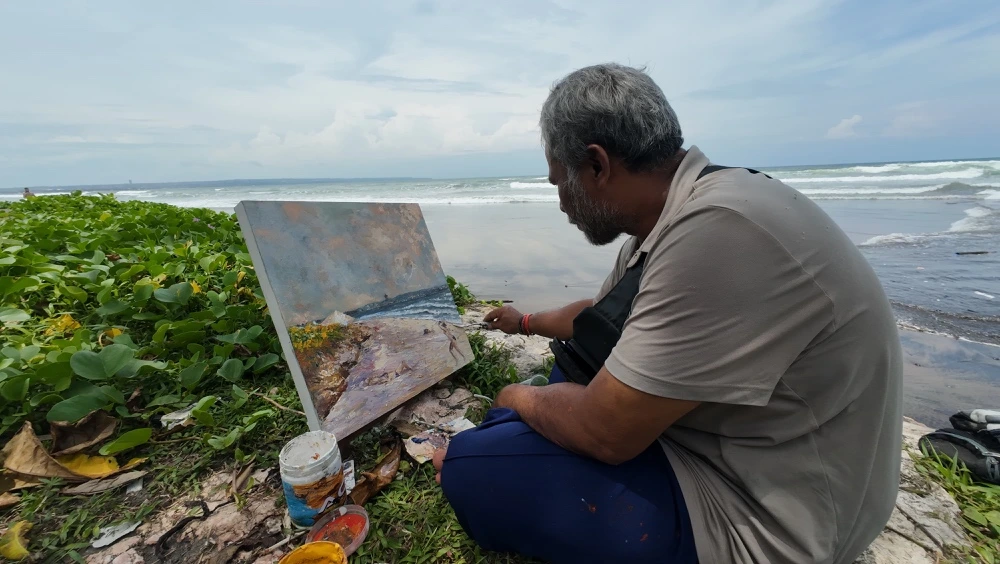
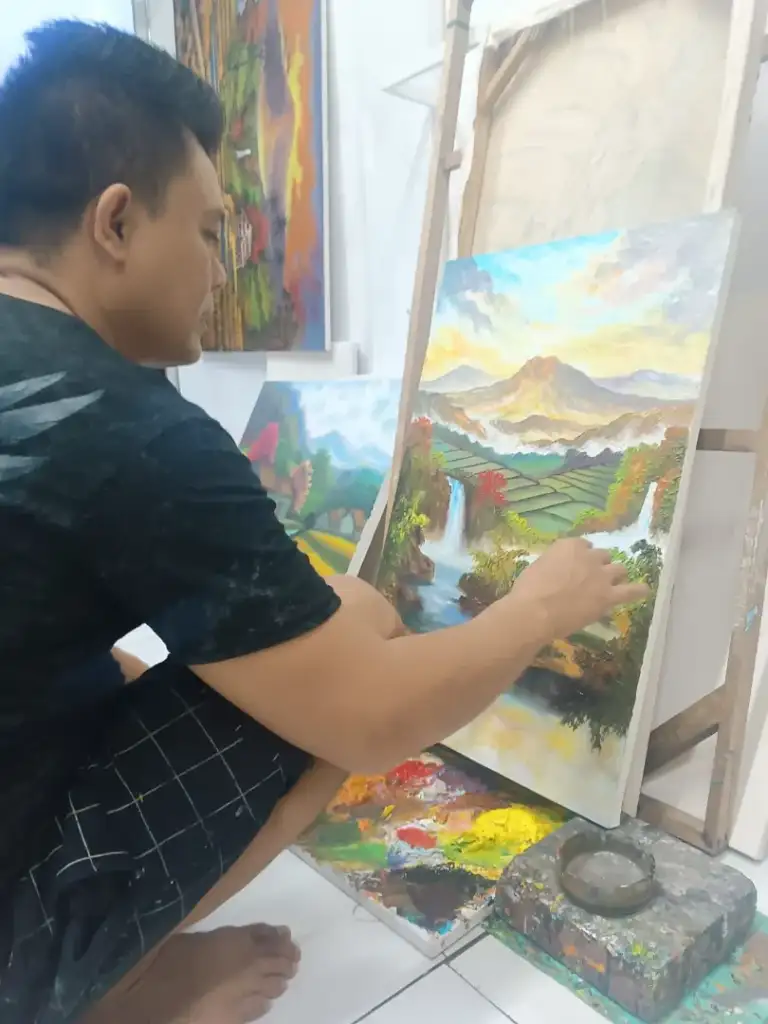
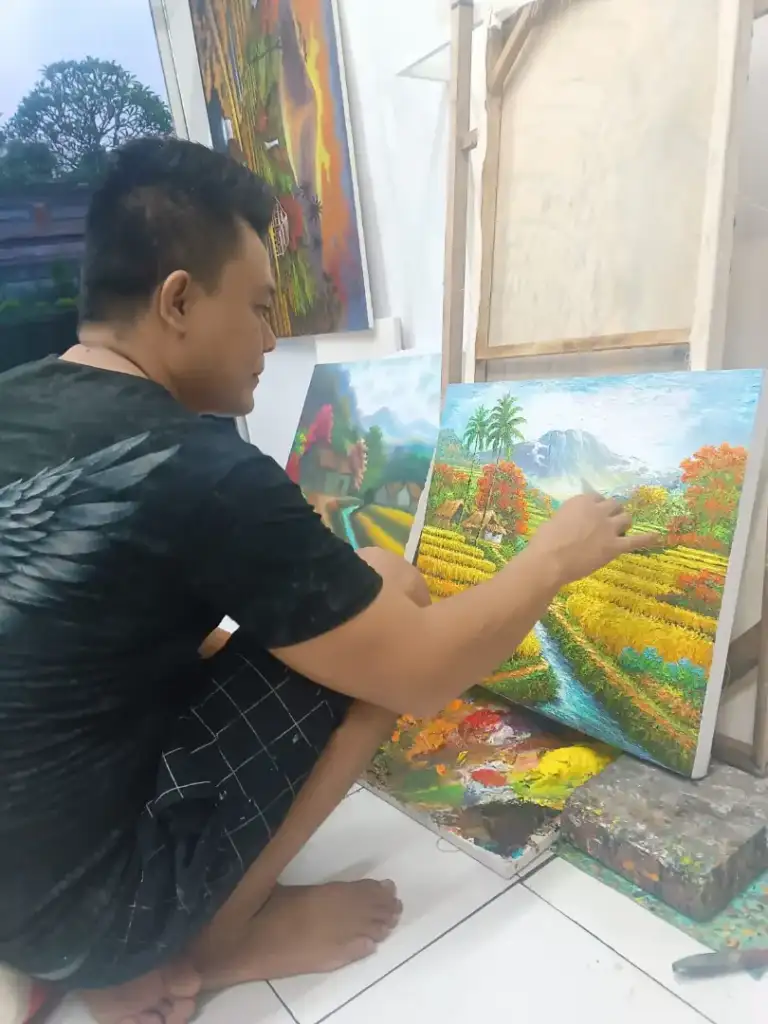
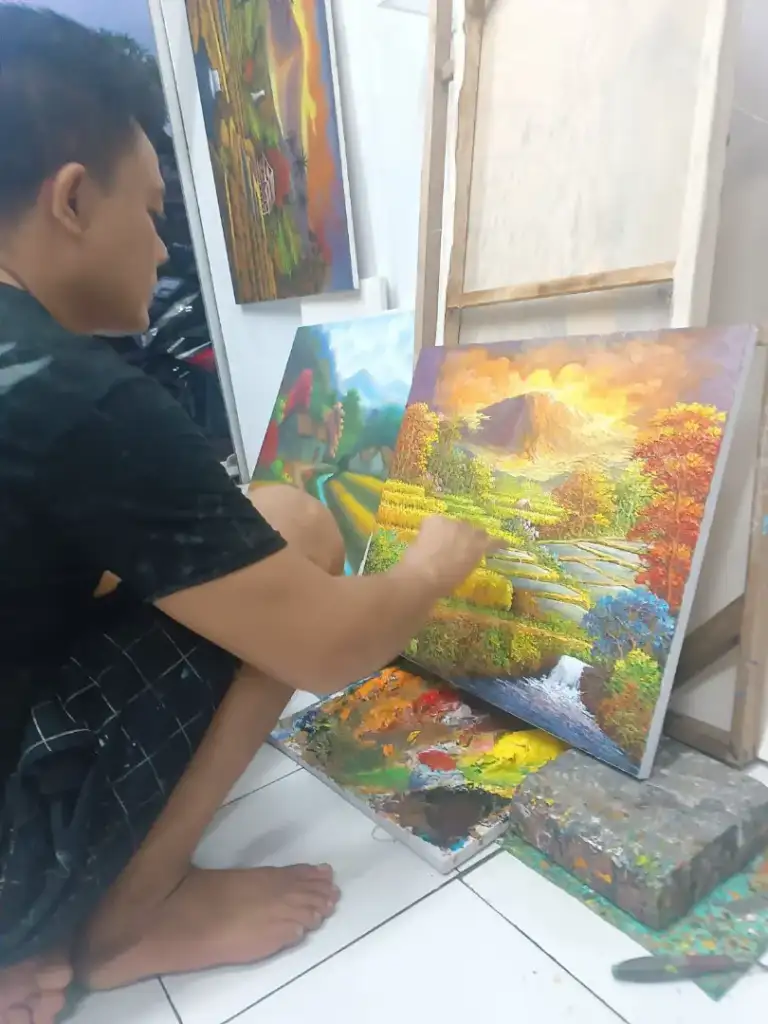
There is paint under his fingernails and a half-finished volcano on the canvas in front of him. The palette knife rests in his right hand like something he was born holding. A. Gandara does not look like someone still searching for meaning. He looks like someone who has already found it — a man who discovered himself through Balinese landscape painting, and is now in the quiet, daily process of transferring it, stroke by careful stroke, onto a white surface that will eventually hold a world.
But it did not always look this way. And that is exactly what makes his story worth telling.
The Doubt That Came Before the Canvas
Most creative lives begin not with confidence but with a question. For Gandara, that question was simple and brutal in equal measure: do I deserve to be here?
“For a long time I was not sure I had the right to call myself an artist,” he says, his eyes still fixed on the canvas. “I kept asking: is this real? Or am I just someone who likes to mix colors?”
It is a familiar doubt to anyone who has ever tried to make something honest. The inner voice that asks whether the work is real enough, serious enough, good enough to justify the time and the attention and the identity you are trying to build around it.
For Gandara, the answer did not arrive through praise from others or validation from the market. It came from something more fundamental. It came from the land itself.
He grew up surrounded by the terraced rice fields, volcanic silhouettes, cool mountain streams, and monsoon-lit skies of the Indonesian landscape. These were not abstract visual references he discovered later in life. They were the actual terrain of his childhood, the physical geography of everything he understood to be home long before he understood it consciously. When he finally allowed himself to commit to Balinese landscape painting without apology, without editing it or making it more sophisticated or more internationally legible, something shifted.
The doubt did not disappear. But it became smaller. And the paintings became larger, bolder, more fully his own. The ground under his feet stopped feeling uncertain.
“I stopped trying to paint what I thought a painting should look like,” he says. “I started painting what I actually knew. That is when everything changed.”
A Language Built from Texture
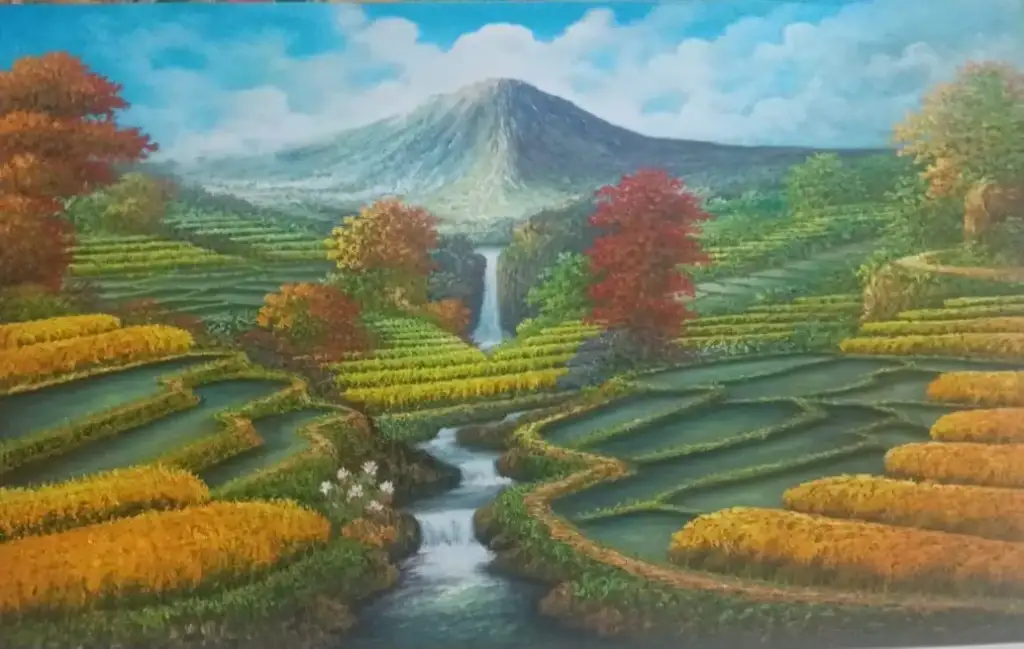
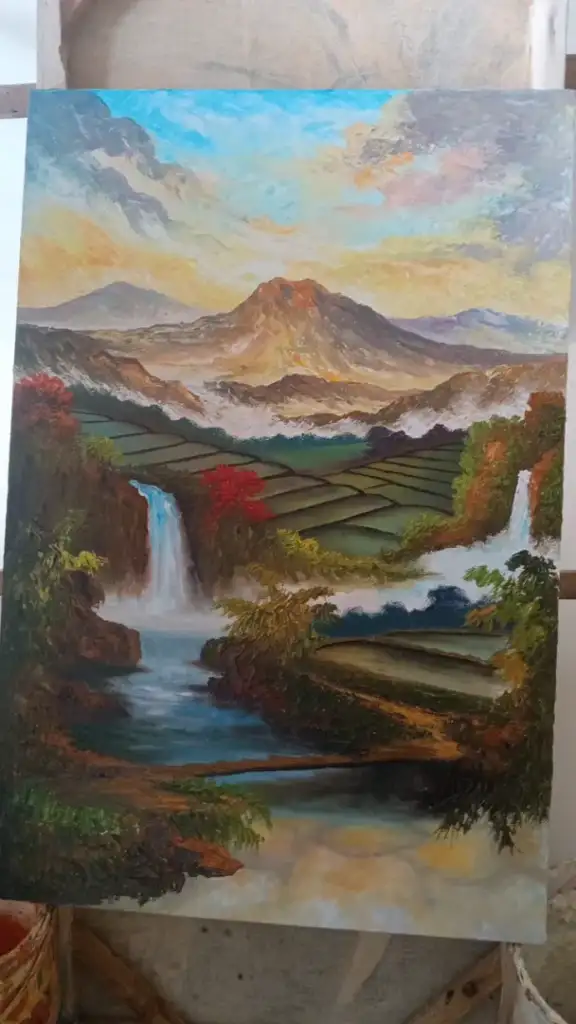
Walk slowly toward one of Gandara’s Balinese landscape paintings and you begin to understand that what you are looking at is not flat. The rice terraces rise from the canvas. The volcanic slopes carry actual weight. The waterfalls have a thickness to them, a sculptural presence, that no brushwork could produce. The surface of his paintings is a landscape in itself.
Gandara works almost exclusively with a palette knife. It is not a stylistic affectation. It is a philosophical commitment to a way of making that cannot hide, cannot smooth over, cannot pretend.
“Texture is honesty,” he says. “When you use a knife instead of a brush, every mark stays exactly as it was made. You cannot erase it. You cannot soften it. The land is like that too. It does not pretend to be something it is not.”

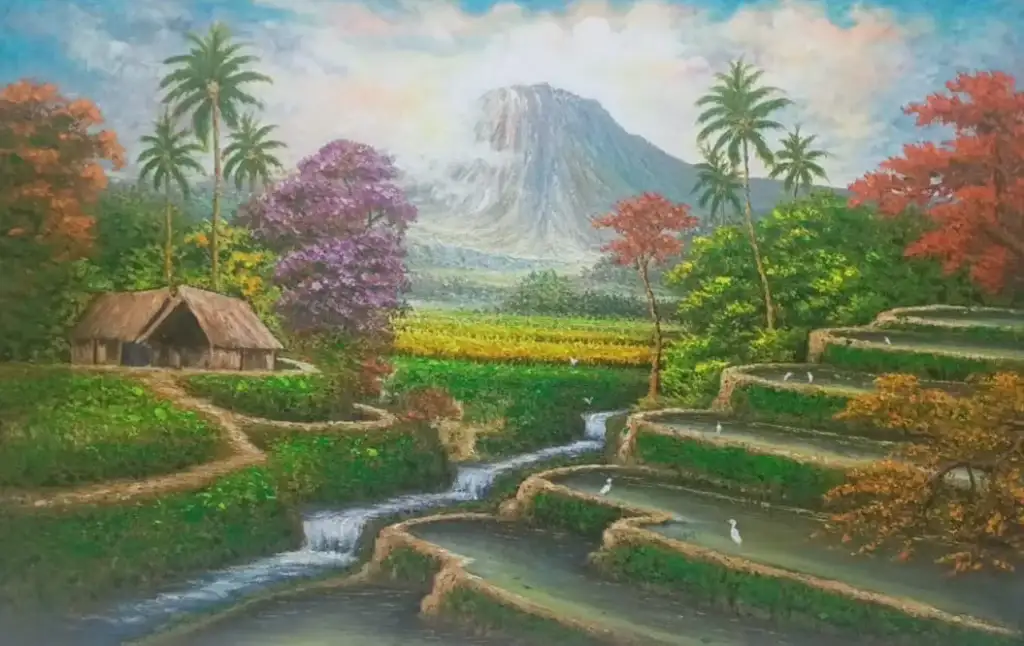
This directness is visible in every piece. A harvest scene where dozens of farmers bend over golden fields beneath twin volcanic peaks, ox carts loaded with rice moving down a dirt road that leads somewhere beyond the frame. A river cutting with quiet insistence through terraced land while white egrets stand still in the shallows, unhurried. A thatched-roof cottage half-absorbed by trees in red and amber, a waterfall appearing in the middle distance as naturally as breath.
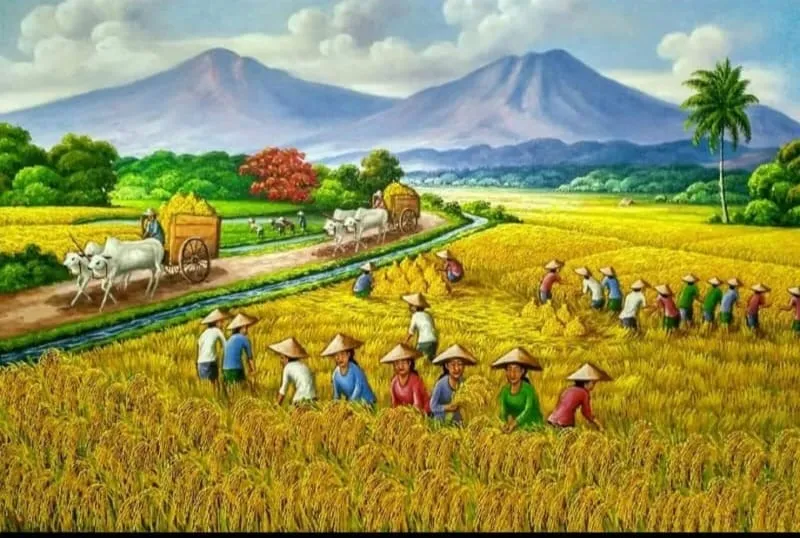
These are not romanticized postcard versions of rural Bali. They are lived landscapes, constructed by someone who has stood in those fields, felt that particular quality of afternoon light, and understood from the inside what it means to work the earth across generations.
The Philosophy of the Living Landscape
There is a particular quality to the light in Gandara’s Balinese landscape paintings that is difficult to name precisely but impossible to miss. It is warm without being sentimental. Hopeful without tipping into false brightness. The skies carry genuine weather. The rivers hold real movement. Even in a completely static image, his world breathes.
He describes the process of painting as something closer to listening than inventing.
“I don’t decide what the landscape looks like. I remember it. My job is just to get out of the way of the memory.”
This is a deceptively simple statement. What it means in practice is that Gandara’s paintings follow the internal logic of the natural world rather than the logic of composition as it is taught in studios. Things are placed where they belong, not where they look best. The mountain anchors the sky because that is what mountains do. The river runs where the land allows it to run. The fields follow the contours of the hillside because there is no other honest option.
“A painting of a landscape is not decoration,” he says, with a quiet firmness that suggests this is not a new thought but one he returns to often. “It is a record of how life works. The mountain, the water, the field, the family in the cottage — everything has a relationship. I am just painting the relationship.”
This connects Gandara’s Balinese landscape painting to something much older than the genre itself. In Balinese cosmology, the relationship between the volcano, the water that flows from it, and the rice fields it nourishes is not merely ecological. It is sacred.
The Subak irrigation system, a UNESCO-recognized network of water temples and cooperative farming that has governed Bali’s rice terraces for centuries, is built entirely on this understanding: that the land, the water, and the human community are one continuous system. Gandara does not paint this philosophy explicitly. He paints it structurally, in the way every element in his landscapes earns and justifies its place.
Finding a Home Inside the Work
The Balinese landscape paintings Gandara produces are also, in a very literal sense, about bringing the outside in.
There is something particular that happens in a room where one of his landscapes hangs on the wall. The temperature seems to drop slightly. The space feels wider. People who live in cities, far from rice fields and volcanic slopes, stand in front of these paintings and breathe differently. The landscape does something to the room that no print or photograph quite manages, because it carries the physical evidence of the hand that made it.
“When someone takes one of my paintings home,” Gandara says, setting down his palette knife for a moment, “I hope they feel what I feel when I am standing in front of the real thing. That coolness. That quiet. That sense that everything is exactly where it should be.”
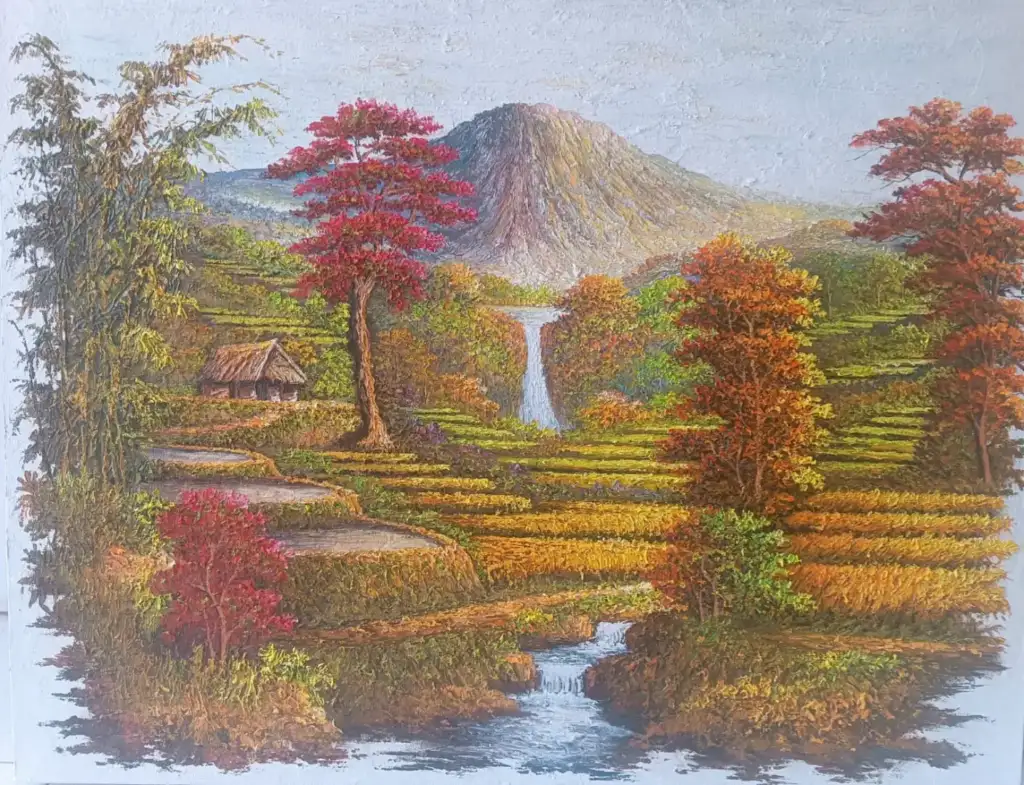
This is the particular gift of a landscape painted with genuine knowledge of the land rather than observation from a distance. This is what the best Balinese landscape painting does — it does not decorate a room, it expands it. It carries something of nature’s actual quality into the spaces where people live.
The mountains, the water, the fields — these things have always been, across cultures and centuries, associated with calm, with rootedness, with a sense that the world is larger and more patient than any individual anxiety.
Gandara found that quality by learning to stop doubting and start trusting what he already carried in him. The doubt that once held him back became, over time, the exact pressure that sharpened his work into something genuinely his own.
A Practice Without an Endpoint
In the studio, Gandara sets the knife down and steps back from the canvas. He looks at the volcano he has been building for three days. Something in the upper left corner is not quite right. He picks the knife back up.
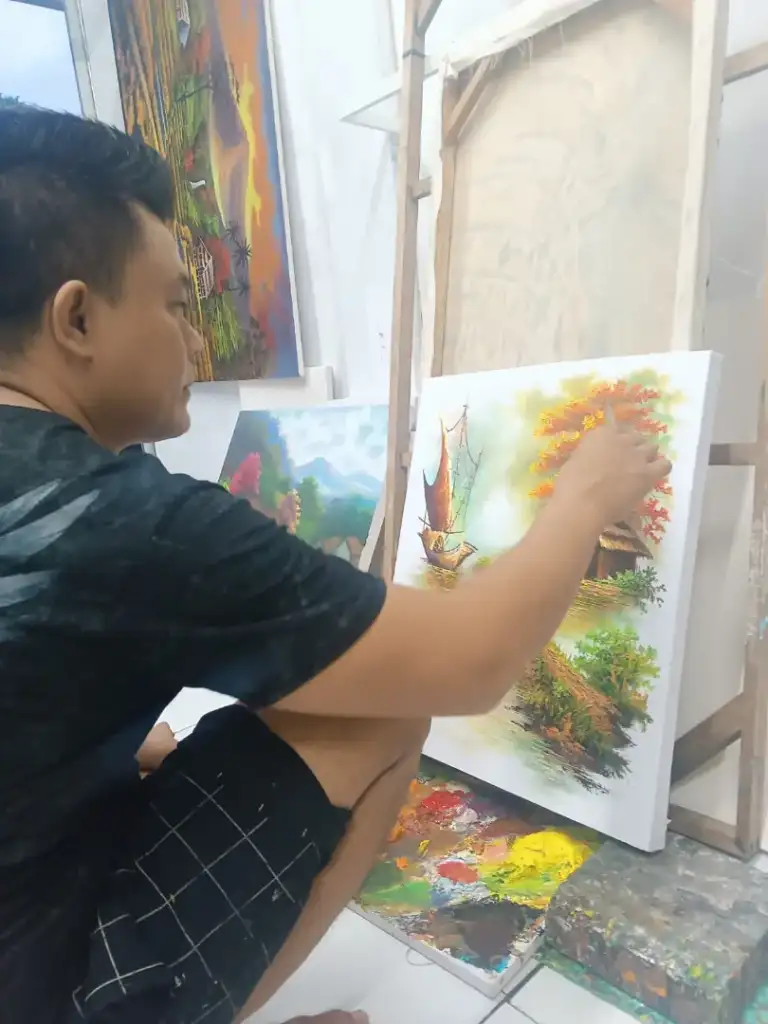
This is the part of the work that does not appear in the finished painting. The returning, the looking again, the small corrections that accumulate over days into something that feels inevitable. Gandara does not talk about this part much. He simply does it, with the same quiet attention he brings to everything else.
The land, after all, does not finish either. The rice grows and is harvested and grows again. The volcano smokes and clears and smokes again. The river keeps running.
Gandara keeps painting.
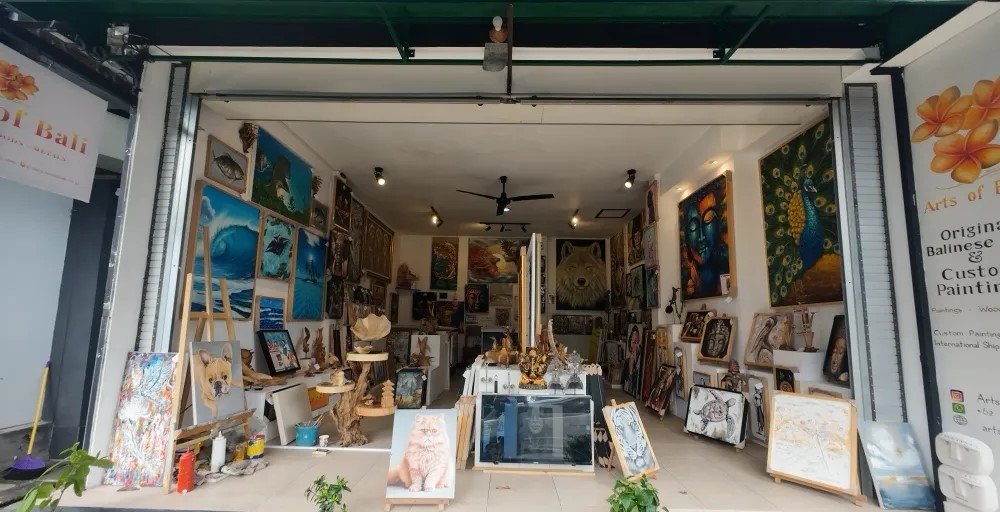
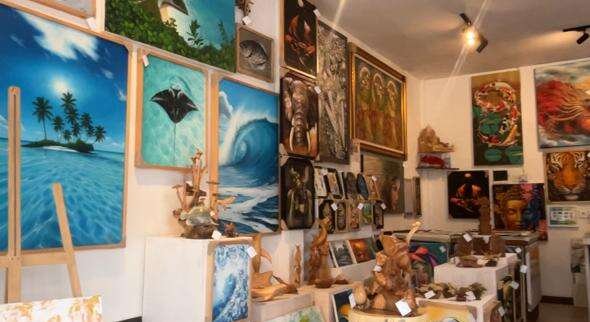
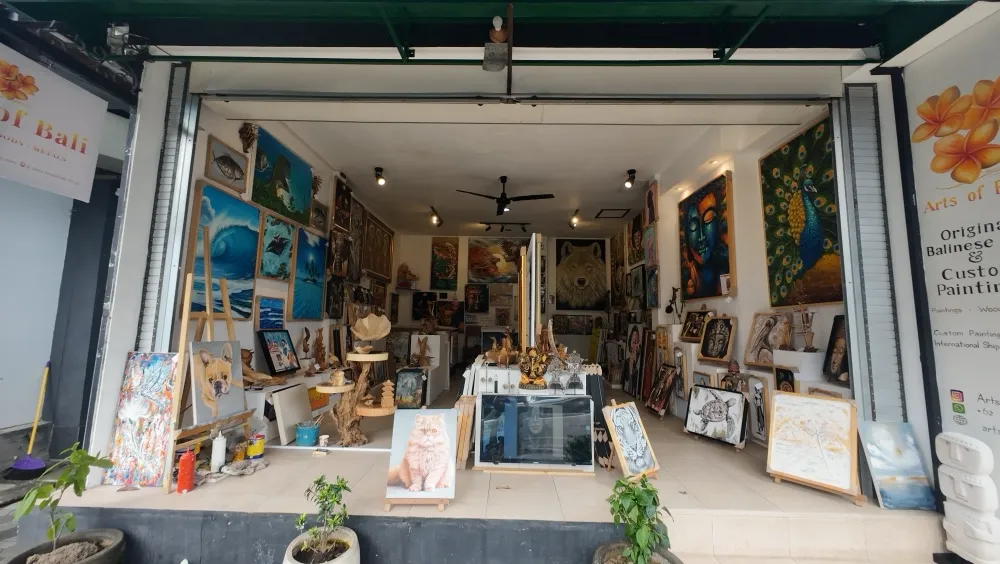
A. Gandara is one of five artists whose original work is available at Arts of Bali gallery, Jalan Raya Seminyak No. 42, Seminyak, Bali. All works are original paintings — no prints, no reproductions.
Browse the full collection at Our Gallery or contact the gallery directly on WhatsApp.