Kelingking Beach is the cliff-top viewpoint on Nusa Penida, an island off Bali’s southeast coast, known for a limestone headland whose silhouette is widely compared to a dinosaur’s head and neck, earning it the nickname T-Rex Cliff. The name Kelingking itself comes from the Indonesian word for “little finger,” a reference to the promontory’s curled shape as seen from above.
Key Takeaways
- Kelingking Beach sits on Nusa Penida, a limestone (karst) island across the Badung Strait from mainland Bali, administratively part of Klungkung Regency.
- “Kelingking” means “little finger” in Indonesian; the “T-Rex Cliff” nickname came later, from travelers struck by the headland’s dinosaur-like silhouette.
- The cliff stands roughly 180 meters above the cove below, by local guides’ estimates, reached by a steep trail of built steps and rope-and-bamboo handrails.
- Nusa Penida has carried two very different reputations: a 1900 Dutch map labeled it “Bandit Island” for its history as a place of exile, while today it’s one of the most photographed islands in Indonesia.
- Swimming at the cove below Kelingking has been prohibited since February 2023 following a fatal incident in the water, and the ban remains actively enforced.
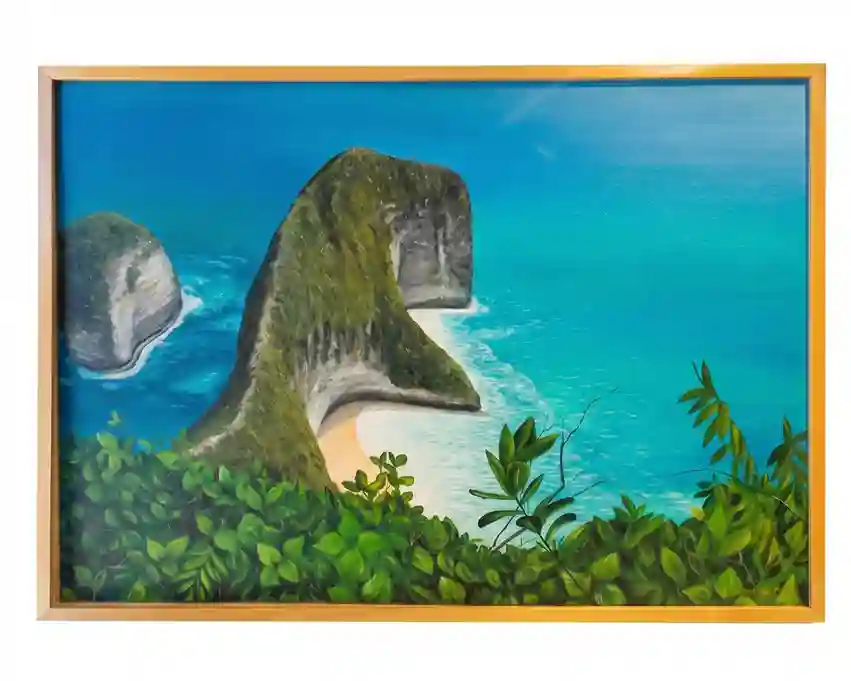
- Arts of Bali’s Kelingking Beach View Painting is a 70×100cm acrylic realism piece on cotton canvas, capturing the view exactly as visitors see it from the clifftop.
Definition: Kelingking Beach is Nusa Penida’s best-known cliff-top viewpoint, a limestone headland shaped like a dinosaur’s head above a cove of white sand, now also the subject of an original painting in Arts of Bali’s Seminyak collection.
Some views get discovered once and then get discovered again, millions of times, one phone camera after another aimed at the same angle. Kelingking Beach is the clearest example of that pattern anywhere in Bali. A decade ago it was a little-known cliff edge on a dry, wind-scoured island most tourists skipped entirely. Today it is one of the most reproduced images to come out of Indonesia, painted, printed, and photographed so often that the shape of that cliff has become instantly recognizable even to people who have never set foot on Nusa Penida.
This guide covers what Kelingking Beach actually is: the island it sits on, where its two names come from, the real story behind its sudden fame, and the safety realities that tend to get left out of the highlight reel. It also introduces the painting Arts of Bali currently has on display, an acrylic realist rendering of the exact view that made this cliff famous.
What Is Kelingking Beach? Nusa Penida’s Limestone Icon
Kelingking Beach sits on the western coast of Nusa Penida, an island of roughly 200 square kilometers that lies across the Badung Strait from Bali’s southeastern coast, close enough to see from mainland clifftops on a clear day, far enough that reaching it still means a boat crossing, commonly a fast boat from Sanur that takes somewhere in the range of thirty to forty-five minutes depending on conditions and operator. Administratively, Nusa Penida belongs to Klungkung Regency, the same regency that includes the historic village of Kamasan, birthplace of Bali’s oldest classical painting tradition, a coincidence of local government boundaries rather than of artistic lineage.
Geologically, Nusa Penida is a karst island, built from limestone rather than the volcanic soil that shapes most of mainland Bali, which gives it a noticeably drier climate and the pale, layered cliff faces visible along much of its coastline. Kelingking is the most dramatic of those cliffs: a headland that juts into the sea and curls downward at its tip, enclosing a narrow cove of white sand and turquoise water directly beneath it. Nusa Penida also has its own distinct dialect of Balinese, reportedly difficult for speakers from the mainland to follow, one small sign of how separate this island’s culture has stayed despite sitting so close to Bali’s most visited coastline.
Two NamesWhy Is It Called Kelingking? Two Names, Two Different Origins
Kelingking takes its official name from the Indonesian word for “little finger,” a description of the promontory’s shape as seen from above: a long ridge that curls at the end, the way a pinky finger bends inward. It’s a comparison that, by most accounts, takes a little imagination to see clearly from ground level, and it’s the name Indonesian sources and local guides generally use.
The nickname most visitors actually use, T-Rex Cliff, arrived later and needs none. Seen from the main viewpoint, the headland’s silhouette reads almost unmistakably as a dinosaur’s lowered head and open jaw, with the pale cove sitting where the throat would be. International travel media popularized the T-Rex comparison, and today both names circulate interchangeably, sometimes in the same sentence.
How It Went ViralFrom a Local Cliff to a Global Icon: How Kelingking Beach Became Famous
For most of its history this cliff was simply part of the coastline, known mainly to the fishing communities of Nusa Penida’s Bunga Mekar village. That changed within the space of a few years. One widely circulated account among travel writers traces a turning point to April 2017, when a photograph taken from the clifftop began circulating on social media and was picked up by a major travel platform soon after, the kind of single-moment origin story that’s hard to verify with precision but broadly consistent with how quickly the location’s profile actually rose.
What’s easier to confirm is the scale of what followed. By some counts, well over half a million photos tagged to the location now circulate on Instagram alone, and Kelingking Beach is marketed today as Nusa Penida’s single most photographed spot, alongside the island’s other social-media icons, Broken Beach, Angel’s Billabong, and Diamond Beach.
A cliff that fishing families walked past for generations became, in less than a decade, one of the most reproduced images to come out of Indonesia, not because it changed, but because everyone finally had a camera pointed the right way at the same time.
A Darker History Behind the View: Nusa Penida’s Past
The island’s current fame sits oddly against its older reputation. A Dutch map from 1900 labeled Nusa Penida the “Bandit Island,” a name earned under the historical rule of the Klungkung kingdom, which used the island as a place of exile for criminals, political opponents, and practitioners of black magic. Balinese legend adds a spiritual layer to that history: Ratu Gede Mecaling, described in local accounts as a powerful spirit with golden fangs, is closely associated with the island, and Pura Ped, one of Nusa Penida’s most important temples, remains a pilgrimage site tied to that legend, visited by Balinese Hindus seeking spiritual protection rather than photographs.
None of that history is visible from the Kelingking viewpoint today, where the crowds gather for an entirely different reason. But it’s part of what makes the island’s transformation into a backdrop for millions of holiday photos a genuinely strange piece of Balinese history, not just a scenic one.
Visiting Kelingking BeachVisiting Kelingking Beach: The Hike and the Safety Warnings Worth Knowing
The clifftop viewpoint itself requires no real effort beyond parking and walking to the edge, which is why it photographs so well and draws such steady crowds. Reaching the cove below is a different matter. By local guides’ estimates, the cliff stands around 180 meters above the water, and the descent follows roughly 150 built steps down to a landing partway down the slope, after which the trail turns into a steeper, unpaved path aided by rope and bamboo handrails. Guides generally put the descent at about twenty minutes and the climb back up at thirty minutes or more, and warn against attempting it in flip-flops or after rain, when the path turns slick.
Swimming at the cove itself has been prohibited since February 2023, after a tourist drowned attempting to rescue another swimmer caught in the shore break. The currents beneath Kelingking remain genuinely dangerous, and local news outlets have reported further fatal incidents connected to the site since, including a fatal fall on the staircase in December 2020 and a drowning years after the swimming ban was already in place. None of this is meant to discourage a visit to the viewpoint, which carries none of that particular risk, but it’s worth knowing before planning to reach the water below. Visitor reports commonly cite an entrance fee of around Rp25,000 per person, plus a small parking charge, payable in cash on site, figures worth confirming locally rather than treated as fixed.
The PaintingThe Painting: Kelingking Beach in Acrylic on Canvas
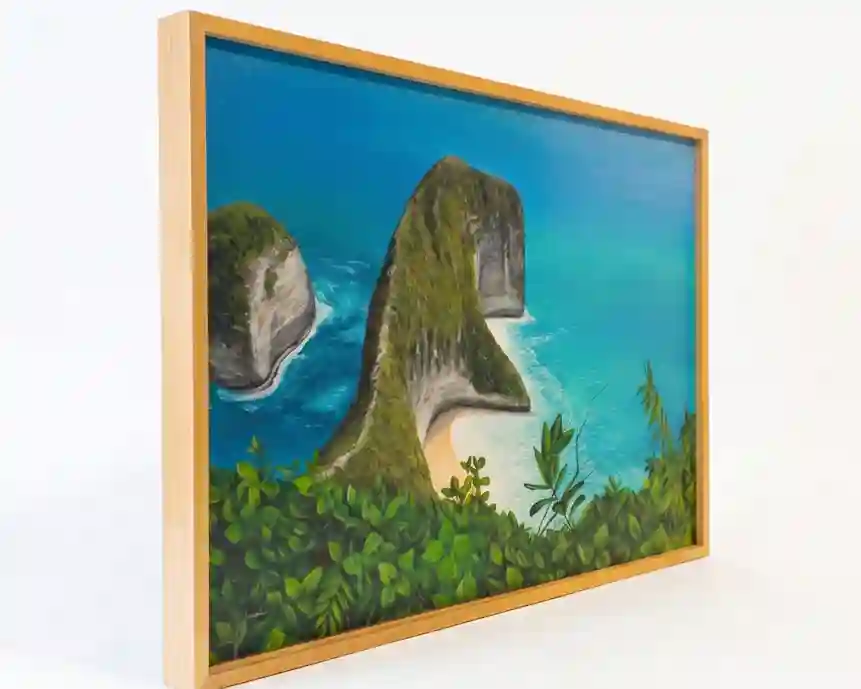
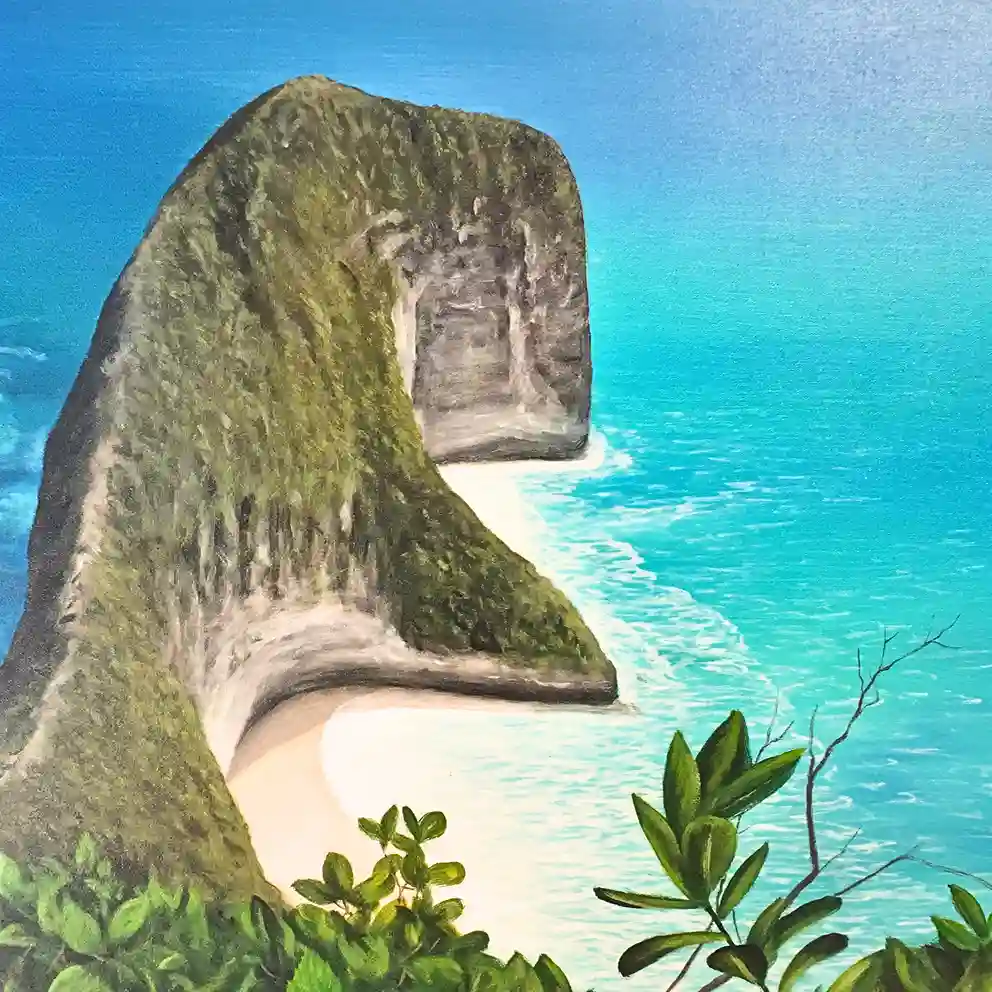
Arts of Bali’s Kelingking Beach View Painting renders this exact view: the curled, green-topped headland, the pale crescent of sand tucked beneath it, and the gradient from turquoise to deep blue that gives the location its color-drenched reputation in photographs. Painted in acrylic on cotton canvas at 70×100cm using a realism technique, the piece is built from the same clifftop vantage point that made the location famous, tropical foliage in the foreground included, rather than a distant or aerial reproduction.
It is currently the only Kelingking Beach painting in Arts of Bali’s collection, an original, one-of-a-kind piece rather than part of a themed series or a print run.
Kelingking Beach Painting Alongside Arts of Bali’s Other Bali Landscapes
This is Arts of Bali’s first painting to treat Nusa Penida as a subject in its own right, though the island has touched the gallery’s collection before. Our guide to ocean painting in Bali notes Nusa Penida’s waters as one of the island’s best-known manta ray and sea turtle encounters, and an earlier feature on resident artist Upeksa ties his own early life directly to Nusa Penida’s rugged coastline, years before this painting made the island’s most famous cliff its actual subject. For a landscape built around a different, equally singular Balinese natural landmark, see our guide to Mount Agung painting in Bali.
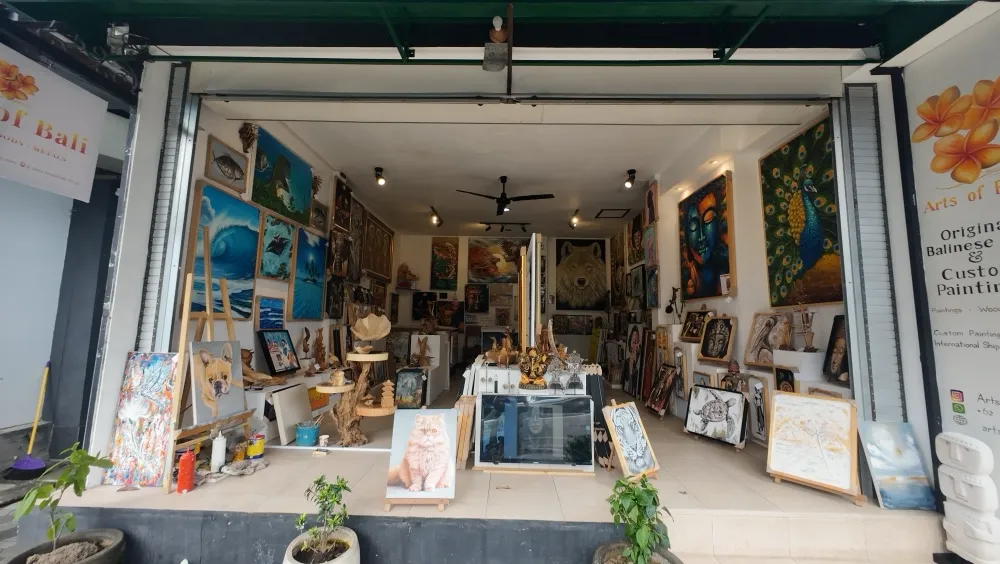
Kelingking Beach View Painting is a single original acrylic piece, painted using the realism technique covered in our broader guide to Balinese art styles, and is currently on display at Arts of Bali, Jl. Raya Seminyak No. 42, Seminyak.
An Original Painting of Bali’s Most Photographed Cliff
Kelingking Beach View Painting is part of Arts of Bali’s current Seminyak collection, a 70×100cm acrylic realism piece capturing Nusa Penida’s most recognizable view.
Chat on WhatsApp View This Painting & PriceFrequently Asked Questions
What is Kelingking Beach?
Kelingking Beach is the cliff-top viewpoint on Nusa Penida, an island off Bali’s southeast coast, known for a limestone headland shaped like a dinosaur’s head above a cove of white sand and turquoise water. It is one of the most photographed locations in Indonesia.
What does “Kelingking” mean?
Kelingking means “little finger” in Indonesian, a reference to the shape of the promontory when viewed from above: a long ridge that curls at the end, the way a pinky finger bends inward.
Why is Kelingking Beach also called T-Rex Cliff?
Visitors and international travel media nicknamed it T-Rex Cliff because, seen from the main viewpoint, the headland’s silhouette resembles a dinosaur’s lowered head and open jaw, with the pale cove sitting where the throat would be.
How tall is the cliff at Kelingking Beach?
Local guides commonly estimate the cliff at around 180 meters above the water. The descent to the cove follows roughly 150 built steps to a landing partway down, then a steeper unpaved trail aided by rope and bamboo handrails.
Can you swim at Kelingking Beach?
No. Swimming has been prohibited since February 2023 following a fatal incident in the water, and the currents beneath the cliff remain genuinely dangerous. The ban is actively enforced and further incidents have been reported since it took effect.
How do you get to Kelingking Beach?
Kelingking Beach is on Nusa Penida, reached by fast boat from mainland Bali, most commonly from Sanur, a crossing that generally takes thirty to forty-five minutes. From the harbor, the viewpoint is a further drive across the island.
Is the hike down to Kelingking Beach difficult?
The clifftop viewpoint itself requires no hiking. Reaching the cove below is considerably more demanding: guides put the descent at about twenty minutes and the climb back up at thirty minutes or more, over a steep, sometimes slippery trail not recommended in flip-flops or after rain.
Is Kelingking Beach part of Bali?
Kelingking Beach is on Nusa Penida, an island administratively part of Bali’s Klungkung Regency but geographically separate, across the Badung Strait from mainland Bali, and reached only by boat.