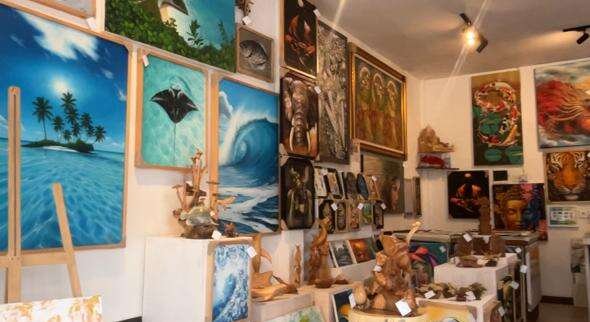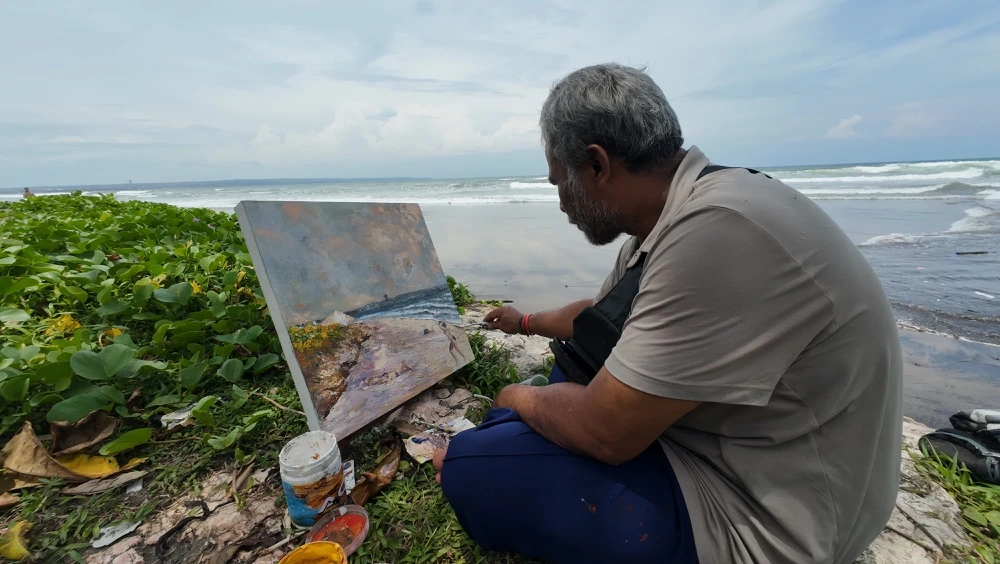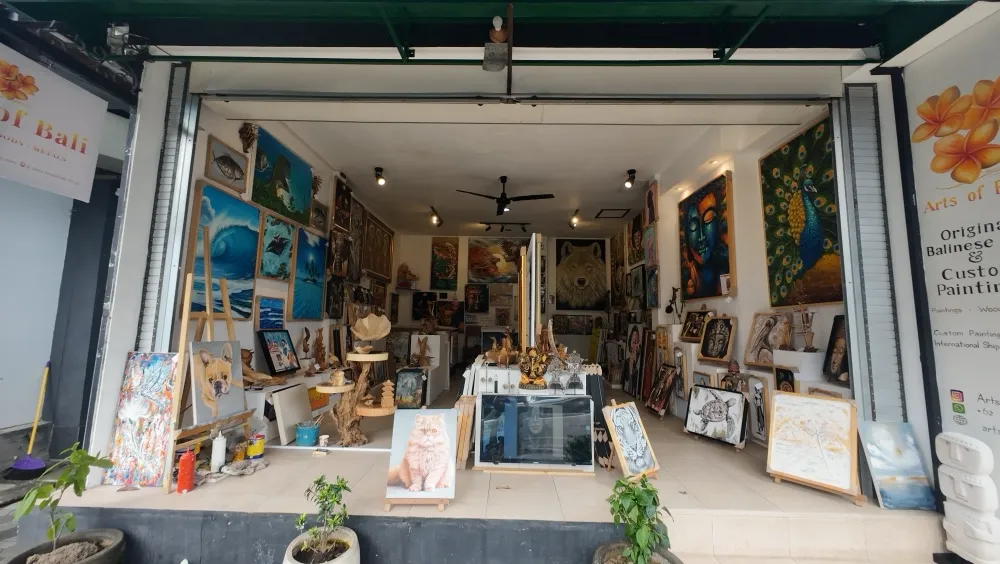
Barong painting in Bali is not a single tradition — it is several, each with its own history, technique, and visual language still alive in studios across Gianyar, Klungkung, and Seminyak today. Original Barong painting Bali artists produce spans dense ceremony canvases with dozens of figures to intimate pastel portraits built from darkness on a black-prepared ground. Arts of Bali gallery in Seminyak carries original works across all of these traditions, directly from the painters who made them.
Key Takeaways
- Barong Ket — the lion Barong — is the most commonly depicted form in fine art canvas painting
- Original Barong paintings are oil, acrylic, or pastel on canvas; never flat prints
- Сайт poleng (black-and-white checkered fabric) always appears and carries deep spiritual meaning
- Works range from intimate portrait-scale canvases to large narrative paintings 150 × 200 cm and beyond
- Authentic pieces carry the artist’s signature and a certificate of provenance from the gallery
Definition: A Barong painting is an original work of visual art depicting Barong, the sacred guardian spirit of Balinese Hinduism, rendered in any fine art medium by a Balinese artist.
There is a second — you will know exactly which one — when Barong walks onto a stage in Bali and every part of your body understands something that your mind hasn’t processed yet.
The crowd goes quiet. The gamelan shifts. A creature made of gold, fur, and centuries of belief fills the air with presence. That is not performance. That is Barong.
For those who have stood in the open courtyard of a pura in Batubulan at dusk, or watched the Kris dance unfold at a temple in Singapadu village, the feeling does not leave when the ceremony ends. It travels home with you — and for many, it becomes the reason they walk into a gallery looking for a painting.
This is a guide to Barong painting in Bali for those people — what makes each style different from the others, what every symbol in the image actually means, and how to find the work that carries that feeling home.
What Is Barong? The Spirit Behind the Paint
In Balinese Hindu cosmology, Barong is the bhuta kala — a powerful protective spirit who guards the village, the temple, and the human world from the forces of chaos. He is not simply a costume or a character. He is considered sakral (sacred) and is stored in the gedong (inner temple chamber) when not in ceremonial use.
Barong represents the eternal struggle between dharma (right action) and adharma (disorder) — a battle that is never permanently won or lost, but endlessly renewed. His eternal opponent is Rangda, the widow-witch, and their conflict forms the cosmological foundation of Balinese spiritual life. The mythological background of Barong spans temple traditions across all nine regencies of the island, each with its own sacred costume, its own ceremonial schedule, its own relationship to this force.
When a Balinese painter chooses Barong as a subject, they are not simply choosing a dramatic image. They are entering a conversation with something their culture has treated as alive for more than a thousand years.
The 5 Forms of Barong in Balinese Painting
Not all Barong are the same. A painter working in Singapadu or Ubud chooses which form to depict — and each carries its own symbolism and visual vocabulary.
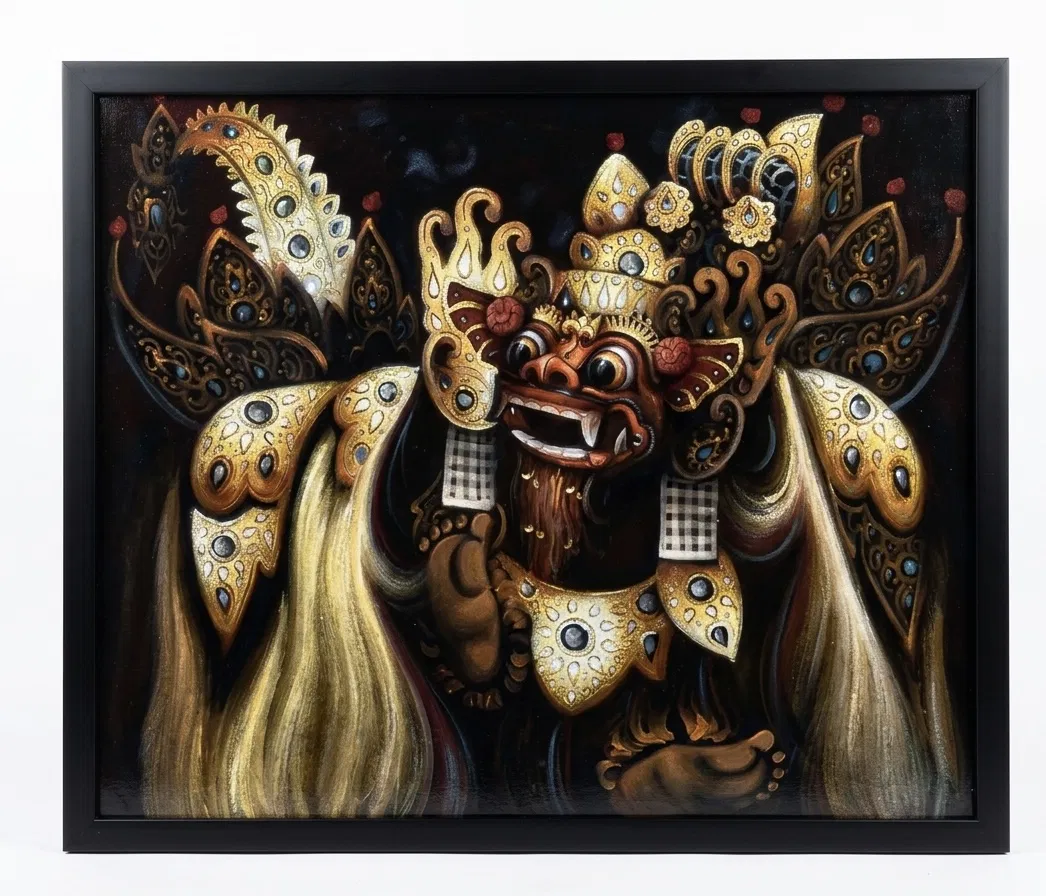
Barong Ket is the most recognizable: the shaggy lion-body with golden ornamental headdress, protruding fangs, wide eyes, and long white or gold fur. He is the most commonly depicted in fine art canvas painting, because his visual complexity rewards detail — the layered golden kwade (armor panels), the poleng fabric at his chest, the mirrored disc ornaments that catch light.
Barong Bangkal takes the form of a wild boar. Rarer in painting, but when rendered, usually appears in narrative ceremony scenes showing the full cosmological battle.
Barong Macan is the tiger Barong — striped, fierce, and associated with specific villages in Tabanan and Buleleng. Painters from those regions sometimes feature this form.
Barong Landung is depicted as two tall puppet-like giants, one light and one dark. Almost never rendered as an intimate portrait painting — more commonly found in large narrative canvases.
Barong Naga takes the form of a dragon-serpent. Rare in fine art painting but appears in some Kamasan scroll-style works.
For the collector, understanding which Barong a painting depicts adds a layer of meaning that transforms the work from decoration into dialogue.
Artistic TraditionsHow Balinese Artists Interpret Barong: Five Distinct Approaches
One of the most remarkable things about Barong as a painting subject is how completely different it looks depending on which artistic tradition the painter works within.
The Traditional Approach: Batuan and Kamasan
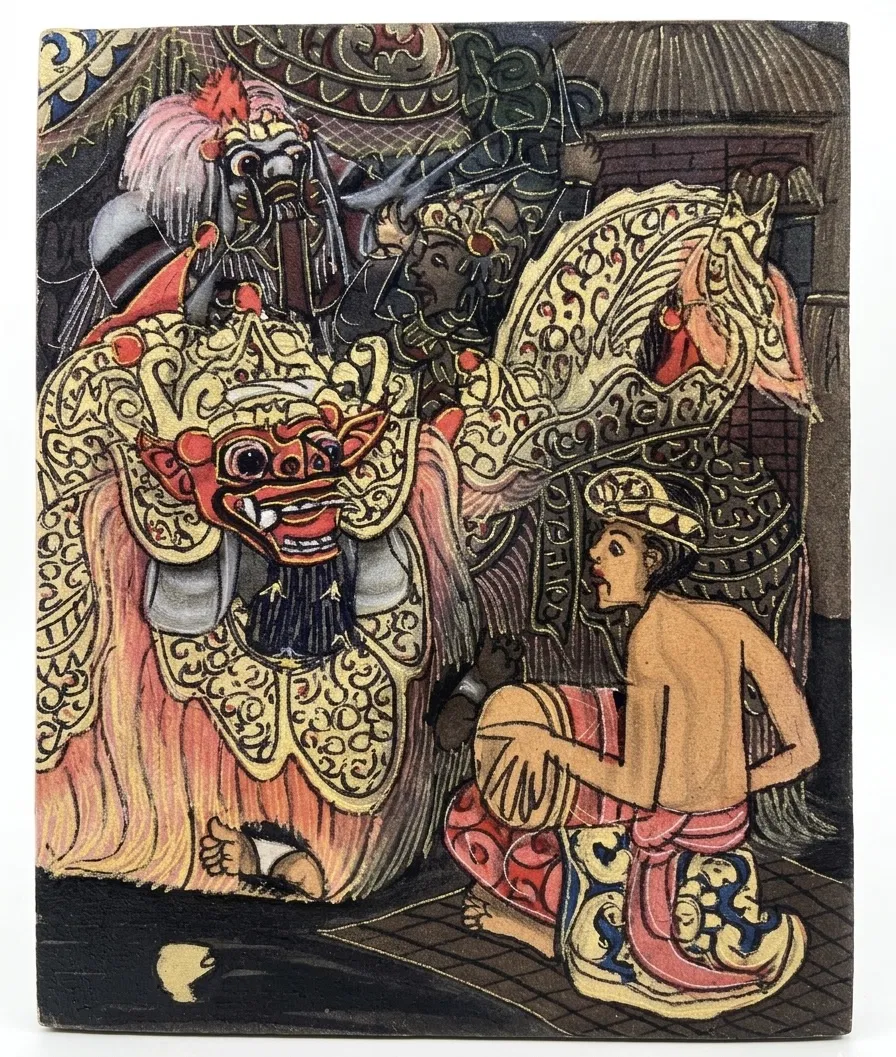
In the oldest Balinese painting traditions — Batuan from Gianyar regency, Kamasan from Klungkung — Barong appears not as a portrait subject but as a participant in a sacred drama. The paintings are dense with figures: temple architecture in the background, dancers in poleng clothing, priests with offerings, Rangda looming, and Barong at the center of swirling action.
These works are painted on canvas or cotton with natural pigments and ink, using fine repetitive lines to build texture. The figure of Barong in a Batuan painting is smaller than the surrounding narrative — he is powerful precisely because the world responds to him, not because he fills the frame.
The Batuan school was first documented by Western scholars in the 1930s, when artists including Walter Spies and Rudolf Bonnet worked alongside village painters in Ubud and Batuan — an encounter that shaped but did not invent the tradition. A broader account of this period is covered in the history of Balinese painting. What that history does not capture is what it looks like to visit a studio in Batuan village today, where painters in their twenties are still learning the technique from their parents.
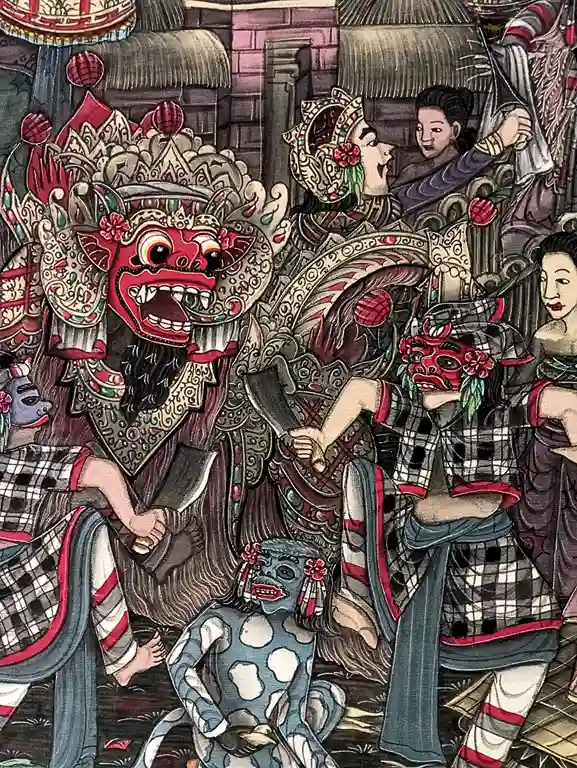
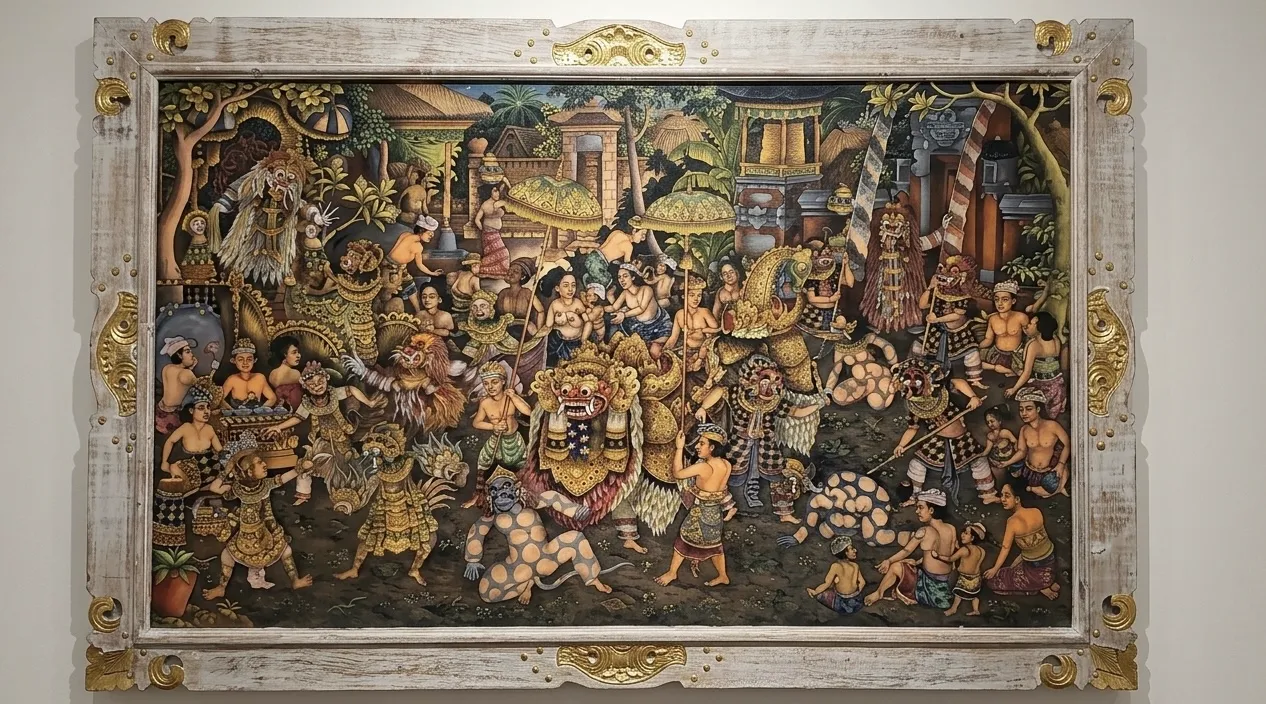
The large narrative canvas above — currently in the Arts of Bali gallery — shows what this tradition looks like at monumental scale: every corner of the painting contains life, ritual, and meaning. Collectors who want a painting that functions as a complete cultural document choose this style.
Explore more works in this tradition: Batuan painting Bali и Камасан живопись Бали.
The Contemporary Portrait: Hyper-Realism on Black Canvas
The most sought-after Barong paintings in the contemporary Balinese fine art market take a completely different approach. Against a deep black ground — sometimes midnight, sometimes charcoal with undertones of indigo — the artist builds Barong’s ornamental armor layer by layer.
Every gold panel is rendered with the precision of a jeweler. The boma (protective faces carved into the armor) look back at the viewer. The fur — whether painted in oil or blended pastel — moves. The eyes hold you.
This style emerged in Bali’s contemporary art scene over the past two decades, applied to sacred subject matter in a way that makes Barong feel newly visible — as if you are seeing him not through a ceremony at dusk but in a studio at noon, every detail available to you.
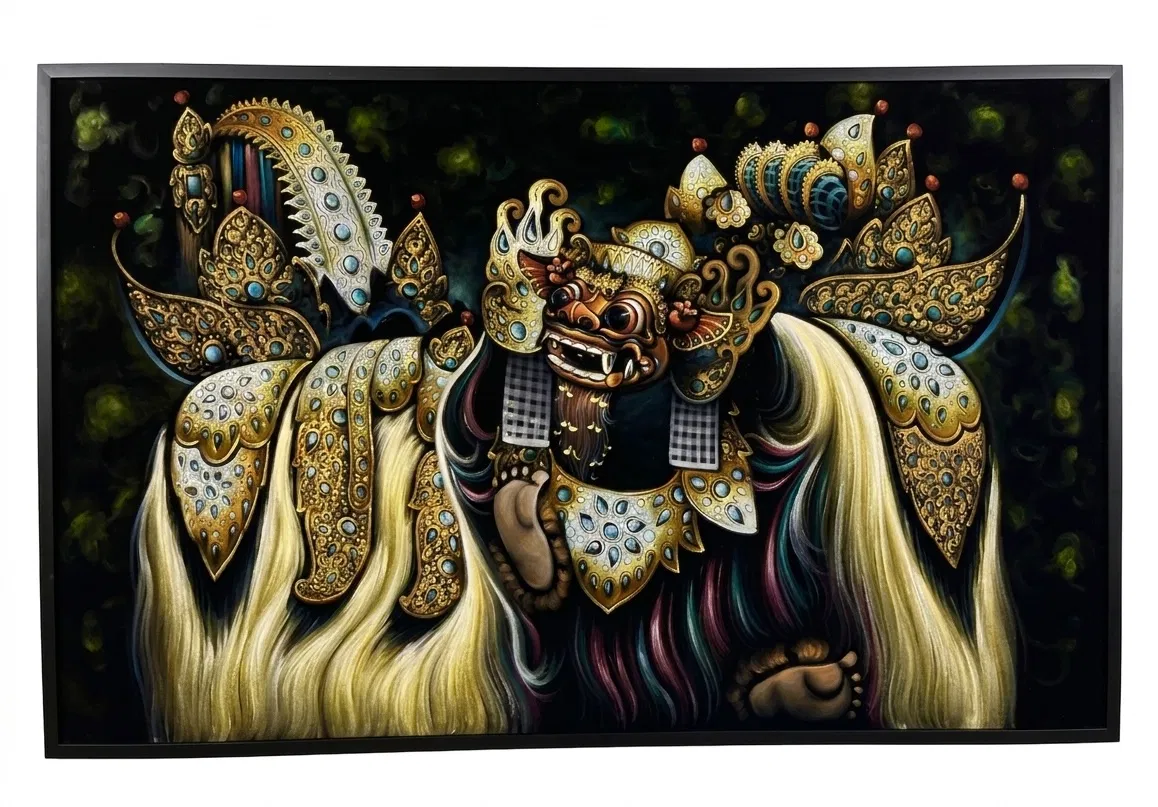
The landscape-format painting above demonstrates how the same subject reads differently at scale. At 100 × 60 cm or larger, the ornamental detail of Barong’s headdress and chest armor creates an almost architectural presence on the wall.
The Intimate Portrait: Pastel and Charcoal Focus
Some of the most quietly powerful Barong paintings take just the face.

Artist Kadek works in pastel on black-prepared canvas, building the face of Barong Ket from darkness. The golden headdress emerges from nothing. The bunga kamboja (frangipani flowers) tucked at each ear — a detail that appears in the actual Barong costume — are rendered in white and yellow with a delicacy that a larger painting would lose. The eyes are the painting’s anchor: wide, slightly orange-ringed, neither threatening nor calm but something more precise — aware.
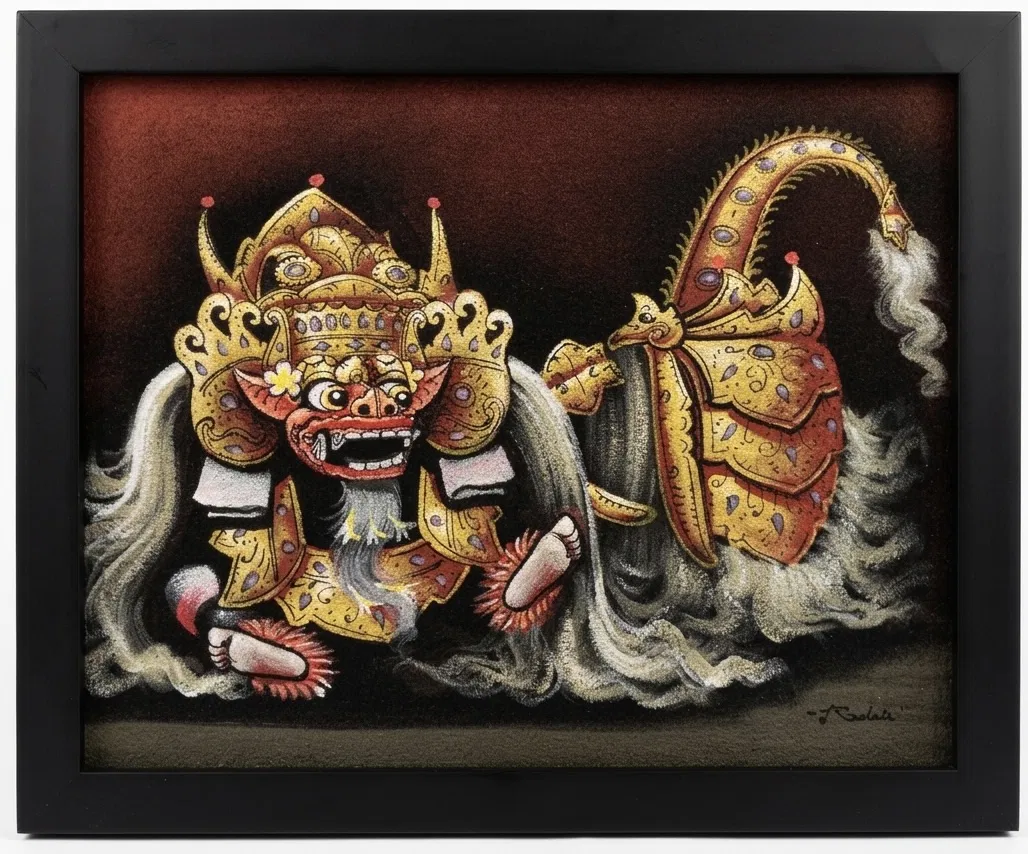
The companion full-body work shows Barong in a different disposition — red ground, the tail curling upward in a detail that separates Barong Ket from all other Barong forms. Together, the intimate portrait by Kadek and this full-body work by Kadek show what years of dedication to a single subject produces: one artist — Kadek — two completely different presences of the same sacred guardian.
The Textured Approach: Palette Knife and Impasto
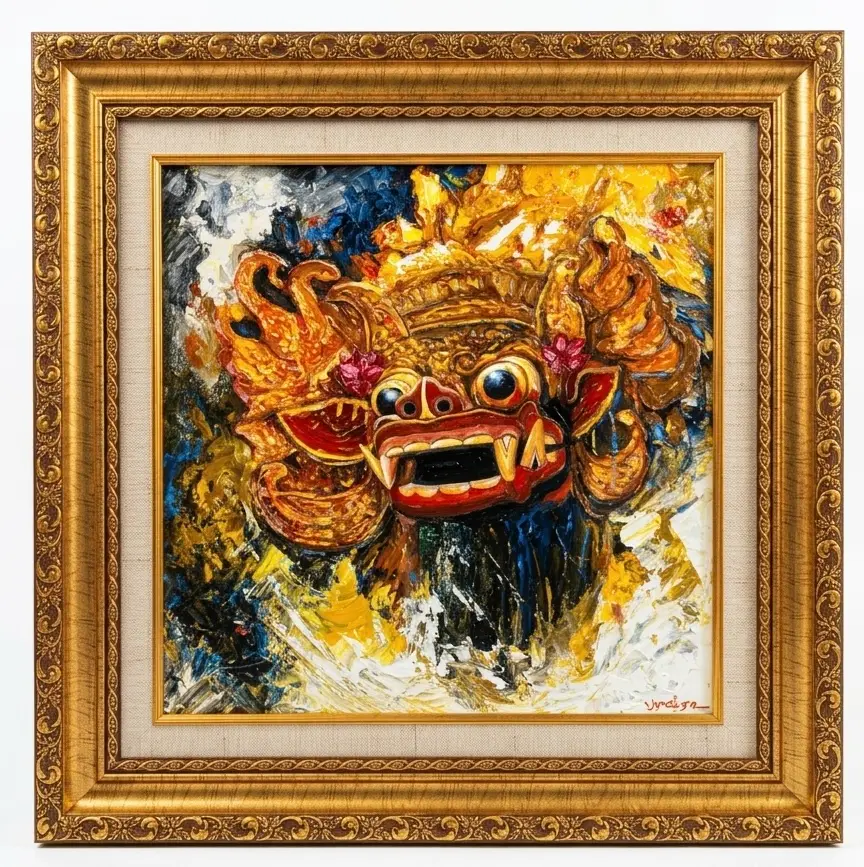
The palette knife school of Balinese painting applies impasto technique to sacred subject matter. Where the hyper-realist approach invites the viewer to look into the painting, the palette knife approach makes the painting push out toward you. The gold of Barong’s headdress is actual texture — ridges and valleys in the paint surface that catch room light differently depending on where you stand. The red and orange of his face are not blended but stacked, one layer over another.
In this reading, Barong does not need a black sky to be dramatic. He makes his own atmosphere.
See more works in this technique: Рисование ножом для палитры Бали и фактурная живопись Бали.
Путеводитель коллекционераReading a Barong Painting: What Every Element Means
The best Barong painting Bali produces rewards close looking. A collector who knows what to look for reads more in the first ten seconds than someone who doesn’t. These are the elements that appear in almost every serious Barong work — and what each one actually means.
The Poleng (black-and-white checkered fabric) appears at Barong’s neck and is one of his defining marks. Poleng represents the balance of opposites — black and white, day and night, sekala и niskala (the visible and invisible worlds). When a painter includes poleng, they are depicting Barong not just as a figure but as a principle.
The Kwade (golden ornamental panels) covering Barong’s body are not merely decorative. They are kavaca — protective armor worn by sacred beings. A painter who renders these with precision is showing their respect for the subject’s status.
The Frangipani flowers (bunga kamboja) at Barong’s ears appear in the actual costume and carry significance: white frangipani is used in temple offerings and cremation ceremonies, connecting Barong to both the protection of the living and the transition of the dead.
The Eyes are always oversized and direct. In Balinese art, eyes represent consciousness and sacred power. An artist who paints Barong’s eyes is painting the part of him that sees you back.
The Fur (bulu) — whether gold, white, or rendered in flowing movement — indicates Barong’s animal nature. Some painters render it realistically; others use it as movement, letting it flow like water or smoke to suggest that Barong is never quite still.
For a broader introduction to Balinese spiritual imagery in painting, see our guide to Картина из балийской мифологии.
Руководство по покупкеHow to Choose a Barong Painting for Your Space
For a modern interior (white walls, minimal furniture): Choose a black-background portrait work — the contrast is dramatic and the figure reads as both ancient and contemporary. A 70 × 90 cm or 80 × 100 cm is usually sufficient for a focal wall.
For a warm, textured interior (wood, rattan, Balinese furniture): A palette knife Barong in warm golds and reds will sit naturally within this environment. The impasto texture adds a tactile resonance that flat paintings cannot achieve.
For a large statement wall (hotel lobby, resort corridor, villa living room): A narrative canvas in the traditional Batuan style — 150 × 200 cm or larger — is the only painting that can hold the proportional weight of these spaces while also rewarding close inspection. See our guide to large painting Bali.
For a private collection focused on craftsmanship: Seek a signed work by a named artist — pieces where you can trace the maker. The most valuable Barong painting Bali collectors invest in over time are not always the largest; they are the ones where the artist’s hand is unmistakably present. These are the works that hold art-historical weight as the Balinese contemporary market continues to grow internationally.
For pricing context across all styles, visit our Справочник по ценам на картины с Бали. If you are purchasing from abroad, our guide to shipping art from Bali covers every step from gallery to your wall.
ГалереяThe Original Barong Paintings at Arts of Bali, Seminyak
Arts of Bali gallery in Seminyak carries original Barong painting Bali artists produce across all the styles described above: traditional narrative canvases, hyper-realistic portraits, intimate pastel works on black canvas, and palette knife impasto originals. Every piece is from a named Balinese artist — the gallery does not sell anonymous work.
Every painting comes with a certificate of authenticity, the artist’s name and background, and — for collectors purchasing to ship internationally — coordination with our gallery team on crating and export documentation.
We do not sell prints or reproductions. Every Barong painting at Arts of Bali is a unique original work.
If you have seen the Barong dance and are looking for the painting that carries that feeling home, our gallery team can help you find the work that matches your space, your taste, and what you experienced in that courtyard. Learn more about Arts of Bali gallery in Seminyak, or start with our guide to покупка произведений искусства на Бали.
Ready to Find Your Barong?
Visit the gallery in Seminyak or reach out to our team. We will help you find the original Barong painting that belongs in your home.
Contact the GalleryFrequently Asked Questions About Barong Painting Bali
What is a Barong painting in Balinese art?
A Barong painting is an original artwork depicting Barong — Bali’s sacred lion-like guardian spirit from Balinese Hindu mythology. It can range from traditional Batuan ceremony scenes on canvas with many figures, to contemporary hyper-realistic oil-on-canvas portrait works. The subject has been central to Balinese visual art for centuries, appearing in temple murals, Kamasan scrolls, and modern gallery fine art.
What does Barong symbolize in a painting?
Barong represents the protective force of dharma (right action) against chaos and evil, eternally opposed to Rangda the widow-witch. Visual elements carry specific meaning: the black-and-white poleng fabric signifies cosmic balance between opposites; the golden armor (kwade) represents sacred protection; the oversized eyes depict divine awareness. Frangipani flowers at the ears connect Barong to both temple offerings and sacred ceremonies.
What is the most common type of Barong shown in paintings?
Barong Ket — the lion form — is by far the most frequently depicted in fine art canvas painting. His visual complexity (layered golden ornaments, distinctive fur, poleng collar, and mirrored disc decorations) makes him the most rewarding subject for painters across all styles. Other forms — Barong Bangkal (boar), Barong Macan (tiger), Barong Landung (giants), and Barong Naga (serpent) — appear occasionally but are far rarer in gallery fine art.
How much does an original Barong painting from Bali cost?
Original Barong paintings at Arts of Bali range from smaller signed works (approximately 40 × 50 cm) to large monumental canvases (150 × 200 cm and beyond). Price depends on size, medium, artist, and technique — palette knife impasto and hyper-realistic detail work typically carry a higher price point due to the time investment. Visit our Справочник по ценам на картины с Бали for a full breakdown, or contact the gallery directly for current availability.
Is it respectful to display a Barong painting in a home outside Bali?
Yes. Barong as a subject in painting is understood as visual art and cultural documentation — distinct from the sacred Barong costume itself, which is a spiritual object stored in a temple chamber. Balinese artists paint Barong specifically to share the image and its meaning with the world. Many collectors outside Bali display Barong paintings as a form of respect for and connection to the culture they encountered.
What is the difference between a Barong painting and a Barong mask?
A Barong painting is a two-dimensional work on canvas, wood, or paper — the image of Barong rendered in oil, acrylic, pastel, or traditional pigments. A Barong mask (carved wood) is a three-dimensional ceremonial object, hand-carved by artisans in villages such as Singapadu in Gianyar. Arts of Bali carries both; they serve different functions in a collection or interior. See our guide to Balinese wood carving masks for more.
Can I commission a custom Barong painting from Arts of Bali?
Yes. Arts of Bali works with Balinese artists on commissioned Barong paintings — you specify size, style (traditional, hyper-realist, palette knife), color palette, and which Barong type to depict. Commission timelines typically range from 3 to 8 weeks depending on scale and complexity. Visit our guide to commissioning art in Bali to understand the full process, then contact the gallery to begin.
Find Your Original Barong Painting in Seminyak
Visit Arts of Bali gallery to see the full collection of original Barong paintings — traditional, hyper-realist, pastel, and palette knife works — all available with a certificate of authenticity.
Посетите галерею Commission a Custom Piece