Saraswati Day in Bali, also called Hari Raya Saraswati, is the Balinese Hindu celebration of Saraswati, the goddess of knowledge, learning, and the arts. It falls on Saniscara Umanis Watugunung, the final day of the 210-day Pawukon calendar, so the date shifts every year rather than sitting on a fixed spot on the Gregorian calendar. The next observance falls on October 31, 2026. An earlier occurrence already passed this year on April 4, 2026, since the 210-day cycle is short enough to complete twice within a single Gregorian year.
Key Takeaways
- Saraswati Day 2026’s next occurrence is October 31, 2026, roughly ten weeks from now. It already fell once this year, on April 4, 2026, because the 210-day Pawukon cycle is shorter than a Gregorian year.
- The date is calculated from the Pawukon calendar, not the Gregorian one, so it moves every year. Always confirm the current year’s date against a Balinese calendar publisher before making plans around it.
- Books and lontar manuscripts receive offerings and are set aside for the day, a practice tied directly to what the goddess represents.
- The following Sunday, Banyupinaruh, is a water purification ritual that also marks the start of a new 210-day cycle.
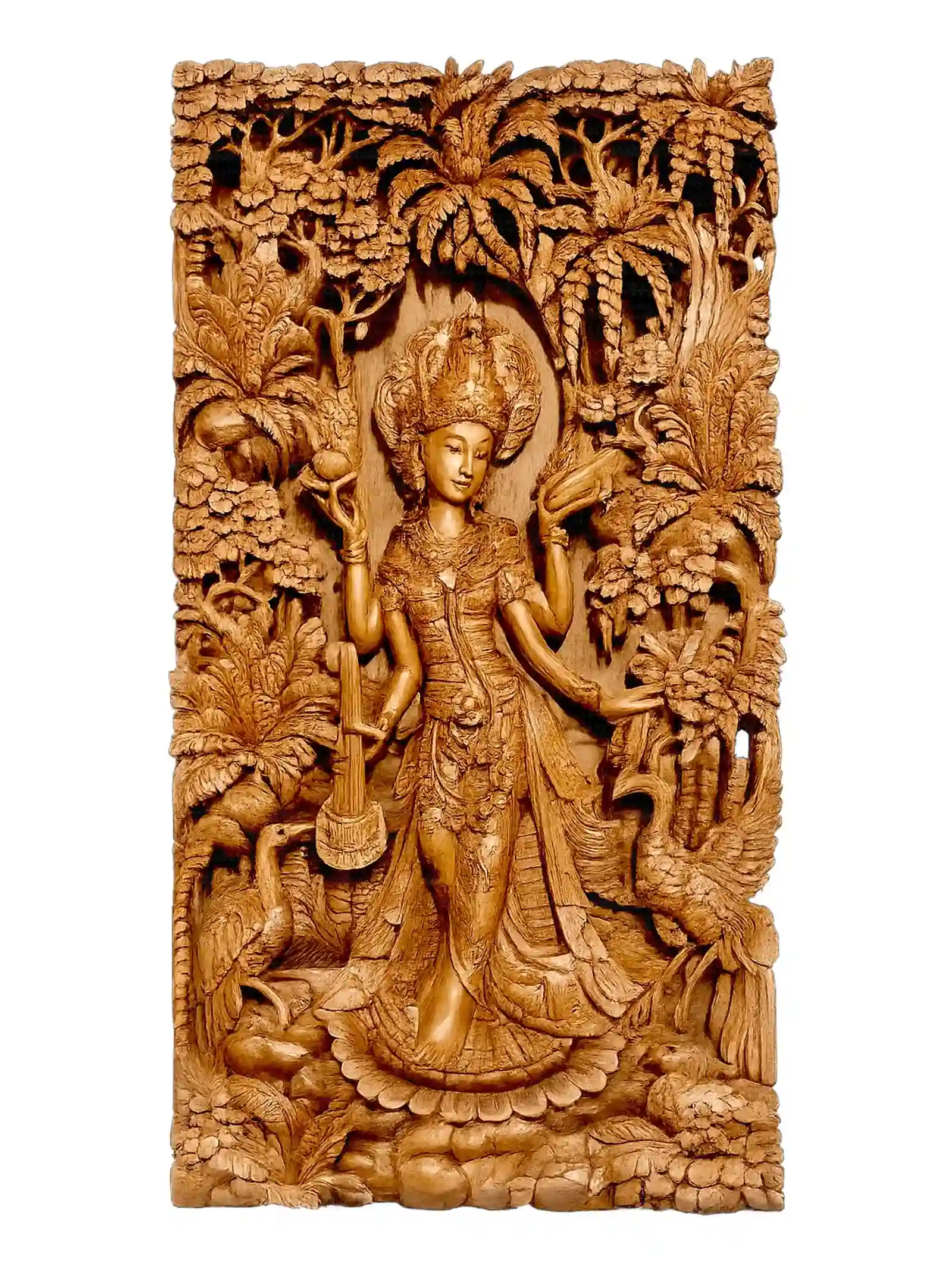
- Saraswati is traditionally shown seated on a white swan (Angsa or Hamsa) among lotus blooms, holding a veena, imagery that shows up across Balinese painting and wood carving well beyond the festival itself.
Definition: Saraswati Day is the Balinese Hindu holy day honoring the goddess of knowledge, observed on the last day of the 210-day Pawukon calendar cycle, with its exact Gregorian date changing every year.
Walk into a school in Bali on the right morning and every book on every desk has a small offering resting on top of it, a few grains of rice, a flower, sometimes a coin. Nobody opens a textbook that day. It isn’t neglect. It’s Saraswati Day, and for twenty-four hours, knowledge itself is treated as something to be honored rather than used.
This guide covers what Saraswati Day actually celebrates, why its date refuses to sit still on the calendar the way most holidays do, when the next one falls, and why the goddess behind it shows up so often on gallery walls and temple carvings across the island. If you’ve ever looked at a Balinese painting of a woman seated on a swan and wondered who she was, this is that answer too. Our complete guide to Balinese art doesn’t cover Saraswati specifically, so consider this the deeper dive into one deity that guide leaves for another day.
The GoddessWho Is Saraswati?
Saraswati is the Hindu goddess of knowledge, wisdom, learning, music, and the arts. In Balinese belief she isn’t a distant, abstract figure. She’s invoked at the start of a school year, thanked before an exam, and honored by anyone whose work depends on skill built through practice, students, teachers, writers, musicians, and craftspeople alike. That last group is worth pausing on, since it includes the wood carvers and painters whose work fills a gallery like ours. Their skill is itself, in Balinese belief, a form of Saraswati’s gift.
She’s traditionally shown seated on or beside a white swan (Angsa, also called Hamsa in Sanskrit), surrounded by blooming lotus flowers, holding a veena, a stringed instrument associated with music and the arts. Our glossary of Balinese art symbols covers the swan and the lotus in more depth as recurring figures on their own, since both appear constantly in Balinese art well beyond Saraswati imagery specifically.
The 210-Day Pawukon Cycle: Why the Date Isn’t Fixed
Most Balinese holy days, Saraswati Day included, aren’t set by the Gregorian calendar most of the world uses. They follow Pawukon, a 210-day cycle built from thirty wuku, or weeks, each with its own name and character. Saraswati Day always falls on Saniscara Umanis Watugunung, meaning the Saturday (Saniscara) that combines with Umanis, one of the five-day market week names, within Wuku Watugunung, the thirtieth and final wuku in the cycle. Since 210 days is shorter than a 365-day year, the whole cycle can complete more than once within a single Gregorian year, which is exactly why Saraswati Day 2026 falls twice: once on April 4, and again on October 31.
There’s a specific story behind why the celebration of knowledge lands on the very last day of the cycle rather than the first. Balinese tradition ties Wuku Watugunung to the myth of King Watugunung, a story that scholars have noted carries the same core shape as the Greek myth of Oedipus. According to the tradition, as told by the Bali culture site NOW! Bali, Watugunung unknowingly married his own mother, and the eventual revelation of that truth is bound up with the myth’s ending and, symbolically, with the end of the calendar cycle itself. Awareness, in other words, is what the story turns on. Placing the celebration of knowledge and self-awareness on the final day of the cycle, right before a new 210-day cycle begins, reads less like coincidence and more like the calendar making a point.
2026 DatesWhen Is Saraswati Day in 2026?
The next Saraswati Day falls on Saturday, October 31, 2026. An earlier occurrence already took place this year on April 4, 2026. Both dates are correct and not a contradiction, they’re simply the two points in 2026 where the 210-day Pawukon cycle happens to land on Saniscara Umanis Watugunung. If you’re reading this anywhere close to the second half of 2026, October 31 is the one worth marking.
Because the date is calculated from a 210-day cycle rather than a fixed Gregorian date, it will fall on a different day again next year. If you’re reading this well after October 2026, it’s worth double-checking the current date against a Balinese calendar publisher such as kalenderbali.org rather than assuming the cycle repeats on the same Gregorian date annually. It doesn’t.
The day directly following Saraswati Day, the Sunday after, is Banyupinaruh, a water purification ritual (pengelukatan) traditionally performed at the beach or a natural spring at sunrise. Banyupinaruh also marks the start of a new 210-day Pawukon cycle, so the two days function together as a close, a purification, and a fresh start within a single weekend.
TraditionsSaraswati Day in Bali: Traditions and Rituals
The clearest sign that Saraswati Day has arrived is what doesn’t happen. Books, lontar manuscripts (the traditional palm-leaf texts used for centuries in Balinese literature and record keeping), and other written material are set aside for the day rather than read or written in. Instead, they receive offerings, small arrangements of flowers, rice, and incense, placed directly on top of books and study materials as a gesture of respect toward the knowledge they hold.
Schools across Bali hold communal prayers, with students dressing in traditional ceremonial clothing rather than uniforms. Temples and family shrines see prayers from anyone whose livelihood depends on learned skill, not only students in the literal sense. Some households also prepare rice cakes shaped like cicak, the small house geckos common across Bali, as an offering connected to the goddess, a detail tied to the gecko’s traditional association with alertness and awareness.
The following morning’s Banyupinaruh ritual closes the observance out. Families gather at the beach or a spring before sunrise for a purification bath, washing away the old cycle before the new 210-day Pawukon begins.
In The GallerySaraswati in Balinese Art
Saraswati is one of the most consistently recognizable figures in Balinese painting and carving, precisely because her iconography is so specific. Look for a seated female figure on a white swan, surrounded by lotus blooms, holding a veena, and it’s almost certainly her. That combination, the swan (Angsa or Hamsa) for discernment and the lotus (Padma) for purity, is covered in more depth in our Balinese art symbols guide, since both figures recur constantly across Balinese art well beyond Saraswati imagery specifically.
Arts of Bali’s current collection includes two original pieces built specifically around this imagery, in two different mediums: the hand carved wooden relief panel shown earlier in this guide, and a classical Ubud style painting, shown below, that leans into finer, more ornamental brushwork, with gold floral motifs worked into the background around the goddess and her swan.
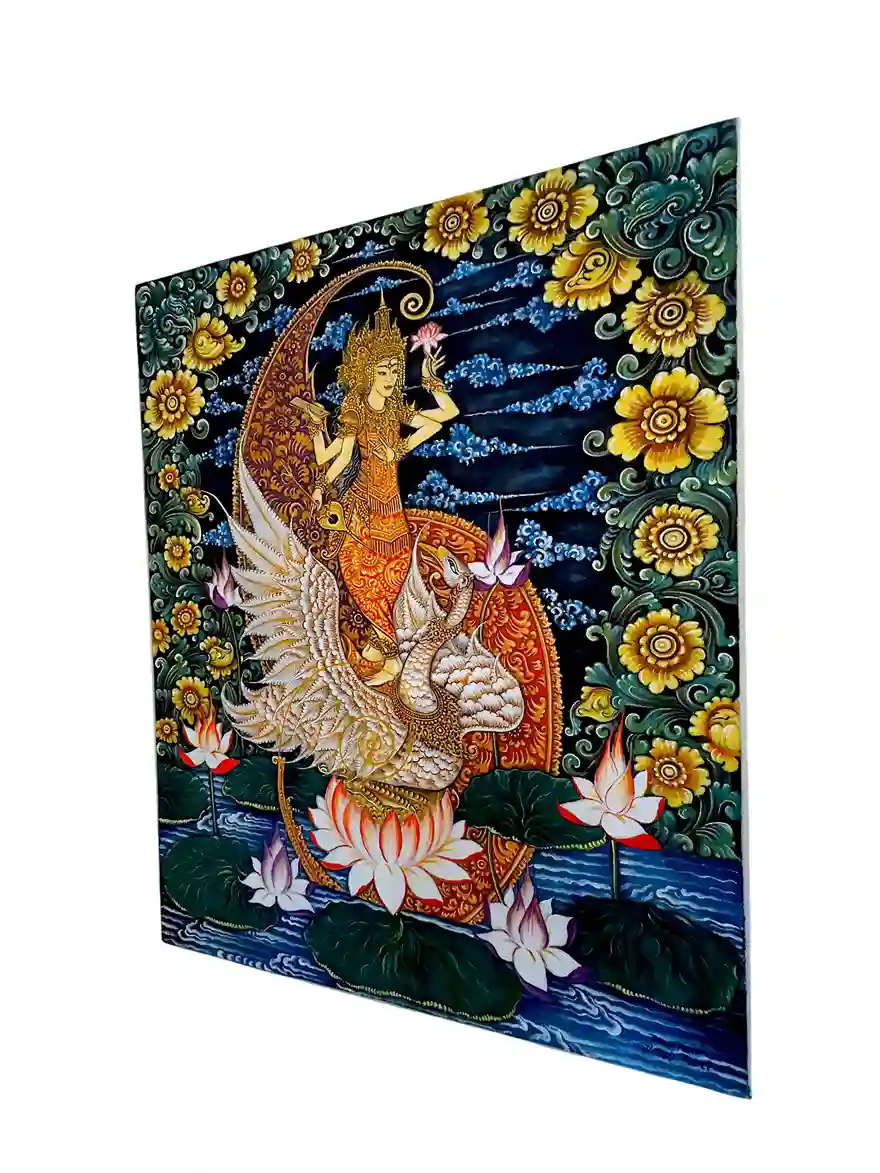
There’s a third medium worth knowing about too. Our guide to Bali bronze statues covers a cast bronze Saraswati, seated on a lotus with her veena in a silver-tone finish, alongside seven other Hindu deities commonly rendered in metal. It’s worth a look if a sculptural piece suits the space better than a painting or a wall-mounted relief.
Saraswati sits within a wider cluster of festival and deity related work in Balinese art. Our guides to Galungan and Nyepi cover two other major points on the Balinese Hindu calendar, and our Kamasan Ganesha painting guide covers another deity frequently painted in the same classical narrative styles. Each celebrates something distinct, Galungan the victory of dharma, Nyepi a day of island-wide silence and self-reflection, Saraswati Day the honoring of knowledge itself, so a collection built around all three reads as a fuller picture of Balinese belief rather than one note repeated three times.
Frequently Asked Questions
What does Saraswati Day celebrate?
When is Saraswati Day in 2026?
Why does Saraswati Day fall on a different date every year?
What is Banyupinaruh and how does it relate to Saraswati Day?
Why can’t books be read or written in on Saraswati Day?
How is Saraswati depicted in Balinese art?
Is Saraswati Day in Bali the same as Vasant Panchami in India?
Looking for a Saraswati Piece Ahead of the Next Celebration?
Both the painted and hand-carved wood relief versions of Saraswati shown above are part of the current Seminyak collection. For the wider vocabulary of figures and symbols that show up across Balinese art, our Balinese art symbols guide is a useful next stop.
Chat on WhatsApp Browse the Gallery