Buddha painting Bali refers to original Buddha portraits made by artists working in Bali, most often using a raised sand-texture technique on canvas. Arts of Bali currently holds eight such pieces: five priced and in stock, ranging from Rp750,000 to Rp3,500,000, and three brand-new arrivals still being priced. Bali is a Hindu-majority island, not a Buddhist one, but its religious history carries a real Hindu-Buddhist thread, which is part of why Buddha remains such a natural subject for Balinese painters.
Key Takeaways
- Arts of Bali holds 8 Buddha paintings: 5 priced and in stock, 3 new arrivals still being finalized.
- Prices for the 5 confirmed pieces range from Rp750,000 to Rp3,500,000.
- Most pieces use a raised sand-texture technique; one uses a lighter semi-texture approach.
- Bali is Hindu-majority, but its religious history includes a documented Hindu-Buddhist syncretic thread, visible at sites like Goa Gajah.
- This guide is a companion to our Kamasan Ganesha Painting 和 巴厘岛纹理绘画 guides.
Definition: A Buddha painting Bali piece is an original, hand-painted Buddha portrait produced by an artist working in Bali, typically finished in acrylic with a textured, tactile surface rather than a flat print.
Walk to the back wall of the Spiritual & Buddha section at Arts of Bali and the same face repeats eight times, and looks nothing alike twice. One Buddha is split down the middle in orange and teal, thick with sand texture. Another is worked entirely in warm gold with faint flecks of color caught in the grain, calm enough to read as stone rather than paint. A third is barely more than a monochrome study in orange, quiet and unadorned. None of them are prints. All of them were built up, layer by layer, by hand.
Bali is not a Buddhist island. It is overwhelmingly Hindu, and has been for centuries. But the line between the island’s Hinduism and Buddhism has never been as clean as that single fact suggests, and a Buddha painting bought in a Seminyak gallery sits inside that longer, more tangled history whether the buyer knows it or not.
This guide walks through all eight Buddha paintings currently at Arts of Bali, five priced and ready to ship, three new arrivals still being catalogued, the sand-texture technique behind most of them, and the actual religious history that makes Buddha such a durable subject for Balinese painters.
Buddha Painting Bali: Why This Subject Fits an Island That Isn’t Buddhist
Bali’s population is overwhelmingly Hindu, practicing a distinct local form generally known as Balinese Hinduism, shaped by centuries of contact with Buddhism rather than developing in isolation from it. That contact left physical evidence still standing on the island. Goa Gajah, the Elephant Cave near Ubud, holds Hindu and Buddhist carvings within the same site, a rare and literal example of the two traditions occupying shared ground rather than separate ones. Buddhism in Indonesia more broadly has a documented history stretching back over a thousand years, well before Islam or, in Bali’s case, before Hinduism took the specific shape it holds today.
None of the eight paintings in this collection claim any specific doctrinal or devotional purpose, and this article makes no claim that they do. Most buyers hang a Buddha painting for the calm the image itself carries, not for religious observance. But painting Buddha on an island whose own religious history quietly includes him is not an arbitrary choice either.
The CollectionThe 8 Buddha Paintings at Arts of Bali
This Buddha painting Bali collection spans two techniques across eight pieces, five already priced and in stock, three brand-new arrivals.
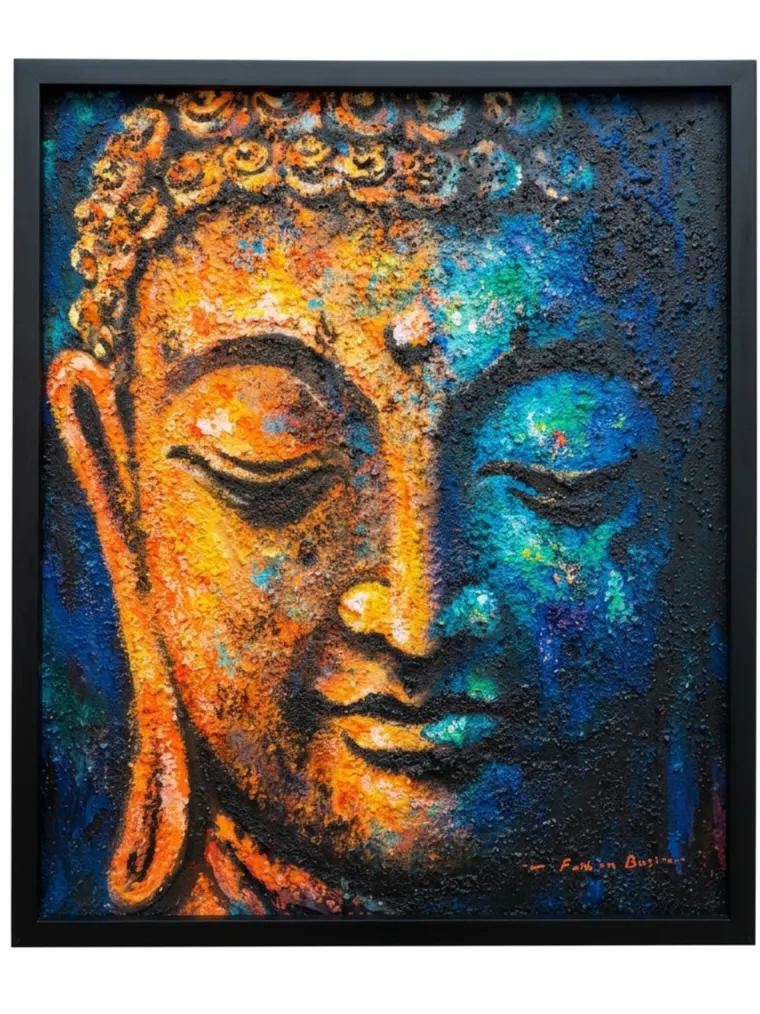
Buddha Painting: Sand Texture, Rp2,100,000
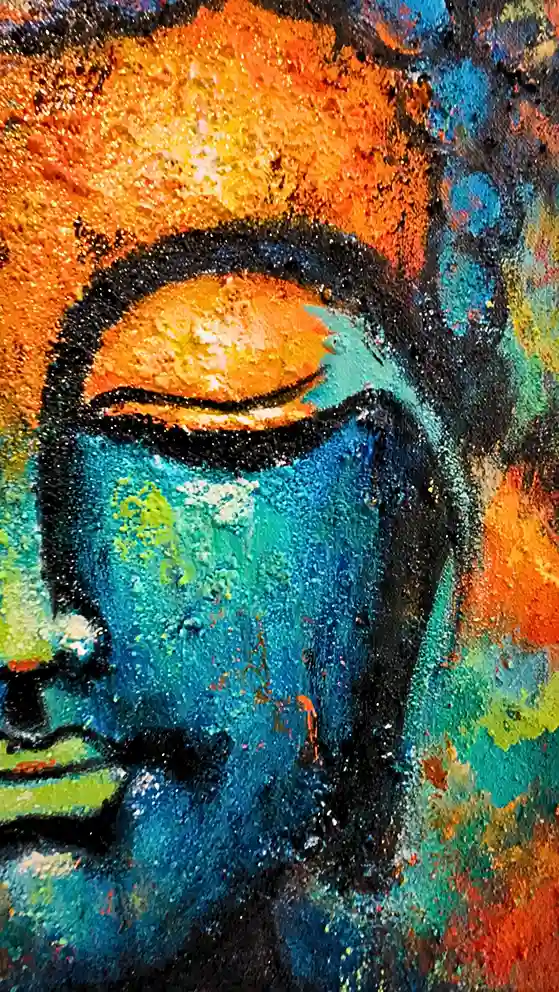
A vertical 50 × 60 cm canvas painted in professional-grade acrylic on Marsoto canvas, split down the middle between warm orange and cool teal-blue. The sand-texture technique gives the face a raised, granular surface that catches light differently depending on where you stand.
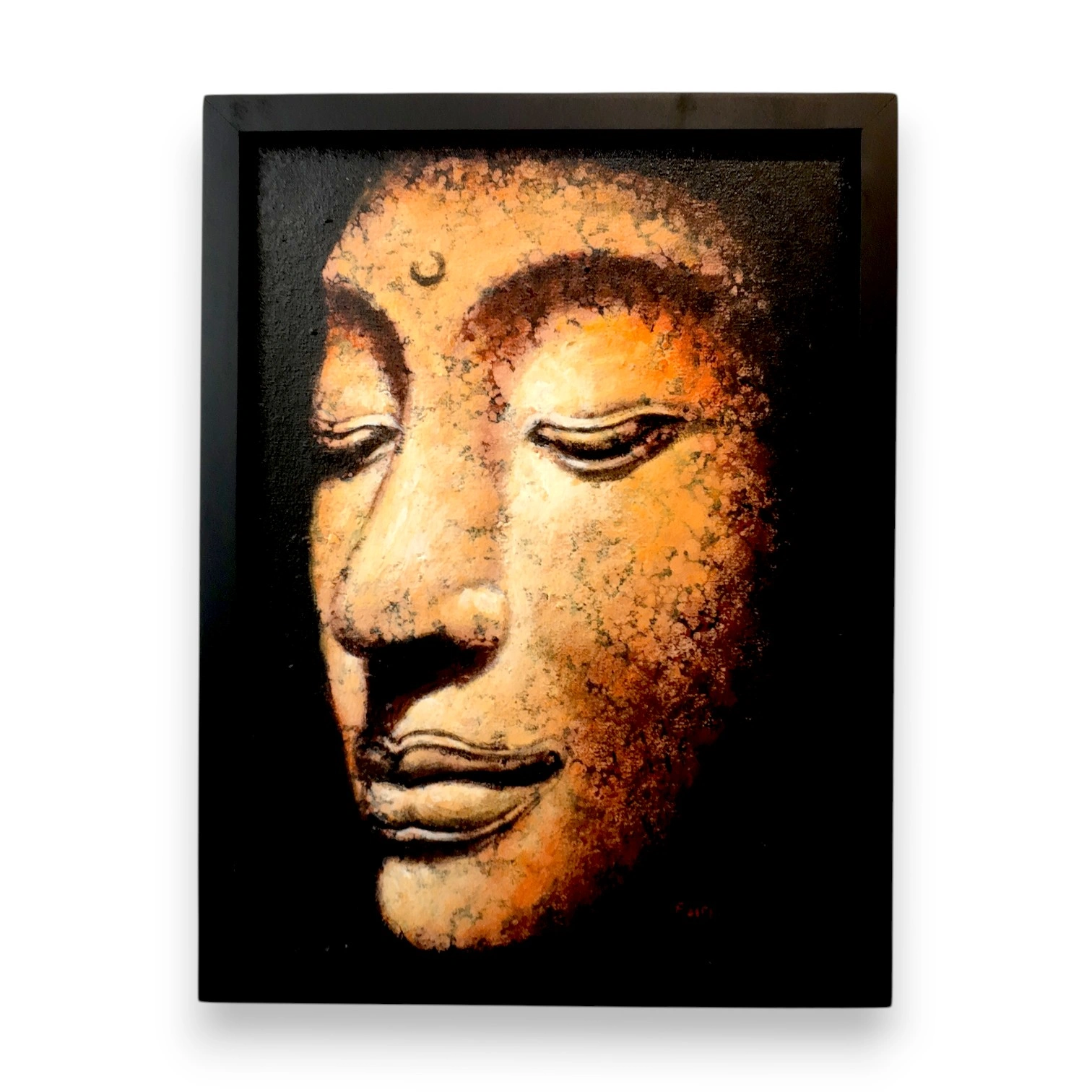
Serene Buddha Head Painting: Sand Texture, Rp2,900,000
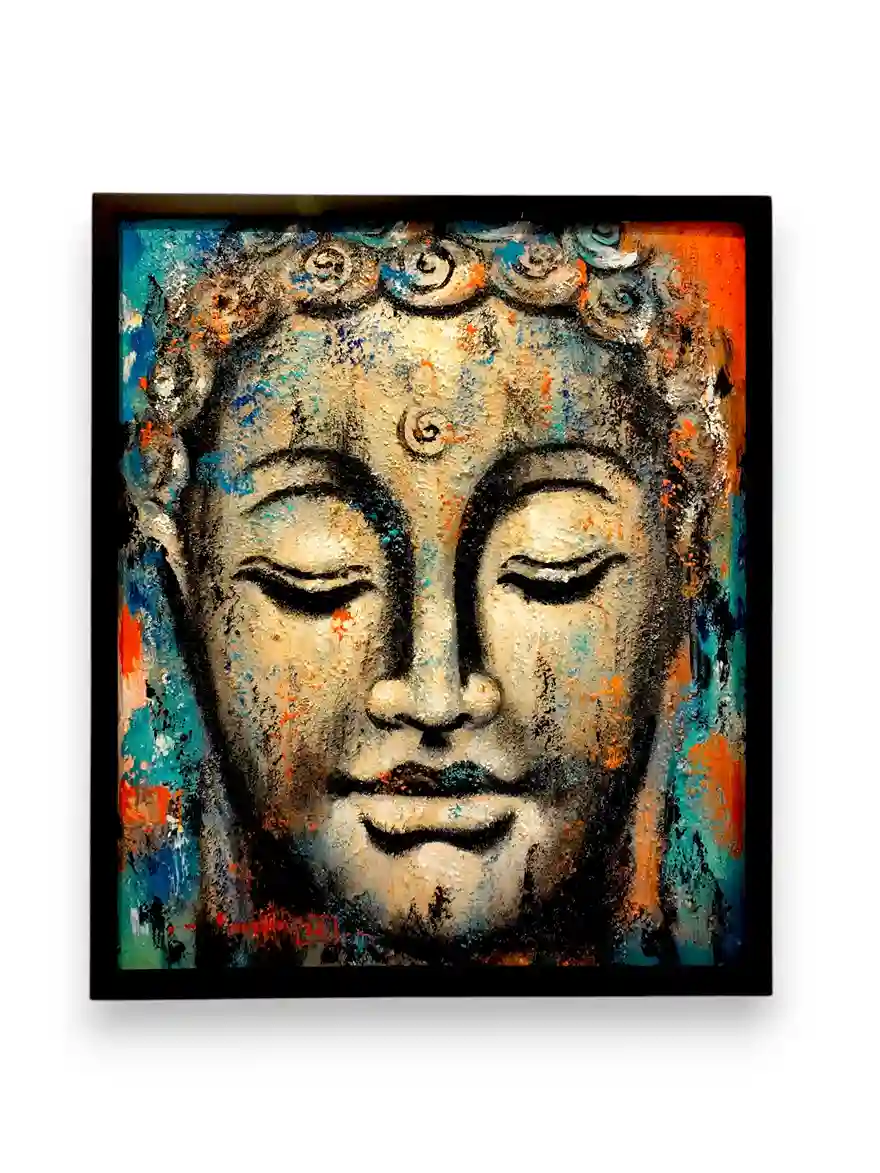
A 50 × 60 cm canvas in acrylic on Marsoto canvas, worked almost entirely in warm gold and tan with faint flecks of red, teal, and blue caught in the texture. The sand-texture finish here reads closer to carved stone than painted canvas.
Serene Buddha Face Painting: Semi-Texture, Rp750,000
The most affordable piece in the collection: a 30 × 40 cm canvas in acrylic on cotton canvas, using a lighter semi-texture technique rather than full sand relief. The palette stays close to a single warm orange-brown tone, quiet rather than dramatic.
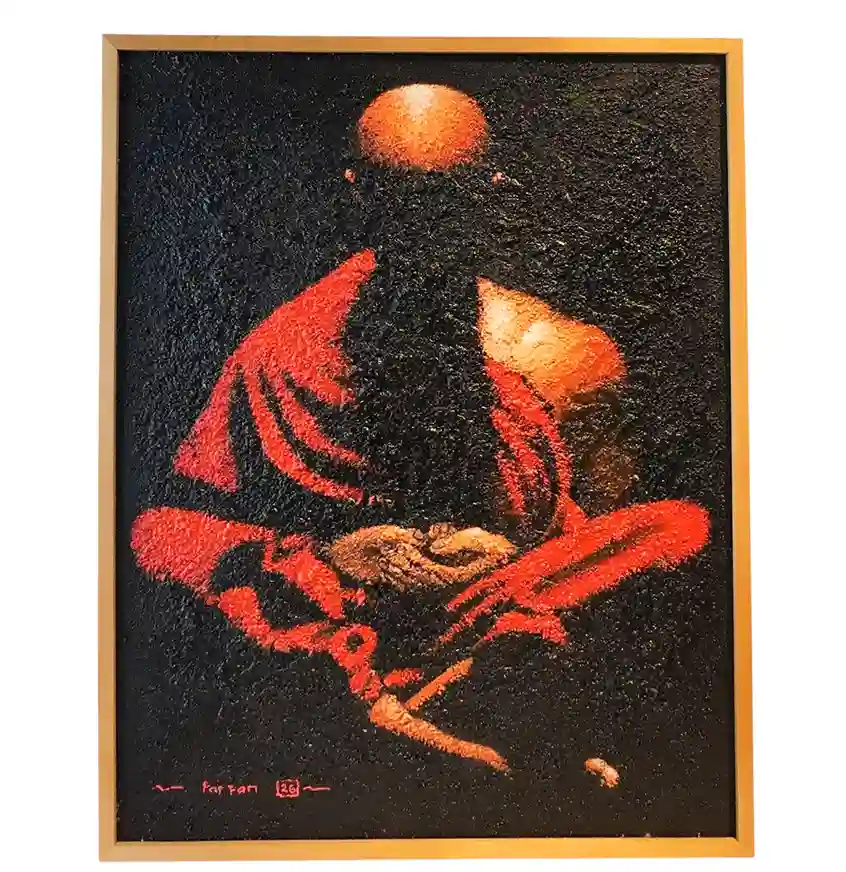
Buddha Mong Painting: Sand Texture, Rp3,500,000
The largest priced piece at 70 × 90 cm, and the only one that departs from a single Buddha face. Buddha Mong Painting depicts a seated monk figure in deep red against a near-black ground, built up with the same sand-texture approach used elsewhere in the collection but applied to a full seated form rather than a close portrait.
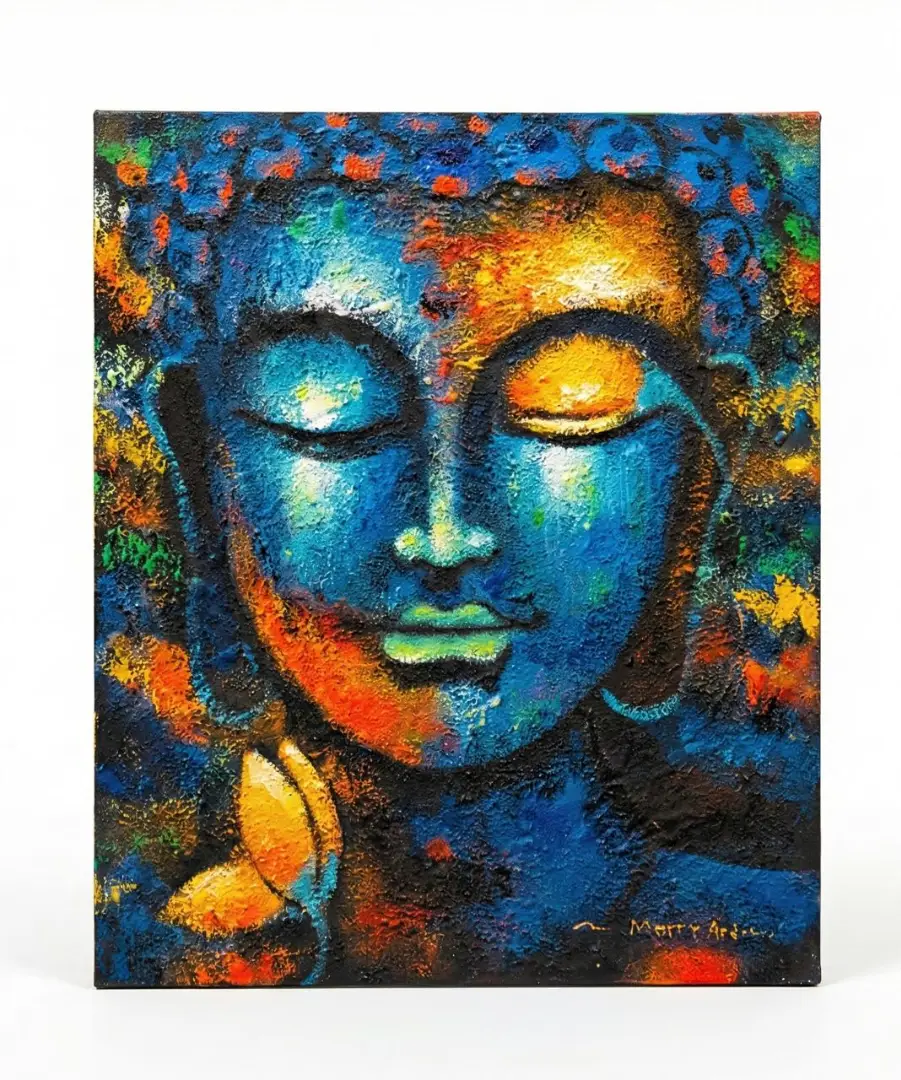
Mystic Buddha Reflection Painting: Sand Texture, Rp3,500,000
A 50 × 60 cm canvas split between deep blue and gold, with a small lotus flower painted at the lower left, signed on the canvas by the artist, Morry Ardeana. The blue side in particular holds a striking, almost luminous quality against the sand-texture grain.
Three New Arrivals: Wood-Textured, Silver Rainbow Burst, and Emerald Ember
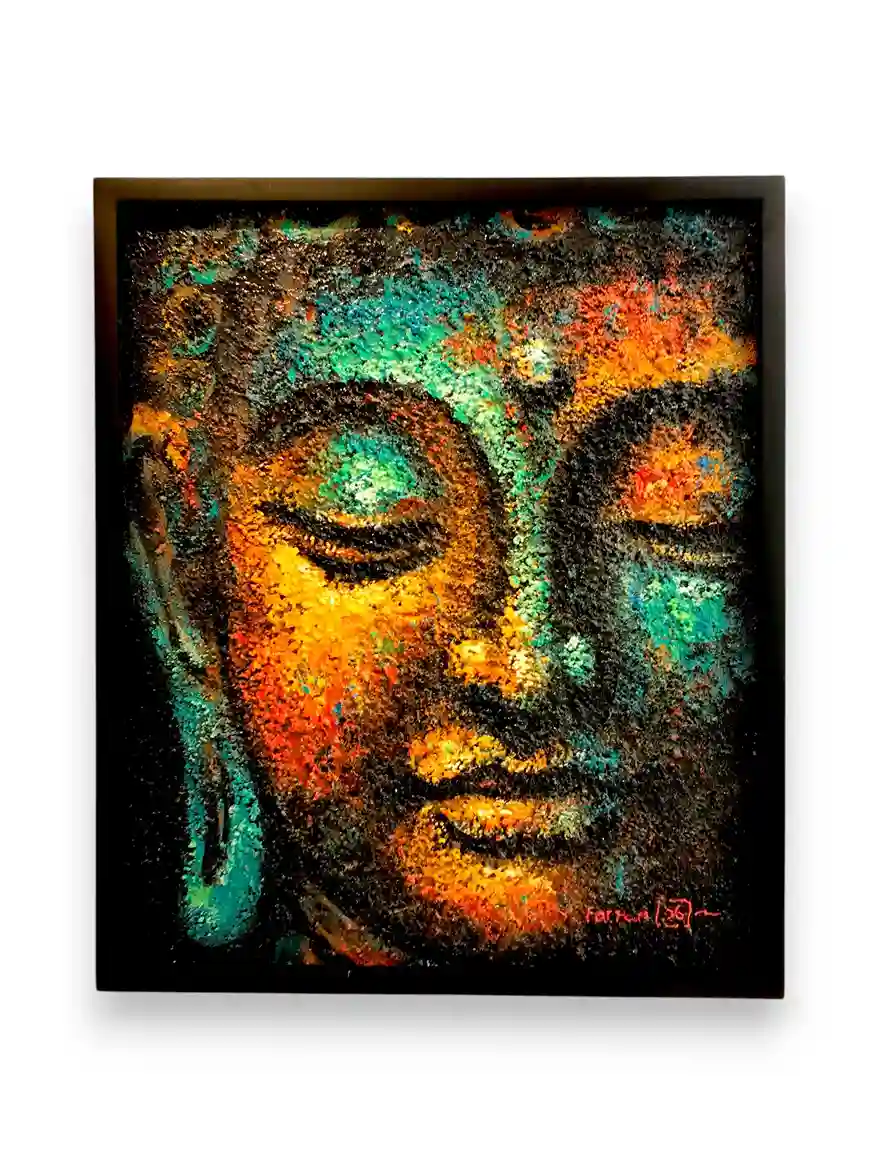
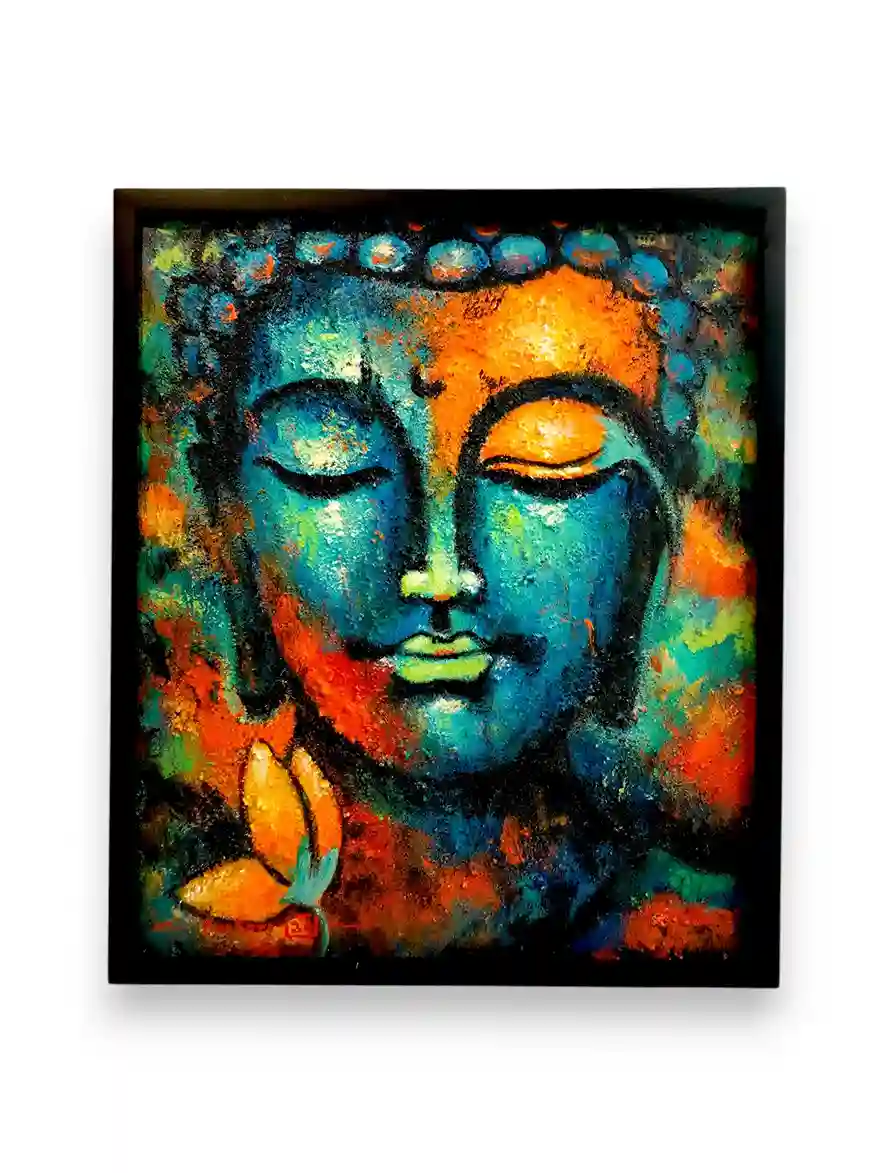
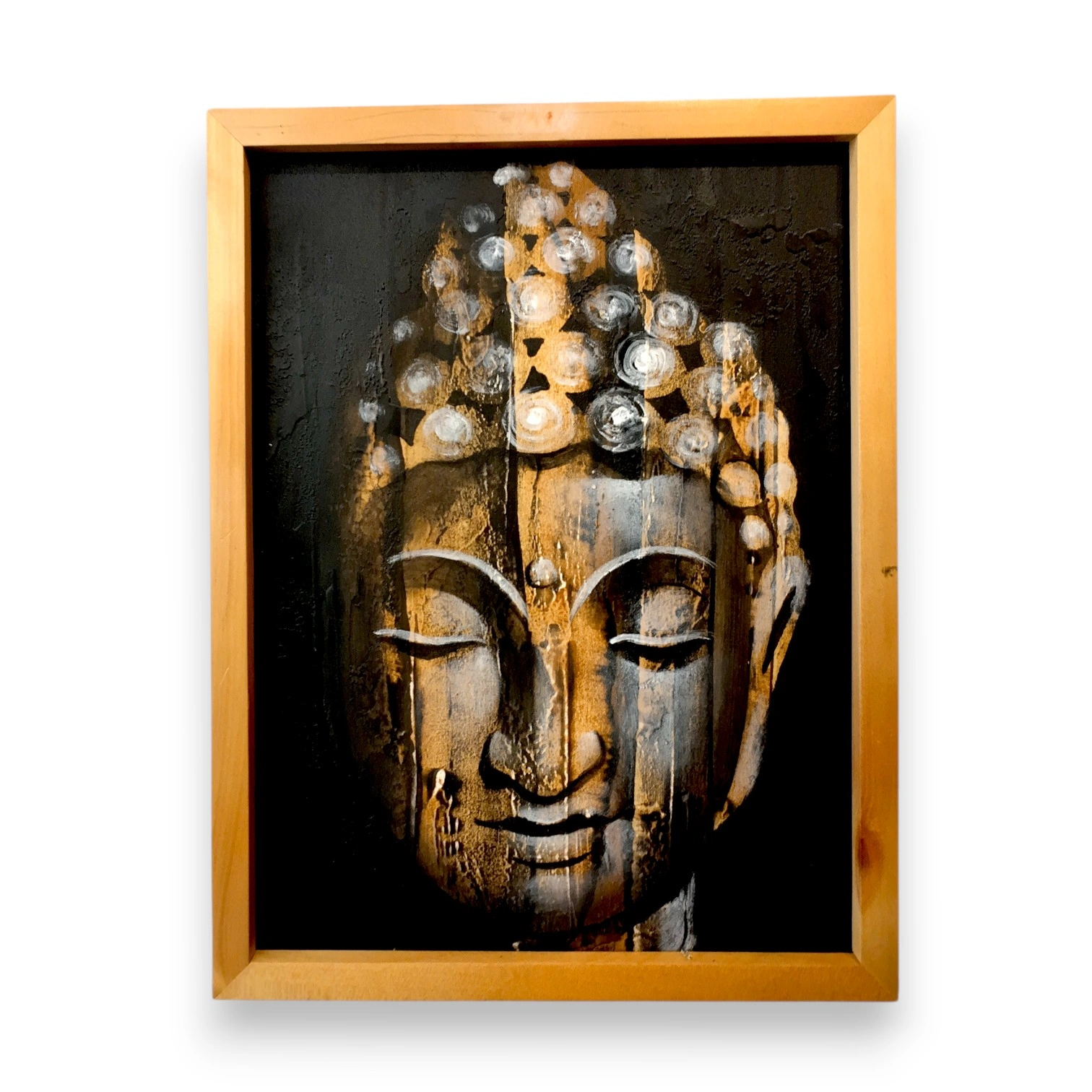
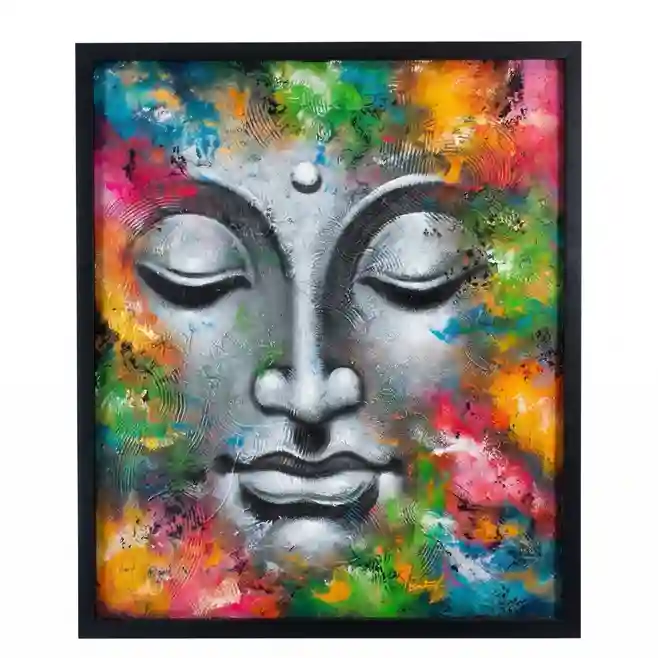
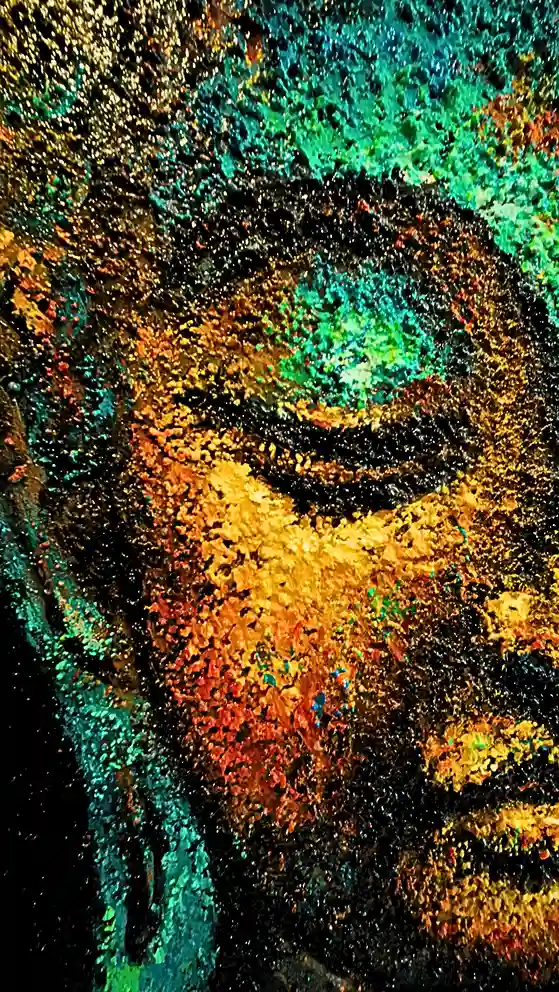
Three additional pieces arrived too recently to have prices, sizes, or product pages yet. Wood-Textured Buddha Painting uses a carved, wood-grain surface finish inside a matching wooden frame, a departure from the black-frame presentation of the rest of the collection. Silver Buddha Rainbow Burst Painting sets a monochrome silver-grey Buddha face against a loose, vivid rainbow-splash background, the most colorful ground in the collection. Emerald Ember Buddha Painting, shown in the hero image above and signed by the artist, splits teal-green and gold across the face with the same heavy sand-texture grain as the priced pieces.
Note on details: size, medium, and price for the three new arrivals are not yet confirmed and are not listed here. Contact the gallery directly for current availability.
Sand Texture vs. Semi-TextureComparing the 8 Buddha Paintings
Placed side by side, these eight pieces show how much a single technique choice, sand texture versus a lighter semi-texture, changes the final feel of the same subject.
| Piece | Technique | Size | Price |
|---|---|---|---|
| Buddha Painting | Sand texture, acrylic on Marsoto canvas | 50 × 60 厘米 | Rp2,100,000 |
| Serene Buddha Head Painting | Sand texture, acrylic on Marsoto canvas | 50 × 60 厘米 | Rp2,900,000 |
| Serene Buddha Face Painting | Semi-texture, acrylic on cotton canvas | 30 × 40 厘米 | Rp750,000 |
| Buddha Mong Painting | Sand texture, acrylic on Marsoto canvas | 70 × 90 厘米 | Rp3,500,000 |
| Mystic Buddha Reflection Painting | Sand texture, acrylic on Marsoto canvas | 50 × 60 厘米 | Rp3,500,000 |
| Wood-Textured Buddha Painting (new) | Wood-grain textured finish | TBD | TBD (contact gallery) |
| Silver Buddha Rainbow Burst Painting (new) | Monochrome, textured | TBD | TBD (contact gallery) |
| Emerald Ember Buddha Painting (new) | Sand texture, acrylic | TBD | TBD (contact gallery) |
Prices as listed at time of publishing (July 2026) and subject to change. Confirm current price and availability with the gallery before ordering.
Sand texture dominates this collection, four of the five priced pieces use it, and it is the technique the gallery clearly leans on for this subject. The one semi-texture piece, Serene Buddha Face Painting, is also the smallest and most affordable, which suggests the lighter technique scales down to smaller canvases more naturally than the heavier sand relief does.
购买指南Choosing a Buddha Painting: What to Look for
The same signals that apply to any original painting apply here, with a few details specific to sand-texture Buddha portraits worth knowing before you buy.
- Feel for real texture, if the piece claims it. A genuine sand-texture painting has physical relief you can see catching light at an angle; a flat print pretending to be textured will not.
- Look at the face’s symmetry and calm. A well-painted Buddha face holds a settled, even expression, not an accidental asymmetry that reads as unfinished.
- Ask what canvas and medium were actually used. A gallery that can specify Marsoto canvas versus cotton canvas, and acrylic versus another medium, is describing real inventory, not a stock description.
- Check for a visible artist signature. Several pieces in this collection are signed directly on the canvas, a small but real marker of an individual hand behind the work.
- Confirm size against your wall before ordering. The size range in this single collection, from 30 × 40 cm to 70 × 90 cm, shows how much scale changes a Buddha painting’s presence in a room.
All eight pieces are original, hand-painted works. For general guidance on evaluating any painting before you buy, see our 巴厘岛艺术品选购指南.
Want to See These 8 Buddha Paintings in Person?
All five priced pieces are in stock at the gallery now, and the three new arrivals can be viewed on request while their details are finalized. Message us to check current availability.
WhatsApp the GalleryCaring for a Sand-Texture Buddha Painting
Sand-texture and semi-texture acrylic paintings share similar care needs. Keep the canvas out of direct, prolonged sunlight to prevent fading, especially on the warm orange and gold tones used across most of this collection. Dust gently with a soft, dry brush rather than a cloth, since textured surfaces can be delicate to the touch. Avoid hanging in direct airflow from air conditioning, which can dry and crack heavier textured surfaces over time.
For international orders, our guide to shipping art from Bali covers packing and crating for canvas works, including the larger 70 × 90 cm piece in this collection.
Where This FitsRelated Spiritual Subjects at Arts of Bali
Buddha is one of several deity and spiritual subjects the gallery works in. Our Kamasan Ganesha Painting guide covers the elephant-headed Hindu deity Ganesha in the classical wayang technique, a useful side-by-side against the sand-texture approach used for most Buddha pieces here. For the technique itself, our Textured Painting Bali guide goes deeper into how sand and palette-knife texture work across subjects beyond Buddha.
Common QuestionsFrequently Asked Questions About Buddha Painting Bali
Does Arts of Bali sell Buddha paintings?
Yes. Arts of Bali currently holds eight Buddha paintings: Buddha Painting (Rp2,100,000), Serene Buddha Head Painting (Rp2,900,000), Serene Buddha Face Painting (Rp750,000), Buddha Mong Painting (Rp3,500,000), Mystic Buddha Reflection Painting (Rp3,500,000), and three new arrivals still being priced. All are original, hand-painted works.
Is Bali a Buddhist island?
No, Bali is overwhelmingly Hindu, practicing a distinct local form generally known as Balinese Hinduism rather than the Hinduism practiced in India. The island’s religious history still includes a documented Hindu-Buddhist syncretic thread, visible today at sites like Goa Gajah, which holds both Hindu and Buddhist carvings side by side.
What technique is used in these Buddha paintings?
Most pieces use a raised sand-texture technique that gives the canvas a physical, tactile surface you can feel under your fingers. One piece, Serene Buddha Face Painting, uses a lighter semi-texture approach instead. Both are hand-applied with acrylic paint, not printed or mass-produced in any way.
How much does a Buddha painting from Bali cost?
The five priced pieces in this collection range from Rp750,000 for a 30 × 40 cm semi-texture piece to Rp3,500,000 for larger sand-texture canvases up to 70 × 90 cm. Price scales mainly with size and technique. The three new arrivals are not yet priced.
Are the three new arrivals available to buy now?
Not yet. Wood-Textured Buddha Painting, Silver Buddha Rainbow Burst Painting, and Emerald Ember Buddha Painting arrived at the gallery too recently to have confirmed sizes, prices, or product pages set up. Contact the gallery directly to ask about current availability and expected pricing.
Is it appropriate to hang a Buddha painting if I’m not Buddhist?
Most buyers of these pieces hang them for the calm the image carries in a living room, meditation space, or office, not for religious observance. None of the eight paintings in this collection are presented as devotional objects, so this is a personal, not a doctrinal, decision.
Can I commission a custom Buddha painting from Arts of Bali?
The gallery accepts custom spiritual and portrait commissions generally, including Buddha-themed pieces. For a Buddha-specific commission, including size, sand-texture or semi-texture technique, and color palette, contact the gallery directly via WhatsApp to discuss options, expected cost, and a realistic timeline before committing to the piece.
How do I care for a sand-texture Buddha painting?
Keep it out of direct, prolonged sunlight to prevent fading, and dust gently with a soft, dry brush rather than a cloth, since textured surfaces can be delicate. Avoid direct air-conditioning airflow, which can dry and crack heavier textured surfaces over time.
See the Buddha Painting Bali Collection at Arts of Bali, Seminyak
Visit the gallery to compare all eight Buddha paintings in person, or reach out to ask about pricing, sizing, and international shipping.
浏览系列 Read Our Kamasan Ganesha Guide