The music stopped decades ago.
The pose never did.
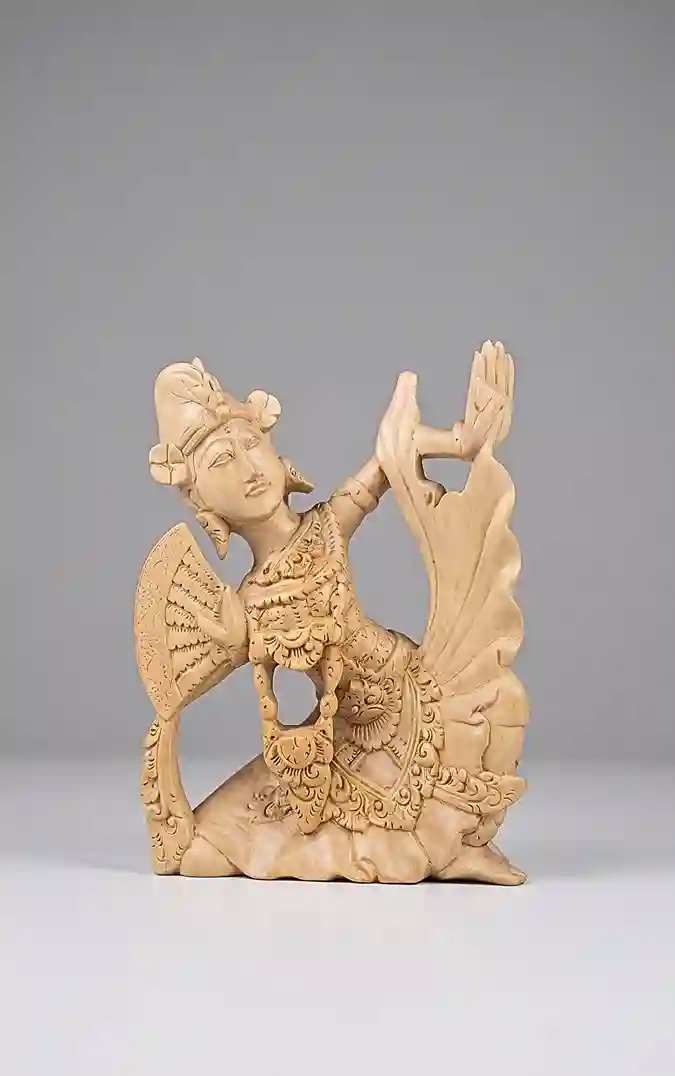
Quick Answer: A Balinese dancer wood carving is a hand-carved wooden sculpture that reproduces a specific pose, costume, and headdress from one of Bali’s classical dances, most often Oleg Tamulilingan, Kebyar Duduk, or Janger. Arts of Bali currently carries 8 original pieces, priced from Rp1,250,000 for a half-body Janger bust to Rp2,250,000 for a seated Kebyar Duduk carving, each carved by artisans trained in the same wood-carving tradition used for the gallery’s masks and temple figures.
- 8 original pieces in stock now, spanning three named dance traditions rather than a single generic “dancer” figure.
- Prices run from Rp1,250,000 for a Janger half-body bust to Rp2,250,000 for the seated Kebyar Duduk carving.
- Every piece reproduces a specific gelungan headdress and costume detail tied to its dance, not an interchangeable design.
- These are decorative collector’s pieces, not props or costumes used in an actual stage performance.
- Custom sizes, finishes, or a different dance subject entirely can be commissioned directly through the gallery.
A Balinese dancer wood carving is a hand-carved wooden sculpture that depicts a figure from one of Bali’s classical dance forms, reproducing the dance’s specific pose, gelungan headdress, and costume detailing, made by carvers trained in the island’s wood-carving tradition rather than by dancers or costume-makers themselves.
Bali’s wood carvers spend most of their attention on two subjects: gods and dancers. We’ve already covered the gods — the Barong and deity masks in our guide to Balinese masks, the epic figures in our Garuda Wisnu Kencana piece. This is the other half: dancers, carved not as a generic figure but as specific characters from specific dances, down to the shape of the headdress and the angle of a raised hand. If you’ve read our guide to Balinese dancer paintings, think of this as the same subject rendered in the round instead of on canvas.
Three Dance Traditions, Carved
The 8 pieces split cleanly along the three dances they depict. Each dance has its own posture, its own headdress style, and — as far as carving goes — its own set of technical demands.
Oleg Tamulilingan
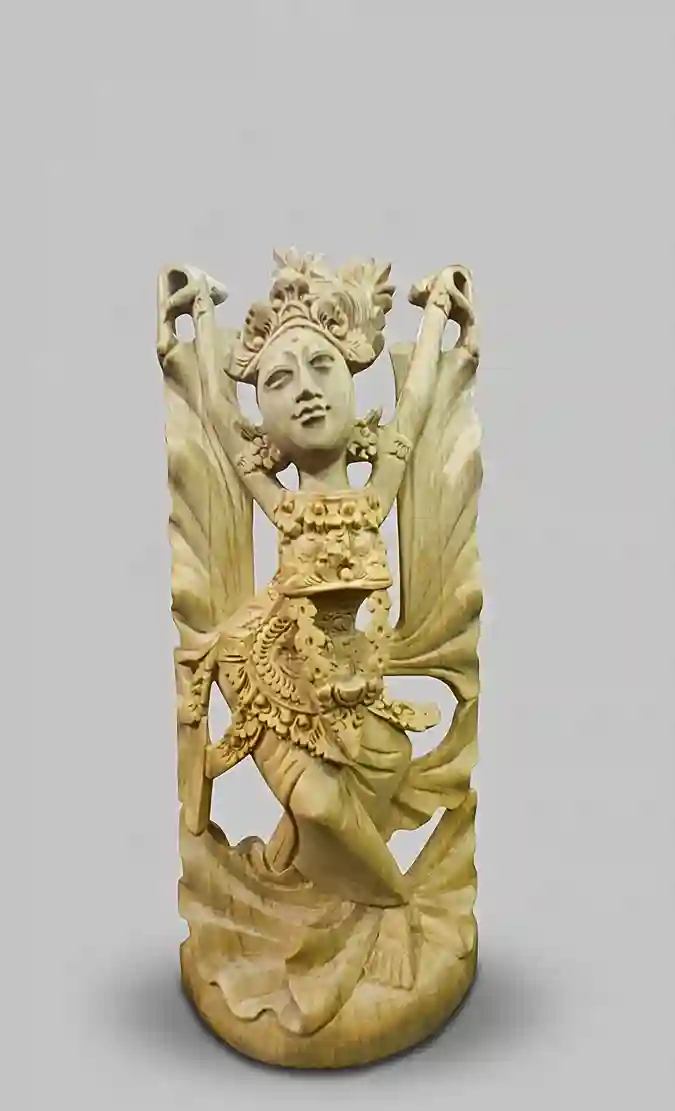
Two carvings from the Dance of the Bumblebees, choreographed in 1952 by the same artist behind Kebyar Duduk. A full standing figure and a smaller companion piece, both built around the dance’s fluid hand and shoulder work.
Kebyar Duduk
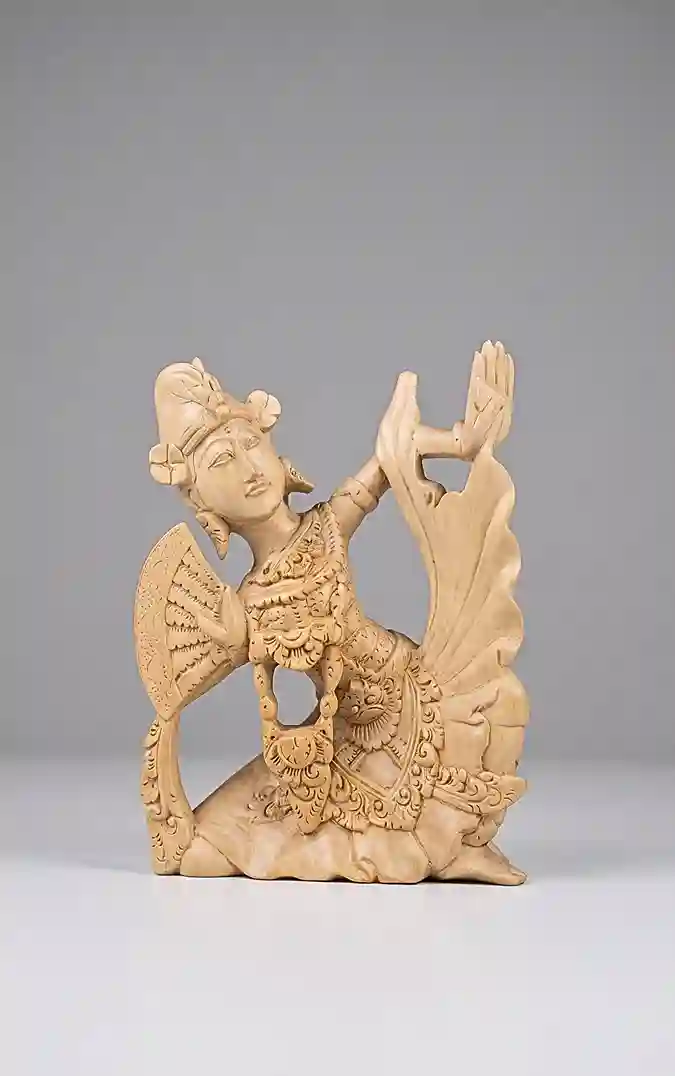
A single seated carving capturing the dance’s signature low, ground-bound posture and fan movement, with the gelungan headdress carved in full detail rather than simplified for scale.
Janger
Five half-body busts sharing the same pose and sunburst-style headdress, each hand-finished individually — the closest thing in this collection to a small edition rather than one unique piece.
The Full Collection at a Glance
The table below lists every piece currently available, grouped by dance, with its carved size and approximate price.
| Piece | Dance | Size | Approx. Price |
|---|---|---|---|
| Premium Balinese Oleg Dancer Sculpture | Oleg Tamulilingan | 40 cm | Rp 1,800,000 |
| Exclusive Tamulilingan Dance Carving | Oleg Tamulilingan | 30 cm | Rp 1,500,000 |
| Sculpture sur bois « Kebyar Duduk » balinaise haut de gamme | Kebyar Duduk | 30 cm | Rp 2,250,000 |
| Janger Half-Body Wood Craft I | Janger | 20 cm | Rp 1,250,000 |
| Janger Half-Body Wood Craft II | Janger | 20 cm | Rp 1,250,000 |
| Janger Half-Body Wood Craft III | Janger | 20 cm | Rp 1,250,000 |
| Janger Half-Body Wood Craft IV | Janger | 20 cm | Rp 1,250,000 |
| Janger Half-Body Wood Craft V | Janger | 20 cm | Rp 1,250,000 |
Prices as of early August 2026; each piece is a small-batch or one-off carving, so a specific item can sell out. Check current stock via WhatsApp before visiting for a particular piece.
Where This Carving Tradition Comes From
Bali’s reputation for figural wood carving is centered historically on Ubud and the surrounding villages of Gianyar regency — including Mas, a village long associated with mask and figure carving specifically — an area that has trained carvers for generations and still supplies much of the wood carving sold across the island today. Devotional figures get most of the attention in guides like ours: masks, deities, temple guardians. Dance figures sit in an interesting middle ground — not ritual objects themselves, but carved likenesses of an art form that is, in Bali, deeply entangled with temple ceremony and offering.
The three dances represented here have distinct histories. Janger is comparatively young by Balinese standards: a social dance that emerged in the 1920s, performed by mixed groups of young men and women in a call-and-response format, built for entertainment rather than temple ritual. Kebyar Duduk is younger still and has a named creator — the dancer and choreographer I Ketut Marya, known as I Mario, first performed it in 1925.
Kebyar Duduk’s defining feature, dancing almost entirely from a seated or crouched position, grew out of the physical constraints of performing within a tightly packed gamelan orchestra. Oleg Tamulilingan, commonly translated as the “Dance of the Bumblebees,” is a later work by the same I Mario — choreographed in 1952 at the request of English writer John Coast, for two dancers from Peliatan near Ubud, ahead of a European and American tour. The name pairs oleg, a swaying dance movement, with tamulilingan, meaning bumblebee, staged as a flirtatious courtship between the two performers.
The five Janger busts are the closest thing in this collection to a limited edition: one pose, one headdress design, carved five separate times. The wood grain and the finish are the only things that tell one apart from another.
Oleg Tamulilingan and Kebyar Duduk: Two Postures, Two Carving Problems
Oleg Tamulilingan and Kebyar Duduk sit at opposite ends of a carving challenge. The Oleg dancer stands, weight shifted onto one hip, arms extended in the dance’s characteristic wide gesture — a pose that asks the carver to balance a tall, narrow figure without the piece looking stiff or top-heavy. At 40 centimeters, the Premium Balinese Oleg Dancer Sculpture is the tallest single figure in this collection, and its stability comes from a wide carved base rather than any added support. The smaller Tamulilingan carving, at 30 centimeters, takes the same dance and compresses it into a more compact standing form, priced accordingly lower.
Kebyar Duduk inverts the problem entirely. Because the dance is performed low to the ground, the carving has to convey motion and drama from a seated, compressed posture instead of an extended one — arguably the harder technical task, since a seated figure has less natural drama to work with than a standing one mid-gesture. The Premium Balinese Kebyar Duduk Wood Carving solves this through the headdress and the angle of the torso: the gelungan is carved with more surface detail than the standing pieces, and the torso twists slightly rather than sitting square, which is where most of the sense of movement in this piece actually comes from.
Janger: Bali’s Youngest Classical Dance, Carved Five Times Over
The five Janger half-body busts are, on paper, a repeat of a single design — same pose, same sunburst-style gelungan, same 20-centimeter scale. In practice, each is carved and finished by hand, and small differences in wood grain, the depth of the headdress relief, and the polish of the finish mean no two busts in the group are perfectly identical. That makes the Janger pieces the collection’s most accessible entry point: five chances at the same subject, at the lowest price point in the group.
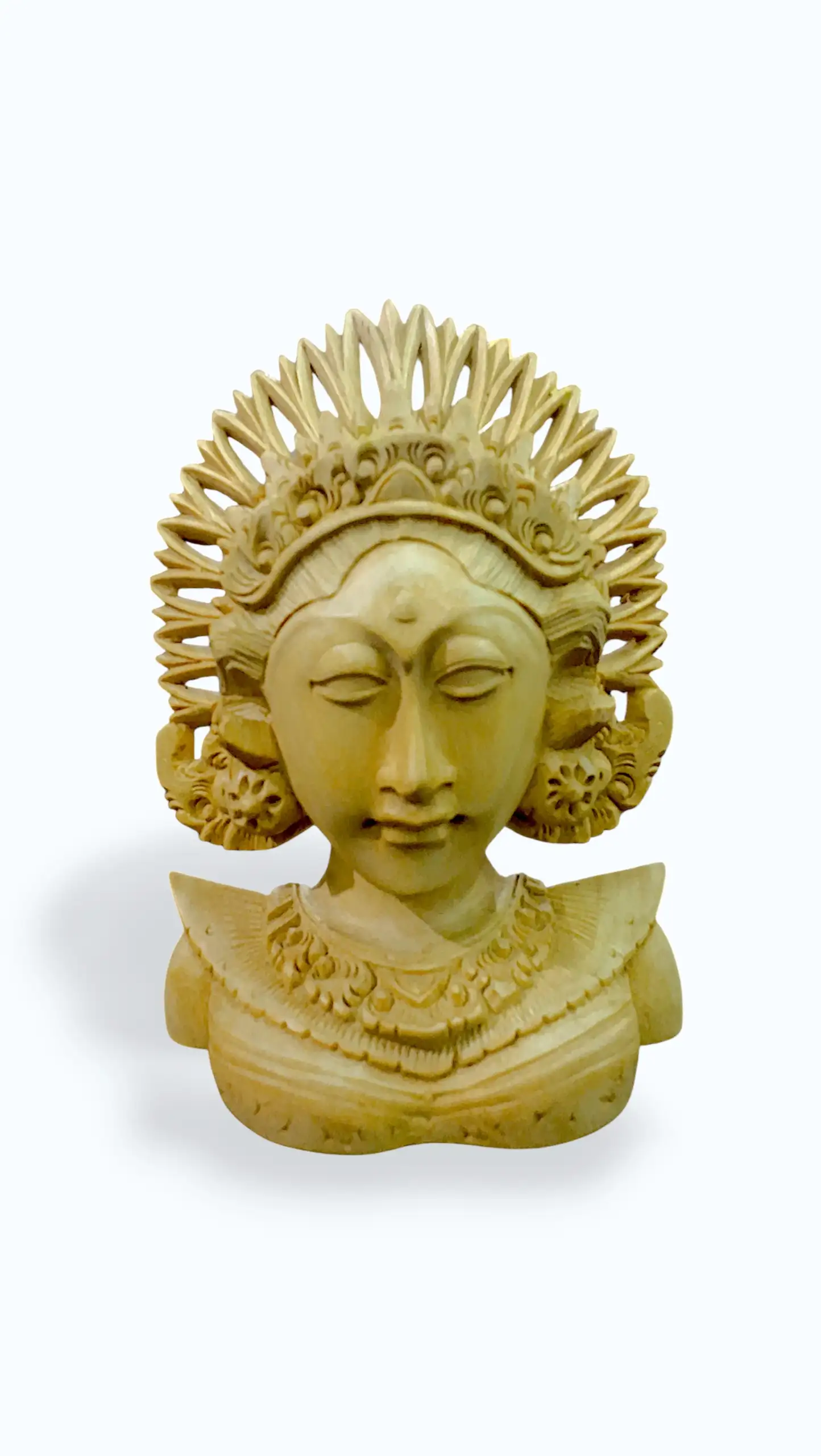
Janger’s youth as a tradition — it dates only to the 1920s, a social dance rather than a temple form — makes it a slightly unusual subject for wood carving compared to the older, more devotionally-rooted subjects covered in our Balinese mask guide. But its visual signature, the sunburst gelungan and the dramatic half-body pose, translates well to a bust format, which is likely why it’s the one dance in this collection carved as a repeatable design rather than a single figure.
How to Choose the Right Piece
Scale and posture are the first practical filters. The Janger busts, all 20 centimeters and priced lowest in the group, work well as a shelf cluster — three or five together read as a coherent set rather than needing to be spaced out. The standing Oleg piece, at 40 centimeters, needs more room to breathe and reads best on its own, ideally with enough clearance that its extended arm gesture isn’t crowded by anything nearby.
Pairing across dances is a matter of taste rather than tradition — nothing about displaying an Oleg dancer next to a Kebyar Duduk carving is historically inconsistent, since both are secular performance dances rather than pieces from the same temple ceremony. The more practical consideration is simply posture: a standing and a seated figure placed at slightly different heights on a shelf or console tends to read better than two pieces competing at the same eye line.
Caring for and Shipping a Dance Carving
These pieces are carved from the same premium hardwood covered in our broader Guide de sculpture sur bois: keep them out of direct sun and away from constant air-conditioning airflow, both of which dry wood unevenly over time, and apply a light coat of natural oil once a year to maintain the tone and protect the finer headdress detailing from drying out and cracking.
All 8 pieces in this collection are compact enough to ship in a padded box, keeping shipping costs modest compared with the gallery’s larger relief panels. Our Guide pour l'expédition d'œuvres d'art depuis Bali covers courier options and the customs paperwork that applies to wood items entering countries like Australia, New Zealand, and the United States.
Browse or Commission a Dance Carving
All 8 pieces in this collection are small-batch or one-off carvings, so current stock is the fastest-changing part of this guide. Check availability and current pricing over WhatsApp, or browse the full gallery online. A different dance subject — Legong, for instance — can be discussed as a custom commission.
Discuter sur WhatsApp Parcourir la galerie