Balinese gamelan is the percussion orchestra of Bali, built mostly from tuned metal keys, gongs and drums and played in a style that Wikipedia calls strong and dynamic, with fast rhythms. UNESCO added gamelan to its Representative List of the Intangible Cultural Heritage of Humanity in 2021. This guide covers what a Balinese gamelan is, how it differs from Javanese gamelan, the instruments, the main ensembles from sacred selonding to gong kebyar, how the shimmering sound is made, where the gongs are forged, and how the music connects to the dances and paintings in our gallery.
Points clés à retenir
- Per Wikipedia, gamelan is ensemble music of the Javanese, Sundanese and Balinese peoples, made up mostly of percussion. Balinese gamelan is described as strong and dynamic with fast rhythms, while Javanese gamelan is soft and slow.
- Instruments are built in pairs tuned slightly apart. The beating between them is called ombak, which means wave, and it gives the ensemble its shimmer.
- Wikipedia sorts Balinese ensembles into three age groups. Selonding is a sacred ensemble dated to at least the 9th century, and gong kebyar had its first public performance in December 1915 at Jagaraga, North Bali.
- Tihingan, in Klungkung, is known for its gong makers. NOW! Bali reports that a group of about ten workers can finish one gong in roughly 3 to 4 hours.
- We are a gallery, not a music school, and we do not sell gamelan instruments. Our Rhythm of the Village procession painting (acrylic on canvas, 85 × 135 cm, Rp12,500,000) shows gamelan players in the Ubud style.
What Is Balinese Gamelan? A Percussion Orchestra Tuned as One Set
Balinese gamelan accompanies ceremony and dance across the island, yet search for it and the first page is a mix of Wikipedia, a travel guide, a school lesson and a resort blog. We carry paintings of village processions and ceremonies, and one of them shows gamelan players, so we wanted one page that connects the music to the art, with every claim tied to a named source.
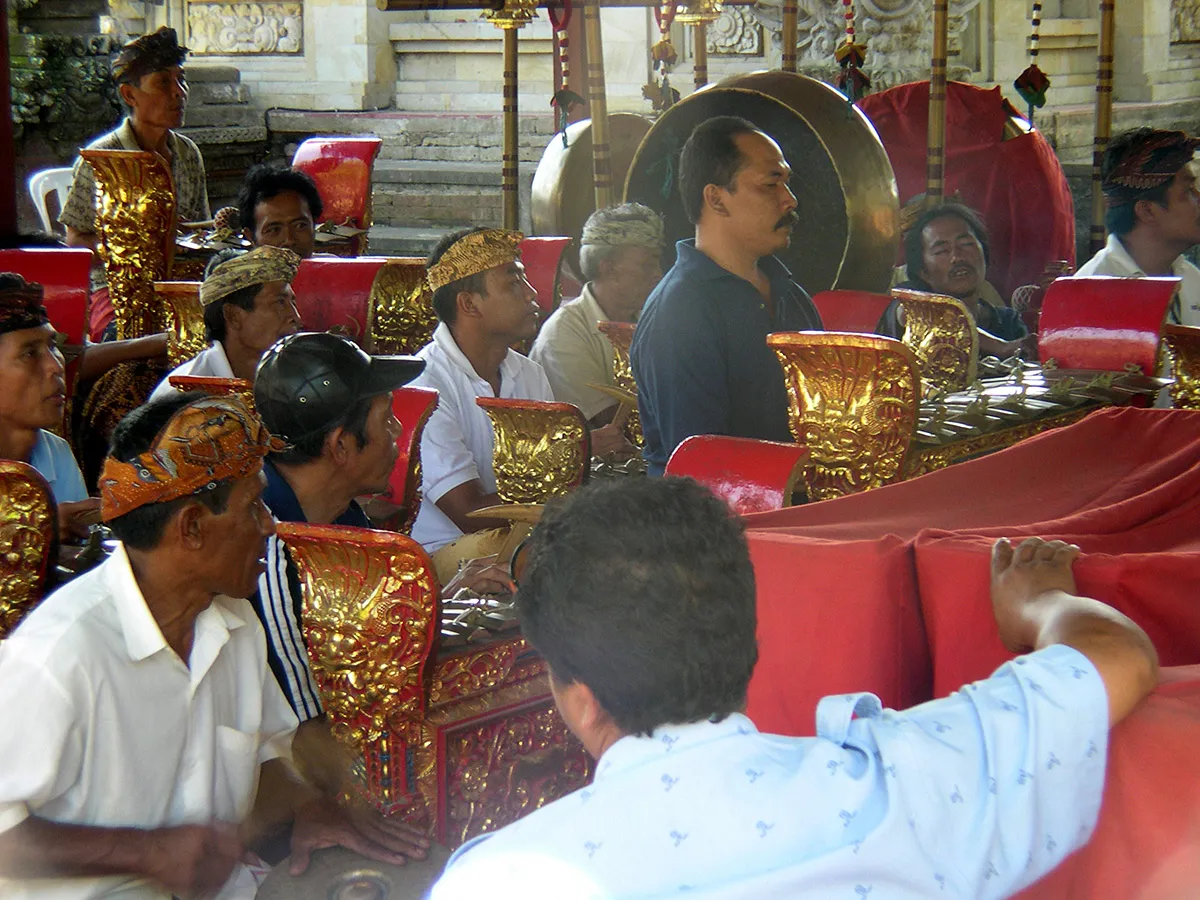
Wikipedia’s Gamelan entry defines gamelan as the traditional ensemble music of the Javanese, Sundanese and Balinese peoples of Indonesia, made up mostly of percussion instruments. The word comes from a Javanese root meaning to strike with a mallet. Metallophones, which are struck with mallets, are among the most common instruments. The rest of the family includes gongs, drums such as the kendang, xylophones, bamboo flutes, bowed and plucked strings, and voices.
UNESCO’s 2021 inscription describes the instruments as mainly ornate, hand-forged metal percussion. It says the music follows precise rules for tuning, instrument layout and rhythmic patterns, and that the melody is played by several instruments at once, often in interlocking parts that form a single rhythm. Practitioners include people of all genders and ages: vocalists, instrumentalists, instrument makers and tuners. The music is heard in religious rituals, ceremonies, traditional theatre, festivals and concerts.
One more point from Wikipedia explains why a gamelan is treated as a set. Each ensemble’s tuning is distinct, so two gamelans tuned to the same notes can still sound different from one another.
The sacred stories that gamelan accompanies on stage and in the puppet theatre are the same ones painters work from, and our guide to Balinese mythology painting maps them.
Bali and JavaBalinese Gamelan vs Javanese Gamelan: Same Family, Different Temperament
Wikipedia describes Javanese gamelan as soft and slow in tone, Sundanese gamelan as dominated by flutes and mellow, and Balinese gamelan as strong and dynamic, with fast rhythms. That contrast is the quickest way to tell the two apart by ear. Wikipedia adds that Javanese gamelan uses two tuning systems, slendro with five notes per octave and pelog with seven, and that a full set holds instruments in both but traditionally plays only one at a time.
We do not go further into Balinese tuning here. The sources we could check were not specific enough for us to describe the Balinese scales with confidence, and we would rather leave that to musicians and ethnomusicologists than guess.
The SoundOmbak and Kotekan: How the Shimmer and the Speed Are Made
Two features give Balinese gamelan its recognizable sound, and both come from how the instruments are built and shared out between players.
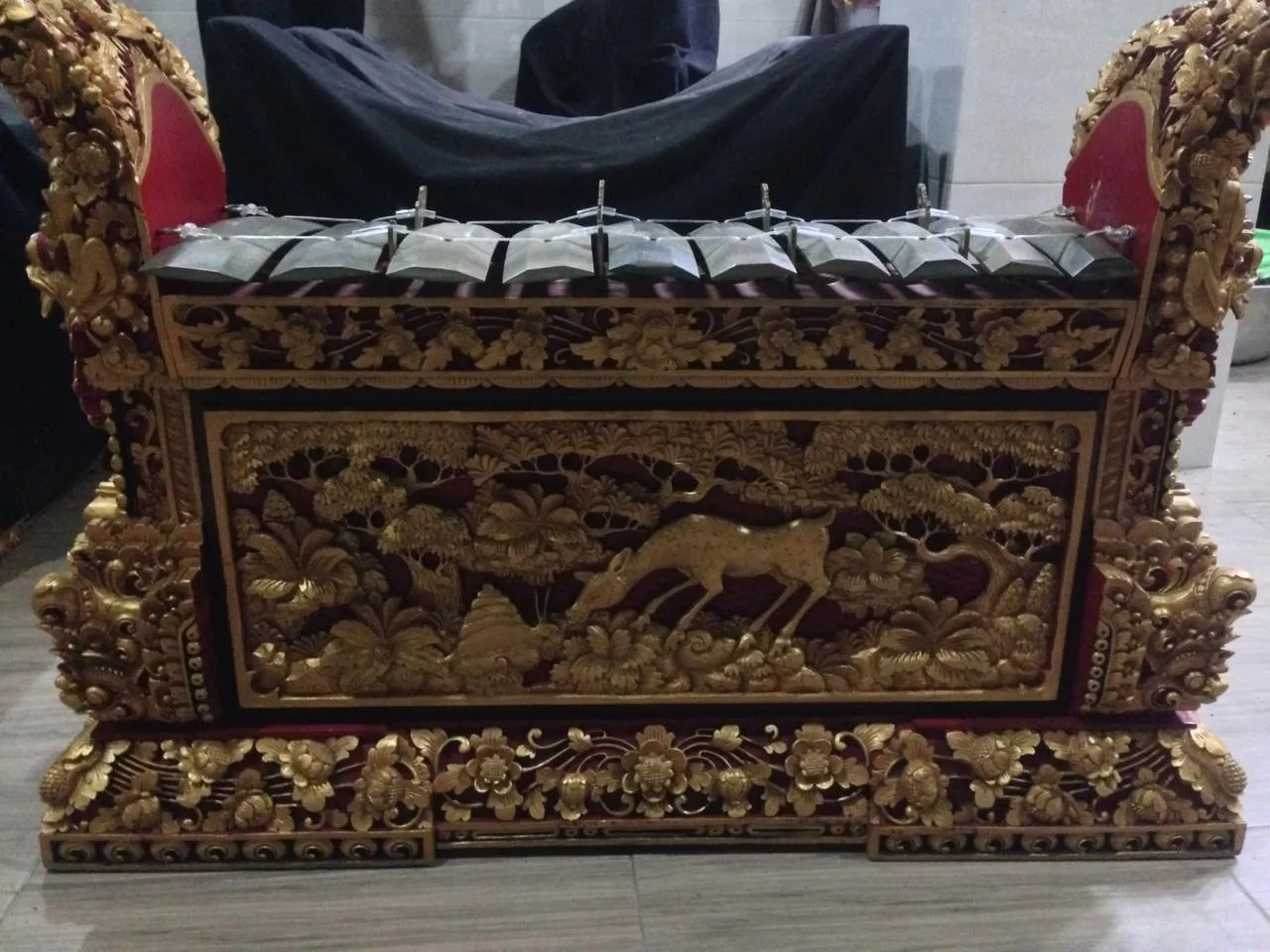
Ombak. Wikipedia’s Balinese gamelan entry says instruments are built in pairs tuned slightly apart, which produces interference beats called ombak, meaning wave. One instrument of each pair is tuned a little higher, described as the inhale, and the other a little lower, the exhale. The entry says this beating gives the ensemble its shimmering sound and, in ritual, is said to evoke a sense of a god’s presence or a meditative state. The gong kebyar entry describes the same pairing as male and female, with the female instrument tuned lower.
Kotekan. In the gong kebyar entry, kotekan means complex, complementary melodic and rhythmic patterns. Each pair of gangsa players splits into polos, which mostly plays on the beat, and sangsih, which mostly plays off the beat. Together they produce rapid, virtuosic patterns, so the fast line is made by two players, not one. UNESCO’s description of interlocking parts that form a single rhythm points at the same idea.
The InstrumentsGamelan Instruments in Bali: Who Plays What in a Gong Kebyar
We use the gong kebyar as the map of the instrument family because Wikipedia’s entry on it lists the parts in detail. It lists the following.
| Instrument | What the source says |
|---|---|
| Gangsa (kantilan and pemade) | Mallet-struck metallophones and the largest section, with 13 to 14 players. Kantilan is the highest sounding, pemade is one octave lower. |
| Ugal | Usually one instrument, played by an ensemble leader who cues the group. |
| Jublag and jegogan | The lower metallophones. Jegogan is the deepest tuned. |
| Gongs | Gong gede, kempur and kemong mark the gong cycle. |
| Reyong | Twelve kettles played by four musicians. |
| Kendang | A double-headed drum pair, wadon and lanang, usually led by the wadon player. |
| Cenceng | A set of small cymbals on a frame. |
| Suling | Bamboo flutes that double and ornament the melody. |
| Kempli, kajar, klenang, tawa-tawa | Small kettles that keep the tempo and mark the rhythm. |
Source: Wikipedia’s Gong kebyar entry. Player numbers and layouts vary between groups, and we only list what we could check.
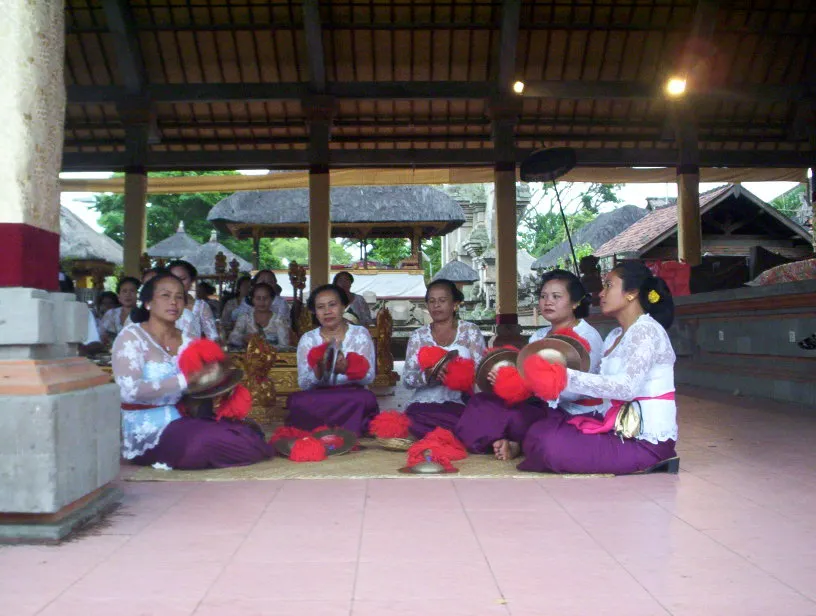
The drum has a job that is easy to miss. Wikipedia’s Gamelan entry says the kendang keeps the beat and signals transitions between sections.
The EnsemblesThe Balinese Gamelan Ensembles, From Sacred Selonding to Gong Kebyar
Bali has many kinds of gamelan, not one. Wikipedia groups them by age into wayah, the older types, madya, from roughly the 16th to the 19th century, and anyar, the 20th century.
| Age group | Ensembles Wikipedia lists | What the sources say |
|---|---|---|
| Wayah (older, thought to predate the 15th century) | Selonding, gender wayang, baleganjur, angklung, genggong, gambang and others | Selonding is a sacred ensemble kept in temples, dated to at least the 9th century. Gender is used in life-cycle ceremonies. Our ogoh-ogoh guide says a baleganjur percussion ensemble often accompanies the parade. |
| Madya (about 16th to 19th century) | Gong gede, semar pagulingan, pelegongan, bebarongan, batel barong, penggambuhan and others | Gong gede is used in temple ceremonies. The names pelegongan and bebarongan point to the Legong and Barong repertoires. Wikipedia notes that drums became prominent in this era. |
| Anyar (20th century) | Gong kebyar, jegog, joged bumbung, janger and others | Wikipedia calls kebyar one of the most recent Balinese styles and notes prominent drum playing in the anyar group. |
Source: Wikipedia’s Balinese gamelan et Gamelan entries, with the ogoh-ogoh detail from our own guide. The lists are long, and we show only part of each.
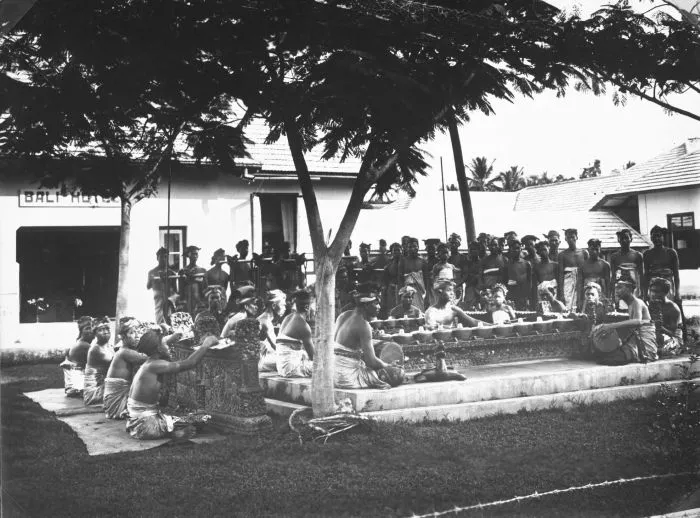
Two details from the same Wikipedia entry show how local the music is. Ensembles are kept in a balé, an open-sided pavilion, so the sound carries into the community, and ownership by the banjar, the neighborhood association, is common. A sekaha, the gamelan group, is led by one instructor who helps it develop new pieces, often leaving room for improvisation. Pieces can change over time, except for the most sacred ones.
Gong KebyarGong Kebyar: The Style That Burst Open in 1915
Gong kebyar is the ensemble in this guide with a dated first public performance. Wikipedia says it was first documented in North Bali in the early 1900s, and that its first public performance was in December 1915 at a gamelan competition in Jagaraga. The entry does not name one creator. It notes that the Dutch sponsored island-wide competitions until Japanese forces ended their rule in World War II.
The name explains the sound. Kebyar means to flare up or burst open, which refers to the style’s sudden shifts in tempo and dynamics. Wikipedia says its explosive, mostly unmetered openings derive from kebyar legong of Buleleng, North Bali, and that early new compositions were loosely constructed and rhapsodic before becoming more standardized through the 20th century.
Dance is part of the kebyar story too. Wikipedia mentions Kebyar Duduk and Kebyar Trompong as dance pieces in which a dancer plays the trompong. Our guide to Balinese dancer wood carving adds that Kebyar Duduk was first performed in 1925 by I Ketut Marya, known as I Mario, and that its seated or crouched posture grew out of performing inside a tightly packed gamelan. Wikipedia’s source for kebyar’s openings, kebyar legong of Buleleng, shares a name with the classical dance in our legong dance guide, though we have not checked how closely the two are related.
The MakersWhere Gamelan Gongs Come From: The Pande Gong of Tihingan
NOW! Bali’s 8 November 2023 feature on Tihingan village, written by Edward Speirs, describes how gongs are forged there. A metal disc about 20 cm across is heated in a fire and hammered on a flat stone while being turned, again and again, until it grows to roughly 55 cm. Stones set at angles under the disc help raise the gong’s walls, and mallets and a grinder handle the final smoothing. A group of about ten workers can finish one gong in roughly 3 to 4 hours.
Two specialists share the work. The pengrajin shapes the instrument by eye, and the tukang laras, the tuning expert, tunes each instrument or key by ear. The article says the smith clan, called pande, is said to descend from the lowest caste yet earned special status because its metalworking skills were considered almost magical. Tihingan’s craftsmen are known as pande gong, and the village’s gong-making tradition is said to date to the 16th century and to be linked to the Gelgel Kingdom.
On the metal itself, the sources we read do not agree. Wikipedia says the best gamelan bronze is about ten parts copper to three parts tin, while the Tihingan article describes bronze or brass made with a set ratio of copper, zinc and lead. We would treat any single recipe with care.
Tihingan is in Klungkung, the same regency as the painting village covered in our Kamasan painting guide. Working metal carries its own holy day: our Tumpek Landep guide explains that a blacksmith’s own equipment is traditionally blessed on that day. Cast bronze figures use a different method, the lost-wax technique, which we cover in our Bali bronze statue guide.
CeremonyGamelan in Ceremony: Blessings, Temple Rites and Processions
Gamelan is part of ceremony, not only a soundtrack to it. Wikipedia’s Balinese gamelan entry says gong gede is used in temple ceremonies, gender is used in life-cycle ceremonies, and gamelan is used in ngaben death-ceremony processions.
The instruments themselves are honored. Our Tumpek Wayang guide describes the gender wayang, the small ensemble that traditionally accompanies a wayang kulit performance, being honored alongside the puppets, and a gamelan set touched with holy water before it is played again. That makes the music part of the same arts calendar as Kamasan painting and carving.
For the festive side, our guide says the parade of an ogoh-ogoh statue before Nyepi moves with torches and music alongside, often a baleganjur percussion ensemble.
DanceGamelan and Dance: The Orchestra a Dancer Answers
In Balinese dance, the music and the body are tied together. Wikipedia’s Balinese dance entry says articulation of the face and eyes is coordinated with the layered percussive sounds of the gamelan.
Several dances we cover are tied to gamelan. Legong is danced to gamelan by two dancers and a condong, according to our guide. Wikipedia’s list of Balinese ensembles includes bebarongan and batel barong, names that point to the Barong dance. The exception is kecak, where, per our guide, Walter Spies suggested a chanting chorus in place of a gamelan.
The stories those dances act out are the same ones painters draw on, which is the subject of our Balinese mythology painting guide.
ListeningWhat to Listen For in Balinese Gamelan
We are not performers, so this is a short list built only from the sources above. If you are listening to a recording or a live ensemble, these are four things the sources let you notice.
The shimmer
Pairs of instruments tuned slightly apart beat against each other. That wavering is ombak.
The fast lines
In kotekan, two players share one rapid pattern, one mostly on the beat and one mostly off it.
The drum cues
The kendang keeps the beat and signals changes of section, and in kebyar the ugal leader cues the group.
The sudden shifts
Kebyar means to burst open. Expect abrupt changes of tempo and loudness.
What We Know and What We Defer On
We are an art gallery in Seminyak, not a music school, a gamelan workshop or a ticket desk. What we write here comes from the sources named in this post and from our own guides and paintings. We do not list venues, rehearsal times or ticket prices, because we could not verify them and they change. On tuning, repertoire and the ritual use of the instruments, we defer to the musicians, makers and teachers who carry the tradition. If you spot something we should correct, tell us and we will fix it.
In the GalleryPaintings Where the Gamelan Plays
We do not sell gamelan instruments, so the closest we come is paintings of the occasions where they are played. The Rhythm of the Village Procession Painting is listed as an original artwork in the traditional Ubud style, acrylic on cotton canvas, 85 × 135 cm, at Rp12,500,000. The listing describes a lively ceremonial procession with village residents in ceremonial attire, traditional gamelan players and sacred regalia moving past a red-brick temple gateway. The listing does not name the painter, so we do not either.

| Piece | Details from the listing |
|---|---|
| Peinture « Le rythme de la procession du village » | Traditional Ubud technique, acrylic on cotton canvas, 85 × 135 cm, Rp12,500,000. The listing mentions gamelan players. |
| Grande peinture représentant un cortège de cérémonie balinaise | Palette texture technique, acrylic on cotton canvas, 85 × 135 cm, Rp6,500,000. Crowd of devotees, penjor and temple gates. |
| The Elegant Legong Dancer Painting | Impressionistic watercolor on cotton canvas, 60 × 80 cm, Rp1,500,000. A dancer in ceremonial attire holding a fan. |
Details are from the product listings, checked on 21 October 2026. Each is a single original piece, so price and availability can change. For more on how ceremony and procession scenes are painted, see our guide to Bali temple ceremony painting, our guide to Ubud style painting, and the wider tradition in our Balinese mythology painting hub.
Ask About the Procession Painting
Tell us the wall you have in mind and we will send close-up photos of the gamelan players, the exact size, and shipping options for the Rhythm of the Village painting. We ship worldwide.
Discuter sur WhatsAppView the Procession Painting