Balinese wood carving care means holding the room steady near 40 to 60 percent relative humidity, keeping the piece out of direct sun and away from heat, dusting it with a dry soft cloth, waxing handled surfaces about once a year, and checking underneath monthly for fine sawdust. This guide gives the source behind each number, then explains what the Arts of Bali Fumigation Declaration and Certificate of Authenticity say, and where each one stops.
Key Takeaways
- The Western Australian Museum’s wood manual sets 40 to 60 percent relative humidity and 15 to 25 °C, with daily swings under 5 percent and 4 °C.
- The Canadian Conservation Institute (CCI) says light damage to organic materials is cumulative and irreversible, so keep wood out of direct sun and away from heaters and vents.
- Denpasar’s average humidity runs from 50 percent in July to 84 percent in February, per Wikipedia, so outdoor Bali air is inside the museum range only in July and August.
- CCI says to wax no more than once a year and only on handled surfaces, not to wet-clean unfinished wood, and to treat sawdust under a piece as a possible sign of insects.
- The Fumigation Declaration is Arts of Bali’s own statement, not a government phytosanitary certificate. A Certificate of Authenticity is issued for paintings on customer request.
Most damage to a carving comes from the room, not from handling. Balinese wood carving care is mostly about air, light and heat, and only a little about cleaning. A piece finished in humid Bali can land in a dry, heated home, and wood answers a change in air by moving.
Each figure names its source, and our own judgement is labeled as ours. Arts of Bali is a gallery in Seminyak, not a conservation laboratory, so ask a conservator about a valuable or damaged piece.
Balinese Wood Carving Care: Humidity and Temperature
Wood takes up and gives off moisture with the surrounding air, so wood carving humidity matters more than any cleaning product. The Western Australian Museum’s wood manual gives 40 to 60 percent relative humidity and 15 to 25 °C, and asks that humidity not move by more than 5 percent, nor temperature by more than 4 °C, in any 24 hours. It names hot, dry conditions as a cause of shrinkage and cracking, and excess moisture as a cause of swelling and warping.
CCI’s page on incorrect relative humidity is written for museum collections in general, but its notes on wood assemblies apply here. It says attached or inlaid metal, horn or shell spanning more than 1 cm across the grain may delaminate or buckle, and it lists fretwork among the parts most sensitive to humidity swings. It also says an exactly correct value may not exist, and the aim is the range that causes the least damage, so a steady room beats a precise number.
Now compare Bali. The climate table on Wikipedia’s Denpasar entry lists average relative humidity from 50 percent in July and 58 percent in August up to 84 percent in February, and 71 percent across the year. Only July and August fall inside the museum range. That is outdoor air, and an air-conditioned room is another climate again. Our reading, not a source claim: a carving finished in Bali’s air faces its biggest change when it moves to a dry, heated room in a cold season.
| Factor | Target or rule | What goes wrong | Source |
|---|---|---|---|
| Relative humidity | 40 to 60 percent | Excess moisture swells and warps wood | WA Museum |
| Daily swing | Under 5 percent humidity and 4 °C in 24 hours | Swings stress attached parts and fine assemblies | WA Museum, CCI |
| Temperature | 15 to 25 °C | Hot, dry conditions shrink and crack wood | WA Museum |
| Light | No direct sunlight | Damage is cumulative and irreversible | CCI, WA Museum |
| Heat sources | Not beside fireplaces, baseboard heaters or over heat vents | Uneven heating and drying (our reading) | CCI |
Sources: Western Australian Museum, “Wood” care manual; Canadian Conservation Institute, “Basic care” for wooden objects and “Agent of deterioration: incorrect relative humidity”; Wikipedia, Denpasar, whose humidity row cites FAO long-term averages (1961 to 1990). Both institutions write for museum collections, so read the numbers as a safe target, not a legal limit.
Our own advice: put a small hygrometer near the piece, and keep it away from air-conditioner outlets, sunny windowsills, bathrooms and stoves, where the air changes fastest.
PlacementWhere to Put a Wood Carving: Light, Heat and Handling
Placement is half of Balinese wood carving care. CCI calls light “a natural enemy of all organic materials” and says the damage is cumulative and irreversible, so it advises against direct sun and suggests blinds or curtains. The WA Museum manual says it in one line: never expose wooden objects to direct sunlight. An hour of low sun each afternoon adds up over years.
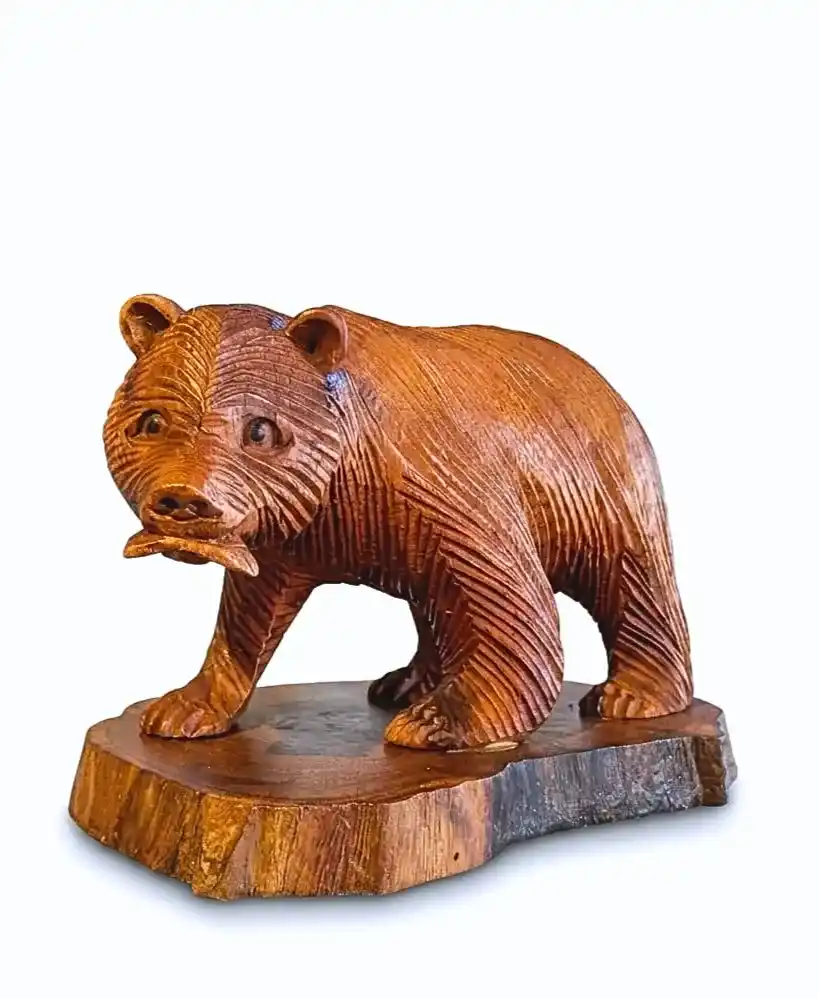
CCI’s furniture advice on handling is to lift at the strongest points and lift rather than drag. Our version for carvings: hold the main body or the base, never an arm, horn, wing, crown or tail, because those are the thinnest parts and the first to snap.
How to Care for Wood Carvings: Dusting, Cleaning and Wax
The short answer on how to care for wood carvings: dust often, wet-clean never, wax rarely. Wood carving humidity and light do the rest.
- Dust: use a dry soft cloth, and a soft brush for deep relief. CCI’s general furniture advice is to dust with a slightly dampened cloth, then buff with a dry, soft cloth, and it says unfinished wood should not be wet-cleaned. The finish on a carving is often unknown, so our advice is to keep water away.
- Wax: CCI describes micro-crystalline wax as a scent- and colour-free paste wax that adds gloss to a finish and makes fingerprints easier to remove. Apply it only once a year and only to the surfaces that are handled. A thin coat and a soft buff are enough.
- Skip commercial polishes: CCI notes that some furniture polishes leave residues that build up and can affect finishes. Our declaration lists a final wax finish, which is why we suggest wax over sprays.
Signs of Insects in a Wood Carving
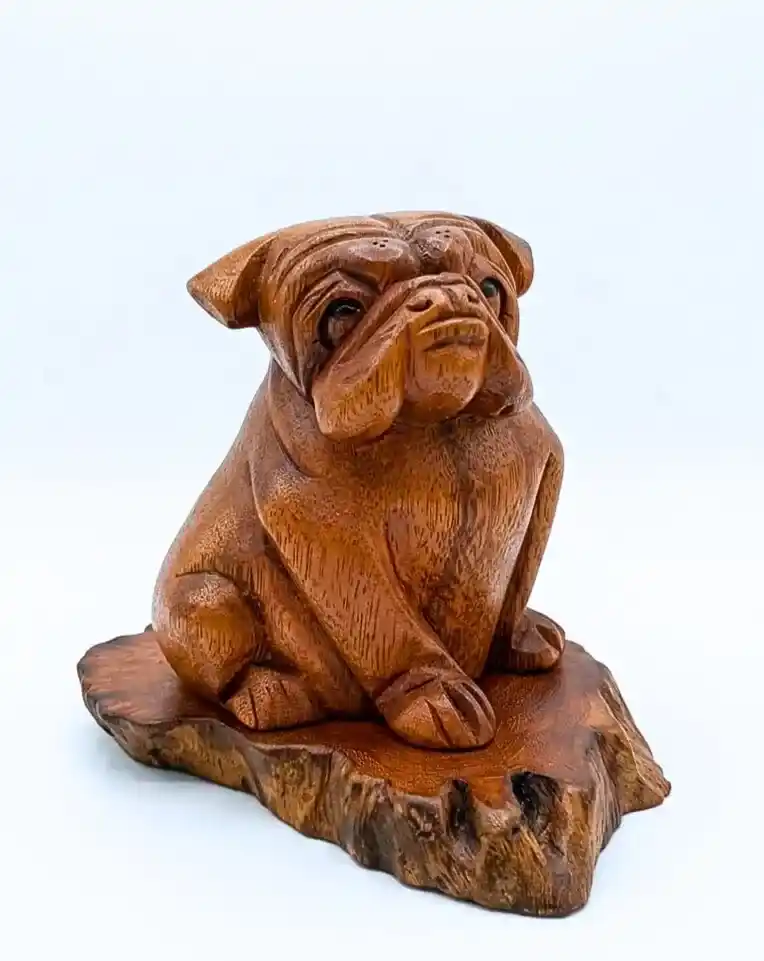
CCI says sawdust-like material under a piece of wooden furniture could signal active insects, and advises isolating the object and consulting a conservator. The WA Museum manual tells collectors to check wooden objects for insect infestation or mould before adding them. Balinese wood carving care therefore includes a monthly look at the base, the back and the surface under the piece for fine powder or tiny holes.
If you find any, move the piece away from other wood, photograph it, and ask before treating it. Message us with the photos and the date you received it. A treatment recorded at the workshop is a record of what was done before shipping, not a guarantee for the life of the carving.
RoutineA Simple Balinese Wood Carving Care Calendar
- Every week or two: dust with a dry soft cloth or brush.
- Every month: check the hygrometer, then look under and behind the piece for fine sawdust.
- Each season: recheck the spot, because the sun angle and the air conditioning or heating change.
- Once a year: a thin coat of micro-crystalline wax on handled surfaces only, then a soft buff.
Fumigation Declaration and Certificate of Authenticity: What They Say
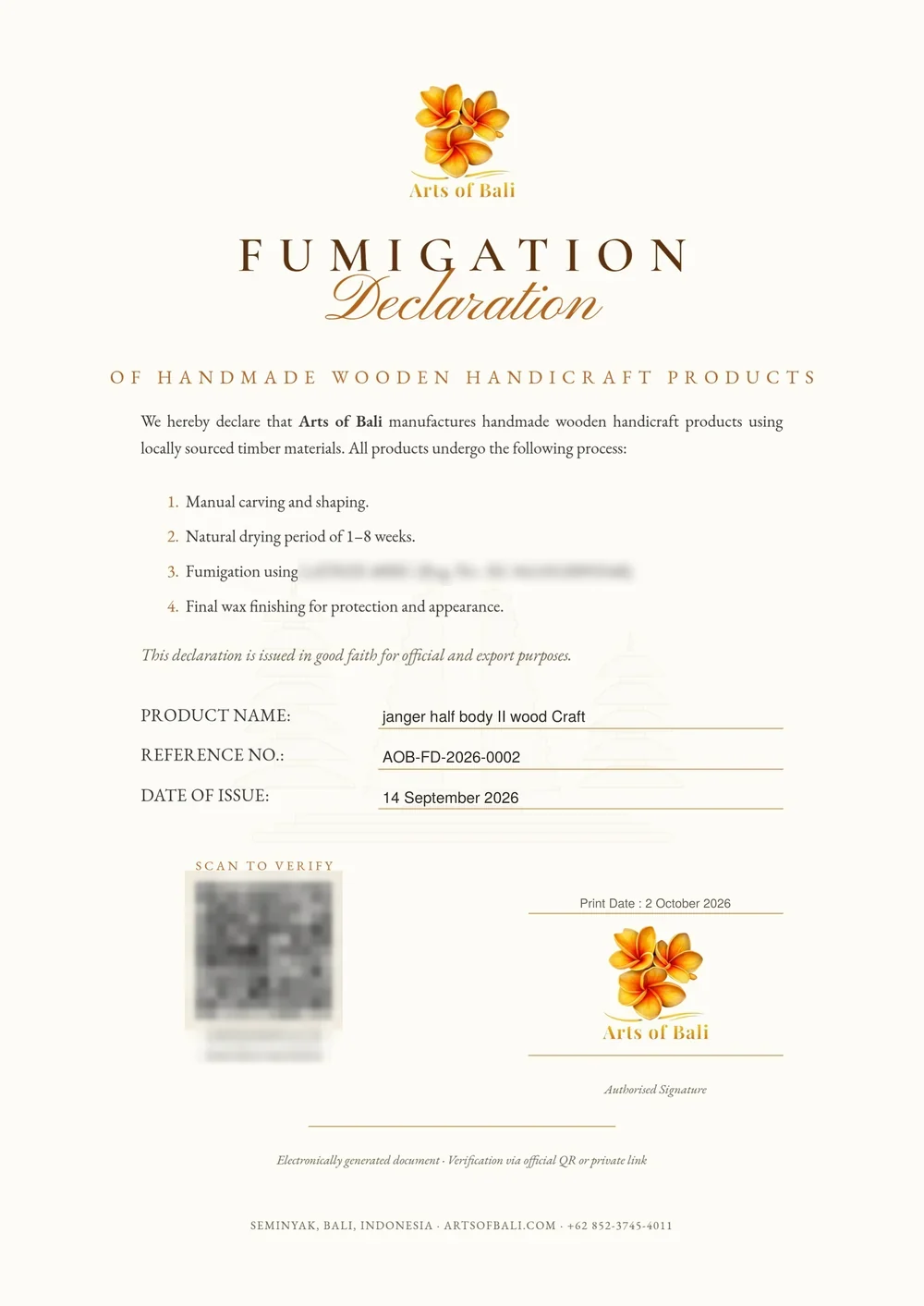
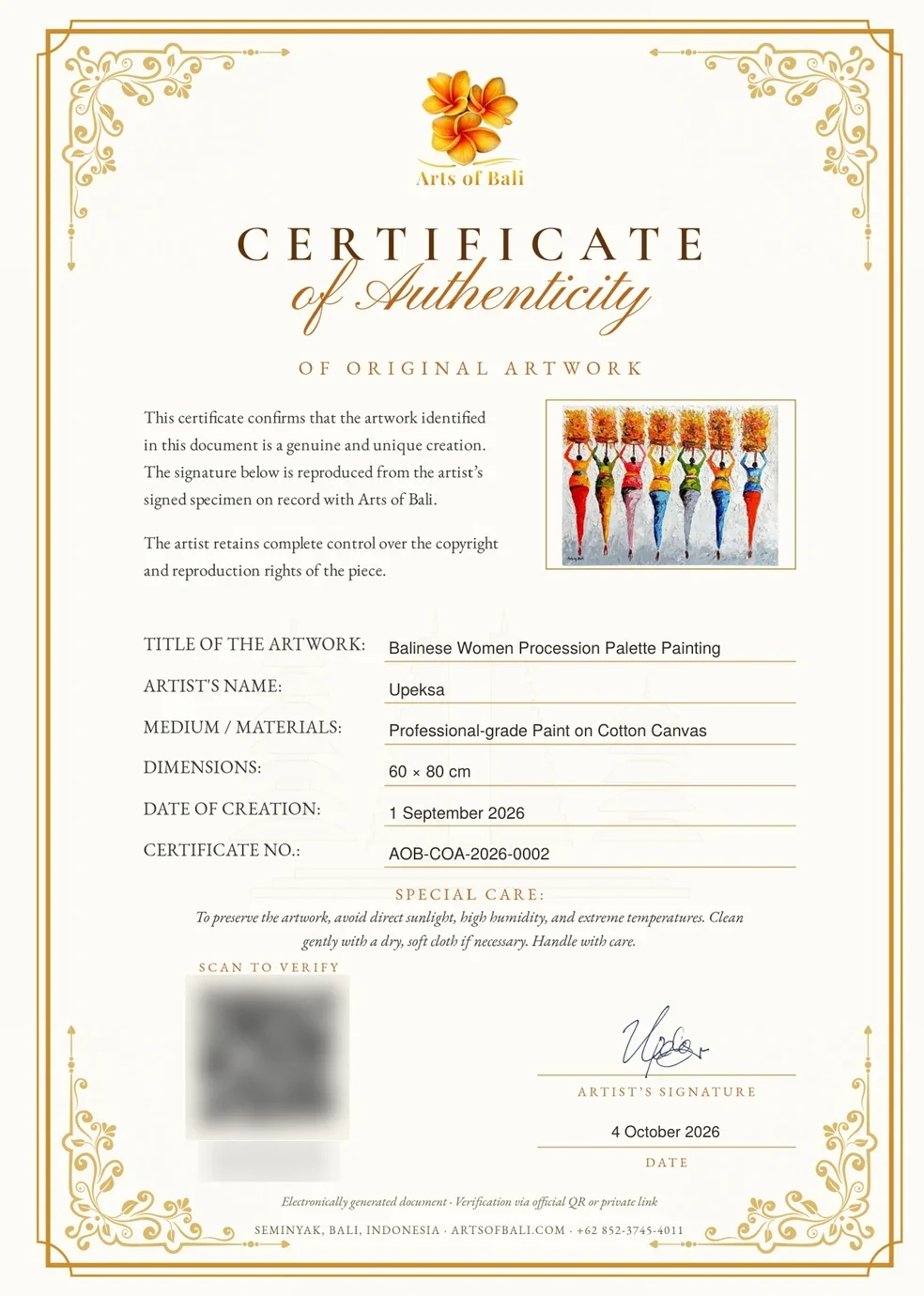
Balinese wood carving care also starts with knowing what you were given. Arts of Bali issues two documents of its own, and neither is a government certificate. Both are electronically generated PDFs with a unique reference number and a QR code that opens a private verification page on artsofbali.com. In the images below, the QR code and verification ID are blurred.
The first is the Fumigation Declaration for handmade wooden handicraft products. In the sample shown, it lists four steps: manual carving and shaping, a natural drying period of 1 to 8 weeks, fumigation with a named product and its registration number, and a final wax finish. It then records the product name, a reference number and the date of issue, and describes itself as issued in good faith for official and export purposes.
What it is not matters as much. A phytosanitary certificate is a different document. ISPM 12, the international standard on these certificates, says they attest that plants, plant products or regulated articles meet the importing country’s requirements, and that only public officers authorized by the national plant protection organization may issue them. In Indonesia that role sits with the Badan Karantina Indonesia. Whether your destination wants one for a wooden handicraft depends on the importing country, so check its rules and ask us before you order.
A precaution of our own, not a finding from the sources above: treat a carving as a decorative object. Do not use carved bowls or spoons for food unless the seller confirms they are food-safe, wash your hands after handling, and keep small pieces away from children and pets who might mouth them.
The second document is the Certificate of Authenticity, which Arts of Bali issues for paintings on customer request. The example below, for a 60 × 80 cm palette painting by the artist Upeksa, records a photo of the work, the title, the artist’s name, the medium (professional-grade paint on cotton canvas), the dimensions, the date of creation, a certificate number, a short special-care note, the artist’s signature and a date. It states that the signature is reproduced from the signed specimen on record with Arts of Bali, and that the artist keeps full control of the copyright and reproduction rights. Its care note, to avoid direct sunlight, high humidity and extreme temperatures and to clean gently with a dry soft cloth, matches the advice in this guide. To tell an original from a print before you ask for one, see our original painting vs print guide.
| Document | Covers | Issued by | It tells you | It does not tell you |
|---|---|---|---|---|
| Fumigation Declaration | Handmade wooden handicrafts | Arts of Bali, as a self-declaration | The four processing steps, product name, reference number and date | Government approval, a lab result, or protection for the life of the piece |
| Certificat d'authenticité | Paintings, on customer request | Arts de Bali | Title, artist, medium, size, creation date, certificate number and care note | An appraisal, a value, or any transfer of the artist’s copyright |
| Phytosanitary certificate | Plant products, when the importing country requires it | The national plant protection organization | That the consignment meets the importing country’s plant-health requirements | Anything about authenticity or carving quality |
Sources: the two sample Arts of Bali documents above, and ISPM 12 (IPPC) for the phytosanitary row. Rules differ by country, so confirm with the importing country’s plant-health authority.
Related reading: shipping art from Bali, le authenticity page, le Bali wood carving guide and the Bali wood carving price guide.
Ask Which Documents Come With Your Piece
Tell us the piece, your destination and whether you want a Certificate of Authenticity for a painting. We will confirm what is issued, and what your country may ask for, before you order.
Discuter sur WhatsApp View the Janger Carving