Calon Arang is the central figure of one of Bali’s most enduring legends: a widow and practitioner of black magic from the village of Girah in the old Javanese kingdom of Kediri, whose story of grief, revenge, and defeat is the origin story behind Rangda, the witch-queen mask at the heart of Bali’s Barong dance. Her tale is not just remembered. It is still performed today as Calonarang, a sacred dance-drama that can end in a kris trance ritual, staged in temple courtyards to protect a community from illness and misfortune, not for an audience of tourists.
Key Takeaways
- Calon Arang was a widow and sorceress from Girah village, whose daughter Ratna Manggali could not find a husband because suitors feared her mother’s reputation for black magic.
- Humiliated, Calon Arang unleashed a plague on the kingdom of Kediri through a dark ritual devoted to the goddess Durga in a graveyard.
- King Airlangga’s spiritual teacher, Mpu Bharada, sent his disciple Mpu Bahula to marry Ratna Manggali and secretly steal Calon Arang’s sacred manuscript of spells.
- Without her manuscript, Calon Arang was defeated by Mpu Bharada in a graveyard confrontation. Sources differ on whether she was killed or spiritually purified.
- Calon Arang lives on in Bali as Rangda, the fanged witch-queen who appears opposite Barong in temple dances, representing not evil defeated but the ongoing balance between opposing cosmic forces.
- The story is still performed as Calonarang, a dance-drama that can climax in a kris trance ritual, historically staged to ward off epidemics.
Most visitors to Bali meet Rangda first, the fanged, wild-haired figure who faces off against Barong in the island’s best-known temple dance. Far fewer are told where she comes from. Rangda is not a generic demon invented for the stage. She is what remains of Calon Arang, a specific woman with a specific grievance, a specific village, and a specific defeat, in a story that Balinese performers still consider serious enough to end with real trance and real kris blades. Understanding Calon Arang changes what the Barong dance means: not a folk tale about good beating evil, but a memory of a real ritual conflict that Bali still stages to keep itself safe.
This guide covers who Calon Arang was, how her story unfolds, how she became Rangda, what happens at a Calonarang performance today, and how a single original painting in our gallery, painted in the detailed Ubud narrative style rather than the classical Kamasan wayang style, depicts this exact legend. For the wider set of sacred stories Balinese painters draw on, see our guide to Картина из балийской мифологии.
Who Is Calon Arang? The Widow of Girah
Calon Arang was a widow living in the village of Girah, within the East Javanese kingdom of Kediri, feared across the region for her mastery of black magic. She had a daughter, Ratna Manggali, who by every account was beautiful, but no suitor would come forward to marry her. Nobody in Girah wanted to become son-in-law to a woman rumored to command dark powers. The rejection was aimed at the mother, but it fell on the daughter, and the humiliation of watching Ratna Manggali go unmarried year after year is what the story gives as Calon Arang’s breaking point.
The story is traditionally placed during the reign of King Airlangga, the historical ruler of the Kahuripan kingdom in eleventh-century East Java, the same king and era behind the Arjuna Wiwaha epic. The written Old Javanese text that records Calon Arang’s story survives in the Kawi language, though exactly when it was first composed is not settled among scholars. What is well documented is that Bali adapted the story into a living dance-drama, a process one dance-history source dates to as recently as the 1890s, which is part of why the legend feels less like ancient folklore and more like a story Balinese communities keep actively retelling.
The CurseThe Curse That Fell on Kediri
Consumed by grief and fury over her daughter’s prospects, Calon Arang went to a graveyard at night and performed a ritual devoted to Durga, the goddess most closely associated with her dark power. Accounts describe her commanding Leyaks, cannibal spirit-familiars of Balinese belief, and unleashing plague, flood, and famine on Girah and the wider kingdom. Children reportedly died in their sleep. Crops failed. The devastation was severe enough that King Airlangga’s own soldiers could not stop it by force, which tells you something about how this story frames the problem: not a monster to be fought with weapons, but a wound to be addressed at its source.
How Mpu Bharada Outwitted the Witch
Unable to defeat Calon Arang through force, King Airlangga turned to Mpu Bharada, his spiritual teacher, a sage associated with white magic and ritual knowledge rather than military power. Mpu Bharada’s solution was patient and indirect. He sent his own disciple, Mpu Bahula, to court and marry Ratna Manggali, Calon Arang’s daughter, the very thing she had wanted for her all along. During the wedding celebrations, while inside the household he had just married into, Mpu Bahula located Calon Arang’s sacred manuscript, the book that held the source of her power, and carried it out to Mpu Bharada.
Without her manuscript, Calon Arang was no longer untouchable. Mpu Bharada confronted her, by most accounts at the same graveyard where she performed her rituals, and the two fought using sacred knowledge rather than weapons. What happens next is where the sources genuinely disagree, and it is worth stating plainly rather than picking one version and presenting it as settled fact.
Two EndingsA Contested Ending: Death or Purification?
Some tellings of the story describe Calon Arang being killed outright once her manuscript is gone and her power broken. Other tellings describe something closer to an exorcism: Mpu Bharada performs a purification ritual over her, freeing her spirit rather than simply destroying it. Both versions agree on the outcome that matters for the rest of the legend, that her reign of terror over Kediri ends, and that Ratna Manggali is left to grieve a mother she understood was both dangerous and, in her own way, wronged. Contemporary readings of the story, including scholarship by the Indonesian writer and scholar Toeti Heraty, have reframed Calon Arang less as a simple villain and more as a woman demonized by a society that punished her for being unmarriageable and then blamed her for the consequences.
The TransformationFrom Calon Arang to Rangda
In Balinese tradition, Calon Arang is understood as the figure behind Rangda, the witch-queen who appears in temple dances across the island. Rangda’s mask is deliberately frightening: bulging eyes, a long protruding tongue, fangs, wild unkempt hair, pendulous breasts, and claws, an iconography built to be seen from across a crowded temple courtyard at night. She is sometimes compared to fierce Hindu goddesses like Durga or Kali, but where those figures are understood as protective even in their ferocity, Rangda is generally regarded as the embodiment of the dangerous, chaotic force in Balinese cosmology, the counterpart Barong exists to hold in balance rather than defeat outright.
One further connection is worth noting, with an important caveat. Some interpretations link Rangda to Mahendradatta, a historical eleventh-century Balinese queen, mother of King Airlangga and wife of King Udayana, who by legend was exiled from the royal court over accusations of witchcraft and is said to have taken revenge with plague and demons of her own before being subdued by a holy man. The parallel to Calon Arang’s story is obvious, and some sources treat the two figures as effectively the same legend told from different angles. This connection is genuinely interesting, but it remains an interpretation rather than a historically confirmed fact, and we present it here as exactly that.
The pairing of Barong and Rangda is the reason the Calon Arang story still matters on stage. Their confrontation is staged as an eternal, unresolved balance rather than a victory, which is also how our guide to Картина из балийской мифологии frames the wider Barong tradition. For a closer look at how Barong himself is depicted across gallery pieces, see our guide to Barong painting in Bali, and for how the same figures are carved rather than painted, see our guide to Balinese wood carving masks.
The Living RitualThe Calonarang Dance-Drama: A Living Ritual, Not a Show
Calonarang, the Balinese dance-drama built from this legend, is not staged the way a play is staged. Performances move through a village across multiple real locations, temples, crossroads, streets, and finally a graveyard, with comic scenes performed in vernacular Balinese providing relief between the heavier ritual passages. The drama builds toward the same confrontation at the heart of the legend, Rangda’s magic turned loose against a community, and Barong’s intervention to protect it.
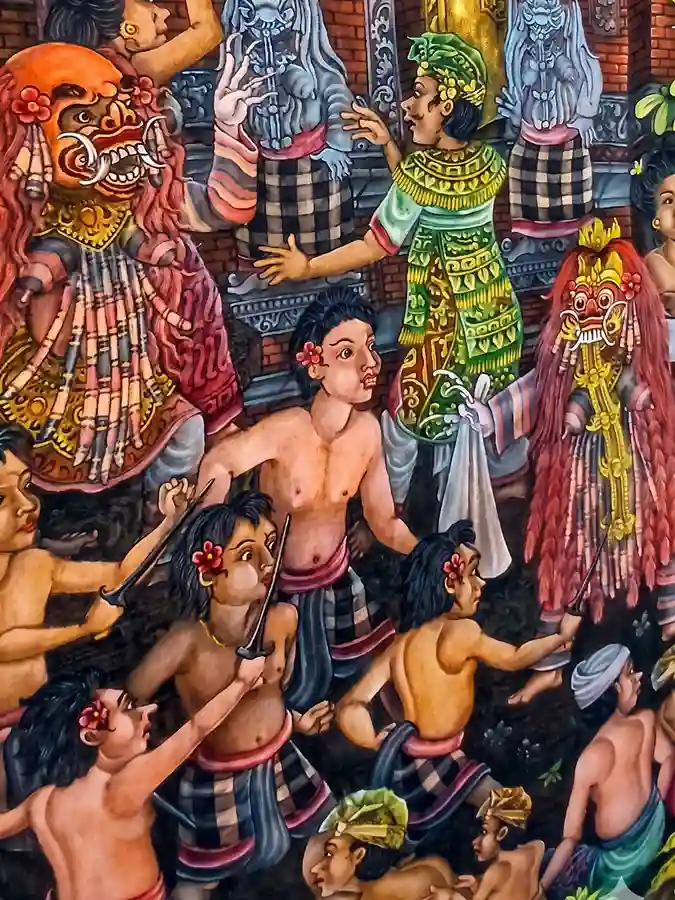
The performance’s best-known and most serious moment is the kris trance ritual, sometimes called ngurek. Dancers who enter a genuine trance state turn their kris blades against their own chests and stomachs, and are widely reported, by performers and witnesses alike, to emerge unharmed. Many Balinese consider this real possession rather than performed choreography. A priest closes the ritual with holy water and incense to bring the dancers safely out of trance. Calonarang performances are traditionally staged during temple anniversary festivals, called odalan, and are considered especially significant around Nyepi, the Balinese new year of silence. Historically, the entire ritual was performed to ward off epidemic illness in a village, which is worth sitting with: this is not folklore staged for entertainment, it is a ritual Balinese communities have used, and in some places still use, as an actual response to sickness and misfortune. Visitors who want to see a Calonarang performance respectfully should look for genuine temple festival occasions in villages like Batubulan or during odalan season in areas such as Sidemen or Bangli, rather than expecting it on a fixed tourist schedule.
The PaintingCalon Arang in Balinese Painting
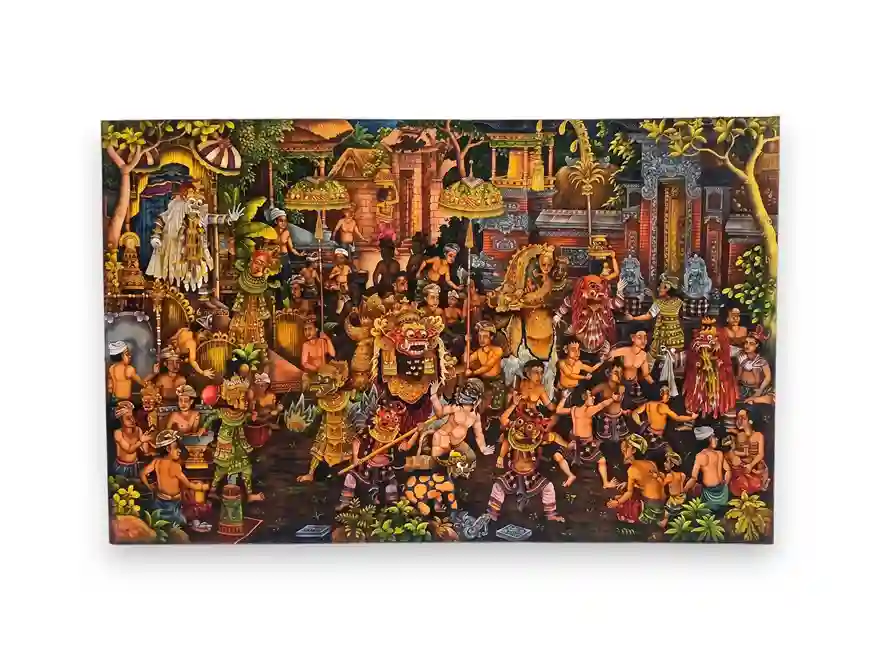
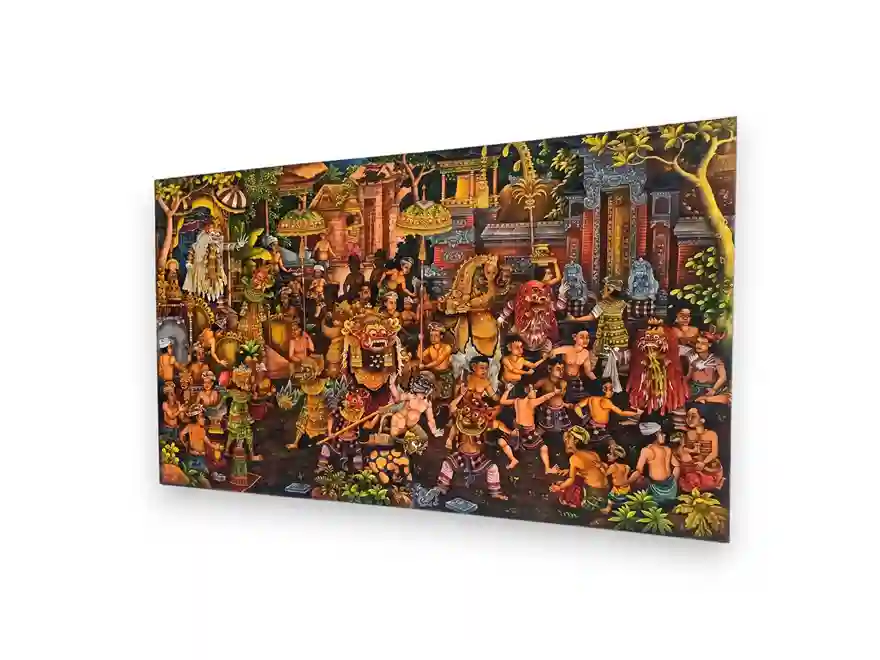
Bali’s two major painting traditions tell sacred stories differently, and it is worth being precise about which one this particular piece belongs to. Kamasan painting, the classical wayang style from Klungkung, renders figures flat and stylized, following prescribed rules for posture and costume passed down for centuries. The Ubud style, which developed later and which our own guide to Роспись в стиле Убуда covers in depth, moves toward detailed, naturalistic crowd scenes with a stronger sense of depth and individual expression. Our original Calon Arang piece, Calonarang: The Cosmic Balance of Bali, is painted in this second tradition, in acrylic on cotton canvas at 85 by 135 centimeters. Rather than showing Rangda as an isolated portrait, it depicts the full scene: a crowd of onlookers, sacred temple architecture, and sword-bearing participants at the moment the story reaches its confrontation, close to how the legend is actually staged in a village courtyard rather than how it might appear on a museum wall.
See This Painting in Person
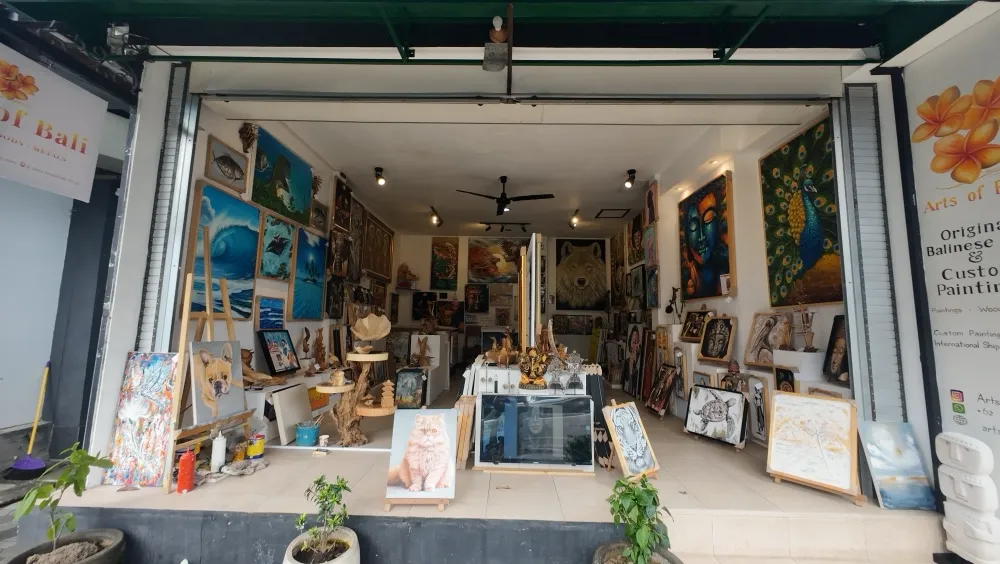
Arts of Bali carries an original Calon Arang painting, rendered in the detailed Ubud narrative style, depicting the sacred confrontation behind Bali’s most famous temple dance.
Чат в WhatsApp View the Calon Arang Painting