Barong dance is a Balinese dance-drama in which Barong, the lion-like king of the spirits, fights Rangda, the demon queen of the leyaks. Wikipedia describes it as the eternal battle between good and evil, and the best-known staging includes a kris scene where entranced dancers turn their blades on themselves. This guide covers the characters, the story in order, the kris scene, the types of Barong, the costume, and how Barong paintings and masks in our gallery relate to the dance.
Key Takeaways
- Per Wikipedia, the cast is Barong, Rangda, two playful monkeys, a priest, and male dancers who stand for King Airlangga’s soldiers.
- The story runs in four beats: monkeys tease Barong, Rangda casts black magic, the soldiers turn their kris on themselves, and Barong drives Rangda away.
- Britannica says two dancers bring Barong to life inside an ornately decorated harness, and that the figure’s magic is believed to sit in its beard, hung with frangipani flowers.
- Barong Ket, the lion form from the Gianyar region, is the most common type. Wikipedia lists five other Barongs, including the doll-like Barong Landung.
- Our gallery lists a Barong Dancing Painting (acrylic on velvet, 30 × 40 cm, Rp850,000) and a hand-carved Barong mask (20 cm, Rp1,850,000).
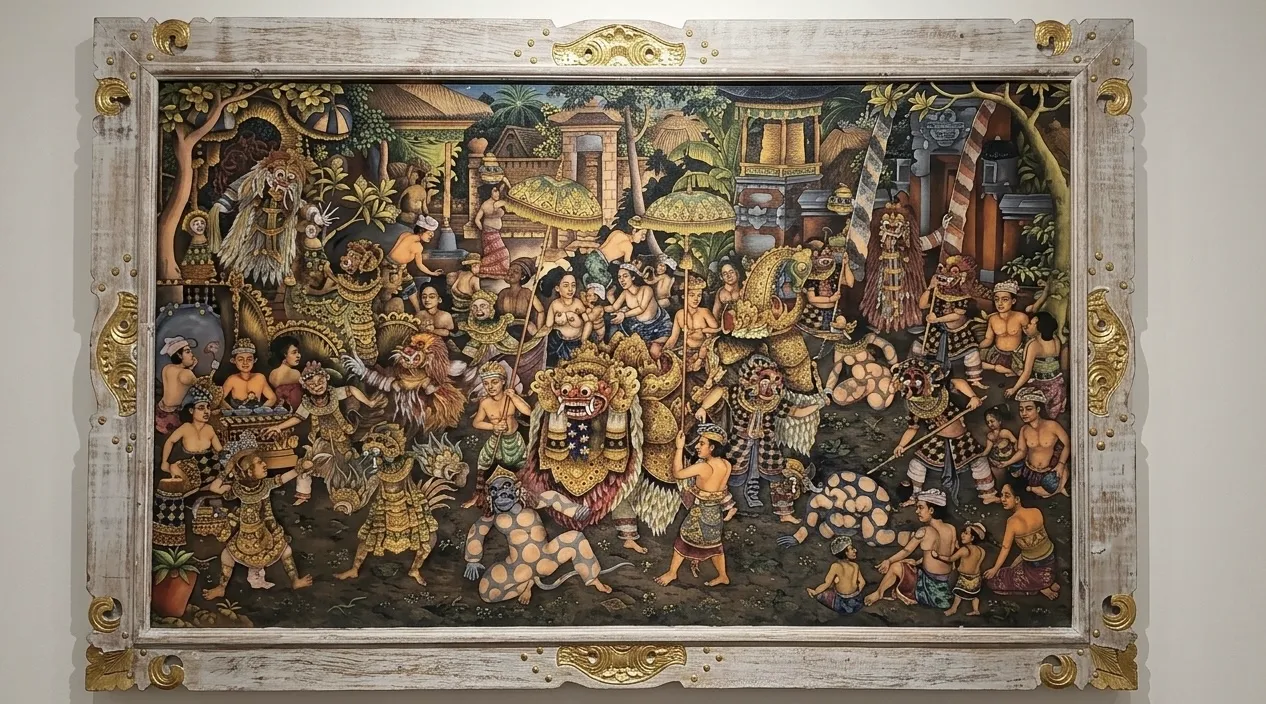
What Is Barong Dance? The King of Spirits Against the Witch Queen
Barong dance is the performance most visitors mean when they say they saw the Barong and Rangda in Bali, yet search for barong dance Bali and many results are tour operators and resort blogs. We carry Barong paintings and masks in the gallery, so we wanted the story on one page with every source named.
Wikipedia’s Barong entry describes Barong as a panther-like creature in Balinese culture, the king of the spirits and leader of the forces of good. Britannica is more cautious about the animal: it says the masked figure usually represents an unidentified creature called keket. So the sources do not agree on what Barong is, and that is a useful warning for the rest of this guide.
On the Barong meaning, Wikipedia says the word may come from the local bahruang, which matches the Indonesian beruang, bear. It also says Barong’s origins are far back and uncertain, possibly in animist worship before Hinduism. In Balinese belief, the spirit that animates Barong is Banas Pati Raja, the fourth spirit brother who accompanies a person through life, which Wikipedia compares to a guardian angel.
The CastWho Is Who: Barong and Rangda, the Monkeys, the Priest and the Soldiers
Wikipedia’s account of the dance names five groups of characters. If you only remember one pairing, make it Barong and Rangda, because the whole drama is built on their opposition.
Barong
The guardian figure, danced by two people inside one costume. Britannica calls him a symbol of health and good fortune.
Rangda
The demon queen of the leyaks. Wikipedia says her name means widow in Old Javanese and links her to the witch Calon Arang.
The two monkeys
Playful figures who open the story by teasing Barong in a peaceful setting, according to Wikipedia.
The priest
Wikipedia says the priest joins Barong in casting the protective magic that keeps the entranced dancers safe.
The soldiers
Male dancers who represent King Airlangga’s soldiers and become the targets of Rangda’s black magic.
Rangda deserves her own guide, and we wrote one. Our Calon Arang article tells the legend of the widow of Girah who became Rangda, and describes the trance ritual that grew out of it. Here we stay with Barong and the shape of the performance. For the wider set of sacred stories that painters draw on, see our guide to Balinese mythology painting.
The StoryThe Barong Dance Story, Scene by Scene
Performances differ from village to village, but Wikipedia gives a clear outline of the dance-drama.
| Scene | What happens |
|---|---|
| 1. The opening | Two playful monkeys tease Barong in a peaceful setting. |
| 2. Rangda arrives | Rangda casts black magic on the male dancers, the soldiers of Airlangga. |
| 3. The kris dance | The entranced dancers stab at their own chests with their kris. Barong and the priest cast protective magic that makes them invulnerable. |
| 4. The finale | Barong defeats Rangda, who runs away, and the celestial order is restored. |
Source: Wikipedia’s Barong (mythology) entry, which also notes that the dance drama is called Calon Arang.
One reading note. In this staging Rangda runs away, which sounds like a clean win. Our Calon Arang guide describes the confrontation as a balance that stays unresolved, not a victory. Both readings exist in the sources, so we present both.
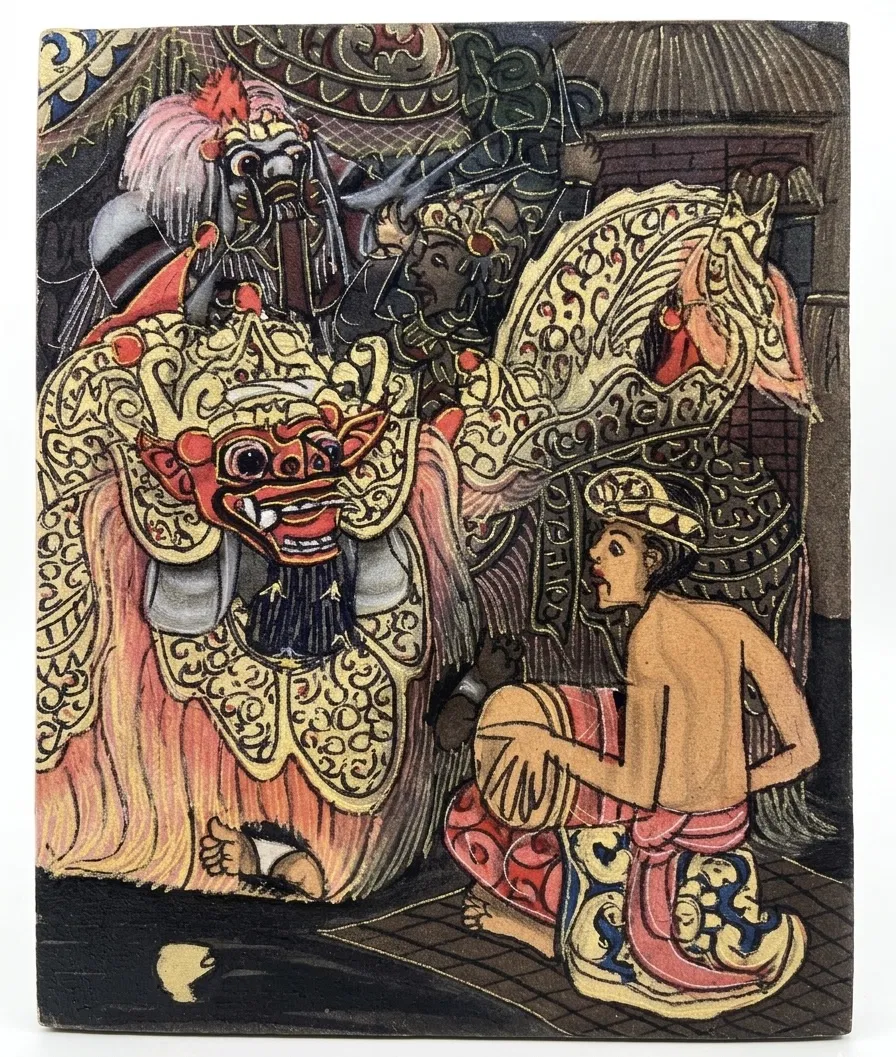
Kris Dance: The Scene Where the Blades Turn Inward
Search for kris dance, also spelled keris dance, and you will land on this moment. Britannica says the Barong dance-drama includes the famous kris dance, in which entranced performers turn their swords on themselves but emerge unharmed. Wikipedia places it in the middle of the story, right after Rangda’s magic takes hold of the soldiers and right before Barong’s protective magic answers it.
We do not describe the trance itself, because we are not performers and the details belong to the people who carry them. Our Calon Arang guide covers what Balinese sources say about the ritual form, including the priest and holy water. For the blade itself, see our guide to Tumpek Landep, the holy day when keris are blessed.
The TypesThe Balinese Barong Is Not One Animal: Six Forms
The lion-like Barong Ket is the most common, but a Balinese Barong can be several different creatures. Wikipedia lists the following, each modeled on a different animal or figure.
| Type | What Wikipedia says |
|---|---|
| Barong Ket (lion) | The most common type, from the Gianyar region. Headdress of carved leather, sliced with gold leaf and set with small mirrors. |
| Barong Bangkal | An old pig, a mythical animal of strength, made of velvet fabric. Paraded on Galungan and Kuningan. |
| Tiger Barong | A forest-dwelling tiger with velvet fur, linked to the Balinese tantri stories. |
| Dog Barong (asu) | A sacred form in Pacung, Tabanan, paraded mainly on Galungan and Kuningan. |
| Elephant Barong | Said to resemble an elephant from India, paraded around the village on Galungan and Kuningan. |
| Barong Landung | Not worn by two dancers. A male and female doll, Jero Gede and Jero Luh. |
Source: Wikipedia’s Barong (mythology) entry. Other sources may name additional forms, and we only list what we could check.
Two of these tie into pages we already have. The parades on Galungan and Kuningan are part of the festival we cover in our Galungan guide, and the lion form ties into the wider story of the winged singa in our guide to lion symbolism in art. About Barong Ket specifically, Wikipedia adds that it has a red head, thick white fur, and gilded jewelry decorated with mirror pieces, and that it is often accompanied by two monkeys.
The CostumeBarong Ket and the Mask: Beard, Harness and Carved Face
Britannica gives the most useful single description of the costume. Two dancers bring Barong to life from inside an ornately decorated harness, and the mask has a beard of human hair decorated with frangipani flowers, which is where the figure’s magic power is believed to reside.
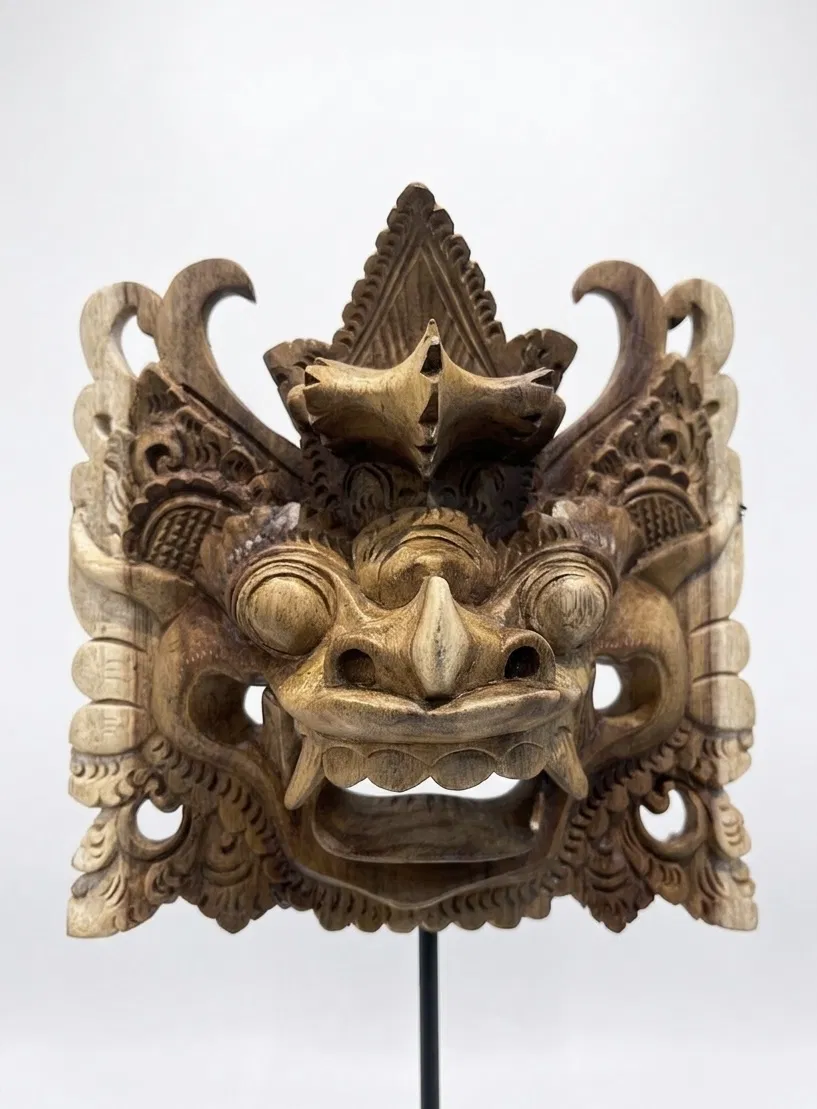
A decorative Barong mask like this one is a different object from the ceremonial costume. Ours is a collector’s piece, listed as an antique-style Barong Mas wooden mask, 20 cm, at Rp1,850,000. For how Barong faces are carved and what to look for, see our guide to Balinese wood carving masks.
Sacred or ShowIs Barong Dance Sacred or Entertainment?
Both, depending on the occasion. Wikipedia’s Balinese dance entry sorts Balinese dance into three categories: wali for sacred dances, bebali for semi-sacred ones, and balih-balihan for entertainment dances. It lists Barong Ket Kuntisraya, from Badung, under balih-balihan, and says new choreographies have been created because of demand from tourists.
The parades of Barong Bangkal, the dog Barong and the elephant Barong on Galungan and Kuningan are a different setting again. Britannica says Barong appears at times of celebration in Bali. So the same figure can appear in a staged show, in a festival parade, and in a ritual, and what you are watching depends on where you are standing.
If Barong is your first Balinese dance, three others make good company. Kecak is a chanting circle, legong is two dancers and a condong, and baris is a warrior in stance.
From Our SideWhat We Know and What We Defer On
We are a gallery, not a dance school or a ticket desk. What we write here comes from the sources named in this post and from the pieces in our own collection. We do not list venues, times or ticket prices, because we could not verify them from the sources above and they change. On points of ritual and technique, we defer to the performers and teachers who carry the dance. If you spot something we should correct, tell us and we will fix it.
In the GalleryThe Barong Dancing Painting and Other Barong Pieces
The Barong Dancing Painting is listed as a 100% original artwork on velvet, painted with professional-grade acrylic using a texture technique, 30 × 40 cm, at Rp850,000. The listing does not name the painter, so we do not either. In the photograph, the gold-ornamented Barong with pale fur at both sides is set against a black velvet ground in a wooden frame.

| Piece | Details from the listing |
|---|---|
| Barong Dancing Painting | Acrylic on velvet, texture technique, 30 × 40 cm, Rp850,000 |
| Balinese Barong Mask | Hand-carved wood, antique-style Barong Mas, 20 cm, Rp1,850,000 |
| The Majestic Barong | Palette knife on marsoto canvas, 100 × 120 cm, Rp7,000,000 |
| The Mystic Barong Majesty | Traditional palette technique on velvet, 85 × 135 cm, Rp8,000,000 |
Details are from the product listings, checked on 19 October 2026. Each is a single original piece, so price and availability can change. For how Barong is treated across styles, see our guide to Barong painting in Bali, and for the wider tradition our Balinese mythology painting guide.
Ask About a Barong Piece
Tell us the wall or shelf you have in mind and we will send close-up photos, the exact size, and shipping options for the Barong Dancing Painting or the Barong mask. We ship worldwide.
Chat on WhatsAppView the Barong Dancing Painting