A Balinese market painting depicts the pasar, Bali’s traditional market, as its own subject: the stalls, the traders, the pedicabs, and the crowd, rather than a temple ceremony or a single portrait. At Arts of Bali, the subject currently exists in four original paintings, each using a different technique, palette-knife impasto, storytelling realism, and monochrome panorama, ranging from a compact 30×90cm panel to an 85×135cm centerpiece. None of the four is a copy of another; each artist reads the same living subject differently.
Key Takeaways
- Balinese market painting treats the pasar as its own genre, separate from temple ceremony or portrait subjects.
- Arts of Bali currently holds four original market paintings in four distinct techniques and formats.
- Prices range from Rp1.200.000 for a 30×90cm panel to Rp4.600.000 for an 85×135cm centerpiece.
- Palette knife impasto, storytelling realism, and monochrome panorama are all represented across the four pieces.
- The genre traces back to real, still-operating Balinese markets, not an invented or staged scene.
Definition: A Balinese market painting is an original artwork depicting the commerce, movement, and social rhythm of a traditional Indonesian or Balinese pasar, rendered by hand in a range of techniques from thick palette-knife relief to fine narrative realism.
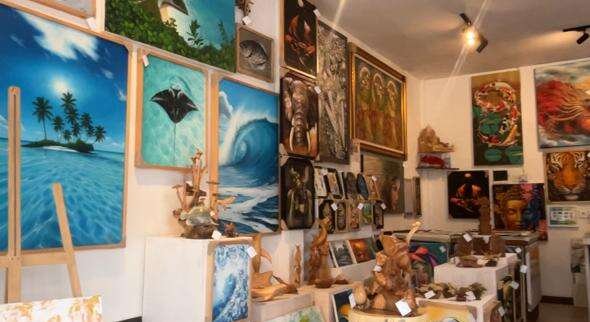
Walk the walls of Arts of Bali long enough and the pasar keeps turning up. Not the same pasar painted twice, four different ones: a golden-hour bazaar built from thick ridges of palette knife, a quiet Ubud scene of women bartering over baskets rendered like a page from a storybook, a black-and-white panorama that strips the same subject down to gesture and silhouette, and a warm procession where market stalls meet the entrance to a temple. Four artists, four techniques, one subject that none of Bali’s other painting genres quite covers on its own.
That’s worth pausing on, because it’s easy to assume “market painting” is just a subset of village life painting, or a background detail in a ceremony scene. It isn’t. A temple ceremony painting documents ritual obligation, offerings prepared, processions timed to a sacred calendar. A market painting documents something more ordinary and, in its own way, just as constant: people buying, selling, carrying, bartering, moving through a public space that has organized daily life in Bali for centuries and still does.
This guide defines the genre, compares the four techniques currently represented in the gallery’s collection, and helps you work out which piece, if any, fits the wall you have in mind.
What Is a Balinese Market Painting?
A Balinese market painting is a narrative canvas built around commerce and public movement, traders under stall awnings, baskets of produce changing hands, pedicabs threading through a crowd, rather than around temple ritual or a single seated figure. Where a village life painting in the classic Ubud tradition typically documents a specific ceremony (an Odalan, a life-cycle rite), a market painting documents the everyday transactional rhythm that happens between ceremonies, on ordinary mornings, in an ordinary lane of stalls.
The genre grows out of the same root as most of Bali’s narrative painting traditions: the shift, formalized in Ubud in the 1930s through the Pita Maha artist collective, away from purely mythological subjects and toward scenes artists were actually living through. Once painters turned that same attention toward the pasar rather than the pura, the market itself became a legitimate subject: not a backdrop for something else, but the whole point of the composition.
It helps to remember that this isn’t an invented or romanticized scene. Bali still has real, working traditional markets, the best-known internationally being Sukawati Art Market (Pasar Seni Sukawati) in Gianyar Regency, where the exact choreography painted in these canvases, stallholders calling out prices, baskets stacked head-high, buyers moving from lane to lane, still plays out most mornings. The paintings in this guide aren’t staged for tourists. They’re a documented visual habit applied to something that’s still genuinely happening.
Four TechniquesFour Ways Arts of Bali Paints the Pasar
Most galleries that carry a “market painting” carry one. Arts of Bali currently holds four, and no two use the same technique, palette, or compositional logic. Reading them side by side says more about how varied Balinese narrative painting actually is than any single piece could on its own.
| Traditional Indonesian Market | Vibrant Traditional Ubud Market | Horizontal Monochrome Market | Horizontal Balinese Market | |
|---|---|---|---|---|
| Техника | Импасто, нанесенное мастихином | Traditional realism, storytelling layout | Palette texture, monochrome | Palette texture, warm tones |
| Средний | Acrylic on cotton canvas | Paint on cotton canvas | Acrylic on cotton canvas | Acrylic on cotton canvas |
| Size | 85 × 135 см | 60 × 80 см | 30 × 90 cm | 30 × 90 cm |
| Format | Horizontal, large-scale | Vertical, dense composition | Horizontal panorama | Horizontal panorama |
| Visual language | Thick raised strokes, golden-hour palette, becak as focal point | Flat storytelling realism, muted earth tones, bartering figures | Black, white, and gray, house and pedicab silhouettes | Warm gold and red, ceremonial gate flanked by stalls |
| Price | Rp4.600.000 | Rp2.000.000 | Rp1.200.000 | Rp1.200.000 |
Традиционная индонезийская рыночная живопись
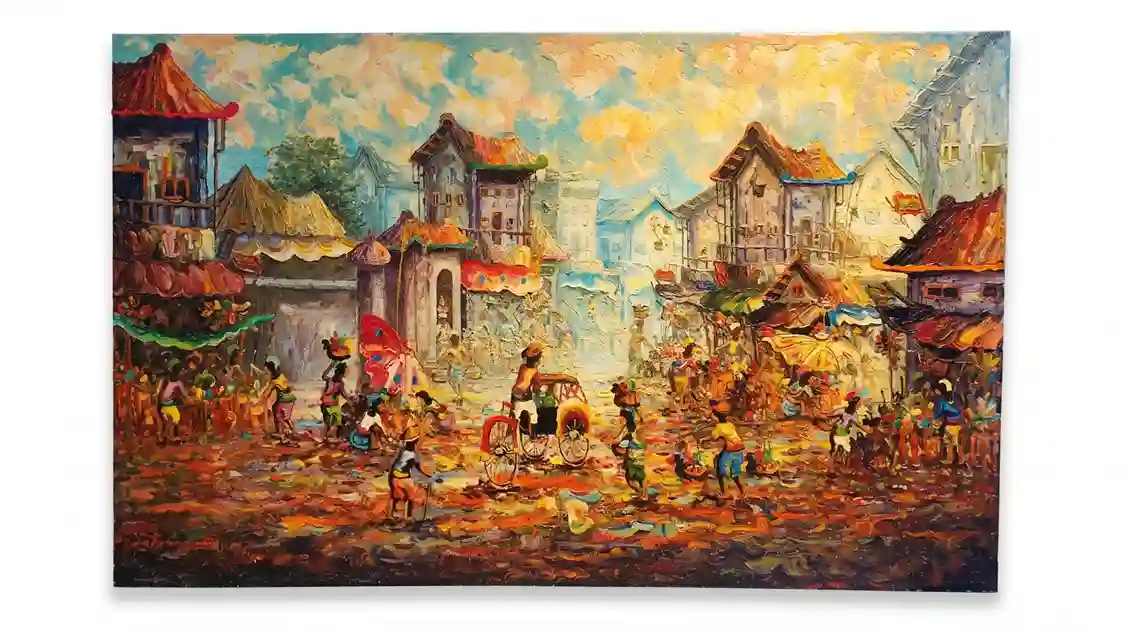
This is the largest and most physically commanding of the four. At 85 × 135 cm, it reads as a full bazaar scene rather than a single moment: a becak (three-wheeled pedicab) sits at the visual center of the composition, its driver paused mid-street, while stallholders, a woman balancing a basket, children weaving between adults fill every remaining plane of the canvas. The palette knife technique builds the entire surface in raised ridges of acrylic, thick enough that the rooftops, the crowd, and the golden-hour sky each catch light differently depending on where you stand. Nothing in the composition is flat; everything has physical texture.
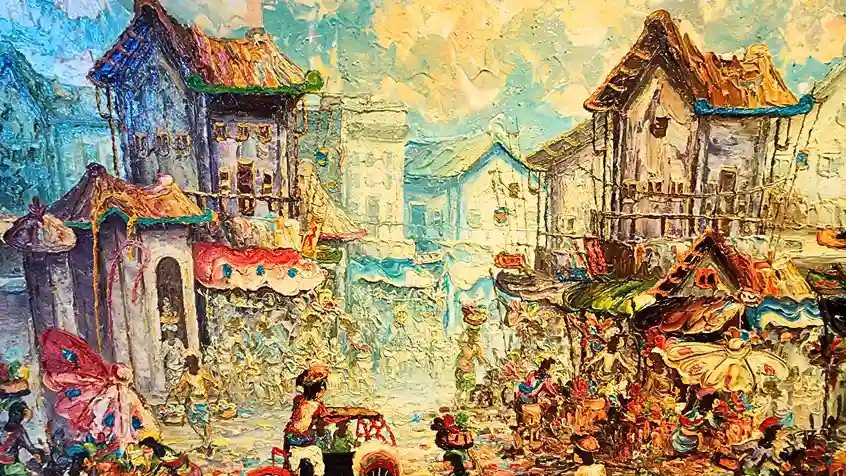
At Rp4.600.000, this is the collection’s centerpiece price point, reflecting both its scale and the labor-intensive nature of palette knife work at this size. It suits a room that can give it distance: a living room wall, a lobby, a space where the texture reads from across the room before it rewards closer inspection. View this piece in the gallery.
Яркая картина, изображающая традиционный рынок Убуда
Where the palette knife piece is built from texture, this one is built from storytelling. Painted in what the gallery describes as complex traditional realism, the composition is dense and vertical: women in traditional dress carrying woven baskets on their heads, seated traders surrounded by produce, a crowd bartering in overlapping small conversations rather than one single focal action. The palette is muted and earthy, closer to the classic Ubud village-life tradition than to the brighter palette knife works, and the figures are rendered with individual facial expression rather than as part of a textured mass.
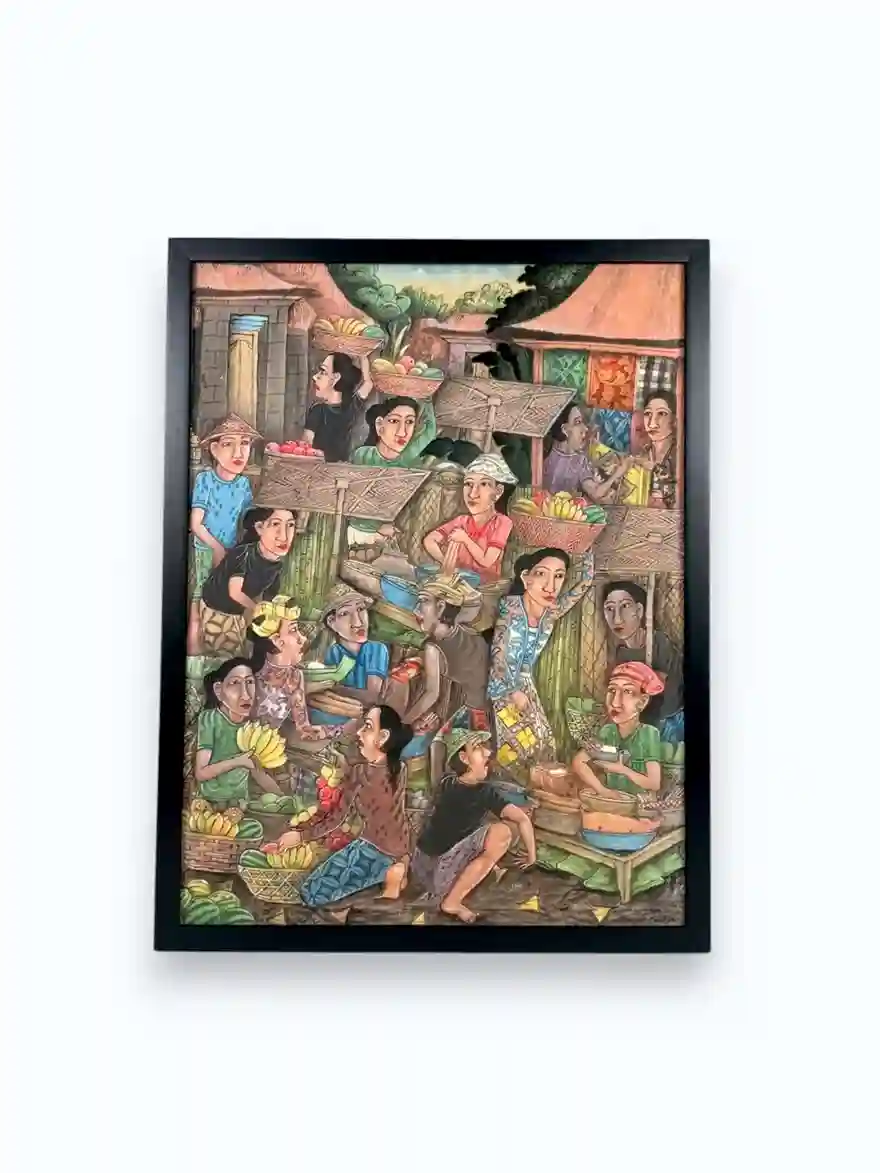
This is the piece to choose if you want the market genre without the impasto’s physical bulk, a work that reads as narrative art first and texture second. At Rp2.000.000, it sits at the collection’s mid-point, and its vertical format suits narrower walls, hallway alcoves, or spaces beside a doorway where a horizontal panorama wouldn’t fit. View this piece in the gallery.
Горизонтальная монохромная картина "Рынок
Strip the market scene of color entirely and what’s left is gesture, posture, and silhouette. This piece uses the same palette-knife texture technique as the collection’s largest work, but confines it to black, white, and layered gray: a two-story house with a red-trimmed roofline, a becak parked in the street, figures walking and working rendered as raised monochrome ridges rather than colored strokes. The panoramic 30 × 90 cm format crops the scene tight, more a horizontal band than a full room-filling canvas.
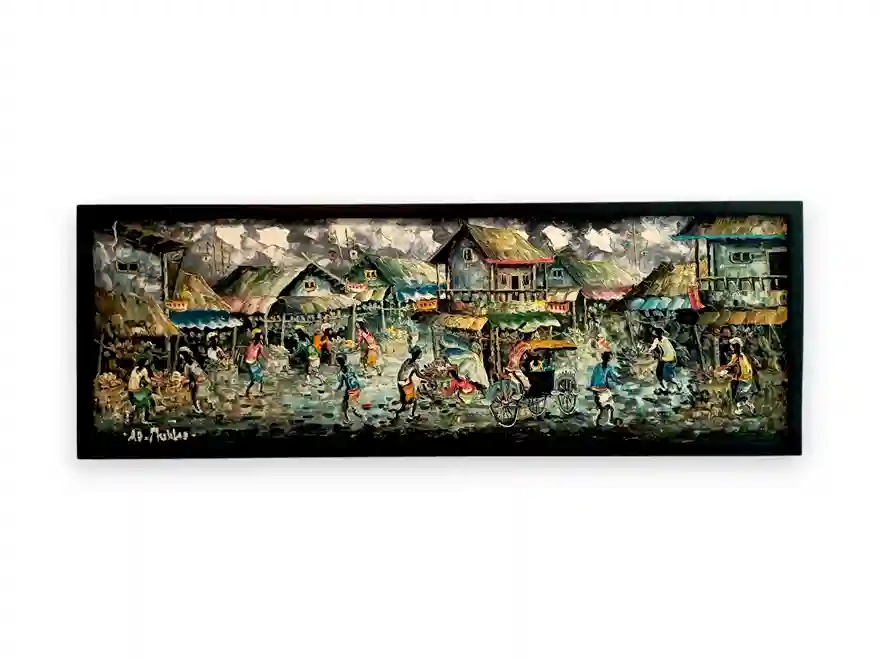
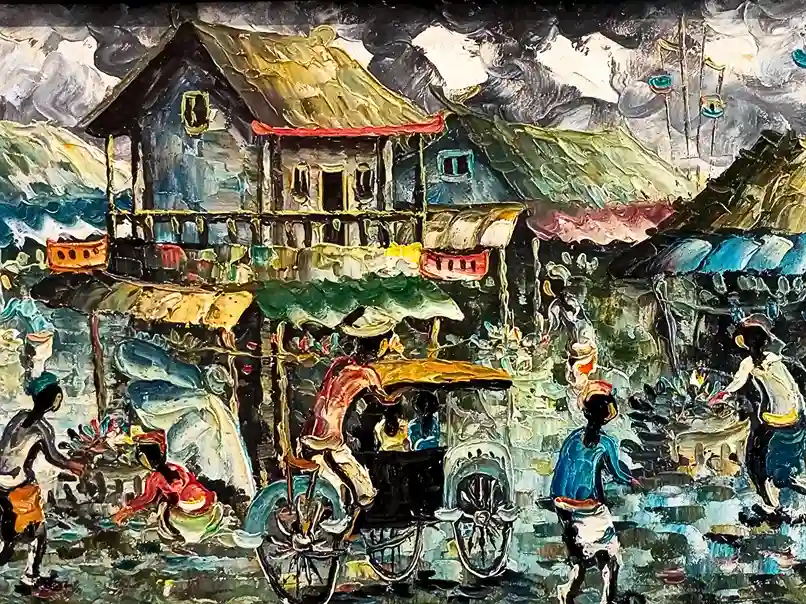
At Rp1.200.000 and 30 × 90 cm, this is the collection’s most accessible entry point, and its monochrome palette makes it the one piece here that reads comfortably in a minimalist or neutral-toned interior where the three color pieces might compete with existing decor. View this piece in the gallery.
Горизонтальная роспись балийского рынка
This piece sits at the overlap between market and ceremony, a reminder that the two subjects aren’t always cleanly separable in real Balinese life. The wide shot shows a market street in warm gold and amber tones, stalls flanking both sides of the composition; the close-up detail reveals a ceremonial gate at the scene’s center, flanked by decorative arches, with figures carrying baskets on shoulder poles crossing what reads as temple steps. Balinese markets frequently sit near, or open onto, temple compounds, and festival days regularly blend ordinary trade with ceremonial movement through the same lanes, which is exactly what this composition captures.
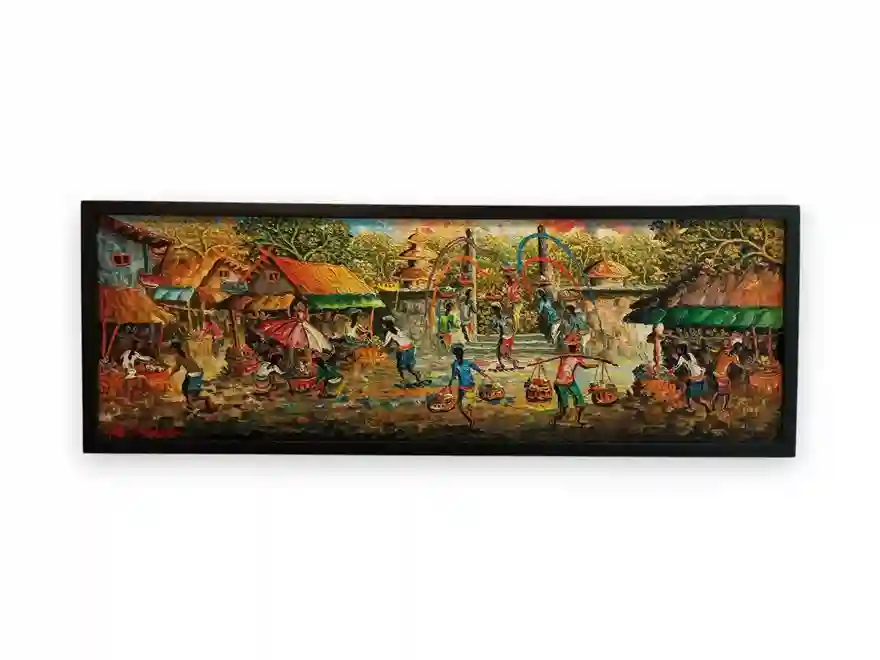
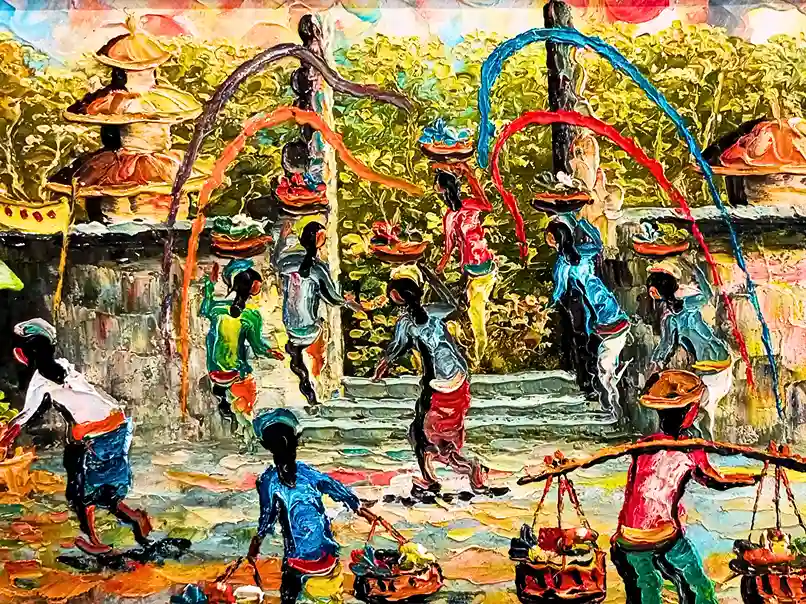
Priced the same as its monochrome sibling at Rp1.200.000 for 30 × 90 cm, this piece works well paired with the monochrome panorama on the same wall, one warm, one neutral, both the same scale, or on its own above a sofa, dining table, or long hallway where its panoramic format has room to stretch. View this piece in the gallery.
Reading the SceneReading the Pasar: What’s Actually Happening in These Paintings
A few details recur across all four pieces and are worth knowing how to read. The becak, a three-wheeled pedicab pedaled or pushed by hand, is one of the most common ways goods and people still move through the tighter lanes of a traditional Indonesian market, and its presence in three of the four paintings here isn’t decorative; it’s the same practical detail an artist working from direct observation would naturally include. Baskets carried on the head or balanced on a shoulder pole, visible in the Ubud piece and in the ceremonial-gate detail of the Horizontal Balinese Market Painting, are how produce, offerings, and goods are transported without carts in market lanes too narrow or crowded for wheeled transport. None of this is invented visual shorthand for “Asian market”; it’s what a working pasar in Bali still looks like.
The market as painting subject isn’t limited to these four pieces alone. Other hands in the gallery’s wider collection have taken it up too, in styles that sit closer to flat, naive storytelling than to palette-knife texture, women bartering over baskets of green produce at a stall, framed in natural wood rather than the darker frames used elsewhere in this guide. That piece is currently a studio study rather than a listed gallery product, so it isn’t pictured or priced here, but it’s a reminder that the pasar keeps attracting new interpretations at Arts of Bali beyond the four pieces compared above, and that the gallery’s stock in this genre changes as new work is completed and listed. Ask us on WhatsApp if you’d like to see it.
All Four Market Paintings Are Currently in Stock
Message us on WhatsApp with questions about any of the four pieces compared in this guide, to ask about the unlisted stall study above, or to discuss a custom market-scene commission in a specific technique or size.
Ask on WhatsAppWhich Market Painting Fits Your Space?
Choose the Traditional Indonesian Market Painting if you have a large wall, a living room, a lobby, an office reception, and want a single centerpiece with real physical texture visible from across the room. At 85 × 135 cm, it needs distance to be seen whole.
Choose the Vibrant Traditional Ubud Market Painting if you want narrative depth over texture, a piece that rewards reading face by face, and a vertical format for a narrower wall, a hallway, a space beside a doorway.
Choose the Horizontal Monochrome Market Painting if your interior is neutral, minimalist, or monochrome-leaning, and you want the market subject without introducing a competing color palette into the room.
Choose the Horizontal Balinese Market Painting if you want warmth and ceremony alongside the commerce, or want to pair it with the monochrome panorama for a matched-scale, contrasting-palette diptych above a sofa or dining table.
Care GuideCaring for Palette Knife and Realist Market Paintings
Three of these four pieces use palette knife or palette texture technique, meaning the surface sits in raised acrylic ridges rather than lying flat. Dust collects in those ridges over time, so a soft, dry brush or a low-suction vacuum brush attachment, used gently and never dragged across the raised strokes, keeps the surface clean without flattening or chipping the texture. Avoid damp cloths on any of the three textured pieces; moisture trapped in the ridges is harder to dry evenly than on a flat canvas.
The Vibrant Traditional Ubud Market Painting, being flat storytelling realism rather than raised texture, can be dusted with a standard soft cloth. All four pieces, like most acrylic works, should stay out of direct sunlight for extended periods, since UV exposure fades even fade-resistant acrylic pigment faster than indirect light. A stable indoor humidity level protects both the canvas and, for the three textured pieces, the long-term adhesion of the raised ridges to the surface below.
For collectors ordering from overseas, our guide to shipping art from Bali covers crating and documentation for canvas works of this size and format.
Where This FitsMarket Painting at Arts of Bali
This is the gallery’s first article to compare the market as painting subject across multiple techniques, sitting alongside our coverage of Balinese village life painting (ceremony and ritual subjects) and Balinese women painting (dancers, offering-bearers, and goddess figures), both of which are related but distinct subjects from the commerce-focused scenes covered here. If palette knife technique specifically is what drew you to these pieces, our guide to Рисование ножом для палитры на Бали covers the method in more depth. For the storytelling-realism piece, our guide to Роспись в стиле Убуда places it within its full stylistic tradition.
New to Balinese art generally? Our Полный путеводитель по стилям балийского искусства covers every tradition on this site and how they connect to each other.
Common QuestionsFrequently Asked Questions About Balinese Market Painting
What is a Balinese market painting?
A Balinese market painting depicts the pasar, Bali’s traditional market, as its central subject: stalls, traders, pedicabs, and the movement of a crowd buying and selling. It differs from village life or ceremony painting, which documents ritual and religious obligation rather than everyday commerce.
What’s the difference between a market painting and a Balinese village life painting?
A village life painting, in the classic Ubud tradition, typically documents a specific temple ceremony, such as an Odalan or a life-cycle rite. A market painting documents ordinary commerce, trading, bartering, moving goods, that happens between ceremonies. Some pieces overlap where a market sits near a temple gate, but the core subject differs.
Are these market scenes based on a real place, like Sukawati?
The paintings aren’t documentary portraits of one named market, but the scenes they depict, stallholders, baskets, pedicabs, crowded lanes, reflect how real, still-operating Balinese markets function, including well-known ones like Sukawati Art Market in Gianyar Regency. The genre draws on lived observation rather than an invented setting.
How much does an original Balinese market painting cost?
At Arts of Bali, prices currently range from Rp1.200.000 for a 30×90cm palette-texture panel to Rp4.600.000 for the 85×135cm palette-knife centerpiece. Price generally reflects canvas size and technique labor rather than the subject itself, and availability can change as pieces sell.
Are these paintings handmade and original?
Yes. All four pieces are 100% original, hand-painted works, not prints or reproductions, made by local artists using acrylic on cotton canvas. Our guide to spotting an original versus a print covers the physical signs to check if you’re buying from another source.
Which market painting should I choose for my space?
Choose by wall and palette first, technique second. The large palette-knife piece needs a big wall and viewing distance; the vertical Ubud realism piece suits a narrower space; the two 30×90cm panoramas, one monochrome, one warm-toned, work well alone or paired above a sofa or dining table.
Can I commission a custom market painting?
Yes. Arts of Bali accepts custom commissions for market scenes in palette knife, storytelling realism, or monochrome technique, in a range of sizes and formats. Contact us on WhatsApp to discuss your preferred composition, scale, palette, and timeline before placing a commission request.
How do I care for a palette knife market painting?
Dust the raised ridges gently with a soft dry brush or a low-suction vacuum brush attachment, never a damp cloth. Keep the piece out of direct sunlight to protect pigment, and maintain stable indoor humidity to protect the long-term adhesion of the textured surface.
See All Four Market Paintings in Person at Arts of Bali, Seminyak
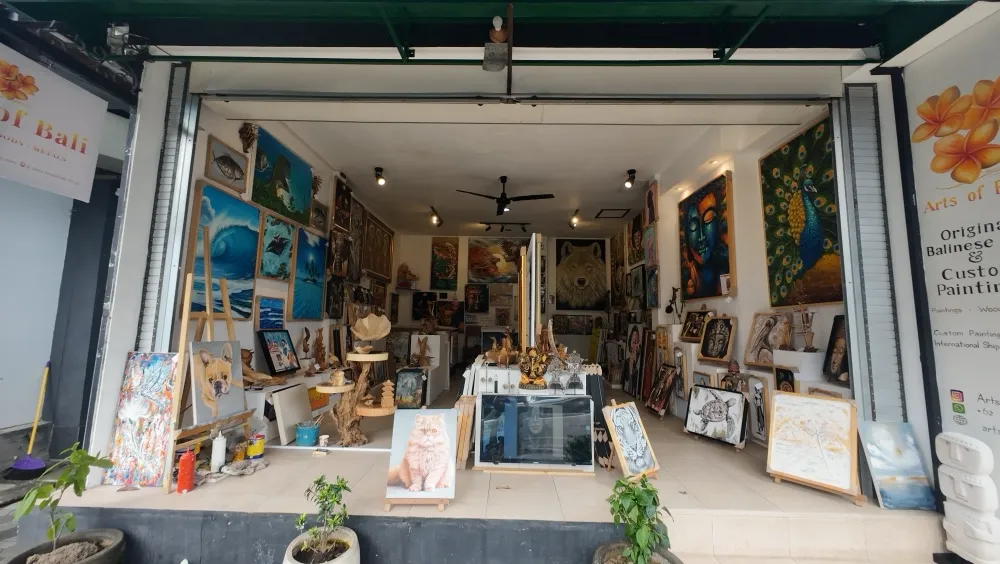
Visit the gallery to compare the palette-knife bazaar, the Ubud storytelling realism, and both panoramic pieces side by side, or message us on WhatsApp to check current availability before you visit.
Посетите галерею Ask on WhatsApp