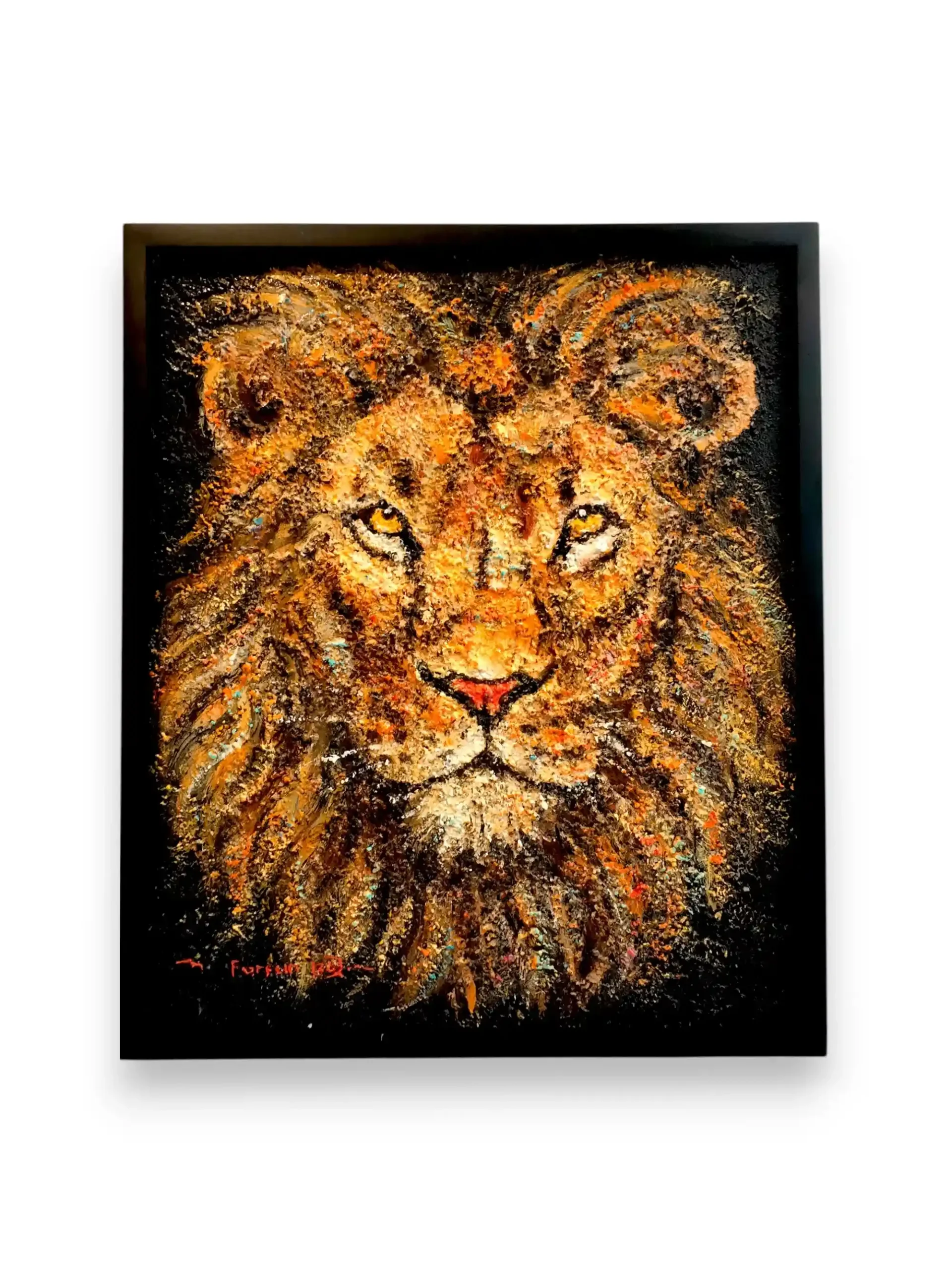
Lion symbolism in art points mostly to kingship, courage, and protection, though every culture adds its own twist. In Bali the lion appears as the winged singa that guards roof beams and as the lion Barong that fights the witch Rangda, even though lions were never native to Southeast Asia. This guide covers both, then looks at a sand texture lion painting that just arrived in the gallery.
Key Takeaways
- Across the cultures we checked, the lion most often stands for kingship, courage, or guarding a doorway.
- Wild lions live only in sub-Saharan Africa and India today, and they were never native to Southeast Asia, so Balinese carvers imagined the animal.
- The winged singa sits where roof beams meet and keeps spirits away. The lion Barong goes into the dance and fights Rangda.
- Imperial Lion Sovereign is a savannah lion portrait in acrylic and sand texture, 50 × 60 cm. It is not a singa or a Barong.
What Lion Symbolism Means in Art Across Cultures
Ask what a lion stands for and the answer changes depending on which wall you are looking at. Wikipedia’s survey of cultural depictions of lions is a handy map, and a few patterns come through clearly.
In Mesopotamia the lion was a symbol of kingship, and the Lion of Babylon still stands at the Ishtar Gate. In ancient Egypt the lioness goddess Sekhmet was a war deity and a protector of the pharaohs. Mycenaean art from about 1600 to 1400 BC leaned hard on lions, and the Lion Gate at Mycenae shows two lionesses flanking a column. European heraldry later made the lion a charge for courage, and lions feature in the Plantagenet arms.
Asia gives the lion a second set of jobs. In Hinduism, Narasimha the man-lion is the fourth avatar of Vishnu, and the lion is the vehicle of the goddess Durga. Pillars raised under Emperor Ashoka carried lions with the chakra emblem, and the Lion Capital of Ashoka inspired India’s national emblem. Lion statues guard the four main entrances of Borobudur in Java, and paired guardian lions sit at doorways in China. One animal can be a king, a goddess’s mount, or a doorkeeper.
| Culture | What the lion stands for | Example |
|---|---|---|
| Mesopotamia | Kingship | Lion of Babylon at the Ishtar Gate |
| Ancient Egypt | War and protection | Sekhmet, and sphinxes with lioness bodies |
| Ancient Greece | Raw strength to be overcome | Lion Gate at Mycenae, Heracles and the Nemean lion |
| Judah | Tribal emblem | Jacob’s blessing in Genesis 49 |
| European heraldry | Courage | Plantagenet arms |
| Hinduism | Divine power | Narasimha, and Durga’s lion mount |
| Buddhist India | Public emblem | Ashoka’s lion pillars, India’s national emblem |
| Southeast Asia | Guardian | Borobudur entrances, winged lions in East Java and Bali |
| China | Doorway guardian | Paired lions at the Forbidden City |
Source: Wikipedia, Cultural depictions of lions. The middle column is our own short summary, so treat it as a simplification.
The Odd PartWhy Bali Carved Lions It Had Never Seen
Here is the strange part. Wikipedia’s entry on the lion says wild lions are found only in sub-Saharan Africa and India today, and the Asiatic lion survives only in and around Gir National Park in Gujarat. The cultural depictions page adds that lions were never native to Southeast Asia in recorded history, and that lion carvings in Java and Cambodia look stylized because the artists had never seen one.
Singapore is the famous example. Its name comes from Malay and Sanskrit-derived words for lion and city, and the Malay Annals tell of a beast seen on the shore in the 14th century that was identified as a lion, even though lions have never lived there. That sentence about stylized carvings names Java and Cambodia, not Bali, but the logic carries over: no lions on the island, so the animal had to be imagined.
Bali did have its own big cat once. The Bali tiger is listed as extinct since the 1950s, and we wrote about that in our tiger painting guide. The lion is different. It is an idea that arrived through stories and art, then got reshaped by local hands into something that looks nothing like the animal on the African plains.
The GuardianThe Winged Lion of Bali: Singa and Singa Ambara
The Balinese lion most visitors notice is the winged one, called a singa. The cultural depictions page notes a winged lion statue in East Java and in Balinese temples, often as a guardian. Two museum records help pin down what the figure actually does.
A Singapore museum record describes a carved wooden singa barong from the first half of the 20th century, seated on a plinth of stylized clouds. It says the figure was a common finial on roof beams in temples and palaces, a protective figure that guards entrances and passageways and keeps demonic forces away. The same record says that in Balinese myth a singa barong was sent to earth to defeat Rangda, a witch who devoured children and caused chaos.
The Weltmuseum Wien lists a 19th century carving titled Singa Ambara Raja. Citing a 2010 publication by Sri Kuhnt-Saptodewo, its description says winged lions like this were placed where the beams of a Balinese roof meet, as symbolic guardians against spirits that could disturb the people inside.
So the singa is a lion with a job. It sits at the joints of a building and keeps watch. If that guardian idea appeals to you, our guide to Bhoma, the fierce face above temple gates covers a close cousin, and the Balinese art symbols guide covers Garuda, Naga, and Ganesha.
The DancerThe Lion Barong and Its Fight With Rangda
The other Balinese lion is the Barong. Wikipedia describes the lion Barong as the most common of the five traditional Barongs, a symbol of a good spirit and the king of the spirits. It has a red head, thick white fur, and gilded jewelry decorated with mirror pieces. It is linked to Banas Pati Raja, described as the fourth spirit “brother” who accompanies a child through life.
The Barong battles Rangda, the demon queen, in the Calon Arang dance drama, and the Barong dance is read as the endless struggle between good and evil. We tell that story in full in our Calon Arang guide, and the painted and carved versions are covered in Barong painting Bali и Balinese mask carvings.
Put the two side by side and you get a useful contrast. The singa guards from a fixed spot on a building. The lion Barong steps into the dance and fights. Both are lions, and both are about protection, but they do it in different ways.
In the GalleryA Savannah Lion on Sand Texture: Imperial Lion Sovereign
This article exists because of a new arrival. Imperial Lion Sovereign is an acrylic painting on Marsoto canvas, 50 × 60 cm, listed at Rp3,500,000. The listing describes a hand-painted lion with a fierce gaze and a sand texture technique that gives the surface a rugged, three-dimensional finish, and it calls the piece a proclamation of courage, leadership, and untamed elegance.
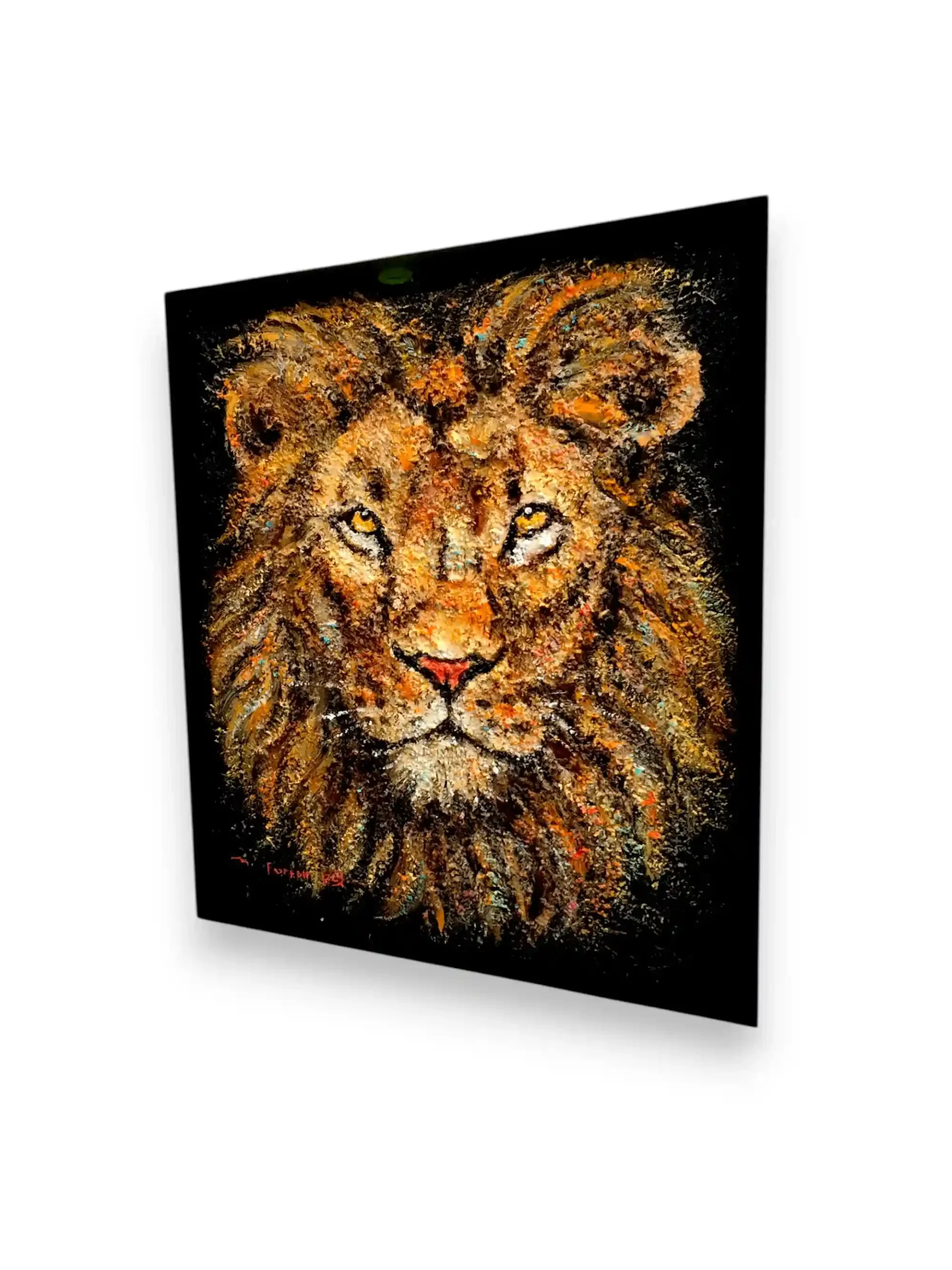
We want to be clear about what it is not. This is a lion of the savannah, painted as a realist portrait. It is not a singa and it is not a Barong, and the listing does not name the painter, so we will not either. Where it connects to the Balinese material above is the old job the lion has always had in art: courage, leadership, a presence you cannot ignore.
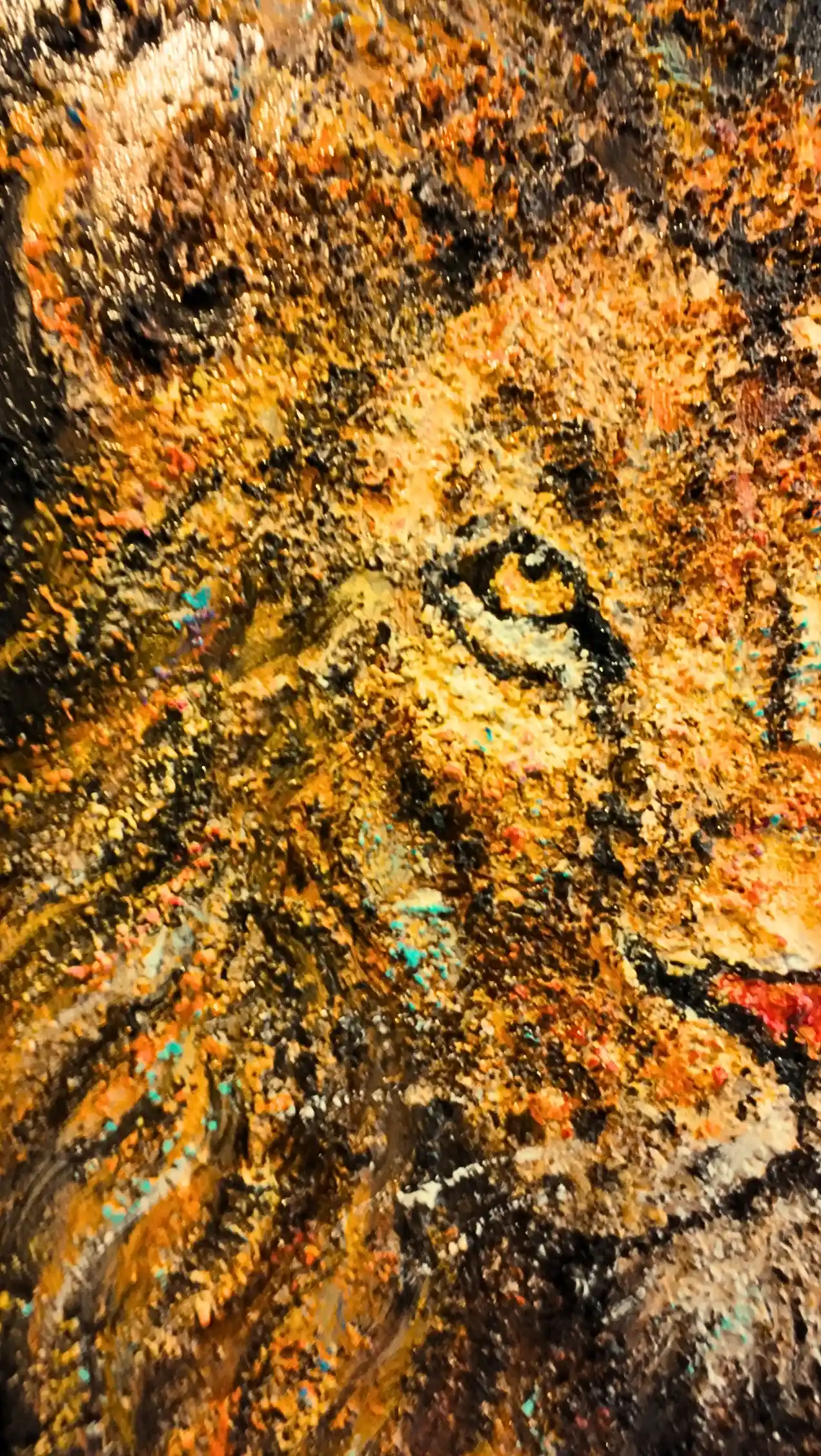
Sand texture painting means sand is worked into the paint so the surface turns rough and raised. Up close you see the grit. From across the room you see the animal. We cover the method in our guide to Фактурная живопись на Бали, and two other gallery lions appear in our wildlife painting guide.
| Живопись | Средний | Size | Price |
|---|---|---|---|
| Imperial Lion Sovereign | Acrylic and sand texture on Marsoto canvas | 50 × 60 см | Rp3,500,000 |
| The Majestic Lion Monarch | Paint and sand texture on Marsoto canvas | 70 × 70 cm | Rp1,500,000 |
| Golden Lion Oil Palette Knife | Oil on cotton canvas, palette knife impasto | 50 × 60 см | Rp3,450,000 |
| The Majestic Barong | Paint on Marsoto canvas, palette knife | 100 × 120 см | Rp7,000,000 |
Details are from the product listings on 8 October 2026. Prices and availability can change.
ChoosingHow to Pick a Lion Painting for Your Wall
Decide which lion you mean
A savannah lion reads as courage and leadership, the words the listing uses. A Barong or a singa brings the Balinese story of protection with it.
Look at the surface
Sand texture is gritty and raised. Oil palette knife work is built in thick, sculpted layers, as the Golden Lion listing puts it. Ask for close-up photos, because the surface is half the painting.
Match the scale
The lion portraits here run from 50 × 60 cm to 70 × 70 cm, and the Barong is 100 × 120 cm. Measure your wall before you fall for a size.
Ask what the listing leaves out
If the painter’s name, framing, or shipping matters to you, message us and we will tell you what we have on record.
Ask About a Lion Painting
Tell us the wall and the mood you want, and we will send close-up photos and shipping options for the lion paintings in the gallery. We ship worldwide.
Чат в WhatsAppView Imperial Lion Sovereign